2017 in review – part 1

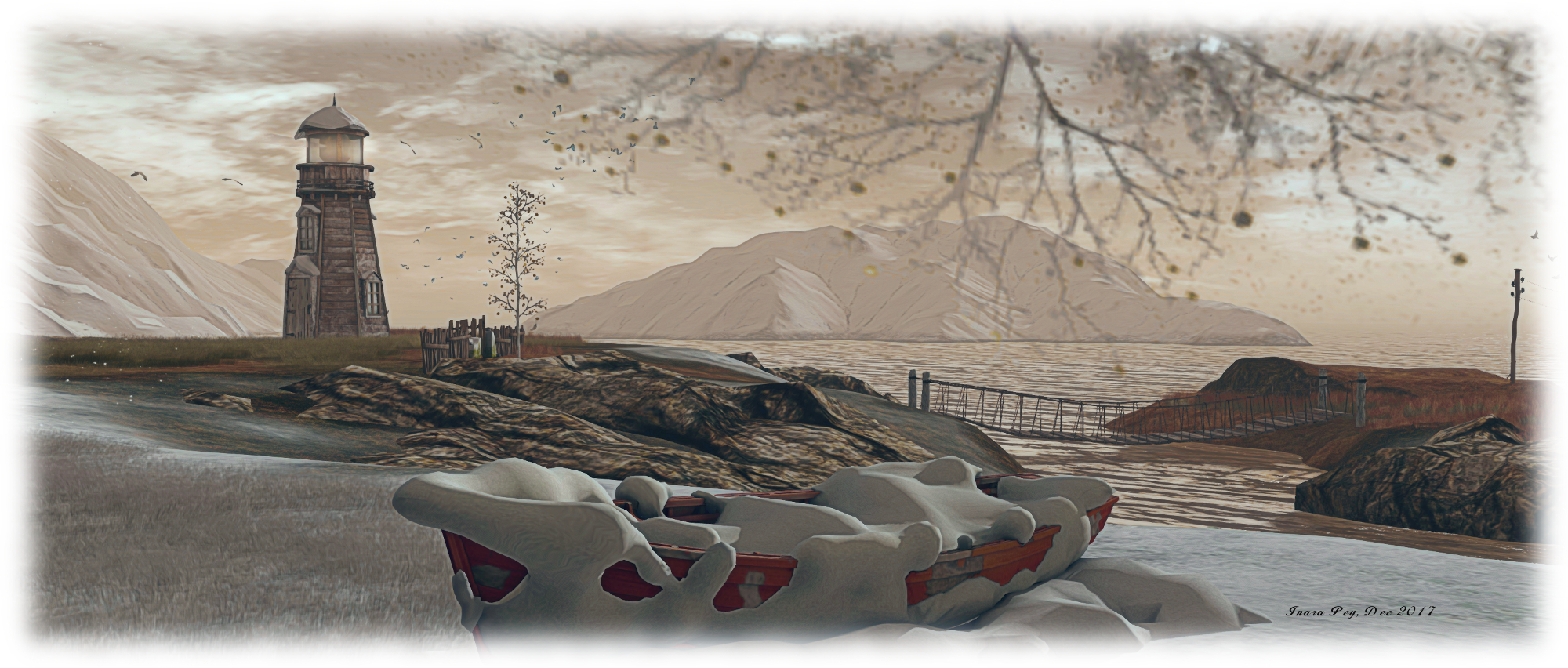
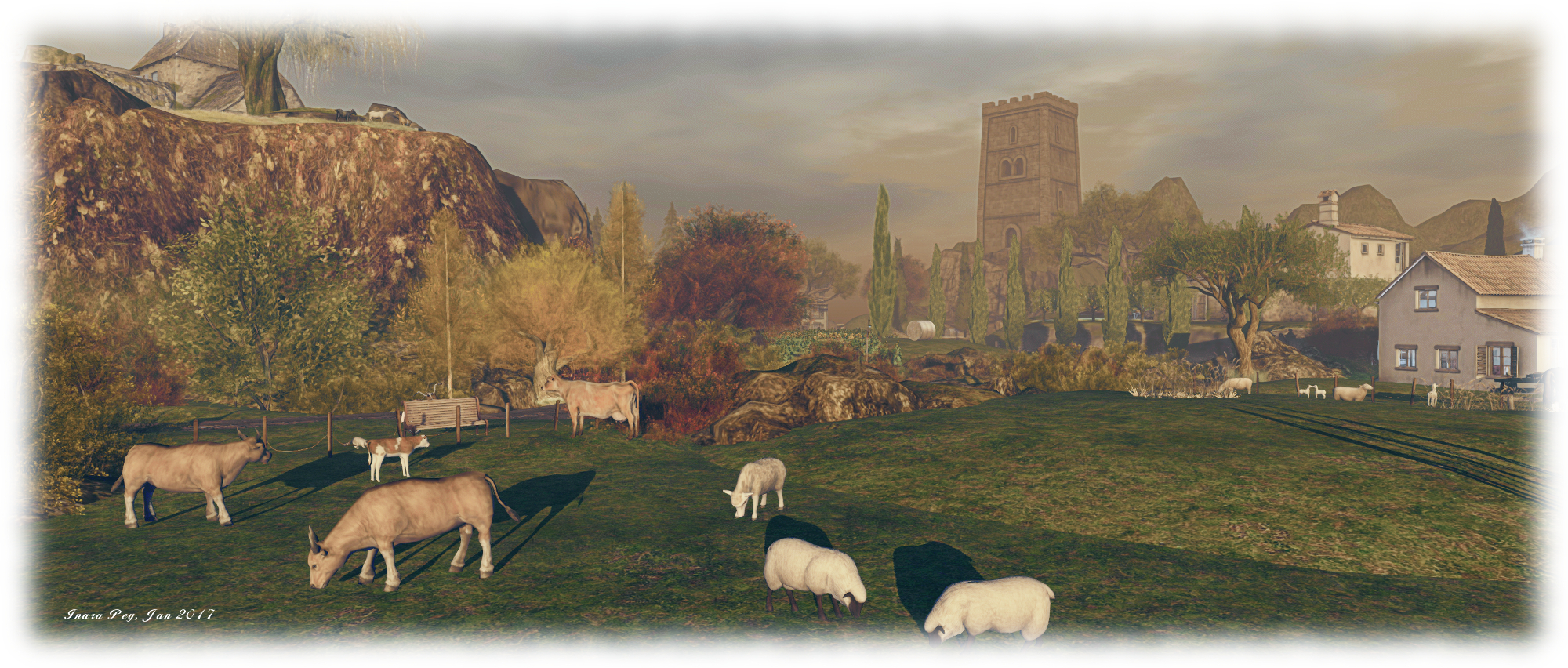
It's A New Dawn, Lemon Beach; Inara Pey, January 2017, on FlickrIt’s A New Dawn, Lemon Beach – our first 2017 Exploring Second Life destination

The end of the year is once more approaching, which is often a time of reflection as we look back over the old before pausing to await the arrival of the new. It’s become something of a tradition in these pages for me to look back over the articles and coverage of the year’s events I’ve managed to write-up, and offer a chance to revisit the ups and downs and the good and the bad the last twelve months have brought us.

To keep things digestible, I’ve broken this year’s review into two parts. This one covers January through June, and July to December will be along later in the week, and I have a review Second Life’s technical enhancements through 2017 available here.

January

Second Life

The year started with a look at Tyche Shepherd’s 2016 end-of-year grid survey summary. This was followed by a behind-the-scenes look at the Bento project, with an article linked to a piece written for Kultivate Magazine. The Horizons project land sale reached its mid-point, and I offered a summary of sales to date. The Second Life Place Pages beta launched,  while there was the usual weekly SL Project Updates from assorted meetings and Spoonful of Sugar announced their 2017 fund-raiser for Médecins Sans Frontières (MSF), also known as Doctors Without Borders. January also saw me note the fact that the Lab would, through 2017, be requiring people to verify their e-mail addresses if they wanted to keep receiving SL-related e-mails and things like off-line IMs being forwards to their e-mail.

Sansar

Sansar opened the year with a Creator Profile video featuring Loz Hyde, on which I offered some thoughts, in general and concerning monetisation. The latter also came in for a little thought when I considered Ben Lang’s piece on Sansar for Road to VR.

Space and Astronomy

I kicked-off my Space Sunday reports with a look at the key events for 2017. January then became a period of remembrance and recalling great missions – including the Huygens Lander, marking the passing of Gene Cernan, the last Apollo astronaut to walk on the Moon, and marking both NASA’s Day of Remembrance and Opportunity’s 13th anniversary.
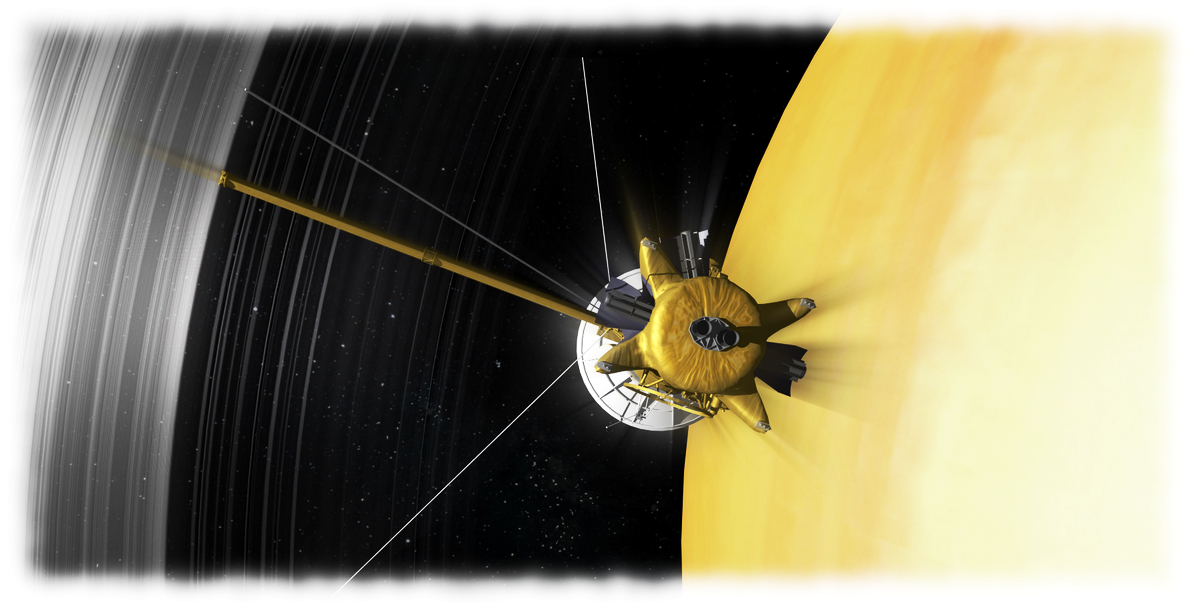
Artist's concept of Cassini's final orbits between the innermost rings and Saturn's cloud tops (see below). Credit: NASA
2017 would mark NASA / ESAs Cassini Mission’s Grand Finale, repeatedly diving between the innermost rings and Saturn’s cloud tops before finally burning up in the planet’s upper atmosphere in September. Credit: NASA

Personal

I started on the first of my fiddling around with the island home sessions for 2017.

Travel and Arts

January Travels January Art Reviews
A New Dawn The art of Grazietta Blauvelt in Second Life
Flotsam and Blake Deeps Lucid Dreams with Miles Cantelou in Second Life
Nagare no Shimajima Gallery 23 in Second Life
The Sagan Planetarium Dathúil: visions of desire
ragVR: imagination and expression The Forest Beyond- Ceakay Ballyhoo
Hell’s Heaven No Frontiers – Gem Preiz
An Uncertain Destiny DiXmiX: Mistero Hifeng and William Weaver
Once Upon a Fairy Tale Cica Ghost: Burning
Devin DaphneArts: Celebrating Poe
Whimberly MetaLES; Illogism
Sol Farm Elo (Elorac Paule): Ray of Light
Elin Egoyan: Lide is a Journey
The Edge Gallery: February 2017
Venus Adored: Light Reflections

February

Second Life

Linden Lab spoke out against Donald Trump’s Executive Orders on US immigration. A new maintenance viewer with inventory management improvements surfaced. One Billion Rising put out a late call for volunteers, with the event taking place mid-month; the organisers of the 2017 Virtual Worlds Best Practice in Education also put out a call for volunteers. The Founder of the East River Community, Indigo Mertel, put out a plea for help to secure the community’s future. Michael Linden of LDPW fame, departed the Lab.

Hobbiton, Dragon Island; Inara Pey, February 2017, on FlickrHobbiton – a visit for February 2017

The second round of Skill Gaming applications, launched in January (but which I previewed in December 2016), closed after a run of a month. The Lab offered their traditional Valentine’s Day celebration, and I gave a final round-up of the Horizons land auctions. There was the announcement of a new Community Platform for Second Life, which took a little longer than planned to get up-and-running, and MadPea held an International Food Fair to raise money for Feed A Smile / Live and Learn Kenya. The final UWA art show – Transformations launched with a call for entries, and also among the event announcement / calls came the first for SL14B – which was directed towards infrastructure builders.

February also saw ALS Awareness Week take place, and an appeal went out on behalf of Ceredwin’s Cauldron creator Elicio Ember, who faced a severe family set-back, and the RFL Home and Garden Expo was announced.

Space and Astronomy

The focus for the month was very much on the discovery of seven Earth-sized planets orbiting a red dwarf star 39 light years away, which I covered in two posts here and here.

Personal

February saw Holly Kai Park overhauled  – notably around Caitinara Bar, which reopened in time for a celebration of the Oscars. The Park’s Pavilion also played host to an event in support for Feed A Smile. In addition, Caitlyn and I also returns to the greens and golfing.

Travel and Arts

February Travels February Art Reviews
Natural Falls Hills (Hillany Scofield): The Recreation
Anduril Artful Expressions: Blip and Nekonuko
NonStop DiXmiX: Angie Manners
Hobbiton Cica Ghost: Frogs
Lost World MetaLES: The Haul
Shot of Tequila Astral Dreams: Mistero Hifeng
Shareta Osumai Tea Garden Solo Arte: CioTToLiNa Zue
History of the Telephone The Gardens by the Bay
AERO Golf Club The Photo Game
Molly Mirassou: Studio M
Nightroglobus: Monique Beebe
InterstellART: Fossil Fractals
Methias Kira: The Architect’s Playground
Venus Adored: Light Reflections

March

Second Life

The VWBPE social calendar was announced together with the Above the Book series, new for 2017. The event itself kicked-off at the end of at the month. I was honoured to be able to announce Filling the Cauldron in aid of Elicio Ember and his family, and the 2017 RFL kick-off weekend took place. The Lab revamped the Second Life Home Page and the 2017 Fantasy Faire regions were announced, and blogger applications opened. The new SL community platform launched, and with the help of Tommy and Corky Linden, I looked at raising abuse reports. The 2017 Sci-Fi convention beamed-in to SL, while SL’s monthly process credit limits were revised. With changes being made to SL’s asset fetching, I took time to look back over the HTTP project and SL’s use of CDNs.
2017 SL Science Fiction Convention -“Water”

Space and Astronomy

March saw Elon Musk announce his lunar ambitions, I looked at options for exploring the icy worlds of the solar system, and the question of when is a planet not a planet – and how many might be in the solar system before catching up with Mars news.

VR / AR

I offered a quick catch-up on highlights from the worlds of VR and AR.

Personal

I became enamoured of the composite designs by Morgan Sim Designs, some of which found their way onto the island home (and can still be found there). I also revamped the Holly Kai Park website.

Travel and Arts

March Travels March Art Reviews
Long Journey Cica Ghost: Under the Sea
Calas Skate-on-rama Artful Expressions: Maxie and Cyoko
NorderNey Dathúil: Private Sphere
Spring Spirit Whitechapel Victorian London
Field of Dreams / L’Intangible Split Screen: Bleeding Books
The Heart of the Sea DaphneArts: The Journey
Storybrooke Gardens MetaLES: Wild Lost Line
PeTOu Art Is… Rhythm
Orcadi Island The Photo Game 2
 Mystical Fae Forest Journey of Life
Second Life 2009-2017
The Way I Feel
Methias Kira: The Architect’s Playground

Continue reading “2017 in review – part 1”

Merry Christmas!

Merry Christmas to all, and sincere thanks for reading / following my random thoughts and reporting on SL, Sansar, VR / AR and all the rest!

The art of Jay Salton in Sansar

Sansar: Jay Salton Art Gallery

Jay Salton is an Australian digital artist with a remarkable eye for creating stunning images which encompass fantasy, surreal and abstract elements and which are rich in colour and depth. He’s long held a desire to see his art evolve into a virtual space which people can explore and experience with their own senses. As Renegade Rabbit, he has taken a step along the road towards this evolution within Sansar, where he presents the Jay Salton Art Gallery.

Set within a walled meadow, the gallery building is fronted by a small garden with a lean towards Japanese influences. The spawn point is at the end of a footpath that leads beneath a Torii gate and over a water feature from which rise two small islands, each topped by a tree – one of which has something of a Bonsai-like topiary around it. A young lady sits on a rock before the water feature, while Jay’s love of the surreal is catered for by the presence of two gigantic mushrooms flanking the gallery building in the meadow.

Sansar: Jay Salton Art Gallery

The gallery, wrapped in the greenery of young birch-like trees, is of modern design, with clean lines with the interior finished in soft tones – an ideal backdrop for Jay’s stunning art. At the time of my visit, fourteen pieces of Jay’s work were on display, eight in individual alcoves or mounted on their own on walls, the remaining four grouped together along the rearmost of the gallery’s walls.

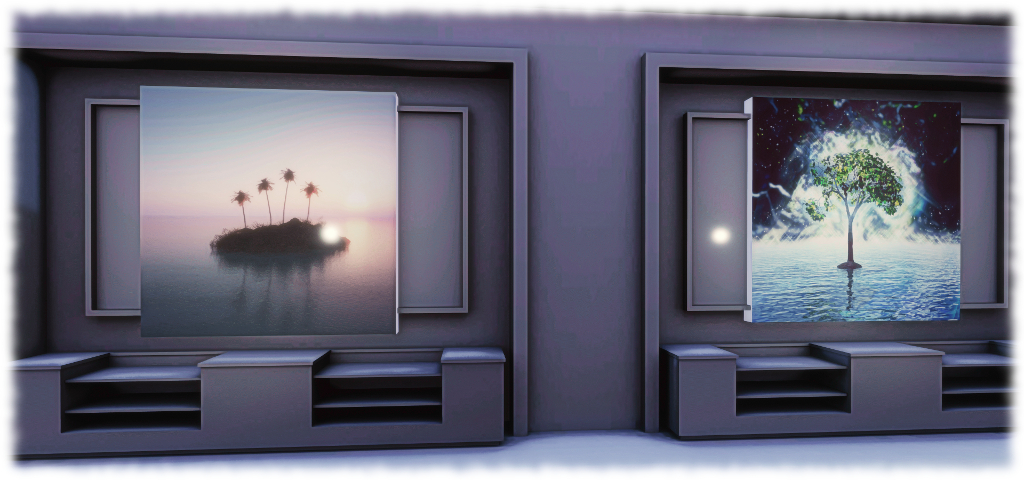
These are all visually stunning pieces, presenting marvellous scenes that range from might Saturn (at least I assume it is Saturn) rising over one of Titan’s hydrocarbon lakes, to images of fabulous islands one can easily picture in the South Seas, to studies of fantasy settings and images hinting at mysticism and magic. All are fabulously evocative, carrying rich narratives that speak to us as we look at them – and which perhaps reveal something of the artist himself, and his love of the digital medium.

Sansar: Jay Salton Art Gallery

“My artistic pursuit started at a young age when I dreamed of creating worlds and realities of my own,” Jay notes, before going on to reveal his life took a darker road. Drugs, a diagnosis of schizophrenia at 18, and a decent into hopelessness from which he escaped through glass blowing after his uncle stepped in and gave him a job at his glass studio. And thus his delight in creativity and art was renewed.

He goes on to note, “When I discovered digital art I was given the tools to turn my childhood dreams into a reality.” With a gift for working with Photoshop, 3Ds Max and Bryce, Jay now offers his worlds and his imagination for all of us to enjoy – and having visited his work in Sansar, I’m looking forward to see how else he might use the platform where he might further realise his dream of evolving his art as a virtual space.

Sansar: Jay Salton Art Gallery

Experience URL

A photogenic twirl in Second Life

La virevolte; Inara Pey, December 2017, on FlickrLa virevolte – click on any image for full size

La virevolte (The Twirl) is a gorgeous Homestead region designed by Iska (sablina). Caught in a winter setting, this is a rugged region is a rugged setting, running from lowland areas in the west to highland regions to the east, surrounded by snow-capped mountains.

Where this might be is open to question – there are few clues in the form of architecture and wildlife, although the vehicles in the region are of European origin. But where this might be really doesn’t matter; what is important is the sheer beauty of the region’s composition, which uses muted tones and colours to considerable effect, both outdoors and inside the buildings scattered across the region.

La virevolte; Inara Pey, December 2017, on FlickrLa virevolte

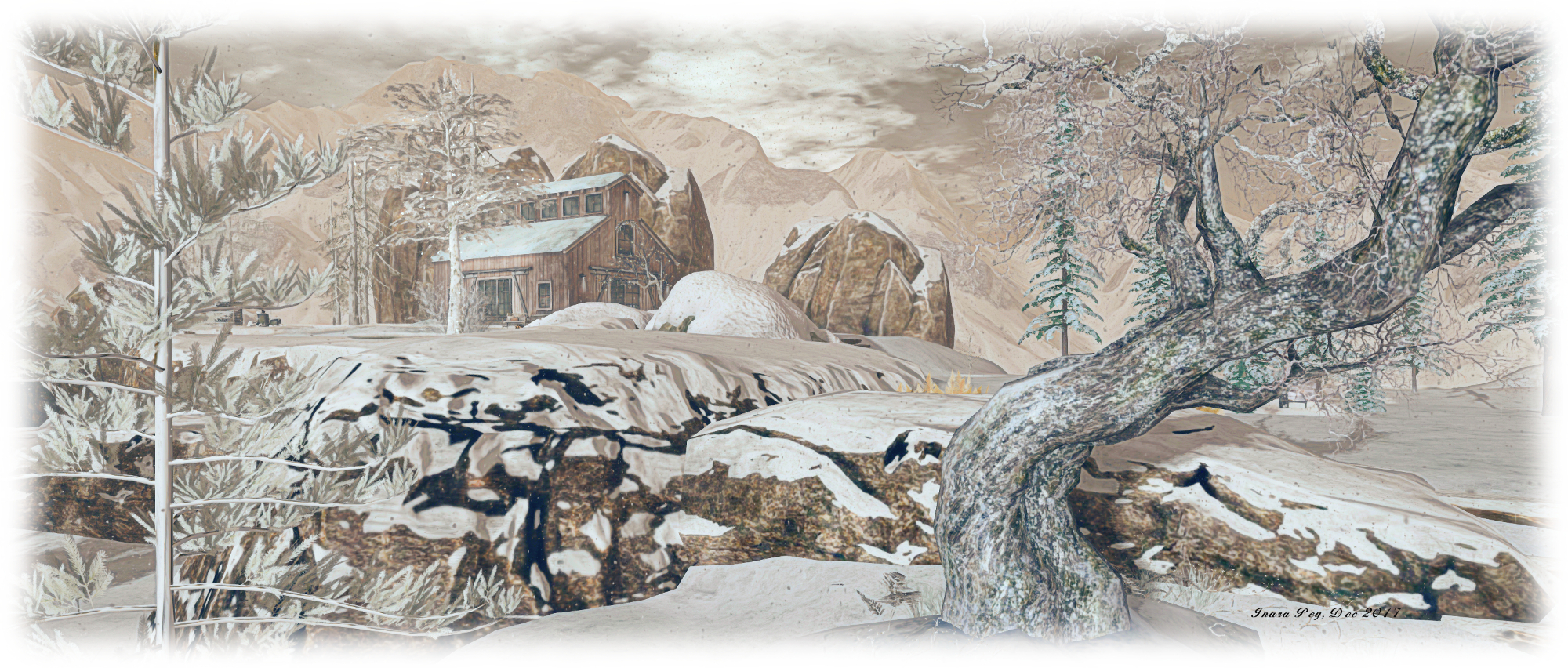
The landing point lies in the middle of the region,  close to a snowy track that winds from a headland on the west side, where an old lighthouse sits, then passes a log cabin sitting within its own fenced-off grounds before arriving at the foot of the eastern uplands.  A narrow channel cuts into the land near the lighthouse, forming a small, oval bay spanned by an ageing bridge. On the south side of this channel lies an old stone-walled barn, a Citroen van parked close by.

This western side of the landscape is largely snow free – although as one travels eastwards, the snow makes its presence felt, both on the ground and as it falls from a sky filled with scurrying clouds that scrape their way over the tall surrounding mountains. This gives the perfect impression of a wintry cold front moving across the land, depositing snow as it passes, gradually hiding the tough grass of the region under a white blanket.

La virevolte; Inara Pey, December 2017, on FlickrLa virevolte

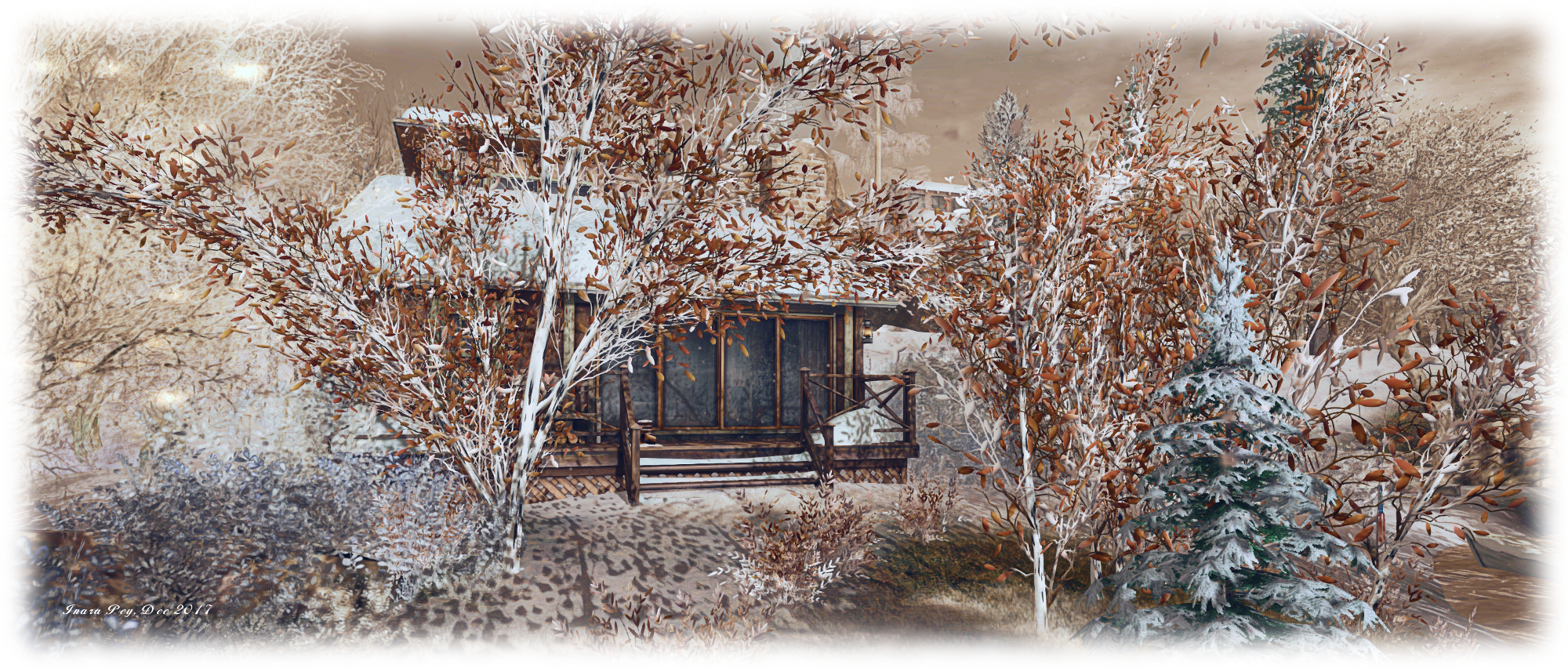
Within the deeper snows of this eastern side of the region, sits a cosy wooden cabin overlooking waters that cut into the landscape from the north to form a small bay and finger of water that cuts a small slice of land off from the rest to form a little island. This brackets the western headland, connected to it by a rope-and-wood bridge. Old ruins sit on this crooked silver of land, sharing it with a curtain of silver birch which line the banks of the water channel.

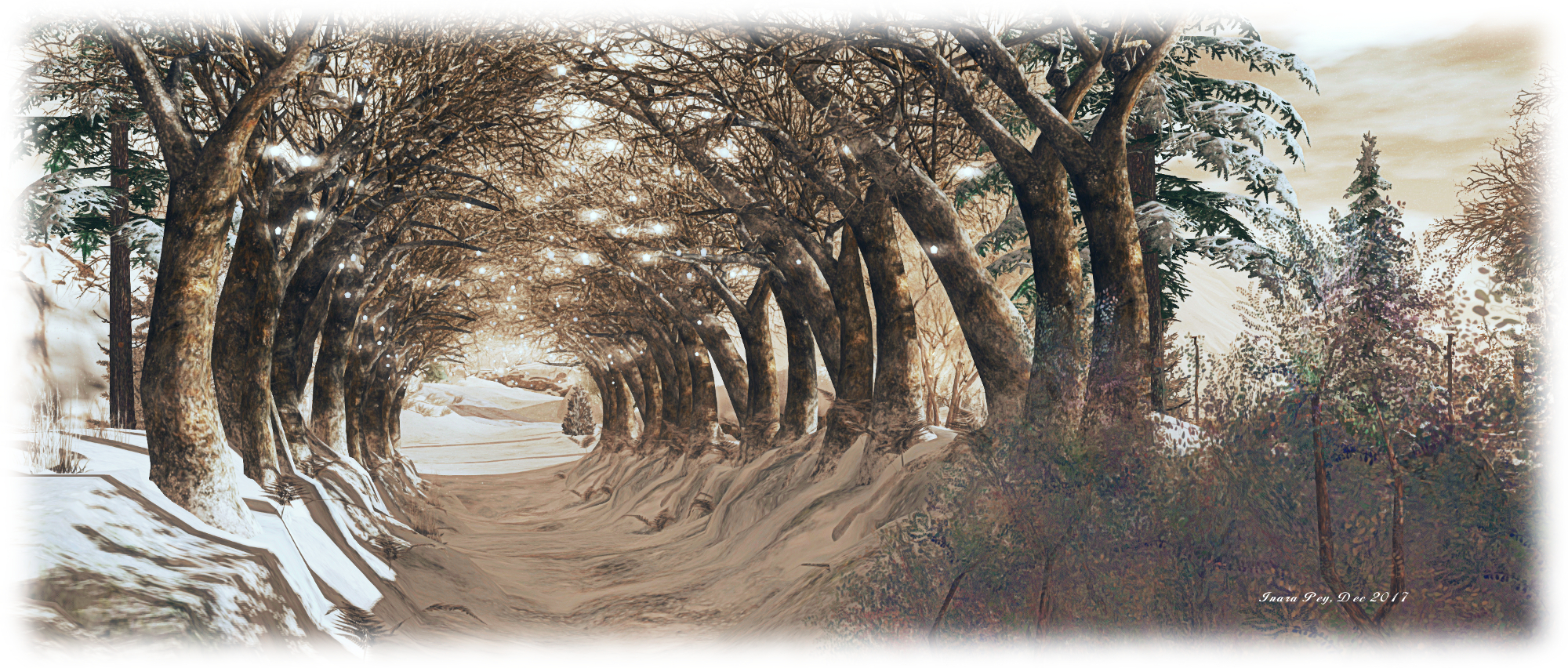
Behind the cabin, the rocky shoulders of a plateau rise in steps to where a barn has been converted into something of a club house or social space, with comfortable sofas and chairs, a pool table and general bric-a-brac. This is reached by way of stone steps cut into the rock, and which rise from the western end of the rutted track mentioned above. An avenue of small trees, their trunks bent into a series of arches, also runs from close by the cabin to the foot of the steps.

La virevolte; Inara Pey, December 2017, on FlickrLa virevolte

Rocks also rise in the south-east corner of the region, offer a small shelf where another, unfurnished, cabin sits. This can be reached by following the curve of a second track that branches from the first to swing around a low table of rock to provide access to a little depression in the land, where sits a well and a pair from benches – and stone steps offer the way up to the cabin.

There are one or two areas where the grasses to the east and north need to be set to phantom, but La virevolte is wonderfully wild, windswept and marvellous photogenic. It makes for a picturesque visit – and our thanks, once again, to Shakespeare and Max for pointing it out to us!

La virevolte; Inara Pey, December 2017, on FlickrLa virevolte

SLurl Details

SL project updates 51/2: CCUG and viewer

Queen of Dragons? Surrounded by Animesh dragons by Wanders Nowhere and used by Lucia Nightfire as Animesh test models

The following notes are primarily taken from the Content Creation User Group meeting, held on  Thursday, December 21st, 2017 at 13:00 SLT. For the purposes of Animesh testing, the meetings have relocated to the Animesh4 region on Aditi, the beta grid – look for the seating area towards the middle of the region. The meeting is chaired by Vir Linden, and agenda notes, etc, are usually available on the Content Creation User Group wiki page.

Medhue Simoni live streamed the meeting, and his video is embedded at the end of this article – thanks to Medhue, as always, for the recording. However, the first part of the meeting is absent the video, so I’ve included two audio extracts of salient points raised, taken from my own audio recording of the meeting. Where the video is referenced, time stamps to the specific point of the video are provided in the text – click on them to open the video in a separate browser tab at that point.

Animesh (Animated Mesh)

“I like the name ‘animated objects’ because I think it’s unambiguous, but it takes a long time to type!” – Vir Linden joking about the name “Animesh”.

Project Summary

The goal of this project is to provide a means of animating rigged mesh objects using the avatar skeleton, in whole or in part, to provide things like independently moveable pets / creatures, and animated scenery features via scripted animation. It involves both viewer and server-side changes.

In short, an Animesh object:

  • Can be any object (generally rigged / skinned mesh) which and contains the necessary animations and controlling scripts in its own inventory  (Contents tab of the Build floater) required for it to animate itself.
  • Can be a single mesh object or a linkset of objects (link them first, then set them to Animated Mesh via the Build floater > Features).
  • Has been flagged as and Animesh object in the project viewer, and so has an avatar skeleton associated with it.
  • Can use many existing animations.

However Animated objects will not (initially):

  • Have an avatar shape associated with them
  • Make use of an avatar-like inventory (although individual parts can contain their own inventory such as animations and scripts)
  • Make use of the server-side locomotion graph for walking, etc., and so will not use an AO
  • Use the avatar baking service
  • Will not support its own attachments in the initial release.

These are considered options for follow-on work, possibly starting with the notion of a body shape (to help with more fully-formed NPCs).

Resources

Bug Stomping

  • Animation Playback issues: as highlighted at the December 14th meeting, animations already running on an Animesh object don’t necessarily play for those entering the region where they are running, or update correctly when camming to them for the first time. This had been considered a viewer issue, but could equally be a simulator / viewer race condition wherein the viewer is receiving animation information before it knows what to do with it (and so is ignoring it). Vir is still looking into this.
  • Object Selection issues: this isn’t just an Animesh issue per se. Historically, selecting multiple animated objects (or an avatar) so they are displayed as wire frames has been handled “extremely inefficiently”, impacting local frame rates. A fix is in hand for this, and will be in the next update of the Animesh project viewer.

Animesh Release ETA and Limits

There is still no indication of a release date for Animesh. Work still to be completed / carried out includes:

  • Bug fixing, including the two issues noted above.
  • Performance profiling (tri, count, LI, etc., limits evaluation, etc.).
    • It is worth repeating (again) that the current limits of tri count, LI, and number of attachments are purely for the purposes of performance testing, they are not the “final” limits for Animesh, some of which will hopefully be somewhat more relaxed / reflective of server / viewer capabilities when scaling Animesh use within a region.

The initial tri count limit (again, set for testing purposes only) was increased from 20K to 50K with the current project viewer release (version 5.0.10.330058, at the time of writing). As noted in my week #50 update, this increase had been requested for some time – although it appeared to be wanted more for testing proposed Animesh products, rather than testing the basic Animesh capabilities. Zooby’s has since issued a video of one such new product, involving both a wearable cat avatar, and which is also intended to support the avatar being used as an in-world Animesh object, once Animesh is released.

Animesh Use Cases

The focus for Animesh among creators thus far has been for avatars (NPCs), and creatures, pets and things like mechanoids (both free-roaming and wearable). However, there is potential for Animesh to be used for landscaping as well: tree boughs / grass moving in the wind, water features, etc., and the Lab is interested in discovering how much appetite there is among creators to use Animesh in this way, particularly when it comes to profiling performance and limits.

Skeleton Use and Bone Naming Convention / Parenting

An extensive discussion on using the skeleton bones.

[0:00-10:36] When talking in terms of unique Animesh objects, the skeleton can be re-purposed to suit the need, and not all the bones need to be animated. So, for example, in a grouping of plants, the leg, arm, wing, and tail bones could be used to animate individual plants (in principle, individual finger bones could be used).

As with any use of the skeleton, the important aspects are preserving the recognised bone naming and parenting hierarchy (although it is possible to constrain bones  / bone groups for specific uses within Blender, then map this back to the SL skeleton, but it requires care and attention with a thorough understanding of the SL avatar).

This is where Animesh is attachments such as hair is of an advantage over hair that simply uses with avatar’s own skeleton. With the latter, the available bones are limited without potentially impacting the ability to wear animated hair with a Bento head (although there are “spare” ear and eye bones which could potentially be used to create an animated ponytail or pigtails).

Using a separate range of bones in Animesh hair offers greater flexibility – but then the issue becomes keeping the animations in the Animesh hair in sync with the movements of the avatar wearing it.

“Dropping” Animesh / Mesh

[11:50-15:31] Worn mesh cannot be simply “dropped” in-world. It has to be detached to inventory and then rezzed in-world from there. This has been seen as limited with Animesh pets, etc., where ideally people might want to pick a pet up and carry it and then put it down again (drop it). Making it possible to drop mesh is seen by the Lab as “kind of a hassle to do”, but it’s not currently clear how big or small a hassle it might be, as it would involve additional land impact calculations, physics updates, etc., none of which were given support when mesh was introduced. Thus, it could require  an extensive simulator-side overhaul.

Bakes on Mesh

Project Summary

Extending the current avatar baking service to allow wearable textures (skins, tattoos, clothing) to be applied directly to mesh bodies as well as system avatars. This involves server-side changes, including updating the baking service to support 1024×1024 textures, and may in time lead to a reduction in the complexity of mesh avatar bodies and heads. The project is in two phases:

  • The current work to update the baking service to support 1024×1024 textures.
  • An intended follow-on project to actually support baking textures onto mesh surfaces. This has yet to fully defined in terms of implementation and when it might be slotted into SL development time frames.

This work does not include normal or specular map support, as these are not part of the existing baking service.

Current Progress

Viewer work has paused while some back-end baking service issues are resolved.

Other Items

How the Lab looks at Features

One oft-phrased point-of-view is that the Lab “only” think about features being used in a certain way – and this has at times been voiced for Animesh. Speaking at the meeting, Oz Linden sought to dispel this idea, pointing to the diverse ways capabilities are frequently used in SL.


Mesh Uploader

[18:15-22:44] Cost calculation issues: discussion on mesh upload costs noted in the viewer. These have long been an issues, where costs can alter due to the same model being automatically decimated differently with each upload, etc. These are most likely the result of errors in the calculations framework, and they are something the Lab is aware of, and might be the result of the removal of the SLM file from the uploader, which caused problems of its own. Those who wish to test whether the cost calculation issue is reduced by using the SLM file can do so by setting the MeshImportUseSLM debug to True.

[23:32-24:22] Mesh object names: Vir reminded people due to a limitation with Collada .DAE files mesh objects for upload via the official viewer cannot currently have spaces in their names. However, the Lab will be adopting the Firestorm work-around for this by allowing the use of underscores in object file names.

Bone Offsets

[26:44-29:18] Bone offsets: Vir points to an issue he encountered with an avatar model using a 75m offset for the mPelvis bone which, every time the offset was calculated, would cause the object to vanish from his screen until Reset Skeleton was used. This prompted the question whether should bone offsets have a constraint of bone offsets – such as no more than 5 metres, as is the case when offsetting using animations.

SL Viewer

  • The Wolfpack RC viewer (containing no functional changes to the current release viewer) updated to version 5.0.10.330113 on Wednesday Novermber 20th, 2017.
  • Nalewka Maintenance RC updated to version 5.0.10.330123 on Thursday, December 21st, 2017.

These likely mark the last viewer updates for 2017, leaving the rest of the viewer pipeline as follows:


Sansar: LOOT Interactive Creator Profile

LOOT Interactive NASA Apollo Museum

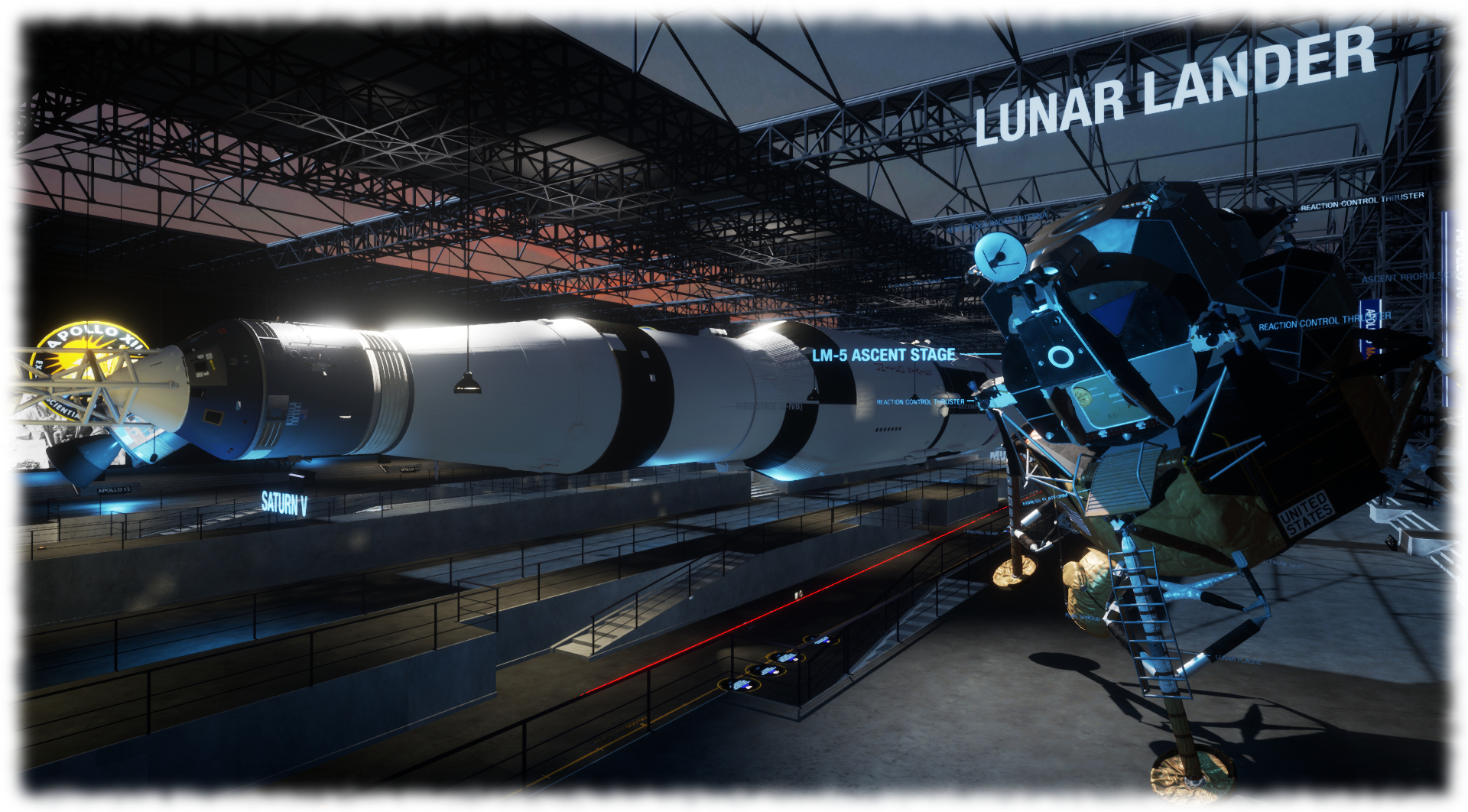
Linden Lab published a new Sansar Creator Profile video on Thursday, December 21st. It’s one I had heard about some time agao, and hard started to wonder what had happened to it. Regular readers will understand why my interest had been piqued when I say that the subject of the video is LOOT Interactive, the makers of the NASA Apollo Museum experience, based on the Apollo Saturn Centre at the Kennedy Space Centre Visitor Centre, and the Sea of Tranquillity experience, commemorating the Apollo 11 Moon landing.

These were two of the first experiences I visited in Sansar, given my interest in space flight and space exploration. As such, I was hoping the video, once available, would delve into the creation of these two experiences and examine the collaborations between LOOT Interactive and NASA and with Linden Lab’s Sansar team which brought the experiences to fruition. Sadly, this isn’t the case. Instead, what is presented is more of a promo reel, in keeping with the other Creator Profile films released in the run-up to Sansar’s Public Beta commencing at the end of July 2017. As such, this video in some ways feels a little out-of-place.

LOOT Interactive NASA Apollo Museum

Which should not be taken to mean the video isn’t worth watching; that promo reel bias notwithstanding, the video does a very good job in underscoring the potential of VR in markets such as education, learning and even – although not directly discussed – virtual tourism. Certainly, it explores the power of something like the NASA Apollo Museum to engage and inspire – and educate – simply by allowing people to experience an environment as personally as if they were there.

Take the Saturn 5 centre-piece for example. Being able to stand under its flank whilst in VR and look along its length brings home not only its gargantuan nature – but the sheer size of the technical and human endeavour that went  into it and the entire Apollo-Saturn programme. For adults and students alike, it, and the entire experience, deeply ingrains the entire voyage of Apollo 11 to and from the Moon in a deeply personal way; one not easily matched by watching archive video footage alone or without actually visiting NASA’s Visitor Centre complex. As the LOOT team note, there is a powerful way in which this immersive engagement translates into retained understanding and knowledge one which could apply to many areas of education and learning, formal and informal.

If you’ve not visited the NASA Apollo Museum experience in Sansar – with or without VR – it is a location I recommend as being a good leaping off point to discover what can be achieved within the place even at this stage of its development. Yes, there are niggles, but these are not enough to detract from the sheer scale and depth of the experience. And if you’re not sure, perhaps this video will also help to persuade you a visit could be worthwhile.