At the start of October 2025 I noted that I would be taking something of a break from SL and blogging in order to address a health issue which had been developing since earlier that year. At the time I did not go into specifics – nor do I intend to here. Rather, I wanted to let people know that circumstances were such that a break was required, and its exact length might well be indeterminate.
As it turned out, things initially appeared to go better than planned: the surgery proved to be less complicated than had originally described, and the immediate cause for concerned fully excised. As a result, my immediate recovery proved to be faster than anticipated, notably in terms of the time I was actually in hospital, such that by the latter third of October I was hoping I’d be returning to SL and blogging pretty much “full time” as it were.
Unfortunately, by mid-November it became apparent that despite these positives, the underlying cause of my problem had not been completely eliminated, and I would therefore require a more sustained period of treatment in order for it to hopefully be dealt with. As a result, my focus on SL and blogging has continued to be reduced and noticeably haphazard throughout the end of 2025 and into 2026 – and will most likely continue to be the case for at least the immediate future.
I mention all of this not to illicit thoughts and messages of sympathy and / or support, but because I’m aware that during the latter part of November and through December I received a lot of personal requests to attend a range of events (art, charity, music, etc.) and / or to ask for my help in promoting specific activities, the openings of public regions, etc., the majority of which went unanswered. As such I genuinely believe an apology for such a lack of response is warranted; the fact that my ramblings and this blog are viewed with regard by many is something I never wish to take for granted – it has and remains something for which I am ever grateful. Thus, I hope readers will take this post in the manner it which it is offered, and continue to bear with the unpredictable nature of my blogging until things again start to settle down for me.
In the meantime, my thanks to everyone for continuing to read this blog, and especially to those who have asked after my health through IMs, DMs, and the like; it really has helped lift my spirits.
A true colour image of Europa, captured by NASA’s Juno spacecraft during its 45th passage around Jupiter (Perijove 45), October 2023. Credit: NASA/JPL
One of the most fascinating places in the entire solar system is Europa, the second innermost of the four Galilean moons of Jupiter, and the smallest – although “smallest” here being a relative term, Europa (diameter around 3,100 km) being only very slightly smaller in size than our own Moon (diameter approx 3,475 km).
As I’ve explained in past Space Sunday pieces, Europa is subject to similar gravitational flexing as seen on Io, the innermost of the four Galilean moons. This flexing, caused by the unequal push-pull of Jupiter’s immense gravity on one side and the unequal yet effectively combined gravitational pull of the other three Galilean moons on the other, has marked Io as the most volcanically active body in the solar system with upwards of 400 active volcanoes marking its surface.
A rendering of Europa’s interior, as the modern consensus of opinion see it: a thin (10-30 km) outer crust with a water ocean approx 100 km deep, either fully liquid or a mix of liquid water and semi-frozen ice and slush, and a large rocky mantle heated by an iron core due to gravitational flexing. Credit: Kelvinsong
In Europa’s case, the common consensus has been that this flexing is sufficient to cause its core to stretch and contract, generating heat which keeps the waters trapped under the icy crust in a largely liquid state. It has also been hypothesised that this flexing could give rise to ocean floor hydrothermal vents and fumaroles, spewing heat, chemicals and minerals into the ocean; elements which might have kick-started life within Europa’s waters, much as we have seen around similar deep ocean hydrothermal vents here on Earth.
However, there are two stumbling blocks with these ideas. The first is whether or not there is sufficient energy being generated deep within Europa needed to drive a tectonic-like motion in the mantle and cause hydrothermal venting. The second is that, even with the minerals and chemicals blasted out of deep ocean fumaroles here on Earth, our oceans are rich in nutrients vital for life generated by things like the constant death and decay of marine life, the interaction of solar radiation with salts and other minerals within the upper reaches of our oceans, etc., and which are carried down to the depths by the natural cycles present within our oceans and help drive the life processes fund around deep water fumaroles.
A rendering showing the tidal heating processes believed to be at work in Europa, allowing it to have a liquid water ocean and – possibly – hydrothermal vents. Credit: NASA/JPL
While it is known that Europa has interactions between the intense radiations given off by Jupiter and the salts and minerals in its surface ice (giving rise to the discolouration seen across much of the moon) which likely give rise to chemicals and nutrients, how these might get down through the ice into the ocean below remains a unclear – although one theory suggests subduction might be a suitable mechanism.
A recently published study by geophysicists at Washington State University and Virginia Tech offers a more novel idea: crustal delamination. This is a geological process long known on Earth whereby our planet’s tectonic movement gradually “squeezes” a zone of the planet’s crust, chemically densifying it until it detaches from the crust and sinks into the mantle.
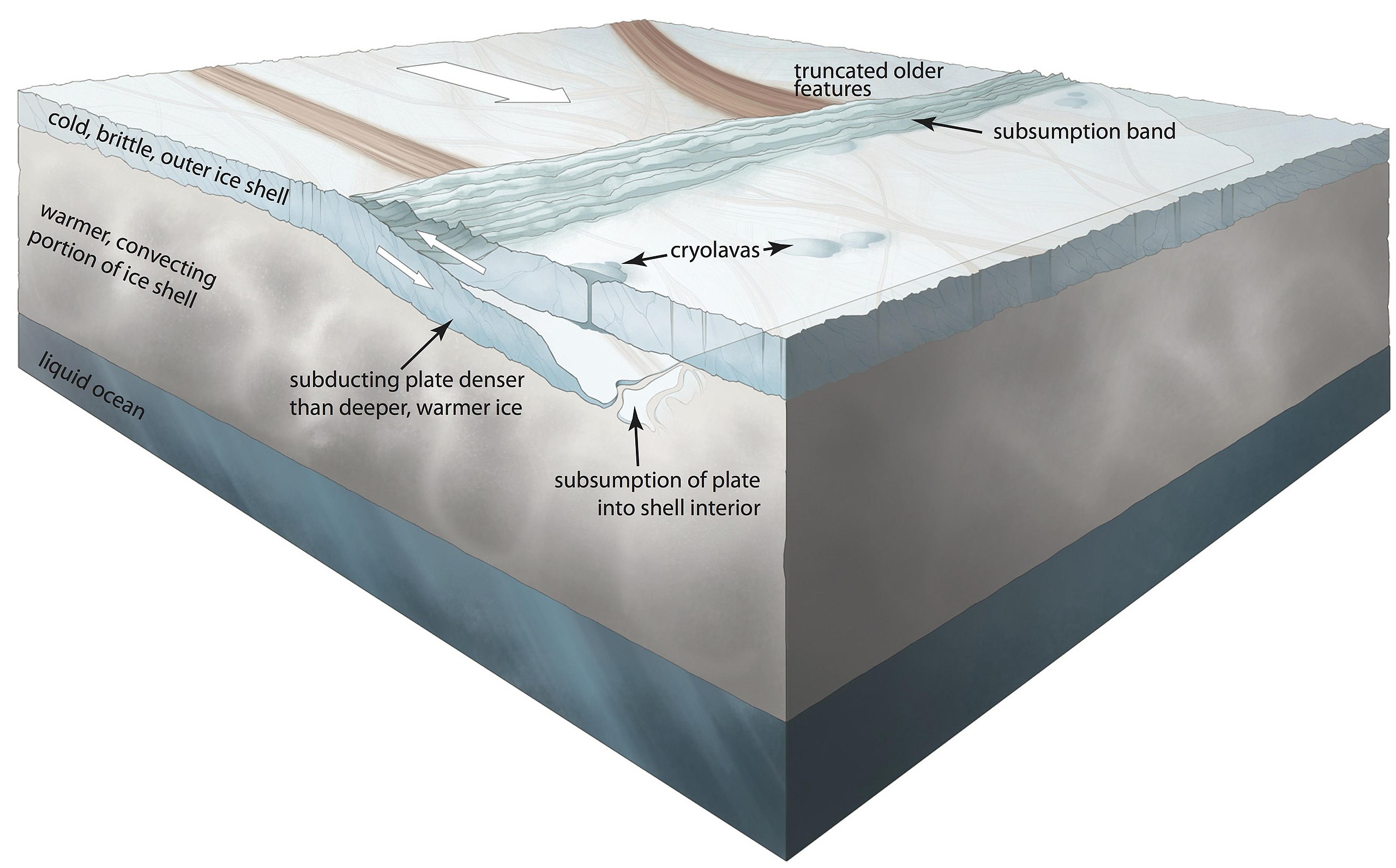
Diagram illustrating the theorised model of a possible avenue toward a form of crustal delamination in a planetary ice shell like Europa’s. Credit: The Planetary Science Journal (2026). DOI: 10.3847/PSJ/ae2b6f
Europa’s icy crust is in a degree of motion thanks to the aforementioned flexing. As noted above, this gives rise to the potential of subduction pushing “plates” of ice under others. Whether or not this is strong enough to push nutrient-laden ice down to the level of the ocean is unclear. However WSU / Virginia Tech study suggests the flexing, breaking and reforming of Europa’s surface ice could result in a unique kind of “crustal delamination”, with their model suggesting it could allow pockets of mineral and nutrient rich ice to “burrow” down to the warm liquid ocean, melt and release their nutrients into Europa’s supposed thermal currents.
If correct, this could allow Europa to provide the kind of nutrients any life down on its ocean floor. What’s more, it’s a theory that works within the subduction model, allowing the two to work together in the supply of nutrients and chemicals into Europa’s waters.
The “crustal delamination” theory sits will with other theories for ice movement on Europa, such as subduction. Credit: NASA
All of which bodes well for the theory that Europa may be an abode for life. However, another study authored by a team of leading planetary science experts concludes that suggests that whilst the competing gravitational forces at work on Europa might be sufficient to cause the moon to flex, but are insufficient to cause any kind of hydrothermal venting on the moon’s ocean floor.
If we could explore that ocean with a remote-control submarine, we predict we wouldn’t see any new fractures, active volcanoes, or plumes of hot water on the seafloor. Geologically, there’s not a lot happening down there. Everything would be quiet.
– Paul Byrne, an associate professor of Earth, environmental, and planetary sciences
This conclusion was reached after taking data on Europa’s size, the likely make-up of its deep core and surrounding mantle, its orbit, and on the likely gravitational forces at work on the moon. In particular, the study also contrasted the orbit of Io with that of Europa, and the role it plays in Io’s extreme volcanism.
Io occupies something of an erratic orbit and this increases the amount of influence gravities of Jupiter and the other three Galilean Moons have on it. But Europa’s orbit is closer to circular, and less prone to gravitational extremes, thus reducing the overall amount of flexing the moon experiences, greatly reducing the likelihood of any internal heating driving the kind of “tectonic”-like shifts in Europa’s mantle needed for venting to occur.
Europa likely has some tidal heating, which is why it’s not completely frozen. And it may have had a lot more heating in the distant past. But we don’t see any volcanoes shooting out of the ice today like we see on Io, and our calculations suggest that the tides aren’t strong enough to drive any sort of significant geologic activity at the seafloor.
– Paul Byrne, an associate professor of Earth, environmental, and planetary sciences
The key point here is that whilst a form of crustal delamination may well be at work alongside subduction to deliver vital nutrients for life deep into the waters of Europa’s oceans, without the hydrothermal venting acting as a direct energy and chemical / mineral source required to give that life a kick-start, the chances are, those nutrients aren’t really helping anything.
All of which make the discoveries NASA’s Europa Clipper and ESA’s Juice mission might make when they reach the Jovian system in the 2030s and start probing Europa’s secrets in great detail, all the more intriguing.
Blue Origin Confirm NG-3 Mission; Rocket Lab Suffer Neutron Setback
Two missions provisionally set for launch in the first quarter of 2026 received updates both good and bad (and a little curious in the case of one) this week.
The good / curious update came from Blue Origin with the confirmation of the next flight of their New Glenn heavy lift launch vehicle (HLLV). In it, the company indicated they are on course to launch New Glenn on its third flight towards the end of February 2026, and that it will utilise the core booster stage called Never Tell Me The Odds, used in the second flight of New Glenn – NG-2 – which set NASA’s twin ESCApades satellites on their way to Mars. Thus, the mission will be the first to see the re-use of a New Glenn core stage.
Never Tell Me The Odds, the New Glenn core stage used for the NG-2 launch in November 2025, sitting on the landing vessel Jacklyn following its flight in that mission. It is now set to be re-used in the NG-3 launch, currently targeted for late February 2026. Credit: Blue Origin
The curious element of the announcement lay in the payload for the mission – NG-3. Following NG-2, Blue Origin had indicated they would be looking to launch their Blue Moon Pathfinder mission to the Moon on NG-3, also reusing Never Tell Me The Odds in the process. However, this mission has now been moved back in the company’s launch manifest and, at the time of writing, has no indicated launch period other than “2026”. Instead, NG-3 will launch a 6.1 tonne Bluebird communications satellite to low Earth orbit (LEO) on behalf of AST SpaceMobile, helping to expand that company’s cellular broadband constellation.
Blue Origin has not stated any reason for the payload swap or whether it is due to requiring more time to prepare the Blue Moon demonstrator lander or not. It might be that the company needs more time in preparing Blue Moon, or it might be because they’d rather launch that mission using a new core booster; or it might be because they want to gather more data on vehicle performance carrying heavier payloads. The first two launches carried around 2-3 tonnes and just over a ton respectively. Blue Moon masses almost 22 tonnes, a sizeable jump, whereas Bluebird is a more modest increment.
Meanwhile, Rocket Labs suffered a setback which spells the end of their hopes to debut their Neutron rocket in the first quarter of 2026 – and which might delay the vehicle’s maiden flight by as much as a year.
Neutron is intended to be a 2-stage, partially-reusable medium lift launch vehicle (MLLV) in roughly the same class as ULA’s Vulcan-Centaur and SpaceX’s Falcon 9. However, it is of a highly innovative design, the second stage of the vehicle and its payload being carried aloft inside the first stage, within a set of clamshell payload fairings the company calls the “hungry hippo”. These open once the rocket has cleared the Earth’s denser atmosphere so the payload and its motor stage can be released, the core stage then returning to land on a floating platform.
A video showing the 2025 ground testing of Neutron’s aerodynamic fins, which will be used in the core stage’s descent to a landing barge touchdown, and the “Hungry Hippo” payload fairing forming the nose of the stage
The first Neutron vehicle (sans its upper stage and payload) arrived on the pad at rocket Lab’s launch facilities at the Mid-Atlantic Region Spaceport (MARS) on the Virginia coast earlier in January. On January 21st, the vehicle was undergoing a hydrostatic pressure trial intended to validate structural integrity and safety margins so as to ensure a successful launch. However, during the test, the vehicle’s main propellant tank buckled and then ruptured, effectively writing off the rocket.
Rocket Lab will now need time to analyse precisely what went wrong, why the propellant tank gave way and whether any significant structural alterations need to be made to it prior to any launch attempt being made.
A rendering of Rocket Lab’s Neutron and how it will work. Credit: Tony Bella
Gazing into the “Eye of Sauron”
Our Sun will one day die. In doing so, its hydrogen depleted, it will swell in size as it struggles to consume progressively heavier elements within itself before it collapses once more, shedding its outer layers into what we call a planetary nebula. It’s not a unique end for a main sequence star such as the Sun, but it can be a beautiful one when viewed from afar and through the eyeglass of time.
One such planetary nebula is that of NGC 7293 / Caldwell 63, commonly referred to as the Helix Nebula. Located some 650 light years away within the constellation of Aquarius as seen from Earth, it is one of the closest bright planetary nebulae to our solar system.
A nine-orbit, true colour image of the Helix Nebula captured by the Hubble Space Telescope (HST) revealing the structure of of nebula. Credit: NASA / ESA / STScl
Formed by an intermediate mass star thought to be similar to the Sun, the Nebula takes its name by the fact that the outer layers look – from our perspective, at least – like a helix. Some 2.9 light years across its widest axis, the nebula features the stellar core of the star which created it near its centre, a core so energetic as it collapses towards becoming a white dwarf it blew off, it causes the layers of gas and dust to brightly fluoresce.
This combination of shape and fluorescing colours has given the nebula two additional informal names: The Eye of God, and more latterly and partially in fun in the wake of the Lord of the Rings films, The Eye of Sauron. The nebula was perhaps first made famous by a nine-orbit campaign using the Hubble Space Telescope to capture true-colour images of it in 2004, resulting in a stunning (at the time) composite image of the nebula.
In 2007, the Spitzer Space Telescope captured the Helix Nebula in the infrared wavelengths, revealing much of the complex structure of the nebula’s gas and dust layering, with the core remnants of the star forming it clearly visible and blood red taking to the infrared, giving it the appearance of an eye.
An nfrared false-colour image of the Helix Nebula from the Spitzer Space Telescope. The white dwarf at the heart of the nebula appears red in this image, suggesting a malevolent eye. Image Credit: NASA/JPL
More recently, both the European Southern Observatory’s (ESO) VISTA (Visible and Infrared Survey Telescope for Astronomy) wide-angle telescope located high in the Atacama Desert of Chile, and NASA’s James Webb Space Telescope (JWST) 1.5 million km out in space, have caught the full majesty of the Helix Nebula in comparative detail.
In particular, the JWST images reveal much of the intricate nature of the layers of gas and dust within the nebula. These include clear signs of how the powerful pulses of stellar wind from the dying star are forcing most of the gases and dust in the layers to be pushed away from the core, with globular-like knots and strands of denser material resisting the push, forming what is called cometary knots, due to their resemblance to comets and their tails. However, these “comets” tend to be wider than the planetary core of our solar system!
Left: a true-colour, high-resolution of the Helix Nebula captured by ESO’s VISTA The image of the Helix Nebula on the left is from the ESO’s VISTA telescope in Chile. Right: an image from JWST offering detail on a portion of the Nebula. Credits: ESO/VISTA / NASA / ESA / STScI, J. Emerson (ESO)
JWST’s images also reveal the blue heat of stars beyond the nebula diffracted into beautiful star-like forms by the intervening (and invisible) gas and dust. VISTA, meanwhile helps put the JWST images into perspective within the Nebula as a whole. They also demonstrate how it was likely Helix was result of three different outbursts – or epochs – from the star.
The innermost of these epochs is obviously the youngest and more intact and more exposed to the outflow of stellar winds from the star’s remnants, whilst the outermost is interacting with the interstellar medium, with evidence of shockwaves, ripples, and a general “flattening” of the expanding clouds as it collides with the increasingly denser gas within the interstellar medium. This outermost layer was likely formed about 15,000-20,000 years ago, with the innermost about 10,000-12,000 years old.
A close-up image from JWST showing the “cometary knots”, the majority likely larger than the planetary core of our solar system, formed by dense clusters of gas resisting the outward push of solar winds from the dying star. A star is shown in blue, indicating its heat, the light from it undergoing diffraction by the non-visible dust and gas of the nebula. Credit: NASA / ESA / STScl
In time – around 30-50,000 years from now – the Helix Nebula will vanish as it merges into the interstellar medium and its star collapses into a quiescent white dwarf. But for now it continues to turn its eye upon us, gazing down as an entrancing ring of beauty, visible to professional and amateur astronomers alike.
Sable Hound Hollow – Romantic Reverie, January 2026 – click any image for full size
Sable Hound Hollow presents a sanctuary for dreamers and a haven for lovers. Here the first whispers of Spring and the enchantment of the Hollow invite you to linger awhile and let your heart rest and your worries fade. Be it alone or with that special someone, allow the quiet beauty of this place remind you the magic of love is real.
– Sable Hound Hollow About Land
So reads a description for Sable Hound Hollow – Romantic Reverie, a setting designed by Honey Heart (H0neyHeart) as a public space for people to visit and enjoy, and forming a part of the wider Sable Hound Hollow region.
Sable Hound Hollow – Romantic Reverie, January 2026
set as a pair of islands floating just over 500 metres in the sky, this is – as the description suggests – a romantic setting, one of considerable beauty and detail and offering much to appreciate and see. The Landing Point sits on the larger, western island, located on its highest level.
Here, within a large gazebo where visitors can join the local Group and – from now through until the end of February – join in a number of events centred on a celebration of Valentine’s Day. These include a hunt (group tag required), and the opportunity to obtain a daily gift when visiting from February 1st through 14th (again, Group membership required).
Sable Hound Hollow – Romantic Reverie, January 2026
Placed within a circular garden area, this upper reach of the setting offer two paths for visitors to follow as they explore. One of leads to a ladder draped over the edge of the plateau to offer a way down to a shoulder of rock arcing around the garden plateau. This forms another garden space with its own gazebo nicely separated form the rest of the setting to give a greater sense of intimacy / privacy, with treats and hot drinks available under its roof, exotic plants scattered among its flowers together with statutes, while trees provide shade and birds watch over the comings and goings of visitors.
The second path goes by way of steps to a larger garden space. this offers seating in the form of a bench floating under a cloud and a balloon holding aloft a seat for singles and couples (beware of the drop when standing up!), together with another table of treats and a Greco-Roman style gazebo where the 14 gifts for Valentine’s can be found, displaying the dates and times they will become available to Group members.
Sable Hound Hollow – Romantic Reverie, January 2026
Beyond this area, another ladder descends to the second half (so to speak) of the lower shoulder of rock, which again offers companionable seating in two locations (and an easily missed swing if you are not paying attention!), together with a bridge spanning the gap to the smaller of the two islands.
Here, the setting is again split into various levels. Just off to the left on crossing the bridge, the island offers a curve of grass richly coloured by wildflowers, as it arcs its way to where water forms a curtain and pool as it drops from a rocky archway. As it does so, the path passes a table set for a tea party, although no individuals in hats or mice or caterpillars are in evidence – just a pair of friendly rabbits :). Just before the waterfall and pool, a hint of magic is provided in the form of a bird perched on an upright post. Magical because if you wait just a few minutes, the bird will change its form and song.
Sable Hound Hollow – Romantic Reverie, January 2026
The waters of the fall drop from the rocks forming the upper tier of this island, reached easily enough by a set of stairs. Here visitors can take a pony ride and receive a gift of said pony at the end. A trail winds around the plateau, passing all the points of interest, including statues, a pair of swings to ride, together with the opportunity for a picnic under the boughs of twisted trees and in the company of white peacocks. This trail ends in steps running down to another path and gazebo set at one end of another sweeping curve of garden.
A third ladder has been cast down from the north-eastern side of this upper space to offer a way down to perhaps the most secluded part of the gardens. This is where water drops down from the pool mentioned above to join with the flow of additional waterfalls as they combine into a large pool before tumbling over the edge of the island to fall away into the clouds below. Marked again by a colourful array of flowers and trees, this area offers seating within another gazebo and a further swing suitable for solo sits.
Sable Hound Hollow – Romantic Reverie, January 2026
All of the above barely scratches the surface of all there is to be found here; Honey’s attention to detail means that everywhere are touches and details. These run from the mix of flower and plants – most conventional, some carrying a sci-fi or fantasy twist; the local wildlife, some of which might be easily missed (like the weasel peeping out of a hollow log); the floating lanterns, and more.
Both romantic and serene, the island of Sable Hound Hollow make for a relaxing and visually engaging visit.
Sable Hound Hollow – Romantic Reverie, January 2026
Nitroglobus Roof Gallery, January 2026: Flossy Nova – Colour of Vulnerability
As I recently noted, there are two exhibitions kicking-off 2026 at Nitroglobus Roof Gallery, operated and curated by Dido Haas. The first – and slightly longer-running in terms of opening date – is by Sydney Couerblanc, as I covered that within Afterimages of Spring at Nitroglobus in Second Life.
The second exhibition, occupying the main hall of the gallery is The Colour of Vulnerability, a striking exhibition of work by Flossy Nova (flo0owl). Like Sydney’s exhibition in the gallery’s Annex, this is a collection of pieces rich in emotive content, but one very different in style to Sydney’s use of narrative as a connecting theme between the images.
Nitroglobus Roof Gallery, January 2026: Flossy Nova – Colour of Vulnerability
Colour is often used to describe mood and emotion, and in some ways this is very much the case within The Colour of Vulnerability; however, through her use of bold, strong colours Flossy not only offers suggestions of mood, but also of self; an expression of state-of-mind when placed within a virtual realm such as Second Life and the freedoms that come with it.
The nineteen images comprising the exhibition border on the abstract in terms of their use of colour, whilst encompassing silhouette-like elements for her avatar; the two combining into a series of expressionist piece which captivate the eye completely. Rather than carrying a narrative thread, each of these images stands on its own; the unifying element being the use of colour.
Nitroglobus Roof Gallery, January 2026: Flossy Nova – Colour of Vulnerability
The colours serve as both backdrops and as expression of mood, whilst also in some suggesting the very aura of life and emotion surrounding the figure they contain. Throughout all of them, Flossy reveals suggestions of both her mood and being in a manner which is both subtle and yet clearly declarative; a fusion of expressiveness matching the interplay of colour and silhouettes.
However we interpret each piece is a matter of personal response and mood. Clues might be found within the titles the artist has given to each work, however I would suggest allowing them to speak to you prior to taking and edit-peek at any of the titles.
Nitroglobus Roof Gallery, January 2026: Flossy Nova – Colour of Vulnerability
A visually engaging exhibition, layered with emotional meaning and reflection.
The following notes were taken from the Tuesday, January 20th, 2026 Simulator User Group (SUG) meeting. These notes form a summary of the items discussed, and are not intended to be a full transcript. They were taken from the video recording by Pantera, embedded at the end of this summary – my thanks to Pantera for providing it.
Meeting Overview
The Simulator User Group (also referred to by its older name of Server User Group) exists to provide an opportunity for discussion about simulator technology, bugs, and feature ideas is held every other Tuesday at 12:00 noon, SLT (holidays, etc., allowing), per the Second Life Public Calendar.
The “SUG Leviathan Hour” meetings are held on the Tuesdays which do not have a formal SUG meeting, and are chaired by Leviathan Linden. They are more brainstorming / general discussion sessions.
Meetings are held in text in-world, at this location.
Simulator Deployments
All simhosts are undergoing restarts this week, with no deployments.
The next simulator release – 2026.01 (Kiwi) is currently with QA.
The simulator release to follow that – 2026.02 – has been given the code-name of Loganberry, but it’s too early in development for details to be provided.
Game Control
Leviathan Linden had planned to try to get a project viewer branch put together for his game_control work, but has been sidetracked in dealing with issues with the Kiwi simulator code.
He still hopes to be able to cut that branch “on the side” and see if he can create an installable that can be used to check to see if the game_control code actually works with the port to the current viewer code branch.
Grid-Wide WebRTC Deployment Announcement
As per the most recent OSD meeting, LL is hoping to deploy WebRTC grid-wide in March 2026.
This is not a set-in-stone target, and further updates will be made.
This means that Vivox, whilst still being held in reserve, will no longer be available as a Voice service – so those using Voice and using a non-PBR / WebRTC viewer will need to update.
The Lab is currently looking at a March deployment of WebRTC voice across the grid.
The public beta for WebRTC has expanded – see this official blog post for details – and Roxie Linden and her team hope the beta expansion will provide more feedback from users on voice quality, voice stability, etc.
Transcription using WebRTC is being poked at by the Lab, but will not be a part of the initial deployment.
SLua Work
Harold Linden has a rough draft on how `require()` has to behave to make sense both in VSCode and in-viewer. This is very much a work-in-progress.
In short: if you’ve ever had to edit someone’s preprocessed LSL script without all the #includes they had on their disk, and had to wade into the generated code + //#line comment soup, this should be a more readable way to bundle together all the code so editing is nicer.
This prompted a series of question on the documentation – please refer to the video.
Having the include/require path include object inventory for scripts in objects was noted as future work.
A new SLua editor will be available with upcoming viewers which should have much faster script editing.
Rider Linden indicated he would like to add something to the VSCode plugin that would provide access to scripts in inventory – and noting a concern in giving anything automated access of any kind to agent inventory.
SLua Resources
The nine beta test regions are centred on SLua Beta Void (mind the water!).
It is not yet available on the VScode marketplace.
Issues and PRs for code submissions can be made here, and the plugin downloaded.
VSCode plugin + documentation (Wolfgang Senizen – likely be discontinued and contributions shifted to support the official documentation).
In Brief
Please also refer to the video, below.
Monty Linden indicated the annual simhost certification work is now in progress. Overall, very little is changing, so no problems are anticipated.
The new certifications are being used by the 2026.01 code running on the release test regions on Aditi (the beta grid).
Monty plans to automate the recertification later in 2026, and the certification will change slightly at that time.
A request was made to allow scripts to exchange messages (or streams of messages) with the viewer using by using llOwnerSay (sending towards viewer), and listen on certain channel (receiving from viewer) but directly without a listen.
Apparently a feature request for this is in development for submission to Firestorm.
Rider Liden expressed an interest in seeing that request once written.
This also sparked a discussion on how llOwnerSay works across region boundaries (e.g. with the help of child agents).
A general discussion on Drawer Distance and how to extend it beyond 1024 metres (e.g. via anchoring the camera in a region and flycamming to another and anchoring there – or by using a 3D Mouse such as SpaceNavigator – my preferred choice).
† The header images included in these summaries are not intended to represent anything discussed at the meetings; they are simply here to avoid a repeated image of a rooftop of people every week. They are taken from my list of region visits, with a link to the post for those interested.
Jade Koltai: Inis Oírr, January 2026 – click any image for full size
Sitting on the mouth of Galway Bay on the west coast of Ireland, are the three Oileáin Árann, the Islands of Aran. Comprising three core isles – Inishmore, Inishmaan and Inisheer, together with a number of small islets, the Arans are not a large grouping; the three main isles provide just 46 square kilometres of land mass between them. However, they carry a history of human habitation going back to around 1100 BC.
Between them, the islands have seen their fair share of history, including Cromwell’s forces stomping around the islands and building multiple churches (among other things), and in being folded into the Nine Years War (1688-1697), with Irish-born privateer Thomas Vaughan, working for the French, seized the islands for a brief period after a series on initial raids on the settlements there.
Jade Koltai: Inis Oírr, January 2026
Of the three islands, Inis Oírr – to give Innisheer its Irish name – is the southerly. Covering just 1,448 acres, it is actually the island with the second highest population count for the Arans (343 as of 2022). Its small size makes it an ideal inspiration for a region build in Second Life – and that is exactly what Jade Koltai has done in order to create her latest region design at Overland Hills, and which she calls, appropriately enough, Inis Oírr.
Of course, even trying to capture 1,448 acres in a single region is no easy task, so Jade has once again sought to capture the spirit of Innisheer, focusing on offering representations of the island’s more notable landmarks and locations. And in my opinion, she more than succeeds. The design captures much of its namesake whilst offering a unique setting in its own right.
Jade Koltai: Inis Oírr, January 2026
Chief among the latter are the Innisheer Lighthouse, completed in 1857 and located on the southern tip of the island; Teampall Chaomháin, the ruins of a church dedicated to the island’s patron saint, Chaomháin of Innisheer, and a representation of the MV Plassy. Despite being the “most celebrated of all the saints of the Aran islands”, little is actually known about Chaomháin, but the church dedicated to him lies within the cemetery on Innisheer, and which today looks more like an excavation than a church , something Jade has neatly reproduced.
The MV Plassy is very much a part of the island’s more recent history. Originally built as an armed anti-submarine trawler for the Royal Navy, the vessel was originally names Juliet (as in Romeo and Juliet, the ship and her sister vessels all being named for Shakespearian characters).
Jade Koltai: Inis Oírr, January 2026
The ship saw service in World War Two, prior to being sold-off and renamed the Peterjon prior to again being renamed Plassy in 1951, and working as a coastal freighter. In 1960, a storm drove the ship onto Finnis Rock off the coast of the island, with the entire crew rescued by the islanders. A second storm then beached the wreck up on the rocky shore of Innisheer, where it remains to this day (perhaps gaining wider fame via a certain British-Irish sitcom of the mid-to-late 1990s).
Jade’s build wisely steers away from trying to present the island’s local community (although the Landing Point does take the form of a harbour wharf), instead concentrating on the above and other historical details, such as what might be seen as the ruin of one of the churches built by Cromwell – or perhaps a reference to O’Brien’s Castle, built in the 1300s.
Jade Koltai: Inis Oírr, January 2026
There are also dry stone walls snaking across the rugged landscape, just as can be found across Innisheer, whilst a part of the landscaping of the coast might be taken as referencing the island’s limestone pavement. Even the island’s connection to Ireland gets a mention: at the landing point is a sign for the Doolin Ferry, which connects the Aran Islands with the settlement of Doolin, County Clare, to the south-east of the group – and indeed, a ferry is docked at the wharf.
The offshore region surround elements might be a little too mountain-like in places to represent the Galway / Clare coastline or Innismaan (Inis Meáin), the second largest of the three main islands, but this hardly matters; the presence of the elements help to give Jade’s Inis Oírr a further sense of place.
Jade Koltai: Inis Oírr, January 2026
When visiting, do have local sounds enabled for a more immersive feel, and do note also that the shared environment is a little on the gloomy side (well, it is winter and this is the Irish Sea, and nature is hardly sunny a gay this time of year!).
It is because of this, I opted to make some adjustments to lighting when taken my photographs, and then overly this with shots using the actual EEP settings for the region as a part of post-processing. Hopefully, this helps bring out some of the details more clearly.
Nitroglobus Roof Gallery, January 2026: Sydney Couerblanc – Afterimages of Spring
Currently being hosted at Nitroglobus Roof Gallery, operated and curated by Dido Haas, are two exhibitions which are very different in tone and style, but which both draw on us emotionally. Over this and a forthcoming piece, I will be covering both, starting with the longer-running of the two.
Located within the Annex at Nitroglobus is an exhibition by Sydney Couerblanc – a Second Life photographer whose work I don’t believe I’ve previously encountered. Afterimages of Spring presents a series of images captured within the ever-engaging Bella’s Lullaby, a place I have been known to frequent and have written about on numerous occasions. For me, this would usually be enough to encourage a visit to an exhibition; however, Afterimages of Spring presents two further attractions: Sydney’s use of black and white photography, together with the fact that these images are not intended to present the beauty of Bella’s lullaby per se, but rather they use the region to present a story, one that might be seen as part of a larger narrative, given the questions it spurs.
Nitroglobus Roof Gallery, January 2026: Sydney Couerblanc – Afterimages of Spring
Spring is ending. It is her last day as light keeper on Blackheart Key. She took the job as a desperate attempt to get away. From the city, from the ex, from herself. Although challenging at first, she found solace in the island, and in time came to call it home. Today, with departure upon her, she misses it already.
– Artist’s statement on Afterimages of Spring
So it is that we join this unnamed light-keeper on the island carrying a name that is the negative (so to speak in photographic terms, that is) of the artist’s, as she travels through her final day at this remote location. Through eleven carefully framed and beautifully executed images, we follow her day from rising, through a final round of tasks to a final farewell, the island apparently seen from aboard a departing vessel.
The unfolding story is heavy in latent emotions, which follow outwards from each image: sadness at a forthcoming departure; apprehension at what now lay head; heart-tugging final times with friends soon to be left behind, and more. Through her framing and the gifted use of focus and depth of field combined with the sharpness , and black and white itself, Sydney conveys her story perfectly.
Nitroglobus Roof Gallery, January 2026: Sydney Couerblanc – Afterimages of Spring
In this, I particularly like Sydney’s use of the lighthouse itself in the majority of her pictures. It is present in nine of the eleven images, generally in the background and in a soft focus. This gives the lighthouse a sense of being; it is not so much a structure designed to fulfil a function – it is a friend; a guardian, a comforting presence keeping a companionable watch on our light keeper without making demands or overshadowing her life and thoughts.
Then there is the broader story hinted at both through the artist’s statement and the idea of the light keeper now leaving this sanctuary she has lived within: what did happen to her city life, her ex – perhaps even her career? – to cause her to seek such remote a withdrawal in the first place? And what now that she is departing – what will see discover or encounter? How will she fair? Might she yet have cause return?
Nitroglobus Roof Gallery, January 2026: Sydney Couerblanc – Afterimages of Spring
These are questions Afterimages of Spring perhaps stirs – but does not seek to answer. Like all skilled storytellers, Sydney presents enough to provide her core story, then leaves the rest to our imaginations.






 Inara Pey: Living in a Modemworld