Space Sunday: back to Betelgeuse and some updates

Betelgeuse is the red supergiant star in the shoulder of Orion. After decades of guessing, study and data-gathering, the long-theorised companion star thought to be orbiting Betelgeuse has been imaged – the bright dot in the left inset, marked by cross hairs. The circle marks were Betelgeuse should be in the image, but it has been removed (but shown in the centre inset), to make the companion more obvious in the image. Credit: ESO/M. Montargès et al. (background star field for illustration only, via skysurvey.org).

In 2019/2020 I covered, the excitement caused by the apparent and sudden dimming of Betelgeuse, the variable red supergiant in the constellation of Orion, when the star dropped from being the 10th brightest object in the night skies to the 27th before it recovered in early 2020. At the time there was much speculation on whether we were seeing the first signs the star had undergone a supernova explosion some 600 years ago (roughly the time it takes the light from the star to reach us). Obviously, this wasn’t the case, and the “great dimming” as it is now called was eventually pinned on something more mundane.

To put it simply, massive red giants like Betelgeuse are comparatively short-lived, in the order of 10-20 million years, rapidly burning through their stocks of hydrogen, and successively heavier elements in turn. As they do so – and before they reach a point where the fusion process can no longer be sustained as the energy to power it exceeds the amount of energy produced by it, causing the star’s core to collapse under its own gravity in less than a second and then immediately exploding outward again in a supernova – they go through some notable changes. Firstly, as each fusion cycle – helium, carbon, etc. – occurs at higher and higher temperatures, the red giant massively expands into a red supergiant. Secondly, they become violent, throwing off massive amounts of super-heated gas.

Betelgeuse, at around 8.5 million years of age is well into both of these phases; it expended its supply of hydrogen a very long time ago, expanding to its present size  of around 600-700 times bigger than the Sun. and it is periodically throwing off vast amounts of super-heated gas into space. With regards to the latter, it is now largely agreed that it was one of these clouds of material which caused the illusion of the “great /dimming”.

Thrown out by Betelgeuse so long ago it had long since cooled to the point it could not be seen from Earth, the cloud gradually drifted in front of our view of Betelgeuse during 2019, giving the impression the star was dimming dramatically. Then, as the dust then moved out of our line-of-sight with Betelgeuse in early 2020, the star appeared to return to its expected luminosity.

An artist’s impression of the 2019/2020 “great dimming”. At some point in the past, a large mass of superheat gas was ejected from Betelgeuse close to the direction in which Earth lay relative to the star (l). Over time, this material and cooled to a point where it could not longer be seen from Earth (2). In 2019, the cloud of dust came between Earth and our view of Betelgeuse, giving the impression the star had dramatically dimmed. Credit: Elizabeth Wheatley, STScl

As mundane as the explanation for the “great dimming” might be, it nevertheless caused a renewed interest in another of Betelgeuse’s mysteries: does it have a companion star orbiting it? It’s a question astronomers have been trying to answer for almost 100 years; but the very nature of Betelgeuse – its pulsing variability which makes even accurately determining its distance from Earth difficult (it’s thought to be about 640 light-years away, with a margin of error of +/- 146 light years); the huge and glowing masses of super-heated gases surrounding it, etc., – make finding any companion exceptionally difficult.

However, 2024 two separate studies carried were out in the wake of the “great dimming”, examining the gas clouds and the star’s coronasphere to see if there was evidence for either being affected the mass of a stellar object passing through them. Both studies yielded positive results but came to very different conclusions. The first study concluded the companion was either a white dwarf stellar remnant roughly the size of Earth or a neutron star some 10-20 km across. Either way, it likely had a mass roughly equitable to the Sun. However, the second study concluded the companion was almost equitable in size and mass to the Sun, and orbiting Betelgeuse so close it will likely be consumed by the larger star within 10,000 years.

Following up on these studies in 2025, a NASA team observed Betelgeuse using the Gemini North Observatory in Hawai’i. They pretty much confirmed the second of the 2024 studies: there did appear to be a companion star orbiting very close to Betelgeuse; however it appeared to be an F-type pre-main sequence star with roughly 1.5 to 1.6 times the mass of the Sun. Such was the NASA team’s confidence in their findings, they informally named the star: Siwarha, meaning “her bracelet” in Arabic, reflecting the fact that Betelgeuse means “the hand of al-Jawzā”. The name was subsequently accepted by the International Astronomical Union (IAU).

A visualisation created by the National Optical-Infrared Astronomy Research Laboratory using data captured via the Gemini North Observatory in 2025, showing Betelgeuse, minus its coronasphere (which would otherwise obscure the companion star with its own brightness) in orange; and in blue, the light of its companion star: Siwarha. Credit: NASA Ames / NOIRLab

More recently, a team of astronomers used the data from the NASA study to calculate where Siwarha would be at the furthest distance its orbit would carry from Betelgeuse as seen from Earth, and the time at which this would occur. They used these calculations to direct the European Southern Observatory’s Very Large Telescope (VLT) cluster in Chile to observe Betelgeuse at the specified time to try to both image Siwraha and gather more data that might be used to better characterise it.

The results were both satisfying and a little mystifying. On the one hand, Siwraha was exactly where the calculations said it would be, and the team were able to image it. However, the data gathered by the VLT’s instruments suggest Siwarha is a B-type main-sequence star some three times the mass of the Sun and between 2 and six times its size – in other words, very different to the star indicated by the NASA study.

There could be many reasons for this; as noted, trying to identify a stellar body which would effectively be little more than a marble compared to Betelgeuse’s soccer ball, and in so dynamic a region of space, isn’t easy. So as the VLT team note, more observations are required to better understand Siwarha’s nature. But in the meantime, it would seem that the 100-year-old question on whether or not Betelgeuse has a companion has been affirmatively answered.

An enlarged view of Siwarha showing its coronasphere (larger dot in the cross hairs and the bright dot of the star itself. Betelgeuse (which would be where the circle is located) has been digitally removed, to make Siwarha clearer. Credit: ESO/M. Montargès et al.

And what of the potential of Betelgeuse going supernova? Given its age and characteristics, astronomers agree that – if it hasn’t happened in the last 600-ish years – it will happen in the next 100,000. However, if it has happened within the last 600-ish years, our first indication will not be a sudden blossoming of light in the night (or even daytime, it will be that bright) sky. Instead, the first signs of its supernova will come invisibly in the form of a blast of neutrinos hitting a global network of detectors called the SuperNova Early Warning System (SNEWS) located deep underground.

This is because when the core of  a star destined to go supernova collapses, it generates a massive burst of neutrinos ahead of the actual supernova event. These travel outward at almost the speed of light, unhampered by the intervening matter of the the star. The light and energy created by the supernova, however, does have to propagate up through those layers of stellar matter, taking several hours to do so. Thus, this neutrino blast will reach us hours ahead of any light from the supernova, and SNEWS will be able to trace their point of origin.

Updates

The Rescuer in need of Rescuing

In June I covered the daring attempt to rescue a NASA satellite – the Neil Gehrels Swift Observatory – from re-entering Earth’s atmosphere in October 2026 and burning up, by using another spacecraft to link up with it and gently push it up to a higher orbital altitude (see: Space Sunday: NASA – a rescue attempt, costs & infrastructure).

The mission got off to a good start. The rescue vehicle, built by Arizona-based Katalyst Space Technologies and called LINK, carried into space by a Pegasus XL air-launched rocket, successfully reached its initial orbit. Once there, it was able to deploy its solar panels for power and enter a period of check-out, calibration and commissioning before starting on its way to rendezvous with the Swift Observatory. However, on July 28th, NASA announced things had gone a little sideways: two out of the three reaction wheels on the spacecraft have ceased functioning, and its cold gas thrusters are also suffering a “loss of functionality”.

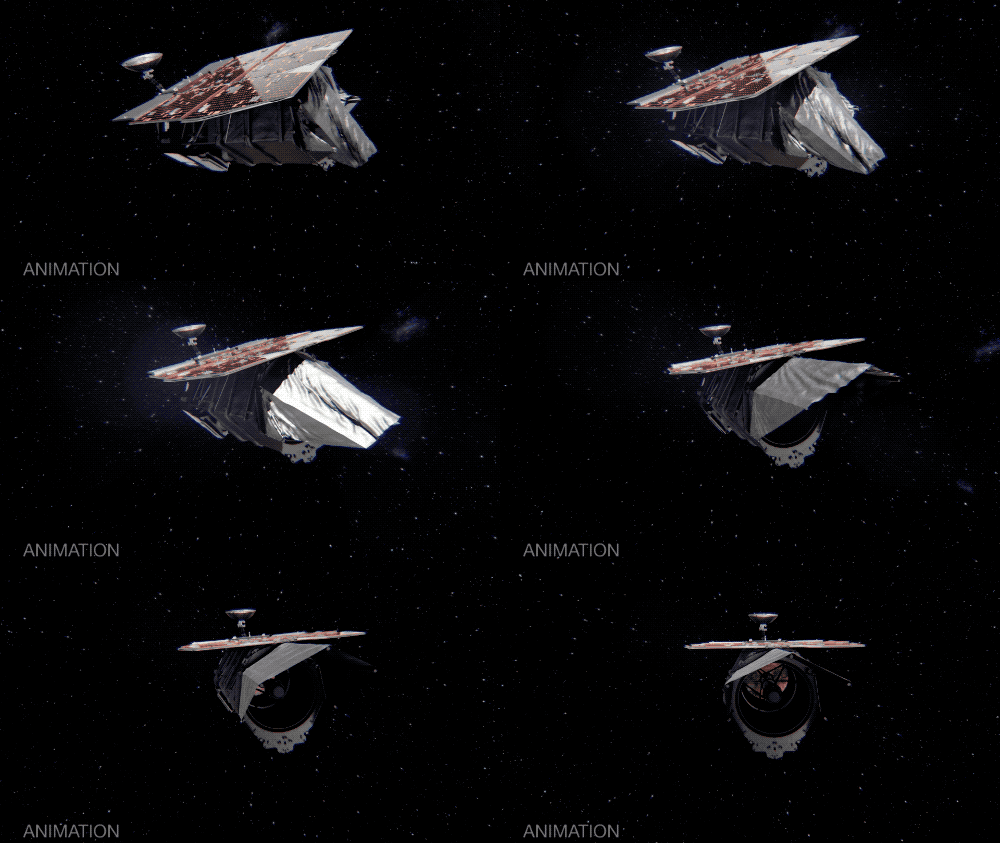
A set of an artist’s renderings of LINK in space and rendezvousing with Neil Gehrels Swift Observatory, ready to gently push it up to a safe operating altitude before atmospheric drag causes it to re-enter the atmosphere and burn up. Credit: Katalyst Space

Reaction wheels are a means to precisely control  the orientation of satellites and spacecraft where the use of thrusters isn’t precise enough and / or could lead to excessive propellant depletion. The failure aboard LINK means it is now slowly spinning and only able to achieve intermittent communications with Earth. Further, the issue with the cold gas thrusters means that these cannot be reliably employed to slow the spin and correct LINK’s orientation.

At the time of writing, both Katalyst and NASA are working through the issues in order to recover the spacecraft. At the same time, and as a back-up measure, work is being carried out to reconfigure the software controlling LINK’s more powerful and propulsive ion thrusters so that if necessary, they might be used in a manner similar the vehicle’s cold gas thrusters, firing short, gentle bursts at appropriate times in the spacecraft’s slow tumble and bring it under control.

And in a twist of history, in 2022, the Swift Observatory also suffered a failure within its reaction wheels, causing NASA to place it in a “safe” mode until the matter was resolved and the observatory could resume normal operations. Hopefully, the same will be true for LINK.

Thar’ She Floats!

It’s probably more than apparent that I’m (one of many) not convinced that SpaceX’s Starship / Super Heavy system is actually a viable commercial launch system with a genuine ROI. It is most certainly not the vehicle that will “take humanity to Mars” or anywhere else in the wider solar system or realistically deliver on any of the other promises made by the SpaceX CEO. However, credit does fall where credit is due.

“I’m still floating better than I ever did. Looking like a true survivor, coming back from outer space” – Starship S40 in the Indian Ocean, 5 days after splashing down. Credit: SpaceX (and apologies to Elton John!)

As I covered in my previous Space Sunday update, the system completed its 13th integrated flight test (IFT-13) on July 24th which achieved the majority of its stated goals, potentially clearing the way for an orbital launch attempt with IFT-14. However, perhaps the most remarkable thing about IFT-13 is the fact that on splashing down in the Indian Ocean, Starship S40 didn’t exit this world by blowing up in the manner of its predecessors, but gently keeled over to float on its back.

And it is still afloat, which is equally remarkable, and speaks to its overall structural integrity. Having taken the time to careful study the vehicle following its splashdown – particularly the condition of its heat shield tiles – SpaceX has indicated it may try to attempt a recovery of the 52-metre long, 100-tonne vehicle by towing to Australia – a distance of around 1,200 km – where it can be transferred to a suitable ocean-going barge for transfer back to the United States!

ESCAPADE’s Long Road to Mars Captures the Moon and Earth

In November 2025, and on its second flight, Blue Origin’s New Glenn rocket sent two small NASA satellites built by Rocket Lab on behalf of NASA on their (indirect) way to Mars (see: Space Sunday: New Glenn “welds” it on second flight!).

The mission, called ESCAPADE (Escape and Plasma Acceleration and Dynamics Explorers) is intended to orbit Mars with the two satellites (informally called Gold and Blue) in a study of the planet’s magnetosphere and how solar wind contributed to the loss of most of the planet’s atmosphere. However, under the original plan, the two 1/2 tonne satellites were supposed to have been launched with NASA’s 16 Psyche mission in 2023, effectively hitching a ride with that spacecraft which would make a fly-by of Mars. However, changes to the 16 Psyche mission meant ESCAPADE could no long launch with it, and so it eventually departed Earth outside of the normal 26-month optimal Earth-Mars launch windows.

This meant that as launched the two satellites could not reach Mars directly. Instead, they were placed on a looping flight around the Sun-Earth L2 position before swinging back towards the Earth-Moon system in first of two fly-bys. This took place in early July 2026, and was used to calibrate the imaging systems on both vehicles, by capturing images of the Earth-Moon system in natural light, ultra violet and infrared.

The Earth (l) and the Moon (r) imaged by an ESCAPDE spacecraft during the July fly-by. Earth is 584,600 km from the spacecraft and the Moon 186,100 km. However, the false perspective of the image appears to suggest Earth and the Moon are roughly the same size, and Earth is the nearer of the two to the spacecraft. Credit: NASA

Both Earth and the Moon are 8% sunlit crescents in the image, with the Sun just out of frame to the observer’s right. The image also presents a comparison of albedo (reflectivity), with Earth is around 30% reflective overall thanks to sunlight being reflected off of the planet’s cloud tops. Meanwhile the Moon is a dull 7%.

When seen in the infrared, the difference is more apparent: even the side of Earth apparently in shadow shines with a temperature range of -43o and -10o, which might sound low in this age of global warming, but remember it is the night side of the planet and includes the temperature of the oceans there. By contrast, the Moon’s shadowed side is -173.3o.

ESCAPADE image showing Earth (l) and the Moon in infrared wavelengths. Credit: NASA

Currently, both satellites are on the outward leg of a shorter loop away from Earth. They will return in November and perform a close gravity-assist flyby which will set them on course to reach orbit around Mars in September 2027.


Space Sunday: Artemis 4 – to the south pole or not?

Either Blue Origin (left) and SpaceX (right) is due to provide the lunar lander for Artemis 4 – but should the landing take place in the Lunar South Polar Region?

Artemis 4 is currently scheduled to mark America’s return to the surface of the Moon in 2028. However, as I’ve noted in covering the programme in this column, there are several technical matters which need to be addressed – particularly if SpaceX remains the supplier of choice for the mission’s lunar lander – which could see the mission slip back to 2029. But now questions on exactly where Artemis 4 should be going.

Taken as The Artemis Project aims to send humans to the Lunar South Polar Region with the aim of establishing a base there, on the basis that base parts of the Moon’s polar regions remain in complete shadow all the time – notably the bottoms of craters – then it is possible there is accessible water ice to be found which could make lunar operations somewhat easier (providing water for drinking / cooling systems, air, ingredients for rocket motor propellants).

The overall goal of the mission is to primarily check-out what will be largely untested hardware, equipment and systems – both in terms of the lander vehicles and the space suits developed for Artemis. But do these necessarily need to be tested using a mission to the Lunar South Polar region? Could they not equally be carried out using a more equatorial landing zone, one which involves less complexity in its execution – and potentially less risk?

Map of candidate landing regions in the Artemis exploration zone (90°S to 84°S), as identified by NASA, 2022 and 2024. Credit: Lunar and Planetary Institute

Landing at the lunar equator offers predictable solar illumination, simplified orbital dynamics, and reduced communication blackout risks compared to the high-latitude Lunar South Polar Region. While much of the latter does experience near-continuous daylight, its chaotic topography with dramatic elevation changes coupled with a low-angle solar elevation (thus resulting in areas remaining in deep shadow, even outside of craters) present severe hazards for landing craft and extravehicular operations.

Thus, by targeting the more “known” regions of the Moon, such as Mare Imbrium (in which Apollo 17 landed) and Mare Tranquillitatis (Apollo 11), Artemis 4 could operate in a somewhat more predictable operational envelope than would be the case with a South Polar Region landing. This would potentially allow for better initial testing of guidance, control, automated landing systems and communications systems.

The latest voice to be heard advocating for this approach is that of Artemis 2 pilot, Victor Glover, who likened the switch to a more stepwise approach to lunar operations. For example, in the 1960s, NASA initially tested the Apollo Command and Service Module in Earth orbit (Apollo 7), then in a flight around the Moon (Apollo 8), then the lunar lander was tested in Earth orbit (Apollo 9) and then on a non-landing voyage to the Moon where its decent / ascent capabilities could be tested in lunar conditions (Apollo 10). Further, the Apollo missions grew in complexity, making targeting more difficult landing sites more acceptable as experience was gained from earlier missions and the capabilities of the vehicles and their systems became more clearly understood.

Credit: Lunar and Planetary Institute

By contrast, Artemis effective jumps: from an uncrewed cislunar test of the Orion Earth-Moon-Earth vehicle (Artemis 1) to a crewed cislunar test of Orion (Artemis 2) to a semi-orbital test of the landing vehicles in Earth orbit (Artemis 3 – which will not even be a test of either vehicle’s flight and propulsion systems) to attempting a landing in a very challenging environment; so there is much to be said for revising efforts.

As well as lowering the technical complexity of the initial mission, Glover raises a health reason. What if a crew member suffers and injury or medical situation requiring evacuation to Earth? With Apollo, the Command and Service Module orbited between 100 and 300 km above the lunar surface. This made getting back to it aboard the lunar lander in an emergency, and it would be in a position to rendezvous with the ascend lander every few orbits, and likewise be able to more readily to break orbit and return to Earth.

Missions to the Lunar South Polar Regions require a more complex, propellant-intensive flight, culminating in an Elliptical Polar Orbit with Coplanar Line of Apsides (EPO/coLA). Because more propellant is required, this orbit must vary between 100 and 6,500 km above the Earth, as the high altitude is required for Orion to be able to break orbit and return to Earth; lower than this, and it could have insufficient fuel remaining to escape the Moon.

NASA Astronaut and mission pilot for Artemis 2, victor Glover. Credit: NASA

Because of its range, this EPO/coLA orbit means that a rendezvous between Orion and an ascending lander can only happen once every couple of days or so. By switching to a more equatorial landing zone, propellant usage is reduced, making Orion more capable of entering a more circular, lower orbit of the Moon, thus presenting more opportunities for an emergency rendezvous with the lander should this be required. Of course, this doesn’t solve the issue of emergency evacuations on missions are Artemis 4; what it does mean is that the risks associated with the “first time” nature of Artemis 4 might be further reduced.

In terms of missions beyond Artemis 4, SpaceX have already suggested that their massive Starship-derived land could actually take Orion to the Moon if the two were to dock in Earth orbit. This would conserve Orion’s propellant, potentially allowing the elliptical nature of the EPO/coLA orbit to be reduced, again offering more opportunities for emergency rendezvous in lunar orbit. Similarly, the switch to using a modified Vulcan-Centaur booster and the upper stage of the SLS rocket, replacing the current Interim Cryogenic Propulsion Stage (ICPS) could also allow the EPO/coLA orbit range to be reduced, again allowing windows for Orion / lander rendezvous to be increased.

Finally, Glover (and others) note that the political onus on Artemis 4 is increasingly about “beating the Chinese” rather than achieving science / engineering goals. If this is the case, then a mission to land within the Moon’s more familiar equatorial regions, building on all of the knowledge gained on such mission during Apollo, would help make that goal easier by removing several levels of complexity to Artemis 4.

Thus far, NASA management has given no indication any such shift will be made, but in many respects it does fit with a more step-by-step approach to lunar operations they have adopted since the start of 2026 .

Starship IFT-13: More of the Same, but with Twists

On July 24th, SpaceX completed the 13th integrated flight test (IFT) of its Starship / Super Heavy booster combination, flying the “version 3” of each vehicle for the second time, the fist having been in May 2026.

A camera mounted on one of the two forward flaps of Starship S40 looks back down the length of the vehicle and its Super Heavy booster towards the Boca Chica launch site as IFT-13 approaches max-Q following launch on July 24, 2026. Credit: SpaceX

In broad terms, the flight was something of re-run of the past few missions: launch, get Starship to sub-orbital velocity / altitude, return the Super Heavy booster for a controlled splashdown in the Gulf of Mexico, with the Starship deploying a payload before initiating a test-restart of one of its engines and then making a re-entry and splashdown in the Indian Ocean not all of which had been achieved through IFT-10 through 12.

An initial attempt to launch the flight had been made on July 16th, but was halted by on-board systems when four of the booster’s 33 Raptor engines failed to ignite. Subsequent analysis revealed that due to the way the engines are chilled, ice had formed within those four engines, choking them at start-up. This resulted in two of the engines having to be swapped-out on the pad. A second Attempt on July 23rd was scrubbed as cloud would have obscured observations of the vehicle’s ascent.

On July 24th, things went remarkably smoothly, with the raw power of the Raptor 3 engines clearly seen – it took just sixty seconds for the booster and ship to go from the launch platform to supersonic speed and then pass through max-Q (the point of highest dynamic stress on the vehicles during ascent).

As the Super Heavy booster performs its boost-back flip, a camera on its hull captures Starship S40 with all six engines lit. Credit: SpaceX

Hot staging took place with the booster shutting down all but five of its engines as the ship fired-up its six engines. On separation, the booster immediately vectored away from the ascending Starship, avoiding the issue which led to a failure with the boost-back engine burn seen with IFT-12 in May. However, the booster did suffer a engine re-start failure just before a planned splashdown in the Gulf of Mexico, when only 9 of the anticipated 13 engines restarted – and four of those immediately shut down again and the booster hit the water at an estimated 160 km/h. This and the ice issues of July 16th suggest the Raptor 3 still needs refinement.

Starship S40, however, went on to achieve sub-orbital flight, deployed its payload, finally carried out a restart of an engine (something the last several flights have tried and failed to achieve, and which forms a vital part of vehicle operations) and then made a perfect re-entry into, and passage through, the denser atmosphere. Finally, it successfully re-lit three engines, flipped itself vertically to make a gentle landing in the Indian Ocean. So gentle, in fact, it didn’t explode; it gently tipped over on its back to float on the ocean, small fires licking around the hull caused by vented gases. This obliging allowed the aerial drone patrolling the landing zone to capture video of the vehicle’s re-entry heat shield for analysis.

The key difference between this mission and the earlier payload carrying sub-orbital flights lay in the fact that this time, and actual working payload was carried aloft in the form of 20 Starlink v3 satellites.

A flap-mounted camera on StarshipS40 captures some of the deployed Starlink satellites reflecting sunlight (white) and seemingly firing their icon thrusters (blue dots). Credit: SpaceX

At up to 2 tonnes each, and with a span of 15 metres with their solar arrays open, the Starlink v3 is a veritable monster compared to the v1 (300 kg) and v2 (600 kg) variants and offers gigabit levels of data transfer rates.

These satellites are seen as vital to Starlink’s future, and are wholly dependent on the Starship / Super Heavy combination to launch them, as they are too big and bulky to be launched en-masse by Falcon 9 (hence why SpaceX is almost solely focused on getting Starship working with a Starlink deployment system rather than building it capable of delivering a range of payloads to orbit – in fact, there is an argument to make that Starlink is Starship’s only viable payload, but that’s for another article).

Starship S20 “bellyflops” through the atmosphere after re-entry, the four and aft flaps maintaining its aerodynamic control. Credit: SpaceX

None of the deployed Starlink units survived long – just 20 minutes given they were sub-orbital as well. However, this was long enough for SpaceX to test their ion engines and communications capabilities, hooking them into the main Starlink network and testing their laser communications systems among themselves.

Six of the satellites were fitted with cameras and spotlights, and were tasked with following the starship vehicle down through re-entry, filming its manoeuvres and interactions with the upper atmosphere. At the time of writing, none of that footage, if successfully relayed to Earth, has been released.

Almost 2 minutes after splashing down vertical and then toppling into the sea, S20 floats as fires from vents gases burn around parts of it. Credit: SpaceX

Overall, IFT-13 was a step forward from the rinse-wash-repeat status of the last few Starship / Super Heavy flights. The system still has a long way to go before it can be said to have met even its baseline requirements (launch, deploy, return and capture for re-use), and even longer to go in terms of actually proving it is viable for anything other than Starlink launches. However, subject to the on-going issues with the Raptor 3 motors, SpaceX have indicated the 14th flight might actually be an attempt to reach orbit – possibly with an attempt to catch the orbital vehicle on its return.

Psyche’s Time-Lapse of Mars

On May 15th, 2026 NASA’s Psyche spacecraft swung by Mars, using the planet in a gravity-assist manoeuvre to help propel it on its way to its intended target, the M-type (indicating it has a high metallic content) asteroid 16 Psyche, which it will reach in 2029.

The fly-by marked the mid-point in the spacecraft’s journey, and I covered it and the overall Psyche mission just after it happened. However, earlier in July NASA issued a time-lapse video of the encounter, stitched together from individual images captured by the spacecraft’s imagining system between May 2nd and May 31st.

Approaching from a “high phase” angle relative to the Sun, Psyche initially reveals Mars as a thin crescent, only around 4% of its surface visible. This rapidly grows as the spacecraft sweeps down towards the planet’s northern hemisphere, features somewhat blurred, but with craters and clouds visible before Psyche arcs over the very heavily cratered southern hemisphere, closing to within 4,609 km of the planet’s surface before heading back into space, speeding towards the asteroid belt and 16 Psyche with 1,600 km/h more velocity than when it approached at Mars.

While the fly-by didn’t add much to the masses of data already gathered on Mars, it did serve a second important function for the Psyche mission: by aiming Psyche’s suite of instruments at a well-studied world, mission engineers were able to properly calibrate and validate the spacecraft’s major science instruments ahead of its encounter with 16 Psyche.

Space Sunday: Rocket Lab’s rise; visiting an asteroid and a planet’s atmosphere

Rocket Lab: the launch of VICTUS HAZE, the upper stage and payload fairings of the Electron rocket; the Pioneer Demonstrator payload. Credit: Rocket Lab

Rocket Lab, the New Zealand / US company, has made a name for itself in the smallsat market – possibly the fastest growing sector of the space industry – both as a launch provider via its Electron rocket (around US $7.5 million per launch). It’s one of the most successful commercial space companies going (although still to consistently earn a profit), and it is growing its reputation both in the commercial sector and in support of US government-related launches.

In this latter regard, in June 2026, the company set a new benchmark for military responsive space operations under the United States Space Force’s (USSF) TacRS – TACtical Responsive Space – programme. This is a programme designed to place satellites into orbit on short notice during a crisis. VICTUS HAZE, the test involving Rocket Lab, tested the concept under demanding timelines and cleared several milestones well ahead of schedule.

In particular, the company was able to take a payload – their Pioneer demonstrator of a satellite they have been specifically developing to meet USSF requirements – from storage through ground check-out, fuelling and integration into a launch vehicle and thence to orbit in under 17 hours, beating the previous TacRS test mission’s record by 10 hours. Key to this was Rocket Lab’s ability to complete all trajectory guidance calculations in order for Pioneer to rendezvous with its intended target in just 4 hours, including coordinating all the required ground tracking stations around the world.

While the launch didn’t shave time off of the satellite’s on-orbit initialisation process, it still meant that within 3 days of launch, the satellite was ready to begin rendezvous and proximity operations (RPO) with a target a vehicle in a simulation of chasing down and observing a Chinese satellite which had itself been launched in order to snoop on an orbital asset operated by a western nation.

The success with VICTUS HAZE further enhanced Rocket Lab’s status as a company that delivers on its promises. Whilst specialising in the smallsat market – perhaps the fastest-growing sector of the commercial space industry – using its Electron rocket putting small payloads in orbit for around US $7.5 million a shot, the company is far more than a launch provider.

As well as providing launch vehicles for customers, Rocket Lab has a dedicated satellite development capability enables the company to provide the payloads customers are seeking to fly. Further, and as demonstrated by Victus Haze, Rocket Lab has the ability to manage and co-ordinate satellites in orbit on their client’s behalf – Pioneer remaining under Rocket Lab’s operational control on behalf of US Space Command. Thus, the company is able to provide a full vertical stack of satellite development, launch and operational capabilities to customers.

While Electron, with its current maximum payload capacity of 300 kilos is the most well-known of the company’s rockets, it is not the only vehicle Rocket Lab operates. There is also the Electron-derived HASTE vehicle, specifically designed for flight test opportunities in the hypersonic and suborbital system technology development field.

The DART AE demonstrator, built for the US DoD by Australian company Hypersonix, mounted on its launch bus ahead of integration into a Rocket Lab HASTE launcher. Credit: Rocket Lab / Hypersonix

A HASTE vehicle was most recently used in February 2026 to lift the DART AE hypersonic demonstrator to a release altitude where it could test advanced propulsion, materials, sensors and guidance systems under real hypersonic flight conditions (5x the speed of sound). Built by Australia’s Hypersonix on behalf of the US DoD, a unique part of DART’s design is that the scramjet engine it uses is 3D printed.

In a typical twist of humour reflective of Rocket Lab’s CEO, New Zealander Sir Peter Beck, the rocket used to successfully launch and deploy DART AE for its (also successful) test flight was called That’s Not a Knife – a reference to an iconic scene in the film Crocodile Dundee, thus referencing the Australian heritage of hypersonic vehicle.

As I’ve reported on several times in these pages, Rocket Lab is also developing a new reusable medium-lift launch vehicle (MLLV) called Neutron. This is due to make its maiden flight later in 2026, and has already gained worldwide recognition for it novel approach to payload carrying.

An artist’s rendering of Rocket Lab’s Neutron rocket and its “Hungry Hippo” payload doors. Credit: Rocket Lab

Rather than have the payload and the upper stage of the rocket mounted on top of the first stage, they are mounted inside the rocket’s first stage behind a pair of clamshell doors which will open up to release both – giving them the nickname of the “Hungry Hippo” – before closing to allow the complete booster to return to Earth.

Currently, Neutron is expected to make its maiden flight later in 2026, despite the loss of a propellant tank intended for the first flight-ready vehicle during pressure tests in January, 2026. The company has reported that it is now entering into vehicle integration, ground-testing of both the rocket’s main Archimedes engines and the vacuum-optimised version used in its upper stage is proceeding, and the construction of the new Neutron- capable launch pad at the Mid-Atlantic Regional Spaceport (MARS) within NASA’s Wallops Flight Facility, Virginia is complete.

A Rocket Lab Archimedes methlox (methane / liquid oxygen) engine designed for the company’s Neutron rocket, undergoing testing at NASA’s Stennis Space Centre, Mississippi. Credit: Rocket Lab

Through its unique design and the reusability of its first stage, Neutron will be able to deliver up to 13 tonnes to low-Earth orbit with the first stage reused. This might not sound much compared to Blue Origin’s New Glenn or SpaceX Falcon Heavy, but it actually places Neutron right in the sweet spot of launch capabilities: able to meet requirements of 98% of all commercial payloads through until the end of 2029 (were all those contracts up for grabs). Thus, it is well-placed to compete not only with the behemoths in the market (which have to wait around until they have sufficient payload to make launches reasonably cost-effective), but very much directly against SpaceX Falcon 9.

At the time of writing, Rocket Lab is attempting to acquire Iridium Communications for some US $8 billion. Iridium operates a network of 80 satellites in near-polar orbits (66 operational, 14 in-orbit back-ups). This constellation provides a globe-spanning network for voice and data communication from handheld satellite phones, satellite messenger communication devices and integrated transceivers, as well as for two-way satellite messaging service from supported mobile phones.

The Iridium network provides global coverage and communications relay. Credit: unknown

If the deal goes through, it will mean Rocket lab has entered another area of competition with SpaceX, Amazon and OneWeb – one which comes with an already established satellite network and 2.54 million billable subscribers (which is well short of Starlink’s 10 million). In addition, Iridium provides services for the US government, airlines, cruise ship and shipping operators. Perhaps most significantly, the Iridium system is certified for use in the Global Maritime Distress and Safety System (GMDSS) and for Future Air Navigation System (FANS) data links, neither of which is supported by the other providers, thus putting Rocket Lab in a unique position to harness new customers.

All of which speaks to a lot for a little rocket company that decided it can.

1 Launch, 1 Billion Kilometres and a Rendezvous

In May 2025, China launched one of its most ambitious missions so far: sending a robotic vehicle to rendezvous, land on and gather samples from a near-Earth asteroid (NEA) and then return those samples to Earth.

It’s not the first time there has been such a mission, both NASA’s OSIRIS-REx and Japan’s Hayabusa and Hayabusa2, have all gathered samples from near-Earth objects; however for China, Tianwen-2 (“’Heavenly Questions-2”) is an ambitious step considering the relative age of their space programme.

The target of the mission is 469219 Kamoʻoalewaa (also known as 2016 HO3), what is called a quasi-satellite because there are periods in its orbit around the Sun where it passes close enough to Earth to become temporarily caught by Earth’s gravity, orbits the planet numerous times whilst continuing along its orbit around the Sun before moving off once more until the next time its orbit and that of Earth intersect. What makes 469219 Kamoʻoalewaa particularly interesting for study is that it is believed to be a piece of our Moon ejected into space when an impact created the crater Giordano Bruno on the lunar far side.

Orbit of asteroid 469219 Kamoʻoalewa showing it’s quasi-moon nature around Earth. Credit: NASA
Rendezvousing with such an object might sound relatively simple compared to sending a probe to somewhere like Mars. However, orbital mechanics mean that doing either is a complex task – particularly in the case of 469219 Kamoʻoalewaa, about which relatively little was known in terms of trajectory when the mission launched. In all, it took over a year for Tianwen-2 to close on the asteroid with frequent course corrections guided using observations from Earth, travelling 1 billion kilometres in the process.

In early June, the probe was able to detect the tiny asteroid – just 27.4 metres across – directly, rather than relying on guidance from Earth. This allowed it to initiate a capture control manoeuvre, settling into trajectory alongside that of the asteroid, matching its orbital path rather than simply crossing it. Through the first part of June, the probe gently closed the distance between itself and the asteroid to just 2,000 kilometres.

By July 2nd, 2026, Tianwen 2 had reached an altitude of 20 km above the asteroid, allowing it to commence its primary science mission. The vehicle will now carry out an intensive survey of the asteroid as it gradually decreases the separation between them until at 300m, with a sampling site determined, Tianwen-2 will attempt to touch-down briefly on the asteroid’s surface and gather around 100 grams of material.

469219 Kamoʻoalewa imaged by Tianwen-2 on 2 July 2026 from a distance of 20 km. Credit: CNSA

If successful, this will be the first time a spacecraft from Earth has used an anchor-and-attach approach method to physically fix itself on an asteroid to gather samples. Both of the Hayabusa missions and OSIRIS-REx used touch-and-go, essentially closing to a point were a sampler gathering device could make contact with the target for long enough – a couple of seconds – to gather a sample before springs in the device compressed by the mass of the spacecraft released to push it away. However, in case Tianwen 2’s anchor and attach mechanism proves unsuitable, the craft also has a touch-and-go capability for sample acquisition.

Following sample gathering, Tianwen-2 will return to Earth, ejecting its payload before heading back out into space for a rendezvous comet 311P/PanSTARRS, which it will reach in 2035.

Astronomers Discover 1st Atmosphere around an Earth-sized Planet in a Star’s Habitable Zone

LHS 1140 is a red dwarf star appearing in the constellation of Cetus (the Whale), approximately 48.8 light-years from our own star. It has 18.4% the mass of the Sun and is 21% of its radius. It is also the parent to two exoplanets – LHS 1140 b and LHS 1140 c.

Of these, LHS 1140 b, is classified a “super Earth”, being roughly 70% larger in radius than Earth and with a mass 5.6 times greater. It orbits very close to its parent star – some 0.095 AU – taking just 24.74 terrestrial days to complete an orbit. Despite this, the planet sits within the habitable zone for 1140, and because of the star’s small size, it receives around 0.43 times the incident flux – the amount of radiant energy received by a surface per unit area, typically expressed in watts per square meter (W/m²) as Earth does.

For some time since its discovery in 2017, observations of LHS 1140 b during its transits in front of its parent star have suggested one of two things: either it is a large rocky world with an atmosphere and perhaps 19% of its surface being water; or it might be a mini-Neptune with a really dense, hydrogen-rich atmosphere. To try to determine which of these might be true, in September 2024 a team of astronomers carried out a 6.5 hour observation of the planet’s transit in front of its star using the Magellan Clay Telescope at Las Campanas Observatory, Chile. During this period, the team measured an excess absorption feature consistent with helium, which they interpreted as a hydrodynamic atmospheric outflow driven by stellar X-ray and extreme-ultraviolet heating.

In other words they detected both an outflow of helium from the planet, indicating it has a potentially helium-rich atmospheric envelope consistent with a world. A further study in 2025 further resulted in measurements consistent with the September 2024 study, minus no excess helium absorption, suggesting the planet’s atmosphere is relatively stable atmosphere which is not constantly outgassing under the influence of a solar wind from its parent star. That the atmosphere appears to be predominantly helium also means the indications that water could exist on the planet’s surface are likely accurate.

An artist’s impression of the limb of LHS 1140 b and its parent star, LHS 1140. Credit: ESO

Of course, being classified “Earth like” and having an atmosphere does not mean there is life on LHS 1140 b – nor does the fact it sits within its star’s habitable zone. However, all of the data gathered suggests that LHS-1140 b has a temperature at least equitable to Earth’s Polar Regions so the water on its surface could well be in part liquid, rather than totally frozen; and if the atmosphere is sufficiently dense, then surface conditions could be a lot warmer, and so more liquid water might be present.

Two of the key determinants in assessing whether a planet like LHS 1140 might be capable of supporting life once it has found to have an atmosphere and the potential for liquid water are: how active is the parent star, and whether the planet is tidally locked.

Most red dwarf stars tend to be violent places; their small size means they suffer powerful convection currents which can led to violent flaring and other outbursts fully capable of ripping the atmosphere away from a planet as close to it as LHS 1140 b is to its parent. However, at an age close to that of our own Sun, LHS1140 is surprisingly clam for its size, meaning there is a good chance of LHS-1140 b retaining its atmosphere for long enough for life to potentially take hold.

Tidally locked refers to a planet being so close to its star that it ceases rotating about its own axis and instead keeps the same side facing the star (like the Moon keeps its same face towards Earth). In these situations, it means that one side of the planet is in perpetual sunlight whilst the other is constantly exposed to space and thus to freezing. This can lead to the planet have extreme weather, particularly along the terminator between the day and night sides of the planet. However, such conditions don’t necessary rule out such a place supporting life – but it does make it harder.

As such, there is still a lot more that needs to be understood about LHS 1140 b, but the fact we now have what appears to be the first direct evidence of an atmosphere around another world means we will likely be able to find others.

Space Sunday: catching a rocket in a net; the dangers of dust

Smoking pouring from it upper end, possibly as a result of a non-critical fire in the interconnect bay, the first Long March 10B to fly a mission to orbit settles towards “net” capture aboard the recovery vessel LingHang Zhe, July 10, 2026. Credit: CCTV

A lot of people laughed when China announced it planned to develop a launch vehicle with a reusable first stage that would, on its return to Earth, be caught by a net. Well, they’re not laughing any more.

On Friday, July 10th, a Long March 10B (CZ-10B) medium lift launch vehicle (MLLV) lifted-off from the Wenchang Commercial Space Launch Site, China’s first commercial spaceport on the type’s maiden flight. Roughly in the same class of vehicle as the SpaceX Falcon 9, the CZ-10B has a 16-total maximum payload capacity and is a derivative of the the CZ-10 design, specifically developed for the commercial space sector and for its first stage to be recovered.

This maiden flight not only tested the system for recovering the rocket’s first stage but confirmed the rocket’s ability to deliver payloads to orbit, which it did so successfully. The vehicle lifted-off at 04:14 UTC, climbing up through Max Q and to upper stage release altitude. Following separation, the booster stage then continued on an upwards ballistic trajectory before starting a fall back towards Earth, deploying a set of grid fins to maintain its vertical orientation and providing steering during the passive descent for an at-sea recovery.

The Long March 10B recovery ship LingHang Zhe without the capture gantry mounted on her deck (although the groups of raised fitting plates can be seen). Credit: China in Space

Following a powered re-entry into the denser atmosphere – lessening the dynamic stresses on the booster – it dropped in an unpowered state to just over 1 km altitude, when the 7 YF-100K motors were relit and, under automated control, the booster steered towards the recovery vessel LingHang Zhe (“Navigator”) with its huge recovery gantry. Under the guidance of four LIDAR systems mounted on the gantry, the booster positioned itself over the middle of the gantry, and began a slow final descent, deploying four hooks on its upper end.

At the same time, the LIDAR system guided four arresting cables along the gantry so they enclosed the booster which was then commanded to shut down its engines. Doing so, it gently dropped the last couple of metres, the hooks catching the arresting cables, which acted alike shock absorbers, bringing the booster to a gentle stop before tensioning. Whilst not seen in the videos released of the landing, the gantry includes a circular restraining mount which can be rotated out, allowing the booster to be placed within it by the arresting cables, securing it for the voyage back to port.

A camera on the side of the CZ-10B provides a view down as the booster positions itself over the capture gantry aboard LingHang Zhe. Credit: CCTV

Incidentally, if you’re wondering about the thick black smoke pouring out of the top of the booster as seen in the video below, it is believed that dumping excess RCS propellants out through valves in the top of the booster (designed to minimise shipboard crew exposure to toxic hypergolic propellants) resulted in a small fire in the booster’s interconnect bay.

If this all sounds mind-bogglingly crazy compared to putting landing legs on the booster and allowing it to land directly on the ship a-la SpaceX / Blue Origin, it actually isn’t. A direct landing system requires landing legs, shock absorbers, a deployment mechanism, etc., whilst the booster itself requires strengthening against the shocks and stress of landing. All of this makes the booster heavier, more complex and thus less payload-capable. It also means the structure of the booster has to be extensively checked for micro fractures, etc., and multiple landings take their toll. None of this is the case when the booster a captured like this. As a result, the booster can be simpler, lighter and lift heavier payloads. Hence why SpaceX discarded landing legs for Starship / Super Heavy.

Following the CZ-10B success some critiqued the Chinese system because any collision between a descending booster and the gantry / capture system could destroy the latter. However, the same is true for Starship / Super Heavy, only more so: it is easier to replace a damaged gantry system when the ship returns to port (or on land, if the Chinese also go on to use land-based captures) than have to completely rebuild an entire launch / return site).

One other interesting offshoot of this is that the CZ-10B first stage is nigh-on identical to the CZ-10 first stage (other than the latter not being reusable). Three of the CZ-10 first stages are to be used to initially power the full CZ-10 which it commences operations – much as three Falcon 9 first stages power the Falcon Heavy. Therefore, it is possible that has experience is gained with capture operations, the Chinese might also launch the CZ-10 using one or more recoverable CZ-10B first stages, thus lowering CZ-10 lunch costs somewhat.

 Asteroids, Collisions and Dust

The subject of asteroid impacts on Earth has come up numerous times in this column. While the risk of such an impact is – relatively speaking – small, it is far from non-existent. The 2013 Chelyabinsk meteor at 18 metres across, for example is in the size category of asteroids liable to strike Earth once every decade (ish). Then there is the Tunguska event of 1908. That’s thought to have been caused by a stony asteroid 50-60 metres across and devastated 2,150 square kilometres of forest. This kind of impact is believed to happen once every 1,000 years.

An artist’s impression of a small (approx 60m) asteroid air burst disintegration over a city. Credit: Igor Zh./Shutterstock

Both of these were air-burst events, the Chelyabinsk object exploding at an altitude of some 30km, and the Tunguska object at around 7km.

The latter came apart with an energy yield of 22.79 megatons. If such a blast were to occur over a city like New York, the thermal radius (the distance at which people exposed to the blast would receive at least third-degree burns) would be 112 km, whilst the 20psi blast radius (enough to demolish buildings and cause 100% fatalities among those caught by the shockwave) would be 21 km.

A simulation of the effects of a Tunguska-sized asteroid fragment exploring some 7 km above Central Park, New York. Credit: NASA Meteor Impact Simulator

However, if the Tunguska object had been an iron-nickel asteroid rather than stony, things get a lot worse because the asteroid would be solid enough to impact Earth, causing a crater some 2.5 km in diameter. The energy yield from the impact would be around 59 megatons; the 20psi blast radius some 24.2 km; and the thermal radius 220 km, while estimated immediate fatalities would be in the 1-3 million range.

This is why decades have been devoted to identifying and tracking near-Earth asteroids in order to assess the threat of one striking Earth at some point in the future. Thus far, over 32,500 such objects have been catalogued, ranging in size from a few metres in diameter to over 1 km across (853), with over 10,500 around three times the size of the Tunguska object. While none has been identified as presenting a real threat of hitting Earth, they represent less than half of the estimated total number of potentially threatening NEAs.

With the map at the same scale, a simulation of a iron-based, Tunguska-sized asteroid fragment impacting Central Park, New York City. Credit: NASA Meteor Impact Simulator

Hence why, as well, the news that China is planning on joining the hunt to find more potentially dangerous NEAs has been welcomed. The announcement was made on June 30th, International Asteroid Day and was a little lean on details. However, based on recently-published papers coming out of China, it appears the broad plan is to establish a combined ground / space effort to hunt and track NEAs and add gathered the information to the growing international database on the subject.

The ground-based effort is to be a chain of large-aperture optical telescopes placed at advantageous high-altitude locations around the world where they can scan the skies continuously at night. In space, China is looking to launch an observatory to the Sun-Earth Lagrange L1 position where it has the Sun behind it and so can much more effectively scan for NEAs both visually and in the infrared – the latter being the route the European Space Agency is taking with its planned NEOMIR (Near-Earth Object Mission in the Infrared), due to launch in the 2030s.

This point in space is important because many NEAs come at us “out of the Sun”, so we’re unable to see them until they are literally right on top of us – or worse, have zipped by without being seen, and we only spot them as they head off back around the Sun – so if one of that had hit Earth, we’d only have known about it after the bang (if at all).

An artist’s impression of NEOMIR occupying the Sun-Earth L1 position as it observe the space around Earth for potential near-Earth asteroids which may pose a threat. Credit: ESA

In addition to the Sun-Earth Lagrange L1 position, China has indicated it may also place an observatory in orbit around Venus and another in what is called a distant retrograde orbit around the Moon. Both of these positions would again allow near-continuous observation of the space around the Earth-Moon system.

Of course, identifying a potential threat is one thing; what to do about it is quite another – which is not to say we don’t have any ideas. If the threat is identified whilst it is far enough away (or when its current orbit will not result in a collision), then the solution could be to give it a short, sharp nudge so its trajectory and orbit changes sufficiently such that it will no longer strike Earth. This is the concept put to test in NASA’s 2021/2022 Double Asteroid Redirection Test (DART), which deflected one asteroid orbiting another by slamming a spacecraft into is at a precise angle and velocity.

Moment of impact: the DART spacecraft impacts the 160-metre across asteroid Dimorphos (top) as it orbits the 780-metre diameter Didymos. The event was captured by a camera on the LICIACube satellite which piggyback to Didymos on DART before separating. Credit: Italian Space Agency

For larger objects, a proximity blast from a nuclear warhead could achieve the same by vaporising a portion of the object’s surface and generating the thrust needed to divert it. If the object cannot be deflected, it could potentially be vaporised using a combination of kinetic impactor and nuclear warhead – the impactor driving the warhead deep into the object prior to detonation, leaving a cloud of dust and debris small enough none of it would survive re-entry into the atmosphere.

Or that has been the perceived thinking until now. Also at the International Asteroid Day astronomers from the University of Edinburgh presented a paper demonstrating how dust from an impact with an NEA – and more particularly “space dust” in general – is now posing a very real threat to our ever-increasing orbital infrastructure and our reliance upon it; a threat that has not really been considered until now.

As we’re all aware, the space around Earth is getting very crowded. The number of satellites in orbit, for example has risen from 1,500 just under 10 years ago to over 12,000 today – and that number is steadily increasing. On top of this, there are literally tonnes of human-made junk in orbit – decommissioned or failed satellites, parts of launch vehicles, debris from anti-satellite missile tests, even bits of equipment lost during spacewalks. All of this has given rise to fears of a Kessler Syndrome event: a single collision between, say, a lump of junk and a satellite starting a cascade of collisions between debris and satellites until much of that orbital infrastructure (potentially including the space stations) becomes a massive orbital cloud of debris that renders large part of the space above us unusable.

Hence why there are increasing efforts to try to clean-up the “junk”.  Unfortunately, most of these rely on shunting dead satellites and other large objects into the atmosphere to burn up – which leads to a whole other problem of atmospheric pollution I’ve previously covered (see here and here for example) and outside the scope of this piece.

Some of the existing and potential future threats of dust and natural debris might generate for our growing on-orbit infrastructure. Credit: Murphy & Cannon / University of Edinburgh

However, in their paper the Edinburgh team points out that the dust created by something like an asteroid impact mission, or those that give rise to the annual series of meteor showers we witness each year  – such as the Perseids every July / August (the result of our passage through a cloud of debris left by the passage of comet Swift-Tuttle around the Sun once every 133 years), or the Geminids (the result of trails of dust almost constantly being thrown off by the asteroid 3200 Phaethon as it zips around the Sun) – is travelling at tens of kilometres per second. Just a single impact from one piece of this dust could be catastrophic for a satellite or space craft.

This certainly happened in 1993, when particles later identified as being from the dust cloud causing the Geminids struck Europe’s $1.2 billion Olympus 1 communications satellite, resulting in its loss. It is also possible (but unconfirmed) that the dust responsible for 2022’s coolant leak aboard Soyuz MS-22 may have come from the dust that generates the Geminids meteor shower.

The point here is, as the paper notes, that while many clouds of dust and particles are known, how we pass through them is variable; most of the time Earth tends to whisk through the outer limits of such clouds. But once every 2-3 decades orbital mechanics dictate that we pass far deeper through several of them over the course of a few years, experiencing far more spectacular meteor showers in our night skies.

One of those periods is due to start in 2028 and run through until 2034. It will be the first one we’ve experienced since the “orbital boom” in satellites in low and medium Earth orbit began – and right at the time we’re trying to get back to the Moon and when activities in orbit will be expanding with new commercial space stations, etc. The University of Edinburgh study suggests that just a 5% uptick in the volume of dust encountered during this period could be enough to trigger on or more Kessler Syndrome events sufficient to cause major damage to most communications, defence data, relay, GPS, and other satellites in relatively short order – and could even impact activities on the Moon or cislunar space. Or it may not; the point is, we simply don’t know.

Another problem here as well is that dust cannot be deflected, so we need spacecraft and satellites better able to deal with it. Thus, the Edinburgh study calls for the formation of two international bodies: the International Commission on Space Infrastructure Resilience (ICSIR), and WARDEN (Warning-network for Asset Resilience from Dusts, Ejecta, and NEOs).

ICSIR, an independent group of experts would investigate the aforementioned risks, and work to integrate our space-based infrastructure into planetary defence systems and methodologies, and establish a managing framework to deal with the treat in cooperation with other planetary defence initiatives.

The ICSIR roadmap. Credit: Murphy & Cannon / University of Edinburgh

WARDEN, meanwhile, would use ICSIR’s finding to work with spacecraft and satellite manufacturers to try to mitigate as many of these threats as possible through improved engineering and hardware resilience.

It’s not clear if the recommendations of the report will be taken up directly, but it does offer a startling reality check on the continuing efforts to just lob everything into orbit to solve whatever the problem of the day might be (yes, I’m looking at you, “space data centre” enthusiasts).

Space Sunday: Starliner, a rover and a rebuild

Starliner Calypso closes on the ISS for docking during the Crew Flight Test, June 6th, 2024. Credit: NASA

Following on from my previous piece on recent NASA Office of Inspector General (OIG) reports about NASA’s launch infrastructure and the costs associated with Artemis / SLS, Thursday June 30th, 2026 saw the release of the OIG’s latest audit of the NASA Commercial Crew Programme (CCP) which gave rise to the SpaceX Crew Dragon and Boeing Starliner vehicles.

As those with an interest in space exploration are aware, one of these vehicles – SpaceX Crew Dragon – has been providing a successful service in ferrying astronauts to and from the International Space Station (ISS), whilst the other – Starliner -, despite two uncrewed and one crewed flight test has, yet to enter service. Unsurprisingly, the OIG audit report does not pull any punches where the Boeing system is concerned. However, its target is not so much Boeing as it is NASA itself.

The report starts by noting that whilst both Crew Dragon and Starliner where technically challenging developments, NASA opted to focus primarily on the SpaceX project in terms of management oversight and intervention, despite the fact Crew Dragon was proceeding from a vehicle already in operation: the Cargo Dragon. Meanwhile, Boeing, despite designing a brand new vehicle from the ground up, was subject to far less NASA oversight and management.

A further complication with Starliner was identified as the use of the United Launch Alliance Atlas V; this effectively split vehicle development between two companies, where SpaceX were responsible for both Crew Dragon and the modifications required to its Falcon 9 launch vehicle. Credit: NASA OIG

Instead, NASA management opted to put their faith in Boeing’s “heritage” procedures and workflows, allowing the company to develop Starliner with minimal intervention. This resulted in programmatic and development issues escaping NASA’s attention where a more hand-on approach would likely have seen them spotted and measures put in place to rectify them long before they became issues deeply embedded in the vehicle’s design.

Nor is the report limited to the development path with Starliner; it is deeply critical of NASA management following the 2024 Crew Flight Test (CFT). This should have been an 8-day test of Starliner liner under crewed control, including time docked at the International Space Station (ISS). However, the vehicle suffered issues remarkably similar to those experienced during the second automated test flight, so it returned to Earth without its crew of Barry “Butch” Wilmore and Sunita “Suni” Williams, who remained on the ISS for a further 278 days before returning to Earth on a Crew Dragon vehicle.

Cutaway of Starliner showing major elements, including the “doghouse” thruster blocks which have been the cause of the vehicle’s major ills. Credit: Boeing via BBC

Under NASA’s own requirements, the CFT should have been classified a Type A mishap, prompting an immediate, NASA-led multi-disciplinary investigation into the flight and Starliner, with full root cause analysis, culminating in the development of a complete plan to remediate issues identified and bring Starliner back to operational readiness. Instead, NASA management labelled the flight a “partial success” and maintained their hands-off attitude to addressing Starliner’s issues.

It was not until Jared Isaacman took over at NASA that the CFT was reclassified a Type A mishap, meaning that for 21 months following the flight, Boeing management left to their own devices at a time when the company was known to be experiencing considerable managerial and programmatic issues across a range of its projects and programmes.

The irony here, as the report also notes, is that while this necessary reclassification has now occurred, more recent staff restructurings at both NASA and Boeing mean that neither organisation is in a position to properly drive the Starliner programme, with the result that the OIG casts doubt as to whether the craft will transition to an operational status ahead of the ISS being shut down in the latter half of 2030. As it stands, Starliner is supposed to complete four crew transfers to the ISS between 2026 and 2029, with perhaps only the 2028 and 2029 flights actually happening as planned.

Worse, the report notes that manage has under planned CCP requirements: even if the four Starliner mission do go ahead, they and the three SpaceX missions planned for the same period are insufficient to maintain a US presence on the ISS through until August 2028.  Therefore, NASA is likely to have no choice but to order further transfer flights, with SpaceX liable to be the recipient of the contracts.

In closing, the report notes that CCP was supposed to provide NASA with two crew-carrying vehicles capable of being operated cooperatively but somewhat competitively with one another, rolling contracts for missions being awarded on the basis of reliability and cost-effectiveness. This has not been the case; Starliner’s issues have meant that SpaceX has been the only game in town for crewed launches from US soil – as as such, they’ve had some degree of unilateral freedom to set the costs of flights sans competition. Meanwhile, and despite Boeing effectively having its original contrast reduce by US $500 million and covering much of the extra costs involved in trying to fix Starliner in the wake of the second uncrewed flight, the entire programme has become a shambolic mess.

NASA to Send Mars OPTIMISM to the Moon as a PROMISE?

On June 30th NASA hosted its second monthly Moon Base Update to provide information on Artemis and plans to establish a human presence at the Lunar South Pole. During the event it was confirmed that three private companies – Astrobotic, Firefly Aerospace and Intuitive Machines – have received further contracts under NASA’s Commercial Lunar Payload Services (CLPS) programme to deliver payload to the Moon in support of Artemis. However, the surprising aspect of the update was the announcement of plans to send a Mars rover to the Moon.

Formally called OPTIMISM (Operational Perseverance Twin for Integration of Mechanisms and Instruments Sent to Mars), the vehicle in question is a full-sized, almost fully-equipped version of the Curiosity and Perseverance rovers (just minus the radioisotope thermoelectric generators (RTGs) which power the latter), the vehicle has been an essential tool for both rover missions, allowing engineers to trouble-shoot software, electrical and mechanical issues the two rovers have experienced in their travels on Mars.

NASA’s OPTIMISM test vehicle (now PROMISE) show with its rear to the right. The two angled brackets are designed to hold a nuclear RTG “battery” and its protective casing / shielding on its operational siblings, Curiosity and Perseverance. Credit: NASA

Under the lunar plans, the vehicle is to be renamed PROMISE (Polar Rover for Observation, Mapping, and In-Situ Exploration –  someone at NASA gets to stay up very late dreaming up acronyms!), and would be delivered to the Moon where it could operate largely autonomously. If the vehicle could be readied and flown in time, it could act as a valuable survey scout and mobile lab, gathering data and carrying out experiments that could greatly help in characterising the Lunar South Polar Region ahead of human landings. However, there are some issues around the idea:

  • Loss of an engineering and software test-bed for the on-going Curiosity and Perseverance missions on Mars, potentially impacting their longevity should a significant issue with either develop in the future.
  • The rover will likely require the development of a suitable lander system for delivering to the Moon, assuming the “skycrane” approach cannot be modified for use in lunar deployments. This will take time – potentially years.
  • As a nuclear powered vehicle, it will require an RTG. These are no longer manufactured and in short supply. Use of one with PROMISE means denying its use on a deep-space mission.
  • The rover will face a far wider range of surface temperatures on the Moon than its systems were designed for when operating on Mars. This means it will require substantially more in the way of heating in order for delicate systems to withstand the cold lunar nights and, conversely, a cooling system so those same systems don’t overheat during the heat of the lunar daytime.

As such, there are considerable pros and cons to the idea, so exactly where this idea goes will be worth following.

Updates

Blue Origin Updates and Unveils

Blue Origin has provided an update on efforts to get Launch Complex 36 at Cape Canaveral Space Force Station back to an operational status following the catastrophic explosion of the NG-4 vehicle in May 2026 which wiped out the main launch pad and caused considerable surrounding damage, including to the vehicle and payload integration building, shown below.

The vehicle and payload integration building at lunch complex 36, Cape Canaveral Space Force Station, home of the New Glenn rocket. Note the blast damage to the large pad-facing roller doors. Credit: Blue Origin

As a part of this update, the company provided a video animation revealing how they plan to both equip the rebuilt launch facilities and prepare their New Glenn rockets – both the existing 7×2 vehicle and the in-development 9×4 (the numbers refer to the count of first and second stage engines on each version) – for launch.

Prior to the NG-4 static fire test explosion, Blue Origin utilised a 1,800 tonne Transporter Erector (TE) and a series of hydraulic actuators on the pad in order to get New Glenn to the pad and ready for launch. These were all completely destroyed in the May explosion. The TE would deliver the rocket to the pad horizontally, the actuators connected and then both rocket and TE would be raised to the vertical, the base of the TE becoming the rocket’s launch platform and the TE’s strongback its “launch tower”.

Under the new plans, a New Glenn will be moved to the launch pad by a simplified transporter and without the payload attached. A mobile crane will then raise it the the vertical and lift it onto a new permanent launch platform on the pad, with a new tower supporting the rocket through until launch.

The latter will actually be the lightning conducting tower which survived the NG-4 explosion, completely repurposed and expanded to fulfil the role of launch tower. It will include two halves of a rotating service platform designed to fit around the upper part of the rocket, allowing the payload within its fairings to be lifted into position by crane, with the necessary connections between it and the rocket then being made.

The overall plan is daring in scope and still ambitious, given that Blue Origin is sticking to their bullish view New Glenn will return to flight before the end of 2026.

This week also saw Blue Origin unveil their planned lunar Power Tower system for use on the Moon.

Whilst the preferred means of powering a lunar base is nuclear, there are some significant challenges to overcome to make this a reality. In the interim, solar power remains an option – at least to a limited degree, given nights on the Moon last 14 terrestrial days making any sole reliance on solar impossible. However, even when the Sun is above the horizon, it remains at a relative low angle in the sky, and this can limit the ability of ground-based solar arrays in gathering sunlight, as they can easily end up stuck in shadows for long periods of the lunar day.

The Blue Origin Power Tower, which can be delivered to the Moon on specialised Blue Moon MK1 landers – offers a possible means of continuous solar power during the lunar day by suspending “sails” of solar arrays from a 20+ metre tall deployable boom system, thus lifting them clear of areas of shadows, etc.

Exactly how effective such a system might be is open to debate, but the system could potentially help power smaller outposts and stations during lunar daylight hours and which are both beyond the reach of having power routed to them from nuclear reactors and do not need to be in constant use.

Swift Rescue Mission Launches

Following my previous Space Sunday report, the mission to rescue NASA’s Neil Gehrels Swift Observatory finally launched on Friday, July 3rd after weather and a software issue conspired to delay the mission for three days.

The launch was flown out of the Ronald Reagan Space and Missile Test Range located on the Marshall Islands in the South Pacific, the Pegasus XL rocket – the last one scheduled to be used – carried to an altitude of 12,000 metres by As I noted last time, the mission was air launched utilising a Pegasus XL rocket (the last mission the rocket will actually fly) carried aloft by Northrop Grumman’s modified Lockheed L-1011 aircraft Stargazer. At 08:36 UTC on July 3rd, the aircraft passed through the designated drop zone for the mission and the Pegasus XL was released, allowing it to fall safely clear of Stargazer before its rocket engine ignited sending it into low Earth orbit in just under 10 minutes.

A set of an artist’s renderings of LINK in space and rendezvousing with Neil Gehrels Swift Observatory, ready to gently push it up to a safe operating altitude before atmospheric drag causes it to re-enter the atmosphere and burn up. Credit: Katalyst Space

Following deployment from Pegasus, the 4.9 metre long LINK deployed its solar arrays for power and is currently going through an initial systems check-out. Once this has been completed, the craft will fire its ion thrusters to gradually close on the Swift observatory. Once within range, LINK enter a 2-3 week observation of Swift, flying around it so that engineers can confirm the best point for LINK to attach itself itself to the observatory to commence the operation to raise Swift’s orbit and save it from burning-up in the upper atmosphere.

The lifting manoeuvre will last several months, boosting Swift from its present 300 km altitude to around 600 km, adding at least another 5 years to Swift’s mission in the process. Not bad for a mission that cost US $250 million and was supposed to last just 2 years when it commenced 22 years ago, and a rescue mission which has cost just US $30 million and was put together in just nine months.  

Space Sunday: NASA – a rescue attempt, costs & infrastructure

Northrop Grumman’s Lockheed L-1011 Tristar Stargazer lifting a Pegasus XL air-launched vehicle to altitude ready for deployment. Credit: USSF

A daring rescue attempt in space is due to commence at 10:23 UTC on June 30th. It will cost NASA some US $30 million, but if successful it will be priceless.

The mission is to rescue the Swift Observatory, a three telescope observatory operating in low Earth orbit for primarily studying gamma ray bursts (GRBs). Smaller than the famous Hubble Space Telescope, Swift – and that’s a name, not an acronym – has been in operational since 2004. It’s a partnership programme between NASA Goddard, the UK and Italy, and was in part intended to take over the work of the Compton Gamma Ray Observatory, which ceased operations in 2000, only with far greater sensitivity.

Originally intended to have a primary nominal mission of just 2 years, Swift has continued to operate almost flawlessly and its science mission has expanded so it ow functions as a general-purpose multi-wavelength observatory, particularly for the rapid follow-up and characterization of astrophysical transients of all types. It was given its name because of the speed with which it can move between targets of interest. Where Hubble can take up to 2 days to re-orient itself to observe different targets, Swift can do so in minutes, allowing it to carry out up to 70 individual observations a day.

The Neil Gehrels Swift Observatory Observatory. Credit: NASA

This speed is important and the phenomena it is observing can be relative transient – particularly GRBs. What’s more it can re-orient itself complete autonomously; when its Burst Alert Telescope (BAT) picks up on a target, it can rapidly slew itself to observe the event without ground-based intervention. Afterwards, it will also automatically re-orient itself to resume whatever other observations it was carrying out beforehand.

Now officially called the Neil Gehrels Swift Observatory in honour of the mission’s first Principal investigator, who passed away in 2017, Swift has been in trouble over the course of the last 18 months as increased solar activity during the current Solar Maximum cycle has caused an expansion in Earth’s atmosphere (as commonly happens) which has exacerbated the observatory’s rate of orbital decay. If not corrected, Swift’s altitude will fall below 300 km, and shortly thereafter it will start to tumble and re-enter the atmosphere.

To the rescue: Katalyst Space’s LINK. Credit; Katalyst Space

Given its science value and relative low cost (US $250 million), the decision was taken to try to boost Swift’s altitude using a custom-build satellite designed and built by Katalyst Space in just nine months. Called LINK, the relative small, solar-powered vehicle is due to be air launched aboard a Northrop Grumman Pegasus XL vehicle carried aloft by a modified Lockheed L-1011 aircraft called Stargazer.

Taking off from the Ronald Reagan Space and Missile Test Range located on the Marshall Islands in the South Pacific, Stargazer will carry the Pegasus XL to altitude before releasing it to allow its rocket motor to ignite and carry it to orbit were the nose-mounted payload can be deployed.

The plan calls for LINK to spend a number of weeks undergoing its own commissioning tests prior to it rendezvous with Swift and use three small robot arms to connect to the observatory and then use its ion thrusters to gently push Swift into a higher orbit – up to its original 600km orbit – before detaching to allow the observatory to continue operations for at least another five years.

LINK mounted on a Pegasus XL air launch rocket with the payload farings about to be fitted around it. Credit: Northrop Grumman

If LINK is successful, it will be a remarkable success – and a major gain for Katalyst, which plans to start offering satellite reboosting services to customers and already has a contract with the United States Space Force. This involves the company’s larger Nexus vehicle, with the first flight due in 2027 with LINK being very much a proof of concept flight for Nexus.

NASA’s OIG Reveals Out-of-Control Nature of Artemis Expenditure

The US Space Launch System (SLS) rocket has frequently been criticised on the basis of its huge launch cost – around US $2.5 billion, which the US government’s own Office of Management Budget (OMB) indicated would likely rise to US $4 billion per launch. However, given it is the only vehicle currently able to launch America’s only deep space capable crew vehicle in the form of Orion, it is not easily replaced.

Hence why in February 2026, rather than cancelling SLS outright as some pundits had been demanding, NASA Administrator Jared Isaacman announced significant changes to the Artemis programme to return humans to the moon (see: Space Sunday: major Artemis updates and a rollback), which included cancelling just the Block 1B and Block 2 enhancements of SLS whilst extending the capabilities of the current Block 1 version to meet launch requirements until such time as alternative vehicle capable of launching Orion – most likely a modified version of the Vulcan-Centaur from United Launch Alliance – become available.

The original planned evolution of SLS, from the current Block 1 version for crewed launches through a cargo variant of the same vehicle to the Block 1B version utilising the EUS in both crewed and cargo versions, through the evolved Block 2 design with more powerful solid rocket boosters. Under the new plan, NASA will replace the Block 1B version with a “near Block 1” enhanced variant. Credit: NASA

Now, a memo made public on June 24th, 2026, NASA’s Office of Inspector General (OIG) reveals just how badly costs were getting out of control for the SLS enhancements and part of Gateway Station.

Core to the Block 1B and Block 2 versions of SLS were the Exploration Upper Stage (EUS) and the Universal Stage Adapter (USA). Ordered in 2017 from Boeing as a prime SLS contractor, EUS was supposed to be a more powerful upper stage for SLS Block 1B and Block 2, allowing SLS (together with more powerful versions of the vehicle’s solid rocket boosters (SRBs)) SLS to lift up to 130 tonnes to orbit and deliver up to 46 tonnes to lunar orbit.

A rendering of the EUS in action (engine unit, orange segment). The Tapered cone is the USA, shown connected to the Orion’s European Service Module after the fairings protecting the latter have been jettisoned post-launch and ascent. Credit: NASA

Because Boeing stated EUS development could be folded-in to their current SLS workflow, the cost for its development was put at US $962 million with initial delivery to be in 2021. By 2026 and its cancellation, some US $2 billion had been spent on EUS, with a further US $1.7 billion likely required to get it to a position where the first units could be delivered to NASA – in 2028.

The USA contract was awarded to Dynetics Inc., in 2017. It called for the development of a conical unit massing some 2.7 tonnes designed to mate the Orion space vehicle to the EUS on Block 1B and Block 2 SLS vehicles, with Orion. At 10 metres in length, 8.5 metres across where it connected to the EUS and 5.4 metres across where it connected to the Orion, USA was to carry electrical and communication paths between the two and provide environmental control to payloads during ground operations and launch and ascent.

A test article of the USA within the Vehicle Assembly Building at NASA’s Kennedy Space Centres. Credit: NASA

The original contract was put at US $131 million with initial delivery to be in 2022. By the end of February 2026 and USA’s cancellation, the cost had risen to US $497 million, with initial delivery pushed back to 2030.

Finally, for SLS at least, was the Mobile Launcher 2 (ML-2), a new version of the platforms and towers used to support SLS vehicles on their journey to the launch pad and then support them throughout launch operations. In particular, ML-2 was supposed to support Block1B and Block 2 SLS launches.

The woefully behind schedule ML-2 under construction at Kennedy Space Centre earlier in 2026. The building to the left is the Launch Control Complex for NASA launches from LC-39B (launches from LC-39A now being exclusively SpaceX). Credit: Jeff Faust

The contract went to Bechtel National, Inc., in 2019 at a cost of US $383 million and an expected delivery in 2023. By its cancellation in April 2026, the cost had risen to some US $1.6 billion with delivery pushed back to the end of 2026, earliest and it would then require some two years of validation and testing at a further cost of US $2 billion.

It addition to this, the memo highlights the Habitation and Logistics Outpost (HALO) module, indicating a reason why the planned lunar Gateway Station was cancelled beyond its sheer pointlessness.

HALO, as built by Thales Alenia Space in Europe (responsible for the International Space Station modules Harmony, Tranquillity and Columbus and the observation Cupola) under contract to Northrop Grumman, is  essentially a modified version of the pressurised module used in Northrop Grumman’s Cygnus resupply vehicle, also manufactured by Thales. HALO was contracted at 1.3 billion, with that cost rising to US $1.9 billion by the time the basic module had been delivered to Northrop Grumman ready for completion, with OIG estimating this would further increase the overall cost by the time it was ready for delivery to NASA in 2031, several years late.

The HALO pressurised module revealed as the upper section of its shipping unit is lifted clear following its delivery to Northrop Grumman in the USA from Thales Alenia in Europe. Credit: Northrop Grumman
The HALO pressurised module intended for Gateway revealed as the upper section of its shipping unit is lifted clear following its delivery to Northrop Grumman in the USA from Thales Alenia in Europe. Credit: Northrop Grumman

OIG highlighted that some of the rising costs could be laid at the feet of the contractors, with all three responsible for delays and failures, and Bechtel National being particularly highlighted for refusal to work with NASA in the planning for ML-2 construction and then ignoring NASA’s expertise in developing the original Mobile launchers. However, it also notes there have been many failures at NASA in properly managing and controlling projects and in putting contracts in place which failed to allow for full fiscal control.

Responding to the memo, Isaacman’s office indicated they were a core part of why the Artemis programme was redirected in February and also why the agency was undertaking a broader overhaul of its methods and processes related to costing and contractual management in order to reduce the risks of such major over-runs in future projects.

NASA Needs US $1 Billion in Launch Facilities Infrastructure Investment

Ahead of the OIG’s memo, the Inspector General published a report into the state of NASA’s launch infrastructure at both Kennedy Space Centre (KSC) and Wallops Island, Virginia, and the ability of both meeting the needs of Artemis and commercial launch operations. It does not make for happy reading, with KSC alone requiring around US $1 billion for essential support infrastructure updates.

In short, whilst several of the actual launch complexes at both receive lease payments from the companies using them – SpaceX, Blue Origin, Rocket Lab, United Launch Alliance, etc., – NASA is responsible for all of the underpinning infrastructure required to support such launch operations at both Wallops and KSC (with the responsibilities at the latter extending into the commercial launch facilities in the neighbouring Cape Canaveral Space Force Station (CCSFS) in what is called the “common infrastructure agreement”).

The launch facilities at Kennedy Space Centre (KSC) and Cape Canaveral Space Force Station for which NASA is responsible for all supporting infrastructure – road, power, on-site consumable supplies, communications lines, etc. Credit: NASA OIG

This infrastructure includes, but is not limited to, the roadways linking various parts of the space centres; the critical electrical power grids serving all launches facilities; the neutral gas supply systems serving them; fuelling capabilities; communications and data capabilities; flight hardware transportation – even elements such as security support and occupational and environmental health services.

The problem here is that many of these physical infrastructure elements – the roads, electric and gas systems, etc., have not been updated in a long time – in KSC’s case, not since the centre was being built in the 1960s. The result is that many are now in danger of breakage or complete collapse.

The report highlights this with just a single example: the electrical supply feeder system at KSC’s Launch Complex 39. Laid in the 1960s, this runs from the C5 substation near the Vehicle Assembly Building along underground conduits to a switch station and from there to LC-39A and LC-39B. However:

  • The loads placed on these cables are reaching the limits of their capability.
  • The conduits through which they run are a decade beyond their lifespan and literally disintegrating.
  • There is therefore a real risk of overload or short circuit which could completely remove electrical power from one or both launch pads, and there is no back-up.
  • Further, the transformers at the C5 substation are at the end of their plan lifespan and are suffering degraded performance and severe corrosion.
All electrical power supplied to LC-39A and LC-39B run through a single set of underground electrical feeders now a decade past their end of life. There are no independent back-up feeds, and even the main power transformers at the C4 substation are at the intended end of their operational lifespan. Credit NASA OIG

Elsewhere, the infrastructure is simply being over-stretched and is in need of comprehensive surveys to assess their condition and ability to meet the continued growth in demand. This is a problem exacerbated by the rapid growth of launches in the last 5.5 years. The combined launch facilities at KSC and the neighbouring Cape Canaveral Space Force Station (CCSFS) have, for example, seen their overall annual launch cadence increase by 352%.

This means that the volume of heavy refrigerated transporter carrying liquid propellants into the tank farm at KSC / CCSFS has risen from fewer than 2,000 annually in 2017 to over 8,700 in 2025 – on roads never designed to take such mass or see such volume of use.

Nor does it end there. The report indicates that with the state of the current support infrastructure at KSC / CCSFS, NASA will be over capacity in terms of the launches it can handle by 2029 unless serious work commences now – and will be unable to meet the demand for launches required to support Artemis (such as the high-cadence, 16 short-period launches required by SpaceX to send each of its HLS vehicle to the Moon (depending on how many of these are actually used)).

The 64 km of underground pipelines supplying gaseous nitrogen and helium, both vital to launch operations at KSC and commercial facilities at CCSFS are also NASA’s responsibility and rapidly approaching the point where they cannot adequately support launch operations across multiple sites. Credit: NASA OIG

The irony here is that NASA did actually make an attempt to deal with the crisis well ahead of time: in 2016, it sought Congressional approval to implement the Infrastructure Investment Fund. This would have allowed the agency to accept contributions from non-federal sources for long-term, large-scale shared infrastructure projects. Congress refused, and continued to refuse each time NASA raised the idea in various forms through until 2022.

Whilst the situation is not exactly rosy at Wallops, the approach to leasing agreements and responsibilities for infrastructure maintenance are a little different, which has the potential to help alleviate some of the concerns – which is not to say action is not required. The report duly notes that Wallops has seen launch cadence increase from 3 to 17 a year in the past 5 years, and this will increase to 43 in the next couple of years, and so elements of infrastructure there do need improving.

The report outlines a step-by-step plan for addressing the most significant infrastructure issues NASA faces at both Wallops and KSC/CCSFS. It also notes that unless Congress significantly re-evaluate infrastructure funding for NASA, under the current annual funding levels for support infrastructure, it will take NASA 260 years to complete all the required updates and modernisation.