TerpsiCorps: five artists

TerpsiCorps gallery: Luly Boop (Lulyboop)

Currently on display at the TerpsiCorps ARTWerks gallery is an ensemble exhibition featuring the art of Luly Boop (Lulyboop), Bamboo Barnes, Isadora Alaya (Otcoc), Sabbian Paine and Myra Wildmist. Located in the former Dionysus Workshop Pavilion area, which has been converted into five individual exhibition spaces very much in keeping with the rest of the TerpsiCorps environment.

“My biggest passion in Second Life is photography,” Luly states of her work. “For the last two years, the photography has allowed me to communicate my thoughts, my emotions, to tell histories. SL gives me the ideal setting to do all this.” This is certainly true of the pieces she offers here. Self studies, each has its own story to tell, with three in particular depicting Luly’s relationship with her art.

TerpsiCorps gallery: Luly Boop (Lulyboop)

“In the last year Photoshop has allowed me to expand my ability to express myself through pictures,” she continues, “I intend to learn more about this tool because it allows me to capture SL not always as it is, but use virtual world to give space to my imagination.” Thus, My Thoughts…, My Goal… and My Dreams… – while perhaps NSFW – are beautifully rendered and processed through Photoshop to reflect the beauty of Luly’s relationship with her art – a woman and her camera.

Bamboo Barnes is a self-taught artist who first started capturing images in 2012. “Very soon Second Life art installations became my biggest favourite theme, and they are a reason I continue to log-in to Second Life. I don’t deal with change well in the real world, but with my art, I don’t like to express myself the same way for too long; that is boring.”

TerpsiCorps gallery: Bamboo Barnes

Again, the seven images she offers at TerpsiCorps richly reflect this drive to see her work change – to evolve. Focusing on the art installations of others, each piece is richly evocative and richly presented. Each is very different from the last – although something of an abstract theme is present in several of them.

Sabbian Paine has been capturing the world of Second Life through his lens since early 2009 when he was introduced to the world of Second Life photography. What started out as a hobby quickly became a passion, offering him a freedom to create images of depth and beauty, reflections of an environment he sees as a immersive 3D world filled with art. The seven images Sabbian presents here stand as a magnificent testimony to both his work and viewpoint.

With four pieces offered in monochrome and three in soft tones, there really are marvellous images, each one deeply evocative and rich in narrative.

TerpsiCorps gallery: Sabbian Paine

Isadora Alaya (Otcoc) is a name from SL photography I had not been familiar with prior to visiting TerpsiCorps gallery, where she is exhibiting the largest number of pieces among the first four artists, with nine pictures on display. seven of these are essentially black and white / monochrome studies covering a range of subjects, with two richly coloured and in strong contrast to the others. all are beautifully executed pieces, which comprise pictures of locations within Second Life and studies of art displays  – notably by Haveit Neox – which present a diverse series of statements on our virtual world, each one fully capable of capturing and holding the eye.

The last exhibit on offer is a small installation by Myra Wildmist entitled Your Vagina is Art, a seemingly self-explanatory title, although the installation is far more subtle than the name implies. With images, quotes, observations and new items, complete with an interactive element, this appears to be an installation designed to combine art and a degree of social / sexual commentary. I leave it to you, should you visit, to determine whether it speaks to you or not.

TerpsiCorp gallery: Isadora Alaya (Otcoc)

All five exhibitions have been available at TerpsiCorps for the last couple of months. As such, and while I’m not clear on when they might close / be changed, I do suggest that if you plan visiting, you do so sooner rather than later, just in case.

SLurl Details

Tralala’s Diner in Second Life

Tralala’s Diner – click any image for full size

We first came across Tralala’s Diner courtesy of (who else?) Shakespeare and Max, who forwarded the landmark back in September 2017, although time didn’t permit us a visit until November (partly because I misfiled the LM in inventory). The description for the region – designed by tralala Loordes – did pique my curiosity in part: “Hong Kong Rooftop Slums” – not that I managed to find anything that remotely put me in mind of that wonderful city. The rest of the description, however, suits this full region right down to the T: it really is post-apocalyptic setting, with lots going on.

In fact, so much is going on visually, that the region is perhaps lifted above other regions offering similar settings; there is a quirkiness about Tralala’s Diner which makes it a little more than “just” your typical post-apocalyptic setting. Yes, there are the fires, the ruined buildings, the areas being reclaimed by nature, the attempts to organise life after the fall as witnessed through the presence of wind turbines, and what appears to be – at least going on the number of antennae, aerials and satellite dishes vying for rooftop space – attempts to make contact with other group who may have survived whatever disaster has befallen this world.

Tralala’s Diner

A visit starts at the landing point, slight off-centre to the middle of the region, in a shack at the end of an old street. An overpass rises just outside the shack, broken and bearing the wrecks of vehicles rusting in the elements. Signs beneath the elevated road warn of bio hazards ahead, perhaps encouraging those stepping out under a grubby sky to turn and follow the old road pointing away from the dire warnings. This road has long since been overtaken by nature, grass and bushes laying claim to its one pristine tarmac, the ageing and decrepit buildings on either side of it seeming to have faired better under nature’s attempts at reclamation.

Where you go from here is a matter of pointing your feet; it actually doesn’t matter where you go, as you’re bound to come across something extraordinary in whichever direction you opt to strike out. Daring the warning signs, for example, will bring you to a shanty town built within and on the roofs of old industrial units, and huddled around the square of a market offering a Sino-Japanese fusion of looks. Southwards, and the southern aspect of the region is given over to the ruins of city tower blocks standing as if blasted by one ore more explosions. Then there are the more eclectic structures to be found that together add a strange whimsy to the place; like the sliced hull of a submarine converted into a dormitory or barracks or the improbable sight of the home built of shipping containers held aloft by a propeller lazily turning beneath them, the owner’s bicycle neatly propped outside the vault-like door.

Tralala’s Diner

And that’s just the start. Everywhere are buildings old and older, whole and broken, some sheltering homes or market stalls or shops or other signs of commerce, others harking back to a bygone era when machines turned within them, people pulled off the roads to spend a night in their bedrooms and money was the oil that kept life moving. Now, among the hodgepodge of homes and places of commerce, the broken road and the decaying vehicles, the only things moving seem to the birds and the wind turbines. The latter are scattered across the landscape, standing alone or in regimented rows of three, as if waiting for some latter-day Don Quixote to come tilting at them, perhaps on a bizarre steed of human design.

What makes Tralala’s Diner particularly fascinating is the detail poured into it. Everywhere you wander there is something to see, be it large or small. The marketplace, for example is chock full of human bric-a-brac and the needs of life, while many of the buildings have interior fittings and furnishing, however shabby they might be. There is some cost for this however, particularly if you run the viewer with shadows enabled: with all the textures, the rainfall, etc., I found my FPS collapsing into single digits while exploring, and did struggle in a couple of places with rendering / movement.

Tralala’s Diner

Nevertheless, for those who like dystopian environments and places offering a post-apocalyptic outlook, Tralala’s Diner should not be missed. It is photogenically captivating, and those taking pictures are encouraged to post them to the region’s Flickr group.

SLurl Details

A look at Second Life updates in 2017

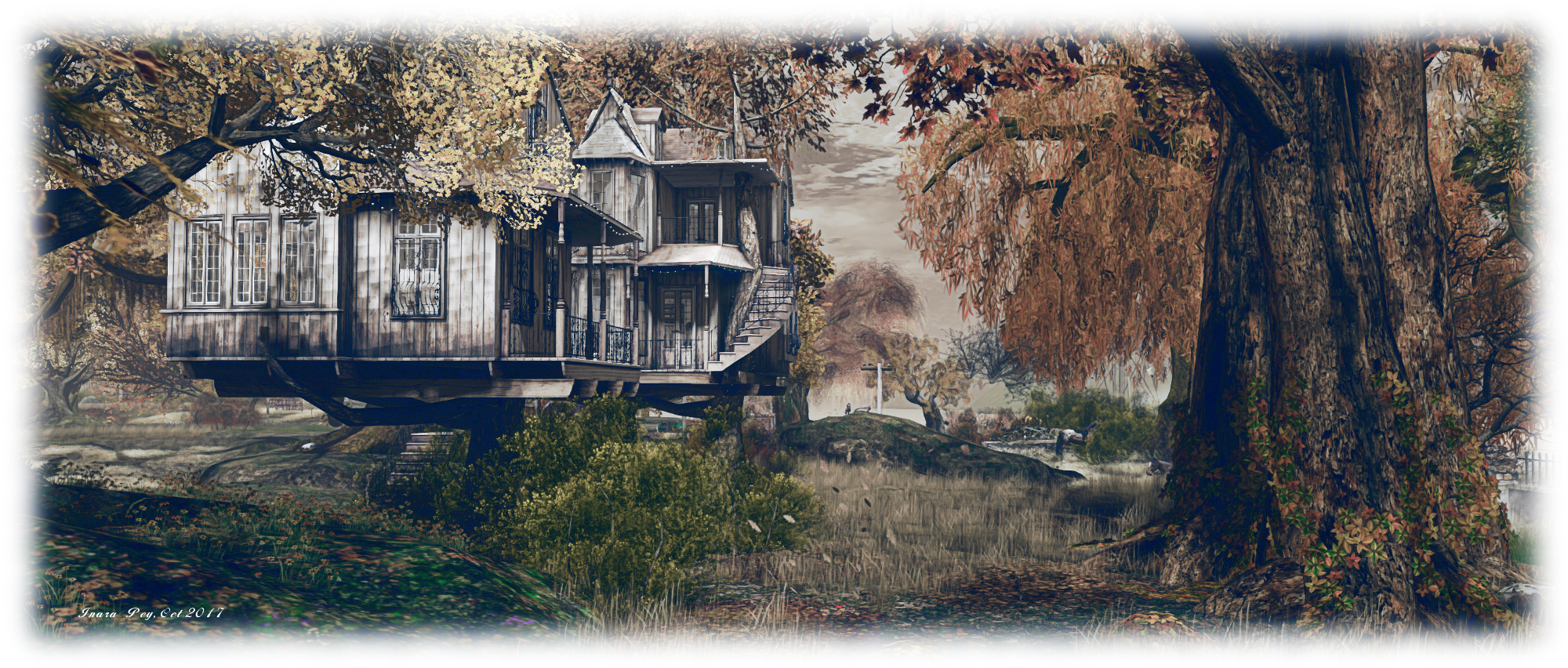
La Vie; Inara Pey, October 2017, on FlickrLa Vie, October 2017 – blog post

Each week through the year, I try to get to as many in-world and other meetings held by the Lab to keep an eye on technical developments and updates which are in the works for the viewer and the simulator, relaying the notable items via my SL project updates. As such, I thought it might be interesting to look back at some of the technical changes and updates have come our way in 2017.

Visible Projects

The year started with everyone still getting their heads around 2016’s Project Bento, which reached release status at the end of that year, bringing with it a much extended avatar skeleton with masses of new bones allowing a range of new animations and opportunities for more diverse avatar looks that used bone animations rather than resource-heavy options such as alpha flipping and so on.

Thus, 2017 – or at least the early part of it at least – saw many Bento releases hitting Second Life, from animal avatars through to Bento-enabled avatar mesh heads and hands which offer a greater range of expressions and natural motions, natural jaw and mouth movements to go with Voice or with text chat, and so on. Given the interest in Bento, I offered a behind-the-scenes look at the project from a personal perspective, having been an observer of the work from the initial closed development work all the way through the open beta to release.

I eventually made the move to a Bento head in September 2017, after extensive fiddling with demos from all the major makers, with (r) Lelutka proving to be the best in terms of maintaining much of my “original” (aka “2010 onwards”) look (l), as I played with the demo model & test skin)

The Bento project gave rise to several potential follow-on projects, of which the three most popular among creators at the Bento / Content Creation meetings were: supplemental animations, to allow smooth interaction between animations as a result of conflicts arising between the extended bone groups (currently on hold), animated mesh – eventually renamed “Animesh”, and bakes on mesh – with the latter two becoming a particular focus of the in-world Content Creation User Group meetings, together with the Environment Enhancement Project (EEP).

Animesh is a means of animating rigged mesh objects using the avatar skeleton, in whole or in part, to provide things like independently moveable pets / creatures, and animated scenery features via scripted animation. It involves both viewer and server-side changes. It can be used with any object (generally rigged / skinned mesh) which and contains the necessary animations and controlling scripts in its own inventory (Contents tab of the Build floater) required for it to animate itself. During 2017, the focus has been on getting a basic Animesh capability working in Second Life, which by the end of the years saw a project viewer at an advanced stage of development. 2018 should see this move to RC status, and the project as a whole move to release. A potential follow-on project may then see the capability extended to allow more in the way of NPC creation through Animesh.

Animesh allows you to take rigged mesh objects, add animations and controlling scripts to them, associate them with an avatar skeleton, and have them run in-world without the need for any supervising viewer / client

Bakes on Mesh extends the current avatar baking service to allow wearable textures (skins, tattoos, clothing) to be applied directly to mesh bodies as well as system avatars. This involves server-side changes, including updating the baking service to support 1024×1024 textures (but does not include normal or specular support). Once this initial work has been completed, an intended follow-on project to actually support baking textures onto mesh surfaces. This has yet to fully defined in terms of implementation and when it might be slotted into SL development time frames.

Environment Enhancement Project is a set of updates to Windlight settings, etc. These include the ability to define the environment (sky, sun, moon, clouds, water settings) at the parcel level; a new environment asset type that can be stored in inventory and traded through the Marketplace / exchanged with others; scripted, experience-based environment functions, an extended day cycle and extended environmental parameters. This work involves both a viewer updates (with a project viewer coming soon) and server-side updates.

While 2017 didn’t see the deployment of many high-profile user-facing projects, it did see a considerable amount of back-end work take place, not all of which was necessarily user-visible, and some of which also affected the viewer. In summary this work included:

  • A complete overhaul of the simulator code build process, including upgrading the Linux OS for the simulator servers – the first of such rounds of OS update.
  • Moving most of the remaining SL asset (inventory items) handling from UDP messaging through the simulators to HTTP delivery via the CDN.
  • Increasing Region capacity (avatar numbers), with a perk for Premium members.
  • Announcing a major initiative to move all the Second Life services into the cloud, if possible. More info came through a TPVD meeting and Tara Hernandez, Senior Director of Systems and Build Engineering at Linden Lab, touched on the project in a presentation at AWS:Invent.
  • Changing how multiple, repeat teleport requests made via scripted HUDs were handled to reduce the impact such requests have on region performance.
  • The start of a project to revise the complexity calculations (in-world objects and Avatar Rendering Complexity) to make them more accurate / stable and reflective of the true cost of rendering items – this work is still ongoing.
  • Continuing work to eliminate exploits use to crash regions and to make the simulator code generally more robust, trying to curb illicit content copying, etc.

The Viewer

Much of 2017’s focus on the viewer was directed at moving it to 64-bit for Windows (whilst also maintaining a 32-bit version as well) and for Mac OS X. Started in 2016, with a significant overhaul of the viewer build process and its associated libraries, the first project viewer release for the 64-bit viewer – code-named Alex Ivy (aLeX IVy = LXIV = 64) – arrived in early January, with work continuing throughout the year to refine the viewer, work out issues in the build process, and move the project towards release status – which should now happen in early 2018.

The 360-snapshot viewer received an overdue update which, while suffering from pro resolution issues, did streamline the production of 360-images. This was the only update to the viewer in 2017, leaving it as project viewer status. More work will be forthcoming in 2018.

The revised snapshot floater in the July 2017 360-snapshot project viewer

The Lab also restated their desire to continue with Linux, by offering a Debian build of the viewer – but only with the help ogf the Linux community.

Other updates for the viewer in 2017 included custom folders for uploads, the launch of a new release candidate branch of the viewer specifically to manage fixes and updates to the viewer’s rendering pipe, the first pass at improving region / estate ban lists for estate owners,  the viewer’s avatar rendering options (right-click context menu and Preferences > Graphics) were improved to allow users to better define how avatars around them are defined. New region / parcel access controls were introduced and a WORN tab was (finally) added to the inventory floater. There was also the ongoing series of Maintenance RC releases throughout the year, aimed specifically at fixing bugs and issues, which in 2017 gained their own code-name series, each one being named for an alcoholic beverage.

Other Updates and Changes

You can follow my updates on SL technical developments and updates through the likes of my weekly SL project updates and weekly viewer release summaries (which also cover TPV releases).


Space update special: the 8-exoplanet system and AI

Artist’s impression of the Kepler-90 planetary system. Credit: NASA / Wendy Stenzel

I missed my usual Space Sunday slot due to Christmas activities taking up much of my time, so thought I’d round out the year of astronomy / spaceflight reporting with a last look at a subject that has dominated space news this year: exoplanets.

Back in February, it was confirmed that a red dwarf star had no fewer than seven planets in orbit around it, all of them roughly Earth-sized, and three of them within the star’s habitable zone (see Space update special: the 7-exoplanet system for more). At the time it was the largest number of planets thus far found to be orbiting a star – in this case, TRAPPIST-1, as it is informally called – named for the Transiting Planets and Planetesimals Small Telescope (TRAPPIST) system that discovered it.

At the time, the discovery meant TRAPPIST-1 tied with Kepler-90 for having the most exoplanets discovered to date orbiting it. However, as announced earlier in December, Kepler 90 has now regained the title, thanks to the work of a researcher from Google AI, and an astronomer from the Harvard-Smithsonian Center of Astrophysics (CfA), with the discovery of an eighth planet orbiting the star designated Kepler-90. However, what is particularly interesting about this discovery is both the way in which it was made.

Located about 2,545 light-years (780 parsecs) from Earth in the constellation of Draco, Kepler-90, unlike TRAPPIST-1 and the majority of other planet-bearing stars, in not a M-class red dwarf star. Rather, it is a G-class main sequence star, with approximately 120% the mass and radius of the Sun. It is thought to be around 2 billion years old and it has a surface temperature of 6080 Kelvin – compared to the Sun’s 4.6 billion years of age and 5778 Kelvin surface temperature. Thus, the star and its planetary system has certain key similarities to our own solar system in terms of Kepler-90’s nature, the number of major planets now known to be orbiting it, and their distribution – the smaller rocky planets being closer to their parent than the system’s gas giants.

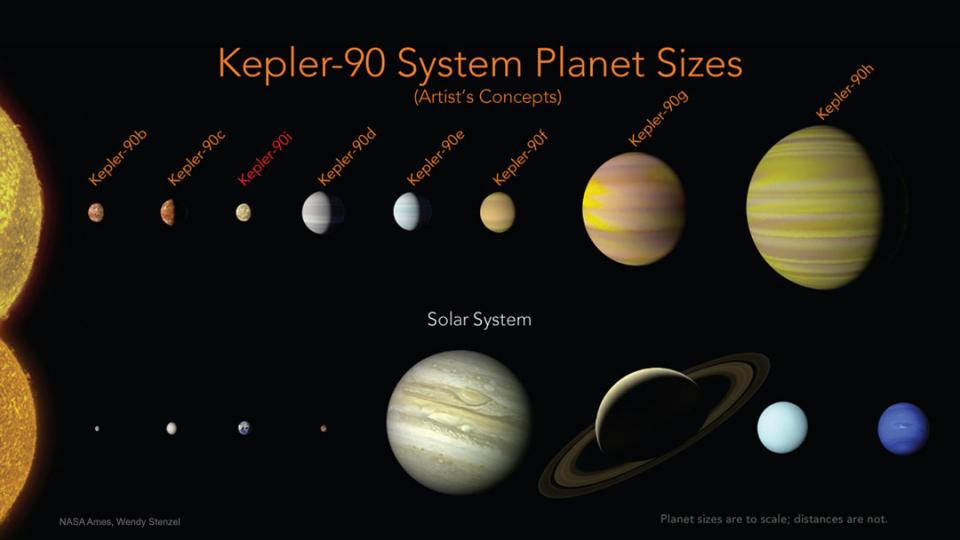
The Kepler system roughly compared in terms of planet sizes, with our own. Credit: NASA / Wendy Stenzel

The Kepler designation for the star indicates it was a subject of study for the Kepler Space Telescope. Prior to that, the star was designated 2MASS J18574403+4918185 in the Two Micron All-Sky Survey catalogue, compiled following the 1997-2001 whole sky astronomical survey of the heavens visible from Earth. At that time, transit data gathered from earth-based observations suggested it may have a planet orbiting it, so it was made a target for observation by Kepler, and re-designated Kepler Object of Interest 351 (KOI-351). In 2013, thanks to Kepler’s observations, it was confirmed the star had six or possibly seven planets orbiting it (the outermost remained a subject of doubt for a while after it was initially identified).

All seven of the initial discoveries were made using the transit method (Transit Photometry) to discern the presence of planets around brighter stars. This consists of observing stars for periodic dips in brightness, which are an indication that a planet is passing in front of the star (i.e. transiting) relative to the observer. Kepler’s data revealed the seven planets orbiting the star over a period of two months, with the planets being designated as follows (in order of distance from their parent star):

Kepler-90 b Kepler-90 c Kepler-90 d Kepler-90 e Kepler-90 f Kepler-90 g Kepler-90 h
Radius: 1.31 Earth Radius: 1.19 Earth Radius: 2.9 Earth Radius: 2.7 Earth Radius: 2.9 Earth Radius: 8.1 Earth Radius: 11.3 Earth
“Super Earth” “Super Earth” “Mini Neptune” “Mini Neptune” “Mini Neptune” “Saturn size” “Jupiter size”
Orbital period: 7 days* Orbital period: 8.7 days* Orbital period: 59.7 days* Orbital period: 92 days* Orbital period: 125 days* Orbital period: 210 days* Orbital period: 311 days*

*=terrestrial days

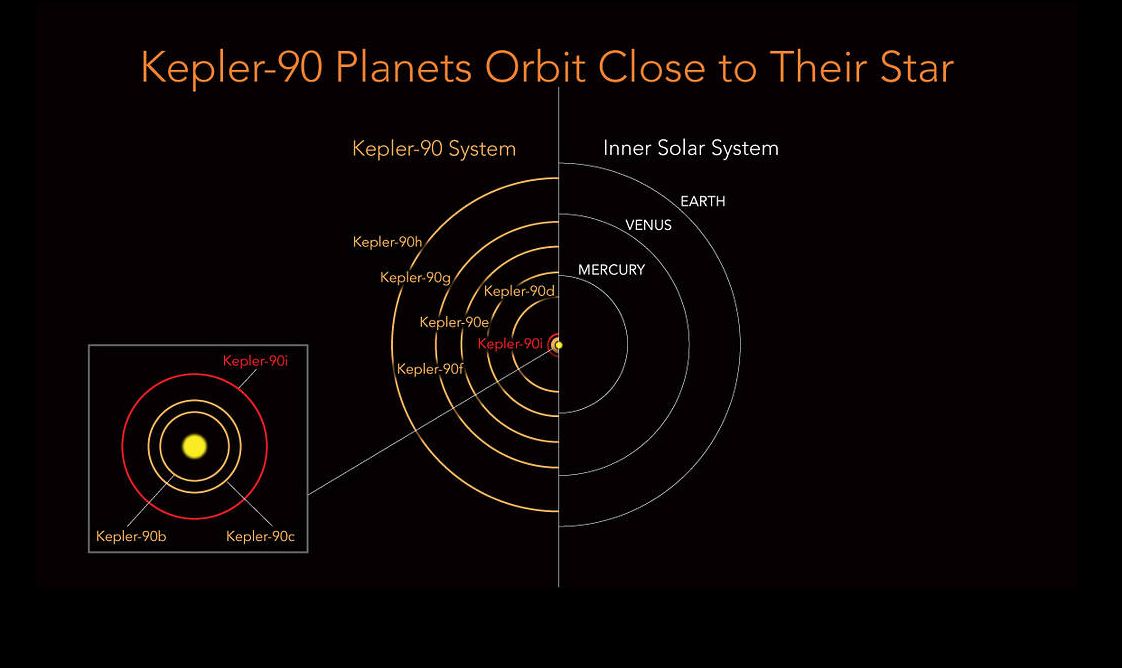
However, while the system does have similarities to our own, all of the planets within it orbit much closer to their parent star than do the planets of the solar system. So much so that the largest and outermost of those discovered, the Jupiter-sized Kepler-90 h, is the only one to orbit within the star’s habitable zone – the point at which liquid water and other essentials for life might exist in the right combinations. And while it may well sit on the inner edge of the star’s habitable zone, given that Kepler-90 h is a gas giant world somewhat equitable with Jupiter in size and mass, it is highly unlikely it is a suitable environment in which life might arise – but there is the intriguing question that should it have a sufficiently large moon orbiting it – say one the size of Titan or Ganymede – which has a good magnetic field protecting it, life might arise there.

The inner planets of the system, while more Earth-like in their size, are unlikely to support life, even if the three “mini Neptunes” were to prove to be solid bodies with atmospheres. Kepler 90 b through Kepler 90 e all orbit within or at about the same distance Mercury orbits the Sun, meaning they all experience similar or hotter surface temperatures the innermost planet of the solar system experiences. Kepler-90 f orbits at approximately the same distance as Venus does from the Sun, which likely means that if it is a mini-Neptune and, it could well be like Venus it terms of the conditions within any atmosphere it might have.

The Kepler-90 planetary orbits compared to those of the solar system’s planets. Credit: NASA / Wendy Stenzel

Continue reading “Space update special: the 8-exoplanet system and AI”

Two quirky stops in Sansar for the holidays

Sansar: The Violin Tree

As it is the holidays and a time for fun and games, I thought I’d blog about two quirky experiences in Sansar which are easy to hop into and enjoy.

The first is the Violin Tree, by Mikki Miles, which offers a fun little trip into the world of music in an abstract kind of way – and one easily missed if not careful. The setting is simple enough: a square, hilly island rising from open waters, a circular lake at its centre. To one side, a down the slope from the spawn point, a wooden jetty points towards a raft floating on the water. A walk out along the jetty will reveal several things: the first is that half of it is a xylophone, which is playing randomly. The second is that a voice is singing over on the raft – but don’t try to walk to it over the water! The singing comes from a megaphone sitting on the raft alongside a wooden frame containing Sandro Botticelli’s Venus from The Birth of Venus (circa 1480-1490), with a granite sculpture sitting on the other side of the frame (if you want to get close use F4 + the movement keys to freecam over the water).

Sansar: The Violin Tree

Atop the island, each flanking a central body of water, sit a tree – the titular violin tree – and the 40,000 year-old bone flute of the experience description. On the lake, a little rubber duck scoots around, attracting attention; walk towards it and as you reach the edge of the lake, the duck vanishes as a gigantic piano rises from the water, the fall board and main lid opening before the piano starts to play Handel’s Water Music – albeit it slightly tinny. Similarly, approach the tree and / or bone flute, and they will also impart a music excerpt, while the brass “piping” rising from the outer slopes of the island are revealed to be the tubing of trumpet, horn or trombone.

But that’s not all. To one side of the island there sits what appears to be the entrance to a mine.  Visitors can enter it and follow the tunnel down into the island, where a little more musical fun is to be had, including a nice tip-of-the-hat to the Rolling Stones.

The Violin Tree isn’t a hugely ambitious experience – but it is one cleverly considered, which makes good use of ambient sounds and trigger volumes to offer an eclectic little musical / art / historical  visit.

Sansar: The Violin Tree

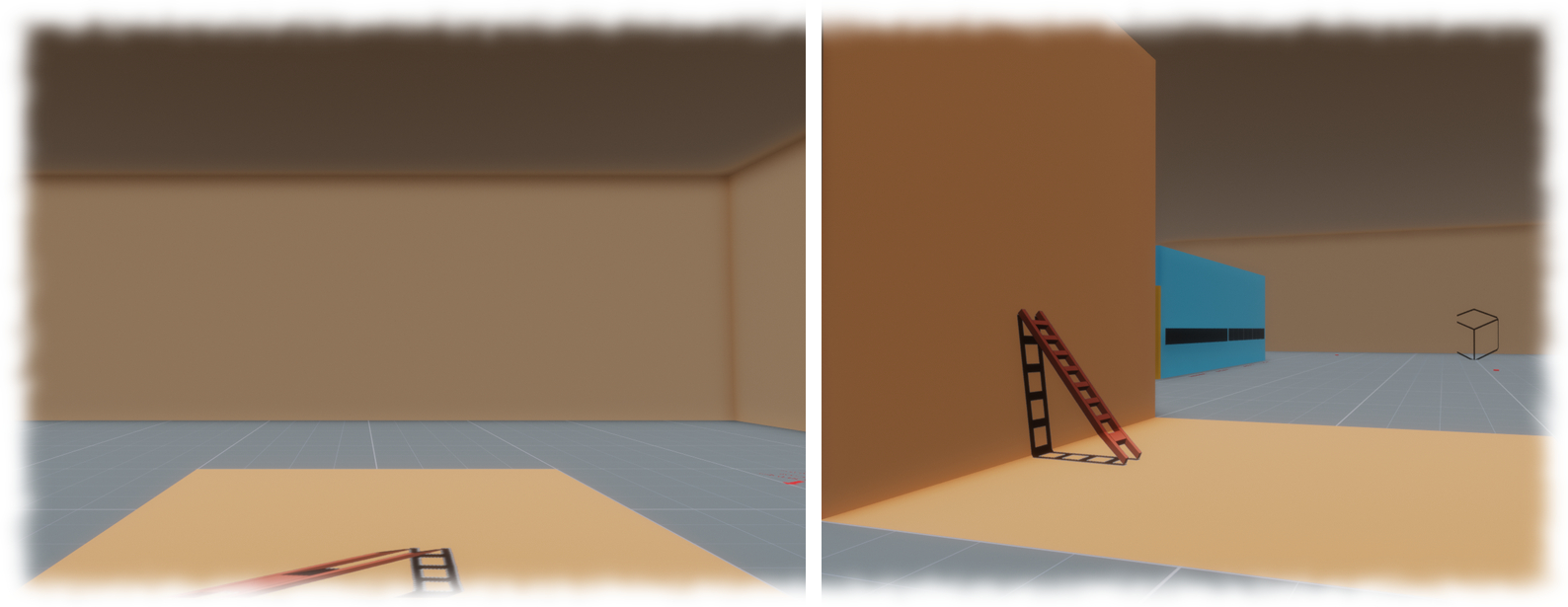
Back in September I visited the Reverse Perspective Art gallery by JackTheRipper, which offers a fascinating tour into the world of reverspective art, as conceived by Patrick Hughes (see here for more).  This is actually one of two art / optical illusion focused experiences created by JackTheRipper, and I for my second little recommendation, I offer the second: his Optical Illusions Arena.

Exceedingly simple in presentation – to the point where it might initially seem to be just a random space where someone has been playing – the Optical Illusions Arena again has more to it than may at first appear to be the case. As the name suggests, it is a space containing images and items designed to trick the eye through the use of set observation points, forced perspective and so on. What’s more, it works in either VR or Desktop mode.

Sansar: Optical Illusions Arena – from one vantages point, an odd painting on the floor (l); from another, a ladder against a wall (r)

Scattered around the single-room arena are a number of elements, some in 3D – such as what at first appears to be a collection of sticks hanging in the air – through to seemingly random paintings on the floor. Also appearing on the floor are a series of red dots with arrows indicating a direction in which to look. When standing on one of these and looking in the direction indicated either in VR mode or first-person (F3) view in Desktop mode, will reveal the secret of one of these random collections or paintings. Thus, the group of coloured sticks becomes as set of painted wooden chairs, the odd splodge of white-and-grey on the ground becomes an opening in the floor, and so on.

If visiting with a couple of friends, the reproduction of an Ames room can offer the most interesting effect. When viewed from the observation point outside of the room, two avatars entering it through the doors on either side will appear to be very differently sized, one to the other, and interesting effects – from the observer’s perspective – can then be had as they move around the room.

Sansar: Optical illusions Arena – the Ames room will make two avatars appear to be different sizes when they are apparently the same distance from the observer (note: the disjointed element of the image is due to my attempt to demonstrate the effect with one avatar and two photos, not a reflection of the build)

Neither the Violin Tree nor Optical Illusions Arena are going to set the world on fire in terms of being major attractions – but that’s not the intend of either. They’re about having a little bit of fun while experimenting in 3D and with Sansar’s tools. As such, if you find yourself with ten or fifteen minutes on your hands, why pay them both a visit?

Experience URLs

2017 Viewer release summaries week 51

Logos representative only and should not be seen as an endorsement / preference / recommendation

Updates for the week ending Sunday, December 24th

This summary is published every Monday, and is a list of SL viewer / client releases (official and TPV) made during the previous week. When reading it, please note:

  • It is based on my Current Viewer Releases Page, a list of all Second Life viewers and clients that are in popular use (and of which I am aware), and which are recognised as adhering to the TPV Policy. This page includes comprehensive links to download pages, blog notes, release notes, etc., as well as links to any / all reviews of specific viewers / clients made within this blog
  • By its nature, this summary presented here will always be in arrears, please refer to the Current Viewer Release Page for more up-to-date information.

Official LL Viewers

  • Current Release version 5.0.9.329906, dated November 17, promoted November 29th – formerly the “Martini” Maintenance RC – No Change.
  • Release channel cohorts (please see my notes on manually installing RC viewer versions if you wish to install any release candidate(s) yourself):
    • Nalewka Maintenance viewer updated to version 5.0.10.330123  on December 21st.
    • Wolfpack viewer updated to version 5.0.10.330113 on December 20th.
  • Project viewers:
    • Project Render Viewer updated to version 5.1.0.511446 on December 18th.

LL Viewer Resources

Third-party Viewers

V5-style

V1-style

  • No updates.

Mobile / Other Clients

  • No Updates.

Additional TPV Resources

Related Links