On Wednesday March 26th, Dave Rowe released CtrlAltStudio version 1.2.0.40751.
While the release does not contain significant updates to either Oculus Rift support or to the stereoscopic 3D capability, the version number change 1.2, as Dave notes, serves to reflect the convergence of the 1.0 and 1.1 Alpha versions, and also brings CtrlAltStudio to parity with Firestorm 4.6.1.
With regards to the latter, this means CtrlAltStudio now includes all updates found in the Firestorm 4.5.1 and 4.6.1 releases, including a number of significant LL-driven viewer updates, such as:
Fitted mesh support – for those unfamiliar with Fitted Mesh, I have an overview here
Temporary attachments no longer get removed improperly
and more
(Further information on the recent Firestorm releases, please refer to my 4.5.1 review and my 4.6.1 review.)
In addition to the above, the release includes a number of fixes:
Fixed turning off Basic Shaders while in Riftlook messing up display.
Fixed Kinect fly up and fly down gestures sometimes being swapped when shouldn’t be.
Removed –riftlook command line option which wasn’t working properly.
An important point to note, again as Dave points-out, is that this release does not include any of the Lab’s own Oculus Rift support – for the simple reason that the code hasn’t been made available for integration into TPVs.
In September 2013, I (among many others!) visited Bowie Zeplin’s home region of Banana Island. At that time it was called Pangloss, a beautifully surreal landscape of vivid colours and striking scenes.
Now, with the changing of seasons much in evident across the grid, Bowie has remodelled the region, and while this pilgrim opted to wait until after the initial rush had passed, a note was made to retrace her footsteps and see what new delights await a re-visit. The effort proved more than worthwhile.
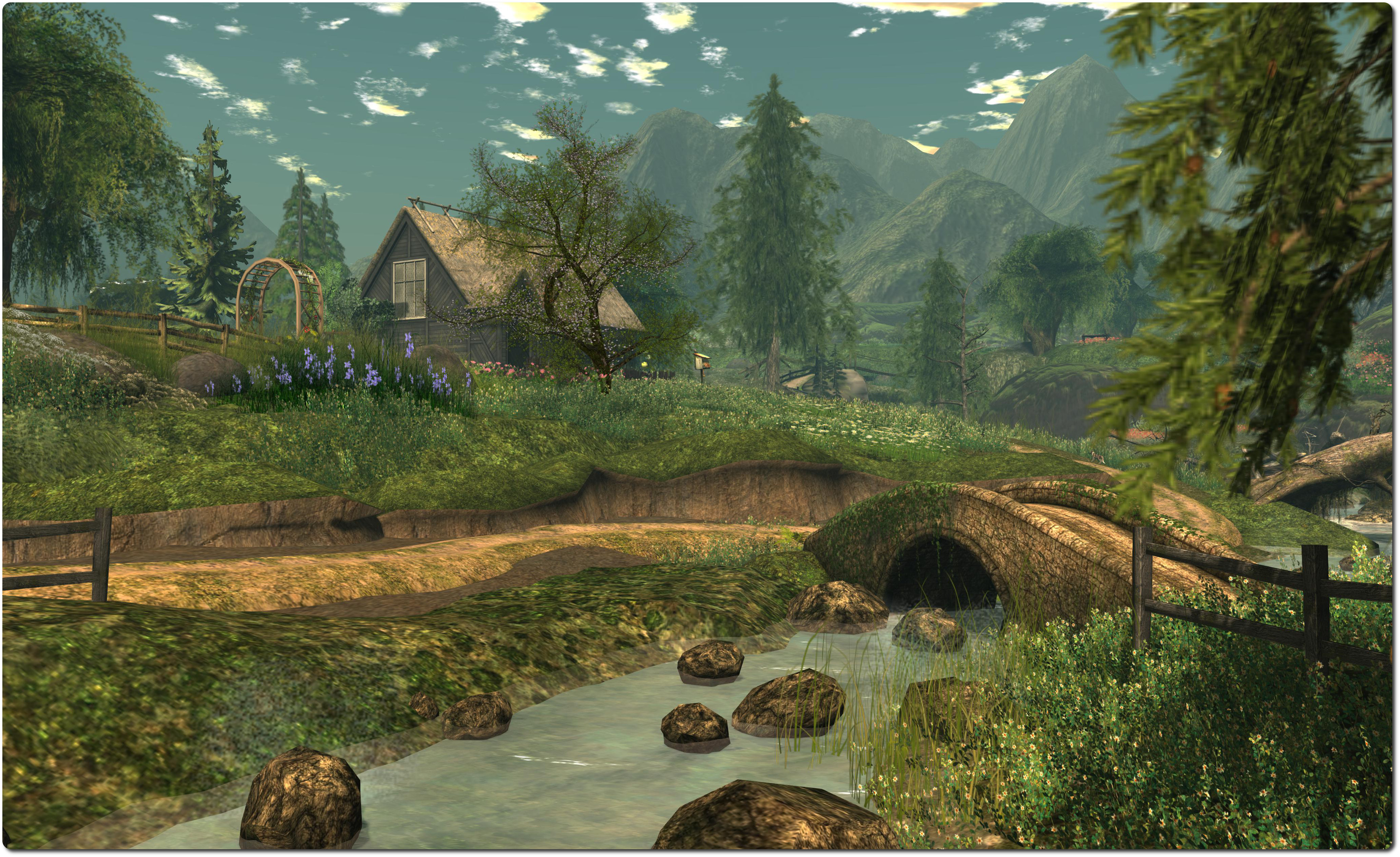
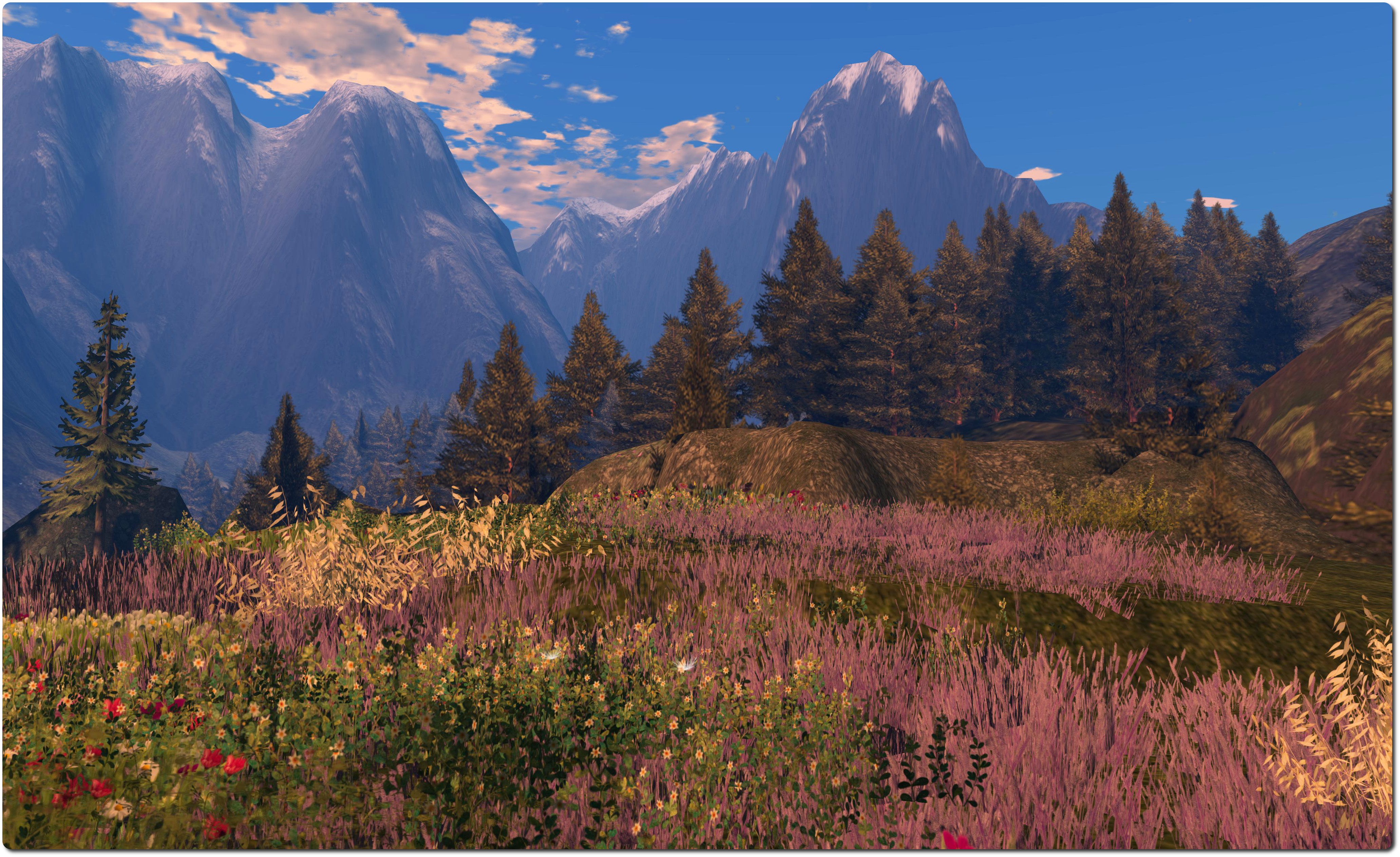
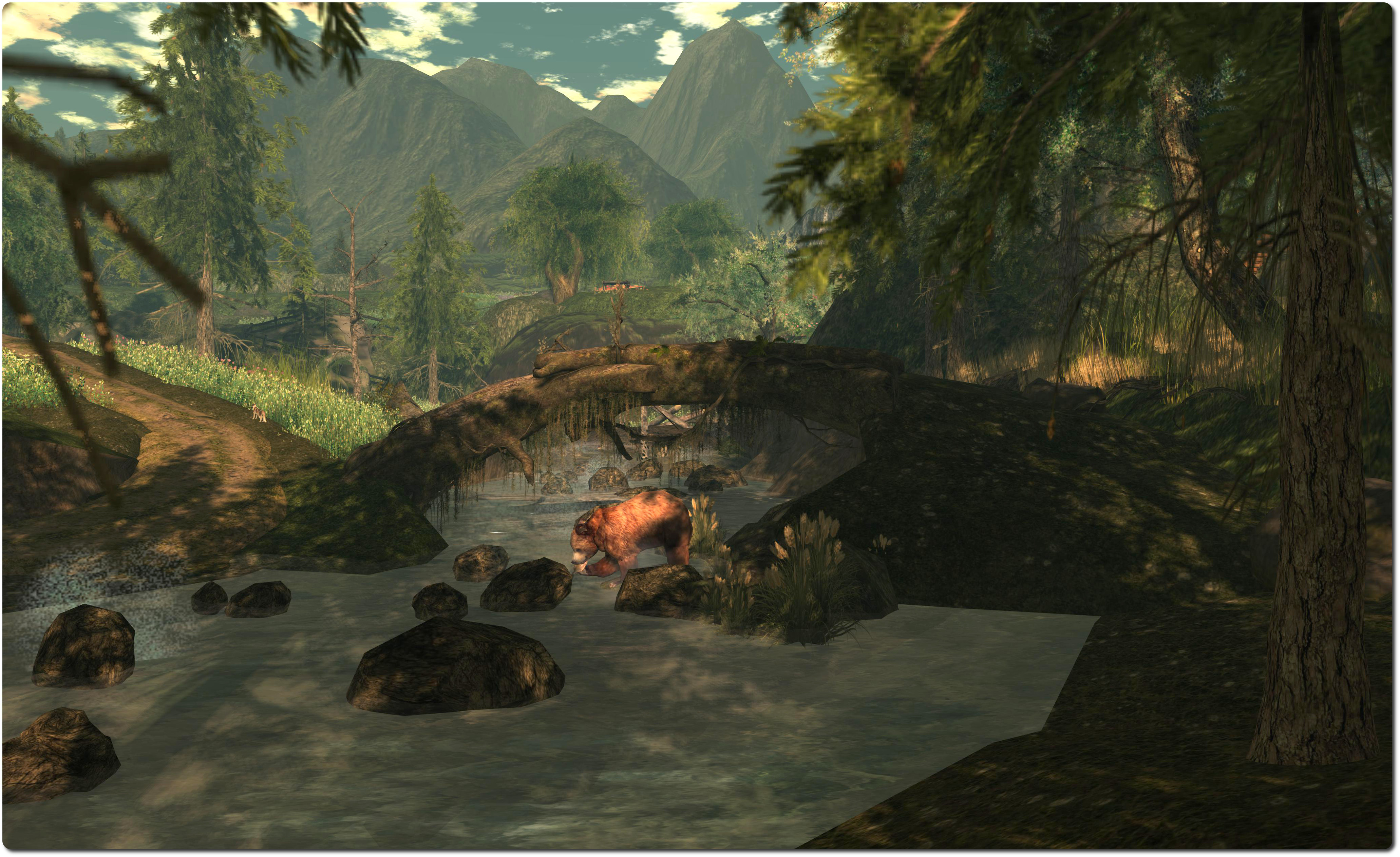
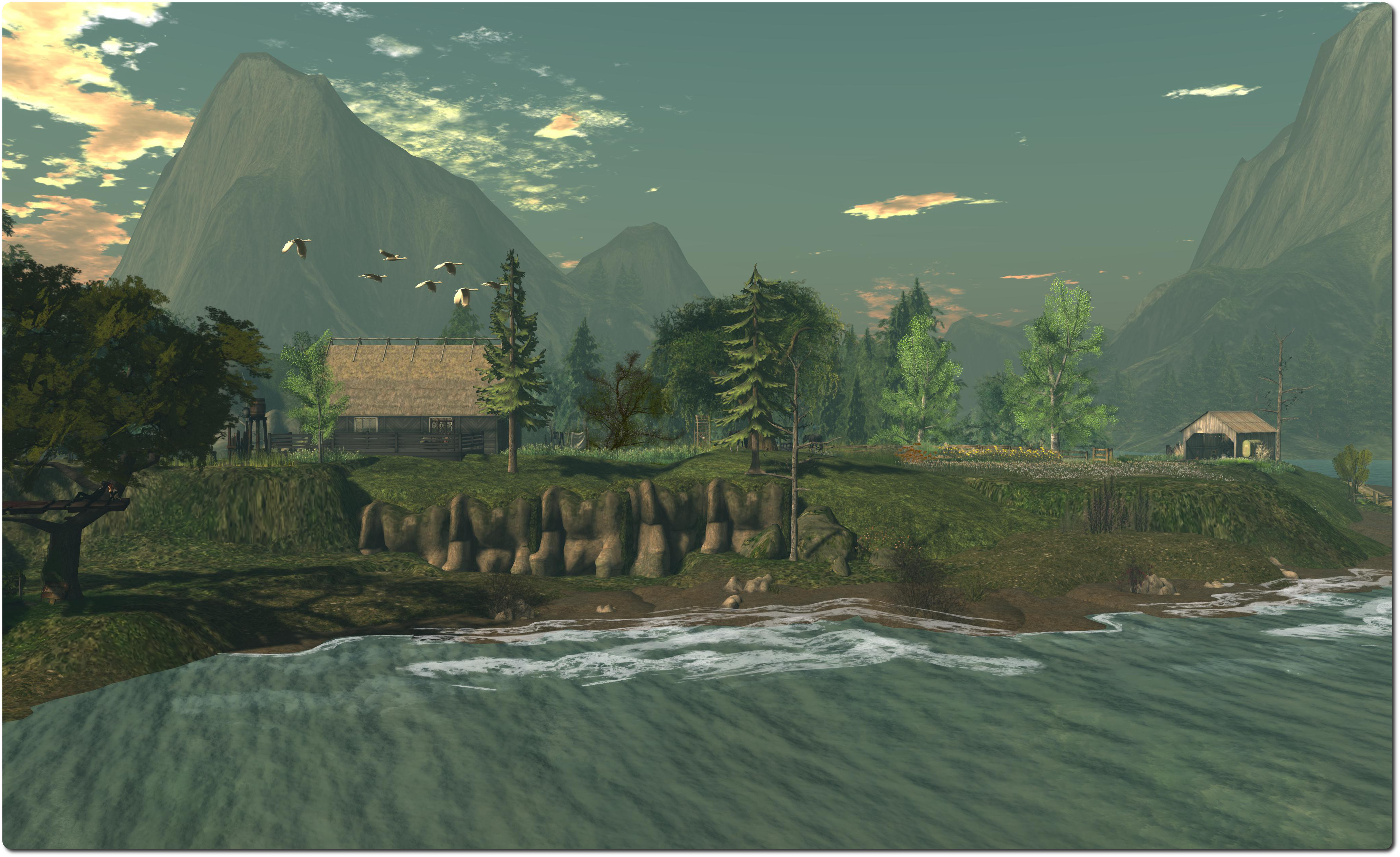
Where Pangloss was surreal and vivid, The Pilgrim’s Dawn, as the region is now known, is beautifully rural and scenic. On arriving, it instantly put me in mind of what might be called “Middle Zealand”, as it seems to form a combination of the scenes and landscapes gathered from around New Zealand to create Peter Jackson’s vision of Middle Earth. There are high mountains, tree-lined slopes, broad rivers, and in the midst of it all, a rural / rustic scene which, while sans Hobbit holes and the like, wouldn’t look amiss with a group of Hobbits passing through on their way to Bree…
Even without the Tolkien references, Pilgrim’s Dawn is simply breathtaking in the way it blends surrounding scenery and region into a whole, presenting a landscape in which one is instantly immersed. It’s very easy to imagine walking out onto the deck behind the house on a morning, mug of coffee in hand, and deciding that today would be a good day to climb the nearest peak and then just sit and paint or photograph the surrounding lands.
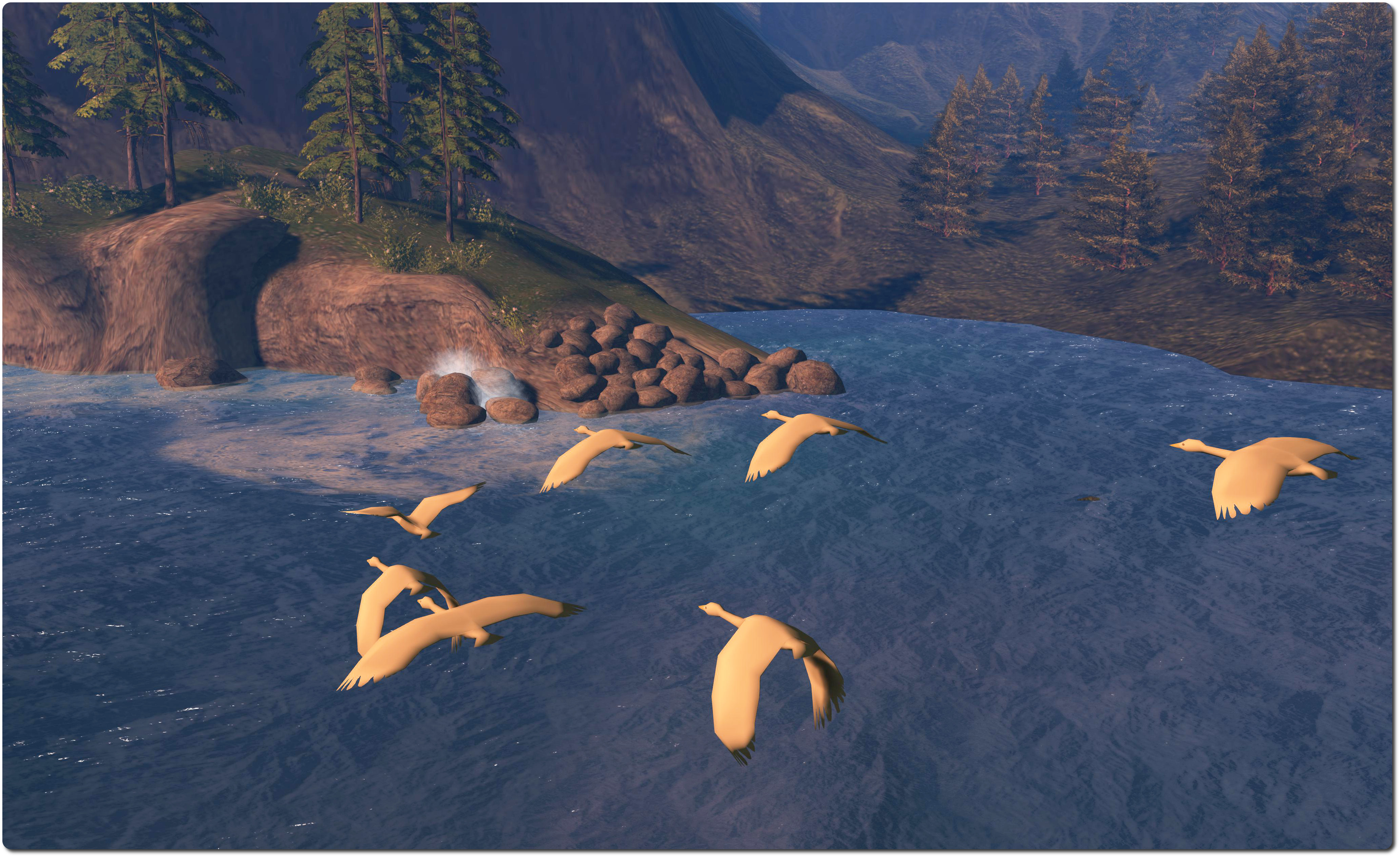
This is an environment which really lends itself to wide photographs of the landscape, something which the default windlight only enhances – but there is also a wealth of detail here as well which makes careful exploration a must. There are tracks to follow across the region, running down from the house to the pastures of the headland, or around from the beach, along the side of the river and up into the hills where sheep graze contentedly. Across the river sits a wooded headland where deer roam, and above it, overlooking the broad stretch of water separating lowlands from mountains, sits an old mine, awaiting intrepid explorers.
It’s been whispered to me that Pilgrim’s Dawn is a commissioned build, and that as such it may well be vanishing in the near future. If so, that’s something of a shame, because it is very much a place where this pilgrim definitely wanted to call her progress to a halt and simply rest, soaking up the scenery and environment.
MENLO PARK, CALIF. – March 25, 2014 – Facebook today announced that it has reached a definitive agreement to acquire Oculus VR, Inc., the leader in immersive virtual reality technology, for a total of approximately $2 billion. This includes $400 million in cash and 23.1 million shares of Facebook common stock (valued at $1.6 billion based on the average closing price of the 20 trading days preceding March 21, 2014 of $69.35 per share). The agreement also provides for an additional $300 million earn-out in cash and stock based on the achievement of certain milestones.
So opens a press release issued by Facebook on Tuesday March 25th, 2014.
This is a pretty stunning announcement, and shows that, as Mark Zuckerberg states in the release, “Mobile is the platform of today, and now we’re also getting ready for the platforms of tomorrow. Oculus has the chance to create the most social platform ever, and change the way we work, play and communicate.”
The news has sent shock waves rumbling across the social media sphere, with many reacting positively to the news, and other reacting negatively. Following the announcement, Cory Ondrejka at Facebook was unsurprisingly excited by the news.
While Markus Persson of Minecraft fame responded to the news with as less favourable response, which was quickly picked-up by the games media.
Others also didn’t appear to be initially impressed by the news, either, including those who funded the original kickerstarter. Meanwhile, Techcrunch reported a slide on Facebook’s share price which, while closing on the day overall, saw Facebook’s share value below its open price of $64.25, resulting in a loss of $1.5 – $1.8 billion market cap. However, as Techcrunch also notes, this isn’t the first time Facebook’s shares had dropped following the announcement of an acquisition.
Theories as to why Facebook have made the move abound, with some pointing to the company tripping-up on the explosion of the mobile market and so are perhaps afraid they might miss-out on the growth of VR if it takes off suddenly. Others are suggesting Facebook is keen to jump on the possible marriage of the Oculus with mobile technology.
I’ve been somewhat skeptical that VR will explode in quite the immediate way many have been predicting – which is not to say I don’t think it will be big; I just think it’ll take longer to get there on all fronts (i.e. beyond gaming) than some pundits are perhaps allowing. It seems I’m not alone in thinking this. Speaking to The Verge, Oculus investor Chris Dixon believes Facebook are playing the long game – rather like Google did with their acquisition of Android in 2005.
It appears Zuckerberg agrees with him. Commenting in a teleconference held on the afternoon on March 25th to discuss the acquisition, Zuckerberg said, “There are not that many companies building technologies that could be the next computing platform, and Oculus is the clear leader.”
But this is just the start. After games, we’re going to make Oculus a platform for many other experiences. Imagine enjoying a court side seat at a game, studying in a classroom of students and teachers all over the world or consulting with a doctor face-to-face — just by putting on goggles in your home.
This is really a new communication platform. By feeling truly present, you can share unbounded spaces and experiences with the people in your life. Imagine sharing not just moments with your friends online, but entire experiences and adventures.
Oculus founder Palmer Luckey has a lot to smile about (image via Popular Mechanics)
Concerns have already been raised over the future of Oculus Rift as an open platform, something Oculus VR founder Palmer Luckey attempted to allay in a statement on the company’s Reddit page:
Facebook is run in an open way that’s aligned with Oculus’ culture. Over the last decade, Mark and Facebook have been champions of open software and hardware, pushing the envelope of innovation for the entire tech industry. As Facebook has grown, they’ve continued to invest in efforts like with the Open Compute Project, their initiative that aims to drive innovation and reduce the cost of computing infrastructure across the industry. This is a team that’s used to making bold bets on the future.
Whether such comments will quell concerns and upset, remains to be seen, although i’m not putting money on it doing so. Facebook undoubtedly have the financial and technical clout to boost Oculus Rift and VR into more mainstream consciousness. Whether this will come tied to a Facebook log-in requirements, again as some are already predicting, remains to be seen.
It’ll also be interesting to see how Facebook, after dabbing with virtual world environments through Cloud Party, consider virtual worlds, and the direction in which they might move. Could it be the “Facebookisation” of SL (or rather, perhaps, Linden Lab) may yet come to have a significantly new meaning? Or, less tongue-in-cheek, what about Philip Rosedale’s High Fidelity coming under the FB eye? Now there’s something to chew on (ETA: and in this regard, Palmer Luckey’s sign-off to his blog post announcing the acquisition is interesting: We’ll see you in the Metaverse!)
P.S. Techcrunch may score the biggest hit in this latter regard with their latest headline on the subject: Facebook Buys A Virtual World – that’s bound to get people rushing to their doors!
As always, please refer to the server deployment thread in the forums for the latest news and updates.
There was again no server deployment to the Main (SLS) channel on Tuesday March 25th. Of the three RC channels, there will be no change to either BlueSteel or LeTigre on Wednesday March 26th. However, the Magnum RC will be updated with a new server maintenance project, comprising:
Crash mode fix.
Fixed a rare case in which certain users were unable to log in (BUG-5130)
Fix for a case in which multiple scripts in the same prim calling llTakeControls() with heterogenous ‘accept’ and ‘pass_on’ parameters would not receive a control() event correctly in some cases (BUG-5281)
Updated LSL syntax file to use a new schema (fixes STORM-2000)
The LSL syntax file update for STORM-2000 is part of a large project being undertaken by Ima Mechanic with assistance from Oz Linden (see STORM-1831). This work is currently awaiting the release of viewer-side changes, which have been undergoing testing by LL’s QA.
A lightly-attended Simulator UG meeting, Tuesday March 25th
SL Viewer Updates
On Monday March 24th, the FmodEx Hotfix viewer (3.7.4.288138, release notes here) was updated to the de facto release viewer. The core updates in this viewer comprise:
Crash fix (MAINT-3703)
Update FmodEx library to 4.44.31
Additional work for MAINT-2718 (Linux viewer was using logging version of library)
Group Chat Work
During the Simulator User Group meeting on Tuesday March 25th, I asked Simon Linden about the outcome of the group chat tests run on Thursday March 20th, now that there’s been time to check the logs files. He said, “It didn’t have any surprises, but that was a good result. That test was mostly checking out the new statistics it gathered, which worked fine too.” He also confirmed that testing with a large group (most likely the Firestorm support group) is the next step in proceedings:
It’s been delayed a bit due to some people being out of the office. I’m hoping to do something next week … I think that’s the earliest possible. In the mean time I’m working on another layer in the back-end system that is inefficient, so I’m hoping to finish that up today or tomorrow and roll it in together.
Other Items
Revision to the TPVD Directory
The Third-party Viewer Directory received a change to the section listing viewers that report crash statistics. Whereas previously, viewers in this section had been ranked from best to worst crash rate (% of sessions that end in a crash), as from March 25th, they are now ordered from best to worst disconnect rate (% of sessions that end without the simulator seeing a logout).
Regions Size Trivia
During a discussion on vehicle design and region crossings, Simon Linde made mention of the factor that he once spent time looking at region sizes in SL. This isn’t the first time he’s mentioned this work. The last time he raised it, he went to far as to indicate that were regions ever to be resized, increasing them to 1 km a side rather than 1024 metres a side would be preferable, although this would impact the power of 2 approach taken with building SL. At the Simulator UG meeting, he reiterated this latter point, saying, “unfortunately the 256×256 region space is carved into the SL design all over … from the database to the simuators to the viewer and the messages. Changing that would be huge.”
Cinema! Take II, by Mary Wickentower, is an extension of her LEA interim piece, The Wonderful World of Particles, originally located at LEA13. Now a part of the LEA’s Full Sim Art series, it has relocated to LEA6 and shifted focus more towards machinima and photography.
Those who visited The Wonderful World of Particles, will find Cinema! Take II somewhat familiar, as it utilises the same large centre-piece movie theatre and drive-in movie space, complete with interlinking roads and tall palm trees. The observant may even note the greeter welcomes them to former, rather than Cinema! Take II!
However, this isn’t merely a relocation of the interim project. As noted, the focus is very much on machinima and photography. In terms of the former, the movie house, the Empire Movie Palace, is showing Princess Ambrosia’s Sakoku: Chained Country (which includes some adult-oriented themes), and also includes photo exhibition spaces, used to display entries into a number of photohunts and other photography-related activities being held throughout the month of March (the next being on Wednesday March 26, see below for details).
Outside, at the drive-in one can watch a veritable plethora of machinima by artists and film-makers from around the world. You’ll need media enabled for this (top right corner of the viewer). Click on the movie screen itself to start things, and use the media controls displayed above it to focus your camera or watch movies in a browser tab, etc. A complete list of film-makers can be obtained in a dialogue box by clicking the frame of the movie screen. Click on the button corresponding to a name to display a list of their available films. To select a film, again click on the number in the dialogue box corresponding to the film, then click on the screen itself if the film doesn’t start automatically after a few seconds.
I confess that I had some issues with the drive-in when using either Firestorm or the SL viewer. Often a movie would start, but either have no audio, or feature the audio of a preceding video. Stopping and re-starting media from the viewer’s controls (top right of the viewer window) generally resolved this.
Also included in the region are Danya’s Garden by Danya Sadofsky, a place of peace & quiet, the Swing Jim Dinner, which is the setting for sock hops and dances, the Gallery of Art featuring fine SL sculpture and Dr. Petrol’s Gas Station featuring a classic collection of pin-up posters.
Special events have been a part of the installation’s month-long run, and coming up next are a photohunt and a Visionaire Institute of Photography field trip.
The photohunt will take place at 18:00 SLT on Wednesday March 26th. Participants will be given a theme or landmark by the moderator, and will have 60 minutes to take a snapshot that best embodies that theme / landmark, with absolutely no external photo manipulation allowed. Finished entries will displayed in one of the Empire Movie Palace exhibition spaces.
On Thursday March 27th at 15:00 SLT, students from the Visionaire Institute of Photography will visit the region to photograph Cinema! Take II, with their work also displayed in one of the Empire Movie Palace exhibition spaces.
It’s been a quiet time for the last three weeks as far as news from NASA’s Mars Science Laboratory is concerned. There have been a couple of reasons for this.
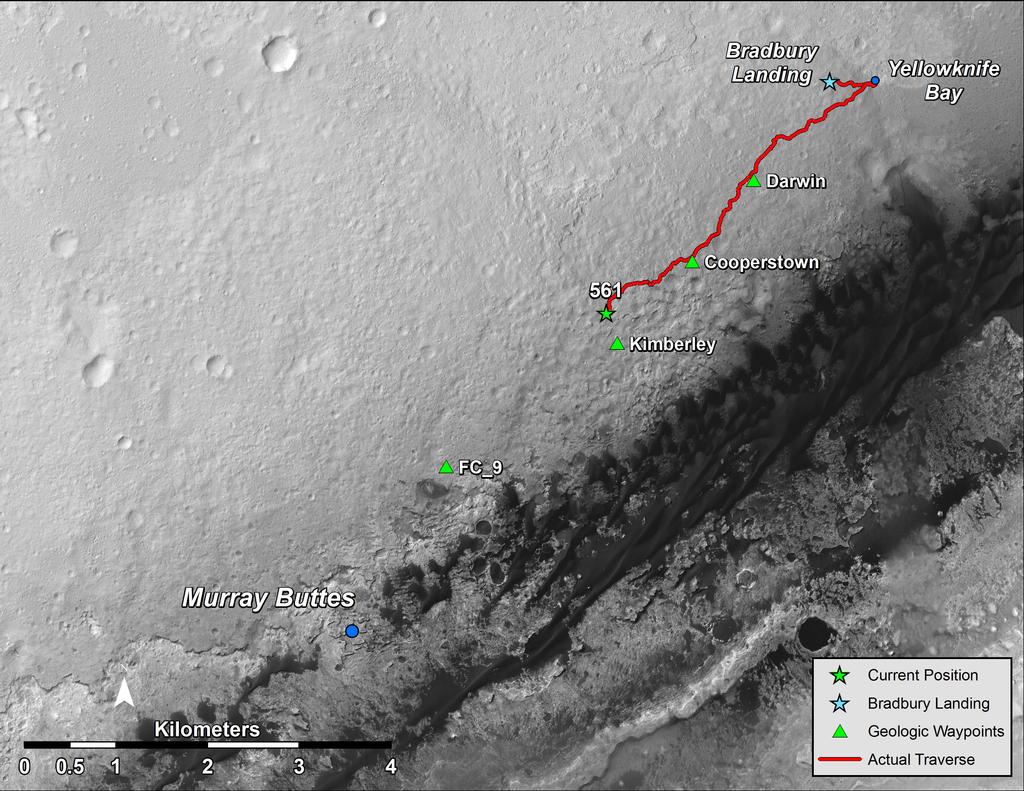
The primary reason is that the rover is on a slow but steady drive towards its next intended science waypoint while en route to the lower slopes of “Mount Sharp”. At the start of February, that waypoint had been around half a kilometre from the rover. However, concerns over the amount of wear and tear being suffered by the rover’s wheels as a result of traversing very rough terrain meant that Curiositytook a diversion.
While this put the rover on much smoother – comparatively speaking – terrain, it also meant the route to the waypoint had become more circuitous, requiring Curiosity cover around a kilometre in order to reach its intended stopover. In addition, engineers have been periodically checking the amount of damage to the wheel which may be accruing, further slowing daily progress, as well as continuing to test alternative driving methods to further ease the load on the wheels – such as letting the rover drive backwards towards its destination. However, the good news is that in the month since crossing Dingo Gap on February 18th, wear on Curiosity’s wheels has been around one-tenth what had been experienced per month during the months traversing the rougher terrain.
The long drive south. Murray Buttes mark the point at which Curiosity is expected to start the traverse onto the lower slopes of “Mount Sharp”, which forms a natural break in a line of dark sand dunes between the rover and the mound. “Kimberley” marks the next stop on the way (click for full size)
Additional tests using Curiosity’s test bed “twin” on Earth have revealed that the rover could sustain substantially more damage than incurred so far, including breaks in the wheel treads themselves, and still remain operational. However, given the potential duration of the mission – Curiosity’s nuclear “battery” could provide it with an operational life measured in a couple of decades barring other failures – means caution is key at this stage of the mission.
“The wheel damage rate appears to have levelled off, thanks to a combination of route selection and careful driving,” said JPL’s Richard Rainen, mechanical engineering team leader for Curiosity. “We’re optimistic that we’re doing OK now, though we know there will be challenging terrain to cross in the future.”
MRO Computer Glitch
The other break in news, although brief in nature, was caused by an unexpected issue with Curiosity’s primary communications relay between itself and Earth – the Mars Reconnaissance Orbiter (MRO) unexpectedly switched itself into a “safe” operating mode on Sunday March 9th. This immediately brought a cessation in the orbiter’s communications relay function for both Curiosity and Opportunity on the surface of the planet, although it did not put either rover entirely out of communications with Earth.
An artist’s impression of the Mars Reconnaissance Orbiter orbiting the planet
While MRO forms the primary means of communications between the surface of Mars and mission control at NASA’s Jet Propulsion Laboratory facility at the California Institute of Technology, the rovers on Mars can also use NASA’s Mars Odyssey as a relay – and, should it be required, Europe’s Mars Express. However, Mars Odyssey, which has been operating around Mars for almost twelve and a half years, has much lower bandwidth and data transmission rates compared to MRO, which reduces the amount of information which can be relayed to Earth at any given time.
MRO’s issue first became apparent on March 9th, when the orbiter performed an unplanned swap between its duplicate computer systems. This is the prescribed response by a spacecraft when it detects conditions outside the range of normal expectations; the safe mode is initiated to reduce the risk of whatever caused the out-of-range event from being repeated by the second computer and potentially permanently harming the vehicle while matters are investigated. MRO has experienced unplanned computer swaps triggering safe-mode entry four times previously, most recently in November 2011, the root cause of which still hasn’t been clearly determined.
The March 9th safe mode entry also included a swap to a redundant radio transponder on the orbiter, marking the first time this has happened during the vehicle’s eight years in orbit around Mars. Whether or not the transponder issue triggered the computer swap-out is unclear. However, after carrying out a series of diagnostics on MRO from Earth, the mission team began bringing the orbiter back-up to full operational capabilities on March 11th, leaving it operating on the computer the swap-out switched to, together with the previously redundant radio transponder.
“The spacecraft is healthy, in communication and fully powered,” Mars Reconnaissance Orbiter Project Manager Dan Johnston said on March 11th. “We have stepped up the communication data rate, and we plan to have the spacecraft back to full operations within a few days.”
Charting a New Frost Channel
Since that event, MRO mission scientists have released a photo comparison showing the active nature of the Martian environment. The image shows two pictures of the same slope in the wall of crater Terra Sirenum, located in the southern highlands of Mars. There were captured some two and a half years apart (roughly equivalent to 1.2 Martian years), in November 2010 and May 2013 respectively.
Side-by-side: an image of Terra Sirenum crater walls taken in November 2010 compared with an image of the same region taken in May 2013, complete with freshly carved gully and outflow fan (light areas)
The right-hand (May 2013) clearly shows the creation of a new gully down the inner wall of the crater, created when material flowing down the older channel broke out to form a new channel and corresponding fantail deposit. While the material responsible for the new gully was liquid in nature, as the event occurred in the Martian winter period in the southern hemisphere, it is believed that carbon dioxide ice, and not water, played the major role in forming the new channel.
NASA had previously experimented with dry ice to see if it could be responsible for such gullies, with interesting results.
 On Wednesday March 26th, Dave Rowe released CtrlAltStudio version 1.2.0.40751.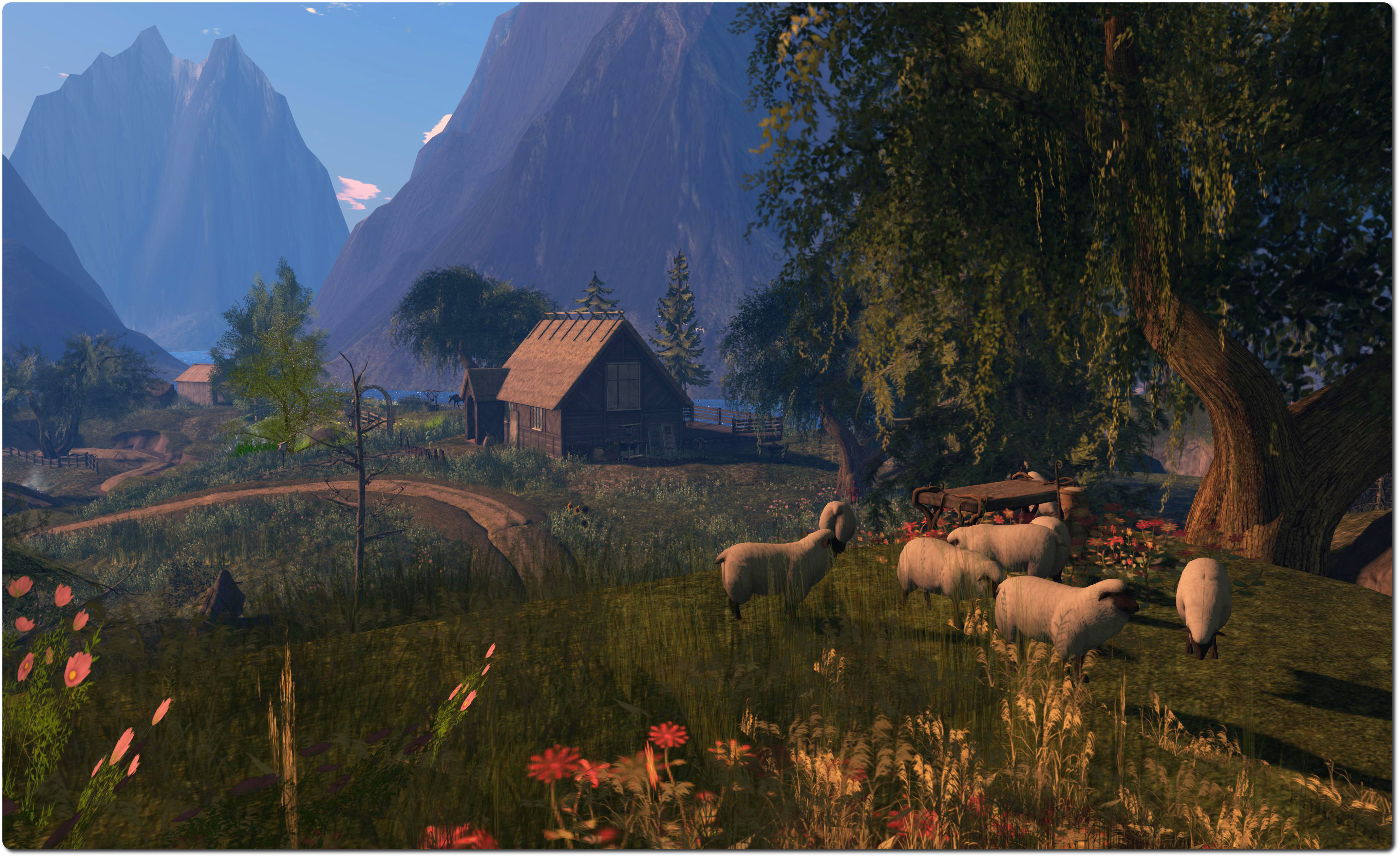







 Inara Pey: Living in a Modemworld