Space Sunday: a look at Betelgeuse

Astro photographer Alan Dyer captured this image of Orion on December 21st, 2019. Betelgeuse (top left) appears to be the same brightness as Bellatrix (top right). Normally, Betelgeuse is the 10th brightest star in our sky and Bellatrix the 27th. Credit: A Dyer

The constellation of Orion is one of the most familiar in the night skies. It is marked by a number of notable features, containing as it does three of the brighter stars in our night sky: Rigel: the 6th brightest star visible from Earth, and serving as Orion’s left foot; Betelgeuse, the 10th brightest, and serving as Orion’s right shoulder (so diagonally opposite Rigel); Bellatrix, the 26th brightest star in our sky, and sits at Orion’s left shoulder; and three  galaxies – the Orion Nebula, the Messier 43 nebula, the Running Man Nebula – all of which can be found in Orion’s “sword”.

Orion  – or more particularly – Betelgeuse – has been occupying a lot of the astronomy-related news cycles of late, with speculation that we might be witnessing the star’s potential move towards a cataclysmic supernova event.

Before I get down to the nitty-gritty of why Betelgeuse has astronomers all a-twitter (quite literally, given the amount of Twitter chat on the subject), some details about the star. Classified a M1-2 red supergiant, Betelgeuse has a very distinctive orange-red colouration that can again be seen with the naked eye. However, it’s exact size is hard to determine, because it is both a semiregular variable star, meaning the brightens and dims on a semi-regular basis as it physically pulses in size, and because it is surrounded by a light emitting circumstellar envelope composed of matter it has ejected.

This means calculations over the years have given many different estimates of the star’s size, suggesting it is roughly 2.7 to 8.9 AU in diameter (1 AU = the average distance between the Earth and the Sun). This means that were the centre of Betelgeuse to be placed at the exact centre of the Sun, then its “surface” would be at least out amidst the asteroid belt between Mars and Jupiter, or lie somewhere between Jupiter and Saturn!
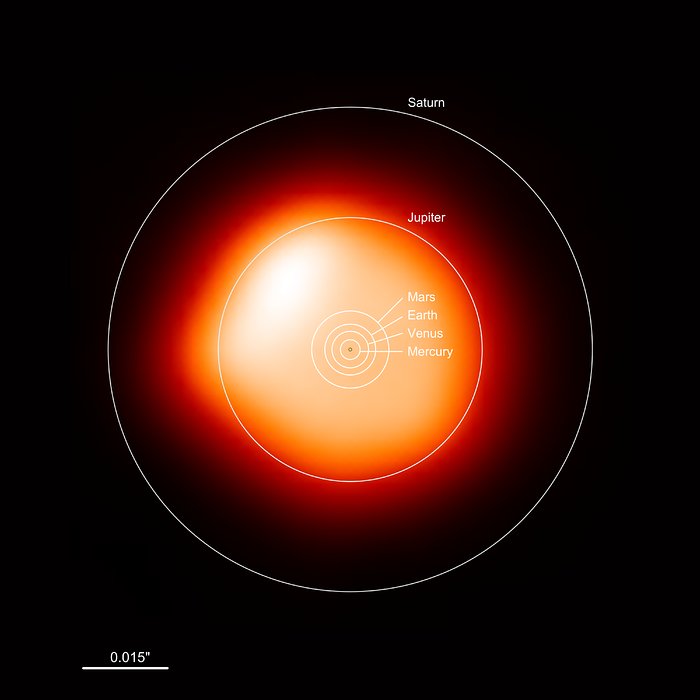
A diagram showing the approximate size of Betelgeuse compared to our solar system. Credit: unknown

That Betelgeuse is pulsating and has a cloud of material around it, also makes it difficult to pin down its precise distance from us. However, the most recent estimates suggest it is most likely around 643 light years from Earth, with a possible variation of around +/- 146 light years.

Red giant stars are of a type that have a comparatively short life, averaging 10-20 million years, depending on how fast they spin (compared to our Sun’s anticipated 9-10 billion years lifespan), with Betelgeuse thought to have a fast spin and an estimated age of about 8.5 million years, putting it close to its end of life, which tends to be a violent affair with stars of this size.

This is because these stars burn through their reserves of fuel at a high speed, although a temperature lower than typically found with Sun-type stars. Eventually, they reach a point where the temperatures generated by the nuclear process is insufficient to overcome the huge gravity created by their size, and they suddenly and violently collapse, compressing to a point where the pressure is so great, they explode outwards even more violently, tearing away most of their mass in an expanding cloud of hot gas called a nebula, leaving behind a tiny, dense core – or even a black hole.

However, while this final collapse and explosion takes place suddenly, the period leading up to it can be marked by observable changes in a star – and this is the reason for the excitement around Betelgeuse.

Comparison chart showing Jupiter, Wolf 359 – a red dwarf star (often featured in this column) – and the Sun, compared in size to other well-known stars in our galaxy, including Betelgeuse and the biggest stars so far discovered. Credit: unknown

Over the last 20+ years Betelgeuse’s radius has shrunk by 15%. While this has not massively altered the star’s brightness over that time, it is still an astonishing amount of mass to lose over so short a period. More recently, however, there has been a further change in the star that has caused excitement: since mid-October 2019, Betelgeuse has gone through a stunning drop in its apparent magnitude – or brightness as seen from Earth’s location – dropping from being the 10th brightest object in our night sky to around the 27th, bringing with it a complete change in Orion’s appearance in our skies.

This sudden drop in brightness has been seen by some as a possible indicator that Betelgeuse may have gone supernova, and we’re now waiting for the light of the actual explosion to reach us. Such has been the interest, reference has been made to monitoring neutrino detectors for the first signs of an explosion. This is because whereas photons have to escape a star’s collapse, neutrinos don’t, and so will reach us ahead of any visible light; so a sudden increase in the number of them detected coming from the region of the sky occupied by Betelgeuse could be indicative of it having exploded.

The clearest image we have of Betelgeuse, captured by the European Southern Observatory’s Atacama Large Millimetre/sub-millimetre Array (ALMA). Credit: ESO / NAOJ/NRAO / E. O’Gorman / P. Kervella.

Continue reading “Space Sunday: a look at Betelgeuse”

Sansar at the end of 2019: a personal perspective

My Avatar 2.0 in the Sansar Nexus

The end of December 2019 brings with it the end of the second full year of public accessibility to Sansar. The year has been marked by both a continuing round of updates to the platform, some of which have given rise to concerns among the established base of creators while others have been welcomed; plus a shift in emphasis in an attempt to try to further build Sansar’s audience base and which might be described as “risky”.

I’ve tracked most of these changes through my Sansar reports, particularly those related to the (generally) monthly updates and releases and my Product Meeting summaries. As such, I thought I’d review some of the more notable changes the year has brought forth, and take a brief look into 2020.

Significant Updates and Releases

Avatar 2.0

The Sansar avatar 2.0 release was one of the biggest changes to Sansar made in 2019 and arrived as a part of the September R36 release, potentially the biggest Sansar release for 2019.

Avatar 2.0 was a complete overhaul of the avatar system, rendering the original avatar system obsolete. It introduced a new range of starter avatars, and provided a set of tools to help users and creators adjust their avatar clothing and accessories to fit the new avatar skeleton. In particular, the system provides a completely new deformation capability, initially limited to the head / face, but with the promise at the time of release that full-body deformation would likely follow before the end of 2019.

The facial customisation options introduced with Sansar’s avatar 2.0 in September 2019

Response to the new avatars was mixed, with the female avatar in particular being critiqued for its proportions and overall lack of feminine shape (which gave rise to new range of body form garments designed to provide the avatar with some semblance of bust, waist, hips and bum).

Beyond this, 2019 saw other avatar improvements, including the ability to jump and / or crouch/crouch-walk, uniform scaling, improvements to object manipulation / throwing (again for games), IK updates, better desktop movement controls and improved VR body tracking, etc, most of which came with the April R32 release.

Gaming, Questing, and Experience Points System

Late 2018 through much of 2019, Linden Lab was pinning attempts to build Sansar’s user base on gaming / questing type capabilities – for example, at the end of 2018, Sansar was released through Steam. More particularly in 2019, the March R31 release saw the introduction of Sansar’s questing capabilities, initially for the Lab’s use only. The ability for creators to build their own quests appeared in the July R35 release, with the ability for creators to offer rewards added in October, and an experience points (XP) system officially released in November’s R36 release.

The questing system is designed to be used in games (e.g. adventure quests), games, puzzles, tutorials, guided tours through experiences (or “worlds” as they would be renamed), with the XP system designed to be a multi-functional means for users to gain points and “level up” in Sansar, whether they actively participated in quests and games or simply spent time exploring the worlds in Sansar or come to the platform to socialise and attend events.

Questing capabilities were first introduced to Sansar with the March 2019 R31 release

Given their nature, these updates also fed into changes within the entire Sansar user / social experience, although changes in this area started in advance of the quest system deployment.

User / Social Experience

The first significant change to the social structure in Sansar came in the January 2019 point release 28.3 with the introduction of the Social Hub. Linked directly to users’ Home Spaces (the point where users were at that time logged-in to Sansar when using the client rather than an experience URL), this was intended to provide a common space all users could easily reach and so meet one another, reach other places of interest via portals, play games, etc. It also became the focal point for the first Lab-derived quests deployed with the March release of the quest system.

To further encourage social interaction, personal and group teleport portal capabilities were introduced with the February release for easier individual / group movement around Sansar, while the May R33 release saw the in-client Atlas receive an overhaul with the aim of making finding events and places easier.

The Nexus, Prime Portal and Codex

The biggest change to the user experience came in the September R36 release, alongside the avatar 2.0 update. This saw the introduction of the Nexus, Prime Portal and Codex.

  • The Nexus: a new landing point towards which all users were initially directed towards when logging-in to Sansar. For new users, it included a set of tutorials built around a series of quests intended to help users gain familiarity with the platform.
  • Prime Portal: a physical location within the Nexus linked to a new UI element that replaced the in-client Atlas. It was intended to manage the process of new world discovery (experiences were re-titled “worlds” by this point) by users.
  • The Codex: a new UI element to allow users record, manage and quickly return to places they have previously visited while in Sansar.

The Nexus was also supposed to introduce an evolving “backstory” to Sansar, initially revolving around an non-player character (NPC) called Agent Primus. However, this back story didn’t receive much growth, with Agent Primus acting as little more than another quest giver.

The splitting of world discovery away from what has been the in-client Atlas and into the Nexus / Prime Portal led to concerns that the latter would become a bottleneck with users, discouraging exploration of “new” (to them) worlds.  This concern appears to be confirmed by a chart released by user Gindipple. While only covering a single week, it shows the Nexus gaining 70% of all Sansar visitors, while 19 other worlds accounted for just under 28% of users by popularity. This split tends to indicate a “pooling” of users within the Nexus, without much of a spread outwards to other world (the 2nd most popular world only gaining 3.69% of logged-in users, for example).

Gindipple’s chart for one week of Sansar visitors by world

However, Linden Lab promised to evaluate the use of the Nexus, and in the December R38 release, they formally changed the log-in process to once again deliver users to their Home Space when using the client instead of the Nexus. In that release, the Codex was also updated to list all public worlds a-la the old Atlas, rather than just those a user has visited, thus hopefully making it easier for people to discover and visit worlds they have not previously been to.

Continue reading “Sansar at the end of 2019: a personal perspective”

Name Changes: poll update

In Name Changes: $40 per change(?), some thoughts and a poll (December 17th, 2019), I offered some thoughts on the proposed US $40.00 fee for name changes, together with a (very) rough-and-ready poll on how people feel about the capability and the fee (so rough-and-ready that on reflection, I should have structured it a little differently and  used Google Forms for the poll for greater flexibility rather than the tools provided by Automattic for WordPress.com users, which are perhaps a little too basic).

As I noted in that piece, since last names were eliminated in 2010 in favour of “Resident” and the use of Display Names, there have been frequent calls for them to be “returned” to SL. These calls started almost immediately after “Resident” was introduced, through both forum threads and via Jira feature requests. Such was the demand, that by late 2011, LL were actively looking into bringing last names back, although ultimately they gave up on that attempt.

However, I also noted that the fee itself might be a limiting factor (together with the fact that the option will be limited to Premium members), and whilst admittedly a small sampling, the results of my very straw man poll would seem to support this. Just under 61.5% of respondents indicated that they probably won’t use the service, whilst over 80% of those responding the the question on the fee indicated that they felt it was too high.

Results from my (very) rough-and-ready Name Changes poll

Given that most people will naturally be opposed to paying almost any kind of fee for anything (even the L$10 upload fee for textures / sounds / animations is a source of grumbles), then opposition to the Name Change fee is to be expected. But the volume of negative responses, together with the level of disinterest expressed in the capability, would seem to point to the fact that  – again allowing for the fact it is limited to Premium members, and the responses to the poll likely came from Basic members as well – the $39.99 fee may will be a limiting factor for users after Name Changes go live beyond the natural pause LL hope it will provide against too-frequent changes that might otherwise impact services – and might in time prove counter to the degree of effort LL have had to put into implementing the service.

Fee aside, comments that followed my December 17th article and made through the likes of Twitter and direct IM, suggest that Premium members who are eligible for the service may well be put off from using it due to what they perceive as a another potential shortfall: the inability to re-use last names previously made available by LL. Those who wish to take their partner’s last name, for example, are effectively unable to do so except by continuing to use Display Names, while those who have a favourite last name that has previously been offered by by the Lab will similarly be out of luck.

Sample comments on how the lack of the re-use of “old” last names is seen as a limiting aspect of Name Changes

Again, this is only a small sampling, and one that uses a very basic poll to gather feedback. Nevertheless, it does suggest that Name Changes may well face a very mixed reaction once deployed, the former interest among users to have a last names make a return to SL notwithstanding.

Dhyezl’s art at Ani’s Gallery in Second Life

Ani’s Gallery: Dhyezl, December 2019

Currently on display on the upper floor at Ani’s Gallery is an exhibition of Second Life art by a relative newcomer to the scene – and apparently to Second Life as a whole.

Dhyezl appears to have joined Second Life just over a year ago, and the exhibition at Ani’s Gallery – which actually closes at the end of the month, so my apologies to him for getting to it so late – is Dhyezl’s first public display of his art. It features some 27 images, all of which fall largely into the category of landscape images, although many have an avatar-centric lean to them as well.

Ani’s Gallery: Dhyezl

Dhyezl says of his work:

As life is full of surprises, I discovered here a passion for photography. If I remain silent, maybe it’s because you speak in voice and I don’t understand everything, or maybe it’s because I am taking a photo!

I’m still learning, so if you are a photographer I would be happy to share about your techniques, or collect advices.

I actually think he is being far too modest. There is considerable technique in his art, and this exhibition demonstrates this to the fullest; there is a rich vein of narrative to his pictures. In addition, some of the pieces have been gathered together somewhat thematically. Three pieces featuring water, for example have a sandy element before them, representing a beach or river bank. Another three, all of which might be called countryside images, are placed over a mini-scene of a meadow, complete with a broken cart among the flowers.

Ani’s Gallery: Dhyezl

These elements add a certain depth to the art on display; but the reality it, Dhyezl’s art is striking enough not to require additional props, and I look forward to seeing more of his art at future exhibitions.

Also when visiting, don’t forget to appreciate Ani’s art on the ground floor of the gallery as well.

SLurl Details

A late summer at La Clef des Champs in Second Life

La Clef des Champs, December 2019 – click any image for full size

Update, April 2025: Chef des Champs has closed. SLurls have therefore been removed from this article.

It has been some time since I’ve paid a visit to La Clef des Champs (literally, “the key fields”), the region setting by Rose Siabonne. When last I visited, in June 2018, Rose had relocated the setting from a Homestead to a Full region (see: A return to La Clef des Champs).

Part of my reason for not re-visiting is that some time after that last visit, the region appeared to close, and Rose later offered the homestead setting of Hors du Temps (see: An Out of Time experience in Second Life). However, in the latter half of 2019, La Clef des Champs made a return to Second Life (the region details show it as returning in August 2019), and with it, Rose has once again created a photogenic, somewhat Adult-oriented  region – one that was, as the time of my end-of-year visit, still caught in the warmth and colour of summer.

La Clef des Champs, December 2019

As with past iterations of the region, this is a place where Adult activities are allowed, provided they are kept indoors and do not spill over into the gardens and open spaces of the region. As such, some of the buildings scattered across the landscape particularly given over to adult pursuits (notably the two white, modern houses). However, those who prefer not to witness such things shouldn’t be put off from visiting: there is more than enough to see and do without entering the various houses, and some of the buildings – such as the pavilion on the uplands to the south-east.

This pavilion, as with a number of other points across the region offer echoes of previous Les Clefs des Champs for those familiar with previous builds (in this case the piano), without ever being derivative of past builds.

La Clef des Champs, December 2019, December 2019

Water plays a role in the overall design, with the setting split into a primary large island with three smaller isles spaced around it. The largest of these, to the north-west, has a cottage atop it, and while there is no indication the parcel is private, the décor and furnishings with suggest it may well be – so perhaps a little caution should be used when exploring to avoid undue trespass.

Elsewhere, a river cuts through the region, almost splitting it in two has it runs from a set of inland falls and to the east coast. In addition, beaches serve the two white houses, while to the south a bay offers rowing boats and a little café. These help to break up the landscape with places to sit and relax.

La Clef des Champs, December 2019

There are some rough edges to the design, but nothing that spoils the overall effect of the design, while the centre lowlands offer a pastoral setting, complete with farmhouse (unfurnished) with geese, chickens and goats. Between this farmhouse and the (furnished) Tuscan house set a little back from the river, horses roam the grass.

As ever, La Clef des Champs retains an eye-catching design that offers rich opportunities for photography and appreciation of the outdoors.

La Clef des Champs, December 2019

Looking at Second Life updates in 2019 and ahead to 2020

Each year through this blog I attempt to track news about, and changes to, Second Life, as driven by Linden Lab. On the technical side, this is do through my weekly SL project summaries, whilst news and general updates are drawn from sources such as Lab comments on the official forums and official blog posts or as a result of attending public meetings and Q&A sessions, etc.

As a lot can happen during the course of the year, so in this article I’ve tried to summarise the more notable updates to occur during the course of 2019.

Land

Mainland Auctions

In March 2019, Linden Lab introduced Mainland user-to-user land auctions. The auction system leveraged Second Life Place Pages as the medium for presenting land for auction and for placing bids, together with a “cover page” listing available parcels up for auction available at https://places.secondlife.com/auctions. At the time of the launch, Linden Lab provided a Land Auctions Walkthrough.

Unfortunately, these auctions had to be suspended in October / November 2019 due to unspecified “abuse” by users. The system is to be revised, but there is currently no indication of when the auctions will be re-enabled.

Premium Homes

The first styles of the new Premium Homes were unveiled at the annual Home and Garden Expo in March 2019 in a single “preview” region that provided both the four types of Traditional homes and four types of Houseboat that would be the first  of the Premium Homes themes that would be issued.

The Homes themselves launched on April 15th, 2019, with the opening of the new Bellisseria continent and a mass release of both Houseboats and Traditional homes.  As with the original Linden Homes, they are available through Premium member’s Land Homes page, accessed through their secondlife.com dashboard.

The new Linden Homes are available to Premium members through the existing Linden Homes registration page

The first mass release of houses and houseboats had been snatched up within 48 hours of the release, with the houseboats proving particularly popular – so much so, that the Lab immediately started planning a 709-parcel add-on to Bellisseria specifically to meet the demand. In the meantime, one of the points noted about the new region was its lack of airstrips and this was addressed with the opening of the continent’s first airstrip in late April 2019.

The new bolt-on for the houseboats opened on May 15th, 2019 – and were all gone within 27 minutes of the release. Then in June 2019, Patch Linden announced that releases would shift to a smaller-scale rolling basis with regions of new houses generally being made available on Mondays, Wednesdays and Fridays.

Also in June, the Lab previewed the next major theme for Linden Homes, the Trailers and Campers, which were introduced in September. In December 2019, the Lab previewed and then released the Victorian theme of Premium Homes.

Fees and Account Changes

Fee Changes

2019 saw the introduction of significant fee changes for Second Life.

From June 2rd, 2019 Private region tiers changed as follows:

  • Full regions were reduced from L$249 a month to US $229.
  • Homestead private regions were reduced from US $195 to US $179.
The changes to Premium fees, announced in June 2019. Source: Linden Lab

These changes were exclusive of VAT, where applicable, and did not apply to Skilled Gaming region; however, Education / Non-profit (EDU/NP) discounted Full islands were be re-priced to maintain their 50% discount off the regularly priced Full island fees.

From June 24th, 2019, Premium fees were increased for the first time in their history:

  • The monthly fee increased from US $9.50 to US $11.99 (an annual increase of 26.21% from US $114 pa to US $143.88 pa)
  • The quarterly subscription increased from US $22.50 to US $32.97 (an annual increase of 46.53% a year from US $90 pa to US $131.88 pa). This fee was to be discontinued to users upgrading to Premium after July 24th, 2019, but a later decision saw it continued on a “temporary” basis that means it is still currently available.
  • The annual fee increased from US $72 to US $99 (an annual increase of 37.5%).
  • In addition, both existing quarterly and monthly subscriptions would again be subject to VAT.

Note: included with the announcement were proposed changes to Basic account users available off-line IMs and total group allowance. However, after receiving wide-ranging feedback (such as this letter from myself), the decision was made to not implement the group changes.

To help sweeten the Premium fees increase, between June 3rd through June 24th, Premium users were offered the chance to “lock-in” their Premium fee for an additional period commensurate to their subscription period from the end of their existing period. In addition, existing annual Premium subscription members were offered the chance to renew their subscription for an additional year from their next renewal date at the Winter Premium discounted rate (10% off).

There was also the 5% increase in Marketplace commission fees which caused some consternation. While the reason for the increase is understandable when put in the proper perspective, it could have been framed a little better.

Account Changes

In July Linden Lab announced that as from August 1st., their subsidiary company, Tilia Inc., would be taking over all responsibility for managing SL user’s USD denominated accounts. In short, this meant that anyone with a US dollar balance on their account would have to agree to the Tilia Terms of Service and Privacy Policy, and in order to process USD amounts out of Second Life, might have to supply personal information to Tilia. See:

Technical Updates

Teleport Disconnects

The early part of 2019 was marked by users experiencing a significant number of teleport disconnects. These proved problematic for the Lab as well,with assorted causes from EEP deployments to server OS updates being suggested as a possible cause. A series of user-involved stress tests on the best (Aditi) grid to help with investigations, allowing adjustments to be made on the simulator side. These helped point towards a race condition, with LL implementing changes and updated monitoring to counter the issue.

Script Processing Changes

Over the course of the year,  number of script-related issues have surfaced:

As a result, LL has worked to improve script handling – such as adjusting how idle scripts are handled to reduce the overhead with place on CPU cycles – and these changes and adjustments have helped to eliminate some, but not all, of the problems encountered through the year.

Marketplace

Release Notes

In May 2019, the Lab introduced new web-based release notes for the official viewer, together with a index page for said release notes. There were some initial teething problems with the system for those who track official viewer releases (sometimes a viewer update would appear on the index page, sometimes on the new Alternate Viewers page, sometimes on both that took a while to smooth out.

Server release notes made a similar move to web pages in September. After this, LL stopped breaking down simulator updates by release channel (e.g. BlueSteel, Magnum and LeTigre), listing all releases as “Second Life Server”, regardless of the actual channel used for a release.

iOS Client

In January, evidence surfaced that Linden Lab are working on a Second Life iOS. After enquiring with the Lab, I received confirmation the app was being actively worked on. As the year progressed, more details were revealed about the app, including: the app should work on both the iPhone and iPad, and will initially be more of a communicator / companion app than a fully-rounded client; it will provide a log-in option, and chat options (e.g. chat, group chat), but will not present users with an in-world location, or rez and avatar in-world. Over time it will be enhanced – but additional capabilities are still TBD. See my mid-year update for more.

Cloud Transition

Work – most of it transparent to users – has continued on the migration of Second Life to the cloud. Most of this work has been on the back-end services, notably the web services. Currently, no public-facing simulators have been transitioned to AWS provisioning. All of this work has been achieved without any significant disruption to services or – more particularly – without users actually being aware the services had been moved, and the Lab reports that the migrated services have been able to achieve almost 100% up time.

Continue reading “Looking at Second Life updates in 2019 and ahead to 2020”