This summary is published every Monday, and is a list of SL viewer / client releases (official and TPV) made during the previous week. When reading it, please note:
It is based on my Current Viewer Releases Page, a list of all Second Life viewers and clients that are in popular use (and of which I am aware), and which are recognised as adhering to the TPV Policy. This page includes comprehensive links to download pages, blog notes, release notes, etc., as well as links to any / all reviews of specific viewers / clients made within this blog
By its nature, this summary presented here will always be in arrears, please refer to the Current Viewer Release Page for more up-to-date information.
Official LL Viewers
Current Release version: 4.0.0.309247, December 17th – no change
Project Azumarill (HTTP updates) RC viewer updated to version 4.0.1.309333 on January 6th – a complete replacement of the under the hood HTTP infrastructure within the viewer (download and release notes)
Maintenance RC viewer updated to version 4.0.1.309460 on January 5th – core updates: some 38 fixes and improvements, including updates for some regressions introduced into the viewer with the current release viewer (download and release notes)
Quick Graphics RC viewer updated to version 4.0.1.309320 on January 5th – provides the new Avatar Complexity options and the new graphics preset capabilities for setting, saving and restoring graphic settings for use in difference environments / circumstances (download and release notes)
NASA’s Mar Science Laboratory rover, Curiosity, continues to perform the first up-close study ever conducted of extraterrestrial sand dunes as it slowly explores the slopes of “Mount Sharp” dubbed the “Bagnold Dunes”.
Located on the north-west slope of the mound which lies at the centre of Gale Crater, the dunes differ from those drifts and sand fields the rover has previously encountered on Mars in terms of both their size and height – some cover an area the size of a football field and are 2 storeys high – and their general shape, something which marks them out as “classic” sand dunes.
This latter point is most evident by the dunes exhibiting a steep, downwind slope, referred to as the slip face, and which exhibits certain features of its own, such as gain fall, ripples and grain flow, as well as the dune as a whole exhibiting typical features such as the horn and toe.
For the last couple of weeks, the rover has been working its way around one dune in particular, dubbed “Namib”, which is somewhat smaller than the “high dunes” images at the start of December, but which still rises to a height of some 5 metres (16 ft). The leeward side of “Namib” in particular demonstrates the classic features of a sand dune, and helps to confirm the fact that the dunes are slowly progressing down the slope of “Mount Sharp” at a rate of about 1 metre (39 inches) a year.
The leeward side of “Namib”:Horn – where sand is escaping the main dune and escaping downhill, as indicated by the ripples; Toe – the downwind extent of the dune; ripples – signs of the sand bouncing sideways over the dune as the wind blows it downslope towards the horn; Brink – the ridge between the windward, gentle slope of the dune and the leeward, steeper slope of the dune; Grail Fall – areas where sand is blown / falls from the brink and comes to rest on the leeward slope; Gain Flow – tongue-like area indicating where large amounts of sand have slumped down the side of the dune towards the toe, again indicative of a dune in motion
The dune-investigation campaign is designed to increase understanding about how wind moves and sorts grains of sand in an environment with less gravity and much less atmosphere than well-studied dune fields on Earth. Such an understanding of how the wind moves sand could lead to a clearer picture of how big a role the Martian wind played in depositing concentrations of minerals often associated with water across the planet, and by extension, the behaviour and disposition of liquid water across Mars.
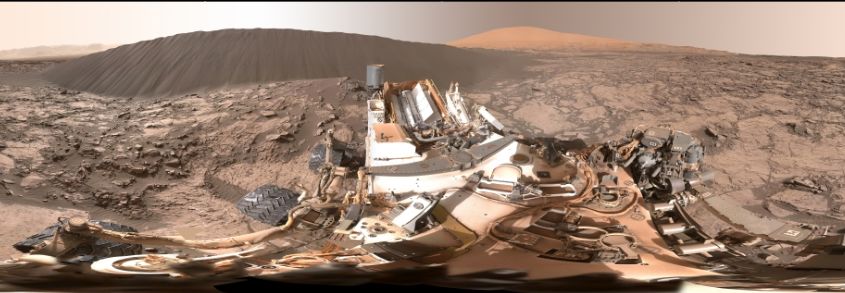
This rather odd-looking image is a foreshortened 360-degree view of the area around Curiosity. In the immediate foreground is the rover’s main deck, with the cylindrical, finned nuclear RTG at the back of it. Beyond this is the “Namib” dune, with a taller dune beyond it. The view was constructed from a series of images taken by the rover’s Mastcam on December 18th, 2015 (Sol 1,197 on Mars), all of which have been white-balanced to present the view under normal Earth daylight conditions
Back to Sea for SpaceX
SpaceX, the private space launch company, is keeping itself busy. Following the successful launch of the Orbcomm mission from Florida’s Cape Canaveral Air force Station, together with the successful recovery of the first stage of the booster when it flew back to the Cape and performed a flawless vertical landing, the company’s next launch is scheduled for Sunday, January 17th.
The launch will take place from Vandenberg Air force Base, California, which is the company’s Pacific Coast launch operations centre. The primary aim of the mission is to place the third in a series of joint U.S.-European satellites into a near-polar orbit (for which Vandenberg AFB is ideally suited, as a polar launch from there does not pass over inhabited land during ascent, lessening the risk to human lives should a launch vehicle suffer a failure).
The Jason-3 series of missions is part of a very long-term series of studies (started in 1992) to study the topography of the ocean surface (i.e. the formation and movement of waves and the troughs between them), which can provide scientists with critical information about circulation patterns in the ocean, and about both global and regional changes in sea level and the climate implications of a warming world.
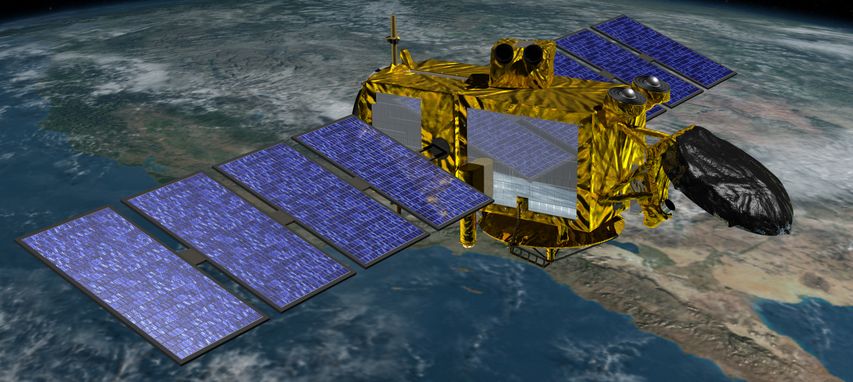
Jason-3, the latest in a series of joint US-European satellites studying the topography of the ocean’s surface, is due for launch on December 17th, 2016, using a SpaceX Falcon 9 1.1 rocket (image: NASA / CNES)
The polar orbit used for this kind of earth-observing mission, being almost perpendicular to the Earth’s rotation, allows the spacecraft to at some point travel over almost every part of the world’s oceans, vastly increasing its ability to gather data when compared to a vehicle in an equatorial orbit.
What is also significant about the mission is that it will use a SpaceX Falcon 9 1.1 booster, the first stage of which will once again attempt to return to Earth and make a safe landing. However, unlike the December 2015, this landing will once again be at sea, using a SpaceX droneship landing platform.
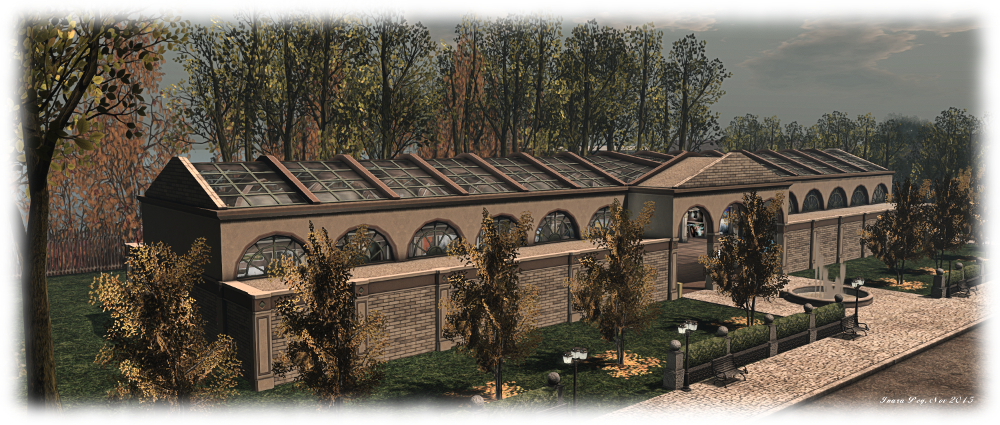
Now open at the Windlight Art Gallery, the January-February 2016 Windlight Fellowship exhibition sees exhibits by Ceakay Ballyhoo, Eleseren Brianna, Jarla Capalini, Warm Clarity, Glitterprincess Destiny, Hana Hoobinoo, Victoria Lenoirre, Carley Noonan, Autopilotpatty Poppy, Jamie86 Resident, Jazsintha Resident, and Tempest Rosca.
On offer is another rich mix of styles and subject matter – landscapes, avatar studies, some abstract work and some images from the physical world. It is this mix of styles and subject which makes the Windlight Exhibitions more than worth the visit; the Gallery design encourages the visitor to focus attention on each artist in turn whilst at the same time allowing individual styles and approaches to be compared and contrasted, helping one to appreciate further the skills evidence by each artist in creating their work.
There are a number of artists in this group whose work I know and admire, and several who are new to me, but whose work I’m rapidly coming to admire as result of seeing them at Windlight. While I don’t like to seem as if I’m picking favourites at an event like this. I have to admit that I found myself drawn back time and again to Hana Hoobinoo’s and Jarla Capalini’s images; the latter offer rich portraits and landscapes with a marvellous painted quality to them, while Hana’s present a beautiful ethereal quality.
But all appearances of favouritism aside, all of the images on display through January and February are guaranteed to please and entice those who visit the gallery; so be sure to add it to your list of places to visit, and if you wish to find out more about the artists, be sure to read the special Meet The Artist articles in the Windlight blog.
Footnote: Due to issues with Second Life, the formal opening event for the exhibition has been rescheduled for 14:00 SLT on Saturday, January 16th, with formal attire preferred. However, the gallery is still open for people to visit and see the art on display.
The Windlight Artist Fellowship Programme
As a part of the magazine’s desire to help promote and support artists and photographers, Windlight Magazine and the Windlight Gallery operates the Windlight Artist Fellowship Programme. This allows artists to apply for free exhibition space at the Windlight gallery for a period of 30 days. Applications are open to artists from across Second Life, and the criteria for acceptance can be found in the Artist Fellowship Programme application form.
It’s time to kick-off another week of story-telling in voice, brought to our virtual lives by the staff and volunteers at the Seanchai Library, as we move from Christmas to New Year celebrations. As always, all times SLT, and events are held at the Library’s Second Life home at Bradley University, unless otherwise indicated.
Monday January 11th, 19:00: Snow Crash
We all know Neal Stephenson’s Snow Crash as one of the inspirations behind Second Life. Now Gyro Muggins opens the pages of this modern classic.
In the 21st Century, Los Angeles is no longer a part of the United States, but is instead run by a variety of corporate and other factions, which much of the city divided into sovereign enclaves. Mercenary forces via with private security firms; drugs and the private vehicle reign supreme and where hyper-inflation is rampant.
Within this strange and complex world exists the Metaverse, an omnipresent 3D “Internet of everything” in which people can roam as avatars. It is in this world that the aptly named Hiro Protagonist (and former pizza delivery driver) operates as a sword-welding heroic warrior and bounces between the virtual and physical worlds as the self-styled “last of the freelance hackers.”
However, when his friend and fellow-hacker Da5id, falls victim to the mysterious new drug Snow Crash, which exists in the virtual world as a computer virus capable of infecting machines connected to the Metaverse and in the physical world as a viral infection which attacks the central nervous system, Hiro sets out to learn the truth of what is going on. Working with his virtual business partner, the 15-year-old Y.T., Hiro digs into the truth behind Snow Crash, leading him (and Y.T.) to the doors of fibre-optics monopolist L. Bob Rife and his acolytes and minions, including the highly dangerous Raven.
Tuesday January 12th 19:00: Pearl
Faerie Maven-Pralou opens the covers of the first book in Lisa Pinkham’s the Doll Collection series.
Everything changes for Addy on her 12th birthday, when she receives a mysterious gift of a collection of dolls and an opal necklace imbued with magical powers.
Soon, Addy finds herself transported to a beach where she meets a mermaid, Pearl, and where she can swim with and talk to underwater fairies and enjoy the company of min-reading dolphins.
But all is not as safe as it seems; when Pearl vanishes and Addy’s magic necklace is stolen, Addy is left with no way home and without a friend – and she must confront the thief on her own, trusting that the magic which resides in her is enough to put things to rights.
Wednesday, January 13th 19:00: LonnyDonny
Caledonia Skytower continues a journey through some of the writings of MJ McGalliard, bringing us LonnyDonny, Stories Told in the Dark Book 1.
What happens when identical twin Rodeo Clowns are afflicted with amnesia? All their lives they’ve been more or less one person. But, what if they can’t remember which is which? There’s also Frito Chili Pie.
Thursday, January 14th, 19:00 Time Travel Thursdays
With Shandon Loring – Also presented to be presented at Seanchai Kitely and Seanchai InWorldz. Check session post during the week for specific grid locations).
—–
Please check with the Seanchai Library SL’s blog for updates and for additions or changes to the week’s schedule.
The featured charity for January / February is Heifer International, working with communities to end world hunger and poverty and to care for the Earth.
Most of us are curious as to how “Project Sansar” will / won’t / might / might not work (with some already going to far as to pretty much write it off before even seeing it, which to me seems a tad premature).
In her own digging around, reader Persephone came across an interesting piece of information, and was kind enough to pass me a link to a case study from Amazon concerning the Lab’s use of Amazon’s EC2 Container Service (ECS) and Docker technology within Project Sansar.
Amazon’s ECS is a “scalable, high-performance container management service that provides cluster management and container orchestration”, which Linden Lab uses to run “the containerized web applications and back-end services of Project Sansar”.
Docker is an open-source technology that allows a developer (e.g. Linden Lab)to build, test, deploy and run distributed applications – all the code, runtime elements, system tools and libraries, etc, – within a “container”, a method of operating system virtualisation. The upshot being it allows an application to be presented as a standardised package for rapid and consistent deployment, regardless of the environment in which it is to be used.
Precisely what “back-end” services for “Project Sansar” are being deployed in this manner isn’t clear; I’m certainly no technical expert and so am open to correction / other ideas.
However, we do know that a key element of “Sansar” is the ability for customers to build and deploy their own gateways (e.g. websites / web portals) to draw their own audiences into the experiences. So, is the use of ECS a means of achieving this? Presenting customers with a packaged environment in which they can build and deploy their own “Sansar” gateways? Or might it be the mechanism the Lab are looking to use to handle the management and scaling of support systems such as the chat, asset and other services – many of which do appear to be of monolithic design with Second Life, and which sometimes don’t scale particularly well.
The Lab’s diagram for using Amazon ECS (images Linden Lab / Amazon) – click for full size
Could it be that the mechanism might actually be for more than just “back-end” services – such as the actual packaging and presentation of “Sansar” experiences themselves? We know that the Lab are wrestling with the issue of optimising “Sansar” experiences and their content so that they present a performant experience across a range of client platforms. We also know the Lab intend to provide a means by which experiences can be rapidly deployed when needed (e.g. the WordPress / You Tube analogy of build and then push a button to deploy) or rapidly scaled via instancing to meet the demands of large audience numbers.
Both of these requirement would seem – to my untutored eyes at least – to fit with the model being presented, although both would tend to suggest the use of ECS beyond the support of “back-end” services.
As it is, we do know the Lab already use Amazon’s services for presenting some of their SL-related services – so developing an existing relationship with the company for the benefit of “Project Sansar” would appear to make sense. At the very least, the case study offers the potential for further “Sansar” questions to be asked at the next Lab Chat.
Opening today, Saturday January 9th, 2016, and running through until January 24th at the Art on Roofs gallery, Solodonna Land, is a small exhibition of my images I’ve called Through a Blogger’s Eyes. In it, I present a series of images I’ve taken of the places I’ve visited over the years; some of the images have been seen before in-world, while others are new to in-world presentation, although they have been seen on this blog.
The images selected lean towards my more recent SL region travels, all of which are documented under my Exploring Second Life tag, and by year through the blog menu (Events-Reviews-Travel > Exploring Second Life > select year), although some stretch back as far as 2013.
It’s the nature of places to come and go in Second Life, so some of the images are of places no longer with us, or as they appeared before more recent make-overs. However, most are still active today, and within the exhibition notes I’ve included a list of landmarks should anyone wish to visit the location depicted in a particular image.
Also, as a part of the exhibit I hope to be running a playlist of videos of the places, art installations and events I’ve filmed over the last few years. The playlist is set-up, but YouTube and SL were having a little bit of a fight during testing, so I’m seeing how that goes :).
As I say in the introductory notes, I don’t consider myself in any way a Second Life photographer or artist; my images are purely produced for illustrating the blog (I use Flickr to simply save on using the limited disk space WordPress provides). I’m therefore genuinely flattered when asked to display like this – and my thanks go to Terrygold, Sniper and Elettra for inviting me to exhibit at Art In Roofs; I hope you will visit and enjoy it.
The opening is at 13:00 SLT on Saturday, January 9th, with music by the folk at Solodonna club, and I hope you’ll join us.








 Inara Pey: Living in a Modemworld