Catznip goes mesh

catznip logoThe Catznip Viewer has been extensively updated in a new 2.8 release (2.8.0 (3)). Not only have the RLV capabilities been updated and a host of new features added and others enhanced, Catznip becomes the latest SL Viewer to support mesh object rendering.

Installation and Start-up

Like all Viewer 2.x /3.x Viewers, Catznip installs direct from the box as a standalone Viewer, and offers no changes or surprises along the way.

On start-up, Catzip joins Dolphin 3 in becoming one of the first Viewer 2.x/3.x TPVs to display the new SL log-in screen with the Destination Guide, etc., options. It’s good to see this option gaining wider traction – and it would be a joy to see it in Firestorm. Departing from the official Viewers, but in keeping with Viewer 2.x TPVs, Catznip dispenses with the Basic mode and keeps both feet firmly planted in the Advanced mode.

Once logged it, the UI looks very similar to that of Viewer 2.x/3.x with a modified toolbar.

Catznip toolbar (top) and the current Viewer 3.x toolbar

Interestingly, there in no Speak button by default on the Catznip toolbar – because Voice is off by default. However, the toolbar does include an inventory button which, as with Dolphin 3, opens an inventory window floater independent of the Sidebar (which can also be open at the same time).

Another nice touch with Catznip is that media is turned off by default on logging-in – a wise move given there is, unfortunately, no media filter.

Given its heritage, Catznip also has the RLVa menu displayed in the menu bar by default, although as with most RLV-capable Viewers, RLV  itself – updated to 2.7 – is disabled on such time as it is turned on through Preferences.

A full list of updates is available from the Catznip website (see the note at the end of this piece on Catznip 2.6), but here are the most visible / user-related changes / differences to the official Viewer.

Preferences

Within Preferences, Catznip has everything common to the official Viewer, plus a few little tidbits and nips and tucks of its own:

  • General Tab: The SHOW MY FAVORITE LANDMARKS AT LOGIN option is moved from the Privacy tab to the General tab, just under the START LOCATION drop-down
  • Privacy tab: adds options to select whether you wish to clear one or more of the following: web cookies, teleport history, Search history and / or Navigation Bar history before you click on CLEAR HISTORY
  • Spell Check: allows you to enable the spell checker (words incorrectly spelt underscored in red, right-click to select options for correction / adding to dictionary). Language can be set to one of four options: British-English; Canadian-English, Australian-English and US-English
  • Skins tab: provides Starlight and Stardust skin options in a choice of colours
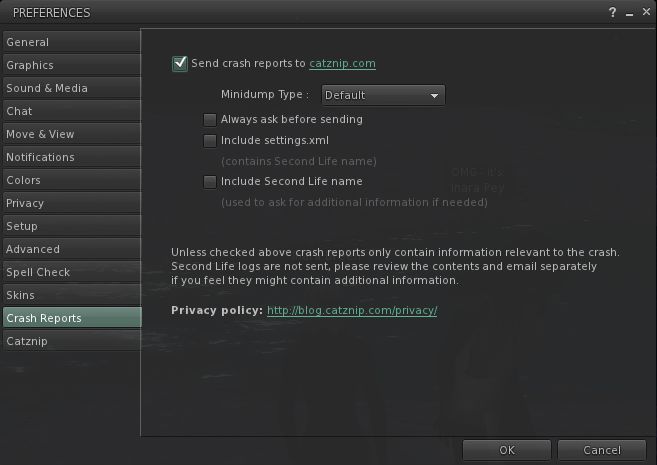
  •  Crash reports tab: allows you to select whether or not crash reports should be sent to catznip.com, and the information the reports should contain
Crash report options
  • Catznip tab:
    • General: allows you to: use legacy multi-attach support (i.e. non-Linden “Emerald” system for multiple attachments); activate RLV support; adjust avatar offset; toggle object inspector on / off; toggle full screen windowed mode on / off
    • Chat: set your chat / IM preferences. An interesting item here is to enable a multi-line chat input option to the Nearby Chat floater
Multi-line chat input option
  • Inventory: allows you to: select the format preference for saving scripts (LSL or Mono); direct inventory you decline directly to trash; set notecard / texture options
  • UI: allows you to: display Group information either in the Sidebar or as a window floater; display an avatar’s Profile as a window floater or their Web profile (an additional nice touch is Web Profiles open on the ABOUT tab, rather than the person’s FEED tab – far more relevant); change the way in which script dialogues are displayed in the bottom tray; alter your My Outfits tab display between “Inventory” and “accordion” displays.

Continue reading “Catznip goes mesh”

Kirsten’s Viewer: Jabba speaks

Jabba Aabye has posted over at Kirsten’s Viewer blog, on behalf of the entire team. The message is one of hope and thanks for all the support offered over the last few weeks.

On the Viewer in particular he states:

A lot of people have stepped forward to help, contribute and/or volunteer in a future plan for the Kirstensviewer-project. And not only the project, also for all the hard work that has been already done. But there might be some light on the horizon. Tho it is not official yet, there is some hope growing it will work out and benefit all of us. Details will come out in the coming weeks. Keep this website close to your mousepointer…

This is very encouraging feedback / news. Hopefully the team can find a way to keep the Viewer going and moving forward, especially after all the hard work they have put into things.

You can read Jabba’s post in full here. To him and the team as a whole, I’d again like to pass on my thanks for all of their efforts over the years. To KL and Dawny especially, I offer every best wish for now and the future.

Another code breakage hits SL

On top of the recent attachment update bug, JIRA (SVC-7283) (as well as the releated SVC-7294) – there is now another scripting breakage that has been deployed to the grid.

PRIM_PHYSICS used in the likes of llSetPrimitiveParams, no longer functions as expected on server release code 11.09.09.240513, leaving scripted vehicles and animals (among other things) not working, malfunctioning and/or running amok.

A JIRA (SVC-7305) has been raised for the issue, which has a widespread impact.  And it has to be said that the JIRA is starting to read like a poorly executed farce, with LL responsible for the script.

  • It appears one creator of scripted vehicles running on the mainland which are now effectively out-of-control, and her account has apparently been suspended as a result
  • Other creators are reported issues with potentially thousands of sold products which, while there is a potential code alternative available (via STATUS_PHYSICS) – this still means considerable re-coding for many creators and a massive product update (and why should they, when the cause isn’t their fault?)
  • Responses from Linden Lab are hinting a fix (again) will not be available for RC channel release until next week, with the implication a full roll-out could be two weeks away – and that, despite the clear severity, there is resistance to accelerating the fix within the company!

Two breaks to basic scripting functionality in Second Life coming a week apart isn’t liable to win Linden Lab awards in the popularity stakes. It’s also liable to have the tinfoil hat brigade nodding to themselves and muttering comments about event numbers, coincidences and conspiracies.

As if we don’t already have enough of that doing the rounds.

Just how bad is a 650-region loss?

Last week an article appeared in New World Notes (NWN) which seemed intent on giving the impression that Second Life is in a state of terminal decline. The headline proclaimed: “Second Life Has Lost Over 650 Sims & $1 Million in Yearly Revenue in 2011; This is Why SL Can’t Survive as a Niche”, followed by a comment that, “The only future for Second Life is several millions of users, or none at all”.

Provocative reading perhaps; but how reasonable is it to make such assertions?

Well, first and foremost, I don’t dispute the figures in terms of region losses or potential revenue drop. They’ve been taken from Tyche Shepherd’s excellent Grid Surveys, which week-by-week look at the overall status of the grid in terms of regions, private and mainland. Rather, I tend to find the conclusions the author draws from Tyche’s figures to be somewhat questionable.

The Ebb and Flow of the Statistical Tide

Let’s try to put things in a little perspective, starting with two points in particular:

  • 650 regions is around 2.6% of the total land mass
  • Linden Lab has an inward flow of revenue of some $75 million a year. As such, $1 million amounts to a 1.3% drop in that revenue. All things considered (economic climate, etc.), that’s not an horrendous drop.

Now let’s take a look back at private regions in SL over the last three years (a not unreasonable time-frame in business terms).

  • 2009:
    • Jan-May SL suffered a loss of 1095 private estates during the first 5 months (from 22406 to 21311); no doubt fuelled in part by the OpenSpace fiasco
    • June-December: SL grew to 24033 private estates, an increase of 1627 regions over the start-of-year
  • In 2010:
    • SL grew by 6% overall in terms of regions
    • 44% of this growth lay in private regions, representing an overall growth of  3% for private regions
  • In 2011:
    • Jan-Aug: 2.6% loss of private estates
    • A potential 3.9% loss by year-end.

In other words, in 2009, private regions on the Grid grew by some 7.26% over the start-of-year figure, despite an initial loss of some 4.88%. In 2010 it grew by a further 3% in private regions.

So while a current 2.6% drop is cause for some concern – it’s not yet drastic. Even if the shrinkage continues through to the year-end (as seems likely, given Tyche’s latest figures), and yields a potential 3.9% drop in private regions, the situation still would not be terminal.

Recession does Nasty Things

There is another factor to consider here. Right now, we’re in the midst of a prolonged global economic downturn. The longer it goes on, the deeper it bites into people’s disposable income. A prudent observer of the current decline in private regions in SL would consider it possible – likely, even – that the recession is responsible for at least some of the shrinkage we are currently seeing. One sees little sign of this in the NWN article.

But downturns don’t last forever (or if this one does, we’ll all have a lot more to worry about than Second Life). Therefore (and while past performance may not always be indicative of future growth), it is no unreasonable to suggest that once the economy does start to improve, people will again have more disposable income they can put towards Second Life, and this is likely to result in an improved demand for land as a result and at least slow – if not reverse – the current trend in private region losses.

Alternatives

Nor do Linden Lab need to convert anywhere near 400,000 users to Premium membership in order to recoup falling land tier income (even should this be necessary), as the NWN article also dramatically suggests.

Right now, Linden Lab generates some 20% of its income – $15 million – through non-land related activities. As such, it only needs to increase that $15 million revenue by some 10% to help offset the losses experienced to date – a not impossible figure.

There have already been a couple of small moves in this direction; we’ve seen the introduction of upload fees charged for mesh imports and a push to generate more Premium memberships. While the former might not have a significant impact in the scheme of things, the same is not necessarily true of the latter. Were Linden Lab to offer a Premium membership package that gave clear and significant benefits to those already engaged in Second Life (rather than just new users, as seems to be the case with the current offering), then the potential uptake could be significant – and relatively rapid.

Beyond this is the fact that Linden Lab doesn’t necessarily have to look at Second Life to recoup “lost” revenue. The company is shortly to launch new products into the marketplace. While details have yet to be released, it is unlikely Linden Lab will do so without the means to leverage them into revenue.

True, the results may not be immediate (depending on how these new products are to be monetized and how they are received by the world at large). However, that the company is launching new products means that it will be less dependent solely on Second Life for revenue. An optimist might even speculate that as a result, Linden Lab might have a greater degree of freedom to better restructure / improve the Second Life platform.

Nor should these products be classified (/dismissed?) as some form of “SL Light”, again as New World Notes suggested.* To quote Rod Humble himself in reference to this idea: “I never said a lite version. I said and I mean new products which are in the area of shared creative spaces. or social creative tools or user-created virtual worlds/places if you prefer”.

Where is Everybody?

Truth be told, there is one figure that gives continued cause for concern for many within Second Life – and it is not region counts; it’s user concurrency. This has been in a steady state of decline for the last three years. In her end-of-year summary in 2010, Tyche Shepherd estimated that SL’s average concurrency levels equated to just 1.57 avatars per region. That’s an awful lot of empty space.

Now to be fair, the New World Notes article I refer to at the top of this piece does indicate that Linden Lab needs to do more to get people involved in Second Life – even if it does over-egg things by putting the figure in the “millions”. And keeping on the side of fairness, Linden Lab have themselves indicated that they are working on the means to get people directly involved in in-world activities (i.e. content creation, engaging in the economy as consumers, etc.) a lot sooner than is currently the case. However, one has to admit that it would be nice to see some practical outworking of these ideas before the year’s end. Even a gentle increase in user concurrency that can be sustained for more than a few months would be good news for just about everyone involved in SL.

Niche isn’t Bad

Finally, and in turning to the claim that SL cannot survive as a niche, one has to ask, “Why not?”. The fact is that Second Life has survived for some 10 years as niche product, and has managed to generate a tidy revenue stream for Linden Lab that has made them “Very profitable”, to use Rod Humble’s words, in the process. Get the flow of people into SL right and the mechanisms of engagement in place, and there is no reason why it cannot continue to do so and enjoy practical growth.

This is not to say that things won’t have to change in time; the reality is that Second Life and Linden Lab will be facing challenges in the coming years that may yet force significant changes to aspects of how things are run (such as, ironically, land tier). However, these needn’t necessarily be negative – although they will need to be planned for and carefully executed.

And what is so bad about being niche anyway? Many a company and product have enjoyed long and fiscally healthy times being precisely that.

—–

*Hamlet has pointed out that his article drew the distinction between any new products and SL; as such, I’ve amended this piece and apologise for any upset caused.

Duché de Coeur: September dates

Duché de Coeur has released details of further events and dates in their September music schedule, and it promises to be a delightful programme.

September 23 – 14:00-15:00 SLT

A concert by the multi-talented Dani Plassitz. A singer and a fashion designer, Dani will be appearing at Aquitaine Coeur-Isla Pequena (SLurl).

September 24 

13:00-14:00 SLT: Ballerina Flori Muffin, a student at the LPBa Ballet Academy in SL, will be performing at the Languedoc Coeur-Opera House (SLurl).

19:00-20:00SLT: 2009 LEMA Award nominee Pmann Sands will be performing in the Duchy’s Blues night at Languedoc Coeur-Beach (SLurl), as a part of the Duchy’s Tunes Around Town series.

September 25th 11:00-12:00 SLT

Renowned singer Ceci Dover will be attending the Languedoc Coeur-Opera House & Art Gallery (SLurl) for a meet and greet.

September 27th 19:00-20:00SLT

Madame Amoufhaz and hexx Triskaidekaphobia are the Born Again Pagans, who will be appearing at the Duchy’s Reggae Night, hosted at Aquitaine Coeur-Isla Pequena (SLurl), as a part of the Duchy’s Tunes Around Town series.

September 30th 12:30-14:00

A concert by the renowned Joaquin Gustav, who will be performing as a part of the Duchy’s Enchanted Evenings series at Provence Coeur Est-Queen’s Hamlet (Slurl). The event will commence with a belly dance performance by Rachel Corleone.

Related links

My review of Duché de Coeur.

The simple guide to Age Verification

Update July 10, 2012: This article is now out-of-date as a result of Linden Lab changing the Age Verification Process. For updated information, please refer to this blog post

Back in July of this year, I reported on Linden Lab’s overhaul of the Age Verification process (and the small part I may have played in the thinking around it – pardon the horn toot).

It would appear that either people are continuing to avoid verifying themselves (hardly surprising given Linden Lab didn’t actually, well, tell anyone about the changes) or are unaware of any reason why they might want to verify themselves. As a result, Linden Lab are, some time in the next two weeks, going to be e-mailing all those using SL who are over the age of 18 to advise them of the Age Verification process and what it means.

If you’ve not already age verified and wish to gain access to all of Second Life (assuming you are over 18) and get ahead of Linden lab’s mail-out. Here’s how:

  • Log on to http://www.secondlife.com. This will display your Dashboard
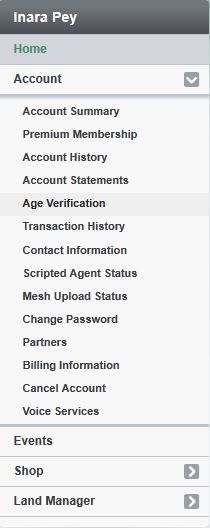
  • On the left of the Dashboard is a panel with your name at the top. In this panel are a number of options: ACCOUNT, EVENT, etc.
  • Click on ACCOUNT. This will expand a list of account-related options
  • Locate the AGE VERIFICATION option on the drop-down list (highlighted, right) and click on it
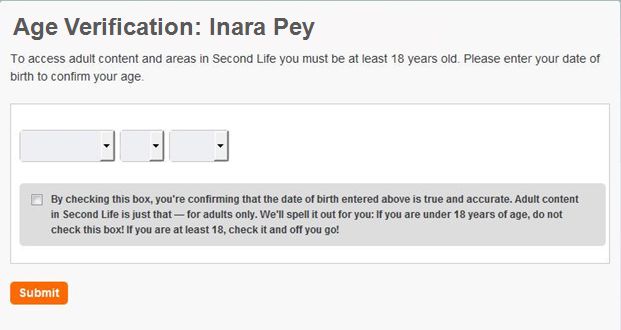
  • You will be taken to the age verification page.

The Age Verification page will display a form requesting that you confirm your date of birth (as given when you signed-up for Second Life. If, for any reason your date of birth is incorrect or doesn’t display, you can select the month, day, year by clicking the appropriate arrow button and making a selection for each from a drop-down list.

To confirm your age, make sure you click on the confirmatory check box, then click on SUBMIT. That’s it.

You’ll be taken to a page confirming you’ve been age verified with the message, “You now have access to Adult-rated areas in Second Life! time to explore. Have a great time!”, together with information on how to update your Viewer’s maturity preferences and a link to the Destination Guide.

Maturity settings are generally found under the GENERAL tab of a Viewer’s preferences, and should be set to General, Moderate, Adult (Viewer 3.x & TPVs) or PG, Mature, Adult (Viewer 1.x TPVs) to get the full benefit from Search.