The following notes were taken from the Tuesday, June 1st, 2021 Simulator User Group (SUG) meeting. These notes relate to the core points of discussion; other topics may have ben raised without specific feedback from LL as actionable items, so please refer to the video at the end of this report for the full meeting and all points covered.
Server Deployments
At the time of writing, there had (again) been no server deployment thread available for review. However:
Tuesday, June 1st saw servers on the SLS Main channel updated with simulator release 560002, containing updates to the logging infrastructure.
Wednesday, June 2nd should see the RC channels updated with simulator maintenance release 560108 that includes a new LSL function: llGetInventoryAcquireTime(), which returns the “Acquired” timestamp that inventory name was added to the object’s inventory.
SL Viewer
There have been no viewer updates to mark the start of the week. So the pipelines remain as:
Release viewer: Eau de Vie Maintenance viewer, version 6.4.18.558266, dated April 23rd, promoted April 29th.
So this is going to be a little different to my usual offerings under the Exploring Second Life tag in this blog, as it is not exactly about a “typical” region visit, nor is it a product review. However, a photo posted by Loverdag at the end of May sent me scurrying across the grid to pay a visit to a commercial build by creator Del-ka Aedilis (karport).
I say “scurrying” because I’ve been immersed in all things Tolkien since the days of my childhood, firstly via having The Hobbit read to me as a bedtime story, and then discovering The Fellowship of the Ring when I was a (very precocious) 12 (I would pass a pun here about Tolkien’s writings being Hobbit-forming, but I’ll leave that to one side). This being the case, I was hardly going to pass up the opportunity of dropping into the community of Men laid low by Smaug the dragon: Esgaroth – or Lake-town – on the waters of the Long Lake east of Mirkwood and south of Erebor, the Lonely Mountain.
Laketown – June 2021
This Laketown (to use the name given to the rezbox-enabled build) appears to be based on the visualisation of Esgaroth as seen within Peter Jackson’s (overly drawn-out) film trilogy of The Hobbit, rather than anything based on Tolkien’s own drawings of the town (which were more akin to neolithicpile dwellings than anything, whereas Jackson’s visualisation allowed for a far more adventuresome setting).
From the watchtowers overlooking the pier and drawbridge linking the town with the shore, through to what appears to be the house belonging to the Master of Lake-town, this is an exceptionally creative and flexible build that utilises both original mesh by Del-ka Aedilis and incorporates full permission kits from the likes of IvanBenjammin to fully capture the tone and spirit of lake-town as seen in Jackson’s films.
Laketown – June 2021
Set within surrounding mountains that are both too numerous to be foothills of Erebor and too close to the the flanks of the Grey Mountains or the Iron Hills but which are nevertheless a perfect setting in which to show of the town, this Laketown is ideal for photography – as Loverdag demonstrated. Even moreso, for those with the space (the build tops out at around 1,736 LI out-of-the-box and covers an area of 196 x 107 metres), this is a build ideal for any medieval or fantasy role-play, whether or not any gold, kings-under-the-mountain, dwarves or dragons are concerned.
Materials enabled, the build is supplied partially dressed with reeds and (I believe) various waterside items – boxes, barrels, etc.). Even tho the buildings are all unfurnished, its hard not to wander the boardwalks around an connecting them and here the sounds of commerce and domestic life going on along the wharves and behind the wooden walls.
Laketown – June 2021
I’m not sure how long this demonstration version of Laketown will be available – the build is apparently available at an introductory price of L$7,499 until the end of June, so perhaps it might poof after that, I’ve no idea. However, for the photographer among us, it does make for an engaging and photogenic visit!
Logos representative only and should not be seen as an endorsement / preference / recommendation
Updates from the week ending Sunday, May 30th
This summary is generally published every Monday, and is a list of SL viewer / client releases (official and TPV) made during the previous week. When reading it, please note:
It is based on my Current Viewer Releases Page, a list of all Second Life viewers and clients that are in popular use (and of which I am aware), and which are recognised as adhering to the TPV Policy. This page includes comprehensive links to download pages, blog notes, release notes, etc., as well as links to any / all reviews of specific viewers / clients made within this blog.
By its nature, this summary presented here will always be in arrears, please refer to the Current Viewer Release Page for more up-to-date information.
Note that for purposes of length, TPV test viewers, preview / beta viewers / nightly builds are generally not recorded in these summaries.
Official LL Viewers
Release viewer: Eau de Vie Maintenance viewer, version 6.4.18.558266, dated April 23, promoted April 29 – no change.
Release channel cohorts:
Love Me Render (LMR) 5 viewer updated to version 6.4.19.560171 on May 27th.
Earlier this year, and initially at the suggestion of CK (Ceakay Ballyhoo), I visited Planet Idun, a role-play / photography region developed by Fazzy Constantine (Faisel Constantine) and the Blushock role-play team, which includes CK as a member. I found it an engaging visit, as I noted in An Away Team Mission to Planet Idun in Second Life).
That visit gave me the chance to familiarise myself with the Blushock team, their backstories and role-play and the future mythology they’ve built up around their activities. It’s an acquaintanceship I was able to extend in April, when I paid a further visit to the group’s region to tour their latest build, Resilient Station, which in their developing story has become the team’s new base of operations (see: Docking at Resilient Station in Second Life).
Hoot Suite Gallery: Blushock Space Adventures
I mention all of this, because CK is also an artist, and in her latest exhibition has opened at Hoot Suite Gallery in Bellisseria (curated by the super Owl Dragonash), and it focuses on the Blushock team and their adventures within the Vanaheim star system.
As an artist, CK is perhaps best known for her regions-as-paintings installations, rich in story and always a delight to tour (see The Forest Beyond in Second Life and Niamh’s Journey of Dreams in Second Life). Here she presents a series of vivid paintings that chart the Blushock Team’s adventures across the Vanaheim system, including their time on Idun, at Jasper Point on the planet, and the worlds around the system’s blue giant star – including the discovery of Baldur, the asteroid that is now home to Resilient Station.
Hoot Suite Gallery: Blushock Space Adventures
Rich in colour and vividly portraying the locations the crew have visited – and members of the crew themselves – Blushock Space Adventures presents an engaging set of images and forms a further means of learning about the Blushock Coalition and their activities, information on which can also be found at the Blushock website.
Information on the exhibition and the team will also likely be available at the exhibition party, which will take place 12:00 noon at Hoot Suite Art Gallery, and will feature the music of Joe Paravane.
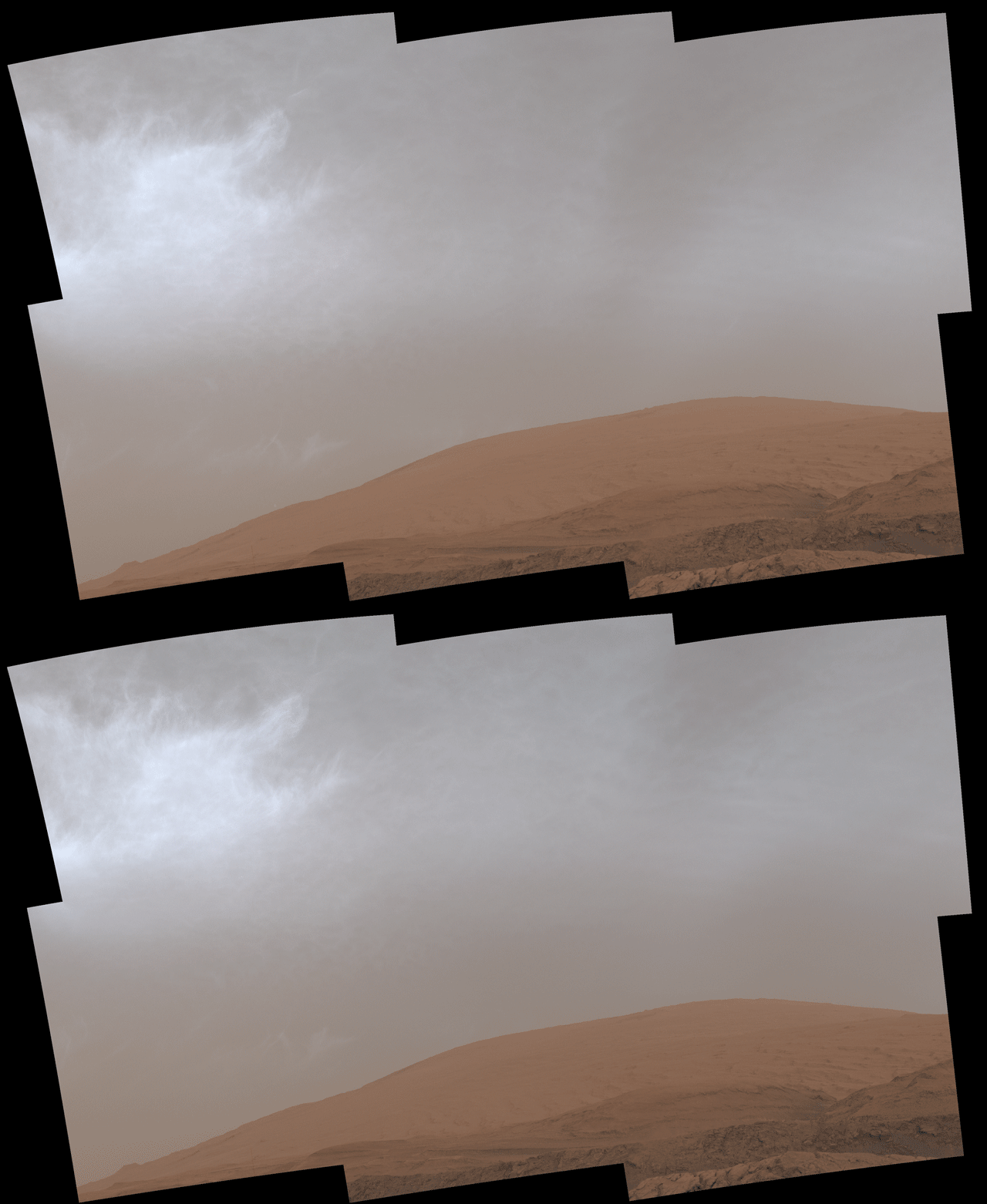
NASA’s Curiosity Mars rover captured these clouds during the twilight period on March 19, 2021, the 3,063rd Martian day, or sol, of the rover’s mission. The image is made up of 21 individual images stitched together and colour corrected so that the scene appears as it would to the human eye. The clouds are drifting over “Mont Mercou,” a cliff face that Curiosity has been studying on “Mount Sharp”. Credit: NASA/JPL
Clouds are rare on Mars, but they can form, being typically found at the planet’s equator in the coldest time of year, when Mars is the farthest from the Sun in its oval-shaped orbit. However, in 2019 – a year ago in Martian terms – the Mars Science Laboratory team managing NASA’s Curiosity rover in Gale Crater noticed the clouds there forming earlier than expected.
With the onset of winter in the region earlier in 2021, the MSL team wanted to be ready in case the same thing happened, training the rovers cameras on the sky around “Mount Sharp” to catch any evening cloud formations that might appear as the tenuous atmosphere cooled towards night-time temperatures.
Clouds moving over Mount Sharp, as captured by Curiosity on March 19th, 2021. Credit: NASA/JPL
What resulted are images of wispy puffs filled with ice crystals that scattered light from the setting Sun, some of them shimmering with colour. Visible through both the black-and-white lenses of the rover’s navigation cameras and the high-resolution lenses of the Mastcam system, the pictures captured by Curiosity might easily be mistaken for high-altitude clouds here on Earth.
And high altitude is precisely the term to use for this clouds. Most clouds on Mars largely comprise water vapour and water ice. They tend to occur some 60 km above the planet, although they can occur much lower – the massive shield volcano of Olympus Mons, for example, has oft been images with cloud formations around its flanks, the product of differing atmospheric temperature regimes on the slopes.
However, the clouds seen by Curiosity are believed to be far higher than 60 km in the Martian atmosphere, and are thought to be largely composed of frozen carbon dioxide (dry ice). They occur during the twilight hours – although the mechanism that gives rise to them is not fully understood; but they are thin enough for sunlight to pass through them, catching the ice crystals and causing them to shimmer for a time before the Sun drops below their altitude, causing them to darken. This effect gives them their name: noctilucent (“night shining”) clouds.
These clouds are best seen in the black and white images captured by the rover’s Navcams, as shown here. However, there is a second form of clouds best seen via Curiosity’s Mastcam colour images. These are iridescent, or “mother of pearl” clouds, rich in pastel colours.
Mother of Pearl clouds spotted by Curiosity in March 2021. Credit: NASA/JPL
They are the result of the cloud particles all being nearly identical in size, something that tends to happen just after the clouds have formed and have grown at the same rate. The colours are so clear, were you able to stand on Mars and look at the clouds, you’d see the shades with your naked eye, and they are another part of the beauty of Mars.
Ingenuity Hiccups During Sixth Flight
NASA’s Mars helicopter Ingenuity encountered some trouble on its sixth flight – the first flight of its extended mission – on May 22nd.
The flight should have seen the helicopter climb to a height of 10 metres, then fly some 150 metres south-west of its starting point to reach a point of interest where it would travel south for 15 metres, imaging the terrain around and below it for study by scientists on Earth, before making a return to a point close to where it lifted-off.
This image was taken from the height of 10 metres by NASA’s Ingenuity Mars helicopter during its sixth flight on May 22, 2021. Credit: NASA/JPL
The flight was designed to be the first specifically targeted at testing the helicopter’s ability to be used in support of ground operations on Mars, offering the mission team the chance to determine if the area images might be worth a future foray by the Mars 2020 Perseverance rover.
However, 54 seconds into the flight, Ingenuity suffered a glitch that interrupted the flow of images from its navigation camera to its onboard computer. This meant that each time the navigation algorithm performed a correction based on a navigation image, it was operating on the basis of incorrect information about when the image was taken, leading to incorrect assumptions about where it was and what it should be doing.
This lead to Ingenuity pitching and rolling more than 20 degrees at some points during the flight as it struggled to return to its landing zone, post-flight telemetry revealed the helicopter experienced some significant power consumption spikes. However, it maintained its flight and executed a safe landing just 5 metres from the intended touch-down point.
In a very real sense, Ingenuity muscled through the situation, and while the flight uncovered a timing vulnerability that will now have to be addressed, it also confirmed the robustness of the system in multiple ways. While we did not intentionally plan such a stressful flight, NASA now has flight data probing the outer reaches of the helicopter’s performance envelope That data will be carefully analysed in the time ahead, expanding our reservoir of knowledge about flying helicopters on Mars.
Håvard Grip, Ingenuity’s chief pilot.
Making the Moon a Busy Place
It’s starting to look like the Moon is going to be a terribly busy place. NASA’s Artemis programme is gathering pace in several areas – despite a degree of in-fighting among the principal US contractors – Russia and China have signed an accord that is liable to see them operating in the lunar south pole regions alongside the US-led mission (although the two will remain separate mission entities), whilst Canada and Japan have announced missions to the Moon as a part of the overall Artemis framework, and NASA is seeking ideas from lunar rover vehicles.
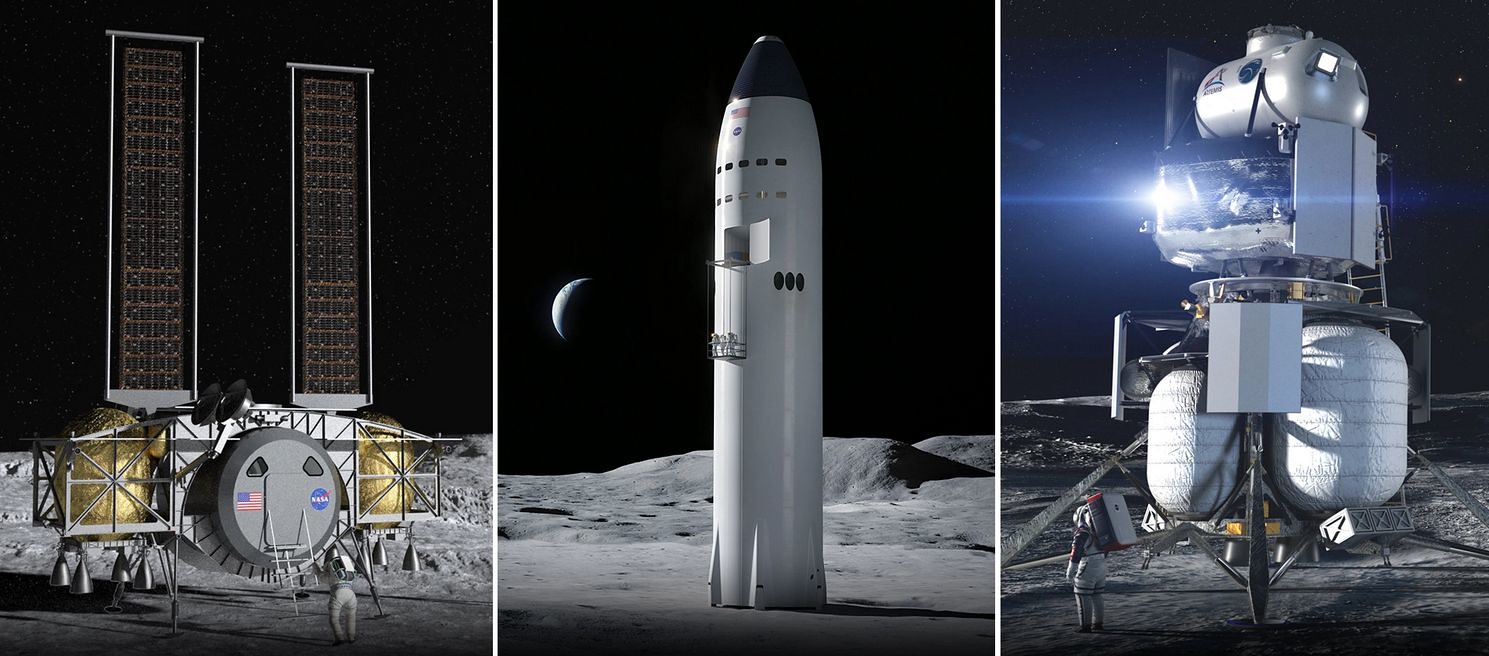
The in-fighting revolves around NASA’s April announcement that SpaceX will be granted a sole contract to develop the HLS – Human Landing System – the vehicle that will place humans on the surface of the Moon and return them to orbit. It was a contentious decision; the US agency had previously indicated that two contracts for HLS would be granted, with three players involved: a team led by Jeff Bezos’ Blue Origin, a team led by Dynetics, and the late-comer to the party, SpaceX.
The three proposals for NASA’s Human Landing System vehicles that had been under consideration for the Artemis programme. Left: the Dynetics lander / ascent vehicle; centre: the modified SpaceX Starship NASA has opted for; right: the National Team’s descent / ascent modules. Credit: NASA
There were several leading reasons for the decision – including the matter of cost. However, both Dynetics (potentially with the most flexible approach to HLS) and Blue Origin raised objections with the Government Accountability Office (GAO), which ordered NASA to cease any financial support to SpaceX (worth a total of US $2.9 billion) to the SpaceX effort until it has completed an investigation.
The US Senate has also weighed-in on the subject, with Senator Maria Cantwell (D-Wash.), chair of the Senate Commerce, Science and Transportation Committee, adding an amendment to the Endless Frontier Act which forms the backbone for financing the Artemis programme, requiring NASA put a further US $10 billion into HLS – whilst Senator Bernie Sanders (D-Vermont) went the other way by calling for the cancellation of the entire HLS programme, wrongly characterising it as the “Bezos Bailout”, and so doing what he does best; creating further division and confusion.
As it is, the GAO will release its findings on the matter in August, and while it is hard to ascertain the impact of the delay, it would likely further diminish NASA’s chances of achieving the original goal of a return to the Moon by the end of 2024.
NASA’s Nancy Grace Roman Space Telescope has been targeted for continued financial support by the Biden administration, potentially ending ill-conceived attempts by the previous administration to axe the project. Credit: NASA Goddard Space Flight Centre / CI Lab
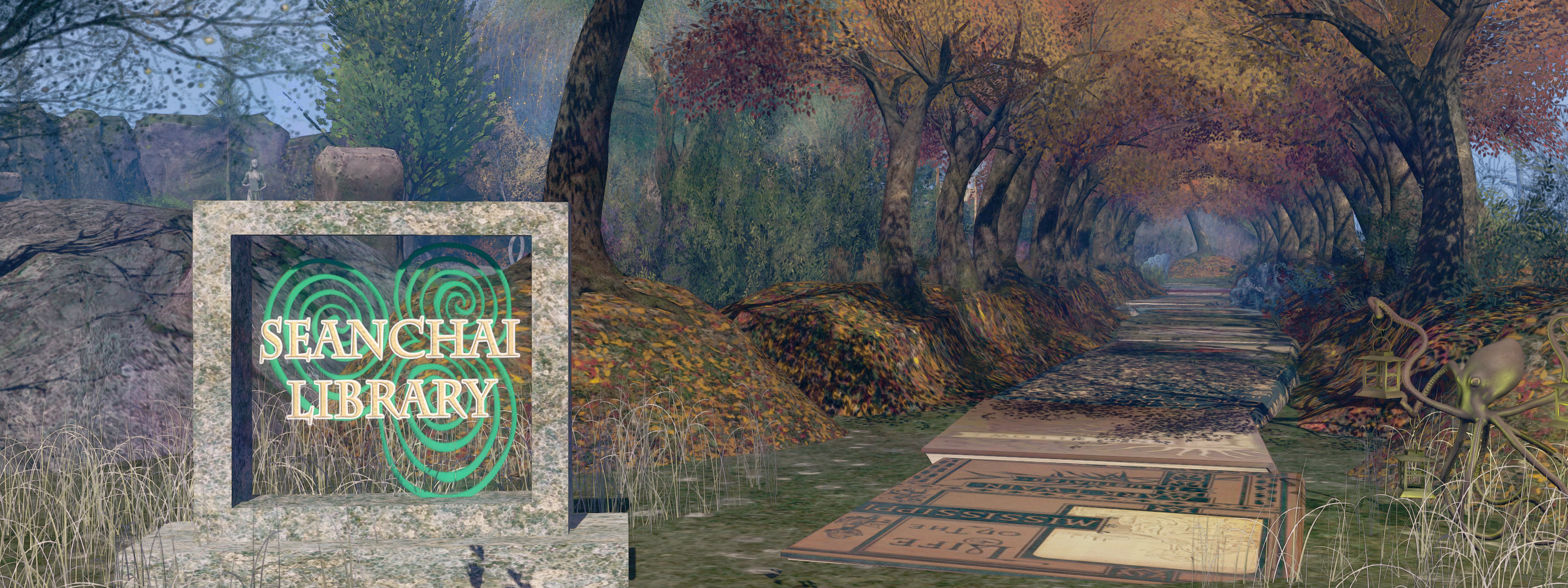
It’s time to highlight another week of storytelling in Voice by the staff and volunteers at the Seanchai Library. As always, all times SLT, and events are held at the Library’s home in Nowhereville, unless otherwise indicated. Note that the schedule below may be subject to change during the week, please refer to the Seanchai Library website for the latest information through the week.
Sunday, May 30th: 13:30 Tea-Time with L. Frank Baum
Lyman Frank Baum (May 15th, 1856 – May 6th, 1919) was an American author best known for his children’s books, particularly The Wonderful Wizard of Oz and its sequels (14 novels in all). His prolific output included 55 novels, 83 short stories, over 200 poems and at least 42 scripts.
In 1901, twelve of his stories were published in anthology form by the George M. Hill Company under the title American Fairy Tales, the move designed by Baum and his publisher to capitalise on the success of The Wonderful Wizard of Oz.
The 12 stories comprise The Box of Robbers, The Glass Dog, The Queen of Quok, The Girl Who Owned a Bear, The Enchanted Types, The Laughing Hippopotamus, The Magic Bon Bons, The Capture of Father Time, The Wonderful Pump, The Dummy That Lived, The King of the Polar Bears. and The Mandarin and the Butterfly.
All 12 are noted for the ironic or nonsensical morals attached to their ends and their satirical, glib, and tongue-in-cheek tones that gives them an appeal to adult readers. They are also the subject of Tea-Time with L. Frank Baum, with Kayden OConnell, Corwyn Allen, Glori, and Caledeonia.
Monday, May 31st
14:00: 100 Word Podcast 16th Anniversary
R. (R. Dismantled) is one of the great talents and generous hearts in Second Life. Estate owner, patron of the arts in all their forms (so much so, that I’ve had the honour of his writing gracing these pages as a guest writer), raconteur and commentator.
R is especially one of the most skilled exponents of the precise art of the drabble – a story (or a poem) that comprises exactly 100 words – no more, no less. Which may sound easy – until you’ve tried it.
After becoming immersed in the genre through witnessing the work of others, R launched the The 100 Word Stories Podcaston May 31st, 2005, promising to write a100 word story every day until the day I die. It is more than likely the longest running daily podcast of original material in the world, featuring both R.’s original stories and those recorded and submitted by listeners as a part of his weekly challenges. In addition, the podcast website is also the home for The Thank Yous,- “an open and flexible way for fans to show their appreciation for their favourite performers, artists, creators, and active residents in Second Life”, that hands down beats any awards scheme you might have come across elsewhere.
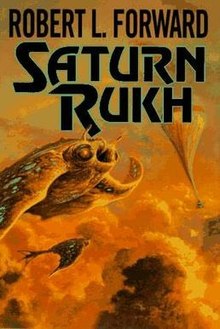
In an unspecified time in the future, a team of astronauts is sent to Saturn on what could be a one-way mission. Financed by a multi-national consortium, their mission is to establish a factory in to upper reaches of the planet’s atmosphere where it can “mine” Saturn’s abundant helium to produce “meta” (nitro-stabilised metastable helium), a powerful propellant.
If they are successful, each of the astronauts stands to earn a billion dollars on their return to Earth. The catch? They only have sufficient fuel to reach Saturn – they must use the factory to produce the fuel needed to make their return to Earth.
However, things go awry when the mission enters the Saturnian atmosphere – and crash-lands on the back of an enormous creature that “swims” through the atmosphere. Another of the creatures – which appear to be semi-intelligent and which the astronaut dub “Rukh” – swallows some of the mission’s equipment, leaving the team with no choice but to attempt to establish communications with the creatures and attempt to recover their equipment.
Join Gyro Muggins as he reads the last full-length novel by physicist and author Robert L. Forward.
It is the summer of 2013 and Abigail Kamara has been left to her own devices. This might, by those who know her, be considered a mistake.
While her cousin, police constable and apprentice wizard Peter Grant, is off in the sticks chasing unicorns Abigail is chasing her own mystery: teenagers around Hampstead Heath have been going missing but before the police can get fully engaged the teens return home – unharmed but vague about where they’ve been.
Aided only by her new friend Simon, her knowledge that magic is real and a posse of talking foxes that think they’re spies, Abigail must venture into the wilds of Hampstead to discover who is luring the teenagers and more importantly – why?
Join Corwyn Allen as he reads Ben Aaronovitch’s latest novel.
Wednesday, June 2nd, 19:00: Carl Hiaasen’s Skink
A native Floridian, Carl Hiaasen is an American journalist who focuses on political issues (notably corruption, environmental issues and other wrong-doings) within his home state. Starting his career in the 1970s , he became renowned for being exceptionally outspoken – even against his own employers.
Carl Hiaasen. Credit: Joe Rimkus Jr.
During the 1980s, he started writing fiction in his spare time, achieving initial success with three co-authored novels published between 1981 and 1984, as well as writing several non-fiction titles.
In 1987, his second novel, Double Whammy introduced the “trailer park star tenant” and private eye, C.J. Decker, which Hiaasen fondly refers to as “the first (and possibly only) novel ever written about sex, murder and corruption on the professional bass-fishing tour.” Among the cast of characters mixed into Double Whammy is one Clinton Tyree, the one-time governor of Florida, who abandoned his office and now lives as a outdoorsman (and partaker of roadkill cuisine) in the Everglades and the Florida Keys, using the pseudonym Skink.
Skink went on to become a recurring character in a further seven of Hiaasen’s novels to date, with all the books in which he features being gathered together under the general title of SKINK, with several of them being been among the 20+ works of fiction and non-fiction by Hiaasen to appear on the New York Times best-seller list.
Join Kayden Oconnell as he continues a journey with Hiaasen’s characters.
Thursday, June 3rd:
19:00: Little Fuzzy
Ktadhn Vesuvino reads the book by H. Beam Piper that spawned a series by him and other science fiction authors about a small, furry species dubbed Fuzzies.
Little Fuzzy charts the discovery of small furry species on the planet Zarathustra and the attempts by humans to determine whether or not they are sentient. If they are, then their planet will be declared a protect aboriginal world. However, The Company has desires to control the planet and its resources.
21:00: Seanchai Late Night
Contemporary Sci-Fi-Fantasy with Finn Zeddmore.
Friday, June 4th 14:30: Terry Pratchett’s Unseen Academicals
Football in Ankh-Morpork is not as we might know it. Rather than being comprised of rules and played within a recognisable ground, it is far more akin to the somewhat violent mob football of medieval Europe.
Not that this is a concern for the elderly, mostly indolent and (some might be tempted to think) somewhat inept old wizards making up the faculty staff at the city’s school of wizardry, the Unseen University. Until, that is, their very handsome annual endowment becomes subject to their playing the game themselves.
Thus, Archchancellor Mustrum Ridcully sets out a two-pronged strategy: to ensure the city’s version of football is restructured with proper (and favourable?) rules, and to put team preparations at the university in the hands of the talented candle dribbler, Mr. Nutt and his assistant, Trevor Likely, the son of the city’s most famous (if deceased – did I mention the game can be violent?) player, who are in turn supported by Glenda Sugarbean, who runs the university’s night kitchen and her assistant Juliet Stollop.
Except Mr. Nutt soon discovers he has problems of his own to deal with, and Trevor has promised his Mum he’ll never get involved in the game. Meanwhile, Glenda has the daily responsibility of baking the Discworld’s best pies, and Juliet is about to find herself whisked towards the heights of fame as a fashion model, thus potentially leaving the team a little short on practical advice…
Join Caledonia Skytower as she presents the 37th novel in the Discworld series, and possibly one of its greatest satirical undetakings encompassing football, academia, traditions, the fashion industry, politics, love, fandom, and which mixes in more serious themes of identity, crab mentality and self-worth.












 Inara Pey: Living in a Modemworld