The Top menu and LL sub-menu on this blog have been revised – see below for details
I’ve had a handful of comments over the last week concerning further small changes to the blog – notably the header, but also about navigation via the menus, so I thought it was time to offer a note on changes.
The new blog banner is a composite image kindly put together by Sonotech Gloom, and hopefully offers something just that little bit different with its suggestion of stepping through a teleport portal.
Sono is someone who is great fun to be around, but more importantly in this context, is a talented graphics designer. If you have a logo or banner you want for your website, your SL store, your event, etc., you really should give her a shout and discuss ideas / rates. My thanks to her for working with me on various banner ideas.
Turning to navigation: I’m always trying to rationalise the blog’s menu system whilst trying to ensure popular information remains accessible. To this end, I introduced some new “Archive” options to some of the sub-menus (Exploring Second Life, RFL, SLB, etc.) at the end of 2020, the idea being to keep the current (and perhaps previous) year’s entries easily accessible, whilst reducing the overall bulk of a menu. However, the tag cloud and search can help focus down on specific subject areas, if required.
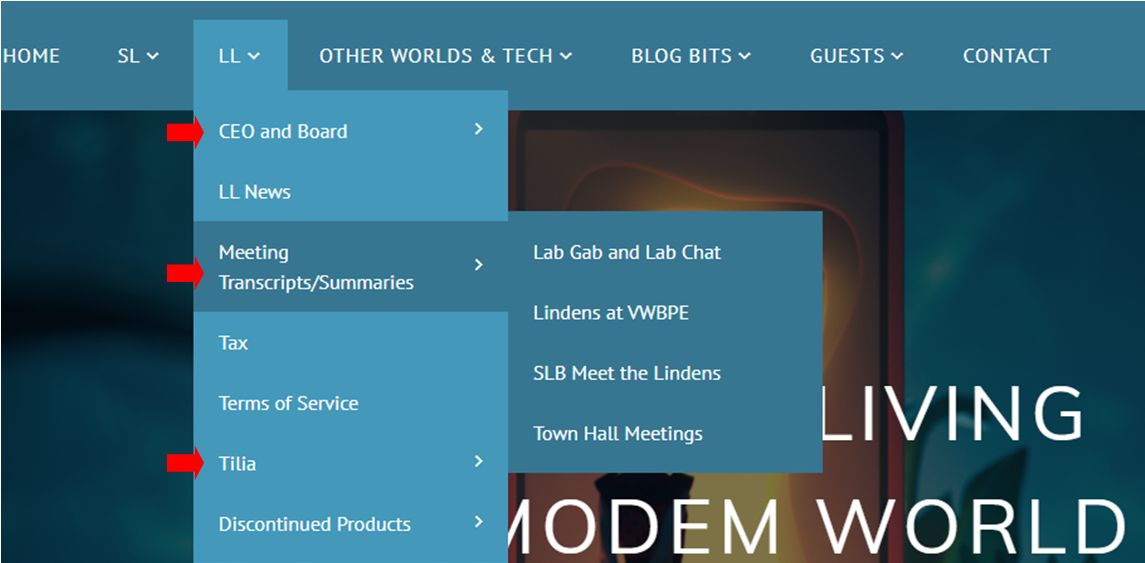
More recently, I’ve rationalised the LL menu tree thus:
An updated sub-menu option provides access to articles on the Lab’s board and current / plus past CEOs.
Tilia Pay is now included under the LL menu, rather than having its top menu option.
An expanded Meeting Transcripts/Summary option provides to all transcripts and summaries I’ve provided on significant meetings / keynotes / presentations by members of the Lab’s management team. This includes (at the time of writing) the following sub-menu options:
Lab Gab / Lab Chat.
Lindens at VWBPE.
SLB Meet the Lindens.
Town Hall meetings.
Hopefully, all this helps reduces some of the clutter and noise in the menus and give a bit more room for expansion, should it bee needed in the future.
On Friday, June 4th, Linden Lab announced that the company’s CEO, Ebbe Altberg had passed away. Across the grid and blogsphere, tributes and obituaries have been offered in the wake of the news.
Ebbe Altberg memorial
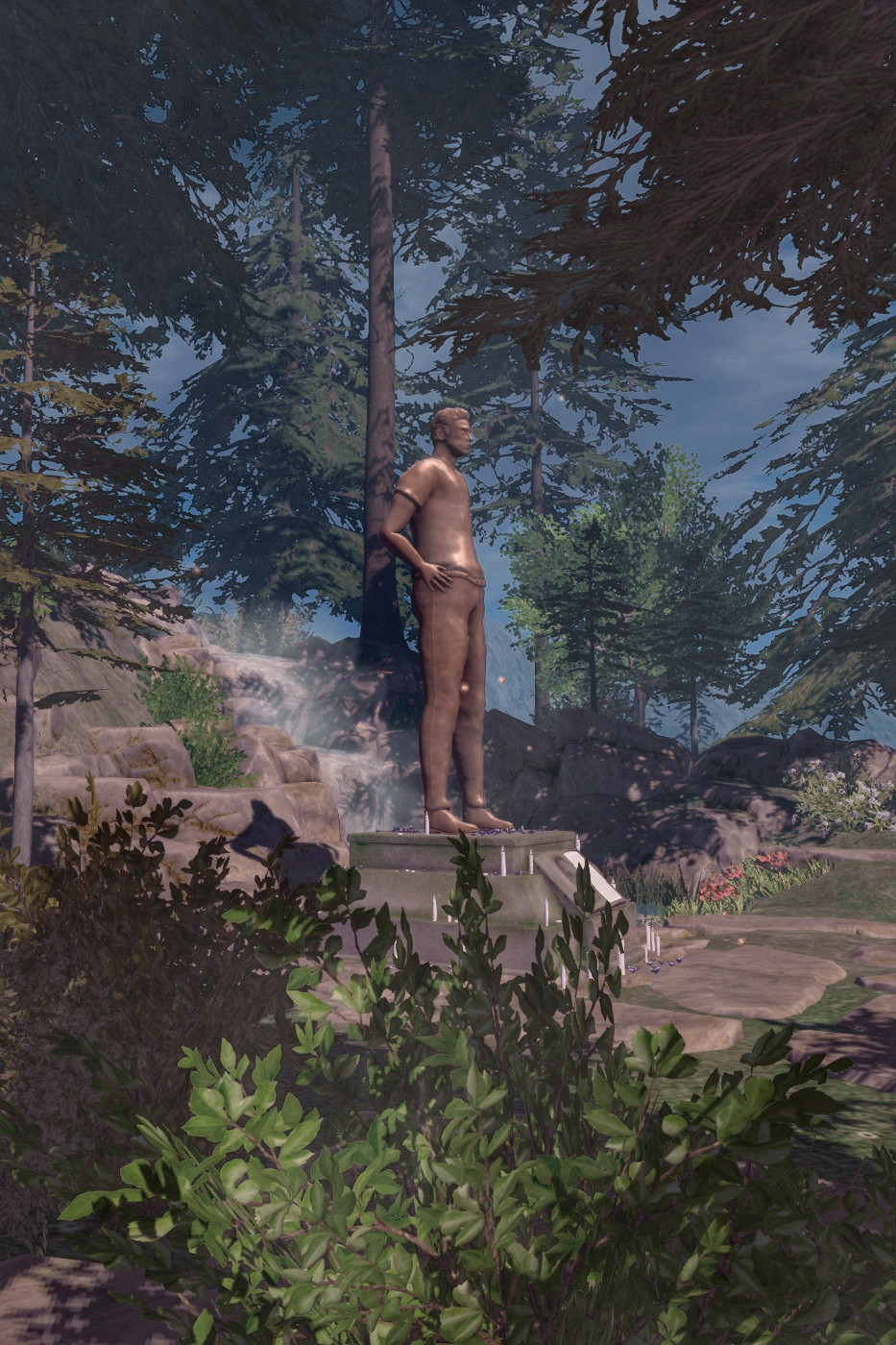
Now, for those who wish to commemorate Ebbe’s time with the Lab and pay respects to his memory in-world, a memorial has been created on – appropriately – Altberg region in Bellisseria.
Designed by the Moles of the LDPW, the region features a single island that is home to the memorial. Surrounded by fir trees offering a hint of Scandinavia, with water falling into a pond that feeds flowers, the memorial stands as a tall bronze figure of Ebbe, with a photo of him and the text of announcement of his passing located at the base of the plinth.
Candles are also to be found at the base of the statue, which will light on being touched, and benches are available for those who wish to sit and remember Ebbe and his time at the Lab.
The island is a gentle, quiet place; a place one cannot help but feel Ebbe himself would appreciate. A place where contemplation and reflection can be embraced.
So, for all those who do wish to pay their respects to Ebbe in-world, I can think of no better place in which to do so.
The base of the statue includes the test of the announcement of Ebbe’s passing (l), while the memorial has been drawing a steady stream of visitors (r)
With thanks to the Moles for creating the memorial.
Note: as Tish Coronet has pointed out via the SL Feeds, be sure to look down on the memorial from overhead – the ground before Ebbe’s has been set memorial has actually been set out to form the Second Life Hand logo, the statue replacing the eye.
The Second Life 18th Birthday event is almost upon us, and it promises to be a time of celebration, and also of remembrance and sadness following recent news.
Given all that has happened since the start of the year – the acquisition of the Lab by a new Board; the arrival of Board member Brad Oberwager as the management team Executive Chair and his long-time business associate, Cammy Bergren as the Lab’s Chief of Staff; the sad news concerning Ebbe Altberg; the on-going technical work on Second Life, the upcoming “new” New User Experience, and so on – many SL residents are doubtless a-buzz with questions.
To this end, and as announced on Thursday, June 10th, Linden Lab will be holding a special Lab Gab session, hosted by Strawberry Linden. She’ll be putting questions to the Lab’s leadership team of Grumpity Linden, Brett Linden and Patch Linden – and there is still time for people to submit questions.
If there is something you’d like to ask of the team, simply hop over to the submission form, type in in and send it off. But hurry – the form will be closed some time on Tuesday, June 15th, 2021.
The show itself will be live streamed via the Second Life YouTube channel. on Monday, June 21st, starting at 14:00 SLT. If all goes according to plan, I’ll have a summary of the session on this blog after the event.
Logos representative only and should not be seen as an endorsement / preference / recommendation
Updates from the week ending Sunday, June 13th
This summary is generally published every Monday, and is a list of SL viewer / client releases (official and TPV) made during the previous week. When reading it, please note:
It is based on my Current Viewer Releases Page, a list of all Second Life viewers and clients that are in popular use (and of which I am aware), and which are recognised as adhering to the TPV Policy. This page includes comprehensive links to download pages, blog notes, release notes, etc., as well as links to any / all reviews of specific viewers / clients made within this blog.
By its nature, this summary presented here will always be in arrears, please refer to the Current Viewer Release Page for more up-to-date information.
Note that for purposes of length, TPV test viewers, preview / beta viewers / nightly builds are generally not recorded in these summaries.
Official LL Viewers
Release viewer: Love Me Render (LMR) 5, version 6.4.19.560171, dated May 27th, promoted June 7th – NEW,
Release channel cohorts:
Project UI RC viewer updated to version 6.4.20.560422, on June 8th.
Grauland Falls Art Park, June 2021 – click any image for full size
I first visited Grauland, the Homestead region held by by JimGarand and home (in the sky) to his M-1 Art Pose business in March 2019. At the time, I was immediately struck by its genuine uniqueness, offering an environment that expresses art as a landscape.
Since that time, Jim has continually revised the region on a regular cycle of iterations, some of which have continued that idea of art-as-landscape, others of which might be regarded as more “natural” settings – tropical beaches, oriental gardens, deserts – all of which have been highly engaging and kept me returning to the region to write about many of them.
Grauland Falls Art Park, June 2021For the iteration I visited in June, Jim has returned the region to what, for me at least, is its roots – a setting in which art plays an important role in expressing the overall landscape.
Rapidly dropping from eastern highlands marked by a high peak and a curtain of cliffs backed by high mountains, the region is immediately visually engaging; the peak giving birth to falls that in turn feed the streams that break up the lowlands as they flow out to the surrounding waters.
Grauland Falls Art Park, June 2021
Rugged and attractive, with western and northern bays watched over by a ranger’s watchtower to the north-west, two tidy woodland areas and a scattering of buildings, the landscape is highly photogenic. However, it is what is to be found within it that captures the eye.
From obelisks through the familiar concrete blocks to statues, tiered gardens and totems, the art to be found throughout the region fits neatly and elegantly into the setting, bringing it naturally to life.
Grauland Falls Art Park, June 2021
As an art park, the setting is laid out as a place one travel to in order to visit: the landing point is presented as a cark park, the road running from it vanishing into a tunnel that appears to pass under the mountains to connect the part with the rest of the world. It sits bounded on two sides by the remnants of what might have once been a complete costal fortification built during the last world war, but which now stand with gaping windows and walls that have in part started to lean somewhat as their foundations have settled.
Forming the entrance to the park, the great blanks walls of this ruin also naturally lend themselves as a part of the park’s artistic statement, providing access to the tiered gardens that form the starting point for explorations.
Grauland Falls Art Park, June 2021
From the gardens with their cobbled paths, visitors can roam where they please – as indicated by the static characters already in the region that add a further sense of it being a a popular place to visit. A single path does offer a route from the landing point, one that passes over the region’s three bridges – which also very much form part of the art statement. These bridges lead the way to the largest complete building on the region, a boxy unit offered as something of a meeting / relaxing space.
Jim’s designs are always engaging and a pleasure to visit, but I admit to finding this iteration particularly engaging. There’s that sense of returning to the focus of early iterations of the region whilst retaining a completely unique look and feel.
Grauland Falls Art Park, June 2021
With photographic opportunities can be found throughout, and the 3D art elements bringing a richness to the environment that encourages the visitor to remain, explore and appreciate, Grauland Falls Art Park is not to be missed.
You would be forgiven for thinking the banner image for this update is an artist’s impression of China’s Zhurong rover and its lander on Mars. But you’d be wrong – the image really was taken on Mars.
It is part of a batch of images the China National Space Administration (CNSA) have released charting the recent activities of their rover on the Red planet, and they are as remarkable as anything seen with the US rover vehicles, with others showing panoramic views around the rover and shots of its lander vehicle.
The Zhurong lander, part of China’s Tianwen-1 Mars mission., as seen from the rover vehicle at a distance of some 6 metres. Credit: CNSA
Captured on June 8th, the image of rover and lander was taken by a remote camera originally stowed in Zhurong’s belly, and which had been safely deposited on the surface of Mars some 10 metres from the lander, allowing mission control to remote capture the unique sight of a rover and its lander side-by-side.
Zhurong has now completed the first third of its initial 90-day mission on Mars, and is well into its survey of its surroundings within Utopia Planitia. In addition to the high-resolution cameras, used to produce these images, the rover is fitted with a subsurface radar instrument, a multi-spectral camera and surface composition detector, a magnetic field detector and a weather monitor.
A 360 panorama of the Zhurong landing site, captured by the Chinese rover prior to is descent from the back of its lander. Credit; CNSA
Ahead of the images released by CNSA, NASA released their own image of the Chinese rover and lander as seen by the HiRISE camera on the Mars Reconnaissance Orbiter from an altitude of around 400 km.
Taken on June 6th, three weeks after Zhurong touched-down, the image clearly shows green-tinted lander (a result of the image processing, not the actual colour of the lander) sitting between two areas of surface material discoloured by the thrust of the lander’s outward-angled descent and landing motors. Zhurong itself can be seen a short way south of the lander, within the eastern arc of discolouration.
Captured by the HiRISE imager on NASA’s Mars Reconnaissance Orbiter on June 6th, this image shows the Zhurong lander surrounded by surface material discoloured by the lander’s rocket motors, with the rover sitting just to the south. Credit: NASA/JPL
And turning to NASA’s surface mission on Mars (specifically Mars 2020): on June 8th, the Ingenuity helicopter completed a 7th flight, this one error-free.
Lifting off at around 12:34 local mean solar time (roughly 15:54 UTC on Earth) proceeded south during the 63-second flight, covering a distance of around 106 metres before touching down at a new location.
Ingenuity captured this image of its shadow passing over the surface of Mars on June 8th, 2021 during its 7th flight. Credit: NASA/JPL
In difference to the 6th flight on May 22nd, which saw the helicopter encounter some anomalies (see: Space Sunday: Martian Clouds, Lunar missions and a Space Station), the seventh flight was completed with incident, once again raising confidence that the helicopter will be able to continue flying several more times.
Overlaid onto an image be NASA’s Mars Reconnaissance Orbiter are the routes for the first and second science sorties to be made by Perseverance. Credit: NASA/JPL
Now regarded as fully commissioned, Perseverance has put its duties as caretaker-watcher for Ingenuity largely behind it, as is now driving south and away its landing zone on its way to study a 4 square kilometre of crater floor, where it will examine two very different geological units and collect samples for analysis and for storage and possible return to Earth as part of a future mission.
“Crater Floor Fractured Rough” is a region of ancient bedrock, whilst “Séítah” (Navajo for “amidst the sand”) presents a mix of bedrock overlaid with more recent ridges and also sand dunes. The rover will perform a gentle loop through these areas, visiting “Crater Floor Fractured Rough” first then travelling through the ridgelands and then back up through “Séítah S” and Séítah N”, before heading for its next target, an area dubbed “Three Fours”.
ESA Looks to Venus and the Outer Planets
The European Space Agency has announced its goals for the next several decades in terms of robotic exploration of the solar system and cosmic science.
Announce on June 10th, the EnVision mission will carry a suite of spectrometers, sounders and a radar to study the interior, surface and atmosphere of Venus. The target launch period is May 2032, with the vehicle arriving in orbit around Venus in August 2033, where it will use the planet’s upper atmosphere to aerobrake into its final science orbit over a 3-year period, before commencing its four-year primary mission. It is expected to cost around 500 million Euros.
ESA plans to further extend our knowledge and understanding of Venus with the EnVision mission, due to launch in 2032. Credit: ESA
While there has been no coordination between NASA and ESA in terms of mission selection, EnVision’s science mission is highly complementary to the two NASA missions – VERITAS and DAVINCI+ – also recently announced, covering aspects of Venus science they do not. Further, ESA will be flying science packages on VERITAS, and NASA will be providing the synthetic aperture radar for EnVision.
EnVision is the fifth M-class mission ESA has selected as part of the Cosmic Vision program. The first, Solar Orbiter, was launched in February 2020, and three others are in development: Euclid, a mission to map dark matter and dark energy to launch in 2022; Plato, an exoplanet search mission launching in 2026; and Ariel, an exoplanet characterisation mission launching in 2029.
In addition To EnVision, ESA intends to spend the next several decades developing missions to follow after the Jupiter Icy Moons Explorer, that will help assess the habitability of the icy moons in the outer solar system and seek any biosignatures they may have. At the same time ESA intends to support further science endeavours aimed at increasing our understanding of our own galaxy and the likely state and development of the early universe.






 Inara Pey: Living in a Modemworld