A little while ago now, I dropped in on the Butterfly Conservatory to grab a landmark with a view to a possible future blog post – and then promptly let it slip from my mind after filing it. Fortunately for me, there’s the weekly Destination Highlights, and the April 14th edition served as an aide-memoire, prompting me to suggested to Caitlyn we hop over and have a look around.
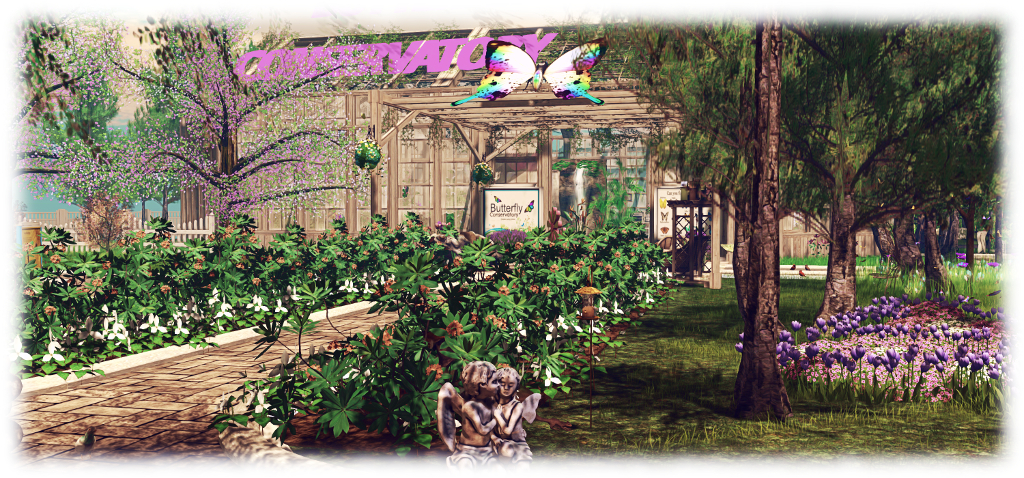
The work of Ry Heslop and Kacey Heslop (Kacey Delicioso), the Butterfly Conservatory occupies one half of a sky platform above their full region home, where it is located within a delightful garden suited to a range of viewer-side windlights.
From the landing point visitors can follow the footpaths around the garden, either going directly to the conservatory, or taking a more extended walk among the trees and flowers. Along the way they can learn about owls, discover some of Ry Heslop’s photography (offered for sale), find places to sit and enjoy the setting, visit a behind glass collections of bugs and delve into the world of bees and honey.
The gardens are nicely laid out, the meandering path giving a feeling of size beyond that of the space it occupies, with the various points of interest well spaced out along it. The latter helps prevent any feeling of having a wall of information thrown at you every few metres.The display of creepy-crawlies is nicely presented, each of the bugs in its own case; the models are understandably oversized so thy can be studied more easily. The bee display is also nicely laid out, with hives and flowers and bees industriously buzzing around.
Throughout all of this, little groups of butterflies can be found, circling plants and reminding us of the central theme of the gardens. The conservatory itself challenges visitors to find various families of butterfly among the plants within its walls. There are also information boards detailing the life cycle, anatomy and diet of the butterfly – although it would be nice to perhaps see a little more information on the individual families of butterfly represented.
A couple of other minor niggles also occurred. While having in-world display boards maintains a feeling of immersion, some might find them difficult to read. So providing an option for people to gain the info via note card might not go amiss. Also, while we’re warned that bees are endangered / critical to human life and challenged to help save them, we’re not told why (they are responsible for pollinating 70 of the 100 top crop species that feed 90% of the world) or how, thus the warning and challenge are diminished somewhat.
Even so, the Butterfly Conservatory makes for an enjoyable and informative visit. It presents a nicely relaxed environment with plenty to see and appreciate. So, if you’re looking for something just that little bit different to visit and explore, we can recommend a visit.
A dramatic plume sprays water ice and vapor from the south polar region of Saturn’s moon Enceladus. Cassini’s first hint of this plume came during the spacecraft’s first close flyby of the icy moon on February 17, 2005. Credit: NASA/JPL / Space Science Institute
I’ve written a lot of late about Saturn’s icy moon, Enceladus. Covered by an icy crust, there is a good chance this distant moon harbours a liquid water ocean beneath that ice. NASA’s Cassini mission has imaged geyser plumes erupting through the ice, and the speculation is that if Enceladus does have an ocean beneath its crust. Now that speculation has been given a sizeable boost.
As a result of a long-term study, on April 13th, 2017 NASA announced the icy plumes of Enceladus contain hydrogen. This is a huge finding; not only does this main the plumes are water vapour, it directly points to a geo-chemical / geo-thermal interaction taking place deep within Enceladus between warm water and rocks which could provide an energy source of microbes.
Current thinking is that life requires three things to get started: water, energy, and the right chemicals. As we know from Earth’s deep oceans, sunlight doesn’t actually enter into the equation; hydrothermal vents provide the energy to support – albeit on a fragile basis – an entire ecosystem from bacteria at the base of the food chain, through tube worms, shrimp, crabs and more. This could well be the case with Enceladus.
As the hydrogen is vented, it is possible that any microbes present in the water of Enceladus could use hydrogen and dissolved carbon dioxide in the water to produce methane in a process called biomethanation (or methanogenesis), one of the foundation processes of life on Earth.
The hydrogen was measured using Cassini’s Ion and Neutral Mass Spectrometer (INMS) instrument. Designed to sample the upper atmosphere of Saturn’s moon Titan, INMS was turned towards Enceladus to follow-up on several discoveries of plumes emanating from the moon’s southern regions dating back as far as 2005.
“This is the closest we’ve come, so far, to identifying a place with some of the ingredients needed for a habitable environment,” Thomas Zurbuchen, associate administrator for NASA’s Science Mission Directorate stated in reference to the report.
Linda Spilker, Cassini project scientist at NASA’s Jet Propulsion Laboratory added, “Confirmation that the chemical energy for life exists within the ocean of a small moon of Saturn is an important milestone in our search for habitable worlds beyond Earth.”
NASA’s Orion / SLS Ambitions Face Delays
In February I wrote about NASA possibly re-scheduling the first flights of their new Space Launch (SLS) rocket system so that the maiden flight could include a crew aboard the Orion Multiple-Purpose Crew Vehicle due to fly as a part of the mission, rather than flying it as an uncrewed mission, and then flying a crew on a second later mission.
Such a move would mean the initial flight of SLS, referred to as Exploration Mission 1 (EM-1), would need to be put back from 2018 to 2019 (at the earliest), to allow time for the Orion vehicle to be correctly outfitted and tested for a crewed mission. However, a new report from NASA indicates that Orion itself may not be ready in time to meet and EM-1 launch in either 2018 or 2019.
The Orion MPCV with its European Service Module (the section with the four solar panels), attached to a propulsion stage in Earth orbit. The Service Module is one part of the system facing delays, according to a NASA report. Credit: NASA
The report, published on April 14th, 2017, highlights three significant areas of concern for the programme. The first is that design changes made to Orion’s heat shield now raise technical risks which need to be eliminated. The second is that the Service Module for Orion, which is being developed by the European Space Agency, is facing delays. The third – which is particularly underlined in the report, is that critical software required by both the SLS / SLS systems and need for ground systems at the Kennedy Space Centre in Florida, will not be ready in time.
As a result of the report, NASA is now weighing pushing back the SLS / Orion launch schedule. Nor do the programme’s woes end there; the report also questions NASA’s ability to achieve its longer-term goals with regards to SLS, Orion and Mars, citing the fact that there is no clear roadmap for developing systems (such as a deep-space habitat module, lander / ascent vehicles, etc.) vital for Mars missions.
Without such a roadmap being put in place within the next few years, the report indicates it will be impossible to tell if planned Orion / SLS project expenditure – which is slated to rise to US $23 billion in 2018 and to US $33 billion (including Mars systems expenditure) by 2030 – will be sufficient for the space agency to meet its goals.
It’s time to kick-off another week of storytelling in Voice by the staff and volunteers at the Seanchai Library. As always, all times SLT, and events are held at the Library’s Second Life home at Bradley University, unless otherwise indicated.
Sunday, April 16th 1:30: Easter Brunch
There’s a table just waiting for you: orange juice, sweet rolls, and maybe even a brightly colored egg or two. No doubt there will be something chocolate! Grab a seat, and welcome Spring as Cale shares selections from Kenneth Grahame’s delightful Dream Days stories, live in voice.
Monday, April 17th 19:00: Miss Prinks
Gyro Muggins brings us this short story by Gordon R. Dickson. First published in 1954 in the June edition of The Magazine of Fantasy and Science Fiction, it has subsequently appeared in various collections such as The Mutants (1970), Mindspan (1993) and The Best of Gordon R. Dickson.
When the clock struck thirteen o’clock on her apartment’s grandfather clock, Miss Prinks, every inch a lady, thought it queer. However, the very mannerly scientist from the eighty-third Zanch dimension who materialized in her living room explained it quite clearly and, on his sudden departure, made several improvements on her condition. With her condition improved, Miss Prinks, in all regards a lady, leapt out of the building, over a train, and into the atmosphere.
Tuesday, April 18th 19:00: Of Mice and Magic
Faerie Maven-Pralou reads the first in the Ravenspell series by David Farland
More than anything, Benjamin Ravenspell wants a pet. But when he buys a mouse named Amber, he gets more than he bargained for. No sooner does Ben take her home, than Amber turns him into a mouse too.
You see, Amber has magical abilities, and it so happens that Ben is a familiar, a creature that stores magical energy. Together they each form half of a powerful wizard. Alone, they’re just vermin.
Soon Ben and Amber find themselves pitted in an epic battle against a magical enemy who is as crazed as he is evil, and the fate of the world will rest on them learning to work together.
Wednesday, April 19th 19:00: The Atrocity Archives Part 2
Bob Howard is a low-level techie working for The Laundry, a super-secret government agency. While his colleagues are out saving the world, Bob’s under a desk restoring lost data. None of them receive any thanks for the jobs they do, but at least a techie doesn’t risk getting shot or eaten in the line of duty. Bob’s world is dull but safe, and that’s the way it should have stayed; but then he went and got Noticed.
Now, Bob Howard is up to his neck in spycraft, alternative universes, dimension-hopping Nazis, Middle Eastern terrorists, damsels in distress, ancient Lovecraftian horror and the end of the world.
Only one thing is certain: it will take more than control-alt-delete to sort this mess out…
Join Corwyn Allen as he resumes relating stories involving Charles Stross’ unlikely hero, Bob Howard.
Thursday, April 20th
19:00: Monster and Myth: The Chimera Part 1
With Shandon Loring from the 2017 Fantasy Faire as a part of the LitFest. Check the Seanchai blog for the SLurl nearer the time. Also presented in Kitely.
Now open at DixMix Gallery is an ensemble presentation of art entitled Switch on the Lights, which appears to be wither sponsored by, or a co-presentation with, LUMIPro, the commercial photography lighting system, and the first to use projection prim capabilities.
So far as I can tell, the participating artists are Jr Feiri, Reneesme Portland, xxstanislasxx resident, Kimma, Cyrece Delicioso, Angi Manners, DixMix Source, Trixie Pinelli, Toxic Valentine, Sedona Silverpath, Peep Sideshow Darkward, Tazara Bailey, Kira Ragged, Scarlett Rhea, Ornella Batriani, Space Hurricane, Ilke Huygens, Freekency Banx, Wiwi Swot, Marleine Magic, Kevin De’Cypher, Bettina, Ember Wulluf, Calypso Keng, Fleur Imagines SL, U.Sabra, Sedona Silverpath and Abi Latzo.
As one might expect with LUMIPro’s involvement, the majority of the pieces in the exhibition are avatar studies. However, if I sound a little uncertain about this display, it’s because the information relating to it is less than forthcoming. The invitation I received contained only the Gallery’s landmark and a note card advertising LUMIPro. There is a similar dearth of information actually at the gallery as well. Thus I had to resort to editing each image to grab the artist’s name. Not ideal when reviewing.
There are other minor annoyances as well. The exhibition is referred to as “selected photographies” – but how were they selected and what role did LUMIPro play in it? Given some artists appear to have only one piece submitted, others 2 or 3, what criteria were employed in the selection process? Did some artists only submit the one piece, and other several? Were submissions adjudicated? If so, how? And so on.
These may sound like minor niggles, but having this information to hand can add depth to an exhibit, whether or not you are reviewing it; and it’s not as if providing background notes is a particularly difficult task. As it is, the lack of available information does diminish the exhibition somewhat.
Which is a shame, as this is a striking exhibition. I was particularly drawn to the wall-sized format images, such as Crisis by U Sabra, and Marita Karu pileup by Jr Feiri (above) – which I found utterly mesmerizing. The range of styles and subject presented (colour, monochrome, individual, couples; indoor, outdoor, nude, dressed, etc), is equally eye-catching, drawing one into the exhibition. Given this, it is possible to look past the niggles and appreciate the exhibition as very much worth viewing.
2016 was the year of virtual hype whereas 2017 is the year of actual realities, in terms of what is achievable from a business sense related to market size, opportunities and potential revenues. Should developers or publishers get involved now? Absolutely but with an intelligent approach and realistic expectations of what these early days sales returns could be.
So considers Sam Watts, director of immersive technologies at Make Real, in a comment quoted by Jem Alexander, in the first part of his series penned for Develop looking at the hype, tech, hope, hang-ups and potentials of Virtual Reality.
Jem Alexander
The piece stands as a reasoned look beyond the hype of VR’s 2016 rebirth, thanks to the arrival of the Oculus Rift, HTC Vive, Cardboard, Daydream, Gear VR and – perhaps most importantly of all, at least in terms of sales – Playstation VR.
Yes, there has been a lot of hype, which the first year of consumer facing VR really hasn’t matched. Some have seen this as cause to deride the VR movement as a whole, relegating it to the role of “fad” – which in itself is perhaps a tad premature.
In writing this two-part series, Jem Alexander avoids both extremes and instead offers a discussion which is reasonably balanced and reasoned – and offers a perspective from many of those at the sharp end of the industry. In the first part, entitled Where are we now, they offer an honest assessment of the market which is both positive while carrying a solid note of caution for those considering taking the VR plunge, as shown in the quote from Sam Watts, above.
There are several reasons why VR’s first year hasn’t lived up to the hype. For a start, the hardware isn’t exactly off-the-shelf, as those talking to Alexander notes. There’s plenty of room for improvements in the tech and the quality of the experience and offer it at a much lower price-point than today. Thus, taking the first year’s sale figures as being indicative of VR’s future is liable to be misleading.
The approach taken by some of the big manufacturers also didn’t help: when the Vive and Oculus launched their supporting ecosystem of games and applications was comparatively weak. Only Sony really offered a substantive ecosystem for the Playstation – and even this was derided in some sections of the VR media for being “merely” VR ports of existing games.
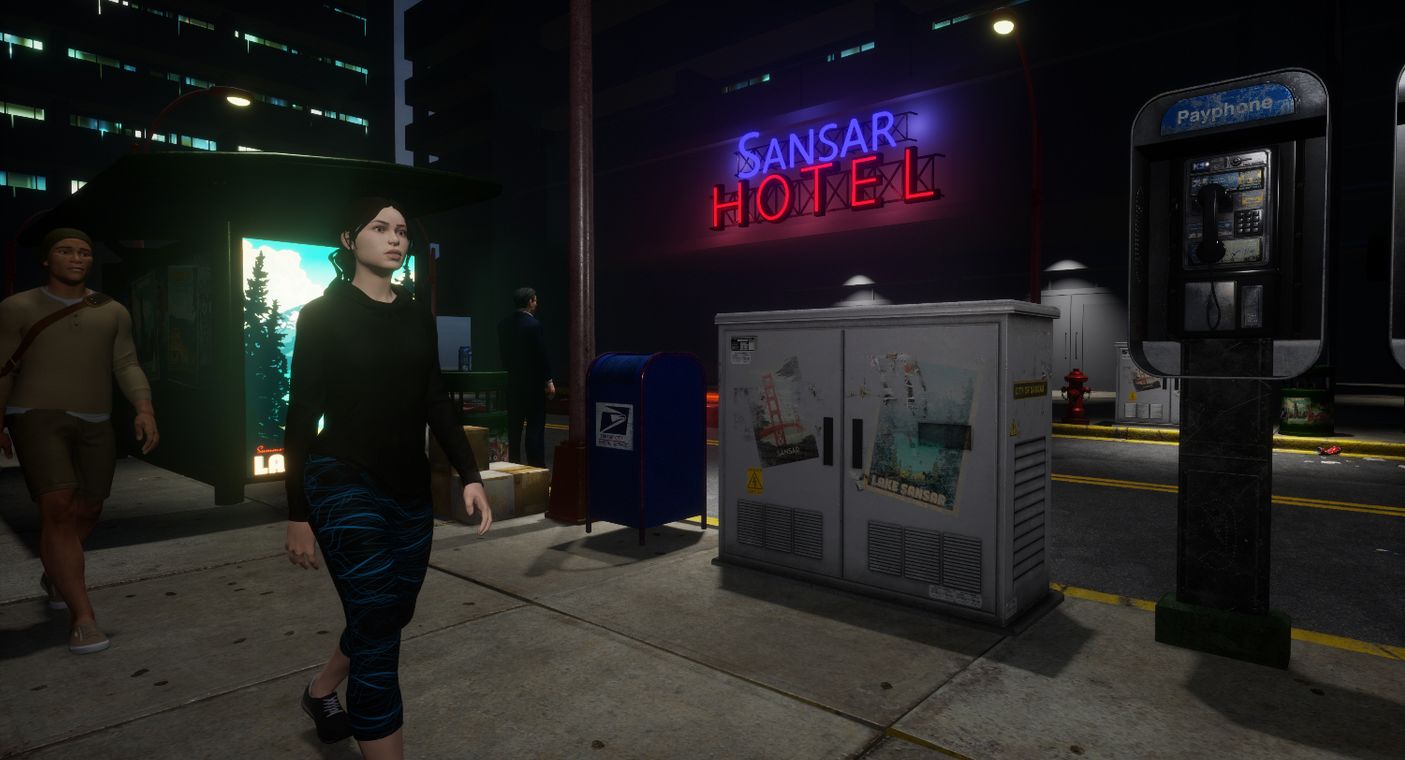
Sansar a city street scene created by Paul Lapointe Credit: Linden Lab
Another aspect which potentially hasn’t helped VR to date is the “room-sized” versus the “seat” VR experience. As noted above, existing games ported to a VR environment is looked down on by many in the VR media, who have preferred to focus on all the juicy tech of room sensors, motion trackers, and associated gizmos which offer a “truly immersive” experience.
But room-sized VR predicates itself on people having the room to indulge themselves and / or the willingness to spend time setting-up / taking down their wonderful gizmos. And what does all this emphasis on freedom of movement say to those who aren’t gifted with good mobility? So is room-sized VR really the be-all of VR at home?
Those Alexander speaks to tend to think not, preferring to point to VR needing both. This is something which is picked-up in the second part of the series, Where do we go?, which also brings Sansar into the frame of the discussion.
Unity CEO John Riccitiello
As with the first part of the series, Alexander opens Part 2 with another level-headed analysis of to how fast VR is liable to develop. Unity CEO John Riccitiello, for example, doesn’t see VR really starting to take off until 2018 or 2019.
His view is echoed by Tim Sweeney, CEO at Epic. He again cites the need for improved hardware, with more favourable price-points as being essential for the high-end VR market, something he doesn’t see forthcoming for a “couple of generations”. This puts his view in roughly the same 2-3 year time frame as Brendan Iribe at Oculus VR, who has indicated it’ll be around that long before his company will have their next generation hardware on the market.
The core of this part is an examination of two emerging aspects of VR: the “out-of-home” experience and “social VR”.
The former is the idea that rather than perhaps having dedicated space at home in which to experience VR, people will instead head off to the local “VR arcade” or “VR theatre” to enjoy a fully immersive experience of some description. This might sound fanciful, but The Void, a New York and London-based out-of-home VR experience has seen OptiTrack, the company behind much of tech used in the game, see an “explosion” of sales in the technology.
“The Void is spectacular,” Alexander quotes says Unity’s Riccitiello. “I think we’re going to see hundreds of these dedicated locations for entertainment. Imagine a room four times this big. Here is the bar and there are six different experiences that are available around the room. I would definitely go. Imagine, In 1000 square feet you could have DisneyLand. All of it.”
When you think of the potential for not only immersive, group gaming environments, but things like group training and simulation, out-of-home centres could become a practical part of the entertainment and business landscapes, offering low-cost access to a wide range of VR environments and experiences for the public and clients.
For “social VR”, the emphasis very much turns to Sansar. While he doesn’t directly praise the platform, it’s fairly clear he sees Sansar, with its potential to truly democratise how people can build their own VR spaces as a potential cornerstone of the home VR market. If it can truly replicate SL’s “secret sauce” in giving users genuine creative freedom in bringing truly tailored and personal VR experiences into their homes, free from the filtering of how professional VR developers and studios think people want to have them, then the future potential with the platform could be enormous.
Through both parts of his examination of VR, Alexander offers much to read and consider, particularly for those who have extended doubts about VR and how it might fit the broader scheme of things (at least in terms of entertainment). As such VR Check-In Part 1 and Part 2 are well worth a side-by-side read.
The was no Main (SLS) channel deployment or re-start on Tuesday, April 11th.
On Wednesday, April 12th, the three RC channels all received a new server maintenance package which includes:
Several internal fixes and two new internal logging modes
Another adjustment to fix issues with off-line IM and Group Notice delivery reliability
Fixes an issue where large numbers of objects could be returned after a rolling restart.
Upcoming Server Updates
Note: DRMSIM is the Aditi (beta grid) channel reference.
DRTSIM-323: New Simulator Build
This update was delayed in its deployment to a release candidate channel on Agni (the Main grid), with Mazidox Linden indicating it will now be moving in week #16 (commencing Monday, April 17th). Region holders wishing to test their applications / services etc., on the new simulator build should contact Concierge about having their region moved to the appropriate RC channel(s) when known.
DRTSIM-332: Updated Avatar Capacity / Access for Regions
After careful consideration, we’re making the new limits a default, rather than requiring intervention from Estate Managers (of course it is still possible to set limits lower using the region console or the current Maintenance viewer at http://wiki.secondlife.com/wiki/Linden_Lab_Official:Alternate_Viewers ). As a result there’s a new version on Aditi and we’ll have an updated version for McRib soon.
DRTSIM-343: Allow Public Access Region / Parcel Settings Changes
This is the updates to region / parcel access that will mean that if a region is explicitly set to Allow Public Access, parcel holders on the region will no longer be able to override the setting at the parcel level (see my update here). The update had been deployed to the three RC channels, where it was awaiting a viewer-side update featuring revised / improved land controls. However, Mazidox notes the code:
Was removed from RC after residents raised concerns about losing their previous state of “Allow Public Access”. To alleviate concerns of accidental change by landlord wiping out existing access settings on all parcels, we’re saving parcel setting until the region restarts. This means that while it won’t be saved permanently, it will be restored if the landlord removes their Ban Lines override. DRTSIM-343 will likely be back this week in testing, but may not have a corresponding viewer change yet.
DRTSIM-347: Fix for Incorrect Object Returns
This fix is designed to prevent a bug wherein objects might be returned from a region when it is restarted. It is about to undergo testing on Aditi prior to onwards deployment to Agni.
Content Creation User Group
The following notes are taken from the Content Creation User Group meeting, held on Thursday April 13th, 2017 at 1:00pm SLT at the the Hippotropolis Campfire Circle. The meeting is chaired by Vir Linden, and agenda notes, etc, are available on the Content Creation User Group wiki page. The audio extracts are from my own recording, and a video of the entire meeting, livestreamed by Medhue Simoni, is embedded at the end of this update.
HTTP Asset Fetching
Vir re-iterated that the HTTP asset viewer, which utilises HTTP and the Content Delivery Network(s) leveraged by the Lab to deliver all Second Life asset types to users (rather than just mesh and texture assets and avatar baking data) as is currently the case with release versions of viewers), is now at Release Candidate status. The viewer has gone through two rapid-fire updates, with the latest version (at the time of writing) being 5.0.4.325368. I have an overview of the viewer, which includes an explanation of CDN use, for those who may not be familiar with the way things work.
Applying Baked Textures to Mesh Avatar
[Video: 2:04-18:35] The Lab is digging further into this idea, which if implemented would in theory allow at least some texture layers to be baked onto avatar meshes in a manner akin to that used with system layers and the default avatar. This could greatly reduce the complexity of mesh avatar bodies by removing the need for them to be “onion skinned” with multiple layers, although there are some issues which would need to be addressed.
One is that the baking service cannot currently handle materials (normal and specular maps; only texture – diffuse – maps), and the Lab has no idea as to how widespread either might be among clothing makers specifically producing applier systems for mesh bodies (which can support the use of materials). As such, they do not have a clear idea as to whether support for materials through the baking service would be required; something that could make any project related to this idea far more complicated to develop.
This led to an extensive discussion on what would be required from a system which could bake directly onto mesh layers, how widely materials might be used, and exactly how such a system would be used. The broad consensus of the discussion was that in terms of baking down layers, most creators like likely prefer to see things like skins and skin variations, tattoos, lingerie, freckles and eyebrows baked down to a single layer, none of which tend to require significant materials support.
The discussion also touched upon the opportunity to present better alpha masking / alpha blending than chopping up mesh bodies into sections for masking / having alpha blending on different layers get into a fight, etc. Overall, it was felt that presenting some means to bake down some layers and reduce the complexity inherent in mesh avatars would be preferable to waiting on the Lab to be able to undertake a more widespread overhaul of the baking service to provide “full” materials support through it. Vir is going to take these points raised back to the Lab for further consideration.
Animating Objects
Animating mesh objects is another project under consideration. This would be especially useful for things like non-player characters (NPCs) and the like. There are several ways this might be approached, but as Vir explained in reply to a question, none of them would involve animating the Collada file. He also pointed out that animated objects is still only at the discussion stage, so whether any project – were it to be taken on – would include the ability for animated objects / NPCs to attach static objects (e.g. a hat or similar), hasn’t been addressed.
Rapid Round-Up
Animating Objects (/ NPCs): This is also still under consideration, but yet to be adopted as a project. However, were it to go ahead, it would likely not involve animated the Collada files, as suggested during the meeting, but leverage SL’s existing animation capabilities. It’s also too early in the process to say whether or not animated objects would support static objects being attached to them (e.g. an NPC being able to wear different hats).
Supplemental animations: The idea is to allow “supplemental” animations to run alongside the animation states keyed by llSetAnimationOverride(), effectively allowing them to play together, rather than conflicting with one another as is the case at the moment. Suggested some time again, it is still be considered, but no work has been carried out as yet.
Rendering Cost Calculations: he Lab is running a background project to look at the cost of rendering a wide range of Second Life features across a range of different client systems running the viewer. The tests for this work have now been defined and are about to be put into use. Once sufficient data has been gathered, the Lab will use it to determine what might need to be done to improve the accuracy of the avatar rendering calculations. Vir further defined the project’s status:
Re-using Linden Water Maps: The question was asked about re-using Linden Water data (Linden water being a combination of animated diffuse and normal maps) so that it might be re-used on other surfaces. The obvious use here would be to enable mirrors. Quite aside for the feared performance hit this could cause, it seems likely that the water system probably stands as its own unique implementation which would not easily lend itself to other uses.
Bouncing Bewb Improvements: In creating a set of animation for a client, Medhue Simoni noticed an issue with breast attachments and rigged mesh breasts. Essentially, as breast attachments go to the chest, they don’t necessarily follow the movement of the breasts when physics are used (which utilise the volume bone). His suggested solution would be to allow breast (/ nipple) attachments to be attached to the volume bone instead, allowing them to naturally follow breast movement,
Other Items
Aditi Inventory Server Update
The Lab has upgraded the hardware for one of the Aditi inventory servers. Almost all users logging-in to Aditi should be using it. There is a request that if those who do file a bug report f they notices anything strange related to inventory: lag, failure to load, textures looking incorrect etc.








 Inara Pey: Living in a Modemworld