Art in the Park: progress to date

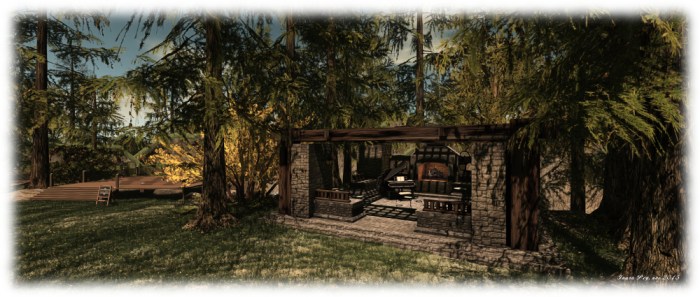
The new pavilion at Holly Kai Park

In the latter half of October, I blogged about taking on a new role in Second Life as curator of the Holly Kai art park. Since then things have been progressing slowly, as I’ve been contacting artists I’d like to see participate in the park’s re-lunch exhibition, and have been working out how best to change things around at the park without undoing all the hard work already put into it.

That said, things have now reached a point where I’m comfortable in revealing progress to date, and to say that all things being equal, the first exhibition will be launching in early December. I’ll be contacting the artists who participating with details on arranges a little later this week, so they’ll have plenty of time to prepare.

For those used to mooring at the park, you’ll find things have changed a lot; there are new slips on both the east and west sides of the park to accommodate more boats coming alongside. Auto-return is set to 60 minutes to allow people time to explore the park, and re-rezzing of boats is allowed.
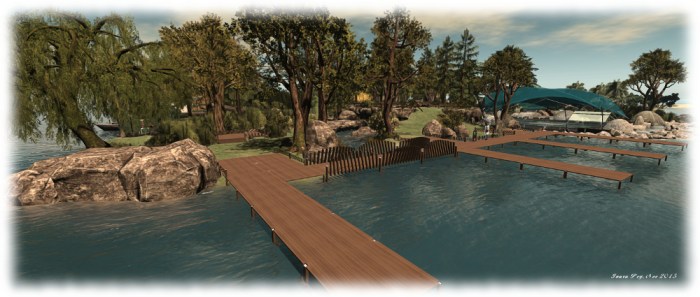
The moorings on both the east and west sides of the park have been revised to offer more room for boats

In addition, some tweaks have been made to the beach area behind the west side slips to give a little more room for those simply wishing to spend time on the beach; there’s still more work to be done with this, but it’s not an immediate priority.

Within the park itself, new wooden decks have been installed to offer artists more formal spaces for displaying their work. Most of these are up on the hill in the centre of the park. The park walls connecting the east and west sides have new lighting which should provide soft illumination during the SL night. There’s also a new stone pavilion where visitors are welcome to rest for a while.

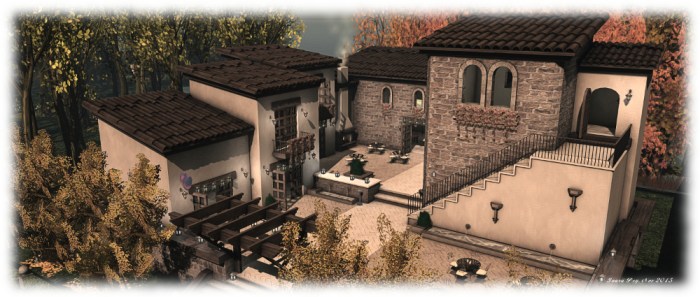
The biggest change, however, is on the west side of the park. As well as altering the moorings here, and at Caitlyn’s excellent suggestion, I’ve added a small venue, the Caitinara bar. Over time, this will hopefully become a place for regular music and dancing for smaller groups.
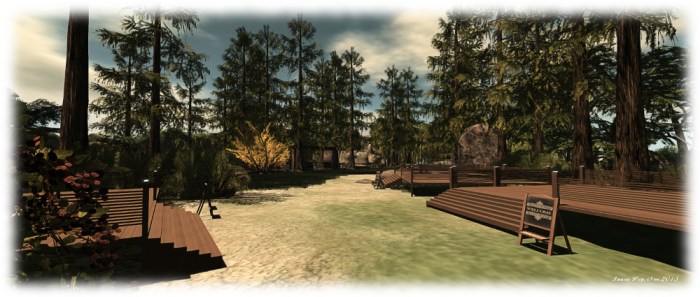
Some of the new deck spaces where artists can more readily display their work, complete with easels for showing their photo / giving their bio
Some of the new deck spaces where artists can more readily display their work, complete with easels for showing their photo / giving their biography and notes on their work

In talking things through, Nber and I have also decided to add a further arts venue to Holly Kai, which will probably be up and running ready for the 2016. Borrowing a leaf from Windlight Magazine’s book, the new Holly Kai Art Garden will be available free of charge for periods of 25 days to any artist who wishes to use it, with both indoor and outdoor display spaces. In addition, those apply to use it will also be able to book either the Pavilion or the Piano Bar for any associated opening / closing events they might wish to hold.

To help manage everything, there will be a new website launching at the time of the first exhibition in the park, and this will include application forms for those wishing to join in the group exhibitions in the park, or who wish to apply to use the new Art Garden.
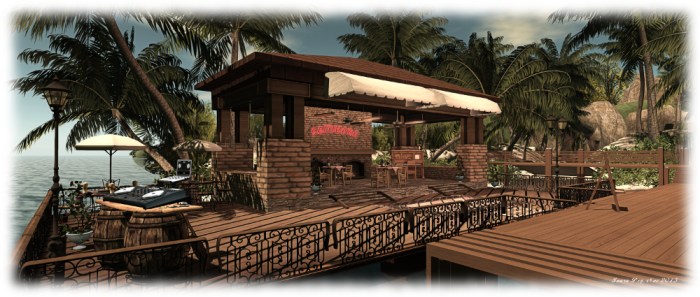
Caitinara, the bar at Holly Kai
Caitinara, the bar at Holly Kai Park

I’ll have a further update as the work progresses through the rest of November!

SLurl Details

2015 viewer release summaries: week 46

Updates for the week ending Sunday, November 15th

This summary is published every Monday, and is a list of SL viewer / client releases (official and TPV) made during the previous week. When reading it, please note:

  • It is based on my Current Viewer Releases Page, a list of all Second Life viewers and clients that are in popular use (and of which I am aware), and which are recognised as adhering to the TPV Policy. This page includes comprehensive links to download pages, blog notes, release notes, etc., as well as links to any / all reviews of specific viewers / clients made within this blog
  • By its nature, this summary presented here will always be in arrears, please refer to the Current Viewer Release Page for more up-to-date information.

Official LL Viewers

  • Current Release version: 3.8.6.305981, October 26 – no change download page, release notes
  • Release channel cohorts (See my notes on manually installing RC viewer versions if you wish to install any release candidate(s) yourself):
    • Quick Graphics RC viewer updated to version 3.8.7.306758 on November 12 – provides the new Avatar Complexity options and the new graphics preset capabilities for setting, saving and restoring graphic settings for use in difference environments / circumstances (download and release notes)
    • Maintenance RC viewer version 3.8.7.307376 released on November 10 – core updates: some 38 fixes and improvements, including updates for some regressions introduced into the viewer with the current release viewer (download and release notes)
    • Project Azumarill (HTTP updates) RC viewer withdrawn, November 11  – possibly due to issues encountered by users on the cohort
  • Project viewers:
    • Project Valhalla (CEF media update) project viewer updated to version 4.0.0.307535 on November 10 – replaces the ageing LLQTWebKit system used in the Web media plugin with a shiny new one based on the Chromium Embedded Framework (CEF) that supports modern web technologies (download and release notes)

LL Viewer Resources

Third-party Viewers

V3-style

V1-style

  • Cool VL Viewer updated as follows: Stable version to 1.26.14.13 and Experimental to 1.26.15.12, both on November 9th – release notes.

Mobile / Other Clients

  • No updates.

Additional TPV Resources

Related Links

Sunday Sunday: Mars, Pluto and WTF hits the atmosphere

CuriosityMars has been in the news a lot this last week, thanks to both the Curiosity rover and the MAVEN orbiter.


Curiosity’s science capabilities received a boost when a upgrade to the ChemCam test system on Earth increased the number of Earth-rock geochemical samples examined by the system tripled to some 350, vastly increasing the science team’s ability to improve their interpretation of data gathered by Curiosity’s ChemCam system – the laser and telescope / camera which vaporises small amounts of rocks on Mars and them images the plasma that’s given of for chemical and mineralogical analysis.

In particular, the upgrade has allowed the science team to re-examine data the rover gathered about a site with the most chemically diverse mineral veins so far examined on Mars. Called “Garden City”, the site sits above the “Pahrump Hills” area at the foot of “Mount Sharp”, which the rover examined in detail in late 2014 / early 2015. Of particular interest to scientists were a series of raised mineral veins criss-crossing the surface of the rocks in the area.

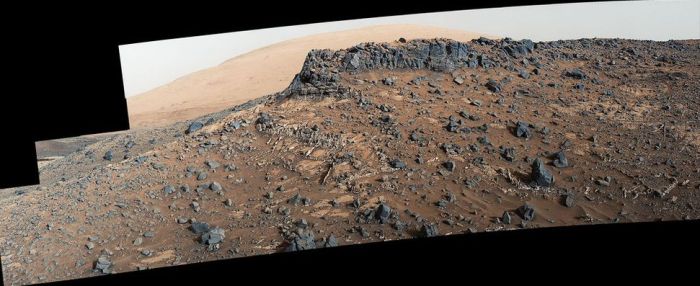
"Garden City", an outcrop about 1 metre (39 inches) high, examined by Curiosity in March 2015, and which exhibited mineral veins criss-crossing the surface of the rocks, and which exhibited different chemical signatures. New analysis capabilities on Earth have helped determine how the veins formed and what they may say about early conditions in Gale Crater.
“Garden City”, an outcrop about 1 metre (39 inches) high, examined by Curiosity in March 2015, and which exhibited mineral veins criss-crossing the surface of the rocks, and which exhibited different chemical signatures. New analysis capabilities on Earth have helped determine how the veins formed and what they may say about early conditions in Gale Crater

These new Earthside capabilities have allowed the science team to better analyse the minerals within the veins and make finer distinctions between them, revealing their mineral and chemical compositions vary one to another, and also appear to vary with age.

These findings suggest that, rather than being the result of a single extended wet period in Gale Crater during which water percolated down through fissures in the rock to leave the minerals behind, the veins are the result of several individual wet periods in Mars’ ancient past. These wet periods appear to have occurred somewhat later than the more extensive wet periods which gave rise to a successive series of lakes within Gale Crater, the sediments from which form the lowest slopes of “Mount Sharp”. As such, the veins give further hints to atmospheric changes going on at a time at which Mars’ climate was undergoing extraordinary changes and fluctuations in its ancient past.

Prominent mineral veins at the "Garden City" site examined by NASA's Curiosity Mars rover vary in thickness and brightness, as seen in this image from Curiosity's Mast Camera (Mastcam). The image covers and area roughly 2 feet (60 centimeters) across. Types of vein material evident in the area include: 1) thin, dark-toned fracture filling material; 2) thick, dark-toned vein material in large fractures; 3) light-toned vein material, which was deposited last.
Prominent mineral veins at the “Garden City” site examined by NASA’s Curiosity Mars rover vary in thickness and brightness, as seen in this image from Curiosity’s Mast Camera (MastCam).  The image covers and area roughly 60 cm (24 inches) across, and shows a mix of thin, dark-toned fracture filling material, likely deposited first, thick, dark-toned vein material in large fractures, and light-toned vein material, which was deposited last.

What Happened to Mars’ Atmosphere? The Answer is Blowin’ in the Wind

Atmospheric changes are also at the heart of the latest data to be analysed from NASA’s Mars Atmosphere and Volatile Evolution (MAVEN). This data, part of the mission’s long terms studies of the planet’s atmosphere and environment greatly clarifies the key role played by the solar wind in the gradual loss of Mars’ once dense atmosphere and the transition of the planet’s climate from a warm and wet environment to the cold, arid planet we see today.

The solar wind is a stream of particles, mainly protons and electrons, flowing from the Sun’s atmosphere at a speed of about 1.6 million kilometres (1 million miles) per hour. The interaction of this solar wind generates an electric field around Mars, much like a turbine on Earth generates electricity. This electric field interacts with the upper reaches of Mars’ atmosphere, accelerating the ions there and shooting them into space.

An artist's impression of the solar wind shredding ions from Mars' atmosphere
An artist’s impression of the solar wind shredding ions from Mars’ atmosphere

MAVEN measurements indicate that gases are being stripped away in this manner from the Martian atmosphere at a rate of about 8.6 million tonnes per day. “Like the theft of a few coins from a cash register every day, the loss becomes significant over time,” said Bruce Jakosky, MAVEN principal investigator. “We’ve seen that the atmospheric erosion increases significantly during solar storms, so we think the loss rate was much higher billions of years ago when the sun was young and more active.”

The impact of solar storms on the rate of loss from Mars’ atmosphere was directly observed by MAVEN at the start of 2015, when the planet was bracketed by a series of large-scale outpouring from the sun – the same solar activity which gave rise to the massive increase in auroral activity at that time (see my October 26th Space Sunday report).

“Solar-wind erosion is an important mechanism for atmospheric loss, and was important enough to account for significant change in the Martian climate,” Joe Grebowsky, MAVEN project scientist said of the data gathered by the mission. “MAVEN also is studying other loss processes – such as loss due to impact of ions or escape of hydrogen atoms – and these will only increase the importance of atmospheric escape.”

Continue reading “Sunday Sunday: Mars, Pluto and WTF hits the atmosphere”

Of baseball, southern living, children’s tales and classic nior

It’s time to kick-off another week of fabulous story-telling in voice, brought to our virtual lives by the staff and volunteers at the Seanchai Library. As always, all times SLT, and events are held at the Library’s Second Life home at Bradley University, unless otherwise indicated.

Sunday, November 15th 14:00: Tea Time with Caledonia

Caledonia Skytower reads the final story from her soon to be published collection Two Houses.

Monday November 16th, 19:00: The Mighty Casey

Rod Sterling“Mouth” McGarry, the manager of a broken-down baseball team called the Hoboken Zephyrs on its last legs, allows a robot named Casey to play on his team. Casey can throw super-fast balls that cannot be hit. Just what is his secret?

His secret is discovered after he is struck by a ball and made to undergo a physical examination in which it is discovered he is an android. When the National League learns of this, they he must be taken off the team because he is not human. So Casey’s inventor gives him an artificial heart so he might be classified as human.

But now the team has another problem – with his new heart, Casey gains an emotional capacity which leads him to gaining empathy with the opposing teams’ batsmen. As a result, he refuses to throw his super-fast balls any more, as he has no desire to ruin the batting careers of others, and it seems the Zephyrs are on the road to nowhere once more unless something can be done. But what?

Join Gyro Muggins as he relates a story written by Rod Sterling for the 35th episode  of The Twilight Zone’s first season.

Tuesday November 17th 19:00: Mama Makes Up Her Mind

Mama makes up her mindWelcome to the unique world of Bailey White. Her aunt Belle may take you to see her bellowing pet alligator. Her uncle Jimbuddy may appal you with his knack for losing pieces of himself. Most of all, you may succumb utterly to the charms of Baileys mama, who will take you to a joint so raunchy it scared Ernest Hemingway or tuck you into her antique guest bed that has the disconcerting habit of folding up on people while they sleep.

White’s indelible vignettes of Southern eccentricity have entranced millions who have heard her read them on NPR. Mama Makes Up Her Mind is as sweetly intoxicating as a mint julep and as invigorating as a walk in Whites own overgrown garden.

Join Trolley Trollop, Kayden Oconnell, and Caledonia Skytower as they commence a romp through this wonderful series of vignettes

Wednesday, November 18th 19:00 The Wonderful World of Roald Dahl

Roald Dahl’s short stories are known for their unexpected endings and his children’s books for their unsentimental, macabre, often darkly comic content, featuring villainous adult enemies of the child characters. Join Faerie Maven-Pralou as she brings more of these tales to life.

Thursday, November 19th 19:00: American Noir

American Noir is the hard-boiled nightmare of flawed souls with big dreams and the  precise how and why of the all-time sure thing that goes bad. Classic stories from the typewriters of Mickey Spilane, James M.Cain, Edward Anderson, and other masters of the genre. Presented by Shandon Loring.

—–

Please check with the Seanchai Library SL’s blog for updates and for additions or changes to the week’s schedule.

The featured charity for October – December is Reach Out and Read, one of the most highly rated literacy charities in the USA which reaches 4.4 million children annually and distributes 1.6 million books.

Additional Links

It’s a New Dawn in Second Life

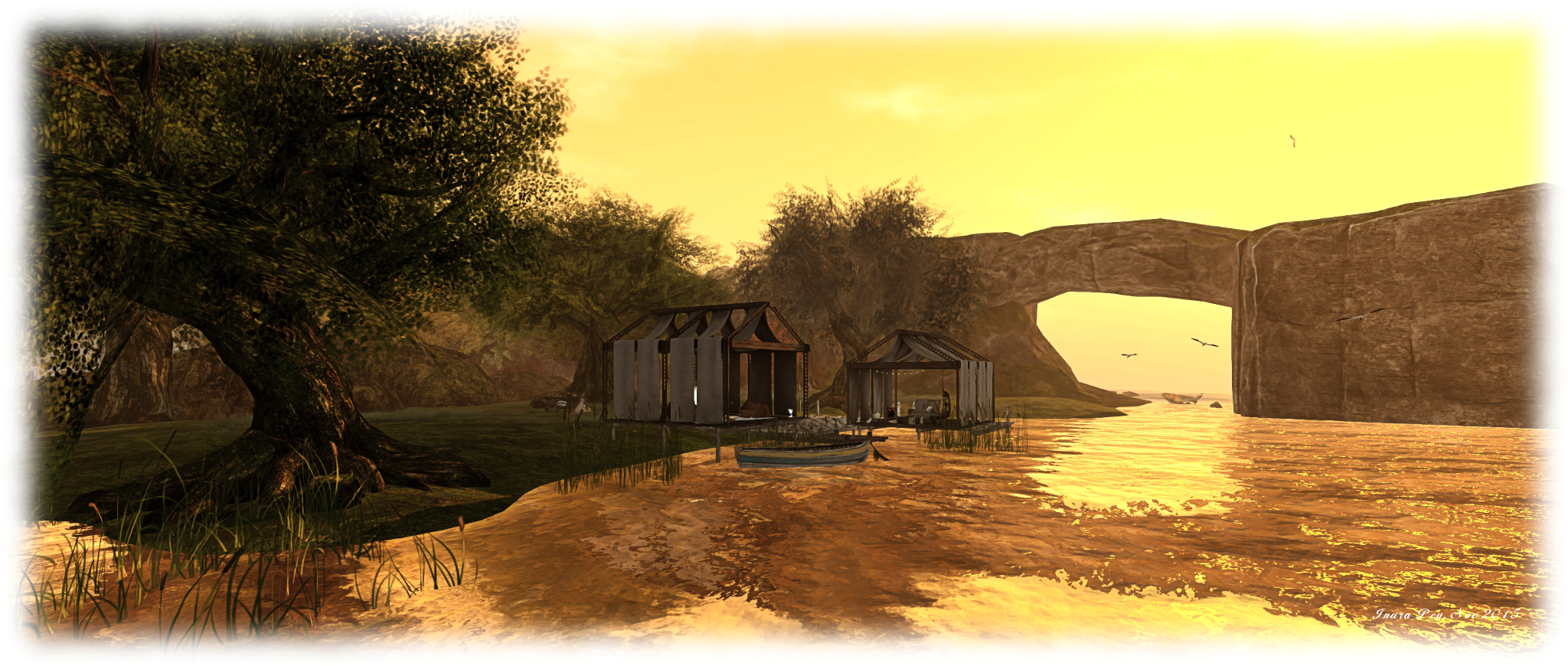
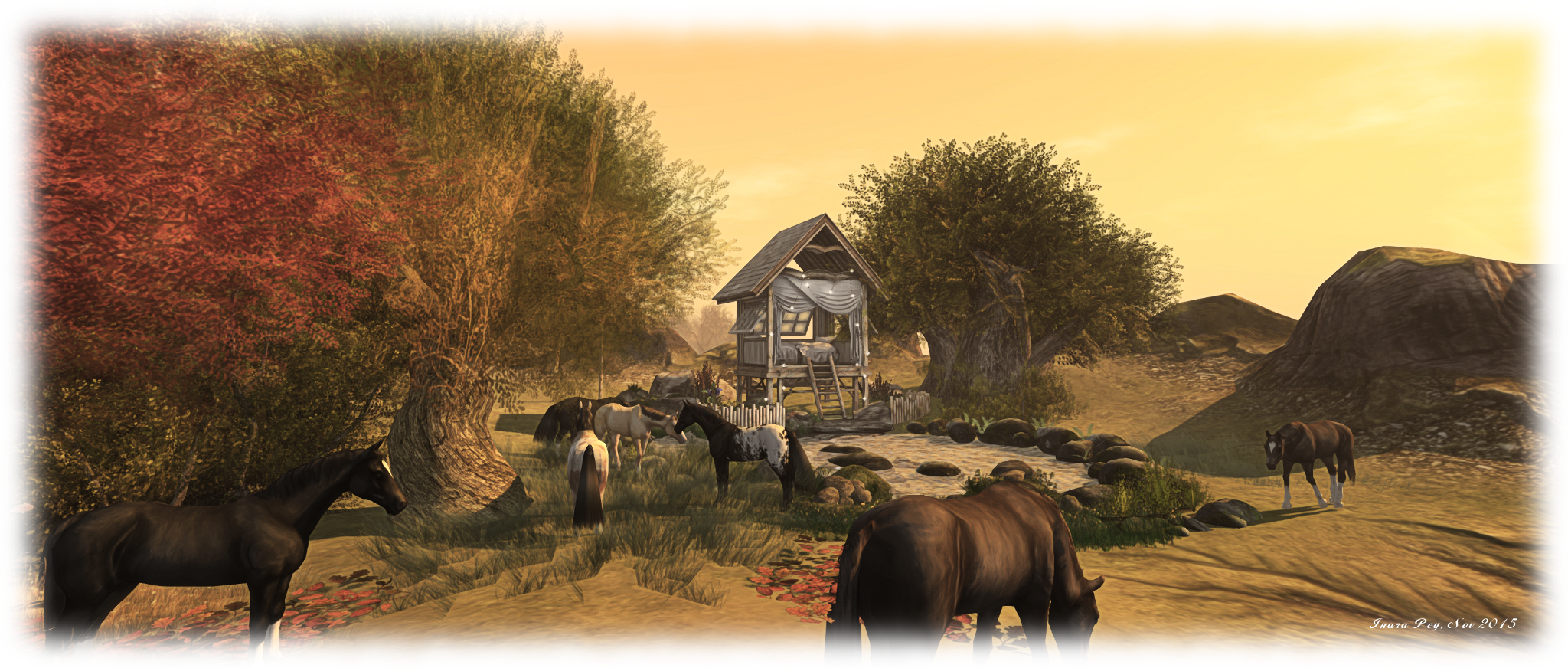
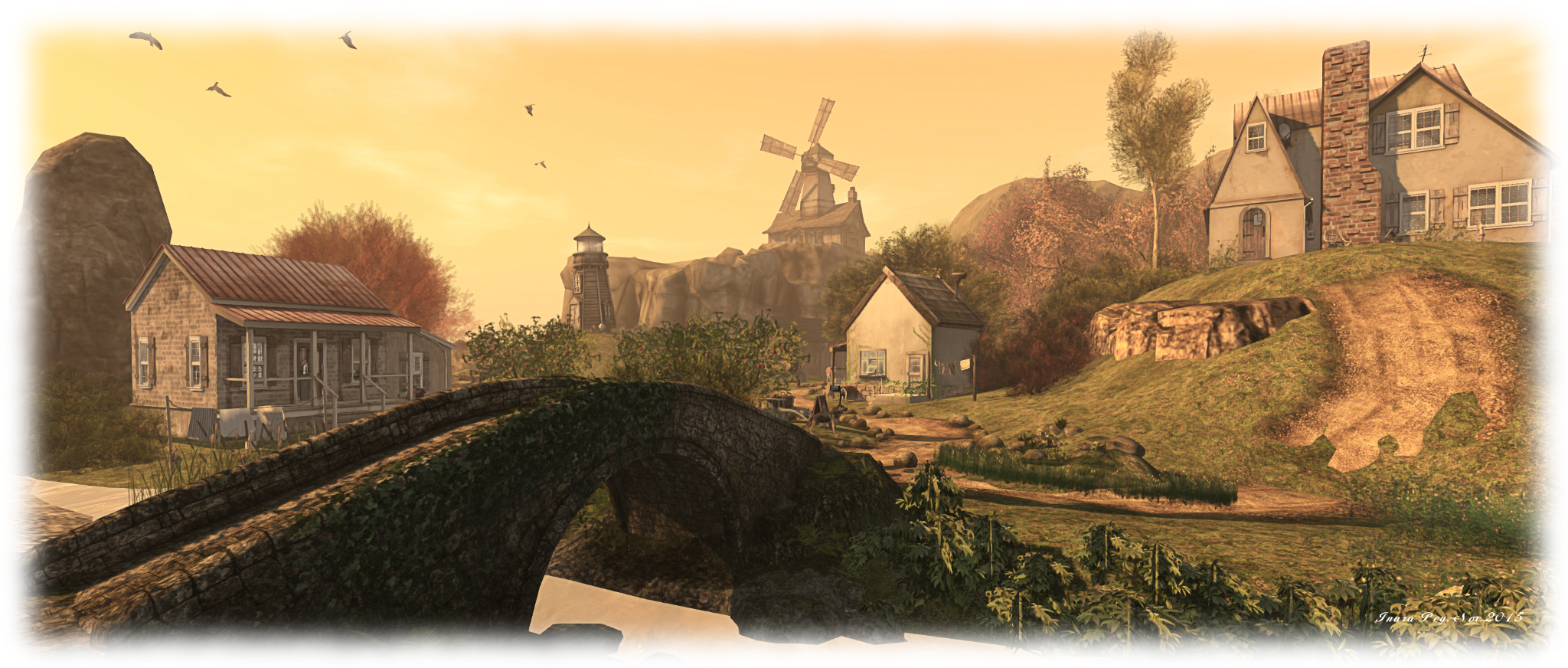
It's a New Dawn; Inara Pey, November 2015, on Flickr It’s a New Dawn (Flickr) – click any image for full size

It’s a New Dawn is the evocative name of Silvermoon Fairey’s new homestead region in Second Life. Like its name, this is an evocative place to visit, filled with sights and sounds to delight the eyes and ears; a place where exploration on foot is greatly encouraged.

I first became familiar with Silvermoon’s work through her region Dawn of Radiance, which you can read about here and here, an enchanting region beautifully designed and constructed and which could reflect the passing seasons of the year, but which passed into memory. It was a place I admired greatly, and given this, I was eager to see what It’s a New Dawn might hold.

It's a New Dawn; Inara Pey, November 2015, on Flickr It’s a New Dawn (Flickr)

From the start you know this is a special place; a rugged island where time has almost stood still in some ways, and where the pastoral life holds sway. A tiny hamlet occupies the island, although the population here seems to be chiefly horses, sheep and cattle, together with the local wildlife and birds. There are no roads, only rough tracks and footpaths worn into the rock by the passage of feet down through the years. Two lighthouses vie with a windmill perched on a tall plateau to be the sentinel of the island, while small inlets and coves around the coast offer sheltered beaches and rocky coastal paths around the base of tall cliffs and craggy slopes.

The contrasts in landscape and elevations here is remarkable and does much to give It’s a New Dawn a stunning natural look and feel. Exploring the island, I couldn’t shake the sensation I was walking across one of the Scottish islands, or perhaps another of the mythical islands in the chain once thought to lie within the North Atlantic may years past, and which includes Frisland, another popular Second Life destination.

It's a New Dawn; Inara Pey, November 2015, on Flickr It’s a New Dawn (Flickr)

This is very much a place to be enjoyed in foot (flying is disabled, and it’s really better to walk than override), and with local sounds enabled. As with most scenic and well-designed regions, It’s a New Dawn has an accompanying sound scape to add to the sense of immersion, so make sure you have local sounds enabled.

Those who remember Dawn of Radiance may notice a few familiar motifs from that region – the windmill mentioned above, the cottage on the escarpment nearby, the use of water and falls to enhance the lay of the land, and so on – all of which serve to give something of a feeling of familiarity whilst presenting somewhere wholly new.

It's a New Dawn; Inara Pey, November 2015, on Flickr It’s a New Dawn (Flickr)

Photography within the region is welcome, and those taking pictures are invited to add them to the Dawn of Radiance Flickr pool. Should you enjoy your visit – and I have no doubt you will – please consider making a donation at the landing point to help with the region running costs.

SLurl Details

Windlight Gallery winter exhibition in Second Life

The Windlight Gallery
Windlight Gallery

The Windlight Gallery winter show for November – December 2015 will be opening its doors on Sunday, November 15th, 2015. Taking place in the gallery’s new building, the show features the work of 13 artists and photographers from across Second Life.

The core of the exhibition is focused on the Windlight Artist Fellows for November and December: Bamboo Barnes, Honey Bender, Van Caerndow, Kaijah Chrome, Dawnbeam Dreamscape, Valium Lavender, Wicca Merlin, Benivinudo Moskalev, Twotone Rhiano and Dean Yao. They are joined by Windlight staff and contributors Ilyra Chardin, Inara Pey and Saoirseheart Resident.

Windlight Gallery November-December 2015 show

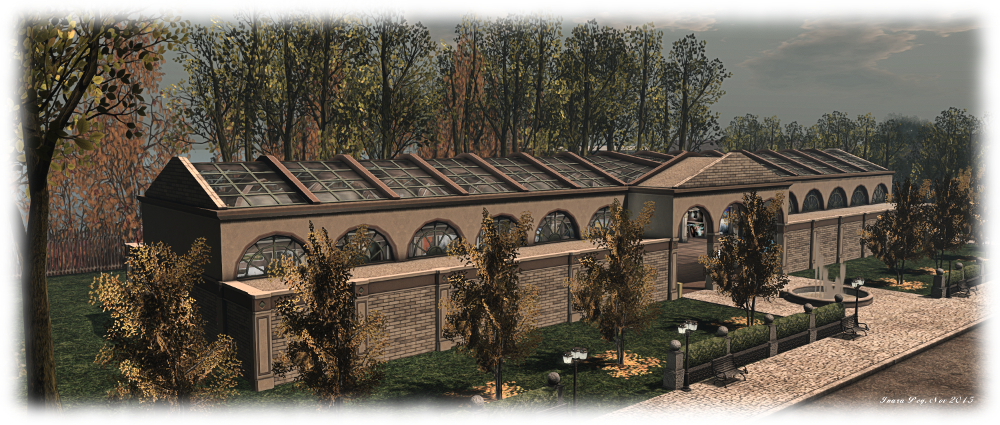
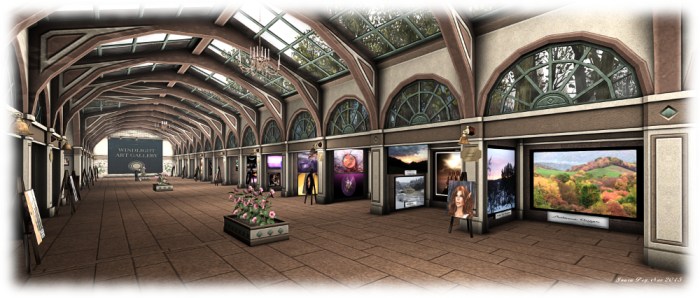
The new gallery building offers alcoved display spaces arranged on either side of a glass-roofed atrium offering plenty of room for visitors to wander and enjoy the art, while the pieces on display for the show cover a broad range of subject matter. Landscape photography and art, avatar portraiture, fantasy and surrealist art and a touch of abstract work are all offered, making this exhibition an ideal visit for those with an interest in still art in Second Life.

The exhibition will officially open at 16:00 SLT on Sunday, November 15th, with a special live performance by Don Devore. This will take place across the road from the gallery at the Ristorante Ivanna, the self-service restaurant and music venue, and run through until 17:00 SLT. Thereafter, the opening event focus will switch to the gallery.  A formal dress code is to be observed.

Ristortante Ivanna will host a live performance by Don during the November-December show opening
Ristortante Ivanna will host a live performance by Don Devore during the November-December show opening

The Windlight Artist Fellowship Programme

As a part of the magazine’s desire to help promote and support artists and photographers, Windlight Magazine and the Windlight Gallery operates the  Windlight Artist Fellowship Programme. This allows artists to apply for free exhibition space at the Windlight gallery for a period of 30 days. Applications are open to artists from across Second Life, and the criteria for acceptance can be found in the Artist Fellowship Programme application form.

Related SLurls and Links