Space Sunday: of water, Apollo and space spies

CuriosityThe Curiosity rover team have released a further study showing that ancient Mars was capable of storing water in lakes over an extended period of time, and that this water was a principal component in the creation of “Mount Sharp”, the mound at the centre of Gale Crater, currently being investigated by the NASA rover.

This forms the latest in a series of reports on the subject of water on Mars and in Gale Crater to be published by the Curiosity science team, and comes almost a year after I wrote about studies released by the team which detailed how “Mount Sharp” – more formally known as Aeolis Mons – was most likely formed by sediments laid down  by successive wet period in Mars’ ancient past.

“Observations from the rover suggest that a series of long-lived streams and lakes existed at some point between about 3.8 to 3.3 billion years ago, delivering sediment that slowly built up the lower layers of Mount Sharp,” said Ashwin Vasavada, Mars Science Laboratory project scientist, discussing the new report.

In December 2014, NASA issued a report on how
In December 2014, NASA issued a report on how “Mount Sharp” was likely formed. On the left, the repeated depositing of alluvial and wind-blown matter (light brown) around a series of central lakes which formed in Gale Crater, where material was deposited by water and more heavily compressed due the weight of successive lakes (dark brown). On the right, once the water had fully receded / vanished from the crater, wind action took hold, eroding the original alluvial / windblown deposits around the “dry” perimeter of the crater more rapidly than the densely compacted mudstone layers of the successive lake beds, thus forming “Mount Sharp”

However, until Curiosity actually started studying “Mount Sharp” in detail,  the accuracy of the earlier studies couldn’t be completely verified. The latest results from the rover indicate that these wetter scenarios were correct for the lower portions of Mount Sharp, and that the filling of at least the bottom layers of the mountain occurred over a period of less than 500 million years, mostly as a result of material deposited by ancient rivers and lakes.

The new report also comes on top of confirmation that the recurring slope lineae (RSL) features seen on Mars from orbit are most likely the result of outflows of water which are occurring today. together they are reshaping some of the thinking around water on Mars – and what might have happened to it.

“What we thought we knew about water on Mars is constantly being put to the test,” said Michael Meyer, lead scientist for NASA’s Mars Exploration Programme. “It’s clear that the Mars of billions of years ago more closely resembled Earth than it does today. Our challenge is to figure out how this more clement Mars was even possible, and what happened to that wetter Mars.”

Strata at the base of
Curiosity has found plenty of evidence for water on the floor of Gale Crater, which likely took the form of one or more lakes during the wetter parts of Mars’ history, before becoming rivers and streams later. Strata at the foot of “mount Sharp” (shown above) strongly suggested water played a significant part in forming the mound, and the evidence for this being the case has continued to be revealed as the rover climbs the lower slopes

Currently, images of the flanks of the mound returned by the rover and from orbit suggest water-transported sedimentary deposition may have extended at least 150 to 200 metres (500 to 650 feet) above the crater floor, and possibly as high as 800 metres (approx 1/2 a mile). This both indicates that there was at least one standing body of water in the crater and further confirms that “Mount Sharp” was a direct result of sediments deposited by this water. Or at least, the lower slopes were; there is currently little evidence for the sedimentary strata extending about the 800 metre mark, however. This has led to speculation that wind-blown deposits are responsible for the upper reaches of the mound.

Taken together, the recent findings concerning Mars and its water suggest that the planet’s history is far more complex than had been thought. “We have tended to think of Mars as being simple,” John Grotzinger, the former project scientist for the Curiosity mission said of the latest findings.

“We once thought of the Earth as being simple too,” he continued. “But the more you look into it, questions come up because you’re beginning to fathom the real complexity of what we see on Mars. This is a good time to go back to re-evaluate all our assumptions. Something is missing somewhere.”

Pluto’s Water

The blue haze of Pluto's atmosphere
The blue haze of Pluto’s atmosphere: released on October 8th, this true colour image taken after the New Horizons spacecraft had completed its closest approach to the dwarf planet shows Pluto’s night side ringed by the blue haze of its thin atmosphere, as illuminated by the distant Sun, far away on the other side of the little world

The latest images and data to be received on Earth from NASA’s New Horizons space vehicle reveal Pluto’s atmosphere to be a rich blue in colour, and confirm that water ice exists on theplanet.

“Who would have expected a blue sky in the Kuiper Belt? It’s gorgeous,” said Alan Stern, New Horizons principal investigator as the striking image shown above was released as part of the latest batch of pictures and data to be received from the space craft and undergo processing and initial analysis.

The blue colour indicates that the haze within Pluto’s atmosphere is made up of a lot very fine of particulate matter, which scatters blue light from the Sun more easily than other colours, due to blue having a shorter wavelength (which is also the reason the sky we see here on Earth also appears blue, because that wavelength is easily scattered by the tiny particles making up our atmosphere).

In Pluto’s case, it’s thought that the particles in the atmosphere are largely tholins, created by ultraviolet radiation from the Sun breaking down the methane and nitrogen in Pluto’s upper atmosphere, allowing their molecules to gradually recombine into the more complex tholins, which draft down through the atmosphere, undergoing further changes, before eventually reaching the surface of the planet, giving it a distinctive reddish colour.

Instruments forming the Ralph suite aboard New Horizons have identified regions of exposed water ice on Pluto which occur in regions which have corresponding deposits of tholins. Quite what the relationship is between the two is unclear. The water ice deposits are shown in blue on the inset image simply for convience, and not because that's how they appear on Pluto
Instruments forming the Ralph suite aboard New Horizons have identified regions of exposed water ice on Pluto which occur in regions which have corresponding deposits of tholins. Quite what the relationship is between the two is unclear. The water ice deposits are shown in blue on the inset image simply for convenience, and not because that’s how they appear on Pluto

The discovery of water ice on Pluto has taken scientists by surprise. Not so much because it is there, but because it appears to be somehow related to areas of heavy tholin deposits. Confirmation of the presence of water ice came from data returned by the Ralph instrument suite aboard New Horizons, but just how widespread it might be isn’t clear, as it seems that it might be masked elsewhere by other surface material.

Continue reading “Space Sunday: of water, Apollo and space spies”
Of mysteries, murders and ghosts in Second Life

It’s time to kick-off another week of fabulous story-telling in voice, brought to our virtual lives by the staff and volunteers at the Seanchai Library. As always, all times SLT, and events are held at the Library’s Second Life home at Bradley University, unless otherwise indicated.

Sunday, October 11th

13:30: Tea time at Baker Street

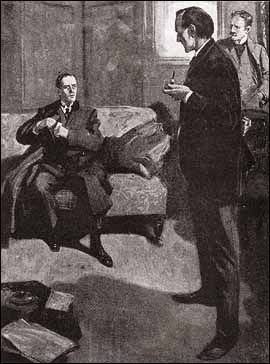
The Valley of Fear, The Strand Magazine, 1915. Illustration by Frank Wiles

It was the fourth of February in the year 1875. It had been a severe winter, and the snow lay deep in the gorges of the Gilmerton Mountains. The steam ploughs had, however, kept the railroad open, and the evening train which connects the long line of coal-mining and iron-working settlements was slowly groaning its way up the steep gradients which lead from Stagville on the plain to Vermissa, the central township which lies at the head of Vermissa Valley. From this point the track sweeps downward to Bartons Crossing, Helmdale, and the purely agricultural county of Merton. It was a single-track railroad; but at every siding—and they were numerous—long lines of trucks piled with coal and iron ore told of the hidden wealth which had brought a rude population and a bustling life to this most desolate corner of the United States of America.

For desolate it was! Little could the first pioneer who had traversed it have ever imagined that the fairest prairies and the most lush water pastures were valueless compared to this gloomy land of black crag and tangled forest. Above the dark and often scarcely penetrable woods upon their flanks, the high, bare crowns of the mountains, white snow, and jagged rock towered upon each flank, leaving a long, winding, tortuous valley in the centre. Up this the little train was slowly crawling.

The oil lamps had just been lit in the leading passenger car, a long, bare carriage in which some twenty or thirty people were seated. The greater number of these were workmen returning from their day’s toil in the lower part of the valley. At least a dozen, by their grimed faces and the safety lanterns which they carried, proclaimed themselves miners. These sat smoking in a group and conversed in low voices, glancing occasionally at two men on the opposite side of the car, whose uniforms and badges showed them to be policemen.

Several women of the labouring class and one or two travellers who might have been small local storekeepers made up the rest of the company, with the exception of one young man in a corner by himself. It is with this man that we are concerned. Take a good look at him, for he is worth it.

Thus opens the second part of  The Valley of Fear, and with it we are transported to the United States in the year 1875, and introduced to a man by the name of Jack McMurdo. But where, in all of this, might sit the hand of Moriarty?

Join Caledonia Skytower, Kayden Oconnell and John Morland as they continue to read the fourth and final Sherlock Holmes novel.

18:00: Serafina and the Black Cloak – Encore

Join Caledonia Skytower as she presents an encore of the beginning of Serafina,  at Magicland’s Golden Horseshoe (see below for more on the story).

Monday October 12th, 19:00: A Night in the Lonesome October

The Seanchai staff are marking the arrival and passage of the Halloween month with readings of Roger Zelazy’s A Night in the Lonesome October. The latter is the last of Zelazy’s published works, and 31 of its 32 chapters (the first being an introductory chapter) each take place on a night in October.

Lonesome OctoberThe book is satirical in nature, and is written in the first person – the narrator being Snuff the dog, the companion to none other than Jack the Ripper.

Once every few decades, when the moon is full on the night of Halloween, the fabric of reality thins, and doors may be opened between this world and the realm of the Great Old Ones.

At this time, men and women with occult knowledge gather at a certain location to engage in The Game – an attempt by some to open the doors, and others to hold them closed. Should the Openers ever win the game, the Great Old Ones will come to Earth, remake it in their own images and enslave or slaughter the human race in the process.

Thus, through the month of October, the Players in The Game – all archetypal characters from Victorian Era Gothic fiction – form alliances, make deals, oppose one another, and even resort to murder in their attempts to make sure the doors are ready to be opened or can be held fast when, on the night of October 31st, the final ritual takes place and the fate of the world is decided.

Tuesday October 13th,19:00 The Ghost of William S. Burroughs

… Makes an appearance at Seanchai… seriously!

Wednesday October 14th 19:00: Serafina and the Black Cloak

serafinaCaledonia Skytower continues reading of Robert Beatty’s spooky mystery thriller.

Serafina lives a life of total secrecy. While her father may be the maintenance man for the great house of the Biltmore Estate, the wealthy owners of the estate have no idea that he lives in the basement of the house – and much less that his daughter lives there with him.

Not that this is a problem for Serafina; she is quite at home exploring the great house and its grounds whilst avoiding being seen. There’s certainly no need for her to venture into the great forest beyond the estate, and with which, he father has said, lie many dangers.

But when the children on the estate start vanishing, Serafina is forced to join forces with the young nephew of the Biltmore’s owners, and discover the identity of the one they believe to be behind the disappearances: the Man in the Black Cloak. But in order to do so, Serafina must enter the forest her father has warned her against; and within that forest lies a deeper secret Serafina must confront – that of her own identity.

Thursday, October 15th

19:00: Ghost Stories

With Shandon Loring.

21:00 Seanchai Late Night

With Shandon Loring.

Saturday, October 17th, 12:00 Noon PDT at Seanchai InWorldz

The Fetch, a ghost story, with Shandon Loring.

A fetch is a supernatural double or an apparition of a living person in Irish folklore. Akin to the doppelgänger it is regarded as an omen, possibly of impending death. So what does it have in store for us? Join Shandon and find out!

(https://inworldz/region/Delphi/176/72/36)   

Also This Month

  • Seanchai Library is participating in the Good Reads Hunt. To get started, visit the Good Reads starting point at Literature Alive!/Desi’s Gifts and Prints
  • Don’t forget to visit the Five Irish Haunts panels at Seanchai Library to discover something about ghosts and hauntings!

—–

Please check with the Seanchai Library SL’s blog for updates and for additions or changes to the week’s schedule.

The featured charity for October – December is Reach Out and Read, one of the most highly rated literacy charities in the USA which reaches 4.4 million children annually and distributes 1.6 million books.

Additional Links

Love pops up in Second Life

Pop Up Love - CKB Gallery
Pop Up Love – CKB Gallery

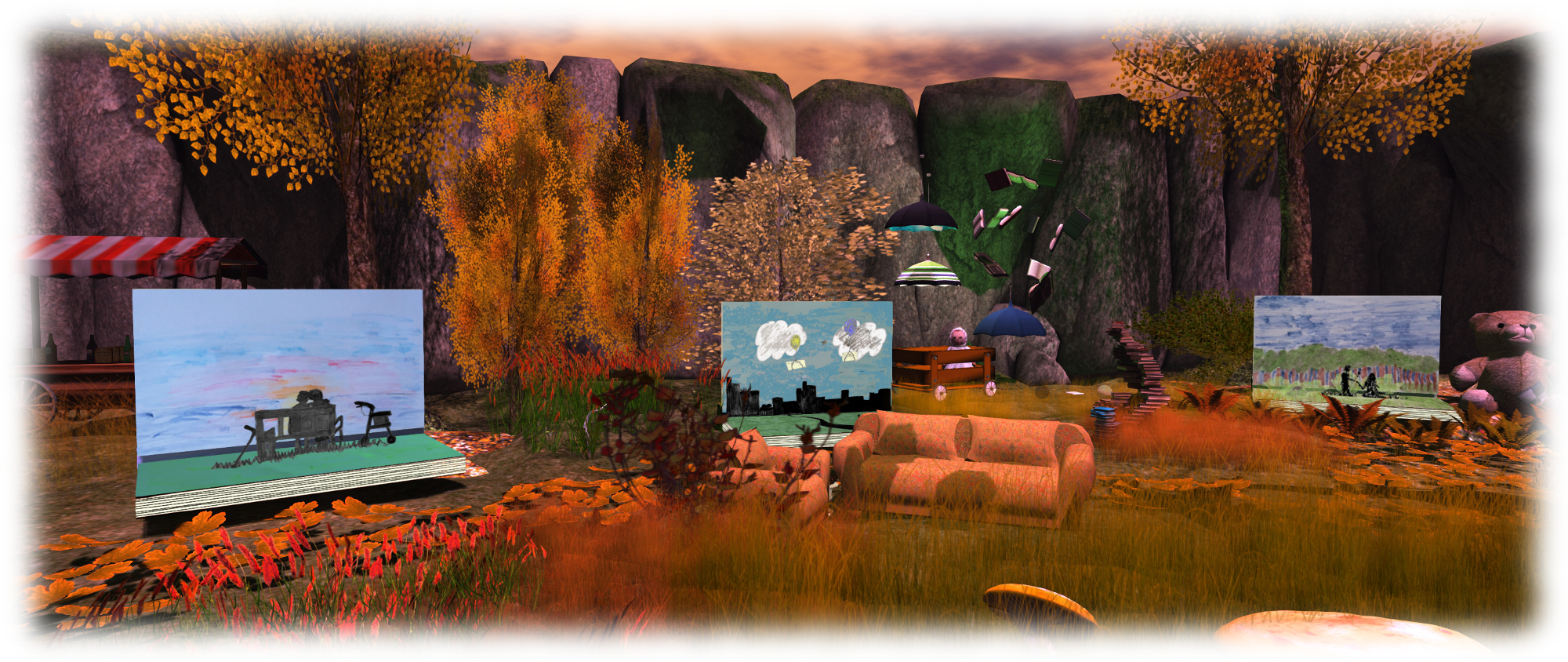
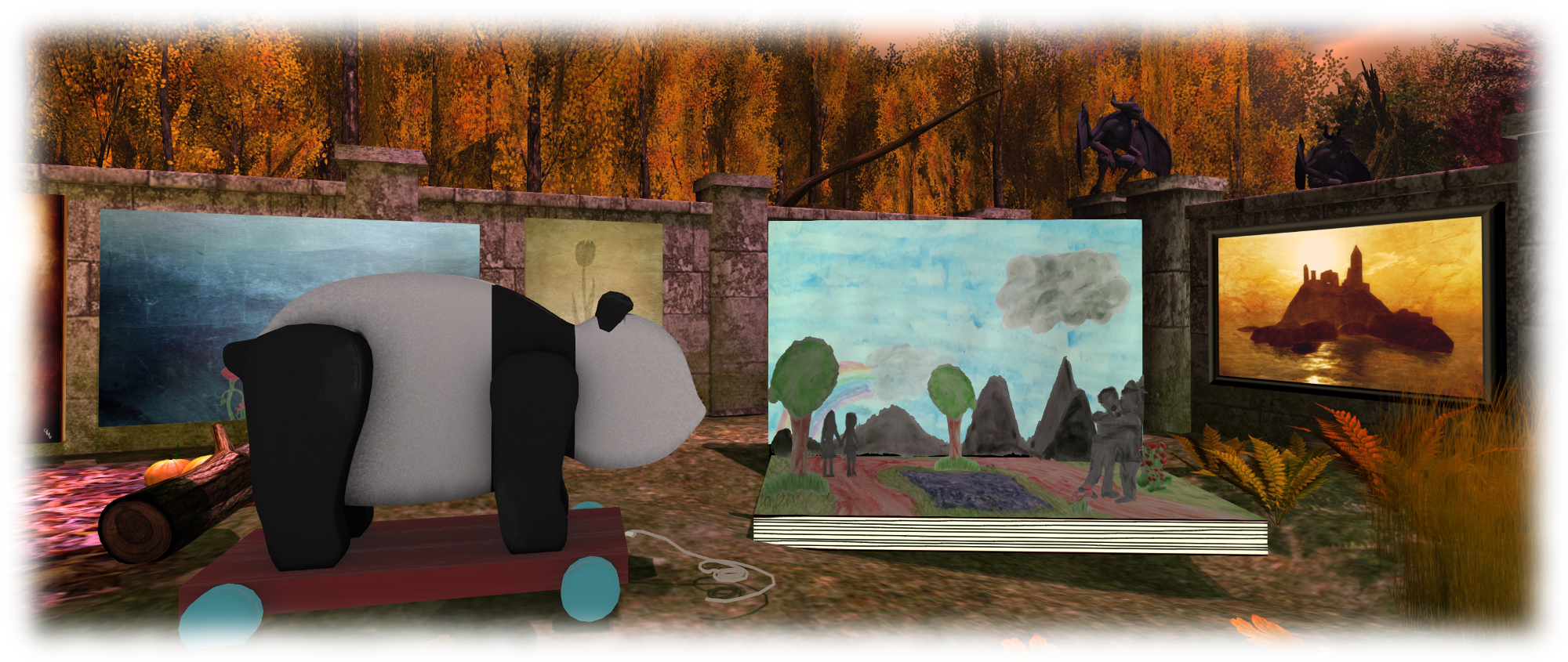
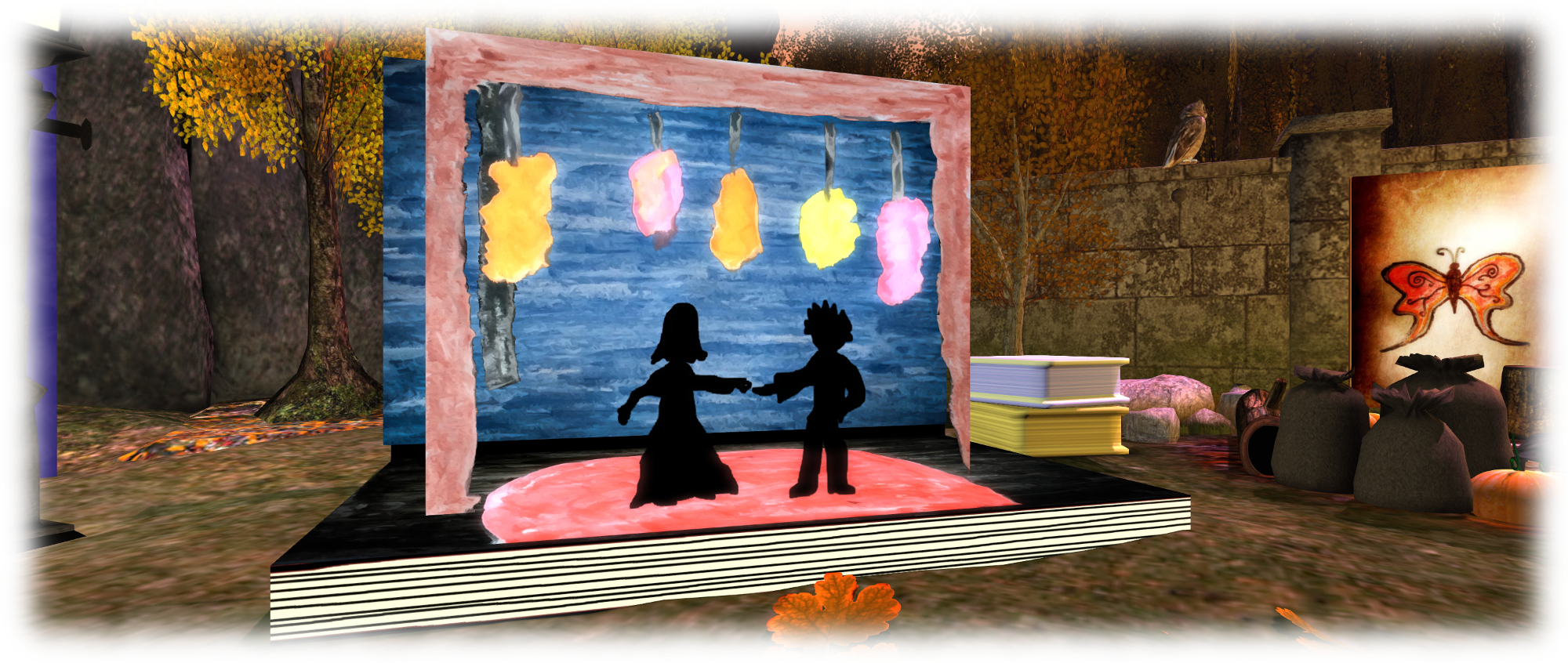
Officially opening at 12:00 noon SLT on Tuesday, October 13th  at CBK Art Gallery is a new exhibition  by gallery owner / curator, Ceakay (CK) Ballyhoo, entitled Pop Up Love. On display are six pieces of CK’s art created in the physical world using aquarelle pencils, and presented as a set of pop-up story books.

“The drawings are simple, childlike,” CK says of the pieces,. “with silhouettes portraying a sensation, an idea, rather than a detailed picture.”

In keeping with the child-like theme, the gallery space has been in part decorated in the style of a child’s bedroom or play room. Toys lay scattered about, coloured stars hang from the sky as if suspended from a ceiling, revolving slowly with a glowing crescent Moon, casting shadows across the limited of the gallery like a child’s mobile might cast shadows on the walls of a room.

Pop Up Love - CKB Gallery
Pop Up Love – CKB Gallery

Each of the books is individually bound, and again in keeping with the title of the exhibit, bears a title related to love: Forever Love, Fragile Love, Hopeful Love, Lost Love, New Love, and All Love. If closed, they can be opened with a click, revealing the picture within which as CK says, is designed to convey the feeling or sensation suggested by the title, rather the provide a detailed image or interpretation. Clicking an open book will close it once more.

As well as Pop Up Love, some of CK’s in-world photography can be seen hanging from the walls of the gallery garden, while in one corner of the gallery sits a little multi-coloured children’s play house, and within it, a series of paintings of a landscape as might have been drawn by a young child. These paintings and the photographs around the gallery edges are all for sale, and if you follow the teleport “door” in the corner of the house, you’ll be carried up to the landscape itself, which CK has created in a skybox.

Pop Up Love - CKB Gallery
Pop Up Love – CKB Gallery

This is a charming exhibition of work by CK, imaginatively presented and which brings a smile to one’s face. As noted,Pop Up Love officially opens on Tuesday, October 13th at 12:00 noon SLT with music by The Vinnie Show. However, the gallery is open now for those who would like to visit ahead of the opening.

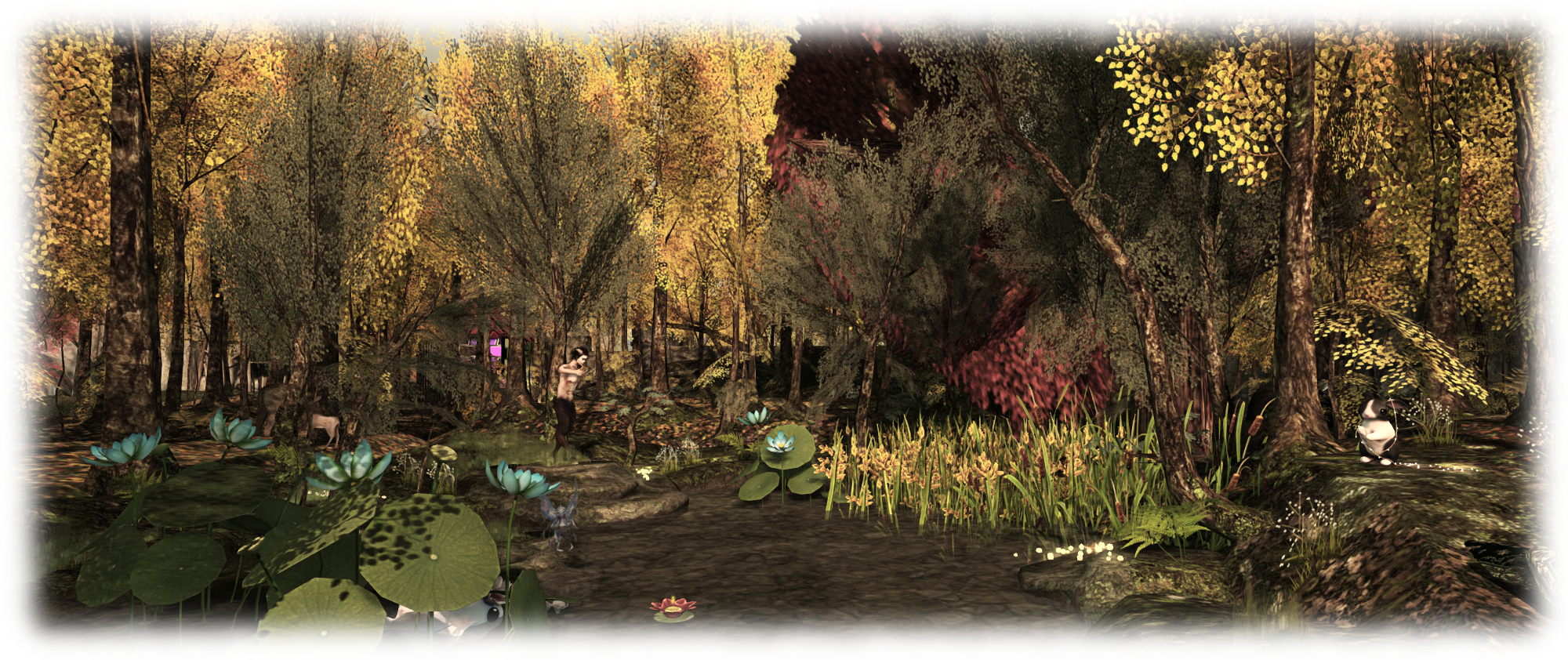
Should you decide to do so, don’t forget to take a walk through the gates into CK’s Mistwood Isle woods and garden, now rich in autumnal colours and incorporating a Halloween theme in the Devil’s Den corner.

CK's Mistwood Garden, alongside the CKB Gallery
CK’s Mistwood Garden, alongside the CKB Gallery

SLurl Details

SL project updates 41/2: TPVD meeting, attachments & Interest List issues

Ironwood Hills; Inara Pey, October 2015, on Flickr Ironwood Hills (Flickr) – blog post

The following notes are primarily taken from the TPV Developer (TPVD) meeting held on Friday, October 9th, 2015. A video of the meeting is included at the end of this report, although the opening few minutes of the meeting are missing. Because of this, I’ve included an audio file as well to cover the opening of the meeting.  Time stamps to both the audio and the video are provided, and my thanks as always to North for the video recording and providing it for embedding.

Please note that any extraneous noises on either the audio or the video are the result of an open mic in the meeting itself, and not from myself or North

Server Deployments: Week 41 – Recap

As per the server deployment thread, there were no scheduled deployments / restarts for the three RC channels during the week, while the Main (SLS) channel received the same server maintenance package deployed to the RCs in week #40.

SL Viewer Updates


[00:00 – 02:10 on audio]

CEF Project Viewer

On Wednesday, October 7th, the Lab issued the long-awaited project viewer utilises the Chromium Embedded Framework (CEF) for media handling – and more – in Second Life. Version 4.0.0.305703 sees CEF replace the ageing llqtwebkit functionality for media management in Second Life (also see my separate update).

[13:25 video] The emphasis from the Lab is that if you use web media in-world test your products / projects / uses thoroughly with the CEF project viewer, and make sure you continue to test as the project viewer is updated, in order that specific issues encountered can be reported and looked at while the lab is still developing the viewer.

It also appears that QuickTime media may still work on this viewer, rather than being disabled, as had been indicated in my last TPVD update. However, this should not be taken to mean either QuickTime or Flash will be supported by the Lab going forward, or that media using them will be viewable by all users. CEF, HTML 5, etc., are the future of media in SL.

Other Viewer Updates

On Friday, October 9th the HTTP updates viewer (project Azumarill) was promoted to release Candidate status with the release of version 3.8.5.305771. This viewer provides improved performance and stability. Impacts include: asset uploads, AISv3 inventory manipulation, VMM, Experience management, LSL compilation, Simhost event polling, etc.

Currently, it appears as though the Maintenance RC viewer, version 3.8.5.305531, is in line to be promoted to the de facto release viewer in week #42 (week commencing Monday, October 12th).

An update for the Oculus Rift project viewer (currently version 3.7.18.295296, and now almost a year old), is still expected, but it is subject to other work being undertaken at this point in time.

Attachment Loss on Region Crossings

[03:44 audio;  00:00 video]

The Lab recently carried out extensive work to reduce the number of attachment loss issues occurring as a result of issues caused directly within the viewer itself (project Big Bird). However, while this work fixed a lot of issues, some still remain, particularly during region crossings, whether physical or via teleport (see BUG-7761 as an example).

Essentially, what happens when moving from one region to another is that all of the attachments on your avatar must get new IDs from the simulator to which you are moving. The viewer then has to associate these new IDs with the attachments you are wearing, and the locations where those item as actually attached. In doing so, it attempts to preserve continuity  by keeping things where they were according to the region you’re leaving, and then updating them with the information it receives from the new region.

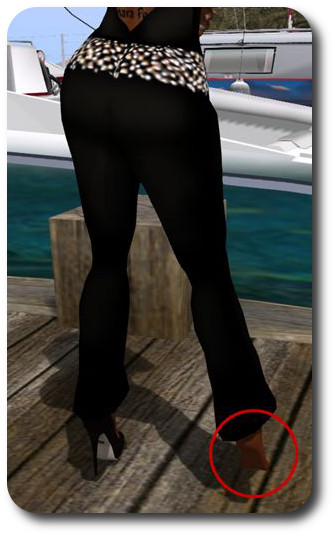
A problem I sometimes encounter when flying / boating is returning home and finding one of my scripted mesh shoes has been detached at some point during the trip

This obviously involves a lot of messages being passed back and forth between server and viewer – and the more attachments you have, the greater the number of messages being passed back and forth.

Additionally, if the attachments are scripted, further messages relating to script states, etc., also need to be passed relating to their state, etc., which adds to the load. Finally, all of these messages may use different transport mechanisms to pass between server and viewer.

This means there are many opportunities for messages to arrive out-of order due to race conditions, etc., or to be dropped and lost because of possible network issues and some messaging mechanisms not having a retry option, etc. It is these problems which tend to result in issues with attachments being removed, etc.

The Lab is interested in trying to eliminate as many of these problems as they can (allowing for the fact some might be related to your network connection, and possibly outside of their ability to control). However, in order to do so, they first need to identify exactly what is going on, and this requires examples of attachment losses, etc., that are consistently reproducible (e.g. attachment type X will always detach when crossing between regions Y and Z, for example). It is these kinds of consistent examples which are proving hard to find – so if you do know of one, please raise a JIRA outlining it step-by-step.

Continue reading “SL project updates 41/2: TPVD meeting, attachments & Interest List issues”

P2P: Helping those with disabilities in Second Life

 It’s widely recognised that for many with disabilities, Second Life offers a major source of engagement, support and enjoyment which might otherwise be beyond their reach. As a result, there are a number of charities, organisations and support groups active within Second Life providing a wide range of services and support networks for those with disabilities and / or disabling illnesses.

One such group, of which I’m embarrassed to say I only quite recently became aware, is the  Pixel to Pixel (P2P) Foundation. Founded in 2009 by Jadyn Firehawk (also known within P2P as Pixel Falconer), it offers a unique service to Second Life users who in the physical world are supporting themselves purely through disability benefits.

“Second Life is a lifeline to many people with disabilities,” Jadyn says in discussing P2P’s function. “Some may live in social isolation, so SL keeps them connected with friends. Others may suffer a physical impairment, and SL gives them the virtual experience of full mobility and freedom.

“But there are costs associated with being involved in Second Life, and for those who are reliant solely on disability assistance programme benefits can struggle to meet those costs. So, the P2P Foundation gives direct financial assistance in the form of weekly Linden dollar stipends to people on disability, to help them enjoy their time in-world.”

Pixel to Pixel foundation HQ offering information, fund-raising kits and more
Pixel to Pixel Foundation HQ offering information, fund-raising kits and more

This stipend, L$500 (approx US $2.00) per week, may not sound much, but for someone who is living purely on benefits, it can mean a lot. As one participant states, “two dollars for me means a loaf of bread for a week.” So the stipend can lift the burden of choice, allowing the recipient to put it to use in Second Life – help cover their rent, upload textures, buy goods or clothing in-world, or spend it however they like, without necessarily having to draw on their physical world finances. As well as the stipend programme, P2P will occasionally award discretionary grants to recipient, so that they can start a business or pursue a major creative project in Second Life.

Because P2P operates purely in-world, beneficiaries can reside in any country around the globe, and their disability assistance can be either from their government or from a private disability insurance company. However, in order to be eligible for the P2P programme, applicants and recipients must be able to demonstrate, if asked, that they are on disability benefits. This is done by sending a copy of their disability benefits award letter (or similar document) to Jadyn via regular, physical world mail, with their personal identifying information blacked out and replaced with their avatar name.

The 3LI P2P donation Kiosk is available as a part of the P2P fund-raising kit available from the P2P HQ
The 3 LI P2P donation Kiosk is available as a part of the P2P fund-raising kit available from the P2P HQ

The money used to pay out the stipends comes directly from donations and fund-raising activities. These currently enable the Foundation to support 20 people in Second Life through payouts amounting to L$10,000 a week.  However, as Jadyn notes, there are a further 20 people on the Foundation’s waiting list – and it can take in excess of two years for someone to secure a place in the programme.

“People who are on disability and in Second Life tend to stay, because SL becomes such an important part of their daily lives, meaning that new slots do not often open up,” Jadyn tells me.

Currently, P2P can generally only take on new recipients as a result of others leaving the programme, such as by becoming self-sufficient through their own entrepreneurial activities in SL – hence the discretionary grants programme P2P operates, which can help facilitate this.

One way to increase the number of people the Foundation can support is through greater guaranteed inflow of donations. Anyone can help with this, simply by making a donation of any amount directly to Pixel Falconer, the Foundation’s donations account, or through one of the Foundation’s donation kiosks located throughout Second Life (see the list at the end this article for the current locations).

Businesses, venues and groups can also help with fund-raising by visiting the Foundation’s HQ to obtain a fund-raising kit, and then setting-up kiosks, posters, etc., in their store / on their land. The kiosks not only help with generating funds to run the programme, but also help raise awareness of P2P’s work. Jadyn would also be delighted to hear from any business, venue or group interested in organising and hosting a P2P fund-raiser.

The P2P Foundation gallery features the work of disabled artists, all of which is available to buy, the proceeds of sales going to the Foundation's work
The P2P Foundation gallery features the work of disabled artists, all of which is available to buy. The proceeds of sales going to the artists to help support them directly, although some may opt to share the proceeds with the Foundation

Two of the most effective means of assisting the Foundation is to either become a weekly / monthly donor, or by sponsoring P2P participant.

If you would like to become a weekly / monthly donor, you can do so by making your payments  directly to Pixel Falconer. Or you can also grab a donation kiosk and use it as a visual reminder to donate, rather than relying purely on memory to make payments to Pixel Falconer it might  also encourage your friends to support P2P!).

Should you wish to sponsor a P2P participant, either as an individual or through your business, please contact Jadyn Firehawk directly in-world.

Continue reading “P2P: Helping those with disabilities in Second Life”

Warm Springs in Second Life

Warm Springs; Inara Pey, October 2015, on Flickr Warm Springs (Flickr) – click any image for full size

Take the ferry to Warm Springs, a lovely town with hills overlooking the sea and beaches. Walk the dirt roads under the intertwined ancient trees and see the picturesque charming houses. Take the bridge to the hills where you can see the lighthouse and the cliffs overlooking the sea. Or, simply go to the town’s Bakery and Cafe for some delectable delights. Come, relax, and enjoy the town’s beauty.

Thus read the invitation luring me across the sea to Warm Springs, the homestead region designed by Irina Sofia Deschanel (aka Irina Forwzy) – and I’m glad I was lured, because it is a place to savour and enjoy.

Now held in the cupped hands of autumn, the region is a true natural delight, filled with warm colours, the trees drawing close to shedding their leaves, yet for now offering them as shade from the autumnal sun as you wander the paths and tracks which wind their way around and across the region.

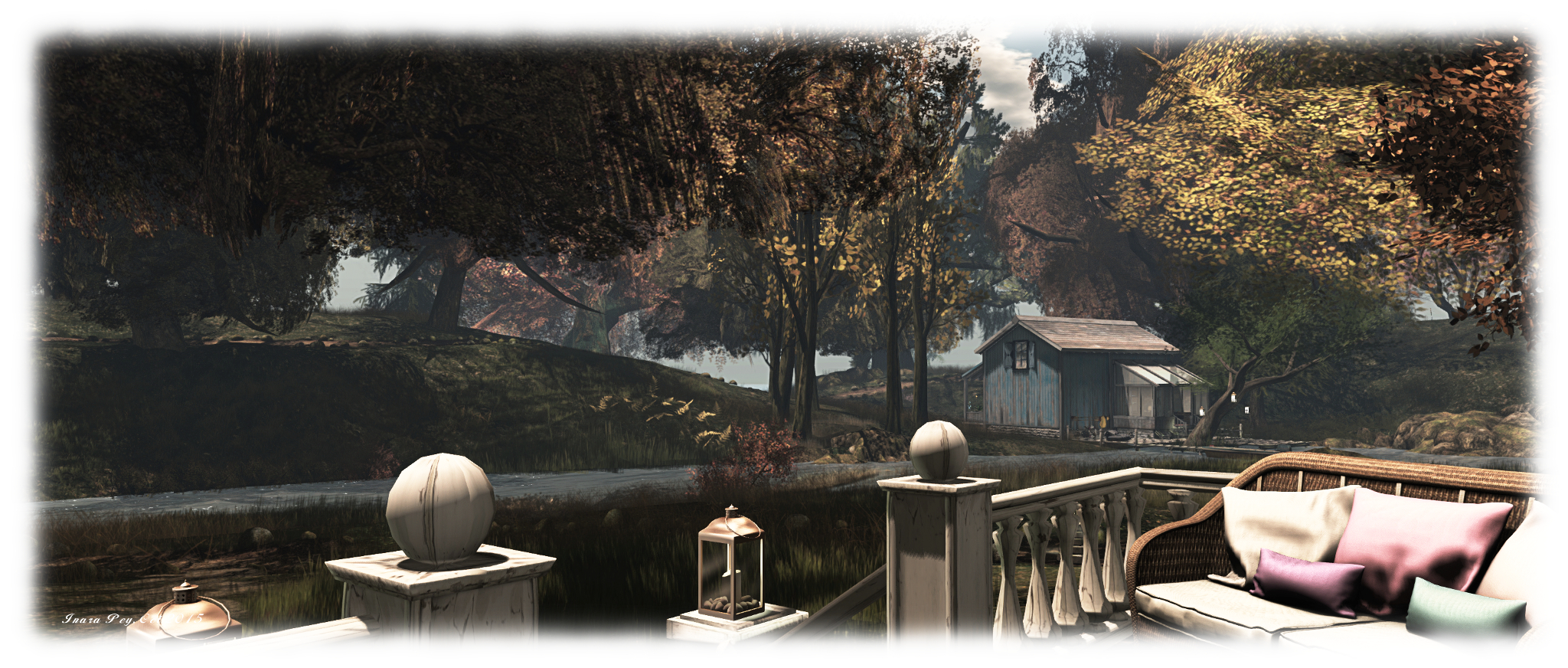
Warm Springs; Inara Pey, October 2015, on Flickr Warm Springs (Flickr)

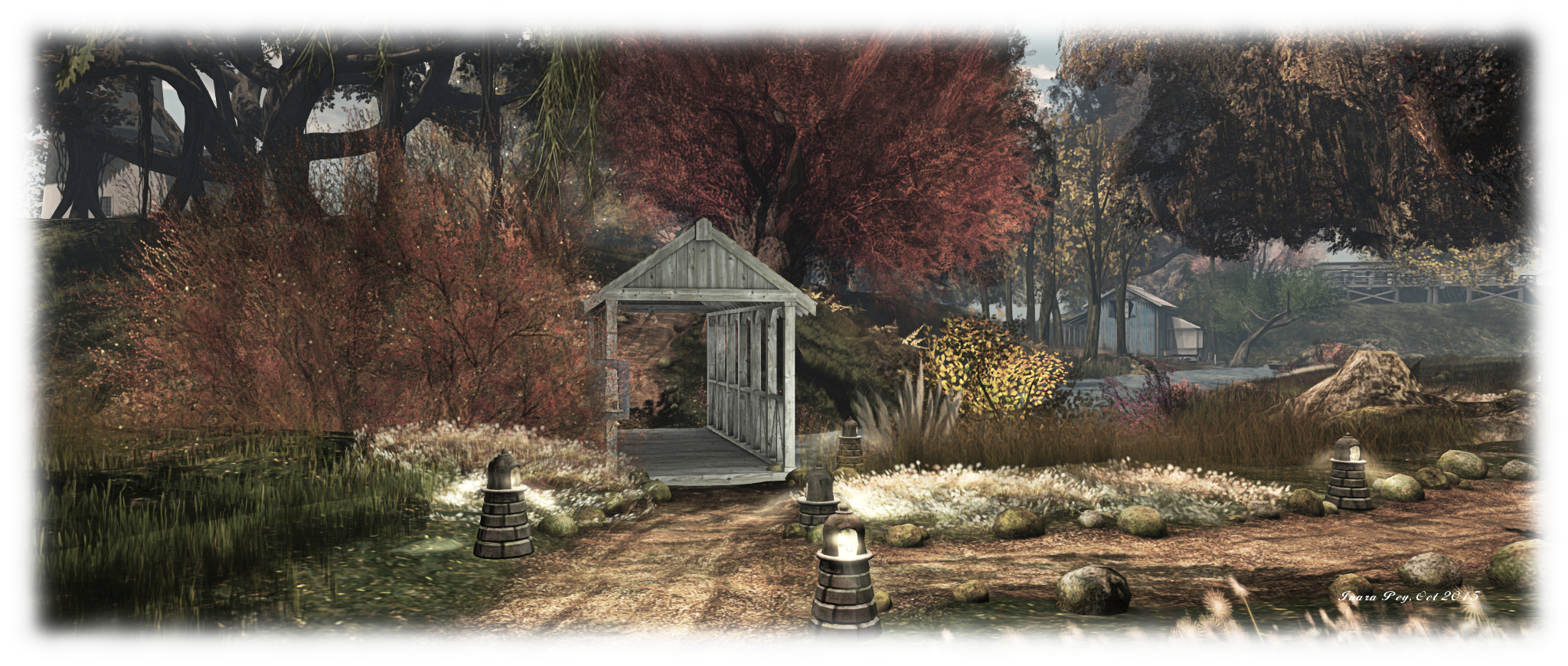
The landing point occupies a small pier on the north side of the island, a sign inviting the visitor to stroll along the beach to one side while a track beckons one inland. Take your pick as to which you follow; each will offer much to see, be it from the sandy shoreline or from under shady boughs. Just across the mouth of the river from the landing point sits a little orchard, apples ripe for the picking and being harvested ready for market, watched over by the tall striped finger of the local lighthouse sitting atop a nearby hill. To reach this, you’ll need to follow the track inland and cross the river by the covered footbridge.

Warm Springs; Inara Pey, October 2015, on Flickr Warm Springs (Flickr)

Once across the river, the track turns away from the lighthouse, so you’ll have to cross the grassy slope to reach it. As you do so, you might spot the board walk and steps leading down to another beach, this one nestled under the lighthouse, offering a secluded spot away from the world.

Follow the track, however, and you’ll be taken past one of the little houses occupying the region and another set of steps offering the way down to a further stretch of beach, and onwards to a hilltop bakery and coffee-house, where refreshments can be enjoyed, indoors or out.

Back across the river, and relatively close to the landing point, are two more little houses; neither is occupied per se, but they are in keeping with Irina’s statement that the population of Warm Springs can be counted on the fingers of one hand! Both of these houses sit with their backs to the beach signposted from the landing point, completing the circle of the region.

Warm Springs; Inara Pey, October 2015, on Flickr Warm Springs (Flickr)

For those who enjoy taking pictures, there is a Flickr group, and Irina invites those who do take pictures of Warm Springs to consider adding them to the group. Should you enjoy your visit, do please consider making a donation towards the costs of keeping the region open to visitors.

SLurl Details