 Following my last Curiosity update, which noted that other than for one potential drilling / sampling target, work was wrapping-up for the Mars Science Laboratory in the “Pahrump Hills” location on the lower slopes of “Mount Sharp”, the decision was taken to indeed gather one more sample.
The selected target had been dubbed “Telegraph Peak”, and sits towards the top end of “Pahrump Hills”. It was selected because Alpha Particle X-ray Spectrometer (APXS) measurements carried out by the rover during its 5-month “walkabout” in “Pahrump Hills” revealed the rocks in the area to be relatively enriched in silicon when compared to the corresponding amounts of aluminium and magnesium, which is somewhat different to rocks sample prior to the rover arrival at the basal slops of “Mount Sharp”. This enrichment has also shown to increase the further up the slopes of “Pahrump Hills” the rover climbed, which is of interest to the science team.
“When you graph the ratios of silica to magnesium and silica to aluminium, ‘Telegraph Peak’ is toward the end of the range we’ve seen,” Curiosity co-investigator Doug Ming explains. “It’s what you would expect if there has been some acidic leaching. We want to see what minerals are present where we found this chemistry.”
Sampling took place on February 24th, 2015 (PDT) or Sol 908 for the rover on Mars. For the first time in Curiosity’s time on Mars, it was carried out with no preliminary “mini-drill” operation. Instead, the science team judged that analysis of the rock by APXS indicted it was of a very similar nature to the previous two sample drilling sites in “Pahrump Hills”, and the new lower percussion drilling capabilities the rover now has were judged as sufficiently safe enough to go ahead with a direct sample gathering operation.

As I’ve covered previously in these pages, obtaining a sample for analysis is a multi-part operation. First the rock is drilled, and a core sample forced up through the drill bit into a one of two sample collection chambers at the top of the drill mechanism. From here, the sample is “shaken” through a feed to another device in the rover’s robot arm turret called CHIMRA – the Collection and Handling for In-Situ Martian Rock Analysis system, used to separate the tailings through a series of sieves, ready for different sizes of sample grains to be passed through the the rover’s on-board laboratory systems.
Both of these operations require the use of the drill’s percussive system to vibrate the turret, forcing material both from the drill’s sample collection chamber and through CHIMRA. However, on February 27th, during the initial operation to move the sample tailings from the drill chamber to CHIMRA, Curiosity’s on-board fault protect system identified a transient short circuit within the robot arm’s electronics. The immediately resulted in all arm-related activities being shut down, and the arm and turret locked into position ready for diagnostic operations to commence.
A transient short can occur for a number of reasons, and can pass without significant problems. However, it may also indicate a potential issue which might require some measure of action, such as a change in operating procedures or a restriction on how a mechanism is used, in order to avoid the issue becoming a serious problem in the future. To this end, following the fault report, mission engineers started diagnosing the problem, with almost all rover operations halted while they did so.
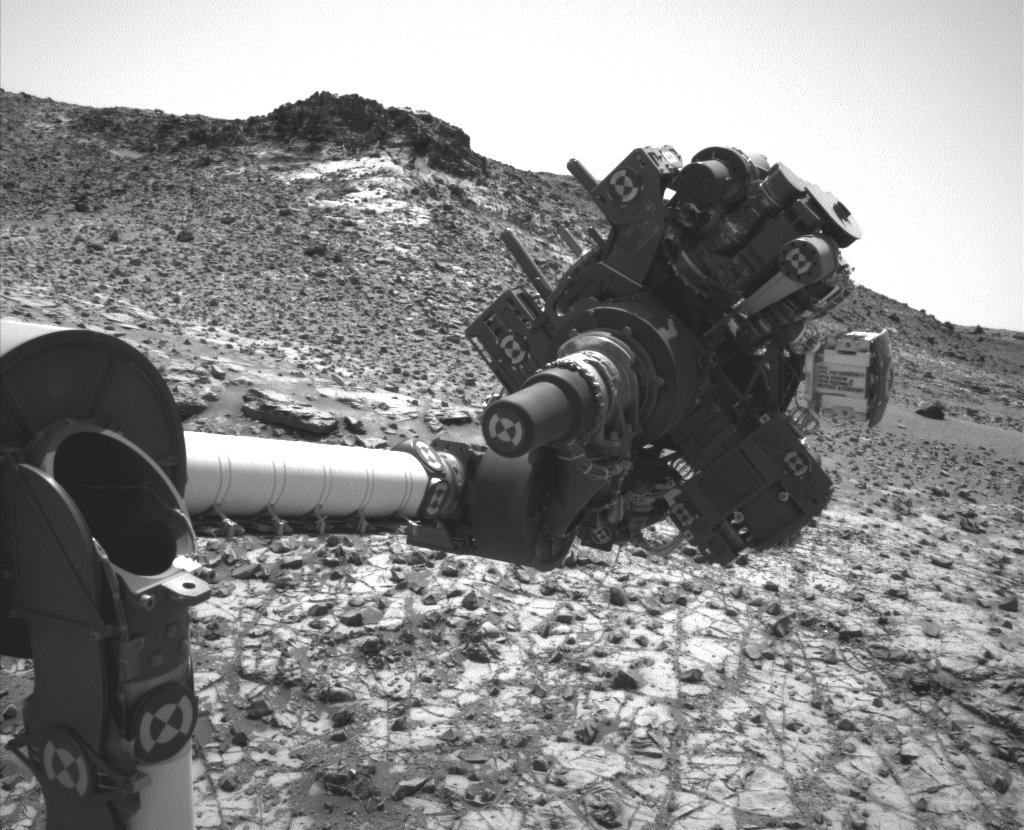
On Thursday, March 5th, as a part of the investigative process, the rover was commanded to carry out a series of vibration tests of the kind performed while forcing the transfer of samples from the drill to CHIMRA. The vibrations were carried out with the robot arm and turret in the same orientation and position which caused the initial triggering of the fault protection system, and in the third of 180 repeat motions, a similar transient short occurred, lasting less than one one-hundredth of a second, enough to trigger the rover’s fault protection systems, and confirming there does appear to be some kind of electrical issue.
Tests are now under-way to determine whether or not the short will occur with the turret in different orientations, and may be followed by additional tests to see if it occurs with the arm in different positions. If no shorting occurs with either a change in the orientation or position of the turret / arm, then the most obvious step in preventing any recurrence of the issue is to avoid placing the turret / arm in the same orientation for sample transfer operations during future drilling activities.
It is hoped that the tests can be completed in the course of the next week. If they show that operations can be resumed safely, it is anticipated that the sample transfer operations will be completed, and Curiosity will then be ready to resume its climb up “Mount Sharp”, leaving “Pahrump Hills” via a narrow valley the science team have dubbed “Artist’s Drive”.
Continue reading “Short circuits on Mars and mapping asteroids”




 Inara Pey: Living in a Modemworld