Nine talents, five staves, four hours, three spirits and one ball

Dickens-2014. . . the floor was swept and watered, the lamps were trimmed, fuel was heaped upon the fire; and the warehouse was as snug, and warm, and dry, and bright a ball-room as you would desire to see upon a winter’s night.

Yes, it’s that special time of year of a very special Second Life Christmas tradition: the telling of Charles Dickens’ popular seasonal tale, A Christmas Carol. And this year, it will be a very special event.

Since its first performance in 2012 by the folk of StoryFest SL, under the title of The Dickens Project, and in celebration of the 200th anniversary of Dickens’ birth, the telling of A Christmas Carol has become something of a very special Christmas event, with readings taking place right across the the holiday period,

For 2014, things will be a little different. Forming a part of Fezziwig’s Ball, which will be held on Sunday, December 21st, commencing at 11:00 SLT, there will be a special reading of A Christmas Carol by the StoryFest SL team, taking place over approximately four hours, and Second Life residents are invited to drop in and listen throughout.

The timetable for the event is as follows (all times are SLT, and from noon onwards, approximate):

  • 11:00 Stave One, “Marley’s Ghost” – Shandon Loring and Caledonia Skytower
  • Noon: Stave Two, “The First of Three Spirits” – Bhelanna Blaze and John Morland
  • 13:00: Stave Three, “The Second of Three Spirits” – Kayden Oconnell and Aoife Lorefield
  • 14:00: Staves Four & Five, “The Last of the Spirits” & “The End of It” – Corwyn Allen, Freda Frostbite, and Dubhna Rhiadra.
Caledonia Skytower, Shandon Loring (centre) and Kayden Oconnell in an evocative shot of the virtual / live performance by Bear Silvershade
Caledonia Skytower, Shandon Loring (centre) and Kayden Oconnell in an evocative shot of the virtual / live cross-over performance of The Dickens Project’s A Christmas Carol in 2013 by Bear Silvershade

Shortly after the conclusion of Stave Five there will be a very special ball / party, with suitably festive music supplied by Dubhna Rhiadra, and to which all are invited, “put on your dancing shoes and dance like it’s 1843!” (period costumes welcome, but optional!). The ball will celebrate both the festive season, and mark the closing of the StoryFest SL storybook, as the organisers seek to focus more of their time and resources on some exciting new projects and work. 

Having attended previous readings of A Christmas Carol by the folk at StoryFest SL, I can state without hesitation that they are always a pleasure to attend. So, if you enjoy this story of grumpy old men, ghosts and redemption, then pour yourself a glass of mulled wine, grab a mince pie or two and hop over to Imagination Island.

On a personal note: as this is the last event that will be held under the StoryFests SL banner, I’d like to offer my thanks to those who have, since 2011, both organised and participated in StoryFest events: StoryFest itself, BOOFest, Bard on the Beach and, of course, The Dickens Project.

Related Links

Note: while this is not a fund-raising event, any and all tips received will benefit The Community Virtual Library, who are hosting the event on Imagination Island.

The algorithms of art

Art and Algorithms Digital Arts Festival
Art and Algorithms Digital Arts Festival – Jo Ellsmere: Biomechanical (click any image for full size to see the details)

The Art and Algorithms Digital Arts Festival, currently located on LEA8, will be closing at the end of December 2014, and if you haven’t already paid it a visit, I would recommend that you do. It is a continuation of the Second Life element of the art festival of the same name, which was held in Titusville, Florida, between October 3rd and 12th, 2014.

Arranged around a central landing point area are eight individual exhibition spaces offering one or more pieces by well-known SL artists. Each exhibit is highly individual in terms of subject matter, and despite the fact they are all packed into a single region, they each offer an individual environment, complete with custom media streaming and parcel windlight presets.

The landing area, designed by Pixel Sideways, initially served as a tutorial area for people entering SL for the first time from the Titusville festival; as such, it may not appear to hold much of interest to the established SL user. However, I’d suggest having a little look around, as there are several points of interest to be found, including a teleport to Pixels’ own display area located high over the region. The music stream provided in the arrival area might also be of interest as well, given it is being driven by solar radiation levels being recorded by NASA’s Lunar Reconnaissance Orbiter as it orbits the Moon!

Art and Algorithms Digital Arts Festival
Art and Algorithms Digital Arts Festival – Ub Yifu: The Tree People, “an absorbing immersive environment, which is at the same time a tribute to Nature and its many gifts, the mysterious duality of life, and the creative people who explore virtual worlds in search of their holy grail”

The first of the installations on display to capture my attention when visiting was Jo Ellsmere’s Biomechanical, picture at the top of this article. A homage to V. Meyerhold’s biomechanics system developed to help train actors, it was first seen as a part of the digital element of The Golden Age of the Russian Avant Garde, by Peter Greenaway (UK) and Saskia Boddeke (Holland) which I wrote about in May 2014, and makes a welcome return here. The piece features five avatars beautifully scripted to move through as series of synchronised actions, both as a single unit and as five unique elements within that unit, a slight syncopation to their movements giving them a time-lapsed grace.

Jo also shares the stage with Pyewacket Kazyanenko for Interstellar Princess, which they disarmingly refer to as simply, “a complete understanding of the universe, why it is as it is and why it exists at all”! Featuring a small army of bots named for the phonetic alphabet, and a similar number of televisions (make sure you run media in the parcel), it’s a curious piece.

Art and Algorithms Digital Arts Festival
Art and Algorithms Digital Arts Festival – Lollito Larkham: Petit-Gris (Little Gray), the Plutoian who passes the days listlessly, moving about his home, reading about alleged “humans” and tale of the wonderful planet Earth, his mood swinging between hope and despair that he’ll ever be able to see it for himself

The origins of ALEA FUKUSHIMA apparently lie in a dream artist Artistide Despres had, in which he imagined a scientist-musician who was able to neutralize the radioactivity at the Fukushima nuclear power plant by transforming the energy into music. This is an interactive piece, musical instruments in the “reactor building” responding directly to avatars.

In another of the overhead domes, Feathers Boa offers visitors Painting in Three Dimensions,  retrospective of her work from the period of 2007-2010. All of the pieces here also respond to the presence of an avatar, changing as you approach them and then step away from them.

Art and Algorithms Digital Arts Festival
Art and Algorithms Digital Arts Festival – in A Comfortable Skin, Gracie Kendal continues her exploration of society’s obsession with appearance, identity, and acceptance, using both physical and virtual avatars. Don one of the paint-splattered skins she offers, jump into the images of physical world locations and similarly-attired “avatars” and take a picture of yourself. Are you comfortable in the skin you’re in?

Glyph Graves presents three pieces for the price of one: Ghost Flora, Breeze, and Forest of Water. The latter two pieces are presented in one of ground-level exhibition spaces, while Ghost Flora can be seen in the waters surrounding the central landing / tutorial area.

Together, these works make up an interesting exhibition, each of them showing various facets of artistic expression and the versatility available within virtual environments like Second Life for immersive art.

Related Links


The Miss Virtual World Gowns and Gift card Auction for RFL of SL

Sunday, December 21st will see the Renaissance Galleria host the  Miss Virtual World 2015 Gowns and Gift card Auction.

Commencing at 10:00 SLT, the auction will be led by Neckcadaver Resident, and 100% of all proceeds will go directly to Relay for Life of Second Life. The gowns and gift cards to be auctioned have been generously donated by the following designers.

Azul, Lyrical Bizzare, Kelini Couture, Enzo Champagne, of Champagne, Mohna Lisa Couture, Pixi of Ala Folie, Lybra, Guila, Purplemoon, Sascha Frangilli of Sascha’s Designs, Carrie Snowpaw, and Elysium Skins & Apparel.

This is liable to be a popular event, so if you would like to available yourself of the opportunity to own a beautiful gown or collect a special gift card, all in aid of a worthy cause, be sure to teleport over to the auction in good time.

The Renaissance Galleria's sumptuous fashion show area will host the Miss Virtual World 2015 Gowns and Gift Card Auction in support of RFL of SL
The Renaissance Galleria’s sumptuous fashion show area will host the Miss Virtual World 2015 Gowns and Gift Card Auction in support of RFL of SL

About BOSL

The Best of Second Life Magazine started in 2008 and is focused on presenting the “Best Of” all that SL has to offer and sharing it with readers. Bringing readers a vast array of information and topics each month the magazine covers events, arts, activities, fashion, people, styles, products, sims, movements, and creativity. This in world and on the web publication is the longest running magazine in SL and reaches an extensive SL audience through its large group and subscriber list as well as outside of SL through the website.

The Best of SL Magazine is part of BOSL & Co, which comprises the following companies:   Best Of SL Magazine; Miss and Mister Virtual World Pageants; Miss Virtual World Modelling  Academy; BLVD Fashion House; Fashion Feed; SL Associated Press and Best of SL Couture Boulevard & Renaissance Galleria Malls. Each company is focused on bring the “Best Of” in its own category and work to collaborate together, building one another’s strengths, to promote the creativity of those who are behind the creative and amazing aspects of SL.

About Relay For Life of Second Life

Relay For Life of Second Life is an annual activity that takes place in Second Life in July each year. Volunteers form or join teams to have fun while fundraising and raising awareness from mid-March through mid-July. In July teams build campsites and walk a track, just like a Real World Relay. Since 2005, Relay For Life of Second Life has raised over $2.25 million USD for the American Cancer Society. In 2013, Relay For Life of Second Life has raised over $390,000 for the American Cancer Society. Relay For Life has become an international movement in RL and SL. In 2011 participants from over 80 countries took part in Relay For Life of Second Life.

About the American Cancer Society

For more than 100 years, the American Cancer Society (ACS) has worked relentlessly to save lives and create a world with less cancer and more birthdays. Together with millions of  supporters worldwide, ACS helps people stay well, helps people get well, find cures, and deal with their journey against cancer.

Related Links

Never Ending surprises

Never Ending
Never Ending

Never Ending, in its winter guise, is perhaps one of the most surprising regions I’ve visited in a while. The work of しゅにん (Syunin Arida), いお (iorri), and TefTef Violet, it not only carries a seasonal theme right now, it does so in a quite remarkable manner, one which may at first deceive the casual eye.

On arriving, you standing close to a little village deep in snow and surrounded by  snow-covered hills of almost cartoonish undulations. Bare trees are strung with lights, while bears are sprawled on and against logs and tree stumps in one corner of the village, looking well and truly worn-out by all the exertions of Christmas shopping – or perhaps by trying to catch the raccoon who is keeping an eye on them from the upstairs window of the tower behind them…

Never Ending
Never Ending

Theses are not the only furry inhabitants of the village. Just over the garden fence, Grandpa Raccoon  stands on his porch, puffing his pipe, while across the snow-blanketed village green a young raccoon reads outside the local bookshop, Mama bear sitting close at hand, baby bear in her lap. Meanwhile, and next door to the bookshop, Mrs. Raccoon is arriving home with the groceries…

If all this sounds a little twee, don’t be fooled. The little village, with its Christmas tree bearing fairy lights and candles and presents spread under its boughs, is both charming  and avoids a feeling of looking just a little too sweet. It offers a lot to see, with seats and cuddle spots inviting visitors to stay a while; but it’s not all there is to see or explore, so don’t be fooled into just taking a cursory look around and skipping elsewhere.

Never Ending
Never Ending

Just outside the village sits a Flea Circus, and wander a little further or cam around and you’ll note there are other places to explore: a frozen lake, a couple of hidden valleys and little nooks shielded from the rest of the region by the steep hills. There even a wooden lodge sitting atop a steep hill awaiting your visit. But unless you’re ready to do some serious climbing (or cheat and fly), how are all of them reached?

The answer lies in a series of teleports which have been scattered around the region awaiting discovery. Some take the form of double doors, other are anywhere doors and still others are photos mounted on display boards. Herein lies another surprise: not all the destinations on offer are at ground level; several are hidden up in the sky, and are themselves a delight to discover and explore. What’s more, quite where you’ll be taken next isn’t always clear when first exploring, which further add to the mystery and charm of the region.

NE-10_001
Never Ending

Never Ending is a true delight, with surprises at every turn;, and a visit I’d suggest you not pass on the opportunity to make. Do be prepared to click on things as well; there are several quite charming poses to be found (look for the umbrellas in particular), and a couple of gift boxes on offer from the designers.

Related Links

SL project updates week 51/2: SBUG, TPV Developer meeting

Frisland, Laluna Island (Flickr) – blog post

The following notes are taken from the Server Beta User Group (SBUG) meeting held on Thursday, December 18th, 2014, and the TPV Developer meeting held on Friday, December 19th. A video of the latter is included at the end of the article, my thanks as always to North for recording it and providing it for embedding.

With reference to the meeting video, summary notes are provided below with time stamps to assist is spotting and listening to the associated conversations.

Server Deployments Week 51 – Recap

  • On Tuesday, December 16th, the Main (SLS) channel was updated with the server maintenance package deployed to the three RC channels in week #50
  • There were no deployments to the RC channels.

The end-of-year code freeze / no change window comes into effect from the end of the week, this means there will be no further server updates until January 2015.

SL Viewer

Release Viewer

The Maintenance RC viewer, version 3.7.23.297296, was promoted to the de facto release viewer on Thursday, December 18th. This viewer comprises a solid collection of bug fixes and improvements to many areas of SL, and also includes a range of fixes to previously released changes in the way joint offsets in rigged meshes are handled. Please refer to the release notes for further information.

Experience Keys RC Viewer

On Wednesday, December 17th, the Experience Keys / Tools viewer was updated to release candidate status with the release for version 3.7.23.297364. Please refer to my overview of the viewer (written while it was at project viewer status) for information on the viewer.

Further RC Updates

[00:50] As a result of the promotion of the Maintenance RC, both the new Experience Keys RC viewer and the HTTP Pipelining RC viewer are currently being rebuilt to include the Maintenance release code. These updates may appear in the release viewer pipeline on Monday, December 22nd, or they may be held over from release until after the end of the no change window.

Viewer Build Tools Project

[01:41] The new year should also see the first release of a project viewer for Mac and Windows built using the new build tools chain and autobuild process.

Group Chat

The last of the 2014 updates are being deployed to the back-end servers. At the time of the Server Beta User Group meeting, there were just a “few more” hosts that had yet to receive the updates, so things should be completed in short order. These improvement are focused on improving the overall robustness of the service and dealing with overload conditions.

CDN Work

What is being referred to as a “mini CDN” test was carried out on the BlueSteel region on the morning (PDT) of Thursday, December 18th. The test was designed to check a more flexible  CDN configuration that is going to make it easier for  the Lab to deal with fall overs. “It should be invisible normally but lets us have better control of where the viewer gets those mesh and texture assets,” Simon Linden said of the work, which will likely see a formal deployment in the New Year.

Viewer-managed Marketplace (VMM)

[03:53] There was an in-world meeting held on Friday, December 12th to discuss the Viewer-managed Marketplace (notes and transcript).

There should be a summary post from the Lab, covering JIRAs raised on VMM and comments made on the forums, which should be appearing on the current forum thread around the time this update is published. A further feedback meeting is being planned for the New Year.

Continue reading “SL project updates week 51/2: SBUG, TPV Developer meeting”

Of mountains, methane and molecules

CuriosityAfter what has been a relatively quiet period in terms of news from Mars, things are once again proving interesting.

The first uptick came following the start-of-month teleconference Mars Science Laboratory personnel held to summarise the results of the last several months of activities the Curiosity rover has been performing in Gale Crater. In particular, these have allowed scientists to better determine how the 5 kilometre high mound at the centre of the crater may have been formed.

Even before Curiosity arrived on Mars, sufficient evidence had been obtained from orbit to show that features in and round Gale Crater were likely influenced by water-related activity. Curiosity itself found evidence for water once having flowed freely across parts of the crater when it encountered the beds of ancient rivers and streams as it explored the regions dubbed “Glenelg” and “Yellowknife Bay”.

With the journey down to “Mount Sharp”, and NASA call the mound, and the recent explorations of its lower slopes, the science team have been able to piece together the processes that led to its formation.

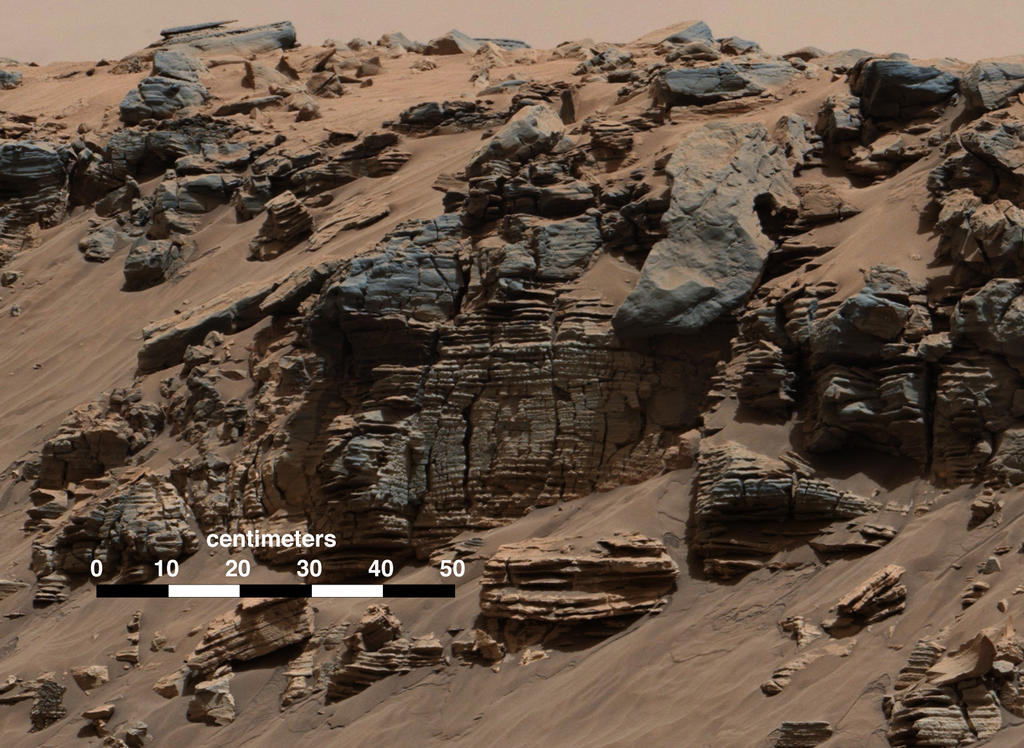
The first clues came while Curiosity was still en route to the point where examination of the “Mount Sharp’s” lower slopes could begin. As it drove southwards and towards the mound, the rover started to encounter layered sandstone deltas, all inclined towards “Mount Sharp”. On Earth, such layered, angled deposits are found where a river flows into a large lake.

A mosaic of images captured by Curiosity’s Mastcam on March 13, 2014 PDT (Sol 569). White-balanced for natural Earth light, the images show layered sandstone deposits, all pointing towards “Mount Sharp”, indicative of delta sediments dropped by a flowing river as it enters a large lake

Once in the foothills of “Mount Sharp”, in the area dubbed “Pahrump Hills”, Curiosity has repeatedly come across layers of tightly-compacted sedimentary mudstone which are entirely consistent with the sedimentary layering found in the muds and rock in lake beds on Earth. Intriguingly, while most of these layers appear to have been formed by sediments settling out of a large, still body of water, some of them appear to have been affected by wind erosion.

This latter point would indicate that rather than the crater floor once being covered by a single body of water which gradually vanished over time, it was subjected to cycles of wet and dry periods, giving rise to a number of lakes forming within the crater over the ages, each one only a few metres deep. As the water receded / vanished during the dry periods, so the uppermost layers of each lake bed were exposed to the wind, eroding them, before the next wet period started, and a new lake formed, gradually depositing more sediments on top of them.

Thus over a period of millions of years, Gale Crater was home to numerous lakes, each of them fed by assorted rivers and streams flowing into them, giving rise to the alluvial plains around the base of the crater walls, and the sedimentary deltas closer to “Mount Sharp” where these rivers and streams met the standing waters of each lake.

This diagram depicts a vertical cross section through geological layers deposited by rivers, deltas and lakes. A delta builds where a river enters a body of still water, such as a lake, and the current decelerates abruptly so sediment delivered by the river settles to the floor.

This view of Gale Crater is further supported by measurements of the deuterium-to-hydrogen ratio in the rocks sampled by Curiosity. These suggest that the sediments the rover is now examining were laid down during a period when Mars had already started losing its surface water, suggesting an extended period of climatic change on the planet, where the amount of free-standing water may well have been in flux.

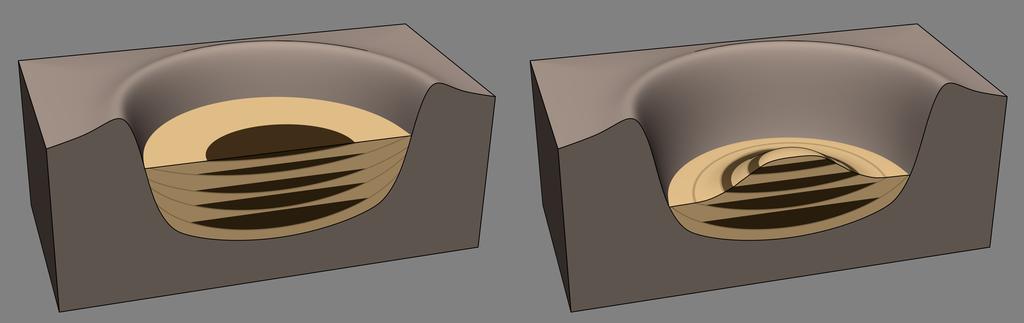
Once the water had completely vanished from Gale Crater, it seems likely that “Mount Sharp” was sculpted by wind action within the crater. Thus, it is thought, would have eroded the material of the alluvial plains faster than the more densely compacted mudstone formed under the weight of the successive lakes.

As it might have been: the left image shows the repeated depositing of alluvial and wind-blown matter (light brown) around a series of central lakes which formed in Gale Crater, where material was deposited by water and more heavily compressed due the weight of successive lakes (dark brown). Right: once the water had fully receded / vanished from the crater, wind action took hold, eroding the original alluvial / windblown deposits around the “dry” perimeter of the crater more rapidly than the densely compacted mudstone layers of the successive lake beds, thus forming “Mount Sharp”

Continue reading “Of mountains, methane and molecules”