Storyfest 2014 arrives a Bran on Sunday, March 23rd, and with it comes a host of storytellers with tales to delight and enthrall.
This year marks the fourth anniversary for this one-day event, presented by Branwen Arts and Stories Unlimited.
“Stories help us feel connect and unique all at the same time. They can provide both the questions you want, and the answers you seek,” Says Caledonia Skytower, one of the organisers of the event, “At their very core, they delight and inspire. There’s a mushroom or a rustic bench waiting for you!”
Those participating in the event are (all times SLT):
11:00: Dubhna Rhiadra
11:30: Shandon Loring
12:00 noon: Crap Mariner
12:30: Lycanthia Wolfhunter
Some of those taking part in Storyfest 2014 (top left-bottom right): Lycanthia Wolfhunter, Crap Mariner, Dubhna Rhiadra and Caledonia Skytower, Singh Albatros, Kaikilani, Big Red Coyote
13:30: Luna Branwen
14:00: Corwyn Allen
14:30: Caledonia Skytower
15:00: BigRed Coyote
15:30: Kaikilani
16:00: Singh Albatros
There will be a break in proceedings at around 13:00 SLT, and do note the schedule is subject to possible last-minute revision.
About Storyfest SL
StoryFest Events produces four annual festival events on the Second Life grid: StoryFest (March), Bard on the Virtual Beach (August), BOOFest (October), and The Dickens Project (December).
In August 2013, I covered the opening of the Kitely Marketplace, having previously reported on its development in January 2013 when it was first announce, and again in May 2013, when it opened to merchants.
In developing the Marketplace, the Kitely team of Ilan Tochner and Oren Horvitz always had the goal of making it possible for merchants to not only sell into Kitely itself, but also into other hypergrid-enabled grids, using a special Export permission flag which can be set by merchants. At the start of March 2014, they took a major step towards this with the opening of the Market Hypergrid Delivery Beta Test.
On March 21st, Kitely announced that the Kitely Market Hypergrid Delivery is now open to all.
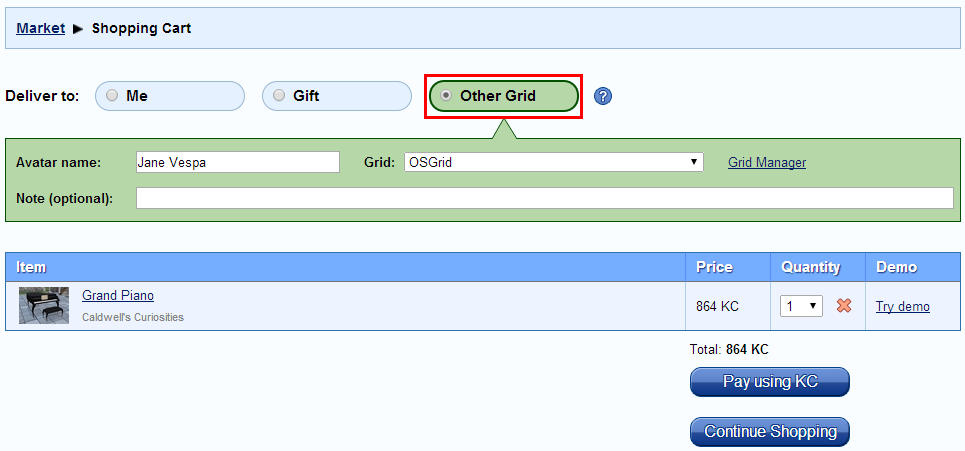
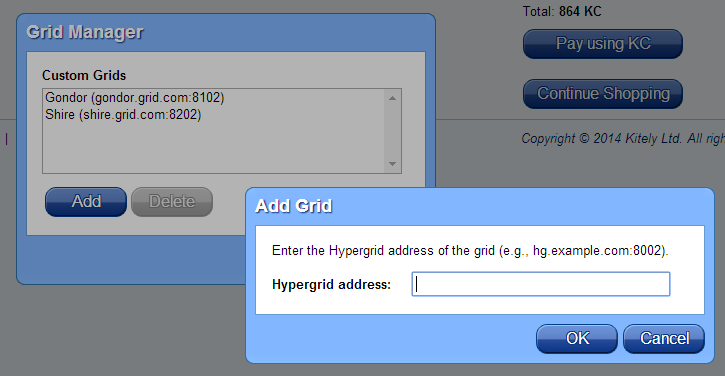
The blog post provides guidelines and instructions on using Kitely Market to purchase goods from the Kitely Market for delivery to hypergrid-enabled destinations, and I don’t propose to repeat things here. By default, the Market offers delivery to the top five (by use) hypergrid capable grids of Craft, GermanGrid, Littlefield, Metropolis, and OSgrid, and more are promised should they prove popular among purchasers. I also understand that delivery to other grids supporting hyerpgrid can be manually configured using the Market’s built-in Grid Manager – all that is needed is the grid’s loginURI.
Customers browsing the Kitely Market can now opt to have goods delivered to other hypergrid-enabled destinations – providing the creator has set the Export permissions flag (thus preventing goods from moving between grids against the creator’s wishes) – image courtesy of Kitely Market, click for full size
Items specifically set for delivery to other grids by their creator can be located using the Export option on the Permissions search filter (lower left corner of the each Market page).
Alongside of the hypergrid delivery capability, Kitely have enhanced their merchant tools to assist with the new capability, as the blog post explains:
We’ve made it easy for merchants to test that their products work correctly in other grids. It has always been possible to use the “Test delivery” link in the Edit Product page in order to deliver the product to the merchant’s avatar in Kitely. This feature has now been extended to deliver to other grids as well. The way this works is that you go to the Shopping Cart page, and select a grid and an avatar. You don’t actually have to buy anything; just enter that information. Then return to the Edit Product page, and click “Test delivery”. The product will be delivered to the “foreign” avatar that was selected in the Shopping Cart instead of to your Kitely avatar.
Another feature for merchants is that in the Sales History, merchants can see which grid each sale was delivered to, because foreign avatars appear along with their grid: e.g., “Jane Vespa @ OSGrid”.
Also, sales reports themselves can now be downloaded as a CSV file, providing improved historical context for merchants as they track sales long-term.
Additional hypergrid-enabled grids can be added via the Market’s Grid Manager
Implementing hypergrid delivery in the Kitely Market is innovative and interesting. Many creators in walled garden grids avoid OpenSim out of fear of content ripping – not that content ripping isn’t a problem in walled garden grids, either. Some OpenSim grids (like Kitely) proactively take steps to reduce the risk inherent in “easy” content ripping (such as by limiting OAR exports to those items created by the exporter themselves). Even so, the fear is there, so it will be interesting to see how many take advantage of the opportunity to sell into multiple environments from a single point. Certainly, the option has been seen as attractive enough to well-known SL creator Lilith Heart of Heart Botanicals fame, who has already opened a store on Kitely Market.
It will also be interesting to see how this new capability within Kitely Market affects the overall OpenSim economy. On the positive side, it means that merchants wishing to extend their reach into new markets (grids) can do so from a single, powerful point, and Kitely’s own pricing structure makes it fairly competitive for them to do so, including the use of the free access Kitely Merchant Sandbox, if required. Through it, merchants can reach multiple channels and also have a good degree of control over where and how their products are used (with some obvious caveats). For those used to only dealing with one market – such as SL – this could open the door to building channels to markets outside of the walled garden environments, such as those grids with a specific focus / purpose, such as education or business.
The downside to this is the it might make it that much harder for smaller grids to attract content creators directly, and thus users – who tend to look for the content first. Grids may well also lose out on opportunities to lease virtual land to merchants, as they’ll potentially have little need for in-world stores. However, it’s fair to say that Kitely Market could actually help grids attract users: if it is seen that a grid actively embraces the Kitely Market and its growing numbers of merchants, then the could leverage that fact in attracting new users, as the lack of visible in-world merchants is negated by the ability for merchants to reach the grid via the Kitely Market, particularly if said grids also take steps to ring-fence what can be exported via the likes of OAR files.
New Logo and OpenSim Core Group Invitation
Oren Hurvitz
Alongside the Hypergrid Delivery launch, Kitely unveiled their new logo (seen in thumbnail at the top left of this article), and have included a few notes on making it easier for people to get started on Kitely included the blog post.
And in a modest footnote to the piece, Oren Hurvitz, Kitely’s co-founder, reveals that he has been invited to join the OpenSim Core Group of developers. The invitation is in recognition of Oren’s ongoing contributions to OpenSim on behalf of Kitely, and is very well deserved; my congratulations to him.
Launched on Sunday September 1st, 2013, the Freedom Project is a joint undertaking by the University of Western Australia, Virtual Ability Inc., and the Centre for ME/CFS and Other Invisible Illnesses.
A 2D and 3D art and film event, the project extended an open invitation to artists suffering from a disability or chronic illness, or associated with those suffering from either, to demonstrate how virtual life has enabled them to engage in activities and interact with others in ways which may not be possible in the real world.
The Freedom Project: iSkye Silverweb – Speechless Freedom
I reported on the project at its launch, and again as submissions came in, and the organisers have now announced the formal opening of the public exhibition part of the project. This will commence with a special Thank You Ceremony, to be held on Sunday March 23rd, at 17:00 SLT.
The ceremony is to thank all the artists, filmmakers, and writers for contributing their works and of themselves, as well as to thank the many individuals, groups and organisations who made the project possible. An open invitation is extended to anyone wishing to attend the ceremony, and for them to visit and experience all of the submissions to the project.
The Freedom Project: Roiben Sweetwater – Alice (l) and The Many Sodes
Entries to the project comprise 2D and 3D art, text, and machinima, featuring individual and collaborative pieces, all with their own stories to tell. The pieces on display provide some very powerful statements, and viewing of the complete exhibition is highly recommended.
About Virtual Ability
Many disabilities in the real world can be a barrier to entry into the digital as well. People may have difficulties in dealing with the keyboard due to illness or disability; others many be reliant upon voice recognition software, and so on. Virtual Ability, Inc. helps people with these kind of challenges get into and become successful in virtual worlds like Second Life.
From an individual skills assessment undertaken during a unique intake process, Virtual Ability inc., are able to refer clients for help with assistive hardware and software as appropriate, and provide customised training and orientation. Once clients are in-world, Virtual Ability Inc., helps them integrate into the virtual society, and provides an ongoing community of support. The community offers members information, encouragement, training, companionship, referrals to other online resources and groups, ways to contribute back to the community, and ways to have fun.
The organisation runs a number of in-world centres, which can be read about on their website.
The Freedom Project: Xia Firethorn – My Body is a Cage
About the Centre for ME/CFS and Other Invisible Illnesses
The Centre for ME/CFS and Other Invisible Illnesses provides resources, support and guided relaxation sessions, for people with Myalgic Encephalomyelitis, Chronic Fatigue Syndrome, Fibromyalgia, Post Traumatic Stress Disorder, Irritable Bowel Syndrome, Gulf War Syndrome, and other invisible illnesses. They host general and research discussions once a week on Mondays at 18:00 SLT, and guided relaxation sessions every day, twice a day, at 08:00 and 20:00 SLT, in the Centre to help people manage their illness. This Centre is open to all, and all are welcome, including anyone with an illness, their families and carers to meet here and help each other. The Centre is located in Curtin University in Second Life.
As noted in part 2 of my week projects update, the Hotfix RC viewer was updated to version 3.7.4.288138 on March 18th
Two new RC viewers entered the channel during the week in the form of:
The latest iteration of the Google Breakpad RC, version 3.7.4.288045, on March 17th
The StatTest RC, version 3.7.4.288282, on March 20th
Neither of the latter two include functional changes compared to the current release version of the viewer (3.7.3.287491).
Because the arrival of the Google Breakpad viewer and the StatTest viewer pushed the total number of RCs in the release channel to seven, the Project Interesting RC viewer (3.7.3.287127), the SL Voice RC viewer (3.7.3.287288) and the Sunshine / AIS v3 RC viewer (3.7.3.287158) have been temporarily withdrawn from the release channel (all were incidentally due a rebuild anyway).
Both of the latter two RCs will be returning to the release channel, most likely in updated versions, once the total number of RCs currently in the channel has been reduced.
Update, October 9th, 2014: Linden Lab announced that development work on Patterns has been discontinued.
With recent focus being on the axing of three of LL’s initial new product offerings – and particularly Versu – it is easy to forget that the longest-running of LL’s moves to diversify is still out there, and actually has yet to officially launch in a release mode.
I’m of course talking about Patterns, LL’s PC / Mac game / content building sandbox application. This first appeared in September 2012, although there had been clues as to its name, if not what it would be about, as far back as July 2012, when Rocky Constantine spotted what appeared to have been a slight boo-boo.
I’ve not followed Patterns as closely as perhaps I could, but I have tried to provide periodic updates under my Patterns tag (menu: News-Updates-Opinion > Linden Lab > LL Products > Patterns), including recent notes on it gaining the ability for users to edit and create their substances, followed by support for materials.
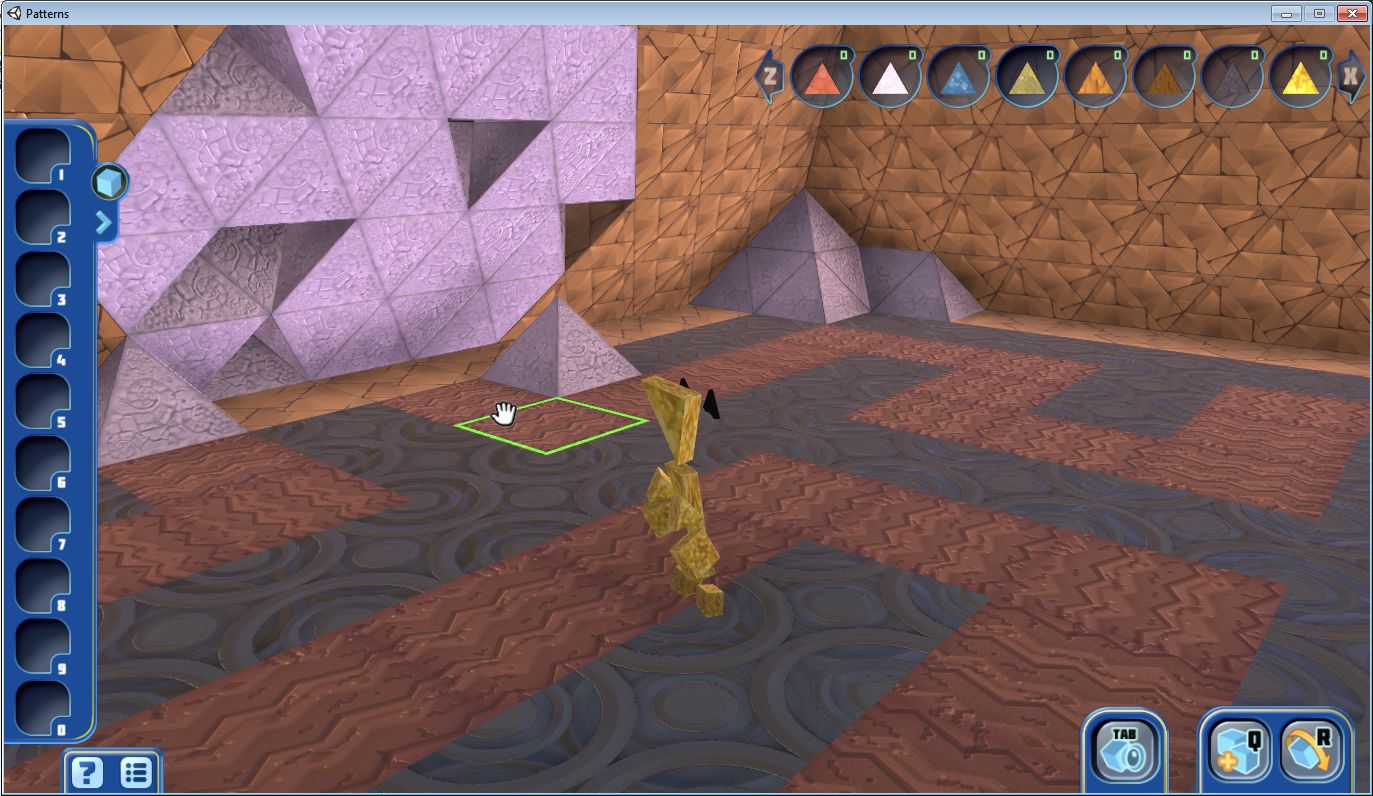
The original Patterns UI
While still in its “Genesis” form, Patterns has built-up a small but strong following in the gaming community and via the likes of Desura and Steam. Many of those who have purchased Patterns have provided feedback and input to the game’s development over the last 18 months, which have seen new capabilities added, functionality improved and a number of enhancements to the UI.
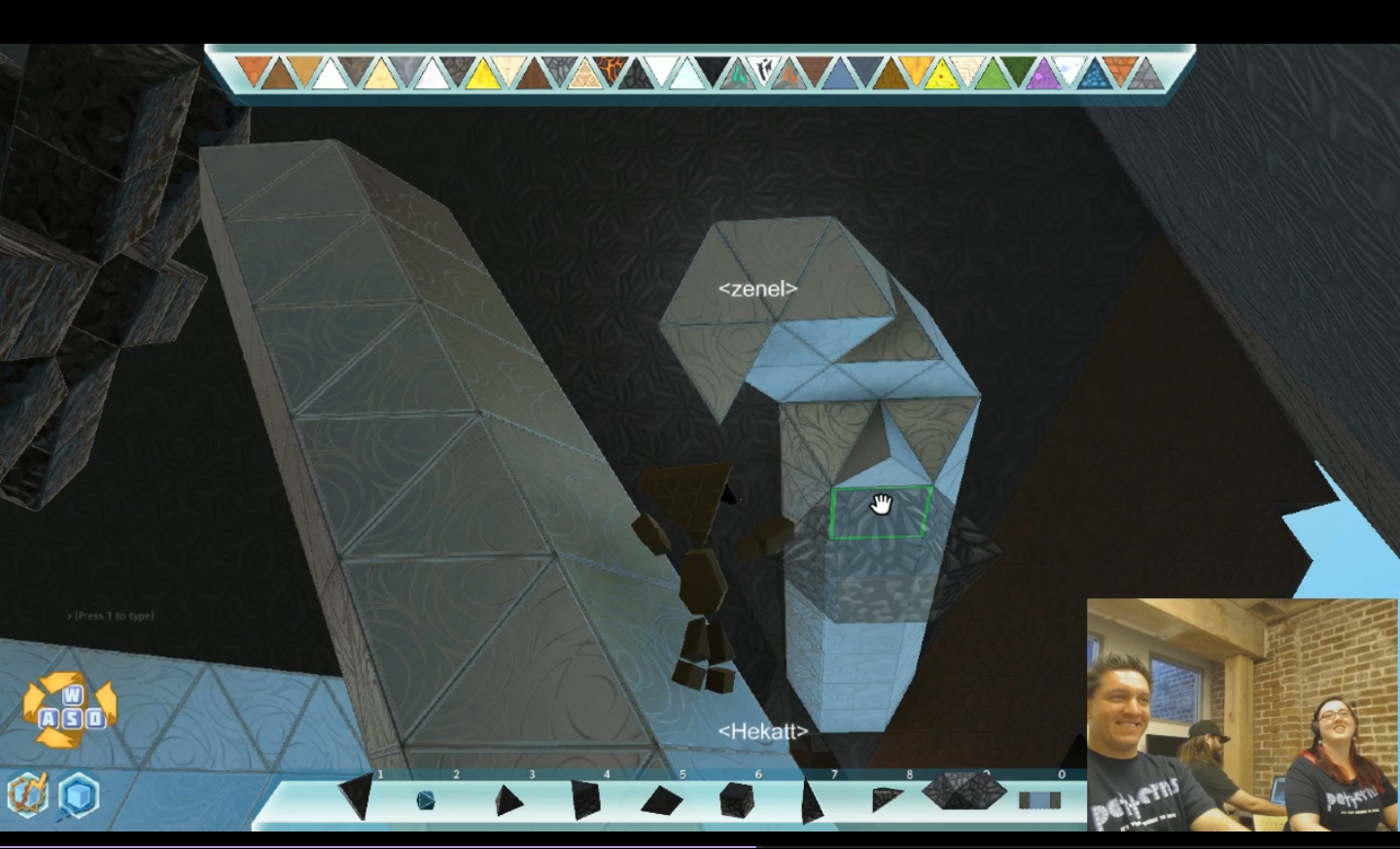
The Patterns UI as seen during a Livestream event with members of the Patterns team (lower right)
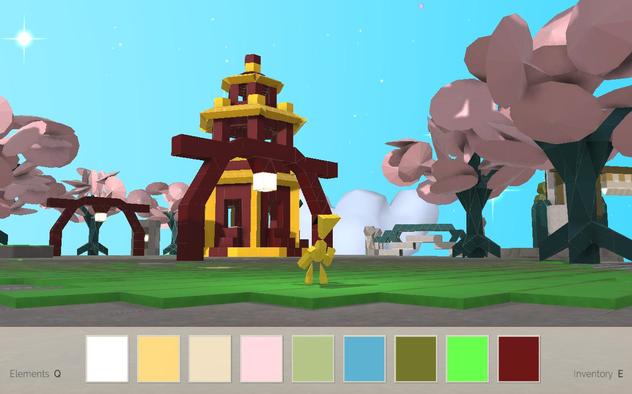
On March 18th, 2014, the Patterns team revealed that as part of the run-up to release (which had originally been indicated as being “late 2013” when the Genesis version first appeared, but has yet to have a date firmly pinned to it), the UI will shortly be getting potentially its most radical overhaul yet, aimed at “optimizing the play space by cleaning up the real estate”, and which will see the move of the tools, substances, and shapes into “one clean area at the bottom of the screen, where you’ll be able to quickly toggle between each of these different toolbars with ease by hitting the Q or E buttons on your keyboard.”
Patterns: extensive UI overhaul coming soon
There’s currently no ETA on when the new UI will appear in Patterns, but the team are promising more sneak peeks in the future as work continues. Also coming in the future, I assume under a separate cover, is the Patterns scripting capability, which should further enhance the application’s creative capabilities.
I’ll endeavour to update as further releases are made for those of you still following Patterns.
There are a couple of things server-side making their way towards a release:
Fix for login issues of agents with number display names – this is a fix an issue where users with display names made-up of numbers are unable to log-in. “It was a subtle change in a low-level library that started treating those as numbers and not strings,” Simon Linden said of the issue’s origins.
Fix for llTakeControls() issues with multiple scripts with mixed parameters in same prim
These fixes are liable to testing on Aditi prior to moving to an RC.
SL Viewer
On Wednesday March 18th, the Hotfix viewer was updated to version 3.7.4.288138. This now lists three core issues as being addressed:
Crash fix (MAINT-3703)
Update FmodEx library to 4.44.31
Additional work for MAINT-2718 (Linux viewer was using logging version of library)
A typical Server Beta meeting
Group Chat
As indicated in part 1 of this week’s report, there is work underway to try to improve group chat. A small-scale test with a dozen people was carried out with some of the initial improvements during the Sever Beta meeting on Thursday March 20th. “This is really a test that shows it doesn’t fall over with minor load,” Simon Linden said of it.
During the test, those present were asked to send lots of short messages at speed to two test groups while moving around and between various regions (walking, flying, teleporting). Few issues appeared to be noted, at least none that Simon indicted he was interested in (e.g. messages showing delay between being sent and appearing), but as noted, it was a small group. In terms of what has been done with the code and plans for the future, Simon went on:
Basically I dug into the code and found some inefficient parts and cleaned them up. I also added more metrics, so I’m hoping it can show an improvement. I’m pretty sure it will be better, but it’s really hard to guess how much better. I’m hoping to test it on the main grid soon. It would get put on a server and then it would affect a fraction of the groups. I can pick one group to target and make sure it covers that group.
As chat is handled back dedicated back-end servers, no simulator or viewer change will be required to take advantage of this work as it progresses. If the logs from this initial test show nothing unpleasant or unexpected, and providing LL’s QA are happy, testing on the main grid could start in a week’s time.
 Storyfest 2014 arrives a Bran on Sunday, March 23rd, and with it comes a host of storytellers with tales to delight and enthrall.




 Inara Pey: Living in a Modemworld