Since the launch of the social web Profiles by Linden Lab, one of the most requested features users have asked to see is the inclusion of a Twitter-like FOLLOW capability. At SLCC 2011 Viale Linden hinted that the function might be coming along.
And he wasn’t wrong.
Linden Lab have now launched the ability for people to “follow” others through the web profiles.
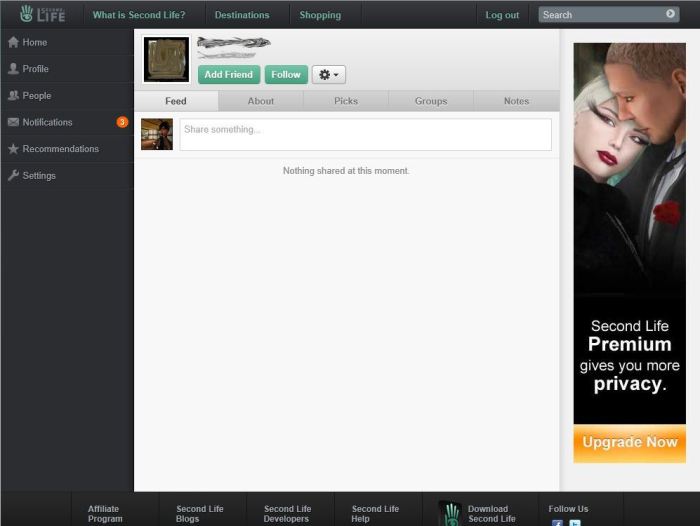
To use it, simply go to my.secondlife.com/first.last (where first.last is obviously your own avatar name) and log-in. Then select the profile of the person you wish to follow in the browser url bar (again “my.secondlife.com/first.last” – where first.last is their avatar name). This will display that person’s web profile, thus:
Note the FOLLOW button
Clicking the FOLLOW button will allow you to receive that person’s messages on your Feed page, allowing for any privacy options set – see below.
For those who use the web profiles Feed, this is a powerful new option, potentially delivering notifications of events, activities, and so on from others who pro-actively use web profiles and the Feed option directly to a single point they can review either in-world (if their Viewer supports web profiles) or on a single web page.
For merchants and entertainers, it presents another means of getting word out about events and goings-on by encouraging people to use their own feeds and then using the FOLLOW option.
There are a couple of points to note:
If the person has their Feed privacy set to FRIENDS/NOBODY, you will not receive any Feed messages from them regardless as to whether you follow them (unless they accept you as a Friend where FRIENDS is concerned)
The same applies to your own Feed – if you set your Feed privacy to FRIENDS/NOBODY, people will be restricted in their ability to receive your feed messages.
The system may yet be refined further; I’ve already suggested to Linden Lab it might be an idea to add something along the lines of a “Friends and Followers” privacy option. As it stands, it is a useful addition to web profiles, and one that is sure to be welcomed.
Yesterday, the Phoenix / Firestorm team released a Beta version of Firestorm (officially called 3.0.1.22525), specifically aimed at mesh object rendering. The team is keen to emphasise that this is bordering on an “experimental” release, and urge anyone trying it out to read the accompanying release notes – of which more anon.
The release itself was almost destined not to take place; on Tuesday morning the team discovered a series of regression issues that needed to be resolved, then their service provider announced significant issues with their fibre, leaving the Phoenix servers only able to accept around 10 connections at a time!
Nevertheless, the team worked through issues and, following the fortnightly Phoenix Hour on MetaMix TV, the Beta was duly released. So – what is it like?
Starting Firestorm
The differences between this version and earlier releases are apparent from the moment you install and run Firestorm. On the log-in screen alone are three new features:
Log-in screen – new features
Log-in drop-down list: Firestorm gains the Phoenix username drop-down list with this release. If you use several alts, names and passwords can be retained by the Viewer and chosen from a drop-down list, making for easy selection. In a further nice touch, if you use the same name to log on to multiple grids, the Viewer will remember the specifics. For example, I have three entries under username: “Inara Pey”, which logs me into the SL Main grid; “Inara Pey @ Second Life Beta” which logs me in to aditi, and “Inara Pey @ InWorldz” which logs me in to InWorldz – the required Grid is automatically selected when I select the user name
Beneath the Username field is a new button – DELETE THIS ENTRY (arrowed). This removes the details of the selected avatar from your log-in records held by the Viewer – again, useful if you have multiple avatars and discard one, or if you no longer log-in to a specific grid
There is also now an option called DEFAULT SETTINGS. This allows you to select a default “UI” style with which to run the Viewer. By default, it is set to “Phoenix”. Clicking on the arrow to the right of the option displays the additional options of “V3” and “Hybrid” (boxed above).
Now, these have been described as setting different User Interface styles – and to a point, they do (setting V3, for example, will give you the familiar Sidebar tabs from Viewer 2.x/3.x); but if anyone is expecting “Phoenix” will deliver a full-blown Phoenix-esque V1.x UI will be in for a disappointment – the differences in presentation are far more subtle: “Phoenix” delivers a UI that is pretty much identical to the current Firestorm release UI, for example.
Firestorm 3.0.1 “V3” UI option
“Hybrid” refers to a new – and, I’d say cleaner – variant of the Firestorm UI developed for this release, which I’ve now set as my default (as far as possible – there is at least one issue with this release).
Firestorm 3.0.1 “Hybrid” UI option
As with the Viewer Modes in Viewer 2.x / 3.x, changing the default settings will require you quit and restart Firestorm. While this requirement is the same as the official Viewer when switching between Basic and Advanced modes, it would be nice if this could be automated if at all possible: clicking the OK button shutting down and restarting the Viewer in one convenient go.
Firestorm 3.0.1 “Phoenix” UI option
Navigation and other “Top” Bars
By default, both the Phoenix and Hybrid settings have the Navigation Bar at the top of the screen turned off, while the V3 option has it on, together with the Search bar. Speaking of the Search Bar, as there is an option to turn it off/on, it would be nice if this worked independently of the Navigation bar (currently turning Search on / off only makes a difference if the Navigation Bar is displayed). It’s a small thing, but would add to convenience of use.
The Favourites Bar is on by default in all three, and while I like the fact that in the Phoenix and Firestorm options it is on a transparent background, this may cause issues for some and it is frequently difficult to see against, say, the sky. I also like the Hybrid option’s transparency around the tool bar at the bottom of the screen; this is a nice touch and adds to the feeling that one has a greater in-world viewing area.
Of Sidebars and Pie Menus
The “V3” option of the UI obviously uses the V2.x/V3.x Sidebar and tabs, although options can be accessed from the toolbar at the bottom of the screen as well.
The “Hybrid” UI option uses the “tabless” Sidebar seen in earlier Firestorm releases, with options accessible from the toolbar buttons. In both cases, options can be “torn off” from the Sidebar and floated as independent windows, and will persist as such between log-ins.
The “Phoenix” UI option disposes with the Sidebar completely, and simply floats options in their own windows.
Both the Phoenix and Hybrid options utilise the Pie Menu by default – I would personally prefer the Context Menu were the default in the case of the latter, but I suspect I’d be in the minority for saying so! The V3 option uses the Context by default.
Major New Features
Volume Control Access
Volume Setting Controls
With this release, Firestorm inherits Phoenix’s quick-access panel for all volume control settings. Simply hover the mouse over the volume icon at the top right of the Firestorm window and the control panel will drop down.
All the expected options are there, with sliders, together with options to mute those that are frequently not used: streaming music, media and Voice.
Alongside the Quick Preferences button located down on the toolbar, this is perhaps one of the most eagerly awaited V1 TPV UI options to reach Firestorm.
Built-in Flight Assist
Adding to the client-side AO, Firestorm now sports a flight assist option. This is accessed through PREFERENCES -> FIRESTORM and then checking the ENABLE BRIDGE FLIGHT ASSIST option. As the option itself suggests, the Firestorm Bridge must be worn in order for the flight assist to work; furthermore, you should remove / turn off any other flight assist options before using the built-in flight assist, or you might experience all sorts of issues!
Camera Floater Updates
The camera floater receives an update in the new release, with the Phoenix and Hybrid versions receiving new buttons, while the V3 floater sits somewhere between the previous Firestorm version and the Viewer 3.x controls.
Camera floaters Viewer 3.x (left), Firestorm Beta, Firestorm “V3” and Firestorm “Phoenix” / “Hybrid” (right)
The layout of the new “Phoenix” / “Hybrid” floater makes it appear slightly larger on-screen, and also a little tricker to resize.
Contacts List Changes
The Contacts List has been updated to show whether friends have allowed you permission to map them / edit their items – all to the good. On the downside, a column to show Display Names has been added alongside user names, which tends to push out the size of the window unnecessarily.
Contacts List – a lot of screen space
It would be nice if there were an option to turn off either the user name column or the Display Name column in order to make the List less screen-consuming. If this could be coded, and reduce the amount of screen real estate lost to the window.
This is a summary report only, due to the circumstances of the release. A full review on the Firestorm Mesh Beta will be forthcoming, complete with a detailed list of all new features and an overview of fixes.
Following the Phoenix Hour today, the Phoenix Firestorm team have released a BETA version of Firestorm with mesh object rendering support.
The release is not to be regarded as a full release – more work is required.
Furthermore, the team has specifically requested anyone wishing to download the release to read the accompanying notesbefore downloading and trying the Viewer as there are some critical issues.
There is also a list of known bugs that Firestorm has inherited from Linden Lab. These are already known about and the team request people do not raise further JIRAs on them again, please read the list before reporting bugs.
Other points to note:
nVidia 400-series and above graphics cards may be prone to immediate crashing on running the Viewer if Basic Shaders are enabled. This again is a bug inherited from Linden Lab, and users of 400-series and above nVidia cards are asked not to enable Basic Shaders
The release should clear settings and cache as a part of the installation. If you wish to preserve chat and IM logs, and set them to the default locations, make sure you move them elsewhere first
Should settings / cache not be automatically cleared, people should go to PREFERENCES -> NETWORK & CACHE and use the button there to clear settings and cache and then relog
This release does not include the spell check option – this will be added in the final release; all effort has gone into responding to user demands to provide a version of Firestorm that can render mesh objects
Mesh uploads are not in this release – the code needs further work.
Jessica (r) and Phaylen at today’s show
The following feature are included in the release (not definitive):
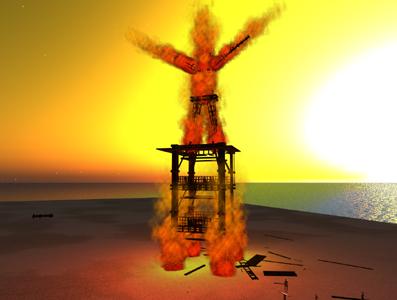
The Burn 2 Art Committee has released the details of artists formally invited to display at this year’s Burn 2 event. In a statement issued by the organisers, the artists:
“Were chosen through an intensive selection process which involved a vastly encompassing variety of criteria to determine through consensus those whom we feel best represent a wide sample of creativity, technique, artistic expression, and resourcefulness that best expresses the spirit and values of Burning Man and Burn 2.”
The selected artists are:
Rebeca Bashly
A Serbian artist, Rebeca has been active in Second Life for almost four years, and uses only her own sculpts and textures in her work. She regards her most significant work in SL as being “SnowCrash” on UTSA Artspace, a collaborative work with Igor Ballyhoo.
Claudia222 has been involved in Second Life since mid-2007, working primarily in fantasy sculptures which use rich, vibrant organic textures to bring them to life. Her first SL build, “Parallel Worlds”, was exhibited on the sim FarStar in January of 2011. She has also exhibited at Pirats Art Network, The Nordan om Jordan gallery and has entered her work at the UWA Expositions and SL8B, where she built a honey swamp.
Claudia Jewell
Claudia222’s work most recently caught the imaginations of many residents when her mesh creations were featured in a Machinima by Rockerfaerie, previously featured in this blog. She is currently working on a sky level installation “mesh mellows”.
Active in SL since December 2006, Oberon Onmura has been making art in Second Life for over two years. In that time, his unique approach to using opposing forces on physical objects has attracted the attention of blog sites, SL and RL galleries and publications. He has recently become interested in the use of scripted agents (i.e. bots) as artmaking material.
His early work with physical objects, “Grid Floaters,” was seen at the “Kiss the Sky” exhibition at the NMC ArtsLab sim, curated by DanCoyote Antonelli, while “Beacon,” a 100-meter tower that constructs and then destroys itself, was selected for inclusion in a national exhibition of virtual and corporeal art – the “@ Exhibition” (www.arsvirtua.com) – in association with the Southern California Institute of Architecture and the College Art Association conference in Los Angeles, California (February, 2009).
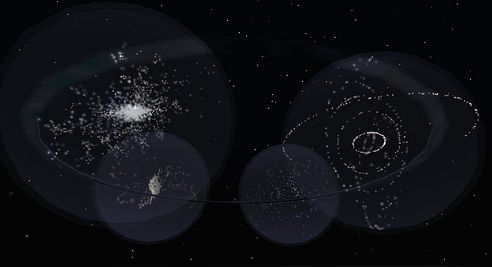
Oberon Onmura: Four Galaxies
More recently, his sim-sized projects, “The Tunguska Event” , “Storm Cells,” and “Four Galaxies” were seen at the Project Z Gallery. His collabortive work includes working with Juria Yoshikawa and Dancoyote Antonelli for a SL/RL event with a jazz club in London, curated by Arahan Claveau. He has also collaborated with Diogenes Wylder (Georgie Roxby-Smith) at the Watermill Center (USA) and Melbourne (AUS). Currently, Oberon exploring the creative possibilities of Opensim grids, running two simulator servers on his home computer in NYC, with the sims, Titania and Elena connected to the Craft grid (http://craft-world.org:8002/).
RAG Randt – the RAG standing for Richard A Goldberg, grew up under the influence of Mad Magazine, Warner Brothers cartoons, and the New Yorker Magazine. He creates artwork for publishers, advertisers, and corporations. His style translates concepts into humorous, thought-provoking art which enables his client’s messages to be memorable and effective.
Starlash will be exhibiting “Identity” at Burn 2, which has a quote from Vithu Jeyaloganathan, “The identity of one changes with how one perceives reality.”
Starlash describes herself as being, “Born at the age of 4 to confuse enemy agents. Growing up in the Central Kalahari Desert and later London has left her with a fertile and vivid imagination which fuels her desire to actualize and add a unique perspective to her creations.”
To date she has had showings of her 2D work at several galleries and has recently started to bring her stories to life with machinima. Using second life as inspiration she is constantly trying new techniques and mediums to evolve her work.
Trill describes herself thus: “Artist maybe, painter, BFA. in Fine Arts from the University of Manitoba, love to travel, draw, paint, make stuff.Canadian, activist with Four Bridges and amnesty international. Curator and Builder of the War and Peace Exhibit at the Howard Zinn Memorial Centre for Social Consciousness and the Arts as well as the Afghanistan Virtual Museum in SL. Illustrator and co-author of It’s All Chinese to Me – a culture and etiquette guide to China’ by Gwen Penner and Pierre Ostrowski: friend, lover, sister, daughter, dog lover, coffee drinker, piano player, book reader, pizza eater…”.
Of his work, she says, “Welcome to the Fool’s journey to the end of the universe and back., through all the pitfalls and trials of identity and desire, to death and beyond, through the gauntlet of useless rusty grails offered up by religion and ideology, through a modernist purgatory, and into the heart and soul of the crumbling grail castle reclaimed by nature and love. all steps along the way leading to the ultimate discovery of the true grail”.
Yesterday I mentioned Radegast 2.0 (.1130) had been released and that it has, among other things, the 3D scene renderer (now called the Scene Viewer), the ability to support avatar physics and the capability to render mesh objects.
Well, it does – and it does so exceptionally well.
Installation is as per previous versions – unsurprisingly – and when you start the application, you’re greeted with the familiar splash screen, albeit it with the login data fields nicely resized and moved to the right. The discerning user will also note that 3D Scene has been added to the menu / tab bar – a hint of what is to come.
Once logged-in, you’re presented with the chat display, which retains the same overall layout as earlier versions, but with a somewhat sharper look, with resized movement controls and extended chat bar.
Preferences Options
The File menus now includes a PREFERENCES option which, when clicked, opens the Settings floater.
Radegast Preferences
This allows you a set a range of familiar preferences within Radegast, including the popular RLV Support (this is described as “partial” support in the documentation, of which more anon) and the use of MU* style emotes (so “:” can be used in place of “/me” when typing an emote), together with the ability to turn-off the typing animation. Unlike the SL Viewer, there is no requirement to re-start Radegast after checking / unchecking certain items (such as, again, RLV).
Preferences also gives you access to two other tabs: Auto Response and Graphics Settings. Auto Response operates in a similar manner to the Auto Response function found in popular TPV Viewers such as Firestorm and Phoenix, allowing you to send a customised message to people who IM you. You can set the response to be sent automatically under one of three conditions:
When you set BUSY from the World menu
When anyone not on your Friends list IMs you
Whenever anyone IMs you.
The Graphics Settings obviously apply to the 3D Scene Viewer. Here you can set a number of graphics defaults that are common to most TPVs, and adjust your draw distance to a maximum of 176 metres. There is also an option to turn-on water reflections, but this will only be accessible when the 3D Scene Viewer is running.
Graphics settings
All options selected in Preferences are applied automatically (unless a restart is explicitly asked for – as with Anti-aliasing in the Graphics Settings), so there is no APPLY button – simply close the Settings floater when done.
An important note to remember if you’re running Radegast over a mobile connection: you might was to keep the draw distance in the Scene Viewer turn down relatively low to reduce the bandwidth you’re using in downloading data & so reduce any charges you may be incurring.
The 3D Scene Viewer
The 3D Viewer itself is now fully embedded into the main Radegast window. When you start it, it simply opens up a new tab.This is a nice touch when compared with the experimental versions, especially as it includes the chat bar as well, a very practical addition over some of the early variants of the renderer.
Radegast scene rendering compared to the SL Viewer (inset) – impressive (click to enlarge)
The rendering is actually bloody impressive, and offers a very good alternative to the full Viewer – but bear in mind that:
This isn’t a full-blown graphical Viewer, so things might take a little time to render, especially in “busy” environments. The results, however are well worth it, as the image above hopefully demonstrates
Running the Scene Viewer significantly increases the use of system resources, and so might not be the best for older systems
There are a few issues, but whether these are tied to the software or your hardware set-up is hard to say. In my case, for example, I found that some prims (such as around the flowerbeds in my garden) simply didn’t rez at all, no matter what draw distance was set or where I stood relative to them. Similarly, not all my sculptie plants were properly rendered and some of the grass of one my lawns was rendered hovering above the surrounding grass and stonework.
However, to suggest this in any way ruined my enjoyment in having my in-world scene rendered, or my inability to interact with it, would be a lie. Certainly, when compared to a Second Life view of the same location, Radegast’s ability to render the scene so well is absolutely clear. I also think the ability to render water reflections is pretty amazing as well (below).
Water reflections
Mesh rendering is equally impressive, as the images below of two familiar vehicles from the Beta grid should demonstrate (top picture captured using the old Mesh Project Viewer, the lower image captured in Radegast 2.0).
Rendering mesh objects: “Full” Viewer (top) and Radegast
Movement in the Scene Viewer has been refined to be smoother than earlier versions, although avatar rendering isn’t entirely perfect. By default, the camera is positioned behind your avatar, a-la the SL Viewer, and you can use the LEFT and RIGHT arrow keys to turn, UP to walk forward and DOWN to walk backwards – all as one would expect. If you are using an AO, the Scene Viewer attempts to render the movement scripted by the AO, although this doesn’t always *quite* work, and occasionally your avatar might develop something of a drunken lean while walking!
Tip: if you opt to reposition the camera at any time, always tap ESCAPE to place it back behind your avatar before you attempt to move again (the camera will not automatically reposition itself should you try to move). Even if you can see your avatar, you should still reposition the camera prior to moving – direction of movement appears to be relative to the camera position, not avatar position, so if your camera is not behind your avatar, it is easy to get confused as your avatar sets off in a totally unexpected direction when you press the UP or DOWN keys!
Camera movement still take a a little getting used to. Movement is carried out through a combination of holding the left mouse button and either the ALT or CTRL keys:
Left-click (and hold) & press ALT to orbit around something when moving the mouse
Left-click (and hold) & press CTRL to pan left / right up/down when moving the mouse.
Camera movement can initially be confusing – using CTRL and the mouse to move to the left will apparently pan the camera to the right, for example. The best way to understand this is to think of all camera movement in terms of dragging the on-screen image. So if you use CTRL + left mouse-click and move the mouse to your right, you are effectively “dragging” the image to the right side of your screen – and the camera position will consequently appear to move to the left as a result. This rule applies to panning up / down (“drag” the image towards the bottom of your screen to pan up, etc.), and also to the use of the ALT key to orbit around something.
Tip: If you find the image going off-centre compared to what you are trying to achieve when panning / orbiting, try pointing the cursor at something you wish to centre-on and ALT-left click to centre the view on it; then try panning / orbiting again.
Additional Viewer Options
For those that prefer the Scene Viewer detached, right-click on the tab name for the Scene Viewer and select Detach. This will float the Scene Viewer in a separate window, complete with a chat bar
Right click anywhere within the Scene Viewer to display an additional menu:
Undock (/Dock): will float the Scene Viewer in its own window or re-dock it as a tab within the main Radegast window
Options: Displays the graphics preferences that can also be accessed through FILE -> PREFERENCES
Debug Panel: opens the Debug options for the Viewer, where you can RESET VIEW and move the camera back behind your avatar (i.e. the same as tapping ESCAPE on your keyboard), and adjust things like the image brightness and contrast using the top two sliders.
Objects in the Scene Viewer respond to touch as they would in the “full” SL Viewer: doors will open, menu-driven objects will display their menu, etc. Right clicking on in-world objects will display a context-sensitive series of additional option to the menu described above. For example, if you right-click on an item you own, you’ll get additional options to take, delete, touch or sit on the object. Right-clicking on an object owned by someone else may give you the options to touch it (if scripted) and / or sit on it.
RLV Support
This is an interesting addition to Radegast. While it is not a full implementation of the RLV API, it nevertheless opens options and possibilities. Among the things it can do:
Deny the ability to remove locked items
automatically accept forced teleports
Act upon forced animations (although not necessarily rendered in the Scene Viewer)
Restrict chat and IM (including forcing chat to whisper, etc.)
The broader restrictions provided by RLV aren’t replicated in Radegast, so things like blocking inventory access, restricting far touch, vision restrictions, etc., are not implemented.
Other Updates
The login screen now stores the details of avatars logged-in to virtual worlds using Radegast, including the actual grid the avatar logged-in to. Simply select the avatar (/grid name) from the drop-down list available from the USERNAME field. The user name, password and grid are all then set
Radegast now supports Viewer 2 avatar Physics Layer – so if you wear a physics layer of clothing, it will render movement correctly in other people full graphical Viewers (the movement won’t be rendered in the Radegast Scene Viewer).
Opinion
Radegast 2.0 offers some nice improvements over the previous releases, and still sits head an shoulders above other “non-graphical” clients in the most common areas of use. If you want a genuinely “light” text-based access to Second Life / OpenSim the likes of Libretto or SLiteChat might be more appealing, but if you are stuck in a situation where you simply cannot run a “full” Viewer and want to have a very flexible means of accessing your preferred VW for more direct interaction with friends and the people around you, Radegast really cannot be beaten.
Elements of the client are still described as “experimental” and as such may well still be prone to crashing. That said, I’ve sent the good portion of a day running the client on both a desktop PC and my Notebook (Intel Atom 330 w/2Gb RAM and nVidia Ion2 graphics processor) without any crashes or major issues (the Notebook did have occasional avatar rendering issues – I was hair and shoes a few times, with nothing between!) and both the PC and the Notebook seemed to have issues rendering the odd prim here and there.
All-in-all a significant and well-implemented update to Radegast which is enjoyable and intuitive (for the most part!) to use. And RLV is a nice option to have – and not just for those of us into D/s scenes *grins*.
Metabolt has recently been through two significant updates – and in doing so, has stolen a march on graphical Viewers. With Phoenix and Firestorm due to get “Contact Sets” for managing Friends lists in the future, Metabolt has the capability to sort and group Friends now.
The 0.9.47 release of 28th August saw a raft of major fixes and the inclusion of new LSL-related Action Commands: Eject from group, Touch, Sit, Stand, Move To (walk, run or fly), Follow, and Send Notice. Additionally, the following enhancements were made:
Metabolt upgraded to the latest version of libopenmetaverse
New neutral colour scheme throughout
LSL API is now activated via the Security tab under Application/Preferences where you need to specify a master avatar and a master object UUID so that commands are only accepted from them. Unchecking the “enforce” option will mean METAbolt will accepts commands from all avatars and objects that pass a valid METAbolt password as it used to be before.
Movement controls issues resolved for better avatar movement
Received Inventory items are auto accepted in 15 minutes of being received if not dealt with within that time limit and information is printed on the chat screen
Deleted inventory items now go into the Trash folder which you will need to empty
Viewer 2 Physics Layer supported (if a physics layer of clothing is worn, movement will render correctly in graphical Viewers).
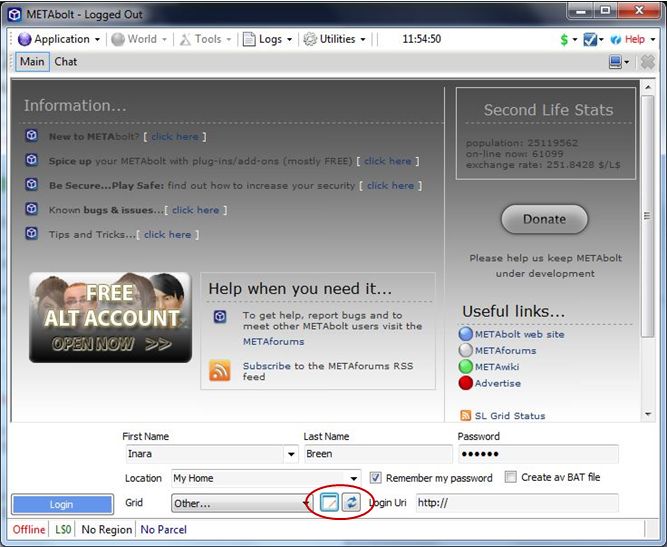
The 0.9.49 release of 3rd September (which obviously includes the 0.9.47 updates) revises the login splash screen to add two new button that are displayed when OTHER is selected from the Grid drop-down list.
New Grid list button (circled)
The first of these will open the grid list in a suitable editor (e.g. Notepad), allowing you to easily add additional grids to the list. The second button will refresh the list to display any new grids you’ve added.
Once logged in to Metabolt, 0.9.49 allows you to organise your friends list into Groups using two new tabs and a new drop-down list.
New Friend Groups options
Creat a Group allows you to create a new group you can categorise your friends by
Friend Groups displays a list of groups you’ve created. Clicking on a group will open a box allowing you to drag-and-drop the names of friends from the main list on the left into the Friend Group.
Currently Displaying under th you main friends list on the left of the window allows you to display all your friends, or select a specific group you have created via a drop-down list.
These are sure to be welcome additions that further enhance Metabolt.










 Inara Pey: Living in a Modemworld