
SpaceX President and COO Gwynne Shotwell has shed a little more light on the company’s plans for this Starship space vehicle.
Two prototypes of the vehicle are currently being developed for test flights at the company’s facilities in Boca Chica, Texas and in Florida, with the company hoping to fly one of them – most likely Starship Mk 1, being readied at Boca Chica – to an altitude of 20 km before the end of the year.
Beyond this, Starship is designed to be lifted to orbit atop the company’s new Super Heavy reusable booster and undertake missions to the surface of the Moon and then to Mars – and possibly beyond. Speaking at the 2019 International Astronautical Congress, Shotwell specifically addressed the company’s nearer-term aspirations, marking 2022 as the year they’d like to put Starship on the Moon for the first time:
We want to get Starship to orbit within a year. We definitely want to land it on the Moon before 2022. We want to […] stage cargo there to make sure that there are resources for the folks that ultimately land on the Moon by 2024, if things go well, so that’s the aspirational time frame.
Such a flight to the Moon won’t be made by either Starship Mk 1 or Mk 2 – these are intended purely for atmospheric flight tests – descent handling, landing capabilities, etc., and to define any changes that need to be made prior to the company committing to building at least two orbital test vehicles – Starships Mk 3 and Mk 4, before they progress to trying for the Moon.
This makes the time frame for the lunar missions as given by Shotwell very aggressive. They are dependent on the company quickly completing atmospheric tests of the vehicle, then moving to being able to undertake orbital missions and integrated with the Super Heavy in order to undertake the lunar flights – particularly the cargo delivery missions -, hence why Shotwell emphasised the “aspirational” nature of the time frame.

While the time frame is in keeping with Elon Musk’s own aggressive approach to such matters (and he would appear to love the sound of them whistling past, as next to none of his stated target dates for SpaceX, Tesla or any of his other ventures have ever been met), it is next to impossible to see how a 2022 goal can ever be met; there is simply too much to be achieved between now and then – such as actually flying a starship vehicle for the first time, or getting it and the Super Heavy booster to a point where they can be tested together, leave alone making any attempt to land a 50-odd metres tall cylinder on the rough and uneven surface of the Moon without it either breaking itsself on landing – or just toppling over.
Beyond the 2024 target for cargo missions, Musk has also stated that he’d like to have a lunar base established by 2028 – although Shotwell didn’t directly reference this, probably quite wisely.
In the meantime, and aside from these goals, SpaceX has already been contracted by Intuitive Machines and ispace. Both companies working with NASA to deliver payloads to the Moon ahead of the agency’s 2024 Artemis programme human Moon landing. However, this contractor are for the use of the company’s proven Falcon launch system, not the behemoth.
NASA Developing Lunar Rover
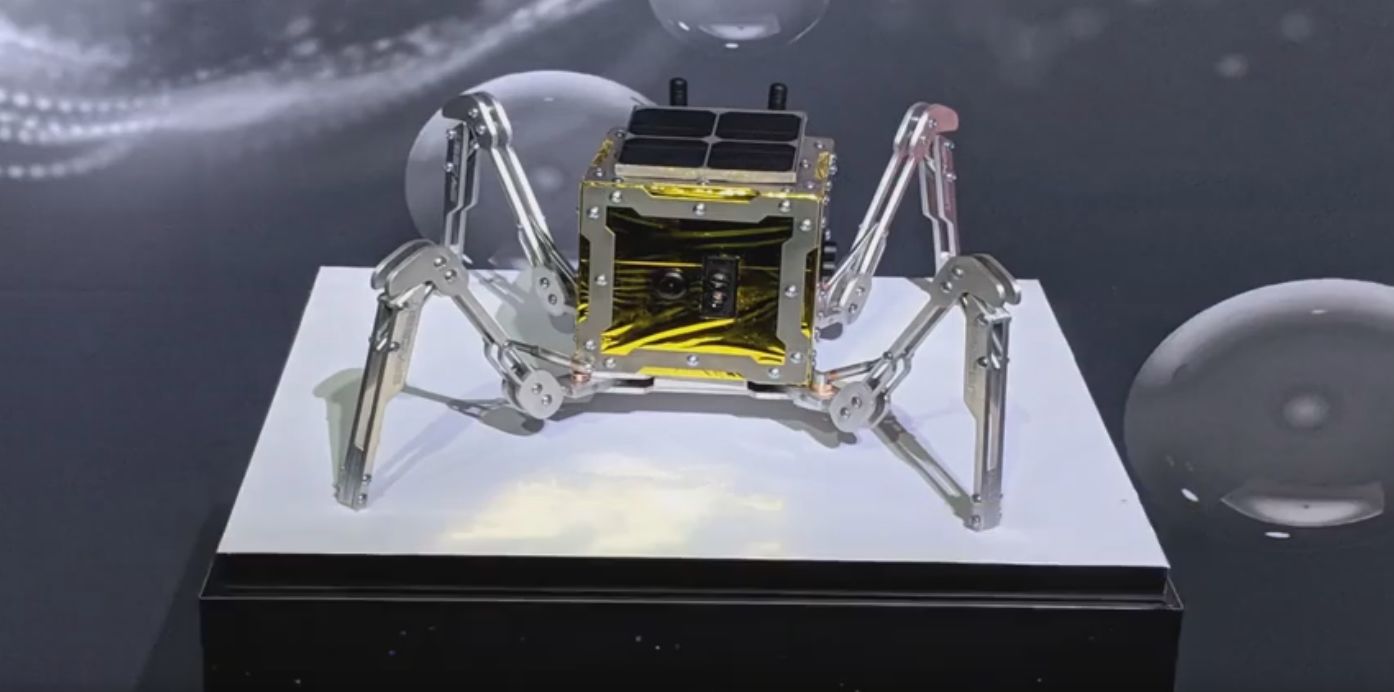
In preparing for, and as a part of, humans returning to the Moon, there will be a range of automated landing and rover missions. I recently wrote about one of these missions, intended to deliver a series of payloads to the lunar surface, including innovative mini-rovers from the UK and Japan (see Moles, rovers, and spacewalks). Now NASA has confirmed it is developing an automated rover of its own.
The rover, called VIPER (Volatiles Investigating Polar Exploration Rover), is due for delivery to the lunar surface in December 2022. Its mission is to gather data that will help inform future missions about the South Pole-Aitken Basin and the eventual construction of a base there. One of its specific goals is to locate water ice, characterise it as it lies under the lunar regolith and then drill down to the ice to determine how it sits within with regolith and then analyse the samples.
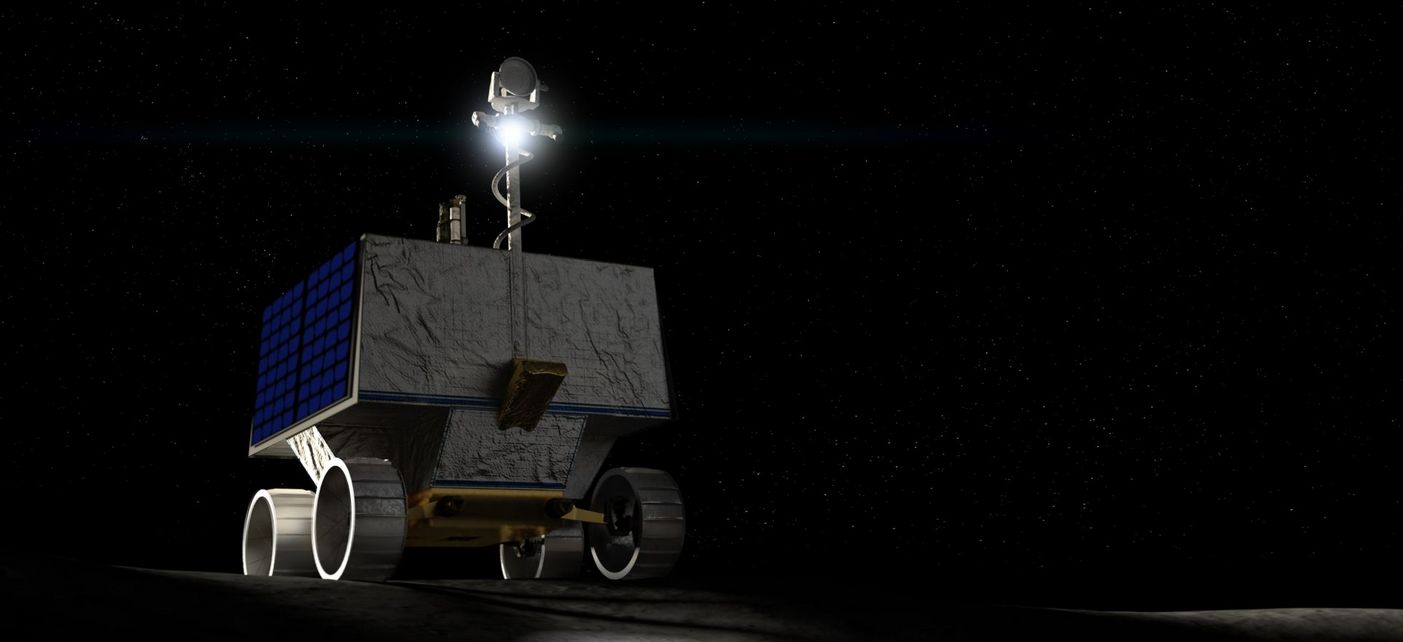
There is strong evidence for extensive sub-surface water ice within the Moon’s South Polar region, including in the bottoms of craters that never see sunlight, and characterising / accessing this water ice is seen as critical to NASA’s lunar ambitions, as it could be utilised in a number of ways, including providing oxygen for breathing or as propellant.
Roughly the size of a golf buggy (around 1.4 m × 1.4 m × 2 m), VIPER is being designed to travel multiple kilometres over a primary mission period of 100 days, carrying a suite of instruments comprising:
- The Neutron Spectrometer System – designed to detect sub-surface hydrogen (potentially water) from a distance, suggesting prime sites for drilling. It measures the energy released by hydrogen atoms when struck by neutrons.
- The Near InfraRed Volatiles Spectrometer System – designed to analyse mineral and volatile composition; determine if the hydrogen it encounters belong to water molecules (H2O) or to hydroxyl (OH–).
- The Mass Spectrometer Observing Lunar Operations – designed to analyse mineral and volatile composition by measuring the mass-to-charge ratio of ions to elucidate the chemical elements contained in the sample.
- The Regolith and Ice Drill for Exploring New Terrain – capable of drilling up to 1 m (3 ft) into the lunar regolith to gather ice samples.
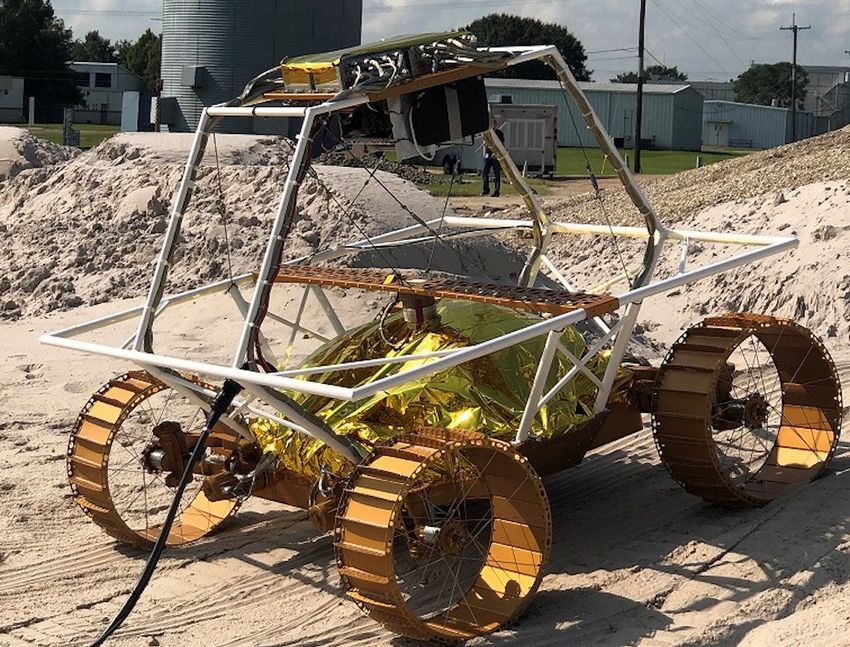
As well as gathering and quantifying ice and water samples, the hope is that VIPER will gather data that can be used to create the first detailed water resource maps of the Moon that will be used to further inform decisions regarding human mission to the lunar surface.
The key to living on the Moon is water – the same as here on Earth. Since the confirmation of lunar water-ice ten years ago, the question now is if the Moon could really contain the amount of resources we need to live off-world. This rover will help us answer the many questions we have about where the water is, and how much there is for us to use.
– Daniel Andrews, VIPER mission project manager
No landing site has been determined for the rover at present, but it will be delivered to the Moon under NASA’s Commercial Lunar Payload Services (CLPS) programme, using a lander vehicle developed by Astrobotic and launched via a United Launch Alliance booster. VIPER itself is being developed by NASA’s Johnson Space Centre, Texas, with the science package provided by Kennedy Space Centre, NASA Ames Research Centre and Honeybee Robotics, with the entire programme being managed by NASA Ames.
It’s incredibly exciting to have a rover going to the new and unique environment of the South Pole to discover where exactly we can harvest that water. VIPER will tell us which locations have the highest concentrations and how deep below the surface to go to get access to water.
– Anthony Colaprete, VIPER project scientist









 Inara Pey: Living in a Modemworld