September 2026 marks two anniversaries, uniquely – if unusually – linked in the manner in which they both sought to “explore” space and went on to influence at least a generation.
On September 8, 1966, the television series Star Trek first aired. At the time, no-one knew what a phenomena it would become after an admittedly less-than-auspicious start (cancelled after just 3 seasons, only to be reborn on the big screen and then spawn multiple series which kept it on air almost continuously with new seasons and syndicated re-runs until streaming came along to ensure its could be seen anywhere, any time), thus allowing it to celebrate its 60th anniversary in 2026.
Whilst entirely fictional – and at times not particularly good science fiction (Spock’s Brain, anyone? Turnabout Intruder?) – Star Trek was a trailblazer because when it is was good, it was very good: frequently wrapping allegory and social commentary within the medium of action-adventure science fiction. And while people can (and do) debate / argue about the relevance and canon-keeping of the more recent iterations of the franchise, the fact remains the original series did much to promote the idea of space travel at the time Apollo was coming into its own, and many were seriously considering careers in science and technology as a result of seeing the show.
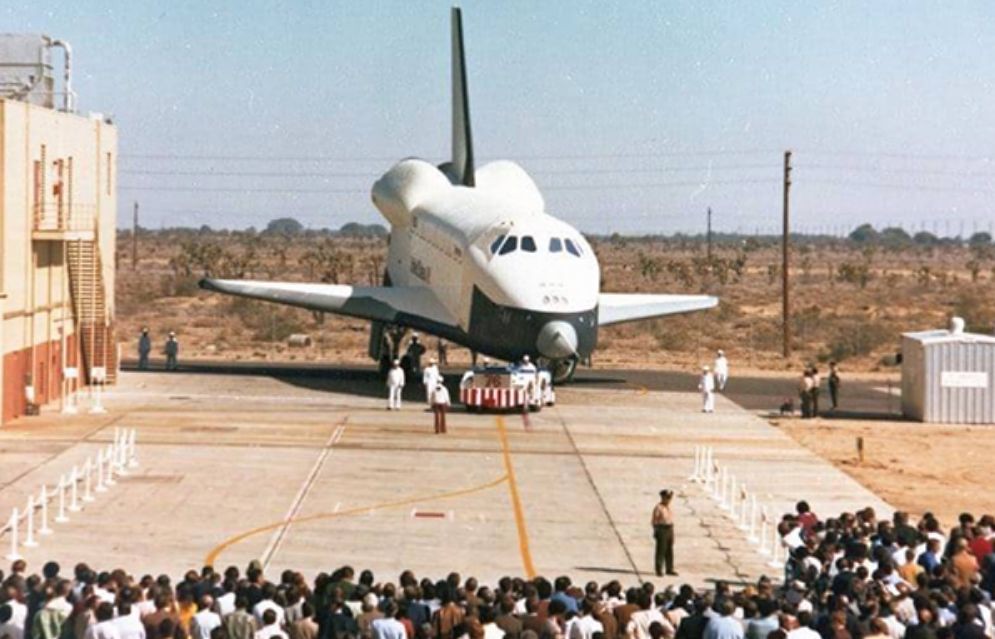
In fact, such was the influence of Star Trek that, ten years after the show had been cancelled and at a time when Star Trek (Phase) II still a twinkle in Paramount’s eye, it was present at a very real milestone in US spaceflight history: the roll-out of the first ever space shuttle vehicle to be seen in public: OV-101 (OV standing for Orbiter Vehicle), 50 years ago on September 17, 1976.
That vehicle had originally been due to be called Constitution, but a fierce letter-writing campaign by Trek fans had resulted in NASA agreeing to call it Enterprise after the fictional starship from the series. The roll-out took place at the Rockwell – being the primary contractor for the orbiter vehicles – manufacturing facility in Palmdale, California. As it did so, the US Air Force band struck up the Star Trek theme by Alexander Courage, cementing the vehicle’s link to the series.

On-hand for the roll-out was the majority of the series’ regulars – only William Shatner was absent – together with Trek’s creator, Gene Roddenberry. It was a further demonstration of the close ties between fictional space exploration in the form of Trek, and NASA’s human and robotic explorations of space; something that would continue as the Star Trek franchise evolved in the coming decades.
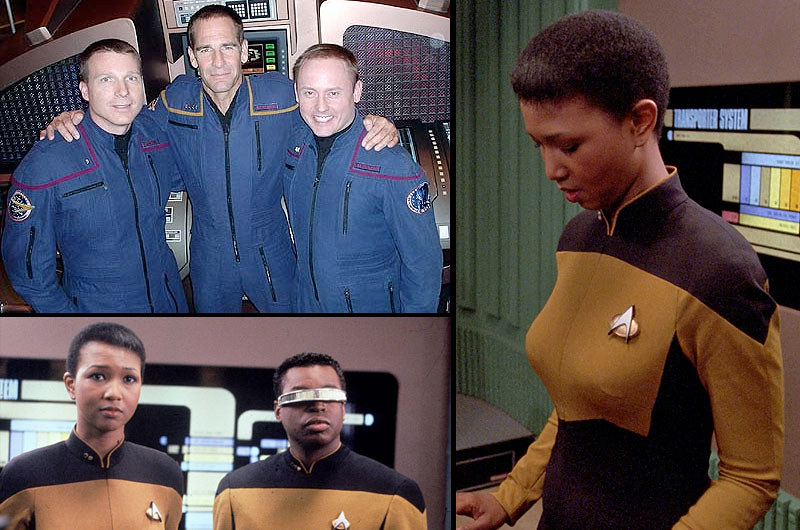
For example, astronaut Mae Jemison attributes her determination to fly in space to watching Nichelle Nichols portray Lt. Uhura. Jemison went on to guest-star as Lt. JG Palmer in Second Chances, an episode of Star Trek: The Next Generation, whilst astronauts Mike Fincke and Terry Virts (both fans of Star Trek) appeared in minor roles in the underrated Star Trek: Enterprise. And, of course, V’ger, the machine entity encountered in Star Trek: The Motion Picture was drawn directly from the Voyager missions (even if there was no such spacecraft as Voyager 6).
Like Trek, the shuttle had its own impact on the generations familiar with it. Take Jack Hathaway, for example. Born the year after the first shuttle reach orbit in 1981, he directly cites shuttle flights as the reason he decided on a career in the US Navy as an aviator and seeking to qualify as a test pilot prior to applying to NASA. He participated in some low-key celebrations to mark the 50th anniversary of Enterprise’s roll-out whilst currently aboard the International Space Station (ISS).
It might be argued that the renaming of Constitution to Enterprise was a pyrrhic victory: OV-101 was a test vehicle, never intended for spaceflight. Had the name been applied to the second vehicle in the fleet – OV-102, which was intended for spaceflight, then reality would have mirrored fiction even more closely: the United Star (or Space) Ship Enterprise NCC-1701 was the second ship in her class, the first being the USS Constitution – just like the first shuttle was originally to have been called. Ultimately, OV-102 was christened Columbia and as we all know, she was tragically lost with her crew on February 1, 2003, an event which started the process of bringing the shuttle programme to an end.
Tragedy aside, it is still quite amazing to think about just how ingrained Star Trek became ingrained in US – and global – culture. It is even more stunning to consider that, in practical terms, the shuttle era started with the first roll-out a half-century ago, and that the first orbital flight took place 45 years ago, just 20 years after Yuri Gagarin became the first man to orbit the Earth – and he did so just three and a half years after the first artificial satellite.
As such, in terms of spaceflight, we’ve come a long way in a relatively short period of time – but as Star Trek also reminds us (and assuming we don’t do something incredibly stupid in the short term): the human adventure is just beginning.
Our Sun: Planet Killer?
Scientists have been observing the Sun for decades, slowly decoding how it works, how it interacts with space, how it generates “space weather”, what its likely lifespan will be, and so on. These studies have resulted in both an increased understanding of our Sun and also raised some intriguing questions.
In terms of the latter, a major puzzle has been that the Sun is, compared to its likely siblings at the time of its birth out of the proto-nebula which formed them, excessively poor in lithium; two orders of magnitude less, in fact.
Then there is the fact that the speed of sound within the deeper parts of the Sun’s convective zone (where heat switches from being transmitted up from the Sun’s core purely by radiative means to being transferred primarily by violent currents of plasma rolling around its core) doesn’t match computer modelling based on measurements of the Sun’s near-surface activity and how super-heated plasma convection within it should be working.
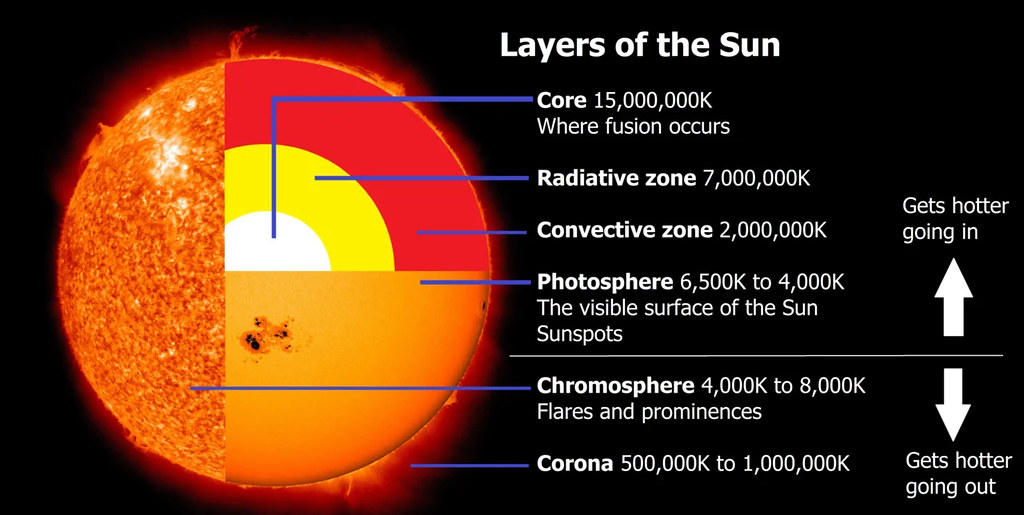
Both of these oddities caught the attention of Mutlu Yildiz, a professor leading the Department of Astronomy and Space Sciences at Ege University, Türkiye, who wondered if they might be linked, and if so, how. His findings point towards the potential that, early in the history of the solar system the Sun “ate” a planet – and it may still be “digesting” it.
Yildiz came to this conclusion after considering a number of potential scenario – including the idea of a planet being swallowed by the Sun. From there, he started work on a series of computer models using a wide range of plants varying in composition, size and density, but all of which might have theoretically started to form in the early solar system and adhere to many of the broad parameters seen with exoplanets orbiting close to their parent stars.
One of these models – featuring a solid, rocky world around 5.6 times bigger than Earth – or slightly largely than Neptune – forming both relatively close to the Sun (roughly equivalent to the orbit of Mercury) would likely be lithium-poor and particularly prone to being drawn into the Sun relatively quickly.
In particular, repeated modelling indicated that whilst the planet would be torn apart prior to the Sun swallowing it, it would likely do so so close to the star, the majority of it would fall into the Sun long before it could dissipate so it’s mass would have an effect on the Sun’s internal mechanisms, particularly the density within various layers of the Sun’s convective zone, impacting things like the speed of sound within them.
Yildiz is the first to acknowledge that whilst his work points to the Sun having once killed a planet doesn’t mean this is the case – but the results do seem to fit a set of observable facts. As such, he’s also suggested possible observations that could be carried out which might further prove (or dismantle) his theory.
Roman Grace Telescope Update
As the Nancy Grace Roman Space Telescope (or more simply, the Roman Space Telescope or RST) continues towards its rendezvous with a halo orbit around the Sun-Earth L2 position, the news concerning it keeps getting better and better.
In my previous update, I noted that the observatory has started powering-up its instruments in readiness for its deep space mission, notably the first of its two science instruments, the Coronagraph Instrument (CGI), and that the Wide Field Instrument (WFI) would be following. Well, I got my timeline a bit muddled, as the WFI had started coming on-line as that piece was being written, with a test image being returned as part of that process.
It’s not an impressive image to be sure: 18 individual images (from the 18 4K imagers) showing a sea of out-of-focus stars – but it is an important start. It shows that the instrument has powered-up correctly. The initial tests also confirmed that the filter mechanism which allows specialist filters to be placed over the imagers to reveal different wavelengths of light is also correctly functioning.

Since then, the work has moved on to the next steps: monitoring the cooling of the imagers down to their -183ºC operating temperature and refining the focusing of the optical elements in the telescope in order to generate pristine, 300 gigapixel images. This work will continue as a part of the overall pre-commissioning of the payload, prior to the formal instrument commissioning period commencing.
Nor does the good news end there. Because of the 1.5 million km transit from Earth to the Sun-Earth L2 position, the potential for errors in launch, initial orbital placement, the potential of additional course correction thrusters burns whilst en route, when it was launched, and so on, RST actually departed Earth with just under 1.8 tonnes additional propellants “just in case”.
However, such was the accuracy of the Falcon Heavy in delivering it to its initial orbit, coupled with the accuracy of RST’s first course correct thruster burn, means the observatory is not only precisely on course for its intended orbit, it has actually used less than 10% of its planned propellant reserves, even without the extra load-out.

This already means that with both the additional propellent load of 1.8 tonnes, RST now has sufficient stocks for and additional 8 years of science once in its operational orbit, giving it 18 years of operations over overall. However, the overall accuracy of its trajectory thus far achieved means that the second planned mid-course correction burn can be carried out when the observatory is much closer to the Sun-Earth L2 position and at a lower propellant consumption, which will in turn reduce the amount of propellants required for the final braking manoeuvre required to place RST in its initial halo orbit.
Both of these latter points meant that, potentially and subject to funding, RST could arrive in orbit around the Sun-Earth L2 position with sufficient cold gas propellants for 22 years of science operations – 12 more than originally planned!


The timing of those two events seems coincidental. My own observation is that similar patterns repeat every fifty years in orbital mechanics.
LikeLike
Well, if we’re referencing the shuttle / Trek thing, it’s also worth pointing out the roll-out was due in the year of the 10th anniversary of Star Trek, with the renaming, NASA / Rockwell moved with roll-out to the anniversary month + the cast invites. The point here is more the relationship between the two throughout – and the fact the shuttle programme is, in practical terms (and excluding the development period) 50 years old. As to orbital mechanics, yes they work on multiple levels, hence why we can predict events & plan missions 🙂 .
LikeLike