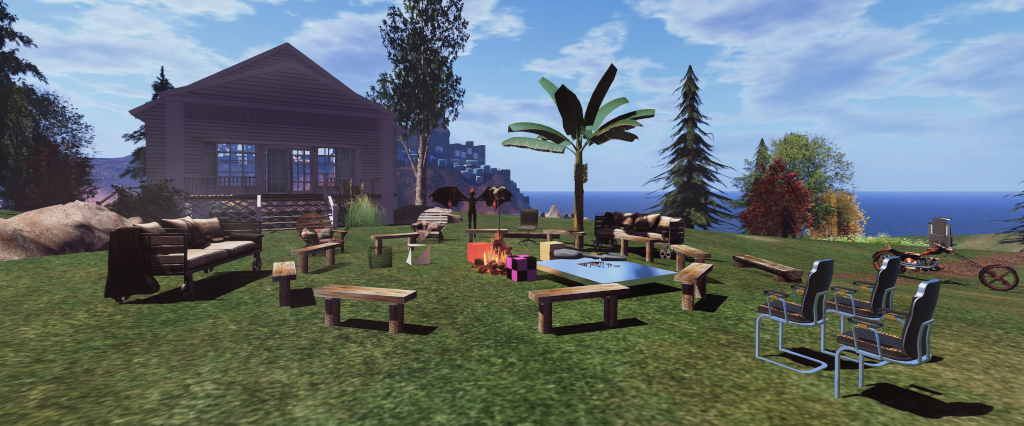
Leloo’s World Dancing Leaves, August 2026 – click any image for full size
As we wave bye-bye to August 2026, so thought for many in the northern hemisphere turn to the ending of summer and the onset of autumn, with many public locations within Second Life also changing to match the seasonal change.
One such place which has done just this is LeLooUlf’s Mainland setting as it straddles the regions of Laothoe and Gunda in the south of Heterocera. It’s a place I last visited in May 2026, not long after it had opened and when it had a decidedly spring / summer feel to it.
Leloo’s World Dancing Leaves, August 2026
LeLoo’s World – Dancing Leaves is a place where the season wraps around you, inviting you to wander, breathe deeply, and feel the calm magic of fall. Enjoy a peaceful stroll along the lakeside, complete with its charming balloon tour, or wander into the adjoining woodland paths. Throughout the area, you’ll discover cosy spots perfect for capturing those special autumn photos.
– From the Destination Guide entry for Leloo’s Mainland world
Now called Dancing Leaves to mark the seasonal change – and as recorded in its Destination Guide entry -, the setting still straddles the two regions but now has a more unified Landing Point than was the case at the time of my May 2026 visit.
Leloo’s World Dancing Leaves, August 2026
Also in keeping with the design at the time of my last visit, there is a sharp divide between the north and south extents of the setting – the latter being greatly elevated when compared to the former, with the two having individual Shared Environments.
However, I was so taken by the EEP setting used for the northern half of Dancing Leaves (and which is active for visitors when arriving at the Landing Point); I maintained it whilst photographing both.
Leloo’s World Dancing Leaves, August 2026
The northern aspect of the setting pushes its way out from stepped cliffs into a wide, circular lake, the majority of which is neatly landscaped, allowing Dancing Laves to now smoothly merge with it, whereas at the time of my original spring visit, there are more of a sharp divide between Leloo’s land and that of her neighbours.
To the west side, a flat finger of land runs out into the waters of the lake from the base of the cliffs, home to a trio of wooden buildings. All are open to the public and form, respectively, a small café, a summer house and a little potting shed / greenhouse.
Leloo’s World Dancing Leaves, August 2026
The eastern side of the land is more broken forming a trio of islands reaching into the lake, connected one to the next and to the land below the cliffs by a series of bridges.
No formal buildings stand on any of these islands, although two are home to gazebos and the third has a windmill sitting on its back. The outermost of these islands sits across the head of Leloo’s land and has a raised bridge connecting it back to the western finger of land, allowing the waters here to be circumnavigated.
Leloo’s World Dancing Leaves, August 2026
All around (and on!) the waters here are places to sit, while an orca surprisingly frolics alongside one of the bridges, ready to splash those crossing it, and the inner, shallow waters are home to a variety of fish.
And don’t miss the little “coffee grotto” tucked under the cliffs complete with a sign I can well understand and appreciate!
Leloo’s World Dancing Leaves, August 2026
At the top of the cliffs and alongside the Landing Point is the local balloon tour – instructions provided on the sign next to it. This gently floats around the lake and is suitable for singles or couples. It doesn’t cross the region boundary into the southern aspect of the setting, so you’ll have to re-engage your pedal extremities to explore here.
Although called “The Woodland” at the Landing Point, the southern, upper part of the setting is more an open garden. Whilst completely rebuilt, it nevertheless carries within it the spirit of the spring / summer build for those who have previously visited.
Leloo’s World Dancing Leaves, August 2026
This is a place for gentle wandering, the colours very much those of early autumn, when the greens of summer vie with the browns, golds, yellows and reds of the fall months. Grassy paths invite exploration. One of these connects to the local road as it passes the setting, whilst the other reaches towards the raised southern end of the garden.
This path winds gently past a small pond to one side, watched over by a vigilant owl and a cube-like garden house as it forms a quiet little retreat.
Leloo’s World Dancing Leaves, August 2026
As with the lakeside areas, the gardens offer many places to sit and pass the time – some perhaps more obvious than others (don’t miss the bee hives wither their novel pose / sit point or the little gazebo ticked away to one side of the garden!).
I particularly like the southernmost end of the garden with its clock and shaded benches and piano – although perhaps it might benefit for a couple more places to sit.
Leloo’s World Dancing Leaves, August 2026
My only niggle with Dancing Leaves is the presence of the billboard sitting between the Landing Point and the archway to the road, which I feel loudly intrudes into an otherwise peaceful location. Fortunately, I never travel without Derender in my pocket, so it was easily taken care of 🙂 .
This aside, I genuinely love Leloo’s work both on the Mainland and with her region. She puts a huge amount of time and care into building very special places for people to visit, and I’m always more than happy to drop into them and just relax. I’m pretty sure you’ll feel the same way as well!
The SpaceX Falcon Heavy booster carrying the 9.1 tonne Nancy Grace Roman Space Telescope towards orbit, transiting the morning Sun as it rises over the Florida coastline, August 30, 2026. Credit: Josh Dinner
August 30th, 2026 saw the launch of the Nancy Grace Roman Space Telescope – potentially the most important space-based observatory yet launched from Earth, and the telescope which is genuinely the successor to the Hubble Space Telescope (HST) in terms of its mission and capabilities.
Also called the Roman Space Telescope (RST – which is how I’ll be referring to it going forward), the telescope has a multi-purpose mission and will seek to increase our knowledge in a number of areas. And it has been a long time coming.
RST: A Brief History of a Telescope
RST’s history goes back to the 2010 United States National Research CouncilDecadal Survey committee, which recommended a new space telescope with a focus on studying dark energy (not to be confused with dark matter, which is an entirely different concept!). In its original design, the telescope would carry a single large instrument, the WFIRST (Wide-Field Infrared Survey Telescope) with a 1.3 metre primary mirror.
However, in 2012, the US National Reconnaissance Office (NRO) offered NASA two “Hubble-class” telescope systems with 2.4 metre diameter primary mirror (the same as Hubble), but with a shorter focal length (allowing them to see far more of the night sky. One of these two units was folded into the new space telescope concept, which became the WFIRST-AFTA (Astrophysics Focused Telescope Asset), allowing the new telescope’s mission to be expanded and a portion of the overall cost of the mission – the design and fabrication of the actual telescope – to be largely eliminated.
The Roman Space Telescope structure. Credit: NASA/GSFC
The WFIRST mission was refined over the next few years, with initial funding in 2014 (US $54 million) allowing conceptual studies to be undertaken for the hardware, software, and mission objectives to be completed, with a further US $50 million added to this in 2015. By 2016, the overall science and technical parameters for the mission were in place:
Primary mission duration: 5 years post-launch, at $2.7 billion, including all development, fabrication and launch costs and 5 years of science operations.
Scientific studies:
Answering basic questions about dark energy – is the expansion of the universe caused by a new energy component, or the breakdown of Einstein’s general relativity; if a new energy, is it constant, or evolving with the universe? In this work, RST will be working alongside the European Space Agency’s (ESA) Euclid
Carrying out a census of exoplanets down to the size of our Moon using gravitational microlensing, whilst examining questions about the commonality of planetary systems, what determines an exoplanet’s habitability, etc.
Using a coronagraph to obtain the first direct images and spectra of very large planets orbiting our nearest neighbours.
Detecting primordial black holes.
Operational location: Sun-Earth Lagrange L2 halo orbit, roughly 1.5 million km from Earth.
A graphic showing the Nancy Grace Roman Space Telescope’s (still called WFIRST) flight to, and orbit around, the Sun-Earth L2 position. Credit: NASA
These studies would be enabled by just two major instruments on the telescope – then still called WFIRST. The first of these is the Wide-Field Instrument (WFI) – essentially a 300-megapixel camera supported by a series of specialised wide- and narrow-band filters which will allow the high-quality imaging of large parts of the sky around the telescope as well as focused imaging of specific groups of stars or of star systems from the visible to near-infrared. The second is the Coronagraph Instrument (CGI), a high-contrast coronagraph designed to suppress the light of stars to allow the imaging and spectrographic analyses of planets and their atmospheres as close as 0.15 arc seconds from their parent star.
Renamed the Nancy Grace Roman Space Telescope in 2020, the project has survived two attempts to cancel it under the Trump Administration, the impact of the COVID pandemic and, most recently, the somewhat premature and chaotic approach to shutting-down various programmes and operations at Goddard Space Flight Centre, the lead NASA centre for the mission, the RST project has remained largely on-time and has avoided going grossly over-budget (US $3.2 billion compared to the estimated US $2.7 billion).
Who Was Nancy Grace Roman?
Dr. Nancy Grace Roman (May 2025 – December 2025) was one of America’s leading astronomers and NASA’s first female executive, being the agency’s Chief of Astronomy through the 1960 and 1970s.
From an early age, she knew she wanted to be an astronomer; actually founding her own astronomy group at school at the age of 11. Encouraged by her music teacher mother and physicist-mathematician father, she enrolled in an accelerated astronomy programme designed to prepare late-coming high school students for college-level astronomy before attending the private Swarthmore College, Pennsylvania, from which she hoped to graduate to university.
Dr. Nancy Roman with a model of Orbiting Solar Observatory (OSO) 1 in 1962. Credit: NASA
At Swarthmore, the head of astronomy, Peter van de Kamp, was initially unimpressed with Roman’s desire to be an astronomer. However, after she had rebuilt two defunct student telescopes – work which she later felt contributed greatly to her innate ability as both an astronomical observer and in understanding instruments and technology – and seeing her dedication to research at the college’s observatory, he relented. He started personally teaching her astrometry – his own specialist field – before helping her obtain a position studying astronomy at the University of Chicago in 1946.
At Chicago she studied under three professors, including William Wilson Morgan. Whilst initially cold towards Roman, Wilson recognised her potential as she developed her PhD dissertation in 1949. Following her graduation, he invited her be his research associate. Thus began her career as a professional astronomer.
Yerkes Observatory, operated from its founding in 1897 through until 2018 by the University of Chicago, where Dr. Nancy Roman worked as an associate researcher with William Wilson Morgan. Credit: J. Takermann
Initially focusing on stellar observations and research, Roman also took up lecturing, enjoying both roles. In the 1950s, and whilst still at the university, she became engaged in research on behalf of the US Naval Research Laboratory (NRL – among other things, and despite its title, a leading astronomical research institute), and many of her papers of stellar astronomy became the most respected and most-cited, both nationally and internationally, throughout the 1950s.
Her fascination with instruments and technology led her to becoming one of the first advocates for the use of computers for digital image processing. Taking her ideas to the university’s Chair of Astronomy at the University of Chicago – Subrahmanyan Chandrasekhar – she was told in no uncertain terms computers had “no place” in the field of astronomical observations and to stop wasting her time on such ideas.
It was around this time that Roman realised her academic career had hit a glass ceiling; universities almost never extended senior astronomy-related academic positions to women, nor offered them tenured research positions. As a result, she opted to leave university life and join the NRL, at that time a pathfinder in the relatively young field of radio astronomy.
Here she further enhanced her reputation as a both a stellar researcher and as a leading expert in the field of microwave spectroscopy. She also carried out pioneering work in the field of geodetics, which led to a request that she consult on the science programme for Project Vanguard in 1957, the NRL’s government-directed response to Russia’s Sputnik. This tweaked her interest in the potential for space-based astronomy, causing her to write several papers on the subject. Then, in 1959, she was approached with a request to create and lead a programme for space-based astronomy for the newly-formed NASA; a request which caused her some mixed feelings, as she recounted in later life:
I was not sure I wanted this NASA position… Taking a management position would mean giving up research. I had left teaching, which I enjoyed, when I left the University of Chicago and was not sure that I wanted to give up research… However, the chance to start with a clean slate to map out a programme that I thought would influence astronomy for fifty years was more than I could resist.
– Nancy Grace Roman, 2018
And so she joined NASA, initially as Head of Observational Astronomy, before rising to Chief of Astronomy at NASA’s Office of Space Science within a year.
At NASA, Roman pioneered virtually the entire astronomy programme, including selecting projects for study / execution as missions or parts of missions, overseeing budgets, recruiting staff, and so on. The post initially saw her encounter hostility from an astronomical community outraged at the idea that NASA was “sticking its nose” into their fields of study and potentially “stealing” grants and funding Earth-based observatories would otherwise receive. Her response to this was to implement a series of policies which NASA has since adhered to, placing the astronomical community as a whole at the heart of the agency’s astronomical programmes, both as participants and beneficiaries. In doing so, she not only ended the enmity, she turned the astronomical world into one of NASA’s most committed supporters.
Whilst not an original proponent of space-based telescopes, Nancy Grace Roman was the woman who brought them to reality through two long-running programmes. The first was the successful Orbiting Solar Observatory programme (OSO, 1961-1975), with eight such observatories were launched to study the 11-year sunspot activity in both UV and X-ray wavelengths. This was followed by the Orbiting Astronomical Observatory programme (OAO, 1966-1972). The second of these – OAO-2 Stargazer – became the world’s first successful deep-space orbital telescope, collecting data on galaxies, stars, planets and comets.
Dr Nancy Roman explains the Advanced Orbiting Solar Observatory to astronaut “Buzz” Aldrin in 1965. Credit: NASA
This pioneering work, together with the Small Astronomy Satellites of the 1970s convinced Roman of the viability of a large-scale orbital telescope, and for the last few years of her primary career at NASA, she devoted herself to bringing such an observatory – then simply called the Large Space Telescope (LST) – and its supporting infrastructure, into being.
This work directly led to the Hubble Space Telescope, the first of NASA’s first four Great Observatories. And not only did she directly help formulate the programme which would become Hubble, she became the voice that “sold” the entire idea to astronomers and the science community, who in turn sold it to the US government.
Regretfully, history has forgotten a lot in today’s Internet age, but it was Nancy in the old days before the Internet and before Google and e-mail and all that stuff, who really helped to sell the Hubble Space Telescope, organise the astronomers who eventually convinced Congress to fund it. Nancy Grace Roman was the Mother of the Hubble Space Telescope.
– Edward Weiler, HST Chief Scientist, 1979-1998, and speaking in 2011
After 21 years with NASA, Roman officially retired in 1979, although she continued in a consultancy position overseeing the implementation of one of the most influential factors of the Telescope’s mission: the implementation of the Space Telescope Science Institute (STScI), which initially oversaw Hubble operations and science programmes, then took on the James Webb Telescope (JWST) following its launch and commissioning, and which will now also manage the RST.
Following this, she entered the private sector, only to return to NASA for two years in 1995 as the head of the Astronomical Data Centre at Goddard Space Flight Centre. Following her second NASA retirement, she turned to teaching for 3 years before spending 10 years (2000-2010) recording astronomical textbooks for Reading for the Blind and Dyslexic.
Sadly, Nancy Grace Roman passed away in 2018, before seeing NASA’s latest space-based observatory fittingly named for her.
RST Launch Highlights
Lift-off: 11:26 UTC, Launch Complex 39A, Kennedy Space Centre.
Launch vehicle: SpaceX Falcon Heavy Block 5.
Side booster separation: 2.5 minutes after launch, boosters recovered to Space Launch Complex 40 and Landing Zone 2, Cape Canaveral Space Force Station (CCSFS).
Core booster: expended, Atlantic splashdown, no recovery.
11:54 UTC: second stage engine re-light and burn (3 minutes).
11:57 UTC: RST deployment from Falcon Heavy upper stage. Launch and deployment complete.
While both of the side boosters from the rocket made successful landings, only one booster was actually filmed making a touchdown. This is because SpaceX had turned on the cameras at landing Zone 1, CCSFS rather than Landing Zone 2 in error!
A camera on the Falcon Heavy upper stage monitoring the burn of the single Merlin engine capture the moment one of the jettisoned payload fairings is left behind, hanging over the limb of the Earth. Credit: SpaceX
RST: Current Status and what’s Next?
Following separation from the Falcon Heavy upper stage, RST commenced a 90-day transit out to its Sun-Earth L2 halo orbit. Ninety minutes after launch, the observatory successfully deployed its combined Solar Array Sun Shield (SASS) designed to both help protect its electronics and instruments from the Sun’s heat and convert that solar energy into electrical power for those instruments and systems.
Over the next few days / weeks the following will occur:
Days:
Complete an initial “mid-course” correction to fine-tune its trajectory (within 24 hours of launch).
Deployment and testing of the main high-gain communications antenna, capable of transferring 1.4 terabytes of data from the observatory to Earth per day.
Unfurling and testing of the deployable aperture cover designed to protect the telescope’s optics from the glare of the Sun during certain periods of operation.
Initial power-up of the Coronagraph Instrument (CGI) and circuitry test, to be followed by pre-commissioning testing and calibration.
Weeks:
Initial power-up of the Wide Field Instrument (WFI) and circuitry test, to be followed by pre-commissioning testing and calibration.
Second mid-course correction.
Science instruments initial commissioning (starting approx. 45 days into transit).
A rendering of the Nancy Grace Roman Space Telescope in operation. From the left: the silver deployable aperture cover in its open position at the front of the observatory. Middle: the black outer barrel protective cover protecting the science instruments, telescope optics and electronics, with the unfolded solar arrays (mottled brown panels on the top) and triple heat radiator (silver) over the circular spacecraft bus assembly, and on the extreme right, the unfolded high-gain antenna on its positional arm. Credit: NASA.
When operational, the WFI will be capable of capturing images of up to 1 billion pixels, capturing views of space 100-125 times wider than can be achieved by Hubble and with far greater clarity thanks to the use of 18 4K resolution detectors within the camera’s imager. The current commissioning plan means that RST will commence formal science operations in early 2027.
Lost Lagoon, August 2026 – click any image for full size
When exploring and writing about Second Life, it can be somewhat easy to focus on those places which are new or which are periodically re-imagined with new designs or in reflection of the changes in the seasons. Indeed, it can be regions that do undergo such changes which can become particular favourites for revisits – and I say this as one who is as guilty as anyone in this regard!
However, there are regions which tend to remain largely unchanged over the years, quietly attracting visitors with their perennial designs – but often being forgotten about when it comes to blogging.
Lost Lagoon, August 2026
I was reminded of this fact courtesy of Cube Republic recently when, following a discussion (and preview) of some of his upcoming new products (which are also highly appropriate for region / parcel landscaping!), he pointed me in the direction of Lost Lagoon.
The last time I visited this Homestead region was way back in January 2020 (which was actually my second visit there). At the time, I found the setting – the work of Mark Knight (knight676) and Jana Guyot – extremely attractive. And I’m more than pleased to report this is still the case today.
Lost Lagoon, August 2026
Lost Lagoon is an isolated paradise in the South Seas. This beautiful jewel of a destination is a great place to explore, get in touch with nature, relax and cuddle. Everyone is welcome to find their piece of paradise at the Lost Lagoon.
– Lost Lagoon Destination Guide entry
Presenting a rugged island with a sweep of rocky and hilly uplands arcing around the north side from west to east, this is an island of dramatic changes, the hills in particular framed as an attention-grabbing view when first arriving at the Landing Point as it sits tucked into the region’s south-east corner.
Lost Lagoon, August 2026
A bridge connects the Landing Point on its little island with the rest of the setting; and on my arrival, I was initially struck by the comforting sense of familiarity. At first camming it appeared that indeed, the setting was much as it had been at the time of my last visit over 78 months ago.
However, just a casual glance around the landing Point itself revealed several small, but subtle changes, all of which suggested that whilst the landscape might not have overly changed since 2020, there was certain pretty of new touches to be found and appreciated whilst exploring.
Lost Lagoon, August 2026
But – I’m not going to just simply do a compare and contrast between my last and current visit; suffice it to say whether you haven’t visited Lost Lagoon in the last few years or have yet to make a first visit, you’re in for a treat as you explore, as there is a lot to discover throughout.
What I will say is that this is a setting deserving to be seen under its Shared Environment, the heavy skies under what feels like a westering Sun (even if it does lie to the east!) ideally suiting the dramatic nature of the landscape and the hardy lives of those who appear to be living here.
Lost Lagoon, August 2026
This is a place of rugged paths winding into the hills, of boardwalks snaking over marshy wetlands and trails encouraging the fee onwards in exploration. Wooden cabins lay scattered over the drier lowlands like a handful of seeds cast over the landscape and left to take root.
One of these sits on the eastern coast where a white-capped tide rolls to the shore, its caps and foam speaking to the potential of rocks waiting just under the surface, ready to rip the bottom out of an unwary boat anxious to cut corners and reach the moorings at the Landing Point.
Lost Lagoon, August 2026
More cabins lie along the southern side of the island, each standing in defiance of the heavy skies and offering calming comfort within. Off to the west and within the wetlands are the remnants of older structures, broken and deserted yet still providing, perhaps, little oases of solitude and relaxation.
Watching over this, up on the hills sits what at first appears to be an old observatory – although a walk and climb up to it will quickly reveal it to be anything but. However, how one gets up to it is not as obvious at might first appear to be the case.
Lost Lagoon, August 2026
Whilst a gravel track does appear to offer a route up the east-side slopes of the hills this only goes as far as a small folly sitting on the east shoulder of the higher peak. True, there is an arch of rock spanning the gap between folly and rotunda (and under which another gravel footpath runs) – but this is not the way forward.
Instead, to ascend to the tall cylindrical building with its imposing dome, one should first travel west along the lowlands, passing by way of an outdoor event space, around a little island on which one of the local cabins sits and then climb the stone steps running up into the hills alongside another of the cabins.
Lost Lagoon, August 2026
From here an old bridge crosses a stream tumbling down from falls bursting forth of the high rocks, and a path points the way to the hidden means of ascent up to a promontory and from there, the way around the peak and to the observatory-like structure.
But wherever you go while wandering here, there is much to see and appreciate. The attention to detail is marvellous throughout, and the entire island is a haven for birds and waterfowl throughout – as well as to sheep and to the stags as they literally but heads.
Lost Lagoon, August 2026
Lost Lagoon exudes a sense of lived-in longevity well suited to its largely unchanged appearance across more than 6 years. It’s an atmosphere that is both inviting yet edged with a hint of mystery which invites onward exploration across land and boardwalks, with discoveries promised no matter how remote the path might appear to be.
Should you require rezzing rights for photograph, these can be obtained via Group membership (L$150). Do make sure to have local sounds enabled when wandering to more fully immerse yourself in the setting.
Lost Lagoon, August 2026
In all, Lost Lagoon remains a visually engaging and attractive location for exploration and photography. My thanks again to Cube for remaining me of its continued presence in Second Life and the Mark and Jana for creating it.
Catch-22: the paradoxical situation a person cannot escape due to contradictory rules or limitations. It lies at the heart of Joseph Heller’s satirical novel of the same name (and which in fact spawned the term) – and currently, also at the heart of C a t c h, an installation by Eta (etamae) which opened in Second Life in late August 2026 at her space within Souland Gallery, operated by Julana Allen (Julana Teichmann).
For Eta, her paradox came in the form of the recent heatwave experienced by the UK (and much of Europe) and her need to be creative. The former was such that its heat and humidity resulted in lethargy and a sense that any expenditure of creative effort would be overpowering to achieve anything, whilst the need to create could only be accomplished by the expenditure of effort, mental and physical within the sapping lethargy of the heatwave, potentially resulting in nothing being achieved.
Souland Gallery, August 2026 – Eta – C a t c h
Within my skybox at Souland Gallery I have tried to convey my no win situation of the intense heat and humidity I felt at a moment in time. Those feelings of being unable to move, being stuck fast even if I was in a place I dearly wanted to be and had paid silly monies to get there.
– Eta
The result is an installation in which monochrome is used to great effect with white suggestive of heat and lethargy, and darker elements to hint at the need for coolness and respite from the heat.
Souland Gallery, August 2026 – Eta – C a t c h
Tall figures and groups of figures are rendered in white. gathered together in poses suggestive of melting or wilting, much as we feel in extreme instances of heat. Meanwhile, dark swirls suggest the vortices of cool air and grey forms on the walls suggest the longed-for cooling influence of fans and / or a longing clouds to come between us and the Sun and offer some respite to allow us to do more than just wilt.
A poem – c a t c h – accompanies the installation, summing up the feeling of being trapped by the heat, of seeing everything we want to do become lost and unimportant in the need to escape to simply be.
Souland Gallery, August 2026 – Eta – C a t c h
Visually engaging and making subtle use of PBR (the installation is best seen in a PBR capable viewer & using the local shared environment.
The CCUG meeting is for discussion of work related to content creation in Second Life, including current and upcoming LL projects, and encompasses requests or comments from the community, together with related viewer development work.
This meeting is generally held on alternate Thursdays at Hippotropolis and is held in a mix of Voice and text chat.
26.3, as the default viewer has a “pretty good” low crash rate.
It is hoped that the 26.4 Lua Editor viewer with Linux support will be moving to beta/RC status “pretty soon” – a beta/RC version is currently with QA for testing.
The idea being to have this available as server-side Lua support is made available on the Main (Agni) grid.
LL is actively building Linux versions of all viewer (alpha/project and beta/RC) moving forward.
There is still some back-end work to complete for Linux support (e.g. updating the viewer download pages (main and Alternative, etc.), to reflect the availability of Linux and to have the relevant URLs, etc.).
Work has resumed on the Graphics Care Package (GCP) viewer, with the focus on bug fixes and cleaning-up regressions. This latter work includes clean-up issues around mirrors, with some long-standing mirror-related bugs also to be worked on.
There is further clean-up work to be done in general before a alpha/Project version of the GCP viewer appears with an official version number.
An alpha version of GCP will not mean it is feature complete; further updates, etc., will be made whilst it is soaking as a alpha/Project viewer, the release being to allow those who wish to to try the viewer and provide feedback.
One element under review with regards to inclusions in GCP (and Second Life as a whole) is materials Transmission.
One potential use for this would be to give any in-world surface the cosmetic appearance of water which could be “seen” as such through the appropriate scripting support – e.g. volume detect, or this Feature Request to get the face details of an in-world object.
Note this is not about giving surfaces / prims the same properties as Linden Water – that is a far more complex ask.
Transmission had been promised in the past, but there are concerns over impact performance, so its inclusion in SL is still under internal review and testing. If the impact is too greater for many systems, it is unlikely to be implemented; if its impact can be moderated through the use of a toggle in the viewer, then it might be considered.
General Discussions
With regards to Linden Water:
We currently have water exclusions surfaces (objects which can “hide” areas of Linden Water when looking on it from above. This is useful for things like keeping Linden Water out of the hulls of boats, etc., when viewed from above, but if the camera moves below the surface, the visual effects of Linden Water (hazing, etc.) will still be apparent.
Given this, there has been a long-standing request for water exclusion volumes which would completely hide Linden Water howsoever the volume is viewed from within (above, below, etc.).
Whilst LL is aware of this, the development of water exclusion volumes is not currently being targeted.
The PBR “terrain painting” project Cosmic Linden was once working on, circa 2023/24 remains “on the shelf” for now.
This led to a general discussion as to what form this project would take if it were to be re-started (e.g. supporting permissions, limits to use (e.g. supported at parcel level, or limited to region level), etc.
However, as these discussion were mostly theoretical at this point, and it is unclear if current priorities, etc., would allow for the project to be dusted-off and restarted. As such, all such discussions were largely academic at this point.
There was a question on improving sound quality in SL (e.g. higher bitrate sampling, etc.). Currently, there is not work in the pipeline for this due to other priorities.
This led to a general discussion on sounds and Voice in SL – matters of attenuation, roll-off (or lack thereof), as well as general sound quality, all of which was user-led with little linden input / feedback.
Maxwell Graf demonstrated a viewer-side project he has been working on for functional water caustics using EEP lighting / settings together with a projector with a frame-based animation with a negative cut-out to shine the light through it (+ objects to create volume).
He noted that scaling the idea beyond anything like fish tank or pond could be problematic, although the process does not require any scripted update mechanism, it is purely based on the animation playback and interaction with the appropriate EEP lighting.
Hiraeth Beach, August 2026 – click any image for full size
Hiraeth Beach occupies around a half of a Full region held by Philippe Bruraf – VOID (bruraf), the other half being taken up with his club THE BLOCK, of which more anon.
I came across it via the Destination Guide earlier in August, and decided to hop over and have a look. What I found was a natural expanse of coastline carrying with it memories of places I’ve visited in the physical world whilst itself remaining a place firmly rooted in the imagination.
Hiraeth Beach, August 2026
Hiraeth Beach is a secluded coastal escape where sea, wind, nature and forgotten history meet. Wander along wild shores, explore ancient ruins and a mysterious temple, discover hidden places beneath the sea, or simply find a quiet spot overlooking the horizon. Hiraeth is a Welsh word for a longing for a place that feels like home, even if you have never known it. More than a beach, Hiraeth is a place to explore, photograph, or simply slow down and breathe. Some places are visited. Others are remembered.
– Hiraeth Beach Destination Guide Description
Hiraeth Beach, August 2026
I’ve spent many a happy hour over the decades walking the sands of places like Bamburgh on the coast if Northumberland, on spring, summer, autumn and even blue-skied winter days when the tide had retreated to expose broad, wets sands, the wind is fresh and clean and the worries of the world are a lifetime away.
Whilst a castle is noticeably absent from Hiraeth Beach (unlike Bamburgh!), there was something about it which immediately put me in mind of those walks, particularly when taken in the early morning. At the same time the setting is suggestive of more far-off places; a feeling most likely heightened by the Kuromatsu pines growing along the back of the beach and out along its headlands and the presence of a stone Buddha’s head.
Hiraeth Beach, August 2026
This is a place with a sense of both age and patience: ruins mark part of the coastline, casting a more Mediterranean feel to it (and hint at the temple remnants lying beneath the ebb and flow of the sea), whilst fishing nets are strung as if awaiting unwary fish carried inwards by an incoming tide.
There are numerous places to sit found scattered along the length of the beach whilst the temple ruins under the waves can be reached via a teleport board.
Hiraeth Beach, August 2026
There are some small niggles with the setting; elements in the form of the privacy surround around the nightclub setting intrude into the western skyline. Whilst not a major inconvenience, once noticed, they do tend to distract when in view; given that he nightclub venue is wreathed in a darkness that largely hides them from within it, it’s hard not to question the necessity of their presence.
The other is that the above aside, Hiraeth Beach is ideal for photography, but the lack of rezzing rights (even with local Group membership and / or Auto Return enabled) might be a limiting factor some seeking to capture themselves using the setting as a backdrop.
THE BLOCK, August 2026
Meanwhile, the nightclub – THE BLOCK, as noted above – is connected to Hiraeth Beach via a road tunnel at the northern end of the region. Passing through this tunnel in either direction will transition visitors through the two local Share Environments – and both of the locations really should be seen using their respective environment settings.
THE BLOCK is a world away from the tranquillity of the beach, being something of a post-apocalyptic setting, complete with a fallen Statue of Liberty. It is located in what amounts to a concrete compound guarding a fortress-like warehouse, the ruins of streets on two sides. Inside, the club is an almost psychedelic tour de force of lighting (hence the reason for viewing it under its Shared Environment) and industrial design, all of it highly effective. Events are held both within the club and in the courtyard of the compound Thursday through Saturdays – details via the local Group; and I gather some events are additionally held out on the beach as well.
THE BLOCK, August 2026
I’m not a great person for clubs in SL, but I did find the lighting and design of THE BLOCK appealing. Camming around also suggested that some expansion to the club spaces is underway, if currently off-limits to public access. As such a return to see what else develops here might be in order.
Hiraeth Beach and THE BLOCK are two very different locations joined by a single designer / builder. Very different in looks and appeal, they equally work together as locations to visit and experience.