On Tuesday, February 7th, the Main (SLS) channel received the same server maintenance package a deployed to the three RC channel in week #5.
There was no planned deployment to the three RC channels for the week.
SL Viewer
Love Me Render
On Thursday, February 9th, the Lab released the first of the new branch of release candidate viewers focusing entirely on fixes an improvements for the viewer’s rendering system. To distinguish it from the current Maintenance RC viewer, the rendering RC has been called (for this release, at least) Love Me Render.
Version 5.0.2.323361 comprises a handful of updates – but as the Lab notes, changes to the viewer’s rendering system can be a little scary, and things can easily go wrong, so huge lists of updates for this type of viewer may not be common. This first round of updates comprises:
An improvement to mesh LOD calculation (account for CTRL+0).
A fix for a mesh avatar deformation issue, which was due to bounding box / LOD swaps.
A fix for the issue where some mesh becomes invisible when camming. This was due to an earlier fix for another issue (non-public JIRA MAINT-6125).
A fix for the bug where setting one avatar to Do Not Render (right-click avatar context menu) caused all avatars to become imposters.
The last item above is related to the Avatar Complexity code, which gets which also gets what might be the most important change in terms of rendering / performance. With this viewer, agents (avatars) which are rendered as “Jelly Dolls” should now have any attachments they are wearing render at 0 LOD.
This change is designed to prevent attachments with high render LOD from being loaded into memory, thus further deterring worn graphics crashers. Note that in order for this improvement to work, you must leave the debug setting RenderAutoMuteByteLimit at its default of 0.
Remaining Pipelines
The rest of the official viewers list remains as per the start of the week:
Current Release version: 5.0.1.323027, dated January 25, promoted February 3 – formerly the Maintenance RC viewer.
RC viewers:
Maintenance RC viewer, version 5.0.2.323359 released on February 3 – new features, improvements and bug fixes
Project viewers:
Project Alex Ivy (LXIV), 64-bit project viewer, version 5.1.0.501863 for Windows and Mac, released on January 10
360-degree snapshot viewer updated to version 4.1.3.321712 on November 23, 2016 – ability to take 360-degree panoramic images – hands-on review.
Obsolete platform viewer version 3.7.28.300847 dated May 8, 2015 – provided for users on Windows XP and OS X versions below 10.7.
Where Is Everybody?
Regular attendees of in-world meetings cannot help but have noticed that the majority of meetings this week were cancelled, mostly due to scheduling conflicts with internal meetings at the Lab. Normal service resumes in week #7 (commencing Monday, February 13th). As the cancellations for this week included the TPVD meeting for this week, this will also now take place on Friday, February 17th, 2017.
On Tuesday, February 7th, the Main (SLS) channel received the same server maintenance package a deployed to the three RC channel in week #5. This includes a follow-up to fix BUG-3286 “Can’t move object” fail notifications, which was partially fixed in an earlier deployment. This release should also see some improvement in off-line IM and group notice delivery.
There is no planned deployment to the three RC channels for the week.
SL Viewer
The release viewer updated to version 5.0.1.323027 on February 3rd. This was formerly the Maintenance RC update with some 42 fixes and improvements.
A new Maintenance RC viewer, version 5.0.2.323359 was released on February 3rd, which contains new features, improvements and bug fixes. You can read an overview of the release features here.
Outside of these changes, the remaining viewers in the various official pipelines are:
Project viewers:
Project Alex Ivy (LXIV), 64-bit project viewer, version 5.1.0.501863 for Windows and Mac, dated January 10th
360-degree snapshot viewer, version 4.1.3.321712, dated November 23, 2016 – ability to take 360-degree panoramic images – hands-on review – still pending completion of work on the 64-bit viewer, and no updates expected in the immediate future
Obsolete platform viewer, version 3.7.28.300847, dated May 8, 2015 – provided for users on Windows XP and OS X versions below 10.7.
Simulator User Group and Content Creation User Group Meetings
Due to scheduling conflicts with internal meetings at linden Lab, there was no Simulator User Group meeting on Tuesday, February 7th, and there will be no Content Creation User Group meeting on Thursday, February 9th. The dates for the next of these meetings are:
As I reported in week #4, many people on 64-bit viewers are seeing their Second Life world view turn decidedly blue. The issue is only encountered when Advanced Lighting Model (ALM) is disabled in a 64-bit viewer, although it can have odd behaviour (e.g. get it on one viewer, then launch another 64-bit viewer and it many not occur with that viewer).
The Nvidia 378.49 driver bug which can occur with 64-bit viewers when ALM is disabled, as seen on a 64-bit version of Windows) – this is not fixed by the recent 378.57 Hotfix issued by Nvidia
The cause of the issue appears to lie with the Nvidia 378.49 driver, released on January 24th. A Hotfix for the driver was released on January 31st (378.57), but this does not fix the SL “blue world” issue.
There was no deployment for the Main (SLS) channel on Tuesday, January 31st, although the regions on that channel were restarted in keeping with the Lab’s policy of restarting regions every 2 weeks, regardless as to whether there is an accompanying deployment.
On Wednesday, February 1st, all three RC channels should receive the same new server maintenance package. This includes a follow-up to fix BUG-3286 “Can’t move object” fail notifications, which was partially fixed in an earlier deployment. This release should also see some improvement in off-line IM and group notice delivery.
SL Viewer
The Maintenance viewer RC was updated on Monday, January 29th to version 5.0.1.323027 (dated January 25th). Otherwise, all other viewers in the current pipelines remain unchanged from the end of week #4:
Current Release version: 5.0.0.321958, dated December 1st, promoted December 5th, 2016 – formerly the Project Bento RC viewer
Project viewers:
Project Alex Ivy (LXIV), 64-bit project viewer, version 5.1.0.501863 for Windows and Mac, dated January 10th
360-degree snapshot viewer, version 4.1.3.321712, dated November 23, 2016 – ability to take 360-degree panoramic images – hands-on review – still pending completion of work on the 64-bit viewer, and no updates expected in the immediate future
Obsolete platform viewer, version 3.7.28.300847, dated May 8, 2015 – provided for users on Windows XP and OS X versions below 10.7.
Non-Player Characters
There has been an ongoing debate about implementing non-player characters (NPCs) in the form of “created agents” or “scripted agents” (essentially avatars), which can exist in-world without the need for a controlling viewer / client. See feature request BUG-11368 for more.
NPCs are not new to SL, and it had been hoped that Pathfinding (introduced in 2012) would lead to an uptick in their use. However, Pathfinding has never really received widespread acceptance / use, and still carried with it many of the limitations in using “bot” based NPCs – such as the need for each bot to have a direct connection to a managing viewer / client.
Scripted agents, by virtue of using the existing avatar system, coupled with being a new class of object would overcome many of the limitations and issues with the current approach to NPCs and other creature creations. However, implementing such a system is seen as a major undertaking, and one with some major hurdles to clear were it to become a project.
If agents (avatars) were to be used, for example, how can they be kept “alive” when there is no controlling client / viewer connected to them? At the very least a new class of hybrid avatar / object would need to be developed (complete with inventory support). If these agents are to be used to provide things like animals – horses, etc., – there is then potentially the problem of how to change the system so that one avatar can ride another (e.g. your avatar on the NPC horse avatar), and so on.
Currently, there is no planned project to take-on NPCs of this kind – but they are a repeated topic of conversation at Simulator User Group meetings, and it is an idea some at the Lab have been mulling over.
Next Meeting
Due to scheduling conflicts, the next Simulator User Group meeting will be on Tuesday, February 14th, 2017.
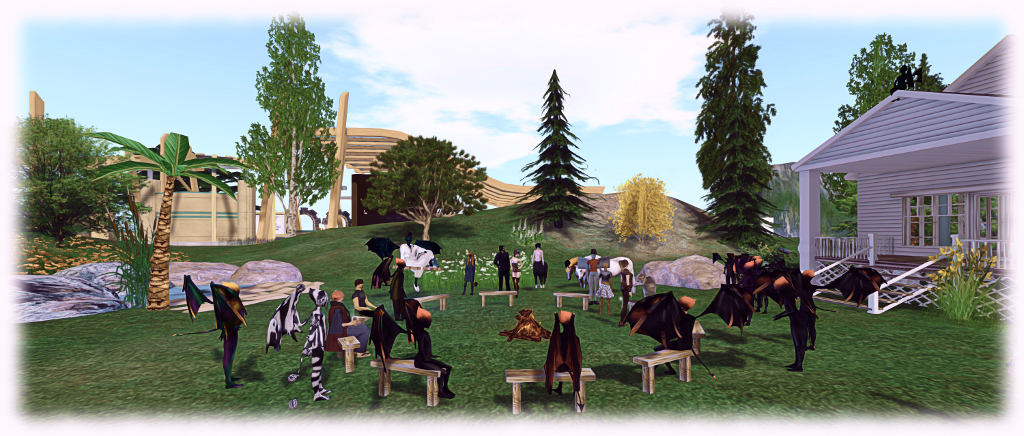
The Content Creation User Group has re-formed out of the Bento User Group, and is held at the Hippotropolis Campfire Circle. Imp costumes entirely optional 😀 .
The following notes are taken from the Content Creation User Group meeting, held on Thursday January 26th, 2017 at 1:00pm SLT at the the Hippotropolis Campfire Circle. The meeting is chaired by Vir Linden, and agenda notes, etc, are available on the Content Creation User Group wiki page.
Core Topics
Potential follow-on projects
Modelling for efficient rendering
Animations
Outfits
Follow-up projects
There has been no further progression on the potential follow-on projects from Bento (see my week #2 Content Creation Group meeting report for details of follow-ups).
In terms of the baked texture on mesh idea, the Lab has asked for specific content there “onion” meshes are used – and it has been reiterated this is most of the common mesh bodies and heads
There is still some confusion as to what may be causing the animation conflict issue. While it may be that changes will be made to the animation system in the future, as per the suggestions Vir forward previously (see the link above), the solution for now is to try to address the issue at a scripting level to prevent conflicts.
Modelling for Efficient Rendering
Medhue Simoni has been producing a series on the use of Level of Detail (LOD) to help with generating rendering efficient models in Second Life. Part 1 is embedded below, and Part 2 can be found here. A third part will be available soon, and hopefully, he and I will be producing a companion article in this blog once that part is available on-line.
Efficient modelling for Second Life has long been a problem within the platform, and something exacerbated by the arrival of full mesh support. Given this:
The Lab is considering revising the rendering cost calculations “at some point” to encourage people to consider more efficient models (e.g. making more use of normal maps to add detail to models where appropriate, rather than rely on always producing an extremely high poly count model).
It has been suggested that providing some basic indicators of what might be considered “reasonable” number – poly counts, proportionate scaling of LODs, etc. – for models could be produced, together with videos (by content creators with a solid understanding of the subject and Second Life) on efficient use of normal and specular maps
Using a normal map to enhance the detail on a low-polygon model. The image on the left shows a model of some 4 million triangles. The centre image shows a model with just 500 triangles. The image on the right shows the 500-triangle model with a normal map taken from the model on the left applied to it. Credit: Wikipedia
The discussion broadened to cover awareness among content creators as to what actually works and where falsehoods / misunderstanding lie. A cited example in the meeting was that of mesh clothing makers avoiding the use of normal maps because they want their clothing to look the “same” to everyone, even though doing so can severely impact the user experience for those on lower-end system, and thus discourage users from buying their goods.
.BVH Animations and Animation Playback
Animations can be uploaded to Second Life in one of two formats, .ANIM and .BVH. The latter are optimised as a part of the upload process, and this is proving to be a particular problem for Maya users when animating facial expressions. These require finer bone movements in the animation, which the optimisation process is filtering out, requiring Maya users to use exaggerated movements. Blender users can avoid the issue by using .ANIM, which does not pass through any form of optimisation / filtering.
While it is recognised that the thresholds used by the .BVH optimisation / filtering process may not be the best for very small bone movements, there are currently no plans to alter / refine the .BVH uploader. Nor is it really feasible to adjust the thresholds for hand and face bones, as this could have an adverse effect where these bones are re-purposed for other uses (as Bento is intended to allow).
There are two possible workarounds which may help with these issues for anyone using the .BVH format:
Swap to using .ANIM files, which do not go through any similar optimisation process. Unfortunately, this isn’t an option for Maya users, as there is current no .ANIM exporter for Maya, although Aura Linden is working on one in her own time, and is hoping to get time in about three weeks to sit down and finish it
Alter the frame rate of the animation itself – so rather than creating it at 30 fps, try 15 or 10 fps, depending on the animation.
There was also some confusion over the maximum file size for animations, as per my 2016 week #25 report, this was increased from 120 Kb to 250 Kb in June 2016. The wiki page on SL limits has now been correctly updated to reflect this. It’s also worth noting, as an aside, that animations will be moving to delivery via the CDN network in the future.
There was an extended conversation around Outfits and the Outfits folder. While much of this revolved around the Visual Outfits Browser option for Outfits, a couple of significant items were discussed.
The first was on the subject of saving gestures with outfits. As noted in my Bento update #26 and Bento update #27, gestures cannot be automatically saved with an outfit, but can be manually added as links / copies. However, Medhue Simoni has found a catch: should the outfit ever be re-saved, the gestures are removed. Expect a JIRA soon
A common request for the Outfit system to allow nested folders once more the ability was removed with viewer 2.1 (see VWR-19774), and while it was at the time noted as a possible “priority” item for consideration by the Lab, the topic has only recently again come up in internal conversations as a result of feature request BUG-41826. However, the amount of work involved to make it happen makes it unclear if the request will be accepted.
One request for Outfits which is unlikely to be acted upon, is to have links to other folders in addition to objects. This is seen as even more complex than allowing nested folders within the Outfits hierarchy.
Next Meeting
The Next Content Creation User Group meeting will be on Thursday, February 16th, 2017.
On Tuesday, January 24th, the Main (SLS) channel was updates with the same server maintenance package deployed to the RC channels during week #3. This includes a partial fix for (non-public) BUG-3286, “Can’t move object” fail notifications (fixes for regions/objects with longer names are pending), together with enhanced server logging and minor internal server enhancements.
There will be no RC deployment on Wednesday, January 25th – but the RC region will be restarted in keeping with the Lab’s new policy of restarting the channels every 2 weeks, regardless of whether or not there is an associated deployment.
The next RC deployment is expected to be week #5 (commencing Monday, 30th January, 2017).
SL Viewer
No changes since my last update. The status of viewers in the pipeline remains thus:
Current Release version: 5.0.0.321958, dated December 1st, promoted December 5th, 2016 – formerly the Project Bento RC viewer
Release channel cohorts:
Maintenance RC viewer, version 5.0.1.322791, dated January 12th
Project viewers:
Project Alex Ivy (LXIV), 64-bit project viewer, version 5.1.0.501863 for Windows and Mac, dated January 10th
360-degree snapshot viewer, version 4.1.3.321712, dated November 23, 2016 – ability to take 360-degree panoramic images – hands-on review
Obsolete platform viewer, version 3.7.28.300847, dated May 8, 2015 – provided for users on Windows XP and OS X versions below 10.7.
Camera Presets
As I noted in a recent TPVD meeting update, Jonathan Yap is working on a code contribution for the official viewer which will allow users to set and save their own preferred camera presets in the viewer.
The idea is that, like the graphics presets functionality Jonathan contributed to the viewer in 2016, users will be able to define their own placements for the SL camera around their avatar (e.g. an over-the-should view, a view from overhead, etc.), which can then be saved and selected / used as required. Jonathan has only recently started on the work – which has an associated feature JIRA, STORM-2145 – but that should hopefully change once various decisions have been made by the Lab.
Nvidia Driver 378.49 + 64-bit Viewer Bug
Nvidia release their 378.49 driver on Tuesday, January 24th, and it can cause an unusual bug / issue with 64-bit viewers. The problem was first noted on Firestorm 5.0.1 (see: FIRE-20774), but I have repro’d it on the Lab’s own 64-bit project viewer (version 5.1.0.501863 at the time of writing) and on Alchemy 4.0.0 (a crash issue had prevented comprehensive testing on Alchemy 5.0.0 at the time of writing).
The Nvidia 378.49 driver bug which can occur with 64-bit viewers when ALM is disabled
The issue only manifests when Advanced Lighting Model (ALM) is disabled in a 64-bit viewer, and renders the in-world view with an odd blue tinge which almost looks like the blue colour channel is impinging on the red channel. As noted in the Firestorm JIRA, enabling ALM can prevent the issues, as can toggling Glow off when ALM is disabled. See the Firestorm JIRA for workarounds, should you encounter the problem.
How the same scene looks in the same viewer (SL Alex Ivy 64-bit project viewer for Windows, version 5.1.0.501863 at the time of writing)
The issue was raised at the Simulator User Group meeting on Tuesday, January 24th, a JIRA for the issue on the Lab’s 64-bit project viewer is available on BUG-41294.
The Main (SLS) channel was restarted on Tuesday, 17th January, but there was no associated code deployment
A new server maintenance package was deployed to the RC channels on Wednesday, January 18th, comprising a partial fix for (non-public) BUG-3286, “Can’t move object” fail notifications (fixes for regions/objects with longer names are pending) + internal server and logging enhancements
SL Viewer
No further updates to the current viewer pipeline list.
Texture Uploads and First Time Rendering
The Lab has been making some hardware (/communication?) changes to the texture upload / delivery mechanism (e.g. both the handling of texture uploads from the viewer to the asset system, and then from the asset system back out to the viewer via the CDN). When deployed to the main grid, these should see improvements in the uploading of new textures and their appearance on in-world objects, whether uploaded individually or in bulk (e.g. hopefully little / no grey panels in new texture upload previews when viewing them from inventory, and few / no grey object faces when uploading a texture and then immediately applying it to an object face).
Content Creation User Group
Summary of General Points
No further movement on the potential “Bento follow-up” project ideas (see my Content Creation UG notes for week #2).
The next Avastar release is in advanced testing, with a potential release around late February / March, but will include devkit support and a large number of bug fixes.
Appearance sliders:
A question was asked whether the slider system could be updated to allow for easier scaling for smaller avatars utilising Bento (as not all Bento bones are linked to sliders). Vir noted this is unlikely, as it would require a change for the base slider scaling which could break existing avatars.
However, Vir noted that suggestions to offer new sliders for sizing things like wings and tales have been discussed at the Lab, but nothing has as yet been decided.
Pain Points / Blockers to Bento Content
A general question thrown out by Simon Linden was whether people are experiencing particular “pain points” in producing Bento content: what they might be waiting for tools-wise or in any other way etc. this quickly spilled out into a much broader discussion on various tools and suggested tutorials. However, core points raised were:
Available time, learning to use external tools such as Blender,
Waiting on Avastar, plus tutorials, both generic and on using specific tools (e.g. Avastar and Mayastar) – which will hopefully come in time
Mention was made of making people more aware of SL-specific areas such as level of detail (LOD), managing physics, LI calculation rules, etc.
It was also noted that possibly having idea of having some for of sample content (e.g. wings, hands), which creators could use as an example / baseline for their own creations, together with a broader selection of documentation / tutorials / videos.
Simon pointed out that in terms of Lab developed tutorials and documentation, there are only limited resources. Many third-parties also produce tutorials (Mehdue Simoni, for example is waiting for the new Avastar to reach release before working on his video tutorials for it).
Others have also put together documentation, but are finding it hard to get that documentation seen heard above the broad range of misinformation on content creation which is in circulation. Vir has suggested that meaningful documentation and tutorials could be linked to through the SL wiki.
In terms of the wiki, there are a range of resources available for content creation / Bento: