The Whisper of Phoenix Gallery, August 2026 – Carelyna: Double Sided
Currently open at The Whisper of Phoenix Gallery, operated by Princess Venusia (Venusia McMahon) is an exhibition of art by Carelyna, which she had called Double Sided. It carries with it a simple yet nuanced idea: why have an image on one side of a canvas and leave the reverse blank when you can have two images, ostensibly of the same scene but each somewhat different on nature, one to either side of the canvas?
The result is a series of paired images with each picture in a pair having its own story to tell.
The Whisper of Phoenix Gallery, August 2026 – Carelyna: Double Sided
Take She Sails Against the Wind as an example; in one version, the sky is brighter, the mainsail more fully set, the waters calmer, all of which give a sense of excitement: a sailboat cutting through the water, its pilot likely at ease as she sail towards ports. In the other, the mainsail is taller, thinner, the clouds darker and more roiled, the water heavier, all of which carry a hint of a gathering storm. Thus in one we have a story of carefree times on the open waters, in the other a more uncertain sense of foreboding for the boat and its mistress.
But there is also perhaps something of a nuanced exploration of choice to be found within this collection. Each pair of images gently asks us to compare / contrast their two sides and deliver a verdict as to which we prefer. In doing so, they gently nudge us to consider why we are drawn to one over the other, and the emotional processes at work within us which drive us to that choice.
The Whisper of Phoenix Gallery, August 2026 – Carelyna: Double Sided
And even if if such Deep Thought is not something we want to plumb when visiting Double Sided, there is a third element in this approach: should we be moved to purchase a piece, we in fact have two images we can hang at home and change according to our mood or the changing of the environment in which we live in-world.
The Simulator User Group meeting place at Longfellow
The following notes were taken from the Tuesday, August 15, 2026 Simulator User Group (SUG) off-week meeting (the “Leviathan Office Hour”). These notes form a summary of the items discussed, and are not intended to be a full transcript. They were taken from my chat log of the meeting. No video this week, as Pantera is on vacation.
Meeting Overview
The Simulator User Group (also referred to by its older name of Server User Group) exists to provide an opportunity for discussion about simulator technology, bugs, and feature ideas is held every other Tuesday at 12:00 noon, SLT (holidays, etc., allowing), per the Second Life Public Calendar.
The “Leviathan Office Hour” meetings are held on the Tuesdays which do not have a formal SUG meeting, and are chaired by Leviathan Linden. They are more brainstorming / general discussion sessions.
Meetings are held in text in-world, at this location.
Simulator News
On Tuesday, August 25, 2026, the SLS Main channel was restarted without update.
On Wednesday, August 26, 2026, the RC channels will likely be restarted without any deployment.
Game_Control
Leviathan Linden is “almost done” with a revamp of game-control.
A pull request has been cut to the server updates, and the hope is that this will be added to the upcoming Nectarine server update. This will likely include a new UDP message for game_control so that all simulators will be aware of it before the viewer-side code is released.
The viewer updates should similarly be going into the viewer Develop repository in the near future.
Leviathan is changing how game_control event is accessed for scripts: scripts now need to llRequestPermissions(PERMISSION_GAME_CONTROL) to get game_control events, similar to how control events work.
He also noted that with this change, attachments and seats permission requests will be auto-accepted (the scripts will need to ask for the permissions, but no pop-up will show on the viewer for those objects).
The main benefit of this latter change is it will be possible to remote-control objects with game-control input (but disconnected objects will cause the pop-up, and it will have to be accepted manually).
It was noted that this change might have to be included in the llRequestExperiencePermissions() protocol.
These changes are not currently live on any simulator.
Region Crossings
Pepper Linden’s work on improving region crossings should be seeing a limited deployment to the Main grid via the Snack RC channel, most likely alongside the upcoming deployment of the Nectarine simulator update is deployed to the other RC channels.
This test deployment is the result of concerns that the updates might result in a need for a roll-back should they might impact other region crossing changes which have been made.
If Pepper’s updates work on Snack without any roll-back, then a broader deployment to RC channels can be considered.
More information on this will be provided at the next Simulator User Group meeting on Tuesday, September 1, 2026.
Avatar Movement
Leviathan has been working on Avatar movement, one outcome of which has been the “breakage” of the ability to “crouch-slide” (crouching and then tapping the forward/rotate keys to cause an avatar to couch and slide along the ground).
He notes he is sympathetic to the complaints this has caused (presumably primarily from within the combat community), and indicated he is going to revisit the changes.
Alongside of this has been reports that avatars are sliding a lot more when on a moving surface than used to be the case. This might also be related to Leviathan’s updates, so he will be looking at this issue as well.
A general discussion on holding down the spacebar being used to slow an avatar being bump-pushed caused Leviathan to mention he would like to find a mans to enable an avatar “slow walk”
The use of spacebar to slow an avatar being bump-pushed only works if the keyboard is not prioritised for text input rather than also being used for movement (e.g. using the WASD keys for movement); it also sees the avatar appearing to “walk” at a normal pace whilst being pushed.
It was noted at if a “slow walk” option was introduced, it would be useful to a) have a means of varying an avatar’s walking speed based on factors (e.g. avatar height), and b) have walking speed accessible to scripted control.
Leviathan acknowledged both of these point but if he is able to work on the idea, the initial focus would be on developing an option for a slow walking pace, noting that this would be useful for game_control, given this currently uses the existing locomotion graph.
General Discussion
No updates on issues such as the mesh face count mismatch, new LSL commands, network improvements, etc.
The multiple issues experienced on Sunday, August 23, 2026 appear to have been related to a significant database outage.
Linden Memorial Park, August 2026: Shrine of Remembrance
Linden Lab recently indicated that they would be carrying out various small-scale projects to improve part of Second Life Mainland following the decision not to close the Gaeta 1 continent. Various aspects of this work are now in progress, as numerous Second life users have noted through the forums and elsewhere.
One location in particular where improvement has long been requested has been the 12-region estate of the Linden Memorial Park, located off the north coast of Corsica.
Linden Memorial Park, August 2026: dedication
For those not familiar with the Memorial Park regions, they were established in 2009 as a place where Second Life residents who have passed away in the physical world could be remembered by their SL families and friends. While its active life was relatively short – the Lab ceased accepting requests for new memorials to be added to the Park in July 2011 – it has remained a part of Second Life, whilst looking increasingly aged.
While there have been various attempts to revitalise the regions (I think I’m correct in saying the last being in 2020, although my memory is hazy on this), it now appears it is subject to improvement, with the first phase of the work now complete, as recently noted by Oatmeal Linden in a comment added to a request made via the Feedback Portal, and which Miro Collas pointed me towards.
Linden Memorial Park, August 2026: Memorial Gardens
Hello everyone! We have made some cosmetic updates to the regions in Linden Memorial Park. This is the first part of the revitalization efforts for this project.
We are still reviewing updates for the Day of Remembrance Garden. The original build in remains in its current location for now, with scripts disabled to prevent damage to or loss of the existing content. We hope to be able to provide a means to continue to leave messages and record the account names for those we’ve lost before the end of this year.
We are also exploring enabling the addition of new stand-alone memorials.
This work appears to be focused on general landscaping, with elements designed and used in some of the Bellisseria themes being given new purpose in updating the general look of the park.
For example: rock forms used within the Stilt, Houseboat and Newbrooke Linden Homes themes been used to redress key areas of the Park, such as the waterfalls surrounding the Greco-Roman style circular Shrine of Remembrance. Meanwhile, trees and shrubs from the Sakura, Newbrooke and Chalet themes have been used to refresh the woodlands and many of the plants throughout the parklands.
Linden Memorial Park, August 2026
For those who have not previously visited the Park, the Shrine, sitting upon its artificial island, forms the Landing Point for the Park, with three sides of the lake fed by pairs of waterfalls, and the 4th (at the time of writing at least) be a single fall.
A bridge crosses the waters on the north side of the Shrine’s island to offer a way up to the Memorial Gardens, a set of five tended plots arranged in the form of a cross with the names of those being remembered rising from the flowers therein.
Linden Memorial Park, August 2026
Exploration of the Park can be carried out by following the paved paths running around and through most of its regions, or simply by wandering freely. The former pass many of the larger memorials placed within the Park between 2009 and 2011 as well as some of the more general contemplative areas – such as the Hyper Mole memorial garden. Wandering freely, meanwhile, particularly through the woodlands might bring visitors to various ruins and memorials such as the LDPW Mausoleum.
With the Highgate Monument, Winterspire and Derran Moor regions in the south-east of the Park largely devoid of landscaping outside of the coastline (as is San Michele to the north-west), it appears the Memorial Park has room to expand. If so, what form the expansion might take could be a further point of interest for future visits.
Linden Memorial Park, August 2026
At Oatmeal notes in their update, scripts within the Park regions remain inactive for the time being. Nevertheless, the facelift carried out so far greatly increases the beauty of the regions without either overwhelming them or replacing the original builds of the Shrines, monuments, etc. The fact the work has been carried out (albeit seemingly paused as of the writing of this piece) makes the Memorial Park well worth (re)visiting. My thanks again to Miro for the poke about the update!
Logos representative only and should not be seen as an endorsement / preference / recommendation
Updates from the week through to Sunday, August 16, 2026
This summary is generally published every Monday, and is a list of SL viewer / client releases (official and TPV) made during the previous week. When reading it, please note:
It is based on my Current Viewer Releases Page, a list of all Second Life viewers and clients that are in popular use (and of which I am aware), and which are recognised as adhering to the TPV Policy.
This page includes comprehensive links to download pages, blog notes, release notes, etc., as well as links to any / all reviews of specific viewers / clients made within this blog.
By its nature, this summary presented here will always be in arrears, please refer to the Current Viewer Release Page for more up-to-date information.
Outside of the Official viewer, and as a rule, alpha / beta / nightly or release candidate viewer builds are not included; although on occasions, exceptions might be made.
Official LL Viewers
Default viewer 26.3 – 26.3.0.31203661088, August 10, promoted August 17 – quality of life improvements; performance improvements; bug fixes – NEW.
Second Life Lua Editor Alpha viewer 26.3.0.32302693173, August 21 – NEW.
Habitat 1 – Planet Terralyth, August 2026 – click any image for full size
I’ve been reporting on the BluShock Coalition on-and-off since 2021. Led by the redoubtable Fazzy Constantine (Faisel Constantine), BluShock have been exploring future worlds through world building and role-play, their story unfolding like the seasons of a continuing sci-fi series as it moves from world-to-world (and occasionally confines itself to life on small outposts or deep space cruisers).
Since my last time spent visiting them in July 2025, the group has renamed itself Cerbshock, and they have most recently arrived on a new world – Planet Terralyth, located in the Andromeda galaxy – and Fazzy extended a subspace invitation for me to explore this world ahead of it being made public.
Habitat 1 – Planet Terralyth, August 2026
In Cerbshock, the universe is basically yours to explore. Check out amazing new planets loaded with beauty and mystery. Dive into a gripping story where your decisions actually matter—pushing your morals and testing how far you’re willing to go. Every choice counts, making your journey completely one-of-a-kind.
Occupying a Full private region, Terralyth has been designed by Fazzy with the assistance of Zeth Ryder (Zeth Starlight) and artist CK (Ceakay Ballyhoo). To say it is a truly impressive build would be an understatement.
Habitat 1 – Planet Terralyth, August 2026
At first glance, there is a faintly Panadora-ish feel to the planet: densely forested and with great fingers of rock pointing skywards with winged creatures circling them. However, unlike James Cameron’s world, Terralyth remains rooted in physics: no floating islands turning a blind eye to Newton and Einstein.
Instead, what we do have is an environment that is immersive and which stands both in the long tradition of and tribute to the work of Noah Constantine (NoahLion), who was for so long the group’s world-building genius.
Designation: Habitat 1 Region: Heleus Cluster, Andromeda Galaxy. Classification: Super-Earth with extreme axial inclination. Surface Temperature: Approximately 30–35°C. Surface Gravity: Approximately 1.15–1.20 Earth standard. Environment: Tropical jungle and elevated rainforest. Atmosphere: Breathable, dense and humid. Natural satellites: One, unusually large. Habitability and lifeforms: Confirmed, with outstanding environmental concerns under investigation.
Habitat 1 – Planet Terralyth, August 2026
There are a few ground rules – pardon the pun – visitors are asked to observe when visiting. These can be found at the Landing Point and are not onerous – in essence, keep to the ground level, keep clothing / look PG and don’t try accessing restricted areas.
One point I will make (outside of the usual “best viewed with a PBR enabled viewer”) is that you might need to occasionally extend Draw Distance up to around 350-360 metres to get some of the off-region elements to render if you wish to see the setting as intended. However, given the overall design, the emphasis here is very much on “occasionally”. Whether or not you opt to have Shadows enabled is entirely up to you – but do have local sounds enabled.
Habitat 1 – Planet Terralyth, August 2026
There are a couple of routes for exploration leading away from the shuttle pad Landing Point. These routes might at first appear limited; the landscape, whilst lush, has been cleaved open as if by a giant’s axe, resulting in deep gorges and paths that sometimes end in long falls.
However, such appearances are deceptive. Spans of rock reach across some chasms (some at giddying altitudes!), with the fallen trunks of trees great bridging others, their positions along trails begging the question: was their gap-spanning toppling fortuitous or designed?
Terralyth is a large, Earth-like world characterised by dense tropical jungles, towering rock formations, deep valleys, elevated landmasses, and extensive networks of rivers and waterfalls. Its warm, humid atmosphere supports an exceptionally diverse biosphere, including widespread bioluminescent flora and fungal life.
The planet possesses an unusually slow and highly inclined rotation. Across the primary jungle regions, both the Sun and moon follow shallow paths along the horizon, rising only slightly before gradually disappearing into the planet’s dense atmospheric haze.
Habitat 1 – Planet Terralyth, August 2026
That this world was once inhabited is clear: some of the paths are clearly well-worn and ancient, and there are ruins awaiting discovery. Then there is the no small matter of the futuristic monolithic tower. Now apparently the base of operations for the Cerbshock team, it does not appear to be of human design – so who might have been responsible for its construction and what might have been its purpose? Such are the rich opportunities for role play to be found here!
As to the life forms present and how much of a threat they may pose – well, that is again a matter of conjecture on my part. They appear to be a mix of herbivore (or possibly omnivore) in the case of the shadowbull. The lean and powerful bloodstalker with its claws and teeth, however, has all the hallmarks of being a carnivore of the hunting variety – so you have been warned!
Habitat 1 – Planet Terralyth, August 2026
It also appears as though the Cerbshock veterans are not the first human / alien alliance to venture to Terralyth. Tucked away within the planet are all the signs of an existing human-involved presence; possibly one intent on planetary exploitation going by the markings on what appears to be their planetary transport.
Are they the reason for the reports of pirate activity noted in the Cerbshock planetary database? Quite possibly – if you’re a role player and curious, then all the more reason for you to consider joining the Cerbshock team and finding out.
Preliminary surveys have identified traces of ancient structures across several elevated plateaus and within caverns exposed by tidal erosion. Their origin remains unknown. Several ruins appear deliberately positioned along the paths followed by the Sun and moon, suggesting that Terralyth’s unusual celestial cycle held significance to the planet’s former inhabitants.
Recent reports have also indicated possible pirate activity within the region surrounding Terralyth. These reports remain unconfirmed, and no direct evidence has been established linking the activity to the planet itself.
Habitat 1 – Planet Terralyth, August 2026
Terralyth is excellently conceived and executed. Even if you are only paying a visit, there is plenty to see; if you’re looking for an immersive, science fiction oriented role play, then it and the Cerbshock team have a lot to offer. In the latter regard, the official website (or Codex) is extremely informative (and also quoted here!), and includes notes on how to join.
Speaking purely as a visitor, I enjoyed wandering / camming and poking around; and even if “Blood Stalker” isn’t the official name for the carnivore – I really think it should be; sums the rascal up perfectly in terms of his looks and actions! 😀 .
Habitat 1 – Planet Terralyth, August 2026
My thanks to Fazzy (as always!( for keeping me informed as to BluShock / Cerbstock adventures and worlds – and best wishes to the team as this chapter in their adventures opens!
An artist’s rendering of Chang’e 7 in lunar orbit. Visible is the cylindrical orbiter (left) with the lander mounted on top of it (right). Neither the rover nor the hoper are visible. Credit: CCTV
China is about to launch its most ambitious lunar mission to date in the form of Chang’e 7, which will be heading for the edge of Shackleton Crater in the Lunar South Polar Region – the part of the Moon both the US and China have identified as the target for their upcoming crewed lunar missions.
Over the past two decades, the Chang’e missions – named for the moon goddess of Chinese mythology – have been a mainstay of China’s space ambitions and marked the nation’s growing space capabilities. The previous mission, Chang’e 6, saw a lander touchdown on the lunar farside – the first mission ever to do so –, deploy a rover and return surface samples to Earth for international analysis.
The 8-tonne Chang’e 7 mission is somewhat similar to Chang’e 6 in that it comprises an orbiter, a lander and a rover vehicle; however, it will not be returning samples to Earth for analysis. Instead, its primary role is to look for evidence of accessible water ice around the crater and carry out initial prospecting for a location where China might start landing materiel and crew to establish a lunar base.
As such, it marks the start of China’s fourth phase of lunar missions, the others being orbital observation (Chang’e 1 and 2), the second landing and rover deployments (Chang’e 3 and 4), the third nearside and farside sample return missions (Chang’e 5 and Chang’e 6 respectively).
The 24 km wide, 4 km deep Shackleton Crater lies at the Moon’s south pole (which is located near the crater rim at the top right of this image). The crater rim tends to be lit by sunlight with the bottom of the crater remaining in cold shadow. Chang’e 7 is aiming to land somewhere on the crater’s rim and search for evidence of water ice whilst carrying out other studies. Credit: NASA
If all goes according to plan, Chang’e 7 will launch atop a Long March 5 (CZ-5) booster from the Wenchang launch centre and will coast out to the Moon over a period of 6 days on a minimal propellant flight. This will see it essentially spiral away from Earth until the Moon’s gravitational influence becomes dominant and the spacecraft will then transfer to spiralling in towards lunar orbit.
Once at the Moon, Chang’e 7 will become the most ambitious robotic lunar mission ever undertaken, with the lander aiming to make a precise landing high on the rim of Shackleton Crater where it can receive the most sunlight. Providing it does so successfully, it will deploy the rover vehicle – a more advanced unit than previously flown – together with a unique surface “hopper”.
A rendering of the Chang’e 7 rover, said to be a more advanced version of the Yutu rovers flown to the Moon on previous missions, designed to carry out a comprehensive surface survey mission to help prepare the way for human landings. Credit: CCTV
A total of 21 science experiments – including instruments from the USA, Russia, Egypt and Bahrain, and Italy – are being carried across the four vehicles. The orbiter will carry out stereo mapping and radar mapping of the lunar surface in extremely high resolution, together with hyperspectral and spectral analysis of surface material from orbit, magnetic field analysis, surface radiation analysis, and solar radiation / space weather monitoring.
The lander will analyse lunar dust and the local electrical field, listen for moonquakes, evaluate the surface environment – radiation, dust ionisation – and carry out astronomical observations from the Moon’s surface, as well as imaging the local topography. The rover will carry out wider-ranging field studies, analysing the lunar surface for volatile and isotope concentrations, monitoring the local magnetic field, examining the subsurface composition via ground penetrating radar and imaging its surroundings as part of the survey to identify possible landing zone for future missions.
The hopper is a new type of vehicle. Relatively small it is designed to explore the more shadowed regions of smaller craters, etc., by literally hopping around on a set of legs. It is design to hop into an area of shadow and expose surface material under the lunar dust via the impact of its landing legs, then make a small jump to one side so it can use a combination drill / water analyser to gather samples of the material exposed by the initial landing, in order to analyse it for evidence of water ice.
A close-up of an early model of the Chang’e 7 lunar hopper, showing five of the 6 legs. The vertical grey mast at the rear of the hopper is the drilling rig. Credit: CAST / CNSA
All of the data gathered – including gaining a more complete understanding of overall surface lighting and areas of near-constant illumination around Shackleton – will be carried forward into planning for China’s human missions to the Moon, which are due to commence in 2030.
New Study Updates Kessler Syndrome Risk
I’ve written on numerous occasions about the increasing risk of a Kessler syndrome cascade: a single collision in the increasingly crowded domain of near-Earth space resulting in the low-to-medium regime of orbits around our planet becoming unusable in part or in full as the debris from the first collision destroys other satellites in a spreading sphere of destruction.
In this contrasted rendering, each visible orange dot represents a satellite being actively tracked in low Earth orbit (up to 2,000 km and the dense cloud around the planet), medium Earth orbit (the larger sphere of dots around the planet – extending from 2,000 to 35,000 km) and geostationary orbit (the central band around the medium orbit sphere, at some 39,500 km). Credit: NASA
However, trying to calculate the actual risk of such an event occurring has been difficult because the Kessler syndrome model was based on high altitude, relatively passive satellites – that is, units which do not have to “fly in formation” relative to one another at much lower, more crowded obits where they have to dodge potential risks posed by other orbital bodies – other active satellites, rocket debris, defunct satellites awaiting re-entry and burn-up, space stations, and so on – which is precisely what modern constellations launched over the last 5-8 years have to do. Take Starlink, for example: it currently has some 10,900-11,000 active satellites in orbit – and all of them have to perform at least one avoidance manoeuvre every week. And SpaceX plans to expand that constellation to 42,000 active units.
To try to better understand the real risk of collision, Professor Hugh Lewis of the University of University, UK, has been updating the Kessler models to reflect how modern day satellite constellations actually behave, taking into consideration things like active collision avoidance, the risk of thruster failures resulting in loss of control, relative proximity of satellites in a constellation “layer” (i.e. operating at the same altitude and close enough to one another for low-latency communications relay), continuous replenishment rates (i.e. defunct satellites get replaced in the constellation), and de-orbital drag profiles based on the geometry of the satellites themselves.
Using this updated framework, Lewis analysed 14 planned or partially operational satellite constellations (e.g. Starlink at its current 11,000 active units and planned 42,000) to place them in one of three categories:
Below Thresholds: a single collision is unlikely to cause a significant issue, and Earth orbital space remains a sustainable operational environment.
Exceed Unstable threshold: a single collision will cause a Kessler cascade which will initially increase prior to stabilising, resulting a balance between those orbital regimes which remain usable and those that are rendered unusable due to the volume of debris remaining in orbit at their altitudes.
Exceed Runaway threshold: a single collision resulting in infinite fragment growth and a guaranteed loss of all of the satellites within the constellation – and a possible complete Kessler syndrome cascade.
Of the 14 constellations analysed, over half already sit within the Exceed categories (both unstable and runaway). Leaving aside those which have yet to be launched (if they ever are) such as the deeply flawed “AI data centre” constellations, this is worrying on two counts.
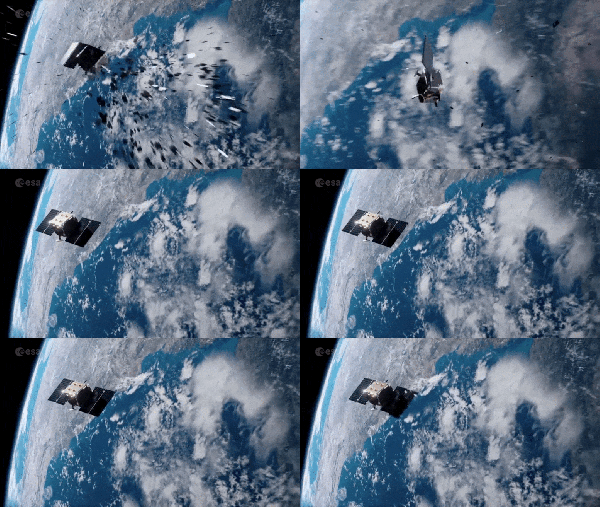
An animation of orbital debris hitting a satellite. Credit: ESA
The first is that the study shows that even a modest constellation can have a significant effect if it is subject to a collision. Consider Eutelsat’s Next constellation, for example. This will comprise just 528 units, but it sits within the Exceed Unstable threshold: a single collision between two of the satellites in the network will result in a large portion of the bandwidth of the low Earth orbit regime (up to 2,000 km above Earth) becoming unusable for other satellites, because Next will orbit sufficiently high enough for the resulting debris cloud to take years to fully disperse and re-enter the atmosphere to burn-up.
The second – more worrying – factor is that the analysis only considers the effect of two satellites within a constellation colliding with one another, and the impact this has on the remaining satellites in the constellation.
So, for example, the analysis only considers how the debris from a collision involving two Starlink satellites will affect other Starlink satellites; it doesn’t consider how the debris could affect satellites from, say, China’s GuoWang (15,000 planned) and Qianfan (13,000 planned) operating in pretty much the same orbital plane and altitude, or how that debris might then cause a further cascade of destruction. Nor does the analysis consider the potential for a sufficiently large, stray piece of debris already in orbit to destroy a satellite and so set off a chain of destruction.
Currently available on arXiv whilst awaiting formal peer review, the Lewis paper – Critical Sizes of Satellite Constellations – offers no solutions for the growing risk, but does suggest regulators need to enforce a more rigorous approach to the potential for a full or partial Kessler syndrome event than current methods of debris analysis allow. These consider only how an individual satellite will fragment should it experience an impact sufficient enough to cause it to break-up not the additional effect the break-up would have given the satellite’s orbit and operating proximity to other satellites.
NASA Ends Swift Observatory Rescue but Maintains Mission
In June I covered the daring attempt to rescue a NASA satellite – the Neil Gehrels Swift Observatory – from re-entering Earth’s atmosphere in October 2026 and burning up, by using another spacecraft to link up with it and gently push it up to a higher orbital altitude (see: Space Sunday: NASA – a rescue attempt, costs & infrastructure).
Whilst the mission started off well, by the start of August 2026, things had gone sideways, as I noted at the time, with the rescue vehicle – called LINK, and built by Arizona-based Katalyst Space Technologies – itself in trouble after two of its three reaction wheels (used to maintain precise vehicle orientation) had ceased functioning, whilst its cold gas thrusters were also experiencing issues.
A set of an artist’s renderings of LINK in space and rendezvousing with Neil Gehrels Swift Observatory, ready to gently push it up to a safe operating altitude before atmospheric drag causes it to re-enter the atmosphere and burn up. Credit: Katalyst Space
On August 19, 2026 NASA called off the rescue attempt – but not the mission as a whole. Essentially, the loss of precise attitude control means that LINK cannot safely connect to the Swift observatory without the risk of a full-on collision. Instead, the spacecraft will now rendezvous with the observatory and carry out approach and operations intended to allow Katalyst to gain data and experience in such manoeuvres as they prepare to start operating a larger recovery craft in future missions.
At a cost of just US $230 million, Swift has been an invaluable science platform and its loss will be felt. The rescue attempt – at just US $30 million has not been a major expenditure, but it was something of a rushed job; despite being aware that Swift would re-enter the atmosphere in 2026, NASA didn’t opt to go ahead with trying to save Swift until late 2025, giving Katalyst just nine months to develop and fly the LINK craft- which is a remarkable feat, even if the outcome isn’t as hoped.
Another Partial Eclipse – Seen from another World
August 12, 2026, as I’ve previously covered (here and here) allowed part of the northern hemisphere – Greenland, Iceland, Spain, in particular – to witness a total solar eclipse, with a partial eclipse being also visible from many areas on both sides of the Atlantic. It was a widely reported event, and the start of a new decade of eclipse watching.
What was less well reported was that just a day later, there was another partial eclipse of the Sun – but this didn’t involve our own Moon and was only seen by one observer: NASA’s Mars 2020 rover, Perseverance.
A magnified and contrast-enhanced image captured by the Mastcam system on NASA’s Mars 2020 rover, Perseverance, showing the 26 km wide Martian moon Phobos (approx. 6,000km from the planet) transiting the disk of the Sun (averaging 229 million km from Mars) to create an eclipse. Credit: NASA/JPL
On August 13, 2026, the rover took time out from exploring the region around Jezero Crater, where it landed in 2021, to look up at the sky with its Mastcam imager to capture Mars’ near most moon, Phobos, transiting the disk of the Sun.
Of course, given Phobos is relatively tiny – less that 26 km across its largest side – means it didn’t come anywhere close to offering so spectacular event as we can witness when our own Moon comes between us and the Sun, but the event was still notable – if not for science, then at least for the impact of being able to see such events from other worlds.