
August 12, 2026 will see a total solar eclipse sweep across the Atlantic Ocean, the path of totality – in which the disk of the Moon completely covers that of the Sun as seen from Earth – extending down from the Arctic Ocean, across eastern Greenland and western Iceland before traversing the Atlantic to pass over northern Spain, the Balearics and parts of the Mediterranean before coming to an end as the Sun and Moon seem to part company once more.
The path of totality is not wide – just 393 kilometres across; but you don’t have to be completely within it in order to witness the eclipse. Countries to both the east and west will be witness to a partial eclipse, with much of western Europe – Scandinavia, the British Isles, France, the low countries, Germany and Italy in particular – will be treated to an evening partial eclipse to varying degrees, complete with a darkening of the skies as the disk of the Moon obscures a fair portion of the Sun, as if taking a bite out of it. For those in Europe who – weather permitting – would like to witness the event, here’s a quick outline of when and where to look and what to expect:
- Start of eclipse time:
- British Isles: 17:10 to 17:16 UTC (18:10-18:16 BST); maximum period of eclipse: 18:05-18:15 UTC (19:05-19:15 BST) – times varying according to latitude.
- Europe: one hour later for either (UTC or daylight / summer time).
- Direction of eclipse: west / north-west (depending on latitude).
- Duration of maximum partial eclipse and percentage of Sun covered: 2-2.5 minutes, between 75% and 95% of the Sun’s disk covered.
- Best coastal locations for observation: western coastal areas with uninterrupted sea views (e.g. west coasts of Ireland, Northern Ireland and Prembrokshire, together with the Scilly Isles and north coasts of Cornwall and Devon for the British Isles).
- Best inland locations: elevated areas to avoid horizon obstructions.
- Locations subject to total eclipse in Europe: the Spanish mainland cities of Bilbao, Santander, Valladolid, Burgos, Zaragoza and Valencia and their immediate surroundings, plus Palma, Mallorca.
If you do decide to watch the eclipse it is essential you follow safety guidelines, including:
-
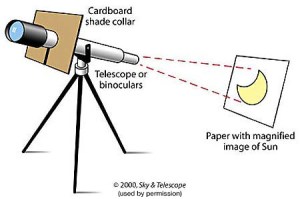
Projecting the image of a eclipse using a telescope. Credit: Sky & Telescope NEVER look directly at the Sun with the naked eye OR when wearing sunglasses. The latter will not provide the levels of protection required, and looking at the Sun in either of these ways can result in serious eye damage.
- If you plan to use solar eclipse glasses, make sure they are certified to ISO 12312-2. Also, if they are the kind with cardboard frames be sure to HOLD them in place; lightweight solar glasses can easily be dislodged by a breeze or by being bumped, potentially resulting in eye damage.
- NEVER, EVER look at the Sun via a telescope or with binoculars without using a fully certified Sun filter system designed specifically for your equipment. If you do not have either, then use projection – position the telescope / binoculars so that the image of the Sun is being cast on a suitable flat surface (such a smooth pavement or piece of cardboard – be careful over over-heating the latter!) and observing the eclipse by watching the image, not by looking through the lens – see the image to the right as a guide.

Given European weather can be a pain at times (let’s face it, we may be in a heatwave, but that doesn’t stop Mother Nature from being awkward on the day and cluttering the sky with clouds!), and given the limited opportunities for really good viewing, the best way to witness the eclipse could be on-line. NASA live, for example will be showing the entire eclipse. and in mentioning NASA I should note that those in Eastern Canada and the United States will also be able to see a partial eclipse, but the coverage of the Sun by the Moon will be much less than will be seen from Europe.
A number of space-related and astronomy sites will also be either livestreaming or blogging the event with photographic updates, so Google is your friend for finding these.

nor is that all; August 12 marks what eclipse hunters are calling a “golden age” of total solar eclipses visible from more accessible locations around the world over the next decade. Some of these will be:
- August 2, 2027: Spain, Gibraltar, Morocco, Algeria, Tunisia, Libya, Egypt, Sudan, Saudi Arabia, Yemen, Somalia, British Indian Ocean Territory.
- June 22, 2028: Christmas Island, Cocos Islands, Australia, New Zealand.
- November 25, 2030: Namibia, Botswana, South Africa, Lesotho and Australia.
- March 20, 2034: Benin, Nigeria, Cameroon, Chad, Sudan, Egypt, Saudi Arabia, Kuwait, Iran, Afghanistan, Pakistan, India and China.
- September 2, 2035: China, North Korea, Japan.
For the poor old British Isles, the next total eclipse to be directly visible across the countries will occur on September 23 – 2090!
Humans to Mars: The Risks of Deadly Dust
At some point in the (hopefully not-too-distant) future, humans will set foot on Mars. However for any nation or group of nations attempting this goal there are a number of challenges to be addressed, particularly in the areas of human psychology and welfare. One of those most frequently mentioned is that of radiation, both solar and galactic; however, whilst a major factor in planning for any human missions to Mars, the focus on radiation does tend to overshadow another equally hazardous issue: Martian dust.
Like the Moon, Mars is an extremely dusty environment. During Apollo, lunar dust caused numerous issues, from spacesuit erosion and compromising suit seals and joints, through getting into electrical and air circulation systems and causing overheating issues to most particularly getting into eyes, sinuses and ears to cause irritation, and into pulmonary systems where it could cause respiratory issues if not treated. Fortunately, the Apollo missions weren’t of a length where the health implications reached a point of any serious debilitation. On Mars, humans will face similar challenges, but to a much greater degree, both because of the nature of the dust and because of the duration of any mission.

While Martian dust – sometimes call “fines” on account of its extremely tiny nature and shape – carries similar and harmful silicates to those contained within lunar dust, it also carries perchlorates and metals like chromium, beryllium, arsenic, and cadmium, all of which are extremely toxic to humans and living cells. Given the duration of a typical humans-to-Mars mission (36-40 months), a crew continuously exposed to dust inhalation without proper precautions being taken, face potentially very serious health risks.
The concern is that future crews will be living and working in a closed habitat, repeatedly going outside, bringing dust back in on suits and equipment, in a low-humidity environment. That’s a condition in which small particles are more prone to becoming airborne and potentially inhaled, with crew members being exposed to fine respirable particles over many days, leading to a real possibility of developing cardiovascular and pulmonary illnesses – even cancers – within the lifespan of a mission.
– Shaunna Morrison, Associate Professor, Earth and Planetary Sciences, Rutgers University
Some of this can potentially countered through technology options such as the use of suitports and the use of high-filtration HVAC systems incorporating advanced and magnetic filters (Mars dust having high concentrations of metals, as noted). However, the Martian Dust Limiting Working Group – a cross-disciplinary group of scientists, doctors and engineers looking at the issue of Martian dust exposure – conclude that a lot of the risk mitigation is going to be via continuous regime of medication from daily intakes of vitamins through to things like iodine doses and supplements, together with the use of cough medicines and bronchodilators to manage inevitable periods of short-term inhalation.
One of the major takeaways from the Mars Dust Working Group is that Martian dust is a real crew-health and engineering issue, but it is also a tractable one if it is treated as a design requirement from the beginning. The best strategy is prevention first. Keep as much dust as possible outside the habitat, remove it quickly when it gets in, monitor airborne particles, and incorporate medical countermeasures into daily routine so crews are not purely relying on them as purely as a possibly limited after-exposure treatment.
– Shaunna Morrison

This, coupled with the need for daily routines of exercise and training – particularly during the transit periods to / from Mars – is why those embarking on the initial missions to Mars and engaged in establishing a possible permanent human presence there will need to be highly trained and highly disciplined. They will be facing a range of potential health hazards and and psychological challenges which make the idea that anyone other than those who have undergone a broad range of physical and mental training and have the capacity to face the ardours of a 36-40 period of continuous living within a deadly environment can participate in such an undertaking a complete fiction.
Updates
Blue Origin Reveal NG-4 Explosion Cause
On May 28, 2026 during a pre-flight engine test while on the launch pad, the New Glenn rocket that was set to undertake the vehicle’s fourth flight exploded, destroying itself and the entire launch pad, and causing significant damage to the supporting infrastructure.

Since that time, Blue Origin has been working to recover and rebuild the New Glenn launch facility at Cape Canaveral Space Force Station (CCSFS), and also carry out an investigation into what caused the explosion, said to have been in the one kiloton TNT range.
with regards to the latter, on Wednesday August 5, 2026, Blue Origin CEO Dave Limp reported via social media that the cause of the explosion has now been identified and is being addressed:
The anomaly originated at the main oxygen valve on one of the BE-4 engines, which was later confirmed by hardware recovery and inspections. Extensive component-level and engine hotfire tests have been conducted to understand the failure mode better and inform mitigations.
– David Limp, Blue Origin CEO

As a result of these tests and the forensic examination of vehicle wreckage, Blue Origin has made a series of modifications to the valve in question which will be incorporated in the production of future BE-4 motors and can be installed into the existing engines awaiting flight / reflight opportunities. This does not mean the FAA Mishap investigation into the explosion has been closed – additional fault tree analysis is continuing to determine if other factors may have been in play. However, Limp indicates that this is most like the key cause of the vehicle loss; as such, it would seem likely that the investigation will be formally closed in the next few months.
In the meantime, work on getting the launch facilities at CCSFS are now well in-hand, and Blue Origin remains of the opinion that the facilities and New Glenn could be ready to resume operations by the end of 2026.
Voyager 2: Instrument Shutdown Reprieve

It’s incredible to think that NASA’s twin Voyager spacecraft will, in a year’s time, mark the 50th anniversary of their respective launches (September and August 1977). The two craft are now so far from Earth (and travelling in interstellar space beyond the boundary of the solar system) it takes over a day for signals sent to or from them to be received.
Sadly, both vehicles are also dying – at least in terms of their available electrical power – as the reserves of plutonium within their radioisotope thermoelectric generators (RTGs) reach a point where the heat created through its nuclear decay becomes increasingly less able to generate the electricity required to power each vehicle’s science and other systems. As a result, NASA has been slowly turning off various instruments on each vehicle in the hopes of eking out power to keep the most useful (in interstellar space terms) functioning. In April 2026, for example, the Low-energy Charged Particles (LECP) experiment on Voyager 1 was shut down, leaving that craft with just 2 of its original 10 science systems functioning.
It had been expected that a similar move would have to be made with Voyager 2 in the second half 2026, to also leave it with only two functioning science instruments. However, in their latest piece of deep space engineering wizardry worthy of Montgomery Scott of the USS Enterprise, NASA engineers have worked out a means to re-route power through some of the spacecraft’s non-science systems at much lower levels than had previously been required, thus allowing power to be maintain to all three of the surviving science instruments.
Referred to by the mission’s engineering team as the “Big Bang” power change because of the risk it could figuratively blow up in their faces, this re-routing means that Voyager 2 now has enough electrical power capacity to run all three of its remaining instruments for up to a year before thought will have to again be given to shutting one down.
Voyager 2 is now being monitored to ensure there are no unwanted side-effects resulting from the change. Providing none are found, it is likely a similar operation will be performed across the 25.5 billion kilometres separating Earth from Voyager 1 so that it might continue to have sufficient electrical power to run its two surviving instruments for longer than had been anticipated.


