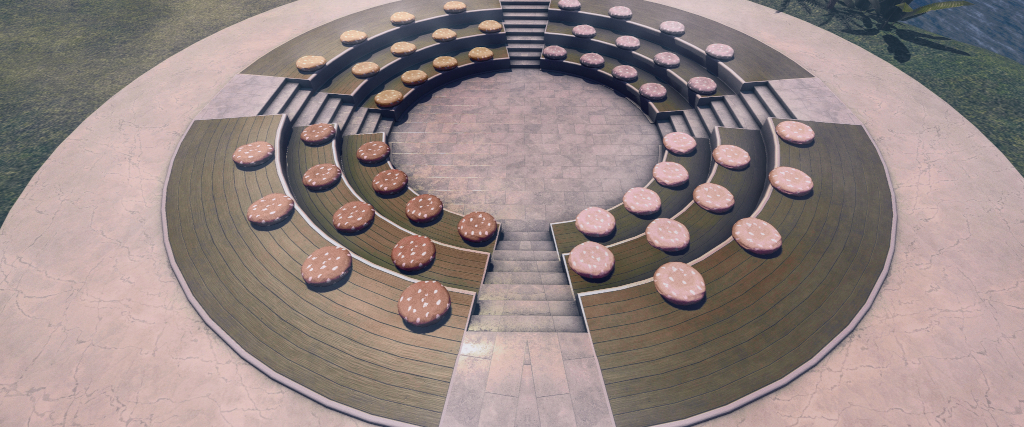
The Simulator User Group meeting place at Longfellow
The following notes were taken from the Tuesday, September 23, 2026 Simulator User Group (SUG) meeting. These notes form a summary of the items discussed, and are not intended to be a full transcript. A video of the meeting by Pantera is embedded at the end of this summary – my thanks to her for providing it, and to Erik Mondrian for the chat transcript after my ISP suffered issues and disconnected me from the world.
Meeting Overview
The Simulator User Group (also referred to by its older name of Server User Group) exists to provide an opportunity for discussion about simulator technology, bugs, and feature ideas is held every other Tuesday at 12:00 noon, SLT (holidays, etc., allowing), per the Second Life Public Calendar.
The “Leviathan Office Hour” meetings are held on the Tuesdays which do not have a formal SUG meeting, and are chaired by Leviathan Linden. They are more brainstorming / general discussion sessions.
Meetings are held in text in-world, at this location.
Simulator Deployments
The Nectarine update was deployed to the BlueSteel RC in week #38. However:
It has a bug that causes it to leave a bad zero-coded block on some ObjectUpdate messages. This shows up in the viewer logs and effectively is a form of packet-loss if the viewer tosses the data, or ignores the final block of data there.
Leviathan has been working on a fix for the issue, and if it passes QA, it will deployed to BlueSteel as an Nectarine update, with the updated code also being deployed to the remain RC channels.
This bug can occasionally impact the 26.4 viewer (currently available as a Release Candidate viewer), he expects this to be included in the in-development 26.5 viewer – and a Pull Request (PR) will be made available for TPVs wishing to pull the fix into their code.
Game Control
Game_control has been re-based on the in-development 26.5 viewer code base. a new pre-release viewer version, but further work on the viewer code is required.
This means game_control could be included in the 26.5 viewer when it services – however, the code has not yet been merged into the development branch of 26.5.
Leviathan is looking for feedback on the current pre-release builds of game_control, particularly:
Whether the default mappings of actions to buttons correct; are there any actions that should be made mappable that are not yet available; and what features are missing that MUST be in the initial release.
However, time is limited for getting suggestions in.
There is still work to be carried out to ensure that game_control doesn’t impact the current SpaceNavigator 3D mouse support.
A discussion on keyboard mapping to game_control (currently, it is not possible to map keyboard keys to arbitrary gamepad buttons).
General Discussion
When it surfaces, 26.5 will likely be the last major viewer release for 2026; Olive (which will follow Nectarine) will likely be the last simulator update for the year.
Region crossings:
Pepper Linden’s region crossing updates also introduced a subtle protocol change which had been previously tried – and had to be rolled back.
This does not mean Pepper’s fixes do not work; rather that there isn’t a lot of confidence that they are ready for full deployment. Right now, it isn’t clear whether the existing system can be fixed or if LL need to move to a new QueueEventGet protocol.
More internal discussions are required on this, but Pepper’s work has renewed a desire to get more region crossing fixes into the works.
This sparked conversation on region crossings and vehicle use.
The latter half of the meeting was devoted to region / simulator capabilities – number of avatars support, number of objects, resource overheads, region pricing, and – yes – “megaregions” (those larger than the current 256×256 sq m size) + more.
This was a fairly wide-ranging discussion, and so please refer to the video below.
The above was intertwined on some history of SL provided by Leviathan Linden touching on the early attempts at social engineering (e.g. originally limiting the build height to 768 metres and limiting flying height to encourage people to remain near the ground and socialise more).
Approaching The Two Loons, Calas Galadhon, September 2026
This is going to be a slightly café and coffeehouse piece this time around. For one thing, it is as much about the journey as it is the destinations.
The other is that strictly speaking, one of my selected destinations is neither a café nor a coffeehouse but a wine bar – although a good cup of cappuccino (or whatever might take your fancy, caffeine-wise) appears to be available.
Calas Galadhon, September 2026
This is because I’m talking about The Grumpy Troll and The Two Loons within the Calas Galadhon estate. Now, to be fair, I’ve covered both in the past – in 2019 to be precise. However, I’ve never covered them together as they deserve. Nor have I really covered them in conjunction with the other aspect of this piece: horse riding.
And, to let my ego out of the biscuit tin I generally keep it locked inside (and hidden under the bed): it is also not untrue that I had a role to play in the history of both.
Arriving at The Grumpy Troll, Calas Galadhon, September 2026
Having visited The Grumpy Troll – the waterside café – when it opened in 2019, I noted that a) as it what just off the Coast Trail running around and through the estate for those keen on horse riding, it should have a hitching post and horse rezzer outside; and b) given its name, I was surprised on my first visit to find it was a café rather than an inn in the manner of Tolkien’s Prancing Pony and given Calas’ tied to Tolkien.
As a result of making these observations, Ty Tenk from Calas dropped me a note to say The Grumpy Troll gained a hitching post and rezzer, and a short time after this, the Two Loons opened as a wine bar a little further along the Coast Trail.
The Grumpy Troll, Calas Galadhon, September 2026
Horse riding is a popular past-time in Second Life; so much so that there is a Group / information service dedicated to providing information on riding in SL and helping to organise riding events: Second Life Trailblazers – and I’ll have more on this in a future article.
With its fourteen regions, Calas Galadhon is a haven for horse riding, and Ty, Truck and the Calas Team have sought to make it a pleasurable experience for all by setting up riding trails complete with rezzers feature horses from both Teagle and Waterhorse for those wanting to give it a go (with the Waterhouse horse offering rides for two).
The Grumpy Troll, Calas Galadhon, September 2026As I have both a Teagle horse and a Waterhorse, I opted to use one of my own horses (being wearable, they don’t require rezzing), and arbitrarily picked a horse rezzing location in Glanduin, as one of the more open regions of the estate to start my journey, making first for The Grumpy Troll.
This sits on one of the large models within Dimrill Dale, and coming up from the south-east of the estate, it is perhaps one of the first stops along the coastal part of the Coast Trail. Located just across the water from the whitewashed Little Church of Calas, it looks westwards over the waters and open spaces of the Gulf of Lune, Belagaer and the Grey Havens, forming a perfect point from which to enjoy sunsets.
The Grumpy Troll, Calas Galadhon, September 2026
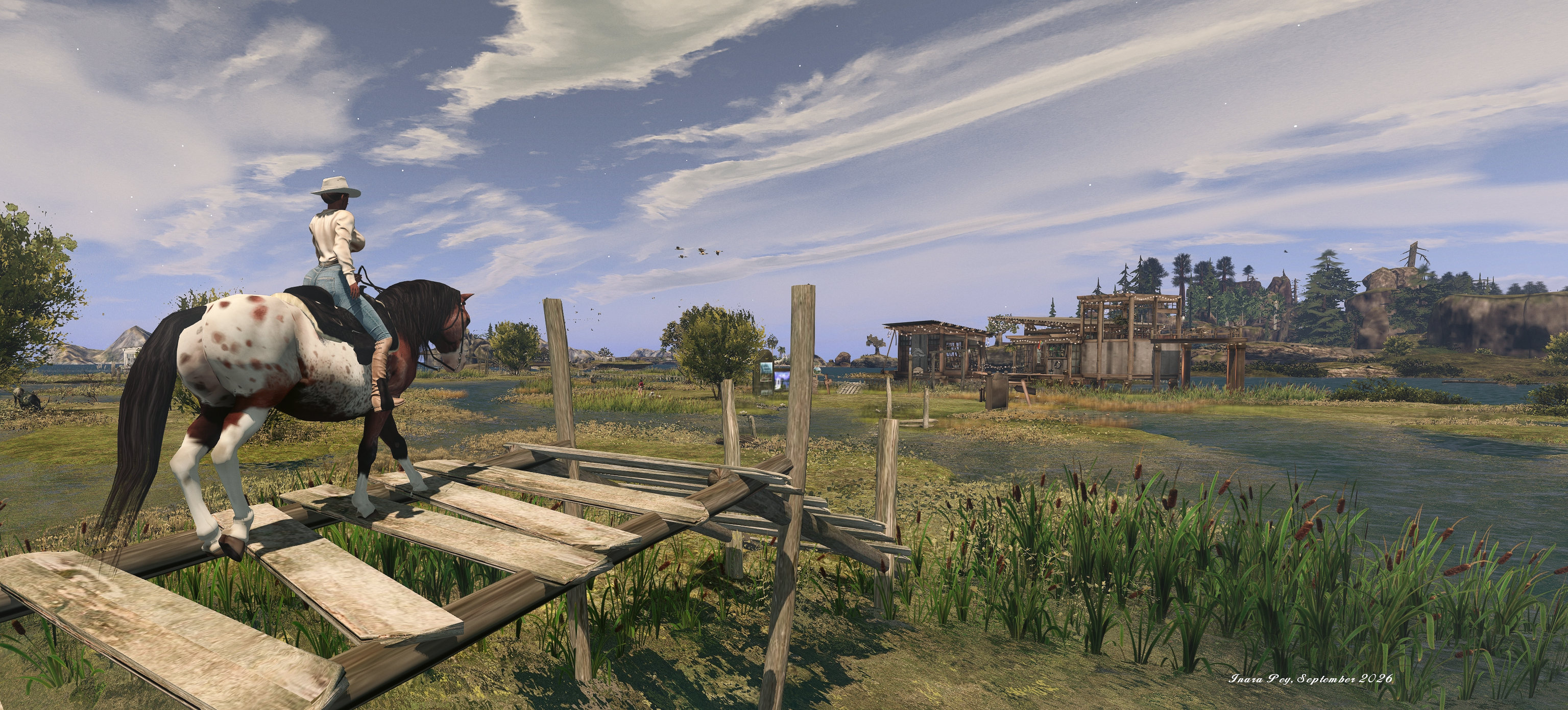
The Two Loons lay further to the west, lying across the intervening wetlands. Navigating your way there on foot (or hoof, in this case) takes a little care and will involve some time passing over stout wooden boardwalks.
This is a somewhat larger establishment than the Troll, comprising two buildings and an upper floor level. It also offers a good westward view together with one to the north, where the causeway points towards the wilds of Armenelos and the opportunity to head west to New Santorini.
Walking the Calas Galadhon wetlands boardwalks with Sisko, heading for The Two Loons, September 2026Separate they may be, but The Grumpy Troll and The Two Loons have much in common beyond both being within Calas Galadhon. Both offer invitations to stay a while, and both offer indoor and outdoor seating (including a hammock in the shade of a tree just to the back of it, in the case of The Grumpy Troll).
Both also make excellent use of building by Cory Edo – in fact The Two Loons makes used of the second half of the tree house used for form the main structure of The Grumpy Troll – kitbashing at its best!
The Two Loons, Calas Galadhon, September 2026
Horse riding in SL can be a lot of fun, particularly if there is somewhere with plenty of space for doing so. Calas Galadhon is one such place, and I also have a piece on following the entire Coast Trail, written back in 2017, not long after it had opened, and Bento was very much the in thing for SL.
As I’ve noted above, however, Calas isn’t alone in this regard, and I’ll be offering more on horse riding courtesy of SL Trailblazers in the near future.
A glass of wine at The Two Loons before continuing my ride, September 2026
But even if you don’t have a horse of your own and, many places – like Calas – offer rezzers for visitors, so you can always get started that way. And when it comes to Calas Galadhon in particular, with places like The Grumpy Troll and The Two Loons available to visit, as well as places like: Villa Eirini,then there is even more reason to mount up and head on out along the trails!
Logos representative only and should not be seen as an endorsement / preference / recommendation
Updates from the week through to Sunday, September 20, 2026
This summary is generally published every Monday, and is a list of SL viewer / client releases (official and TPV) made during the previous week. When reading it, please note:
It is based on my Current Viewer Releases Page, a list of all Second Life viewers and clients that are in popular use (and of which I am aware), and which are recognised as adhering to the TPV Policy.
This page includes comprehensive links to download pages, blog notes, release notes, etc., as well as links to any / all reviews of specific viewers / clients made within this blog.
By its nature, this summary presented here will always be in arrears, please refer to the Current Viewer Release Page for more up-to-date information.
Outside of the Official viewer, and as a rule, alpha / beta / nightly or release candidate viewer builds are not included; although on occasions, exceptions might be made.
Official LL Viewers
Default viewer 26.3 – 26.3.0.31203661088, August 10, promoted August 17 – quality of life improvements; performance improvements; bug fixes – No Change.
Default viewer 26.3 – 26.3.0.31203661088, August 10, promoted August 17 – quality of life improvements; performance improvements; bug fixes – No Change.
Second Life Lua Editor RC / Beta viewer with Linux support 26.4.0.34502396632, September 11 – No Change.
Lua scripting support (on regions with Lua scripting enabled).
Improved communication between the Viewer and the newly published Second Life VS Code extension.
Offers an experimental Linux viewer build.
Includes the latest WebRTC Voice and viewer-maintenance updates.
Second Life Chat Modernization viewer 26.3.0.33643480083, September 4 – No Change.
Recent conversations follow you seamlessly: a direct message you receive on SL Mobile can also be available when you return to desktop, and vice versa; Recent direct message history will be available on logging-in; existing desktop chat logs are preserved – previously saved local history isn’t being replaced or removed; conversation history feels continuous: on desktop, your existing local history and newer message history are brought together into a single conversation.
Alpha Auer: October, September 2026 – click any image for full size
It’s been a while since I last visited Alpha Auer’s Alphatribe Island (more fool me), but after seeing the Destination Guide recently and seeing the island’s latest entry, there was no way I was going to miss it!
As can be seen from the title and header image to this piece, the autumn iteration of Alphatribe is called October, and it is something quite marvellous in its touches and humour – even for a region that is always filled with much to delight.
Alpha Auer: October, September 2026
As the name suggests, this is a setting not only celebrating autumn, but also all that October brings with it by way of oddness, although here the touches are very subtle.
For example, there are no hordes of pumpkins everywhere (they are present, but keep themselves well under control!), nor eerie lanterns or suchlike; just little touches offering a nod towards the end of the month: the odd pointed hat perched upon a head; a purple Minion-like character among those greeting new arrivals, the young beau chaperoning his belle, his arms both on the same side…
Alpha Auer: October, September 2026
The village itself is a marvel in keeping with the season. The colours are all muted and caught under an autumnal sky of soft bronze (do use the Shared Environment setting when visiting!).
The houses in particular offer another little October twist: they are both inhabited and inhabitants, many of them sharing a certain resemblance with their occupants, others with entirely unique features. And talking of features, there is something charmingly Tim Burton-ish in some of the locals’ expressions.
Alpha Auer: October, September 2026
Between the human locals and the houses there is also a touch of Steampunk to be found here and there, particularly when it comes to some of the headgear being worn (and the rooftops of some houses!). Elsewhere, meanwhile, hats and clothing perhaps lean more to celebrating the season.
All of which is to say this is a fascinating and quirky little place. One which, whilst touched by October’s lean towards Halloween, is by no means dark or spooky but rather openly fun and bright; even the scarecrows are perhaps more crow than scare!
Alpha Auer: October, September 2026
Thus, October is a place to be wandered through slowly; Alpha always packs her settings with details large and small, but October has so much that some of it might easily be missed (who lives in one of the local wells? Did they divert the water so it runs down from the top of the well in an attempt to keep their home moderately dry?).
One also cannot help but wonder if the two chaps apparently in deep, earnest conversation are aware that their heads have taken the second line of Scott McKenzie’s If you’re Going to San Francisco quite literally!
Alpha Auer: October, September 2026Do be sure to take a stroll along the line of trees to the south west. Not only will you come across a couple (grandma and granddaughter?) pausing in sweeping leaves (assuming their pointy headgear and brooms aren’t indicative of their occupation – Granma in particularly appears to be trying particularly hard to look innocent!), you’ll see a little flotilla of boats parading through the bay, each one a marvellous little vessel with plenty of quirky details.
Wander far enough and you’ll come to Alpha’s store and the chance to purchase some of the characters found within the village or, if you prefer, obtain some headgear in keeping with some of their hats (also to be found on Alpha’s Marketplace Store along with the boats and miniatures of the houses).
Alpha Auer: October, September 2026
I always enjoy visiting Alphatribe island; Alpha’s creativity is joyous and at times mischievous. October demonstrates this is spades throughout, with everything wonderfully balanced from the environment settings through the terrain and to the characters – people, creatures, houses and vehicles.
In this regard, as well as using the Shared Environment when visiting do also make sure you have local sounds on, and to see the village as fully as possible as you wander, draw distance as high as your system can manage – or at least around 100-128 metres.
Alpha Auer: October, September 2026
A genuinely charming setting, highly photogenic and well worth visiting to take a wander through.
Oh, and don’t forget to pick up your gifts at the landing point, together with a notecard from alpha that is well worth the read for the village’s back-story.
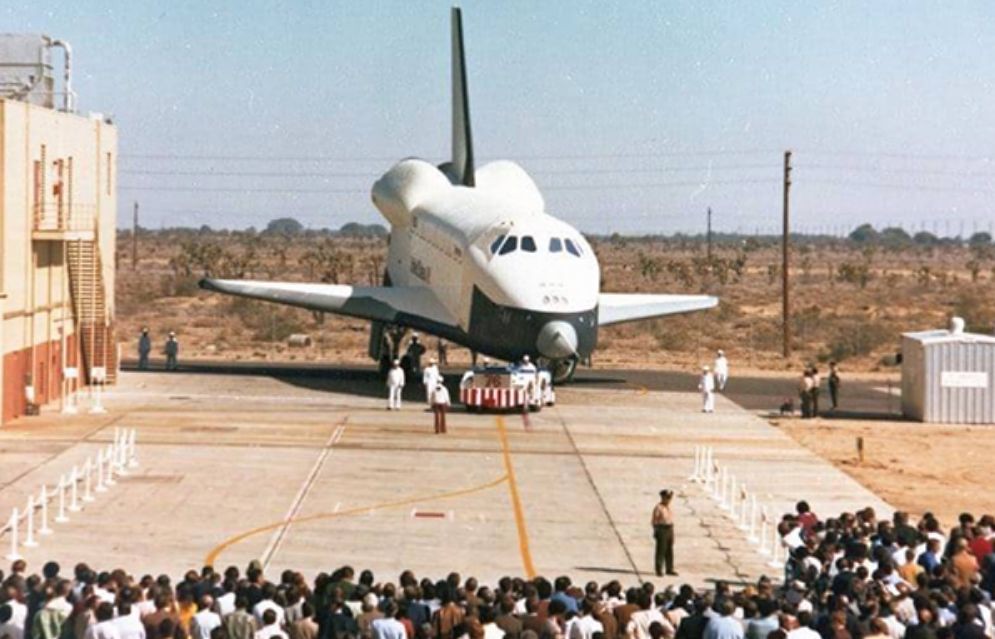
September 17, 1976: the shuttle test vehicle OV-101, christened Enterprise in honour of the original Star Trek TV series, roll out of the Rockwell manufacturing facility, Palmdale, California. Credit: NASA
September 2026 marks two anniversaries, uniquely – if unusually – linked in the manner in which they both sought to “explore” space and went on to influence at least a generation.
On September 8, 1966, the television series Star Trek first aired. At the time, no-one knew what a phenomena it would become after an admittedly less-than-auspicious start (cancelled after just 3 seasons, only to be reborn on the big screen and then spawn multiple series which kept it on air almost continuously with new seasons and syndicated re-runs until streaming came along to ensure its could be seen anywhere, any time), thus allowing it to celebrate its 60th anniversary in 2026.
Whilst entirely fictional – and at times not particularly good science fiction (Spock’s Brain, anyone? Turnabout Intruder?) – Star Trek was a trailblazer because when it is was good, it was very good: frequently wrapping allegory and social commentary within the medium of action-adventure science fiction. And while people can (and do) debate / argue about the relevance and canon-keeping of the more recent iterations of the franchise, the fact remains the original series did much to promote the idea of space travel at the time Apollo was coming into its own, and many were seriously considering careers in science and technology as a result of seeing the show.
In fact, such was the influence of Star Trek that, ten years after the show had been cancelled and at a time when Star Trek (Phase) II still a twinkle in Paramount’s eye, it was present at a very real milestone in US spaceflight history: the roll-out of the first ever space shuttle vehicle to be seen in public: OV-101 (OV standing for Orbiter Vehicle), 50 years ago on September 17, 1976.
That vehicle had originally been due to be called Constitution, but a fierce letter-writing campaign by Trek fans had resulted in NASA agreeing to call it Enterprise after the fictional starship from the series. The roll-out took place at the Rockwell – being the primary contractor for the orbiter vehicles – manufacturing facility in Palmdale, California. As it did so, the US Air Force band struck up the Star Trek theme by Alexander Courage, cementing the vehicle’s link to the series.
Deforest Kelley (Dr. McCoy) in conversation with the then NASA Administrator James Fletcher, with George Takei (Hikaru Sulu), James Doohan (Montgomery Scott), Nichelle Nichol (Nyota Uhura), Leonard Nimoy (Spock), Gene Roddenberry (series creator), Congressman Don Fuqua and, in black, Walter Koenig (Pavel Chekov) stand before OV-101 Enterprise, September 17, 1976
On-hand for the roll-out was the majority of the series’ regulars – only William Shatner was absent – together with Trek’s creator, Gene Roddenberry. It was a further demonstration of the close ties between fictional space exploration in the form of Trek, and NASA’s human and robotic explorations of space; something that would continue as the Star Trek franchise evolved in the coming decades.
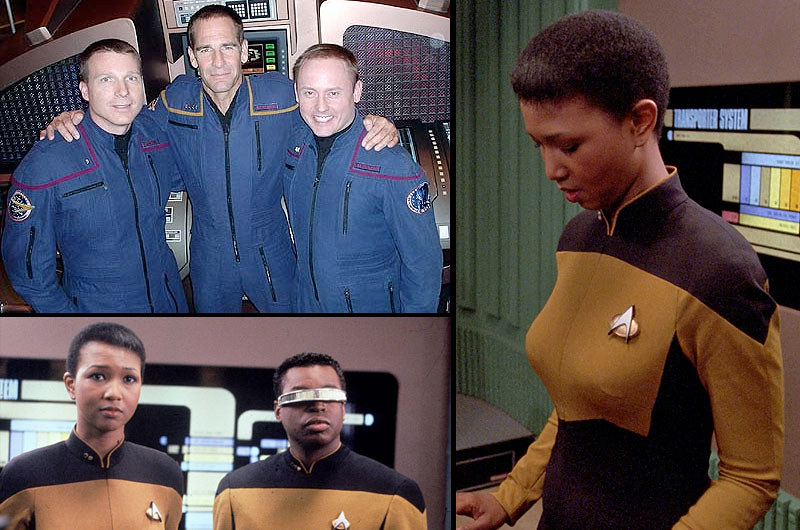
For example, astronaut Mae Jemison attributes her determination to fly in space to watching Nichelle Nichols portray Lt. Uhura. Jemison went on to guest-star as Lt. JG Palmer in Second Chances, an episode of Star Trek: The Next Generation, whilst astronauts Mike Fincke and Terry Virts (both fans of Star Trek) appeared in minor roles in the underrated Star Trek: Enterprise. And, of course, V’ger, the machine entity encountered in Star Trek: The Motion Picture was drawn directly from the Voyager missions (even if there was no such spacecraft as Voyager 6).
Top left: former NASA astronauts Terry Virts (l) and Mike Fincke (r) pose with series lead Scott Bakula during their joint appearance on Star Trek: Enterprise. Bottom Left: former astronaut Mae Jemison with LeVar Burton as Lt. JG Palmer and Lt. Commander Geordi LaForge in Star Trek: The Next Generation. Right: Lt. JG Palmer at the transporter controls aboard the USS Enterprise NCC-1701-D. Credits: Paramount/CBS
Like Trek, the shuttle had its own impact on the generations familiar with it. Take Jack Hathaway, for example. Born the year after the first shuttle reach orbit in 1981, he directly cites shuttle flights as the reason he decided on a career in the US Navy as an aviator and seeking to qualify as a test pilot prior to applying to NASA. He participated in some low-key celebrations to mark the 50th anniversary of Enterprise’s roll-out whilst currently aboard the International Space Station (ISS).
It might be argued that the renaming of Constitution to Enterprise was a pyrrhic victory: OV-101 was a test vehicle, never intended for spaceflight. Had the name been applied to the second vehicle in the fleet – OV-102, which was intended for spaceflight, then reality would have mirrored fiction even more closely: the United Star (or Space) Ship Enterprise NCC-1701 was the second ship in her class, the first being the USS Constitution – just like the first shuttle was originally to have been called. Ultimately, OV-102 was christened Columbia and as we all know, she was tragically lost with her crew on February 1, 2003, an event which started the process of bringing the shuttle programme to an end.
Tragedy aside, it is still quite amazing to think about just how ingrained Star Trek became ingrained in US – and global – culture. It is even more stunning to consider that, in practical terms, the shuttle era started with the first roll-out a half-century ago, and that the first orbital flight took place 45 years ago, just 20 years after Yuri Gagarin became the first man to orbit the Earth – and he did so just three and a half years after the first artificial satellite.
As such, in terms of spaceflight, we’ve come a long way in a relatively short period of time – but as Star Trek also reminds us (and assuming we don’t do something incredibly stupid in the short term): the human adventure is just beginning.
Our Sun: Planet Killer?
Scientists have been observing the Sun for decades, slowly decoding how it works, how it interacts with space, how it generates “space weather”, what its likely lifespan will be, and so on. These studies have resulted in both an increased understanding of our Sun and also raised some intriguing questions.
In terms of the latter, a major puzzle has been that the Sun is, compared to its likely siblings at the time of its birth out of the proto-nebula which formed them, excessively poor in lithium; two orders of magnitude less, in fact.
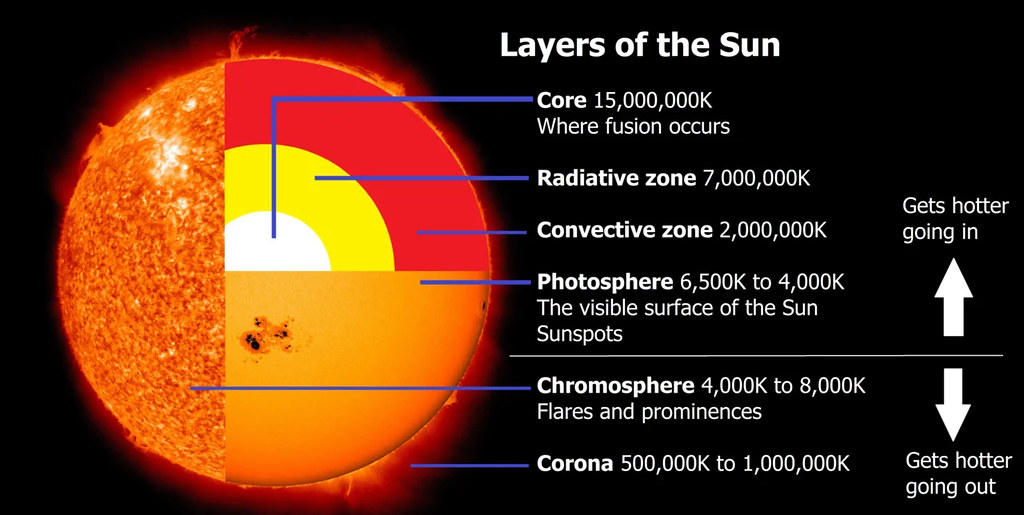
Then there is the fact that the speed of sound within the deeper parts of the Sun’s convective zone (where heat switches from being transmitted up from the Sun’s core purely by radiative means to being transferred primarily by violent currents of plasma rolling around its core) doesn’t match computer modelling based on measurements of the Sun’s near-surface activity and how super-heated plasma convection within it should be working.
The structure of the Sun as we understand it, from core to the two layers of the atmosphere. Credit: NASA
Both of these oddities caught the attention of Mutlu Yildiz, a professor leading the Department of Astronomy and Space Sciences at Ege University, Türkiye, who wondered if they might be linked, and if so, how. His findings point towards the potential that, early in the history of the solar system the Sun “ate” a planet – and it may still be “digesting” it.
Yildiz came to this conclusion after considering a number of potential scenario – including the idea of a planet being swallowed by the Sun. From there, he started work on a series of computer models using a wide range of plants varying in composition, size and density, but all of which might have theoretically started to form in the early solar system and adhere to many of the broad parameters seen with exoplanets orbiting close to their parent stars.
One of these models – featuring a solid, rocky world around 5.6 times bigger than Earth – or slightly largely than Neptune – forming both relatively close to the Sun (roughly equivalent to the orbit of Mercury) would likely be lithium-poor and particularly prone to being drawn into the Sun relatively quickly.
In particular, repeated modelling indicated that whilst the planet would be torn apart prior to the Sun swallowing it, it would likely do so so close to the star, the majority of it would fall into the Sun long before it could dissipate so it’s mass would have an effect on the Sun’s internal mechanisms, particularly the density within various layers of the Sun’s convective zone, impacting things like the speed of sound within them.
Yildiz is the first to acknowledge that whilst his work points to the Sun having once killed a planet doesn’t mean this is the case – but the results do seem to fit a set of observable facts. As such, he’s also suggested possible observations that could be carried out which might further prove (or dismantle) his theory.
Roman Grace Telescope Update
As the Nancy Grace Roman Space Telescope (or more simply, the Roman Space Telescope or RST) continues towards its rendezvous with a halo orbit around the Sun-Earth L2 position, the news concerning it keeps getting better and better.
In my previous update, I noted that the observatory has started powering-up its instruments in readiness for its deep space mission, notably the first of its two science instruments, the Coronagraph Instrument (CGI), and that the Wide Field Instrument (WFI) would be following. Well, I got my timeline a bit muddled, as the WFI had started coming on-line as that piece was being written, with a test image being returned as part of that process.
It’s not an impressive image to be sure: 18 individual images (from the 18 4K imagers) showing a sea of out-of-focus stars – but it is an important start. It shows that the instrument has powered-up correctly. The initial tests also confirmed that the filter mechanism which allows specialist filters to be placed over the imagers to reveal different wavelengths of light is also correctly functioning.
Whilst it may not look much, this is the first image captured by the WFI aboard the Nancy Grace Roman Space Telescope. Captured shortly after the instrument was powered up, it shows the full field of view across all 18 of the 4K imaging devices. However, as a test image, it does not show the full depth of view, nor is it focused at operational levels: the instrument needs to fully cool to its -183ºC operational temperature and go through focusing and alignment before it is ready to produce truly spectacular images. Even so, this image is an important first step. Credit: NASA
Since then, the work has moved on to the next steps: monitoring the cooling of the imagers down to their -183ºC operating temperature and refining the focusing of the optical elements in the telescope in order to generate pristine, 300 gigapixel images. This work will continue as a part of the overall pre-commissioning of the payload, prior to the formal instrument commissioning period commencing.
Nor does the good news end there. Because of the 1.5 million km transit from Earth to the Sun-Earth L2 position, the potential for errors in launch, initial orbital placement, the potential of additional course correction thrusters burns whilst en route, when it was launched, and so on, RST actually departed Earth with just under 1.8 tonnes additional propellants “just in case”.
However, such was the accuracy of the Falcon Heavy in delivering it to its initial orbit, coupled with the accuracy of RST’s first course correct thruster burn, means the observatory is not only precisely on course for its intended orbit, it has actually used less than 10% of its planned propellant reserves, even without the extra load-out.
The time line of operations as RST travels to the Sun-Earth L2 position, which it will orbit. Overall transit time is around 100 days. Day 20 was September 19, 2026. Credit: NASA
This already means that with both the additional propellent load of 1.8 tonnes, RST now has sufficient stocks for and additional 8 years of science once in its operational orbit, giving it 18 years of operations over overall. However, the overall accuracy of its trajectory thus far achieved means that the second planned mid-course correction burn can be carried out when the observatory is much closer to the Sun-Earth L2 position and at a lower propellant consumption, which will in turn reduce the amount of propellants required for the final braking manoeuvre required to place RST in its initial halo orbit.
Both of these latter points meant that, potentially and subject to funding, RST could arrive in orbit around the Sun-Earth L2 position with sufficient cold gas propellants for 22 years of science operations – 12 more than originally planned!
IMAGOLand & Galleries, September 2026: Mareea Farrasco: Nature and Culture
Currently open at IMAGOLand & Galleries is an interesting exhibition by the gallery’s owner, Mareea Farrasco. Entitled Nature and Culture, it sits as an examination of the intersection of nature and culture expression, as seen through the creative lens of Second Life.
In the physical world, what we today view as culture – which here might be defined more as lifestyle and couture – largely stands very apart from the natural world. Where once culture – culinary preferences, mode of dress, belief systems, etc. -, were very much rooted within the environments in which they flourished, they now easily exist divorced from their natural origins, allowing them to be found and experienced the world over.
IMAGOLand & Galleries, September 2026: Mareea Farrasco: Nature and Culture
However, in Second Life, there is no such separation – indeed no such evolution from nature to culture / couture. As Mareea notes, everything is effectively manufactured, born out of deliberate design and the manifestation of light photons through the electronic medium of graphics chips and processing.
The result is a world in which “nature” and “culture” are – from a creative standpoint – one in the same. There is no separation of one from the other, just as there is no natural progression from one to another. They both simply exist.
IMAGOLand & Galleries, September 2026: Mareea Farrasco: Nature and Culture
This is reflected within Nature and Culture through both juxtaposition and combination through its mix of avatar-centric “fashion” pictures and images of an avatar exploring in-world locations. The juxtaposition is just that: the placing of the “fashion” images alongside of – but somewhat distinct from in terms of style (such as the triptych) and content, the “landscape” images. It’s a presentation that leaves the two as feeling separate and distinct. Until, at least, one considers the avatar herself. She brings them together, and she does so not merely because of the outfit she wears
She does so because her presence throughout all of the images reminds us of the fact that everything in SL is conjoined through the aforementioned act of intentional creation. She, the clothes she wears, the settings she is “exploring” – all underscore the fact that neither nature nor culture exist within Second Life in the manner in which they have grown together and undergone separation within the physical world.
IMAGOLand & Galleries, September 2026: Mareea Farrasco: Nature and Culture
Thus we’re presented with a series of images prompting us to consider both the nature of Second Life as an environment of consciously-created landscapes, characters and couture and – perhaps, in going beyond the exhibition itself – on the manner in which we have managed to take culture from its natural origins and environments and reduce it to a statement devoid of natural heritage and open to appropriation.