
China is about to launch its most ambitious lunar mission to date in the form of Chang’e 7, which will be heading for the edge of Shackleton Crater in the Lunar South Polar Region – the part of the Moon both the US and China have identified as the target for their upcoming crewed lunar missions.
Over the past two decades, the Chang’e missions – named for the moon goddess of Chinese mythology – have been a mainstay of China’s space ambitions and marked the nation’s growing space capabilities. The previous mission, Chang’e 6, saw a lander touchdown on the lunar farside – the first mission ever to do so –, deploy a rover and return surface samples to Earth for international analysis.
The 8-tonne Chang’e 7 mission is somewhat similar to Chang’e 6 in that it comprises an orbiter, a lander and a rover vehicle; however, it will not be returning samples to Earth for analysis. Instead, its primary role is to look for evidence of accessible water ice around the crater and carry out initial prospecting for a location where China might start landing materiel and crew to establish a lunar base.
As such, it marks the start of China’s fourth phase of lunar missions, the others being orbital observation (Chang’e 1 and 2), the second landing and rover deployments (Chang’e 3 and 4), the third nearside and farside sample return missions (Chang’e 5 and Chang’e 6 respectively).

If all goes according to plan, Chang’e 7 will launch atop a Long March 5 (CZ-5) booster from the Wenchang launch centre and will coast out to the Moon over a period of 6 days on a minimal propellant flight. This will see it essentially spiral away from Earth until the Moon’s gravitational influence becomes dominant and the spacecraft will then transfer to spiralling in towards lunar orbit.
Once at the Moon, Chang’e 7 will become the most ambitious robotic lunar mission ever undertaken, with the lander aiming to make a precise landing high on the rim of Shackleton Crater where it can receive the most sunlight. Providing it does so successfully, it will deploy the rover vehicle – a more advanced unit than previously flown – together with a unique surface “hopper”.

A total of 21 science experiments – including instruments from the USA, Russia, Egypt and Bahrain, and Italy – are being carried across the four vehicles. The orbiter will carry out stereo mapping and radar mapping of the lunar surface in extremely high resolution, together with hyperspectral and spectral analysis of surface material from orbit, magnetic field analysis, surface radiation analysis, and solar radiation / space weather monitoring.
The lander will analyse lunar dust and the local electrical field, listen for moonquakes, evaluate the surface environment – radiation, dust ionisation – and carry out astronomical observations from the Moon’s surface, as well as imaging the local topography. The rover will carry out wider-ranging field studies, analysing the lunar surface for volatile and isotope concentrations, monitoring the local magnetic field, examining the subsurface composition via ground penetrating radar and imaging its surroundings as part of the survey to identify possible landing zone for future missions.
The hopper is a new type of vehicle. Relatively small it is designed to explore the more shadowed regions of smaller craters, etc., by literally hopping around on a set of legs. It is design to hop into an area of shadow and expose surface material under the lunar dust via the impact of its landing legs, then make a small jump to one side so it can use a combination drill / water analyser to gather samples of the material exposed by the initial landing, in order to analyse it for evidence of water ice.

All of the data gathered – including gaining a more complete understanding of overall surface lighting and areas of near-constant illumination around Shackleton – will be carried forward into planning for China’s human missions to the Moon, which are due to commence in 2030.
New Study Updates Kessler Syndrome Risk
I’ve written on numerous occasions about the increasing risk of a Kessler syndrome cascade: a single collision in the increasingly crowded domain of near-Earth space resulting in the low-to-medium regime of orbits around our planet becoming unusable in part or in full as the debris from the first collision destroys other satellites in a spreading sphere of destruction.

However, trying to calculate the actual risk of such an event occurring has been difficult because the Kessler syndrome model was based on high altitude, relatively passive satellites – that is, units which do not have to “fly in formation” relative to one another at much lower, more crowded obits where they have to dodge potential risks posed by other orbital bodies – other active satellites, rocket debris, defunct satellites awaiting re-entry and burn-up, space stations, and so on – which is precisely what modern constellations launched over the last 5-8 years have to do. Take Starlink, for example: it currently has some 10,900-11,000 active satellites in orbit – and all of them have to perform at least one avoidance manoeuvre every week. And SpaceX plans to expand that constellation to 42,000 active units.
To try to better understand the real risk of collision, Professor Hugh Lewis of the University of University, UK, has been updating the Kessler models to reflect how modern day satellite constellations actually behave, taking into consideration things like active collision avoidance, the risk of thruster failures resulting in loss of control, relative proximity of satellites in a constellation “layer” (i.e. operating at the same altitude and close enough to one another for low-latency communications relay), continuous replenishment rates (i.e. defunct satellites get replaced in the constellation), and de-orbital drag profiles based on the geometry of the satellites themselves.
Using this updated framework, Lewis analysed 14 planned or partially operational satellite constellations (e.g. Starlink at its current 11,000 active units and planned 42,000) to place them in one of three categories:
- Below Thresholds: a single collision is unlikely to cause a significant issue, and Earth orbital space remains a sustainable operational environment.
- Exceed Unstable threshold: a single collision will cause a Kessler cascade which will initially increase prior to stabilising, resulting a balance between those orbital regimes which remain usable and those that are rendered unusable due to the volume of debris remaining in orbit at their altitudes.
- Exceed Runaway threshold: a single collision resulting in infinite fragment growth and a guaranteed loss of all of the satellites within the constellation – and a possible complete Kessler syndrome cascade.
Of the 14 constellations analysed, over half already sit within the Exceed categories (both unstable and runaway). Leaving aside those which have yet to be launched (if they ever are) such as the deeply flawed “AI data centre” constellations, this is worrying on two counts.
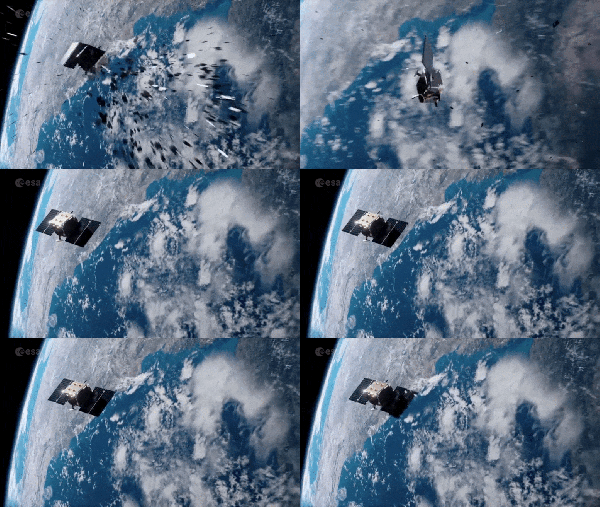
The first is that the study shows that even a modest constellation can have a significant effect if it is subject to a collision. Consider Eutelsat’s Next constellation, for example. This will comprise just 528 units, but it sits within the Exceed Unstable threshold: a single collision between two of the satellites in the network will result in a large portion of the bandwidth of the low Earth orbit regime (up to 2,000 km above Earth) becoming unusable for other satellites, because Next will orbit sufficiently high enough for the resulting debris cloud to take years to fully disperse and re-enter the atmosphere to burn-up.
The second – more worrying – factor is that the analysis only considers the effect of two satellites within a constellation colliding with one another, and the impact this has on the remaining satellites in the constellation.
So, for example, the analysis only considers how the debris from a collision involving two Starlink satellites will affect other Starlink satellites; it doesn’t consider how the debris could affect satellites from, say, China’s GuoWang (15,000 planned) and Qianfan (13,000 planned) operating in pretty much the same orbital plane and altitude, or how that debris might then cause a further cascade of destruction. Nor does the analysis consider the potential for a sufficiently large, stray piece of debris already in orbit to destroy a satellite and so set off a chain of destruction.
Currently available on arXiv whilst awaiting formal peer review, the Lewis paper – Critical Sizes of Satellite Constellations – offers no solutions for the growing risk, but does suggest regulators need to enforce a more rigorous approach to the potential for a full or partial Kessler syndrome event than current methods of debris analysis allow. These consider only how an individual satellite will fragment should it experience an impact sufficient enough to cause it to break-up not the additional effect the break-up would have given the satellite’s orbit and operating proximity to other satellites.
NASA Ends Swift Observatory Rescue but Maintains Mission
In June I covered the daring attempt to rescue a NASA satellite – the Neil Gehrels Swift Observatory – from re-entering Earth’s atmosphere in October 2026 and burning up, by using another spacecraft to link up with it and gently push it up to a higher orbital altitude (see: Space Sunday: NASA – a rescue attempt, costs & infrastructure).
Whilst the mission started off well, by the start of August 2026, things had gone sideways, as I noted at the time, with the rescue vehicle – called LINK, and built by Arizona-based Katalyst Space Technologies – itself in trouble after two of its three reaction wheels (used to maintain precise vehicle orientation) had ceased functioning, whilst its cold gas thrusters were also experiencing issues.

On August 19, 2026 NASA called off the rescue attempt – but not the mission as a whole. Essentially, the loss of precise attitude control means that LINK cannot safely connect to the Swift observatory without the risk of a full-on collision. Instead, the spacecraft will now rendezvous with the observatory and carry out approach and operations intended to allow Katalyst to gain data and experience in such manoeuvres as they prepare to start operating a larger recovery craft in future missions.
At a cost of just US $230 million, Swift has been an invaluable science platform and its loss will be felt. The rescue attempt – at just US $30 million has not been a major expenditure, but it was something of a rushed job; despite being aware that Swift would re-enter the atmosphere in 2026, NASA didn’t opt to go ahead with trying to save Swift until late 2025, giving Katalyst just nine months to develop and fly the LINK craft- which is a remarkable feat, even if the outcome isn’t as hoped.
Another Partial Eclipse – Seen from another World
August 12, 2026, as I’ve previously covered (here and here) allowed part of the northern hemisphere – Greenland, Iceland, Spain, in particular – to witness a total solar eclipse, with a partial eclipse being also visible from many areas on both sides of the Atlantic. It was a widely reported event, and the start of a new decade of eclipse watching.
What was less well reported was that just a day later, there was another partial eclipse of the Sun – but this didn’t involve our own Moon and was only seen by one observer: NASA’s Mars 2020 rover, Perseverance.

On August 13, 2026, the rover took time out from exploring the region around Jezero Crater, where it landed in 2021, to look up at the sky with its Mastcam imager to capture Mars’ near most moon, Phobos, transiting the disk of the Sun.
Of course, given Phobos is relatively tiny – less that 26 km across its largest side – means it didn’t come anywhere close to offering so spectacular event as we can witness when our own Moon comes between us and the Sun, but the event was still notable – if not for science, then at least for the impact of being able to see such events from other worlds.


