
The subject of Jupiter’s moon Europa is rather hot at the moment. With two major missions currently en-route to Jupiter to study this icy world – NASA’s Europa Clipper mission, which will focus entirely on Europa, and the European Space Agency’s Jupiter Icy Moons Explorer (Juice) mission, there have been various science papers of late on the subject of liquid water on Europa – two of which I covered most recently at the start of the year.
Those two studies directly speculated on the opportunities for Europa – assuming it does have a relatively warm, liquid ocean sitting under this icy crust – to be the abode of basic life, and with somewhat differing outcomes.
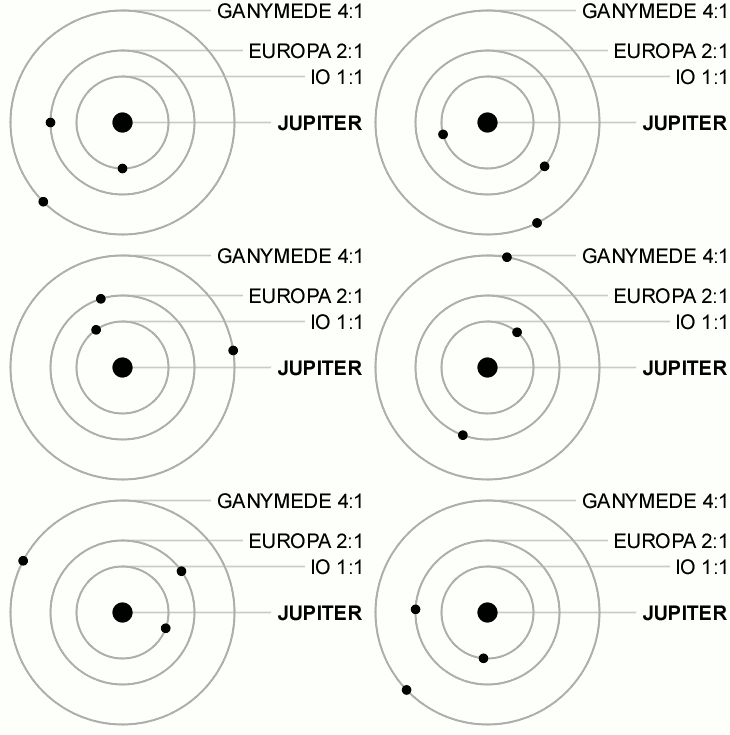
While it seems likely that Europa does – through a combination of interior heating and a similar kind of tidal flexing experienced by volcanically active neighbouring Io – have sufficient heat to give rise to a liquid water ocean under its surface, the problems remains of how to get down to that ocean and probe for signs of basic life.
The most common idea for this has been to actually land on Europa and drill down into the ice to obtain deep core samples which might contain minerals and other deposits indicative that the Moon has potentially habitable zones in its ocean – or even to get an automated mini-sub to actually explore the waters under the ice.
The problem here is that we now know that the ice of Europa’s crust is around 30 km thick – that’s not something easily drilled through to any significant depth. Such a thickness of ice also casts doubt on the idea that – based on images and data obtained by the Hubble Space Telescope (2012/13) and the Galileo spacecraft (1995-2003) respectively – water is escaping up from the ocean through crack in the ice as water vapour geysers.
As a result, the focus of efforts to try to reach liquid water on Europa and gather samples or remote analysis shifted to trying to analyse what appear to be reservoirs of water actually within the ice crust itself, in the belief that these “lakes” were being created by warm water forcing its way up through faults and cracks in the ice and then spreading horizontally through the ice strata – and that this might also be causing the geysers of water vapour believed to have been seen.
However, more recently, revisiting the data from Hubble and Galileo has cast doubt on the idea that Europa is geysering water vapour into space. On top of this, a new study led by scientists from Rutgers University now casts credible doubt on the idea of warm water pushing its way up through 20-30km of ice so as to be close enough to the surface so that when the surface ice breaks as a result of the flexing mentioned above, it could escape as a vast outgassing of water vapour.
The models previously used for determining whether warm water could form conduits up through Europa’s ice from the ocean and then exploit weaknesses within the strata of ice were based on the mechanics of magma here on Earth, which operates in a fairly uniform manner. Given the apparent nature of cryovolcanism among various bodies around the solar system, this idea of uniform action appeared reasonable.

The Rutgers’ study however, looked at the behaviour water is volcanic-like systems and found that its behaviour is far more turbulent than found with denser magma, with convection currents being far more extensive, particularly as warm warm came into direct contact with ice of a density similar to that measured on Europa.
So instead of the water simple melting and forcing its way up through cracks it forced into conduits, the Rutgers study found the the water would quickly start forming convention currents: the warm water rising up into cracks, with its outer edges rapidly cooling as it made contact with the ice, forming a convection current of rising and descending water – with the latter carrying ice crystals melted off the the ice before the water cooled. These crystals would then clump and cool the water further, eventually choking the entire flow long before the water could rise up through the ice far enough so it could form a reservoir which a) would remain liquid and b) be available to escape as a geyser if the remaining ice above it cracked open.
But given there is data indicating bodies of water are suspended within Europa’s ice, and if they are not formed by warm water forcing its way up from below, what is forming it? The Rutgers’ study suggests a simple, somewhat elegant solution: as noted, Europa is in tidal flux and subject to interior heating; its curst is cracked and line as a result of stress fracturing from this motion. This cracking and fracturing will result in frictional rubbing between different elements of ice and different densities of the ice strata – and friction melts ice.
If the Rutger’s study is correct, it would suggest that trying to obtain samples of any water trapped within Europa’s icy crust is unlikely to reveal much about the potential of the underlying ocean having all the mineral and chemical elements present to give life a kick-start. This does not negate the study of Europa as a whole; there is still much to find out about it – including whether or not the ocean believed to exist there is actually liquid water (rather than, say, an icy slush) – it just underscores the fact that nothing about Europa can really be taken for granted.
Imaging the Eclipse

August 12 saw a total / partial eclipse visible across the north Atlantic and a good portion of western Europe. Whilst the path of totality was predominantly lay across the Atlantic, it did touch eastern Greenland, western Iceland and part of northern Spain and Portugal, with up to 98% partiality witnessed from parts of northern Europe.
Here are some images of the event which have been publicly released.

Obviously, those sitting along the line of totality got the greatest views of the eclipse – bot that’s not to say those only witnessing a partial eclipse missed out, as “Mr photon” from Switzerland demonstrated, with the assistance of a local hot air ballooning event!

Long March 7A Explodes After launch
Just to show western rockets have exclusivity on exploding, on August 10, 2026, China suffered a failure with a Long March 7A booster.
A variant of the Long March 7 (CZ-7) workhorse, capable of lobbing just under 14 tonnes to low Earth orbit (LEO) and 7 tonnes to geostationary transfer orbit (GTO), the CZ-7A was first launched in 2020 and up until the August 10 launch, had a record for 16 successful flights out of 17 launches.
The launch was intended to deliver a Zhongxing-4B telecommunications and broadband internet satellite to GTO, the rocket lifting-off from the Wenchang Space Launch Site, Hainan province at 12:00 noon UTC on August 10. The flight appeared to be proceeding well until 85 seconds after launch, when the vehicle exploded.

It is not clear exactly what happened, but the timing of the flight suggests that the explosion occurred as the vehicle was experiencing “max-Q” – when the structure is facing the maximum in aerodynamic stresses as it accelerates and tries to punch its way through the denser atmosphere. Some reports suggest that this might have resulted in the forward, upper section of the rocket suffering a structural failure, however, amateur footage taken of the launch appears to show an initial explosive flare near the base of the vehicle, which appears to have split it in two, prior to a second explosion occurring.
This might be significant, as the very first flight of the CZ-7A in 2020 is said to have been result of a pressurisation failure in one of the rocket’s four strap-on boosters – although that particular vehicle loss came some 168 seconds into the flight.
The Long March 7 family has an interesting operation in regards to its core stage and side boosters. While such arrangements are common in rocket systems, in most, the side boosters tend to be jettisoned once they’ve carried out the work of initially accelerating the booster and getting it through “max-Q”, lightening the load and allowing the first stage to continue to power the rocket until its fuel is expended. However, with the Long March 7, the side boosters and core stage are jettisoned as a single unit, generally around 170-175 seconds into the flight.
At the time of writing, some 5 days after the vehicle loss, the state-owned China Aerospace Science and Technology Corporation (CASC) has not commented on the event, other than to state it is under investigation. Whether or not any reason for the vehicle loss will be given in the future is unclear – while there is speculation as to the cause of the loss of the first CZ-7A in 2020, China has never officially revealed the cause of that loss, and the same could be seen with this vehicle as well.

