Kondor Art Centre: Blip Mumfuzz – Urban and Industrial Images
As an artist, Blip Mumfuzz is generally an improvisor; her images tend to come about as a direct result of her general interaction with the environment she is in, rather than conscious pre-planning of pieces. Initially becoming involved in SL photography as a means of cataloguing her grid-wide travels, she started to drift away from the more conventional angles and camera positioning common to such photography, her eye and camera becoming freer, allowing her to look not so much at any given focal point within her field of view and any object therein, but more towards the physical relationships of objects, one to one another.
This gave rise to a more spontaneous, visually engaging style of photography, one coupled with a lean towards finding subjects that feature bright and / or contrasting colours, which images often presenting their subjects – objects, landscapes, settings and avatars, from unique angles or unexpected perspectives. This is turn feeds into exhibitions of Blip’s art being wonderfully free-form and rarely bound by a single idea of theme or narrative.
Kondor Art Centre: Blip Mumfuzz – Urban and Industrial Images
Which is why, when Hermes Kondor approached her about mounting an exhibition of her more urban / industrial art, Blip was somewhat sceptical, feeling that focusing on a single theme would be too confining, limiting her to archival pieces and forcing her to avoid other themes and ideas often present within her work. However, Hermes persisted, and with the assistance of Naru Darkwatch, Blip accepted his request – and the result is both unique and remarkable.
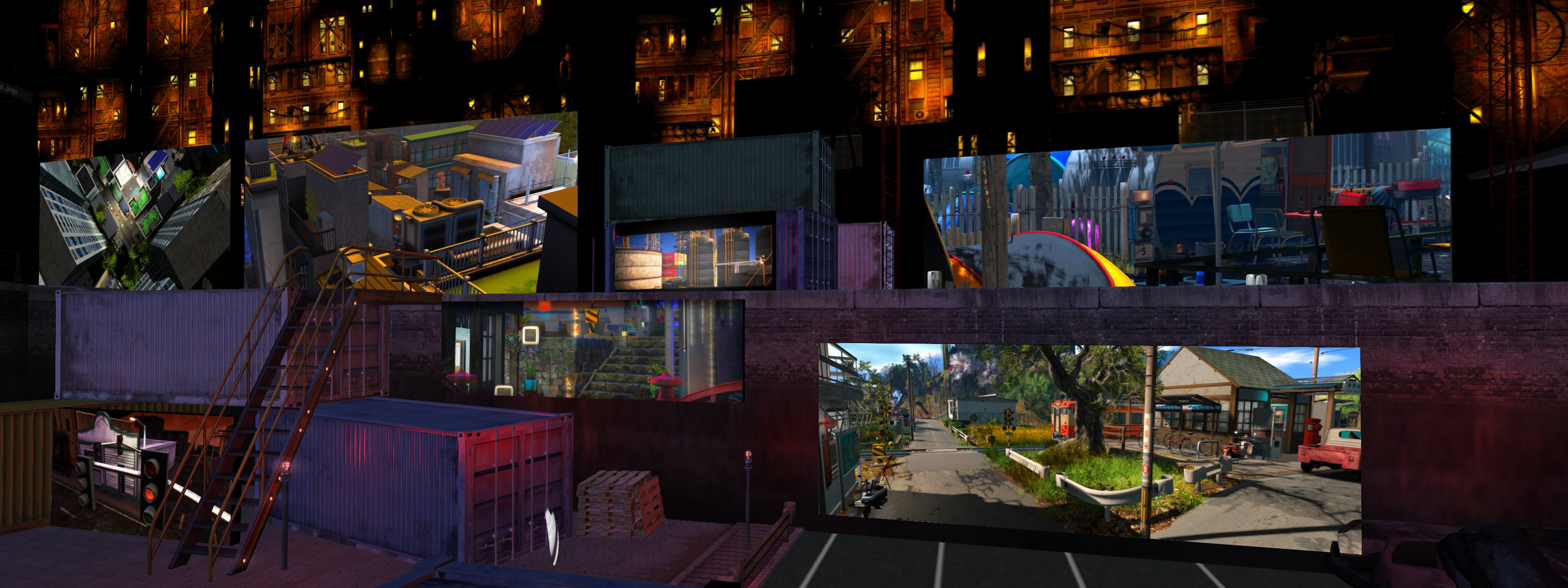
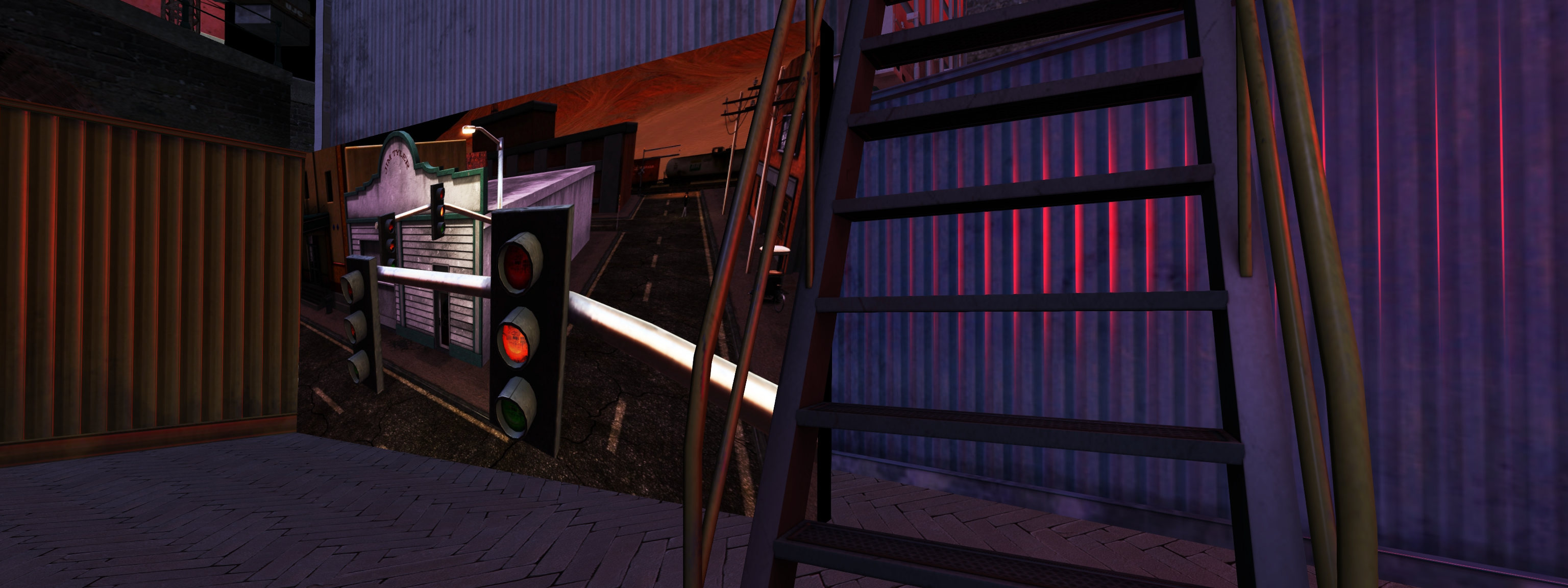
Urban and Industrial Images isn’t just an exhibition of Blips’ art, it is something of an immersive engagement with her work. Rather than merely hanging her images on the walls of a gallery space, she had the idea of presenting her work within a setting that reflects its nature. The result is an environment brought together by Naru as an industrial setting, split into two levels: an upper “street” level, where stand shipping containers, an office space and a backdrop of illuminated buildings suggestive of a larger town or city. The lower sits as a canal intended to bring barges and materiel to the city, and perhaps carry the detritus of industrial activities away – as with the barge sitting on the water.
Kondor Art Centre: Blip Mumfuzz – Urban and Industrial ImagesWithin it, Blip’s images have been laid out, some mounted in a manner so as to form a natural flow of the eye from backdrop into setting, others sitting within a building or mounted on the shipping containers, the back of a street sign, and along the deep walls of the canal. In this way, setting and art form a whole, allowing us not only to view Blip’s art, but to experience very much how she might see the scenes she comes across in her travels.
From the lower level, for example, a view of Tonarino is set beyond the arch of a bridge, the later curtailing our view, framing it to present it as a moment of motion rather than a photograph. Above it, meanwhile, the rooftops of Kekeland sit beyond the arm and jib of a crane as it raises a girder, forcing us to consider the spatial relationship between image and crane – just as Blip does in observing the places she explores and the objects within them – as does the placement of images within the old office space at one end of the setting.
Kondor Art Centre: Blip Mumfuzz – Urban and Industrial Images
An engaging, engrossing exhibition, Urban and Industrial Images is an engrossing examination of the photographer’s art.
A conceptual model of a SpinLaunch coastal launch facility with the vacuum accelerator exposed – the launch vehicle is located at the outer end of the black rotating arm. Credit: SpinLaunch
Up until now, the only means to get payload into space has been through chemical propulsion – rockets. And while they are not entirely efficient, they do work. However, if an American company gets its way, launching small payload into orbit could see the core part of their rocket replaced by a vacuum accelerator. Think of whirling an object around at speed on the end of a piece of string and then releasing it vertically, and you’ll get the picture.
The idea may sound bonkers, but it is precisely what US company SpinLaunch is planning to do.
They propose building a 100-metre diameter vacuum accelerator that, over the course of 90 minutes can accelerate an 11.2 tonne launch system up to a speed of Mach 5 before releasing it to travel along a launch tube and into the air. This velocity should be sufficient to propel the launch vehicle – comprising an aerodynamic aeroshell within which is placed a two-stage rocket carrying a 200 Kg payload.
The SpinLaunch payload vehicle, showing the outer dynamic shell, the two-stage rocket vehicle, and a pair of small satellites as the payload. Credit: SpinLaunch
On reaching a altitude matching that of a Falcon 9 first stage, the aeroshell would then split open, releasing the rocket to power itself and its payload on to orbit. Sound this work, it could reduce the cost of placing small payloads into space by around 80%, and allow for multiple launches from a single facility per day, if required.
To prove the idea works, SpinLaunch has constructed a one-third scale version of the accelerator, and on October 22nd, used it – operating at around 20% of rated output – to propel a 3-metre long ballistic projectile “tens of thousand of feet” into the atmosphere. According to SpinLaunch, the test was the first of 30 to take place over the next 6 months before they start work on construction on what they claim will be the first of a number of full-scale launch facilities at various points on the American coast.
That said, there are some significant technical challenges. Spinning at a maximum speed of 450 rpm, the system will subject the launcher and its payload to a peak dynamic load of 10,000 G; that’s a lot for the more sensitive part of the rocket motor to handle. More particularly, when it breaks the vacuum seal at the end of the launch tube, it will be travelling at Mach 5 – and slamming straight into the densest part of the atmosphere, again placing a massive load on it and its payload, as well as generating a lot of frictional heat as a result of its passage through the air. And that’s without considering the challenges in translating the spin of the accelerator into linear motion for the launch vehicle such that it can smoothly and successfully exit the launch tube, etc.
Even so, SpinLaunch appear to be carrying out the right amount of research – even if they are somewhat circumspect in addressing specific technical questions. As such, it will be interesting to see where things lead.
SpaceX Starship Update
With the public phase of the FAA’s Programmatic Environmental Assessment (PEA) of the Starbase facilities at Boca Chica now closed and the agency putting together its final version of the report, SpaceX has been moving ahead with site and vehicle development.
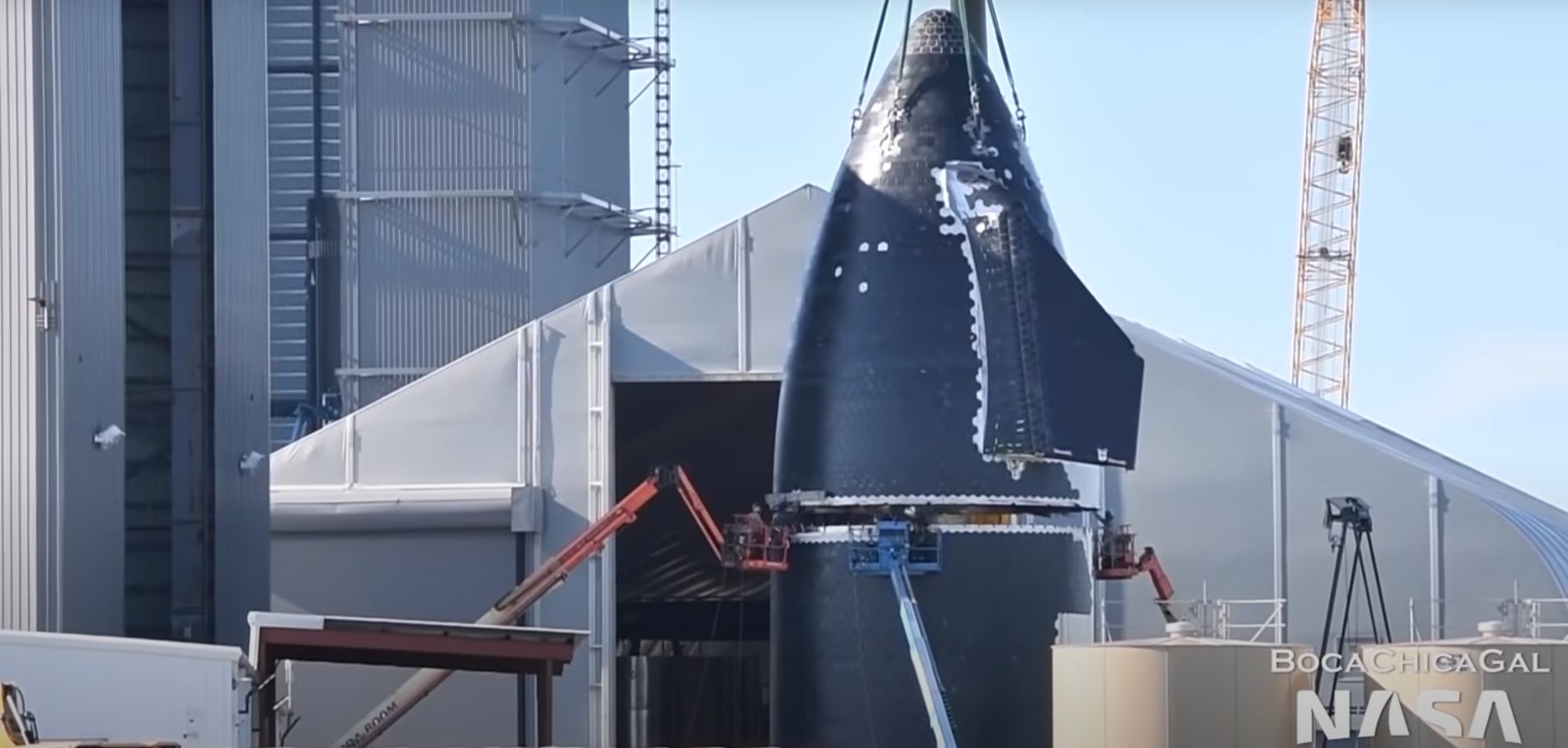
Most notably with the former has been work on erecting the framework of the new Wide Bay facility that could allow work to progress on up to four Super Heavy / Starship vehicles at a time, massively increasing the ability for the company to stack vehicles elements together. At the same time, in the current 2-vehicle High Bay, Booster 5 is nearing stack completion, and work has resumed on Starship 21.
The nose cone section of Starship 21, due to be the second orbit-capable test vehicle, is mounted onto the upper section of the vehicle. Note the thermal protection system already installed on both sections. Credit: BocaChicaGal / NASASpacelfight.comBooster 5 includes significant differences to Booster 4, which is now sitting on a hard stand at the launch facilities as work continues on the launch platform there. Most notably, elements of the booster are emerging from the fabrication facilities in a completed state than was the case with Booster 4 – which even now, is still awaiting various elements of aerodynamic casing, etc., to protect various parts during its ascent and decent through the atmosphere. Similarly, Starship 21 is showing differences in construction to Starship 20, most notably in having sections fitted with their thermal protection blankets and tiles prior to being stacked together.
At the launch site, work has continued in getting the catching mechanism on the launch support tower properly rigged to the cable system and massive winches that will allow it to move up and down the tower for eventual stacking and catching operations. A short distance away, Booster 4 has started to receive the protective skirting around its base to keep the more sensitive parts of its ring of outer engines safe from the flames and heat of ignition, as well receiving the last of its 29 Raptor engines.
However, the biggest new in recent weeks came with the pre-burn and static fire test of all six Raptor motors on Starship 20. These came almost back-to-back on November 12th, with the pre-burn (a kind of clearing the rocket engines’ throats) coming first and lasting just under a second. Then, around an hour later came a 2-second firing of the vehicles’ 3 sea-level engines and the 3 vacuum rated engines.
As with the last static fire test (with just 3 motors), some of the vehicle’s thermal protection tiles were blown clear, with a good number coming off lower down the vehicle when compared to the 3-engine test. Although brief, the static fire gave a small taste of the amount of noise that will be generated when Booster 4 ignites all 29 of its motors and then sustains their thrust through an actual launch.
Whether or not this launch, which will hopefully carry Starship 20 aloft, will come before the end of the year still hangs in the balance, with a lot riding on the outcome of the FAA’s final version of their PEA.
NASA Updates
Hubble Partially Recovered
On October 25th, the Hubble Space Telescope (HST) entered a “safe” mode, shutting down all science operations, the result of “multiple losses of synchronisation messages” – messages designed to coordinate how the various science instruments on HST receive and transmit data to / from the telescope’s primary computer system. While of concern, and possibly a little more frequent than initially diagnosed, the issue left Hubble in good health and engineers confident science operations could be recovered.
During the week, further tests were carried out that gave NASA the confidence to return the Advanced Camera for Surveys (ACS) to operational status on November 7th. The coming week will see the completion of additional tests with the hope that the more sensitive instruments on the telescope can be returned to operational status.
Artemis 3 Moon Landing Now “No Earlier” Than 2025
In a move that should have surprised no-one interested in space exploration, NASA has pushed back their return to the Moon to at least 2025, citing four reasons: the disagreement with Blue Origin over the contract for the Human Landing System (HLS), delays due to COVID working restrictions in 2020, Congress “failing” to fund HLS development and the Trump Administration placing unrealistic time frames on the programme.
Of the four reasons, the last is perhaps the most accurate: you simply cannot lop 4 years off of a programme and expect it to succeed (simply so you can take the credit as theoretically still be in office), without a commensurate increase in budget to allow NASA to achieve the required goals in the reduced time frame. On the other hand, blaming Congress isn’t entirely honest. In 2019, NASA stated they need $5+ billion for HLS development – but only requested less than $2 billion – hoping they could take money from the infrastructure bill and put into HLS – which Congress refused to allow.
The Artemis 1 mission profile. Credit: NASA – click for full size
As it is, the “no earlier” statement is standard NASA parlance when they do not wish to commit to a specific data as yet, in this instance it is perhaps indicative that Artemis 3 could slip to 2026. A lot is riding on the Artemis 1 mission, which has already slipped to February 2022, being the first flight of the Space Launch System (SLS) rocket critical in getting crews to the Moon. Should this first (uncrewed) flight reveal issues with either SLS or the Orion crew vehicle, then it is likely to seriously impact the entire Artemis timeline.
Similarly, while Elon Musk claims SpaceX will be able to land a crewed Starship HLS vehicle on the Moon in 2023, his time-frames tend to be over-optimistic. Also, there are some major questions around the Starship HLS that have yet to be answered; plus SpaceX are working to NASA’s crew safety requirements, not their own, which can (rightly, given crew safety is at stake) cause additional overheads on a development programme.
Crew Dragon: 4 Down, 4 Up
After uncooperative weather mixed things up, and caused delays, SpaceX Crew Dragon Endeavour has returned to Earth, bringing with it NASA astronauts Shane Kimbrough and Megan McArthur, ESA astronaut Thomas Pesquet and JAXA astronaut Aki Hoshide, who were all just a few hours short of spending 200 days aboard the space station.
Departure and splashdown took place on November 8th, with only the late-opening of one of the 4 main parachutes preventing the return from being perfectly textbook.
A remarkable shot captured by the NASASpaceflight.com team showing Crew Dragon Endeavour forming a bright star as it flies through re-entry high above the SpaceX Starbase at Boca Chica. In the foreground is the launch support tower for Super Heavy / Starship. Credit: NASASpaceflight.com
The departure left a lone US astronaut on the ISS along with two Russian cosmonauts. Mark Vende Hei arrived on the station aboard Soyuz MS-18 in April 2021. In September he and cosmonaut Pyotr Dubrov, who also flew to the station on MS-18, had their stay on the station extended through until March 2022. This means that Vende Hei will take the record for the longest individual space flight by an American – 353 days.
However, on Thursday, November 11th, he was joined by NASA colleagues Raja Chari, Tom Marshburn, and Kayla Barron, who arrived at the ISS along with ESA astronaut Matthias Maurer aboard Crew Dragon Endurance as the Crew 3 mission. They had launched earlier on Thursday, November 11th (Late on Wednesday, November 10th, US time), marking the maiden flight of the third Crew Dragon vehicle to enter service. They will remain aboard the station for 6 months.
Further Push to Retire SOFIA
NASA’s Stratospheric Observatory for Infrared Astronomy (SOFIA), the 2.5 metre telescope flown aboard a converted 747 SP aircraft has been recommended for “termination” by the committee that originally prioritised it.
The astrophysics decadal survey committee, which originally pushed for the airborne observatory in both 1990 (when it was not funded) and 2000 (when it was, although technical issues meant it did not enter service until 2014), now believe it is not worth the annual US $85 million cost of operating it and a “lack” of “scientific productivity”.
SOFIA: the Stratospheric Observatory for Infrared Astronomy, a flying observatory, capable of flying high enough to put it above the majority of atmospheric interference – but again threatened with cancellation. Credit: NASA
The “lack of productivity” references the fact that in its first 6 years, SOFIA has only generated 178 scientific papers that were cited 1,242 times, far less than other, more specialised observatories like the Transiting Exoplanet Survey Satellite (TESS); however, supporters of SOFIA note that the figures ignore the fact that in the last 12 months there has been a 59% increase in SOFIA papers, and the observatory is gaining more use in a variety of roles.
NASA has twice tried to cancel SOFIA, but in 2020 Congress provided sufficient funding for operations to through 2021 and into 2022. Currently, the House has also provided funding for the observatory until the end of 2023, although the Senate has yet to make a determination on funding.
Blue Origin Space Tourist Killed
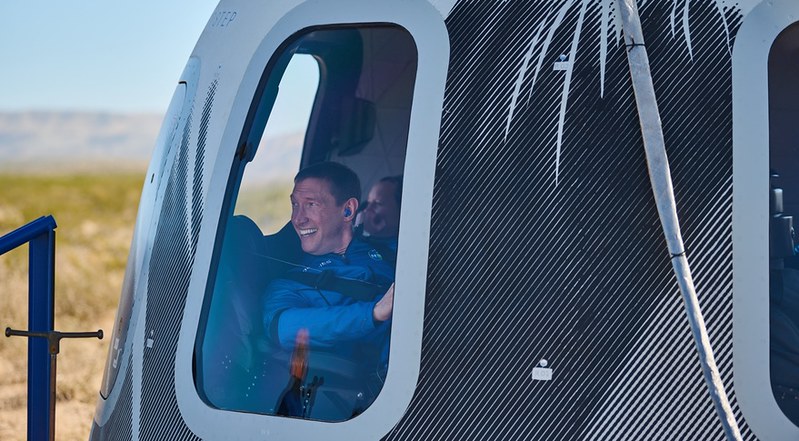
Glen de Vries, who flew with William Shatner, Chris Boshuizen and Audrey Powers, a Blue Origin vice president on the second passenger-carrying Blue Origin New Shepard sub-orbital flight, was one of two people on a Cessna 172 aircraft that crashed in New Jersey on November 11th.
Glen De Vries aboard New Shepard NS-18 capsule prior to launch
De Vries, a biomedical entrepreneur and self-described “space nerd”, paid an undisclosed sum for the flight, and had been giving talks and presentations on his experience since his return to Earth.
At the time of his death, he had been flying with Thomas Fischer from Essex County Airport in Caldwell, N.J. Both men were well-qualified pilots – Fischer also being a flight instructor – but it is not clear who was flying the aircraft. Emergency services were alerted after the pair failed to arrive at their destination, and the wreckage of the aircraft were subsequently found in a heavily wooded area near Hampton Township, about 64 kilometres northwest of New York City. At the time of writing, the cause of the crash remains undetermined.
We are devastated to hear of the sudden passing of Glen de Vries. He brought so much life and energy to the entire Blue Origin team and to his fellow crewmates. His passion for aviation, his charitable work, and his dedication to his craft will long be revered and admired.
Blue Origin statement on the death of Glen de Vries
Whitechapel, November 2021 – click any image for full size
Okay, okay. I’ll just come out and say it (as if it wasn’t already obvious) I’m a Hera (Zee9) fangirl. There is simply not a build Hera creates that does not have me grabbing camera, pen, notebook and clicking my heels together in expectation of a teleport pretty much the moment I get to hear about it.
And so it is with her latest design, which has just opened to the public. Whitechapel is a build that takes over from (and kind-of overlaps with) October’s Whitby (which, if you missed it, you can read about here).
Whitechapel, in the East End of London, is perhaps most (infamously) well-known for the 11 Whitechapel murders (1888–91), five of which were said to have been the work of the mysterious serial killer known as Jack the Ripper. As such, it is a place beloved of drama and mystery, and in the last decade has been featured in two television series: BBC’s, Ripper Street (later financed by Amazon), and the UK Sky TV / American Showtime horror series Penny Dreadful.
Whitechapel, November 2021
It is from both of these, mixed with some additional inspirations that has given birth to this build, as Hera explains:
Many years back I did a game level in Unreal Tournament called From Hell, based on the movie. When I got to SL I wanted to re do it, but unfortunately someone had already taken all my Unreal Textures and used them here to build a Victorian RP sim which looked suspiciously like My Level [from the tournament]. In fact I only came to SL originally because a friend said many sims were using my textures, and of course they were 🙂 Such is SL.
Anyway, this is the Victorian sim I always wanted to build. It is based on three sources, which is why I call it “Penny Dreadful meets From Hell on Ripper Street” . Most of my favourite characters are here: Jack and all his murders, Sweeny Todd, Scrooge, Dorian grey, Alan Quartermain, Dr Jekyll, Victor Frankenstein, and all their associated locations from the aforementioned TV series. Hope you enjoy what you find, It was fun to do it at last!
– Hera (Zee9)
Whitechapel, November 2021
The setting is reached via Hera’s main landing point, which also gives access to Drune Gotham (which has reopened alongside of Whitechapel, the region having been closed to allow Hera to build the latter). From here, a further teleport will carry visitors to the sooty enclosure of Whitechapel underground station, a train hissing and chugging on the tracks (this is the era before the use of electricity as the means of locomotion for such transport under the city). No dress code is enforced, but Hera requests visitors consider being somewhat appropriately dressed for the period.
The station emerges on Commercial Road, which for those who are not familiar with the East End was, and remains, one of the main thoroughfares of the district, some 3 km (1.9 miles) in length, commencing a junction with Whitechapel High Street to run east to the (now old and redeveloped) London Docklands.
Whitechapel, November 2021
In particular, this part of Commercial Road connects to Hanabury Street (which I take to be a slight mis-spelling of “Hanbury Street”), where in 1884 Florence Eleanor Soper, the daughter-in-law of General William Booth of The Salvation Army, established The Women’s Social Work, a house intended to be a place where young woman might be persuaded not to turn to prostitution, and a retreat for those already suffering from the trade.
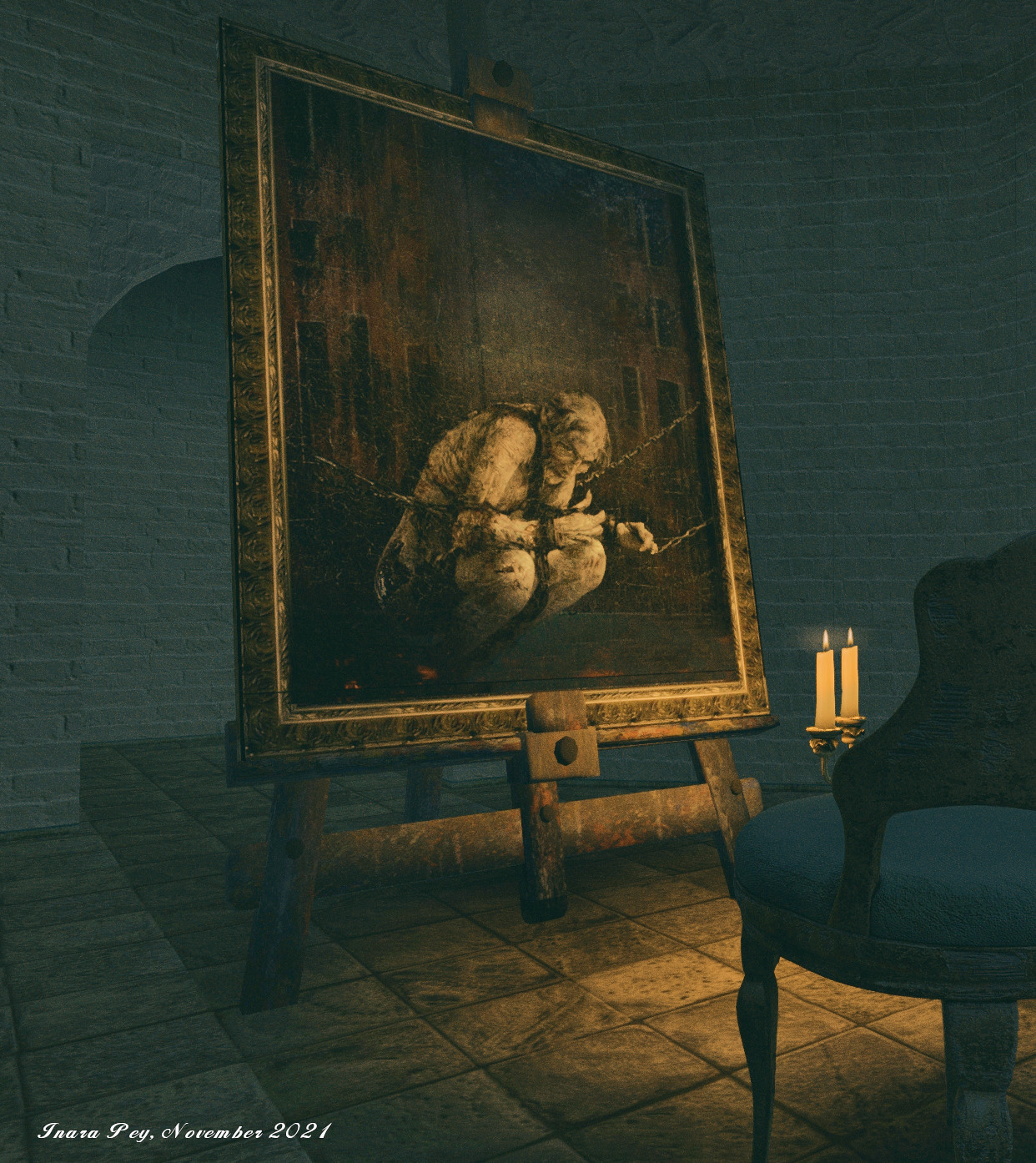
Whitechapel, November 2021: The Portrait of Dorian Gray
It was also in the back yard of No. 29 Hanbury St, that the body of Annie Chapman, believed to have been Jack the Ripper’s second victim, was found on September 8th, 1888. And indeed, the shop-come-house can be found here, complete with interior and its grisly backyard, although the real No. 29 Hanbury Street has long since gone from Whitechapel, with the number today applied to a building on the opposite side of the road.
Also within the setting are Berner Street, a further road exiting off of Commercial Road, and the place where the body of the Ripper’s third victim, Elizabeth Stride was found (Sunday 30th September 1888); Mitre Square (Catherine Eddowes, also 30th September 1888, within an hour of Stride’s murder); the house at Miller’s Court (wherein the body of Mary Jane Kelly, the Ripper’s final canonical victim, was found on the morning of November, 9th, 1888, the only victim found indoors; and finally, the narrow passage of Bucks Row, where on the morning of August 31st, 1888, covered by a tarpaulin, the body of the Ripper’s first canonical victim, Mary Ann Nichols was found.
Nor is it just the Ripper murders awaiting discovery.
Whilst I have not seen all of Penny Dreadful, there is much from that series awaiting discovery – be it Malcolm Murray study, the chamber in which Dorian Gray hides his portrait, Frankenstein’s attic laboratory; while from Ripper Street one might find other elements – such as what might be the station house for H Division of the London Police, and base of operations for Detective Inspector Edmund Reid and Detective Sergeant Bennet Drake. The latter, like many of the buildings along the streets, has an interior, making it – and them – suitable for photography and / or light role-play for the period; elsewhere, a reference to at least one game might also be found. All of this lies under an environment setting that is mindful of Whitby, but unique to Whitechapel.
As us usual with Hera’s builds, the work: structures, roads, signage, and more are all her own work, with only the various street décor – cars, lamps, carts, etc., and various items used into interiors or additional dressing coming from other creators. This is one of the reasons – alongside of her vision and attention to detail – that makes Hera’s design so visually engaging and worthy of praise.
Whitechapel, November 2021
But for now I have said enough: Whitechapel awaiting explorers and those who wish to delve into some of the mysteries bound with it; and I urge those with a love of exploring Second Life to visit sooner rather than later, lest Hera’s muse whispers to her and calls for a new location to be built. And, if you do visit and enjoy, please consider a donation to the Batbear at the landing point in a show of appreciation for Hera’s continuing work.
November marks Diabetes month in may parts of the world, with the World Diabetes Day falling on November 14th, 2021 this year is an especially notable celebration, as it marks the 100th anniversary of the discovery of a treatment that has saved millions of lives around the world: that of insulin. One of the 20th century’s greatest medical breakthroughs, insulin is today, still the only effective treatment for type 1 diabetes.
Team Diabetes of Second Life is marking both Diabetes Month and World Diabetes Day – the latter with a weekend of activities that kicked-off on Friday, November 12th, and concludes on Sunday, November 14th.
The weekend features 2D and 3D art, music and the first annual Team Diabetes of SL Diabetes walk – and while I’m a little late in getting to things, there is still time to appreciate the art and participate in the activities of Sunday, November 14th, where you can help raise money for the American Diabetes Association.
Team Diabetes of SL: World Diabetes Day weekend – Jamee Thomson (Jamee Sandalwood)
The artists participating in this year’s event comprise: Jamee Sandalwood, Aquarius27, Inara Pey, Eucalyptus Carroll, Vita Theas, Kayly Iali, Myra Wildmist, Johannes Huntsman. & Jennylynn Capalini. Several of the artists are offering their work for sale, with some / all of the proceeds of sale going to Team Diabetes of SL / the American Diabetes Association (100% of the proceeds of any sales I make will be donated).
Sunday’s events and entertainment will comprise:
12:00 noon until 14:00 SLT – World Diabetes Day Walk: join other walking the track at the event.
12:00 noon until 13:00 SLT – live music by Ziggy Sixpence.
13:00 – 14:00 SLT – live music from Agatha Knowles.
Also running throughout the month is the Red Hunt in support of Team Diabetes of Second Life. You can click here for a list of participating merchants / brands and hints. Items in the hunt cost L$10 each, with all proceeds going to the American Diabetes Association.
About the American Diabetes Association
Established in 1940, the American Diabetes Association is working to both prevent and cure diabetes in all it forms, and to help improve the lives of all those affected by diabetes. It does this by providing objective and credible information and resources about diabetes to communities, and funding research into ways and means of both managing and curing the illness. In addition, the Association gives voice to those denied their rights as a consequence of being affected by diabetes.
Team Diabetes of SL: World Diabetes Day weekend – Bryn Oh
About Team Diabetes of Second life
Team Diabetes of Second Life is an official and authorised fund-raiser for the American Diabetes Association in Second Life. Established with the aim of raising funds in support of diabetes treatment and to raise awareness of the disease in SL, Team Diabetes of Second Life was founded by Jessi2009 Warrhol and John Brianna (Johannes1977 Resident).
It’s hard to believe that Spielberg’s Jurassic Park is nigh-on 30 years old. Whatever you may think of the sequels, the original was a seminal piece of cinematic adventure, a lightning-in-a-bottle moment of film-making (even if the science is as wonky as ride on a bus with hexagonal wheels); even now, the scene where Grant and Sattler first see the dinosaurs on Isla Nubar, complete with John Williams’ soaring theme, can bring a lump to the throat and cause the eyes to water.
I cannot promise the same reaction when visiting Justice Vought’s Jurassic Park! in Second Life – but I can say you’ll get to have quite the adventure when visiting (complete with a extract of Williams’ theme). In places drawing on the entire film franchise but with a strong emphasis on Isla Nubar, Justice presents a personal interpretation of the film and novel that captures several of the former’s iconic moments, and which includes some rather unique chuckle moments that set outside of the film’s story, but very much feel well-suited to the moment here.
Jurassic Park! November 2021
A visit starts down within caves where dinosaur skeletons are being uncovered together with insects trapped within fossilised amber. From here, visitors are invited to find their way to where they can board a helicopter (rezzed on touching the box at the helipad) to fly, a-la Alan Grant, (Sam Neill), Eliie Sattler (Laura Dern) and Ian Malcolm (the always brilliant Jeff Goldblum) to John Hammond’s fabled park.
From there, and progressing through the visitor centre, the park is laid out as several distinct sky-based areas linked by teleports and various means of travel (including the caverns of the arrival point). The visitor centre itself gives a nice feel of the one seen in the film, complete with the T-Rex skeleton (check for a sit-point!) and the huge banner that is intended to greet guests. A little ride (best taken in Mouselook) reveals the secrets of creating dinos, whilst touching the door at the back of the centre will carry you to the park gates, where you can start your tour via jeep.
I really do not want to give too much away here, for fear of spoiling a visit; however, some elements are hard to avoid mentioning. The jeep ride will take you so far – passing by way of the T-Rex enclosure and its hapless goat – before you’ll have to continue on foot, coming across a Triceratops and a pair of Diplodocus, passing on the other side of the T-Rex enclosure (now looking somewhat the worse for wear and with a fun pose), whilst close by, a Baryonnyx appears to be stalking a Parasaurolophus.
Other dinosaurs waiting to be encountered include Carnotaurus, Pteranodon (one of which you can rez and ride), Stygimoloch (which may actually be juvenile Pachycephalosaurus), Iguanodon, Allosaurus – and, of course, velociraptors and ol’ T-Rex himself, complete with a novel recreation of a scene from the film (with pedal extremities replacing the jeep!).
Jurassic Park! November 2021
Along the way there are numerous things to click on, from rezzers to givers and assorted interactive elements – look for the red and blue arrows and click where directed – but also be sure to Mouse over in places. There’s also a trap featuring monsters of its own, and one particularly novel way of … blasting … yourself between points in the park!
At the end of the adventure, you can rez and grab a helicopter to escape what might otherwise be a grizzly fate, and this will carry you to a waypoint you can use to either journey back to the start of the adventure, or hop back to the visitor centre or the disaster area. With tiny meteor periodically falling the the ground, this also offers a reminder of the eventual fate of the dinosaurs. Donations for the maintenance of Juctice’s Oxygen locations (of which this is a part) can be made here as well.
Jurassic Park November 2021 – “Where’s the bloody jeep when you need it?!”
Justice always puts a lot of effort into his builds, and Jurassic Park is no exception. The range of dinos means that most of the film franchise is represented, although the focus is clearly on the original film / book, as noted. Yes, not all the reptiles are animated – but this does help reduce script load and things like animation loading / running on the viewer, and it doesn’t stop a visit from being fun; I think I can safely say it’s the first time I’ve ever been digested by a closet when travelling!
Fun to visit and explore individually or with friends. My thanks to Justice for the personal invite, and to Shawn for also sending me the LM!
Jurassic Park! November 2021 – “I’m ready for my close-up, Mr. Spielberg!”
The following notes are taken from the TPV Developer meeting held on Friday, November 12th, 2021.
These meetings are generally held every other week. They are recorded by Pantera Północy, and her video of the meeting is embedded at the end of this report – my thanks to her for allowing me to do so – and it is used with the chat log from the meeting and my own audio recording to produce this summary, which focuses on the core topics discussed.
SL Viewer
The Tracy Integration RC viewer version 6.4.23.563771 (dated Friday, November 5) entered the list some time after Tuesday, November 9.
Performance Improvements project viewer updated to version 6.4.24.565324 (dated November 5) also some time after Tuesday, November 9.
The Maintenance RC viewer updated to version 6.5.0.565607, on November 10th – this viewer now contains a fix for the media issues caused by the Apple Notarisation viewer. If you have been impacted by these issues and have had to roll back to an earlier version of the official viewer, it is recommended you download and install this RC.
The remaining official viewer flavours remain as:
Release viewer: version version 6.4.23.564172, formerly the Apple Notarisation Fix RC viewer, issued September 24 and promoted October 15.
360 Snapshot RC viewer, version 6.5.0.564863, issued October 21.
Simplified Cache RC viewer, version 6.4.23.562623, dated September 17, issued September 20.
Project viewers:
Performance Floater project viewer, version 6.4.23.562625, issued September 2.
Mesh Optimizer project viewer, version 6.4.23.562614, issued September 1.
Legacy Profiles viewer, version 6.4.11.550519, dated October 26, 2020.
Copy / Paste viewer, version 6.3.5.533365, dated December 9, 2019.
General Viewer Notes
It is possible the 360 Snapshot RC viewer and the Simplified Cache RC viewers may be merged prior to either being individually promoted to de facto release status.
The Performance Improvements viewer has been further updated, but will likely go into a round of bug fixing before progressing further – as Vir pointed in the meeting, the problem with moving operations between threads / to their own threads, things can have undesired consequences, and these are to be addressed with fixes.
The focus at the Lab is to try to get all of the current list of viewers updated & quite possibly promoted to release status by the end of 2021.
In Brief
Mojo Linden indicated that the Lab is keen to hear back from users on the Performance Improvements viewer, and in receiving suitable performance improvements code from TPVs, and the emphasis remains on trying to improve overall performance for all users.
BUG-231417 “ADITI LOGIN – Fields not conforming to previous login behaviour” (preventing clients reliant on libomv and libremetaverse from logging into Aditi (the Beta grid), and BUG-231303 “Scripted agents can no longer log in” (an outcome of the dropping of TLS 1.0/1.1 support) together form the backbone of discussions in the meeting, which includes cipher sets, use of (effectively) deprecated operating system versions (e.g. Windows 7, Windows Serve 2012), TLS / SSE support, etc. Please refer to the video below for details.
Catznip R13 is now on the horizon as a release.
Firestorm is testing an “auto tune” capability to better handle other avatars to help boost performance – LL are apparently also looking at something similar.














 Inara Pey: Living in a Modemworld