Get Out in Second Life

Kondor Art Square: Get Out by Loviathar Hellman & Moolfryt Klang
GET OUT is an invitation into turning your compy off, grabbing the first quite satisfying camera you can find and into getting down the street, breathing more or less fresh air and look at your surroundings with new eyes, a street photographer (amateur or not) eyes. Soon, you’ll feel overwhelmed by the duality you can find in a city: darkness and light, colours and grey tones, tradition and modernity, beauty and ugliness, life and death.

– Insane Focus (aka Loviathar Hellman & Moolfryt Klang)

These are the opening words Loviathar and Moolfryt offer as an introduction to their joint exhibition Get Out, which opened on August 19th, 2021. And as they go on to note, this is not a call to rebel  against common sense precautions in the face of the continuing SARS-CoV-2 situation, but rather a call to those who might spend a little too much time in front of the computer (/me coughs and avoids looking into the eyes of my reflection in the monitor) to take the proper precautions and then get out and spend a little time in the big, wide world – preferably with a camera in hand.

In this, Get Out leads by example. Occupying the Kondor Art Square in Second Life, it is a celebration on multiple levels. On the first, it is a celebration of the artists’ time spent visiting numerous locations across Europe from England through Belgium, France, Italy, Croatia, Bosnia-Herzegovina, Montenegro and Greece. On the second, it is a celebration of one of the most powerful genres of photography – street photography; a means to capture and document moments in time and place and the lives of people around the world as they go about their daily lives.

Kondor Art Square: Get Out by Loviathar Hellman & Moolfryt Klang

Thirdly, it offers a celebration of the world of photography, opening is it did on August 19th, 2021, World Photography Day.

It was on that date, back in 1839 that France took it upon itself to offer to the world the Daguerreotype process of photographic image development. Developed by Louis Daguerre, the technique (using a highly polished sheet of silver-plated copper mentioned) was not the first means to “fix” an image captured through a camera lens onto a medium – Daguerre actually built his technique on the work of his uncle, Nicéphore Niépce whilst others around the world were developing their own techniques – but it was the first publicly available technique of photographic image development, and in doing so, it started a movement that led directly to popular photography as we know it today.

Set out by country, some of the photos focus on a single centre (e.g. London in the case of the UK, Rhodos in the case of Greece) or two or more ports of call within a country (as with, for example, France and Belgium). The images presented are richly diverse in subject, tone and use of colour, each one fully capable of transporting its audience to the place it frames and the the glimpse of the story it has to tell, as well as allowing us to personally share in Loviathar and Moolfryt’s travels. All of them remind us of the power of the photographic lens to record a single moment of time and a unique perspective on that moment as seen through the eye(s) of the photographer; one that can be both deeply personal  and increasingly historical as time passes.
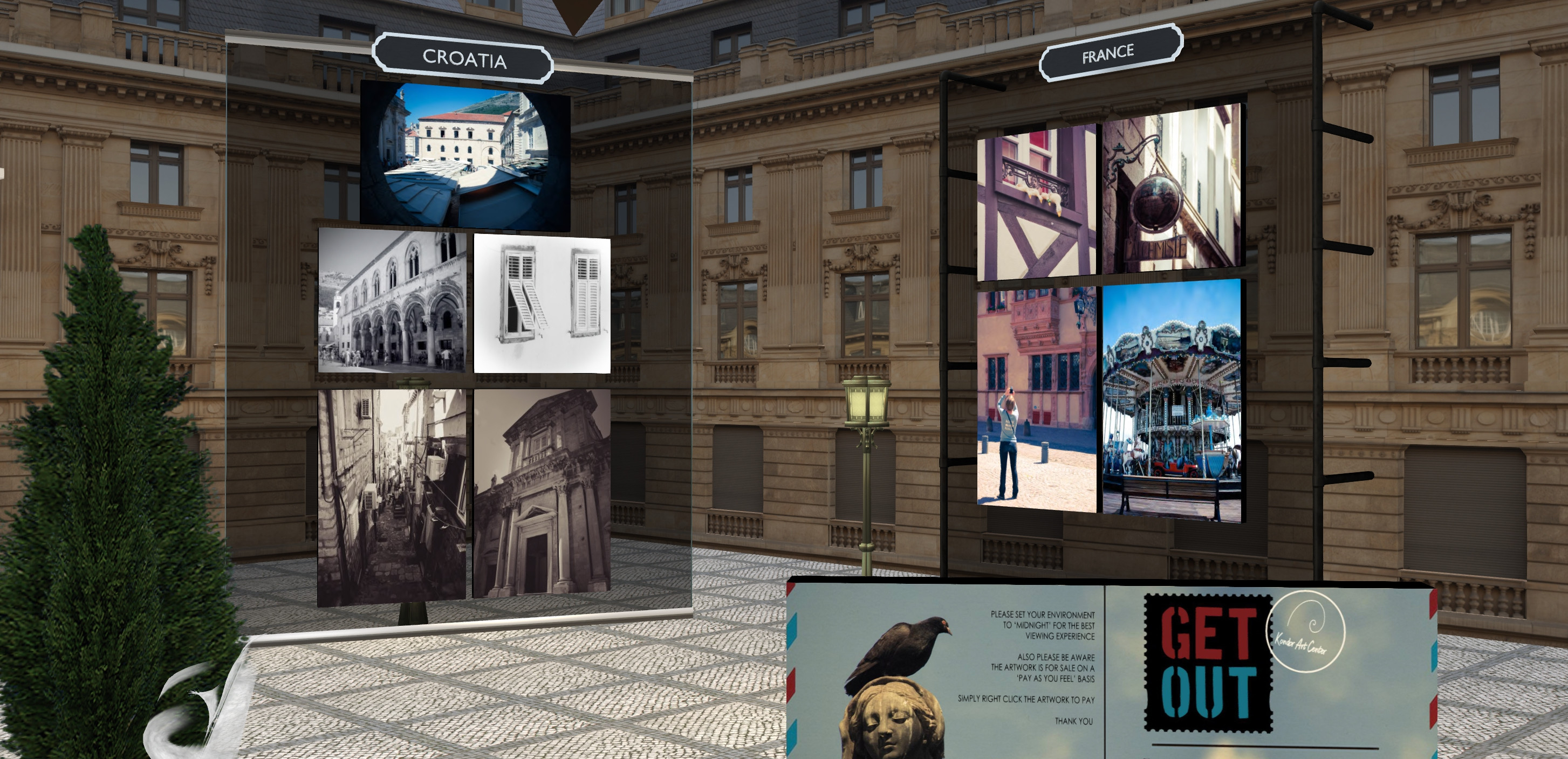
Kondor Art Square: Get Out by Loviathar Hellman & Moolfryt Klang

Get Out also reminds us that photography is open to all of us to try. Maybe we cannot all be a Dorothea Lange or a Lee Friedlander or a William Klein or an André Kertész – or a Loviathar or Moolfryt – and we might not be able to travel to distant towns and cities; but that doesn’t matter. The camera gives us the opportunity to capture moments across the very town we live in (and the opportunity to experience time away from the computer, as the exhibition’s intro notes). So why not go see Get Out and let it offer inspiration, then take the advice of the artists and take time away from the computer and get out and see what the streets around you have to say about themselves?

SLurl Details

2021 CCUG and TPV Developer meetings week #33 summary

Soul Deep, May 2021 – blog post

The following notes were taken from my audio recording and chat log of the Content Creation User Group (CCUG) meeting held on Thursday, August 19th 2021 at 13:00 SLT, and the TPV Developer’s meeting of Friday, August 20th.

With the meetings once again falling on the same week, and with the degree of overlap in content between the two, core discussion points from both have been combined into this one summary. The TPV meeting was recorded by Pantera Północy, and her video is embedded at the end of this article, for those wishing to refer directly to that meeting.

Meeting Details

  • CCUG meetings are held on alternate Thursdays each month (generally the 1st and 3rd Thursday, vagaries of month start / end dates allowing), with dates available via the SL Public Calendar. The venue for the CCUG is the Hippotropolis camp fire.
  • TPV Developer meetings are generally held on alternate Fridays each month, although dates are not currently listed in the SL Public Calendar. The venue for meetings is at the Hippotropolis Theatre.
  • Both meetings are currently chaired by Vir Linden, and are led using Voice, although attendees can use either Voice or text to provide input / feedback (with text generally being the preferred medium).

SL Viewer

There have been no official viewer updates during the week, leaving the current crop of available versions as follows:

  • Release viewer: version version 6.4.22.561752, formerly the CEF Update RC viewer, issued July 24 and promoted August 10  – NEW.
  • Release channel cohorts (please see my notes on manually installing RC viewer versions if you wish to install any release candidate(s) yourself):
    • Simplified Cache RC viewer, version 6.4.22.561873, issued August 9.
    • Grappa Maintenance RC, version 6.4.22.561850, issued July 29.
  • Project viewers:
    • Legacy Profiles viewer, version 6.4.11.550519, dated October 26.
    • Copy / Paste viewer, version 6.3.5.533365, dated December 9, 2019.
    • Project Muscadine (Animesh follow-on) project viewer, version 6.4.0.532999, dated November 22, 2019.
    • 360° Snapshot project viewer, version 6.2.4.529111, dated July 16, 2019.

General Viewer Notes

  • The next viewer that might go directly to de facto release status could be the Mac Notifications fix viewer (which has yet to even appear in RC).
  • However, depending on how QA work goes with that viewer, it is possible the Grappa Maintenance RC viewer might be promoted to release status.
  • As a result of recent internal testing (see my week #33 Simulator User Group summary), the 360° Snapshot viewer is having some further massaging of the the UI, but is expected to be passed to the QA team for checking / testing in the coming week, so may not be that far from being issued as an updated project viewer.
    • As a result of recent feedback from users, the Lab is now considering updating various web properties such as the Marketplace to make use of  360° images (Place Pages used to be able to use them, but may also require update to work with the newer viewer). If this work goes ahead, it will not be tied directly to the the release of the viewer.
    • Output from the internal testing can be found on Alexa Linden’s Flickr stream – be sure to click on images to activate them.
  • The Legacy Profiles viewer is still awaiting some back-end work, which has yet to be scoped / scheduled, so an update is unlikely to be appearing in the short-term.

Upcoming Viewers

  • There is currently an internal bottleneck at the Lab which is slowing the issuing of viewer updates / viewer versions. This is in the process of being addressed.
  • The viewer with the updates for presenting performance-related information is “close” to being  ready for issue as a project viewer.
  • Tracy Debugger / System Analyser:
    • Integrating the Tracy debugger / system analyser to allow for better cross-platform profiling of client hardware to help with cross-platform graphics development has been a focus for the Graphics team of late.
    • This is nearing a point where a viewer with Tracy will be ready to be made public. However, the library will be off by default, as a) it has a performance overhead when running in the viewer; b) it requires a server running Tracy for the data produce to be analysed. Developers / viewer compilers who have the necessary environment for analysing the data should be able to enable it prior to viewer compiling, if they wish to use it.
  • Mobile Client:
    • The new features for the iOS version mentioned during the August Web User Group meeting appear to be the addition of push notification support and some  additional UI work.
    • The Android version remains on hold pending the focus shifting from the iOS version.
    • As noted above, the core environment for getting updates on the Mobile client is via the Web User Group (as Keira Linden, who is leading the Product side of Mobile also chairs that meeting), and as a result, I provide monthly updates on Mobile through my WUG meeting summaries.

LOD Generation Viewer

  • A new project viewer using the mesh optimiser library for automatic LOD model generation for mesh uploads is getting close to being available for public use. This reportedly works better than the GLOD code that is currently in use.
  • For the initial project viewer version(s), once available, creators will have a choice of using either GLOD or the optimiser at upload. Longer-term and depending on internal discussions / the results of actual use of the optimiser library, GLOD may be removed (or at the least, made a non-default option).
  • If the use of the library proves sufficiently beneficial, LL might also opt to enable it in real-time against mesh objects that do not have any defined LODs. Doing so could potentially be beneficial for those on lower-end systems (e.g. by reducing the number of draw call being made , etc., as they no longer have to render the “full” model all the time).

Future Work – Avatar Usability

[via the CCUG meeting]

Following the arrival of the new VP of Engineering, Mojo Linden (see: Say Hello to Linden Lab’s New VP of Engineering, Mojo Linden,  aka Andrew Kertesz), there are ongoing discussions at the Lab related to future work.

While there is nothing official to report on this at present, a focus of these discussions is very much on the question of avatar usability. While this was already a focus for the Lab prior to Mojo arriving, it now seems “likely” that this work may be stepped up, with changes appearing “over the coming months” – and will probably include viewer UI updates and well as other yet-to-be-publicly-defined changes.

The mention of this again raised the question of allowing completely custom skeletons into SL / rebuilding the entire avatar skeleton/rig. Both have technical issues associated with them (e.g. backward compatibility issues in the case of the latter), and also non-technical issues (e.g. the risk of further marketplace fragmentation / user confusion over what is supposed to work with which avatar types in the case of both), so the Lab is not currently looking at either option.

In terms of market fragmentation, it was suggested that some mitigation might be provided by LL producing some form of standard “developer kit”, rather than creators relying on third party tools.  The problem here being that a) LL does not have the resources to devote to doing so, and users are potentially fair more aware of the internals of applications such as Blender, Maya, etc., to be able to provide and maintain such tools far more effectively.

User Suggestion: Pro-Active Complexity Monitoring

[via the CCUG meeting]

User Lucia Nightfire has proposed the Lab consider a means by which avatar complexity values can be stored on the back-end and made available to simulators as avatars move between regions, such that it can be polled by (or supplied to) viewers within the region a user is entering.

The idea here is that by pro-actively supplying complexity information to viewers in a region and allowing them to compare it to the Maximum Complexity value set within them, they can make a simple determination of whether to fully render the incoming avatar or go directly to “Jellydolling” it without having to download all the associated geometry and attachment data, etc., in order to locally calculate how the incoming avatar should be rendered (as is currently the case).

This approach would be beneficial to the user experience, simply be reducing the amount of work the viewer has to carry out calculating avatar complexity. While this particular idea hasn’t been directly considered by the Lab, the idea of greater automation in general (where applicable –  see the notes on mesh optimisation above) could well help improve people’s Second Life experience, particularly those on lower-end systems. However, implementing such capabilities will require a degree of back-end work, and as such are not on the the immediate road map at this point in time.

In Brief

  • Issues arising from viewer changes made to accommodate the custom key mappings capability – LL are aware of a number of issues relating to the introduction of the custom key mappings viewer. Fixes are in the works, but no dates on when they might be made available or in which Maintenance viewer. These issues include the following reported bugs:
    • BUG-231083 “Rapidly left clicking objects or attachments while the Edit menu is open triggers a double-click teleport”.
    • BUG-230983 “Holding of modifier keys ALT and CTRL ignored when occurring in combination with double-click teleporting” (Kokua has already implemented their own fix for BUG-230983, which has also been offered available to LL..
    • BUG-230922 “Right Alt + Right Shift + H shortcut to show/hide HUDs no longer works when a floater is in focus”.
  • The announcement that the use of Gacha systems is to be discontinued in Second Life from the end of September has raised questions concerning the exploit by which some individuals have been able to use an exploit to crash a region in such a way that No Copy items would be duplicated on a restart (thus allowing them to make multiple copies of Gacha items). This issue is now being looked at again by the Lab.
  • The HTTP2 update work is awaiting the CDN(s) used by LL to implement HTTP2 support. This is becoming something of an internal hot topic, as the lack of HTTP2 progress is also hampering cURL advancement on the back-end.
  • Viewer stats: TPVs wishing to obtain stats on use, etc., from the Lab should e-mail Vir Linden to request a report.

CCUG Specific Questions / Items

  • Is there potential for increasing the number of allowed face/material slots for mesh objects (8 per single object)? – This is actually a limit that was pre-dates the arrival of mesh, which “inherited” it. As such, any change to this would be fairly substantive in nature, and thus is not something the Lab is currently considering.
    • Some at the meeting also felt any such change could have a noticeable negative impact without a “proper” mesh accounting system being put in place, or SL moves away from the current drawcall overhead.
  • Could a forum thread be opened to allow content creation questions to be asked in advance of meeting, particularly those that might require referencing to over teams within LL (e.g. the simulator engineers) in order to gain feedback input? – This is seen as a potentially good idea, and will be looked into, along with having a member of the simulator engineering team attend CCUG meetings more regularly.
  • Requests are again being made for LL to revisit Animesh to provide support for body shapes, attachments, Bakes on Mesh, re-evaluation of the Land Impact associated with Animesh objects, etc.
    • Some of this work require extension to viewer capabilities and back-end services (e.g. Outfit support for BoM + processing via the Bake Service), and are thus more long-term.
    • Others aspects (e.g. re-evaluating Animesh LI) could be said to be dependent upon other projects (e.g. ARCTan, and re-evaluating the impact of in-world objects), and thus are awaiting work to resume on these projects – and it is hoped the ARCTan work will resume sooner rather than later.


Say hello to Linden Lab’s New VP of Engineering, Mojo Linden, aka Andrew Kertesz

via Linden Lab

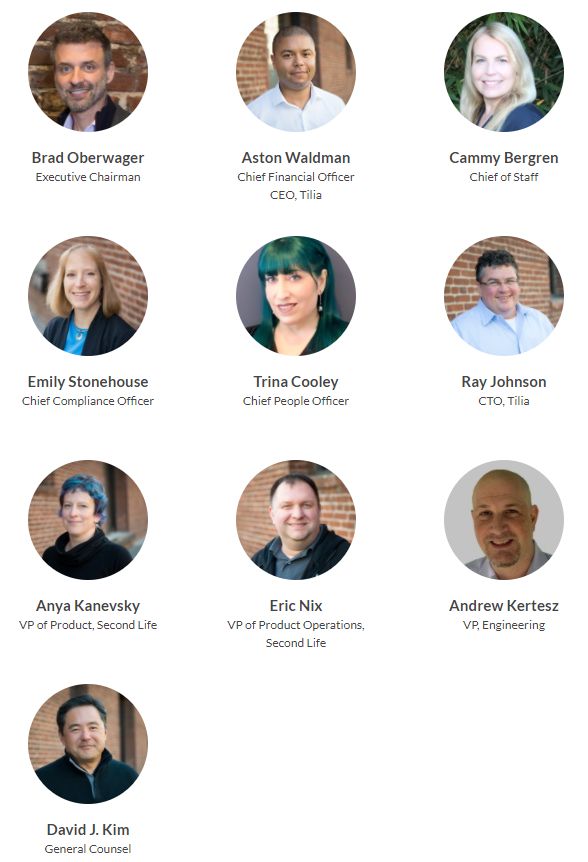
Some time between August 11th and August 19th, Linden Lab quietly slipped out a biography of their new Vice President of Operations, who has come aboard to take up the post vacated by Oz Linden at the end of February, when he retired from business after over a decade with Linden Lab.

The new VP of Engineering is Andrew Kertesz, a 20-year veteran of the gaming industry, who joined Linden Lab at the end of July 2021 from Level Ex Inc., a company creating “industry-leading medical video games that challenge physicians to perform at the top of their game”, and where he served as Principal Software Engineer / Principal Engineering Manager for a period of just over year.

The official biography for Mr. Kertesz posted by the Lab (and accessed via the About Linden Lab page on their corporate website) reads as follows:

Andrew Kertesz

WITH OVER TWENTY YEARS OF EXPERIENCE IN THE GAMES INDUSTRY, ANDREW IS AN EXPERT AT BUILDING TEAMS AND LAUNCHING GROUND-BREAKING GAMES ACROSS GENRES THAT PUSH THE LIMITS OF THEIR RESPECTIVE PLATFORMS. HIS PRODUCT AND TECHNICAL EXPERTISE SPANS ACROSS MULTIPLE MOBILE, PC AND CONSOLE GAMES, AS WELL AS PLATFORM AND SDK DEVELOPMENT, WEB APPLICATIONS AND CLOUD SERVICES.

PRIOR TO JOINING LINDEN LAB, ANDREW HELD SENIOR-LEVEL POSITIONS AT LEVEL EX, ZUME, DOUBLEDOWN INTERACTIVE, IGT, AND MICROSOFT. ANDREW HAS WORKED ON ICONIC FRANCHISES SUCH AS HALO, FORZA, MOTORSPORT, FABLE, CRACKDOWN, AND WHEEL OF FORTUNE. ANDREW HAS A DEGREE IN COMPUTER ENGINEERING FROM THE UNIVERSITY OF WASHINGTON.

Like Oz Linden before him, Mr. Kertesz – who has taken the name of Mojo Linden – will have overall responsibility for managing both the viewer and the simulator engineering teams at the Lab.

As noted in his biography, he comes to the Lab with extensive experience in a range of games development environments, and perhaps most interestingly, he has experience in mobile app development and exposure in managing cloud-based services and applications, both of which are of considerable relevance to Linden Lab.

It is unclear whether he will be as directly hands-on as Oz Linden in terms of chairing in-world meetings such as the Open Source Developer and Third-Party Developer sessions – both of these were particularly within Oz’s sphere of interest, as he was originally brought into Linden Lab to manage the open-source side of viewer development, and so he directly formulated those meetings as we all came to know them. However, we will hopefully get to see Mojo active at least on occasion through the likes of these and sessions such as the Simulator User Group meetings over time. Currently, he’s likely focused on getting his feet firmly under the desk and getting up to speed on everything, and there will doubtless be other opportunities to get to meet him in the future beyond any of these particular meetings as well (Lab Gab, anyone?).

The updated Management Team page on the Linden Research corporate site, with Andrew Kertesz

In the meantime, here are some relevant links.

Abstract expressions in Second Life

Raging Graphix Gallery: Matt Thompson

I recently received invitations to visit two exhibitions within Second Life which although unrelated in concept or core themes, are nevertheless linked by genre and technique, both utilising aspects of abstractism in their presentation. Given this, I’ve opted to offer thoughts on both exhibitions through a single article and hope that it will tweak curiosities sufficiently for readers to visit both exhibitions.

Matt Thompson (MTH63) in some ways needs no introduction here; I’ve covered his art on a number of occasions and have appreciated seeing the focus of his work in-world shift. Having built a strong reputation as a Second Life landscape photographer, Matt has, over his last several exhibitions, taken the opportunity to show his physical world art through the platform.

Raging Graphix Gallery: Matt Thompson

So far as I’m aware (and thus subject to correction on this), the majority of these latter exhibitions have been ensemble in nature, Matt sharing the space with a number number of other artists. However, with Abstractia Hugs the Countryside, which opened on on August 15th at Raging Graphix Gallery, owned and operated by Liv (Raging Bellls), his work takes centre-stage in a vibrant pieces that are largely abstract in nature, each of which has its own story to tell.

Rich in colour, largely vibrant in tone, Abstratica presents pieces that range of pure abstract expressionism (Zoom Boom, The One and Only the Brain Knows  through Yea Blah Blah), mixed with a degree of abstract impressionism (The Dangerous Solo Thought and Gateway to Oblivion) to even touch on Fauvism (Get a Tan You Said). The one exception to this is Faith Hope and Charity, a piece that carries a marvellous sense of etched realism even (conversely) though it appears to have its origins from within Second Life.

Raging Graphix Gallery: Matt Thompson

Each piece, combined with its title, gently marshals thought and perception to bring forth narratives that are as wide-ranging as the colours and tones used within each piece. As well as the inkling of a tale, these are pieces which can contain other elements – touches of Matt’s humour for example, which reveal him as an artist who is confident in his work but not in any way conceited about it; others perhaps have a subtle message within them, rather than narrative per se. Again, take Get a Tan You Said again, is there not a comment on global warming sitting within it? Thus, Abstractia stands as an engaging and layered exhibition.

Hailing from India, Neil (lo01ner01) has been active in Second Life since mid-2017, and at Les Halles de Paris Gallery, owned by Darcy Mokeev he offers a collection of images under the title TATHASTH: a monologue, a collection of 28 abstract images in which one might discern multiple narratives that stand both within single pictures and which may also appear to link some of them in theme.

Les Halles de Paris Gallery: Neil
Neil informs us that tathasth is a Hindu word “which speaks of standing back and calmly observing everything with love and detachment” – which very much speaks to Neil’s general approach to his art, and which here offers a frame in which the 28 images are set. All of them are numbered, and to get the fullest sense of flow between them, I strongly recommend taking the note card from the exhibition’s title easels and then viewing the images in their numbered order around the lower floor and then the upper.

On the lower floor are pieces that might be seen as a mix of abstract expressionism and abstract impressionism, their tones and colouring strongly suggestive of mood and emotion. Several of these perhaps most clearly have the sense of narrative running through them, one to the next. The upper level offers pieces that are more abstracted in nature, but which share that sense of mood / emotion through the use of colour.

Tonally, these are “darker” pieces that those offered by Matt in his exhibition – but that doesn’t necessarily translate to dark or brooding moods throughout TATHASTH: a monologue. Rather, what is presented might be be summed up as perceptions of the the physical world (good and bad), as rendered through the filter of the subconscious, something which suggests that whilst abstract in form, these pieces are the product of automatism, rather than directed thought, further adding to their depth.

Les Halles de Paris Gallery: Neil

Abtractia and TAHASTH are, as noted, two very different exhibitions, but between them they demonstrate the richness of expression that artists can use through a chosen genre, particularly one as richly branched as abstractionism. Both are well worth the time taken to visit them, whether you chose to do so individually, or take the time to visit them one after the other.

My thanks to Fen (Fenrue) for pointing out Neil’s exhibition at Les Halles de Paris to me. 

SLurl Details

Kailana’s tropical sunset in Second Life

Kailani, August 2021 – click any image for full size

This is going to be a shorter than usual travelogue piece – which might be a blessing, given the way I can ramble on 🙂 – but I’m caught between several personal projects at the moment, which are limiting my time a little. However, Shawn Shakespeare pointed me towards half-region design  called Kailani, designed by Peter (Peterkes Beaton) with assistance from Sakira Mirabella.

Kaïlanï, a place between heaven and the ocean! A place created to hang with friends by friends, come and enjoy the chill mood at the beach or other photogenic spots.
Wander around at the plaza or play a little game just enjoy your stay…

– The About Land description for Kailani

Kailani, August 2021

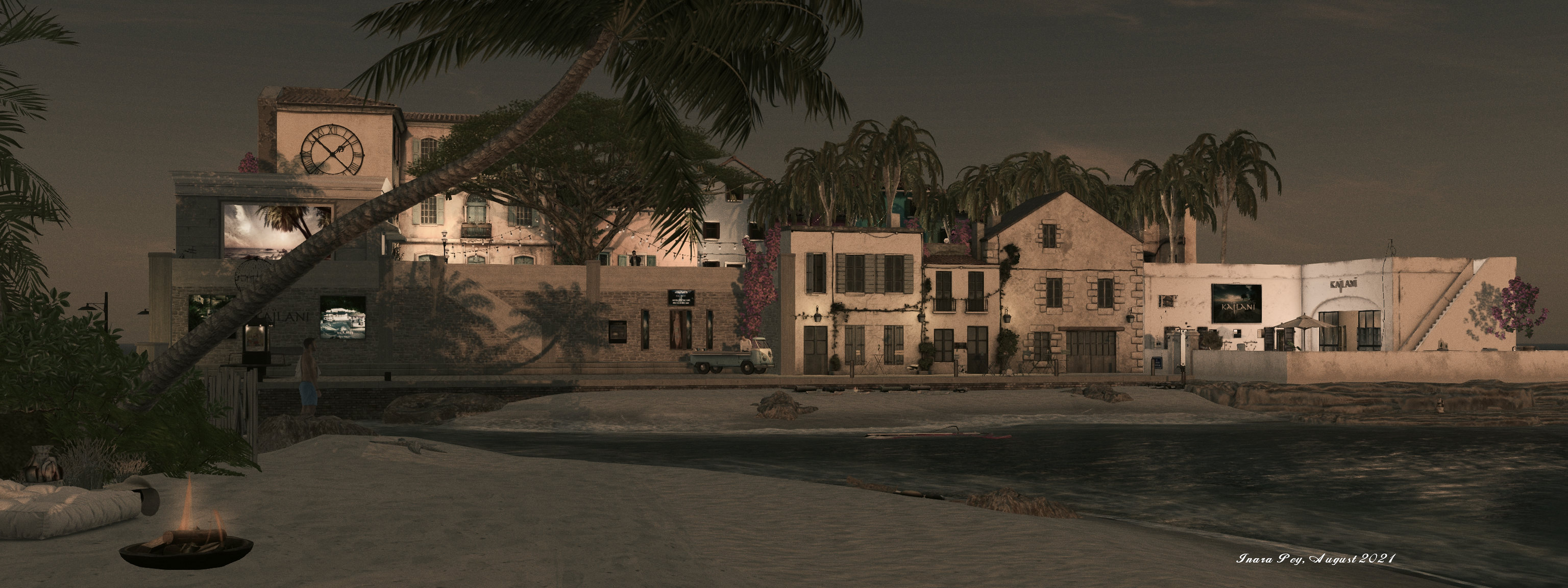
Recently opened (August 7th), this is a setting of two distinct halves that blend together as a whole, making for an easy-to-tour location that is – as the About Land description notes – nicely photogenic.

The landing point sits within the walled yard of what looks like it might be a gallery space in the future. It sits tucked into the south-east corner of the region – Kailani has an east-west orientation – forming part of the small split-level town the form one of the two major areas of the setting.

Kailani, August 2021

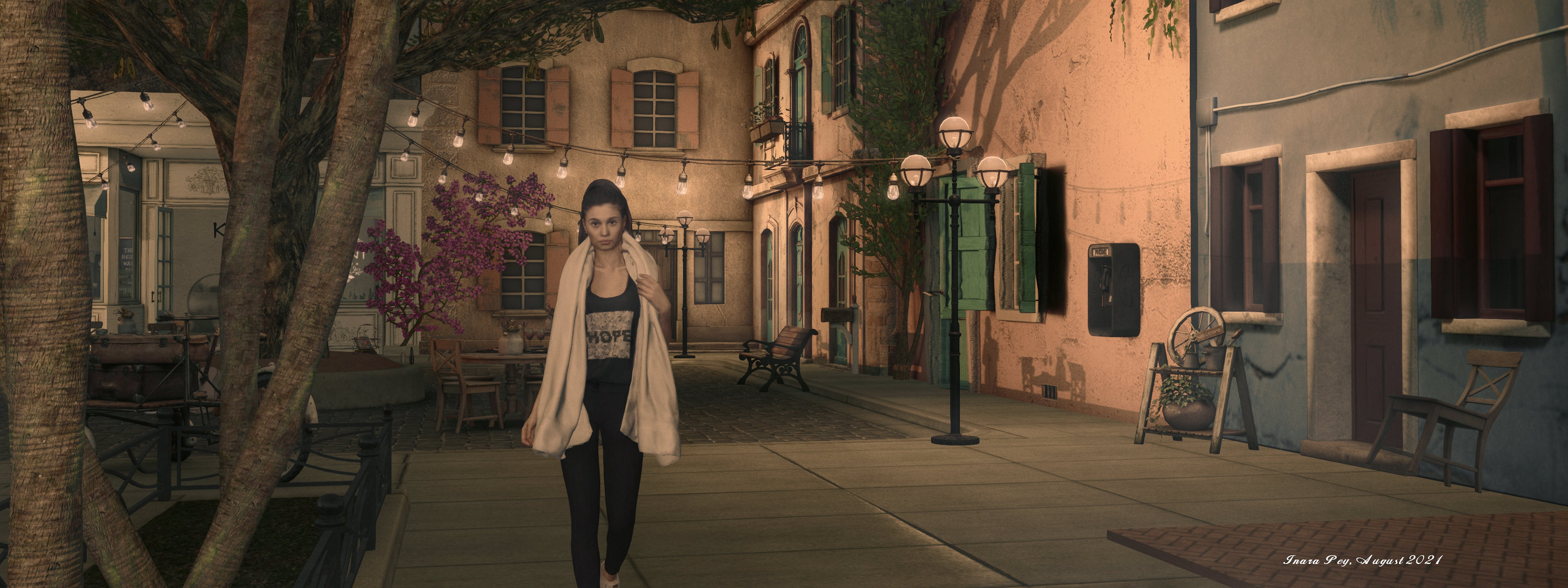
The lower aspect of this town forms a waterfront area, complete with a small beach and wharves for fishing boats. Above it, reached by steps, is a square piazza and a cobbled street that sits between two paved sidewalks shaded by palm trees and the broad umbrella of a monkeypod tree. Brightly coloured houses line one side of the street, pointing the way to the Kailani café sitting in the little piazza, while a number of static NPCs add a sense of life to the setting.

West and north, separated from the rest of the region by a curtail wall of high cliffs and from the little town by a narrow channel of water, is a broad beach that arcs around a tropical forest that holds its own little secrets awaiting discovery.

Kailani, August 2021

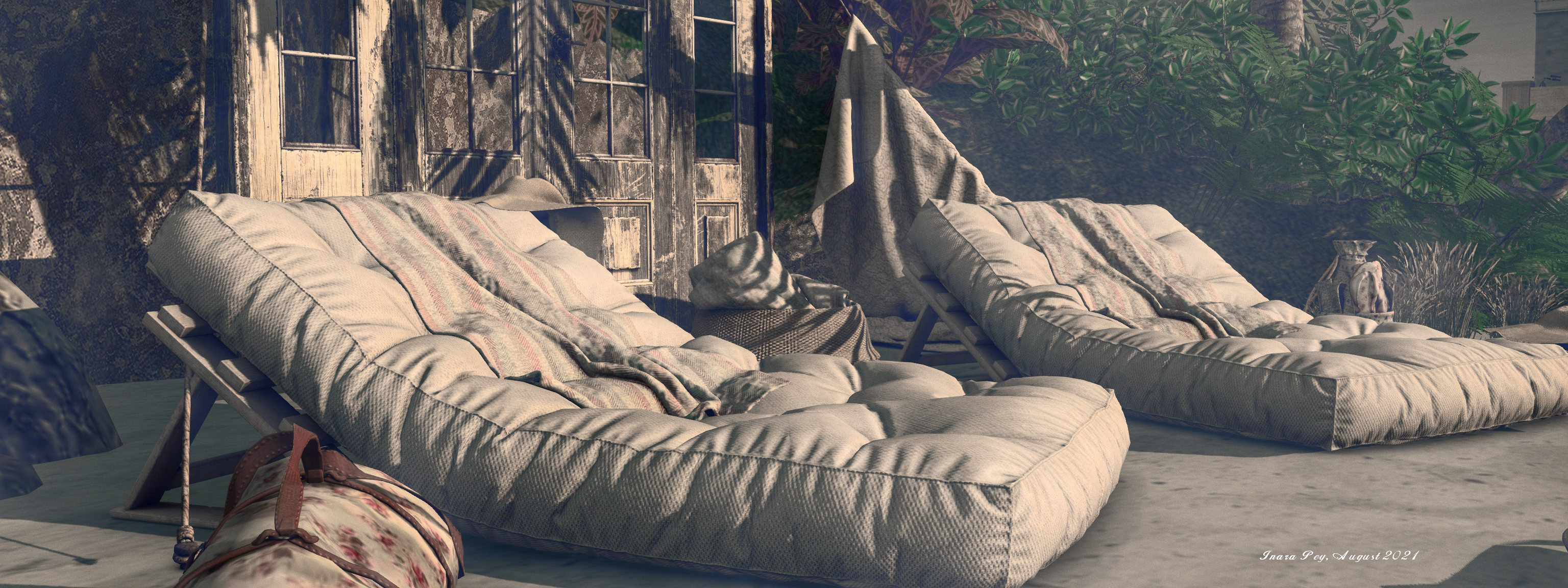
This beach itself is home to the Hermit bar, while there are numerous places to sit both on the sand on on the water. At the western end of the beach, a boardwalk passes over the shallows to a circular sand bank where further places to sit and / or escape can be found. A second board walk skirts a small set of falls at the forest’s eastern end to reach a little set of facades nestled beneath the cliffs almost is if they are a little holiday home for visitors.

To reach the second board walk explorers must make their way through the forest to where wooden steps descend down to it. The route will carry visitors past the locations event space (and claim a group gift if so minded), and find a further place to sit and relax beyond it that offers a nice little view back towards the town.

Kailani, August 2021

There’s more to be found here (will you find the little cavern, for example?) as the setting sits beneath a setting Sun that casts long shadows photographers may enjoy playing with. However, other then repeating the fact Kailani offers multiple opportunities for photography and kicking-back (trying alternate EEP settings is recommended), I’ll leave things at that and suggest you hop along to witness things for yourself.

Thanks again to Shawn for passing along the LM!

Kailani, August 2021

SLurl Details

  • Kailani (Destiny Isle, rated Adult)

2021 SUG meeting week #33 summary

Craggy Island, May 2021 – blog post

The following notes were taken from the Tuesday, August 17th, 2021 Simulator User Group (SUG) meeting. The meeting was recorded by Pantera Północy, and the video is embedded at the end of this summary. Note this summary focuses on the key points of the discussion where there is something to report.

Server Deployments

There are no planned deployments for week #33, with Mazidox Linden leaving the following note in the deployment thread:

There are no rolls planned for the week of August 16th. We’re looking at possibly rolling out our performance optimizing configuration changes to all RCs next week and putting a new maintenance release on RCs that are already optimized, but we need some more time to gather and parse the relevant data, plus testing the Maintenance release.

SL Viewer

There have been no official viewer updates to mark the start of the week, leaving the current crop as follows:

  • Release viewer: version version 6.4.22.561752, formerly the CEF Update RC viewer, issued July 24 and promoted August 10  – NEW.
  • Release channel cohorts (please see my notes on manually installing RC viewer versions if you wish to install any release candidate(s) yourself):
    • Simplified Cache RC viewer, version 6.4.22.561873, issued August 9.
    • Grappa Maintenance RC, version 6.4.22.561850, issued July 29.
  • Project viewers:
    • Legacy Profiles viewer, version 6.4.11.550519, dated October 26.
    • Copy / Paste viewer, version 6.3.5.533365, dated December 9, 2019.
    • Project Muscadine (Animesh follow-on) project viewer, version 6.4.0.532999, dated November 22, 2019.
    • 360° Snapshot project viewer, version 6.2.4.529111, dated July 16, 2019.

360° Snapshot Viewer

As I’ve reported through both my Content Creation User Group and TPV Developer Meeting updates, work has resumed on the 360° Snapshot viewer. This takes a total of 6 images  (four around your camera position and one looking down and one looking up), which are then stitched together into a 360° image that can be used on various platforms. Part of the work has involved in getting the viewer able to take these shots has involved making simulator-side changes to ensure that objects not in your direct field of view at the time the snapshot is initiated (e.g. behind your camera) will be rendered correctly when all of the images are captured by the viewer.

This work, as well as updates to the viewer, has now reached a point where Alexa Linden has been out and about testing the viewer, and you can see the results of her trials on Flickr (be sure to click on the images to engage Flickr’s 360° playback). There is no data on when the updated project viewer will be publicly available but it will apparently it will be “Real Soon Now”.

In Brief

  • The code for controlling the data one what the viewer needs to render is called the Interest List. There have been some issues with this code, and further work to improve it is planned, but has not climbed sufficiently up the priority list to gain attention as yet.
  • The “2 second delay” rezzing bug continues to be an issue, particularly in combat-related regions where weapons require projectile rezzing. In encountering the issue, users have noted the following:
    • Restarting a region can eliminate / reduce the impact of the bug for around a 24-hour period before it starts to be a problem once more.
    • The more scripts within a newly-rezzed object, the longer the delay in rezzing.
I’m fairly certain that something is not getting released correctly. It is a matter of hunting it down and see what’s holding onto that memory.

– Rider Linden

  • BUG-229301 “Maximum Memory allowable by scripts not being reset until teleport or relog” – this also continues to be a problem, and it has been observed that temp attachments suffer the same issue with recently recompiled scripts: the script memory on the avatar increases when the temp object is attached, but does not go down after the object is removed and no longer exists, although a region crossing or teleport will correct the memory.
  • Some using external services are still seeing 5xx errors with HTTP-out messaging. Those experiencing them appear to find them more an annoyance than a show-stopper.