Urban scenes in Purple Crayons

Purple Crayons, Private Property; Inara Pey, February 2015, on Flickr“The Lost Town” – Purple Crayons (Flickr) – click any image for full size

Update, February 26th: I’ve received a note saying that Purple Crayons and Square Pegs in Round Holes will be closing on March 5th, 2015.

My recent visit to The Lost Town, Jordy B. Zipdash’s build on Rawh’s homestead region of Square Pegs in Round Holes, reminded me that I had yet to blog about another of Rwah’s builds, that of Purple Crayons, which I visited a little while ago, but had yet to write about; so I decided to correct that oversight.

Rwah charmingly describes Purple Crayons as a place where “colouring outside the lines is the norm,” and “nothing makes much sense, where there is little reason or rhyme as to why, it just happened.” The result is a build with mixes urban, rural and coastal builds into an interesting and photogenic whole, and which offers the curious much to explore.
Purple Crayons, Private Property; Inara Pey, February 2015, on Flickr“The Lost Town” – Purple Crayons (Flickr) – click any image for full size

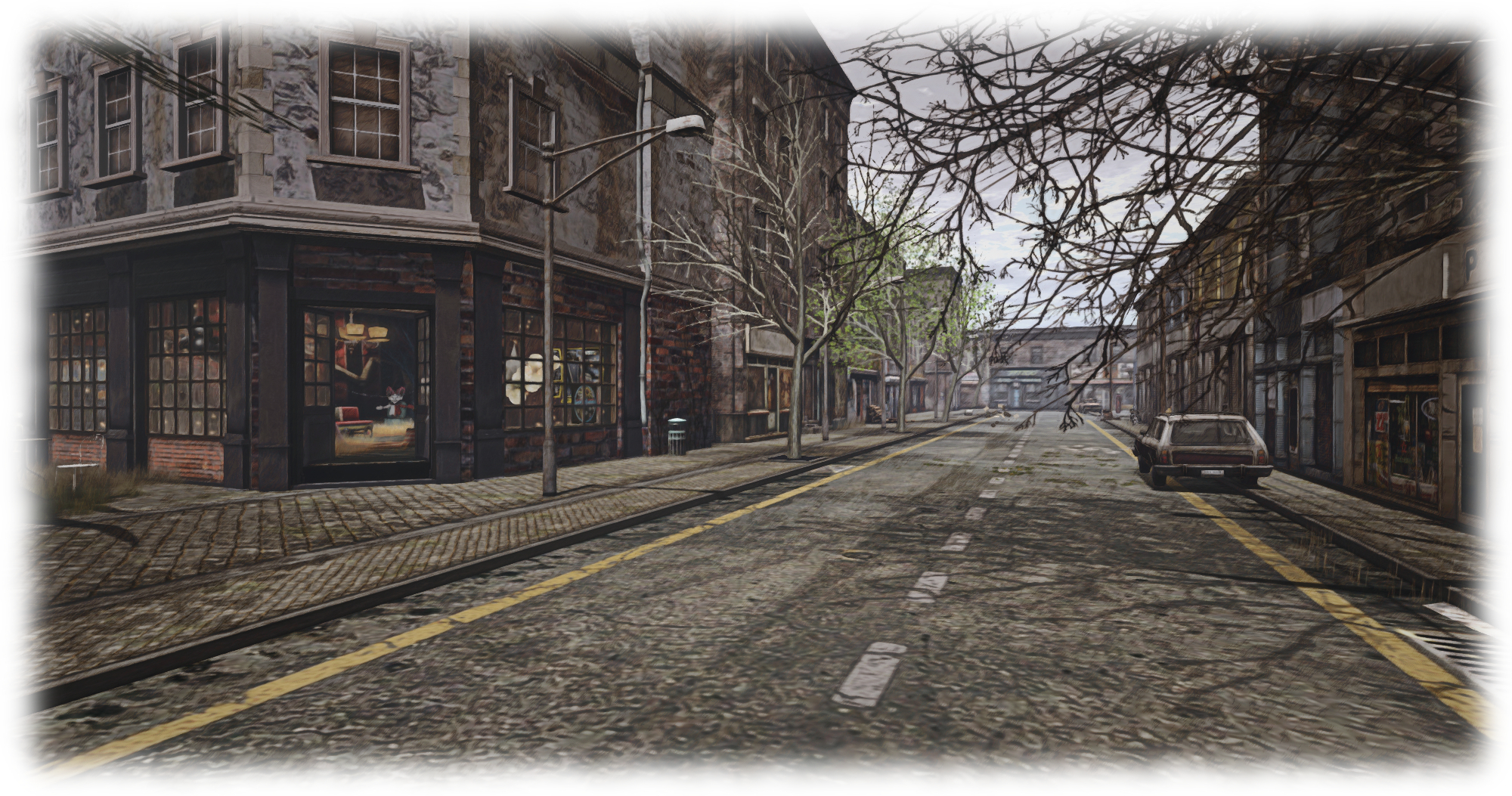
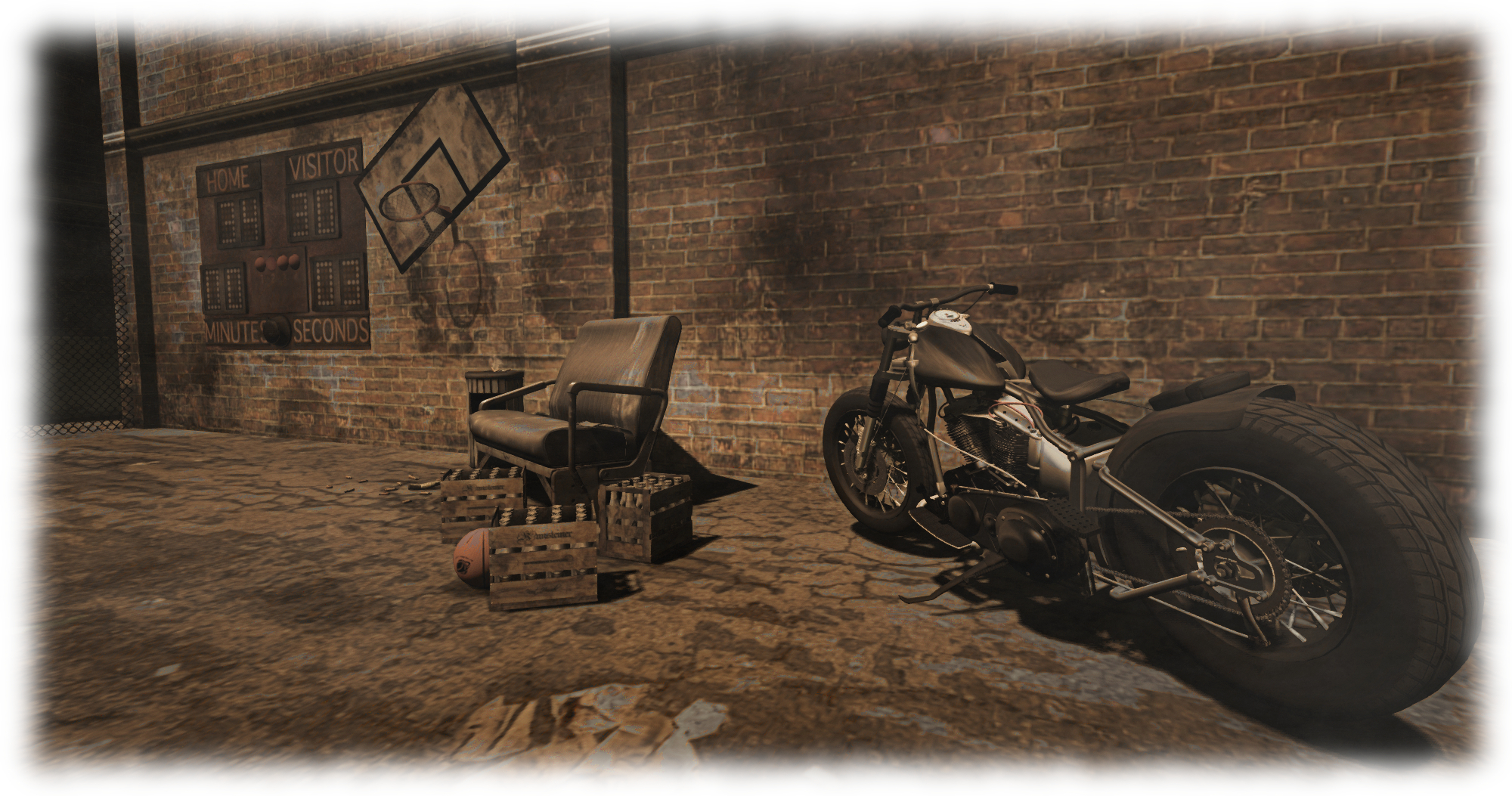
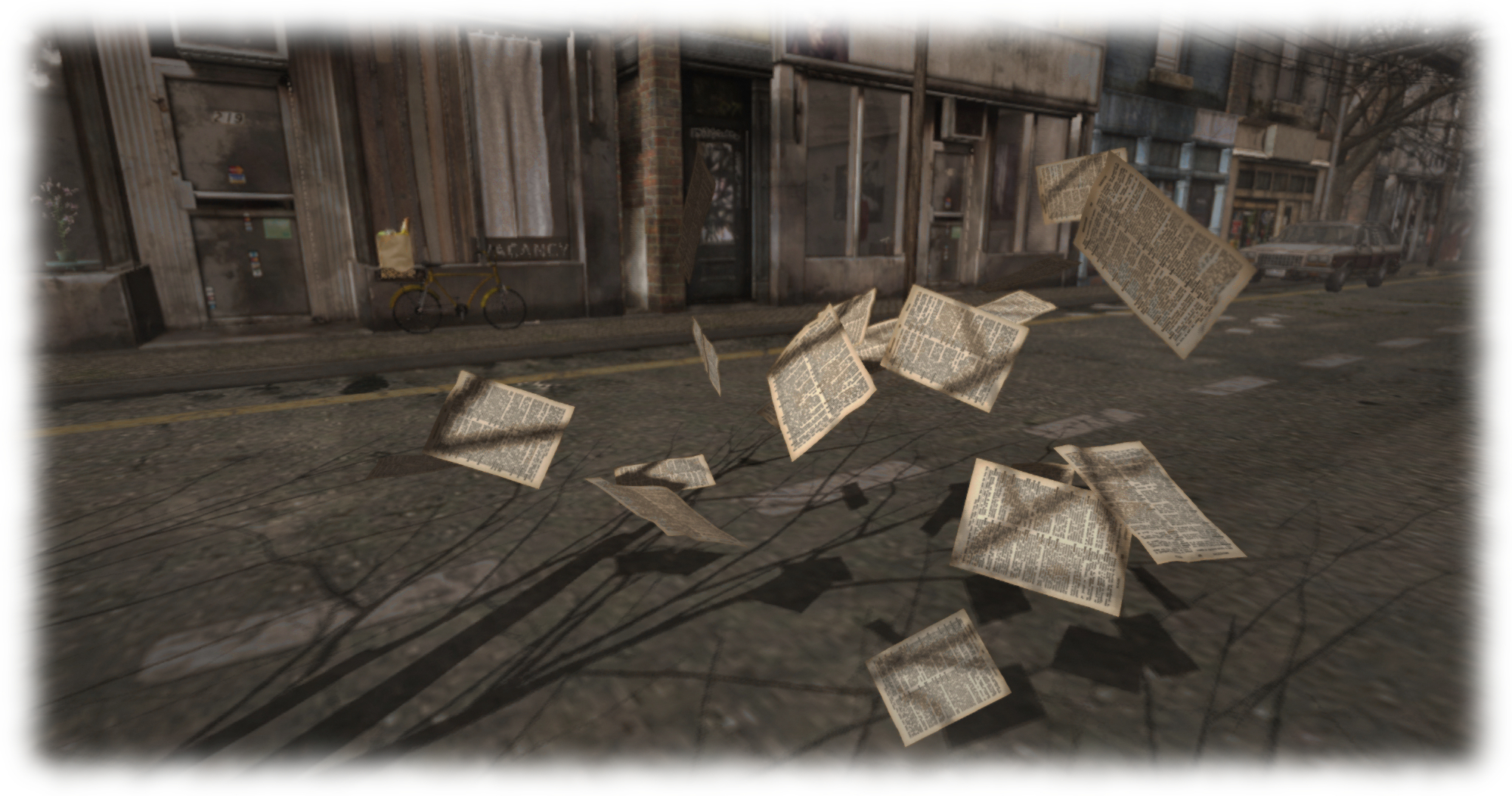
Visitors arrive at the mouth of a tunnel, from which stretches a paved road lined on either side by somewhat run-down shops; clearly a place which has seen better days. Several of the premises lining the street are façades, but equally, several are not, and can be entered. It’s worthwhile taking a little time to discover which these are, as some contain small art gallery spaces, including a studio by Thorn Arisen, who offers evocative portraits of SL avatars and life through his Flickr stream.

One of the things that makes Purple Crayons so natural in appearance is the “stepped” nature of the urban build; above and behind the main street is a raised section of the town, reached via steps. It is something that helps give the place more of that feeling there there is no rhyme or reason to the design of this little urbanised corner of the world – it just happened.

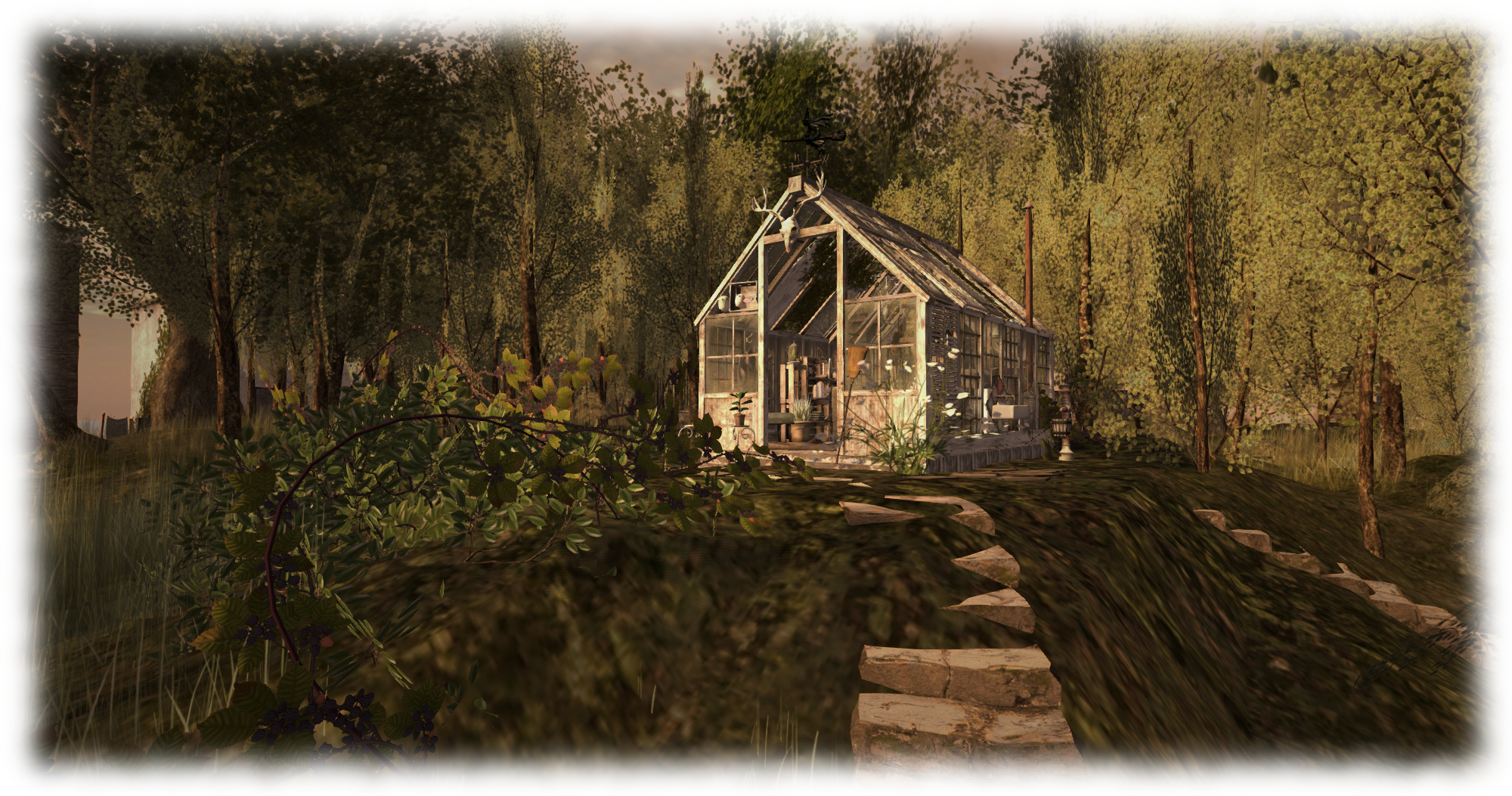
Beyond the buildings sits a small area of woodland which separates the urban grunge from a pristine beach to the north, complete with a prim little pier which appears to be far better maintained than the buildings in town. The beach itself seems to grow a little shabbier the further it travels to the east and west and approaches the edges of the town. To the east, for example, sits another wooden jetty, this time with was appears to be a slightly beaten-up bar promising Girls! Girls! Girls! To the west, shade from the sun is provided by the hulk of an old bus.
Purple Crayons, Private Property; Inara Pey, February 2015, on Flickr“The Lost Town” – Purple Crayons (Flickr) – click any image for full size

Yet there seems to be more here than meets the eye; the questions is, is it intentional, or purely happenstance, as the region’s description might suggest? The aforementioned bar, for example, is anything but, and if you look around carefully enough, a story seems to suggest itself, perhaps involving lost love and regret. The walk through the woodland to the pristine beach to the north also nudges the subconscious into perhaps making connections and drawing conclusions: past times of happy picnics, carefree vacations, all separated from the present just as the beach is separated from the town by the trees.

Or perhaps it really is just a design of contrasts, without intent, existing simply to be enjoyed. Only you can decide.

With rezzing open, and auto-return set to 30 minutes (but, as always, do please clean-up behind you anyway), Rwah invites people to make use of Purple Crayons for the photography, if they wish, and provides a few simple rules she asks people to observe during their visit.  Do abide by them and enjoy your explorations.
Purple Crayons, Private Property; Inara Pey, February 2015, on Flickr“The Lost Town” – Purple Crayons (Flickr) – click any image for full size

Related Links

Lab updates on forthcoming improvements for SL

secondlifeOn Monday, February 9th, the Lab issued a blog post outlining some of the upcoming improvements to Second Life.

In all six improvements are listed, five of which are user-facing, while the sixth should also yield benefits, although these may not be in terms of observable differences in how SL operates for most people. Further of the six listed, four have project viewer associated with them, three of which relate to visible viewer-side changes in terms of improved or new functionality. The remaining two updates should be appearing as either project or release candidate viewers in the very near future.

Regular readers of my weekly SL project updates will likely already be familiar with these improvements, at list in principle, but I’ll run through them here as well.

The first of the improvements which is already available for testing is the new Avatar Hover Height (AHH) feature. For those who remember it, this effectively sees the return of the old “z-offset height adjustment” found in many TPVs, which allowed users to adjust their avatar’s height relative to the ground, whether standing, sitting or kneeling, or when using poseballs, etc., to ensure they were correctly positioned relative to whatever they were standing / sitting / kneeling upon.

Now in a project viewer (and soon to be a release candidate: Avatar Hover Height provides a means of adjusting your avatar's graphical height above the ground / floor / objects, as seen by yourself and others
Now in a project viewer (and soon to be a release candidate: Avatar Hover Height provides a means of adjusting your avatar’s graphical height above the ground / floor / objects, as seen by yourself and others

I’ve provided a complete overview of the new functionality, which does not replace the existing Appearance panel Hover slider), and server-side support for it is now available grid-wide. So, if you want to try-out the feature for yourself, you can do so by downloading the Avatar Hover Height project viewer. I’ll continue to provide updates on this feature under the Avatar Hover Height tag in this blog.

The Marketplace listing panel is the viewer-side hub of the new VMM functionality

The second of the improvements currently undergoing testing is the Viewer-managed Marketplace (VMM). This is more specifically aimed at people selling goods on the SL Marketplace, and provides them with the means to manage their Marketplace inventory and carry out an number of Marketplace operations from directly within the viewer.

Server-side support for this functionality is only available on Aditi, the beta grid at this point in time, and I’ve also provided an overview of how it works, complete with a look of the viewer-side changes and how to use the test regions on Aditi for those interested. Testing of VMM on the main grid should be commencing some time in the next month (but not until after February 14th), and I’ll continue to carry news about it under the Viewer-managed Marketplace tag in this blog.

The third improvement that is available for testing and mentioned in the blog post is that of the new Mesh Importer (upload) project viewer. As the name suggests, this provides a modified mesh uploader with optional debug output, performs name-based LOD association, and handle models with many materials, allowing models with more than 8 unique faces to be imported.

A number of bug reports have already been filed for this viewer – see the JIRA filter list for details.

The remaining two updates which will be visible to users should be appearing in project or release candidate viewers in the near future are:

  • An improved means to control and organize the many notices users receive: inventory offers, group notices, event invites, and money transactions, which will offer a new floater for such messages, rather than simply having them arrive in the same pop-up / chiclet formats which make them indistinguishable to one another at first glance
  • graphic-presets-1A means for users to save one or more sets of graphics settings on a per-account basis, allowing them to quickly switch between different sets of graphics options to assist with performance as they move around the grid (so, for example, you might have a set of “low” graphic settings you could switch-on in order to maintain performance in busy regions, and a set of “high” graphics settings, with as many bells and whistles turned on as you like and in accordance with your GPUs capabilities,, for use in quieter regions). It will also provide controls for defining how other avatars are rendered in your field of view, by allowing you to define a limit above which the viewer will cease rendering avatars fully, and instead will render them as a sold colour imposter.

The last update mentioned by the blog post is that of the Lab’s extensive tool chain update and changes to the viewer autobuild process. While this won’t bring any noticeable changes to the viewer UI, etc., it should, as the blog post notes, “improve stability, performance, and the productivity of developers so that we can more quickly bring you an even better Second Life.”

As added benefit in this work is that it should in time allow TPVs to build their viewers using the same packages as the Lab a lot more easily. And, as a side note, it also potentially smooths the way for the Lab to produce 64-bit versions of the official viewer, although there are currently no plans in the pipeline for them to start doing so, due to the 32-bit versions of the official viewer being very stable on 64-bit operating systems.

An initial project viewer built using the new tools is already available, but note that this does not contain any functional changes compared to the current release viewer.

In addition, as the Lab’s blog post notes, a similar operation has been under way to update a number of the tools used to build the server-side simulator software as well.

Related Links

LG morph Cardboard into plastic to rival Samsung in the mobile VR world

LG's VR for G3 uses Google Cardboard to bring VR to users of their G3 'phones
LG’s VR for G3 uses Google Cardboard to bring VR to users of their G3 ‘phones

In June 2014, Google informed the world that, in order to enjoy a VR experience on your mobile ‘phone, all you need is … Cardboard. Then, as I reported at the end of 2014, Samsung announced the availability of its Gear VR headset, which utilises their Galaxy Note 4 phablet and technology from Oculus VR, while Zeiss released VR One for the Samsung Galaxy S5 and iPhone 6.

Now, not to be outdone, Samsung’s home-grown rival in the world of mobile devices and consumer electronics, LG, is also getting in on the act.

On Monday, February 9th, LG announced the availability of VR for their G3 handsets. Like Google’s DIY cardboard kit (made available in full kit form by Dodocase, to save you having to source the parts yourself), VR for G3 is a hand-held unit providing a set of optics into which LG’s new range of G3 ‘phones can sit. In fact, not only does it look like Google Cardboard’s grown-up cousin, it is actually based on the cardboard headset design and is intended to be used with the Google Cardboard development environment for mobile VR experiences, and any apps built using that environment.

What’s more, it’s free. Well, free for those buying a new LG G3 handset, and then possibly only for a limited time period. Currently, no details have been released on pricing once the promotional period has ended. It is also currently unclear if VR for G3 will be made available as a separate accessory for the G3 ‘phone.

The hand-held headset is modelled on Google's original Cardboard DIY headset, and utilises the Cardboard development environment and applications
The hand-held headset is modelled on Google’s original Cardboard DIY headset, and utilises the Cardboard development environment and applications

“This is just the beginning of the virtual reality movement, which until recently was expensive and inaccessible to everyday consumers,” Chris Yie, vice president and head of marketing communications at the LG Electronics Mobile Communications, was quoted as saying in a press release from the company announcing the move. “By leveraging Google Cardboard, not only are regular consumers able to participate in the VR experience, we’ll be able to introduce this technology to future developers who may one day show us how VR can be used to improve our lives.”

VR for G3 will be rolled-out across LG’s global markets over the coming month, and the promotion will include a code allowing purchasers of the handset and headset to download the VR game Robobliteration.

With a screen resolution of  2560 x 1440, and packing a whooping 538 pixels-per-inch, the G3 handset is seen by LG as an ideal candidate for running immersive VR applications, and the hand-held headset includes optics specifically designed to leverage the screen’s capabilities.  As with Google’s original Cardboard design, a ring mounted on the left side of the headset, together with a small magnet within the unit work with the gyroscope sensor in the G3 to select applications and scroll through menus without the user needing to touch the display.

The G3 'phone sits within the snap-one cover of the headset, but the unique design of the 'phone, with it's back-mounted sleep button meanes that it doesn't have to be removed in order to place the phone into, or bring it out of, sleep mode
The G3 ‘phone sits within the snap-one cover of the headset, but the unique design of the ‘phone, with it’s back-mounted sleep button means that it doesn’t have to be removed in order to place the phone into, or bring it out of, sleep mode

Google are also keen to emphasise their involvement in LG’s entry in to the VR marketplace. “With Google Cardboard, we wanted to create more immersive and delightful experiences for anyone on their mobile devices,” Andrew Nartker, Product Manager for Google Cardboard is also quoted as saying in the LG press release. “We are excited about VR for G3, and the rich ecosystem of developers and manufacturers who are innovating with Google Cardboard and making VR more easily accessible.”

How much of an actual market exists for mobile VR has yet to be seen (by necessity, VR-on-the-go is more suited to sitting down rather than wandering the streets, so many might perfer to await the arrival of Oculus Rift CV-1 and similar headsets). However, it would appear that manufacturers like LG might see it as a way of reinvigorating ‘phone sales in the face of an saturated market.

Source links

All images courtesy of LG Electronics Mobile Communications Company.


In the hall of the Centaurs

The Centaurs' Hall
The Centaurs’ Hall – click and image for full size

Ziki Questi posted word that there’s a new build on Verdigris, home of the fabled (and quite lovely) Vintage Village by Oriolus Oliva (a place I last wrote about in July 2013), what’s more, it’s by none other than Haveit Neox, someone whose work in SL I’ve come to really appreciate and enjoy over the last few years.

The Centaurs’ Hall was apparently put together fairly rapidly, the majority of it being put in place in just three days from the start of the month, which is really quite remarkable given the complexity and beauty of the build.

The new build occupies the opposite side of the gorge above which Vintage Village is perched, the great wooden bridge built by Oriolus linking the two. When first viewed, there is something of a similarity between both the Vintage Village and The Centaurs’ Hall. Both occupy hilltop locations bordering the deep gorge which cuts through the region, and both are built out over huge piers rising skyward, their weight cantilevered to a degree: the Vintage Village in a south-north direction, The Centaurs’ Hall along an east-west line.

The Centaurs' Hall
The Centaurs’ Hall

However, that the two are different builds quickly becomes apparent as you cross the amphitheatre that forms the entrance to The Centaurs’ Hall; Haveit’s distinctive style is unmistakable, not only in the architecture, but in the overall harmony of design and use of textures and colour, and the presentation of space.

Inside the arched vaults of the Hall there is much to see, including a reproduction of The Miniature Goal, originally displayed at the Art India Galley exactly a year ago (see my review), and included here on Ziki’s suggestion. Follow the dusty tracks through the upper halls and they well lead you past some of Haveit’s glorious sculptures to the Czardas Greenhouse. While there might not be a lot of floor space available for dancing, this great room with its huge, glass-panelled walls and ceiling, offers plenty of food and drink in keeping with the origins of the name upon which it draws. Beyond the greenhouse, a broad stone terrace, dizzyingly set over the waters at the edge of the region, offers a panoramic view across the gorge to the Vintage Village.

The Centaurs' Hall
The Centaurs’ Hall

This is a quite a magnificent build, one while compliments the vintage village perfectly. Long may both continue together.

Related Links

2015 viewer release summaries: week 6

Updates for the week ending: Sunday February 8th, 2015

This summary is published every Monday, and is a list of SL viewer / client releases (official and TPV) made during the previous week. When reading it, please note:

  • It is based on my Current Viewer Releases Page, a list of all Second Life viewers and clients that are in popular use (and of which I am aware), and which are recognised as adhering to the TPV Policy. This page includes comprehensive links to download pages, blog notes, release notes, etc., as well as links to any / all reviews of specific viewers / clients made within this blog
  • By its nature, this summary presented here will always be in arrears, please refer to the Current Viewer Release Page for more up-to-date information.

Official LL Viewers

  • Current Release version: 3.7.24.297623 no change
  • Release channel cohorts (See my notes on manually installing RC viewer versions if you wish to install any release candidate(s) yourself):
    • No updates
  • Project viewers:
    • Importer project viewer version 3.7.25.298441 released on February 3rd – provides a modified mesh uploader with optional debug output, performs name-based LOD association, and handle models with many materials, allowing models with more than 8 unique faces to be imported (download and release notes)

LL Viewer Resources

Third-party Viewers

V3-style

  • Black Dragon updated to release 2.4.1.8 on February 6th – core updates: Inclusion of LL,s December 2014 maintenance release (3.7.23.297296) plus assorted tweaks and updates (release notes, download)
  • Kokua updated to release 3.7.25.35124 on February 9th- core updates: parity with RLV 2.9.6.6 and a fix for avatar appearance issues (release notes, download)
  • UKanDo updated to release 3.7.24.28064 on February 4th – core updates: parity with recent LL code released through to version 3.7.24, and with RLV 2.9.6.6. (release notes, download)

V1-style

  • Cool VL Viewer updated on February 7th, the stable branch to version 1.26.12.30 and the legacy branch to 1.26.8.88 (release notes for both)

Mobile / Other Clients

Additional TPV Resources

Related Links

“I spy with my big eye…” and landing a rocket on Earth

CuriosityNASA’s Curiosity rover has been a busy bunny on Mars. Currently still parked in the “Pahrump Hills” terrain on the lower slopes of “Mount Sharp”, the Mars Science Laboratory (MSL) rover has now completed its latest drilling activity, collecting samples from a rock dubbed “Mojave 2”.

This isn’t actually the rock from which the science team had originally hoped to gather samples. That rock, dubbed “Mojave” broke apart as a result of the percussive action of the rover’s drill during a “mini-drill” test. As a result, the rock was ruled out as a sample gathering target. “Mojave” was of particularly interest to scientists as Curiosity had images tiny, rice-grain sized crystalline minerals that might have resulted from evaporation of a drying lake, thus presenting the science team with a further insight into environmental conditions within Gale Crater.

To counter this loss, the team relocated Curiosity to  “Mojave 2”, another rock within the same outcrop as “Mojave”, and which exhibits similar crystalline features. In doing so, the team were able to bring into play software improvements only recently uploaded to the rover as a part of an overall systems upgrade, which was deployed to one of the rover’s two computer systems at the end of January.

The software improvements for the drill are the result of investigations into the fracturing of a rock during a previous attempt to obtain samples prior to the rover arriving on “Mount Sharp”. Like an Earth-based hammer drill, the rover’s drill uses a percussive action, so that as well as drilling into a rock, the drill bit effectively hammers its way into the rock. In all, there are six settings governing the amount of percussive energy used during drilling, which range from a gentle tapping (level 1) through to hammering at the rate of 30 times a second with a 20-fold increase in energy imparted (level 6).

During early drilling operations the software monitoring these percussion settings “learned” that defaulting to the “level 4” setting best met the needs of gathering samples in the harder rock types the rover initially encountered. However, this was proving too forceful for the softer rocks closer to, and on, “Mount Sharp”, but the software was unable to switch down to a lower setting.

The drill hopes on "Mojave 2" captured by Curiosity's Mastcam. Towards the top is the small, "mini drilling" test bore, just a couple of centimetres deep, created on Sol 881 (January 28th, 2015, PDT) and some 10 centimetres below it, the sample-gathering bore hole, some 6.5 centimetres deep, cut on Sol 882 (January 29th, 2015, PDT).
The drill holes on “Mojave 2” captured by Curiosity’s Mastcam. Towards the top is the small, “mini drilling” test bore, just a couple of centimetres deep, created on Sol 881 (January 28th, 2015, PDT) and some 10 centimetres below it, the sample-gathering bore hole, some 6.5 centimetres deep, cut on Sol 882 (January 29th, 2015, PDT).

The new update causes the drill software to reset to “level 1” after each drilling operation, and then step through the levels incrementally until the ideal is found. As a result, a sample was gathered from “Mojave 2” without the drill needing to step beyond the “level 2” percussion action.

Drilling operations on “Mojave 2” took place on Sol 881 and Sol 882 (January 28th and 29th, PDT, respectively). As per standard operating procedure, the first drilling operation was a test “mini drilling” to see how the rock responded to encroachment and cutting. The second, which took the dill to a depth of around 6.5 centimetres (2.6 inches). The gathered samples were then sifted and sorted through the CHIMRA system in the rover’s turret, prior to being transferred via the surface scoop to Curiosity’s primary laboratory systems, ChemMin and SAM.

At the same time as Curiosity was carrying out its initial analysis of the “Mojave 2” rock, NASA released an image captured by the HiRise (High Resolution Imaging Science Experiment) carried aboard the orbiting Mars Reconnaissance Orbiter (MRO), which forms the mainstay of the rover’s communications with Earth. The image, which was taken on December 13th, 2014, reveals Curiosity mid-way through its “walkabouts” in “Pahrump Hills”, when it was seeking potential targets of interest for further study.

While not the first time the rover has been imaged from orbit, this is one of the clearest pictures from the rover yet capture from an altitude of around 280 kilometres (175 miles) above the surface of Mars.

"I see you!" - MRO's HiRise image of the curiosity rover, obtained on December 13th, 2014, as the rover explores the "Pahrump Hills" region on a basal slopes of "Mount Sharp"
“I see you!” – MRO’s HiRise image of the curiosity rover, obtained on December 13th, 2014, as the rover explores the “Pahrump Hills” region on a basal slopes of “Mount Sharp”

Initial results from ChemMin (the Chemical and Mineralogy) instrumental has shown that the rock was likely effected by water that was much more acidic in nature than evidenced through the analysis of other rock samples obtained by the rover. The still-partial analysis shows a significant amount of jarosite, an oxidized mineral containing iron and sulphur that forms in acidic environments. This raises the question of whether the more acidic water was part of environmental conditions when sediments were being deposited to form “Mount Sharp”, or the result of fluids soaking the rocks at a later time.

ChemMin was also unable to identify a clear candidate mineral for the crystalline deposits which first attracted the science team to the outcrop; this presents the possibility that the minerals responsible for originally forming the crystals may have been leached away over time and replaced by other minerals during later periods of wet environmental conditions.

It is hoped that SAM – the Sample Analysis at Mars – suite of instruments may be able to reveal more about the nature and composition of the samples once they have completed their round of analysis. Depending on the outcome of this work, Curiosity may be ordered to gather a further rock sample from “Pahrump Hills”, or may be ordered to continue upwards and into new territory on “Mount Sharp”.

Continue reading ““I spy with my big eye…” and landing a rocket on Earth”