100,000 zaps and a Sievert

CuriosityNASA’s Mars Science Laboratory (MSL) rover Curiosity chalked-up another milestone on October 30th, 2013, when the laser which comprises part of the Chemistry and Camera instrument (ChemCam)  system mounted at the top of the rover’s mast, was fired for the 100,000 time.

The shot was one of a series of 300 fired at a total of 10 locations on a rock called “Ithaca”, and was taken at a range of 4.04 metres (just over 13 feet) from  the target. The laser is used to vaporise tiny amounts of an object (the target area being around the size of a pin head), producing a spark of plasma (ionised gas). This spark is observed via a telescope which also forms a part of the ChemCam system, and the spectrum of light from the spark is analysed to identify chemicaal and mineral elements within it.
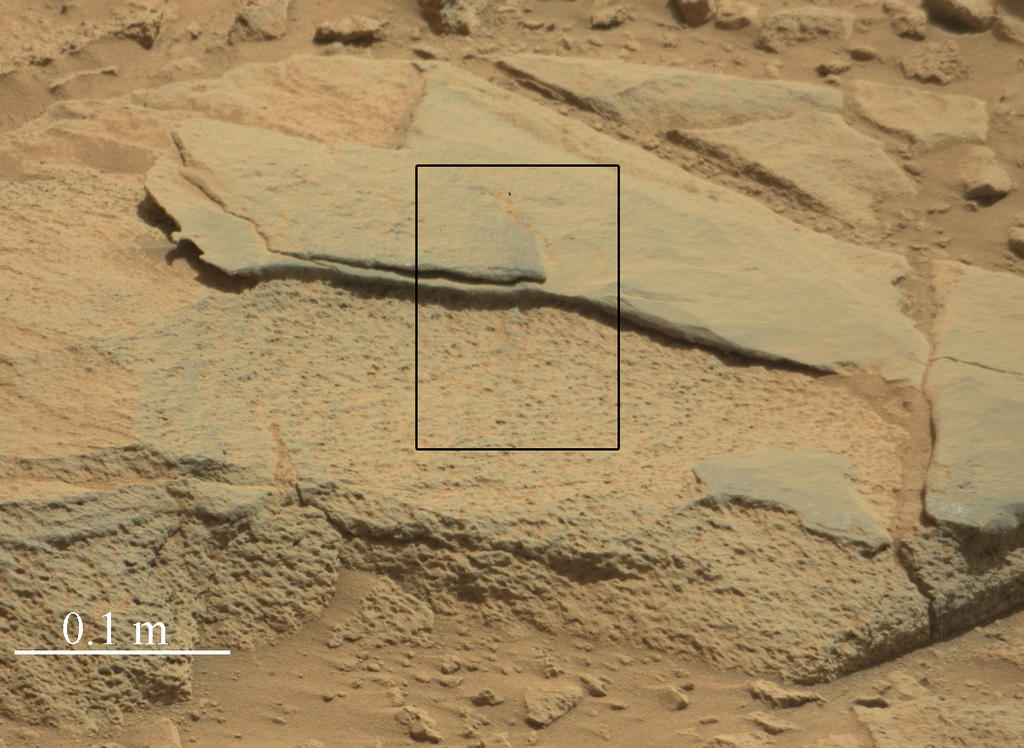
The rock “Ithaca” shown here, with a rougher lower texture and smoother texture on top, appears to be a piece of the local sedimentary bedrock protruding from the surrounding soil in Gale Crater. This image, taken by Curiosity’s Mast Camera (Mastcam), was captured on Sol 439 (October 30th, 2013). The rectangle indicates the area where ChemCam used its laser and remote micro-imager to inspect “Ithaca”. That inspection included the 100,000th laser shot fired by ChemCam on Mars

Each pulse from the laser delivers more than a million watts of power for about five one-billionths of a second. The technique used by ChemCam, called laser-induced breakdown spectroscopy, has been used to assess composition of targets in other extreme environments, such as inside nuclear reactors and on the sea floor. Experimental applications have included also environmental monitoring and cancer detection. MSL is the first mission to use the technique on another planet.
minerals-dec-13
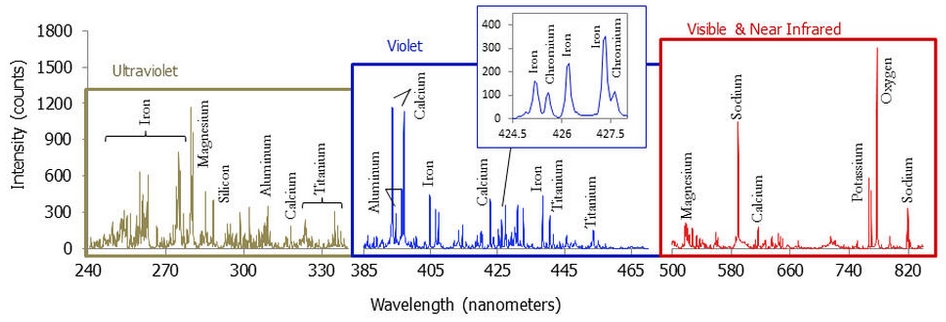
A graph showing a spectrum recorded by ChemCam which averages data from multiple laser firings at the same point on the rock “Ithaca” on Sol 439, and which included to 100,000th laser shot. The spectrum is typical of Martian volcanic (basalt) material. Although Ithaca is a sedimentary rock, the particles in the sediments that became the rock originated in igneous source rocks. The elements identified from the spectrum include a standard major-element suite of silicon, magnesium, aluminium, calcium, sodium, potassium, oxygen and titanium. Chromium and manganese, though not labelled, were also present (click to enlarge)

Virtually every shot taken by the laser yields a spectrum of data which is returned to Earth. Most targets get zapped at several points with 30 laser pulses at each point. An international team of scientists and students is mining information from ChemCam to document the diversity of materials on the surface of Gale Crater and the geological processes that formed them.  The range of materials recorded so far includes dust, wind-blown soil, water-lain sediments derived from the crater rim, veins of sulphates and igneous rocks that may be ejecta from other parts of Mars.

Since reaching the 100,000 total in late October, the laser has been fired a further 2,000 times. ChemCam also includes a micro-imager camera, which has taken over 1600 images during the time the rover has been operating on Mars.

The ChemCam mast element on Curiosity


Four Billion Years

In a little more than a year on the Red Planet, Curiosity has determined the age of a Martian rock, found evidence the planet could have sustained microbial life, taken the first readings of radiation on the surface, and shown how natural erosion could reveal the building blocks of life. MSL team members presented these results and more from Curiosity in six papers published on December 9th, 2013 by Science Express and presented them in press briefings and talks at the Fall Meeting of the American Geophysical Union in San Francisco.

As a  part of its operations, Curiosity has carried out a number of sample drillings into rocks on Mars. The second rock, dubbed “Cumberland” from which the rover obtained cuttings for analysis is now the first rock ever to be dated while sitting on another planet. Analysis of the mineral ingredients in the cuttings obtained from “Cumberland” estimates the age of the rock to be about 3.86 to 4.56 billion years; this matches estimates as to the overall age of Gale Crater itself, obtained through other means, which suggests that the techniques being used to analyse the samples gathered by the rover are reliable.

“The age is not surprising, but what is surprising is that this method worked using measurements performed on Mars,” Kenneth Farley, from the California Institute of Technology and a co-author of one of the new papers, said. “When you’re confirming a new methodology, you don’t want the first result to be something unexpected. Our understanding of the antiquity of the Martian surface seems to be right.”

Before they could measure rocks directly on Mars, scientists estimated their ages by counting and comparing the numbers of impact craters on various areas of the planet. The crater densities are correlated with ages based on comparisons with crater densities on the moon, which were tied to absolute dates after the Apollo lunar missions returned rocks to Earth.

The Cumberland sample analysis was a fundamental and unprecedented measurement which had been considered unlikely even as recently as the rover’s arrival on Mars in August 2012. To obtain it, Farley and his colleagues adapted a 60-year-old radiometric method for dating Earth rocks that measures the decay of an isotope of potassium as it slowly changes into argon, an inert gas. Argon escapes when a rock is melted. This dating method measures the amount of argon that accumulates when the rock hardens again.

The researchers also assessed how long Cumberland has been within about an arm’s reach of the Martian surface, where cosmic rays striking the atoms of the rock produce build-ups of gasses Curiosity can measure. The analysis of different gases present in the rock yielded exposure ages in the range of 60 million to 100 million years. This suggests shielding layers above the rock were stripped away relatively recently. Combined with clues of wind erosion Curiosity has observed, the exposure-age discovery points to a pattern of windblown sand eroding relatively thick layers of rock, which form a retreating vertical face, or scarp.

“The exposure rate is surprisingly fast,” Farley said. “The place where you’ll find the rocks with the youngest exposure age will be right next to the downwind scarps.”


Continue reading “100,000 zaps and a Sievert”

Kitely announces pricing changes

Kitely-logoKitely, the on-demand virtual world platform, is revising its pricing structure.

The changes, which come into effect from January 1st, will see both the Metered (also referred to as “Time-based”) payment options and the Fixed-price payment options revised with the aim of presenting a more streamlined set of options which more closely suit the needs of Kitely users.

Changes to Metered (time-based) Payment Options

The first part of these changes, as announced in a blog post and an e-mail sent to users, will see the Metered payment options substantially revised. Currently, these payment options comprise four plans:

  • Free: 1 full Metered Region plus 2 hours in-world time a month
  • Bronze plan: $5.00 a month, 2 full Metered Regions and 30 hours in-world time a month
  • Silver plan: $20.00 a month, 10 full Metered Regions and 120 hours in-world a month
  • Gold plan: $35.00 a month, 20 full Metered Regions and unlimited time in-world.

The monthly in-world time offered under the Free, Bronze and Silver plans can be used as time spent by the user on their own Metered Region(s), and/or as time they spend visiting other Metered Regions. Additional time for these plans, if needed during a month, can be paid for at the rate of 1 Kitely Credit (KC) per minute. Under all of the plans, additional Metered Regions in excess of the stated allowance can be obtained at a rate of 10 KCs per day per Metered Region.

As of January 1st, 2014, these plans will be replaced by two new account types:

  • A Regular account, which will include 1 free Metered Region, with additional options still to be announced by Kitely
  • A Premium account, which will cost $19.95 a month, include up to 5 free Metered Regions and the ability to visit any Metered Regions (your own or anyone else’s) for free (neither you nor the region’s manager pay for your visit).

For anyone who is either on, or who signs-up to, the Silver or Gold time-based plans before the end of the year (whether they are an existing user or new to Kitely), there is good news: their plan will be grandfathered-in under the Premium account, with additional benefits. This means that:

  • Those with the Silver plan will continue to pay $20.00 a month and will gain unlimited access to any Metered Regions as well as retaining their allowance of up to 10 Metered Regions (so they will pay $0.05 more a month than those signing-up for Premium accounts after January 1st, 2014, but have up to twice the number of Metered Regions)
  • Those with the Gold plan will continue to pay $35 a month and will retain their unlimited access to any Metered Regions, and the total number of Metered Regions they can have at no additional charge will be increased from 20 to 30.

This incentive is being provided to encourage people who are considering Kitely as a future option to make the move now and take advantage of this limited-time offer before it expires.

Those on the Bronze plan (which has been discontinued as an option with immediate effect) who do not upgrade to either a Silver or Gold plan before January 1st 2014, will be automatically downgraded to the new Regular account. Any second Metered Region they have developed under their Bronze plan will then be charged for at the standard rate of 10 KCs a day (the equivalent to paying as little as $1.00 a month for it, if buying KCs in bulk).

Those opting to stay with the Regular account after January 1st 2014 (whether they were on the Free or Bronze plan) will still be able to purchase additional Metered Regions at the rate of 10 KCs a day. They will also be able to upgrade to a Premium account if they wish, but they will not enjoy any of the grandfathered benefits on offer until the end of December 2013.

There is one other change with the new Metered payment options, and that is in relation to OAR (OpenSim Archive) file operations. OAR allows users to back-up their regions to their hard drive for use elsewhere, while fully respecting the permissions system (thus preventing users from exporting objects when they don’t have the required permissions as set by the objects’ creators). Currently, each OAR operation cost 10 KCs for Metered Regions. From January 1st 2014, this will be increasing to 150 KCs per operation for Metered Regions.

Kitely CEO Ilan Tochner (via Google+)

Even without the grandfathering of existing Silver and Gold account plan holders, the new Premium account still offers significant value for money, as Ilan Tochner, Kitely’s CEO and co-founder, pointed-out as we discussed the changes.

“This means that a group of builders, each on a Premium account, can get a LOT of land in Metered Regions and not have to think about time while visiting those regions,” he said, “and they can have all their Premium account friends with them in-world for as long as they want without thinking about time even though they are using Metered Regions.”

Continue reading “Kitely announces pricing changes”

Tales for Christmas and a Dickens of a time

It’s time to kick-off another week of fabulous story-telling in Voice, brought to Second Life by the staff and volunteers at the Seanchai Library SL. Also this week, Storyfest SL’s The Dickens Project is in full swing.

Seanchai Library Readings

All programmes at Seanchai Library this week commence at 19:00 SLT, and will be held on the Seanchai Library’s home on Imagination Island.

  • Monday, December 16th: Views of Christmas in 100 Words with Crap Mariner
  • Tuesday, December 17th: A Faerie Christmas  with Faerie Maven-Pralou
  • Wednesday, December 18th: Christmas in the Classics with Caledonia Skytower
  • Thursday, December 19th: Duel in the Snow (“You’ll put your eye out!”)  –  with Shandon Loring.

Please check with the Seanchai Library SL’s blog for updates and for additions or changes to the week’s schedule. The featured charity for November and December is Reading is Fundamental.

The Dickens Project 2013

TDPThe Dickens Project offers you the chance to enjoy Charles Dickens’ classic A Christmas Carol, as well as extracts from some of his other works in an immersive, interactive environment where you can learn more about the man, his writings and the times in which he lived. Having opened its gates to the public on Friday December 13th, this week sees the presentation of A Christmas Carol over fives and featuring some of SL’s best voice talents. Each reading occurs twice daily, allowing people to attend at a time that suits them.

Events take place within The Dickens Project set, and all times are SLT.

  • 12: 00 noon Sunday, December 15th: Other Works of Dickens: Chapter Ten from Little Dorrit “Containing the Whole Science of Government” with Klannex Northmead
  • Monday, December 16th:  A Christmas Carol: Stave One, “Marley’s Ghost”: 13:00 – Dubhna Rhiadra; 17:00 – Kayden Oconnell
  • Tuesday, December 17th: A Christmas Carol: Stave Two, “The First of Three Spirits”: 13:00 – Corwyn Allen; 18:00 – Caledonia Skytower
  • Wednesday, December 18th: A Christmas Carol: Stave Three, “The Second of Three Spirits”: 14:00 – Ixmal Supermarine; 18:00 – Kayden Oconnell
  • Thursday, December 19th:  A Christmas Carol: Stave Four, “The Last of the Spirits”:
    • 13:00 – Dubhna Rhiadra
    • 17:00 – Corwyn Allen
    • 21:00 – Dickens Late Night with Caledonia Skytower, Shandon Loring and Finn Zeddmore.
  • Friday, December 20th: A Christmas Carol, Stave Five “The End of It”:
    • 13:00 – Ixmal Supermarine
    • 17:00 –  Kayden Oconnell
    • 21:00 – Dickens Late Night with Caledonia Skytower and Kayden Oconnell.

All performances at The Dicken Project are free, but donations will be accepted on behalf of War Child North America.

Related Links

Of Ice and Fire: BURN2’s Santalarity

SantalarityThe Black Rock Desert is colder than you might expect this time of year.  A lot colder.  Overnight temperatures in Nevada’s high mountain desert have hit record lows.  But now, after dumping a load of fresh snow, the clouds are gone. The moon reflects brightly off the smooth, frigid, white desert.  The sky is awash with stars.

It’s been a long, lonely drive from Reno. Up ahead, a brilliant light glows. You rub your eyes, puzzled by the anomaly. Nothing lives out here. What could it be? You stop your pickup and step out to get a better view, standing on your running boards. All of a sudden, something seems to be pulling you…teleporting you…to ICE PLANET on the playa!

So reads the opening of the Press Release for the BURN2 seasonal event, Santalarity, which this year has the theme of Ice Planet: The Turning of Time, and kicks-off at 10:00 on Saturday 14th December at 10:00 SLT, running through until 22:00.

Santalarity sees the playa transformed into an ice planet where aliens have come to “help restore peace and hope and celebrate a renewed planet”. The event will feature art, music, dancing, skating, fire and fun, and will include content contributions from:

  • UltraViolet Alter
  • Leroy Horten
  • Barbs Kurka
  • Bryn Oh (with permissions)
  • TheDove Rhode
  • Eifachfilm Vacirca
  • Zorch Voom
  • Ub Yifu
  • Jedda Zenovka
  • Nathan Zetkin
  • “and more”.

The scheduled events will kick-off at 10:00 SLT with a procession by the Lamplighters, and the music entertainment will start at 12:00 noon with Ultraviolet Alter, with DJs changing on the hour through until 21:00, when DJ Astro-X will present the final set of the evening.

Related Links

Home and garden … again

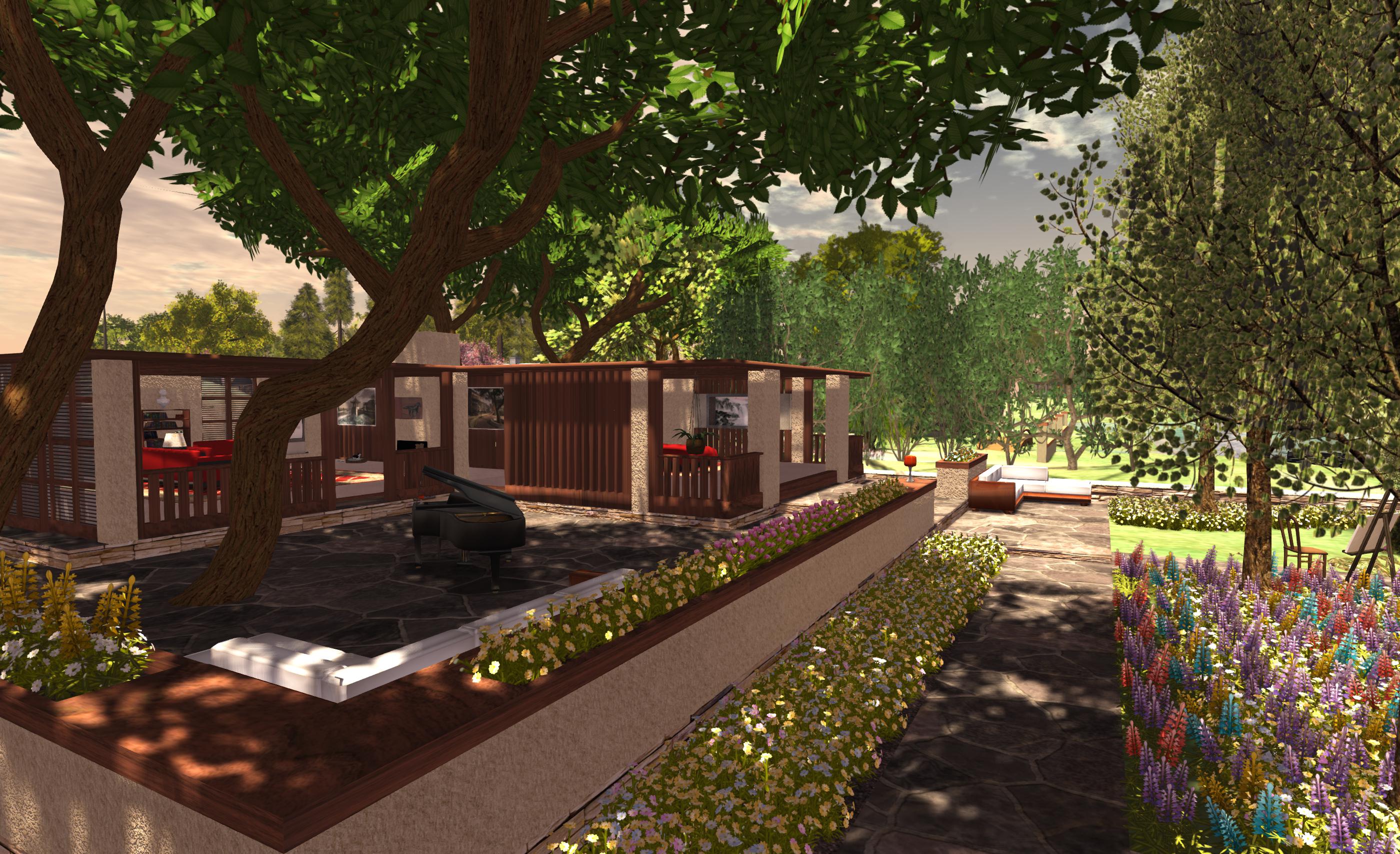
The house and revised garden paving

I recently blogged about changes to my parcel on Blake Sea and doing more to landscape it decently. Turns out that post was a little premature; at the time I wrote it, I still wasn’t really happy with things, but the creative muse had decided to the take a few days off, leaving me bereft of ideas.

Since then, I’ve had time to play and re-work things a little more – which is part of the reason blog posts have been a little sporadic of late (the other being RL and sorting out things for Christmas and New Year with family and all). The place still isn’t entirely finished, but I’m approaching a point where I’ll be reasonably comfortable with it and happy to let the rest fall into place over time.

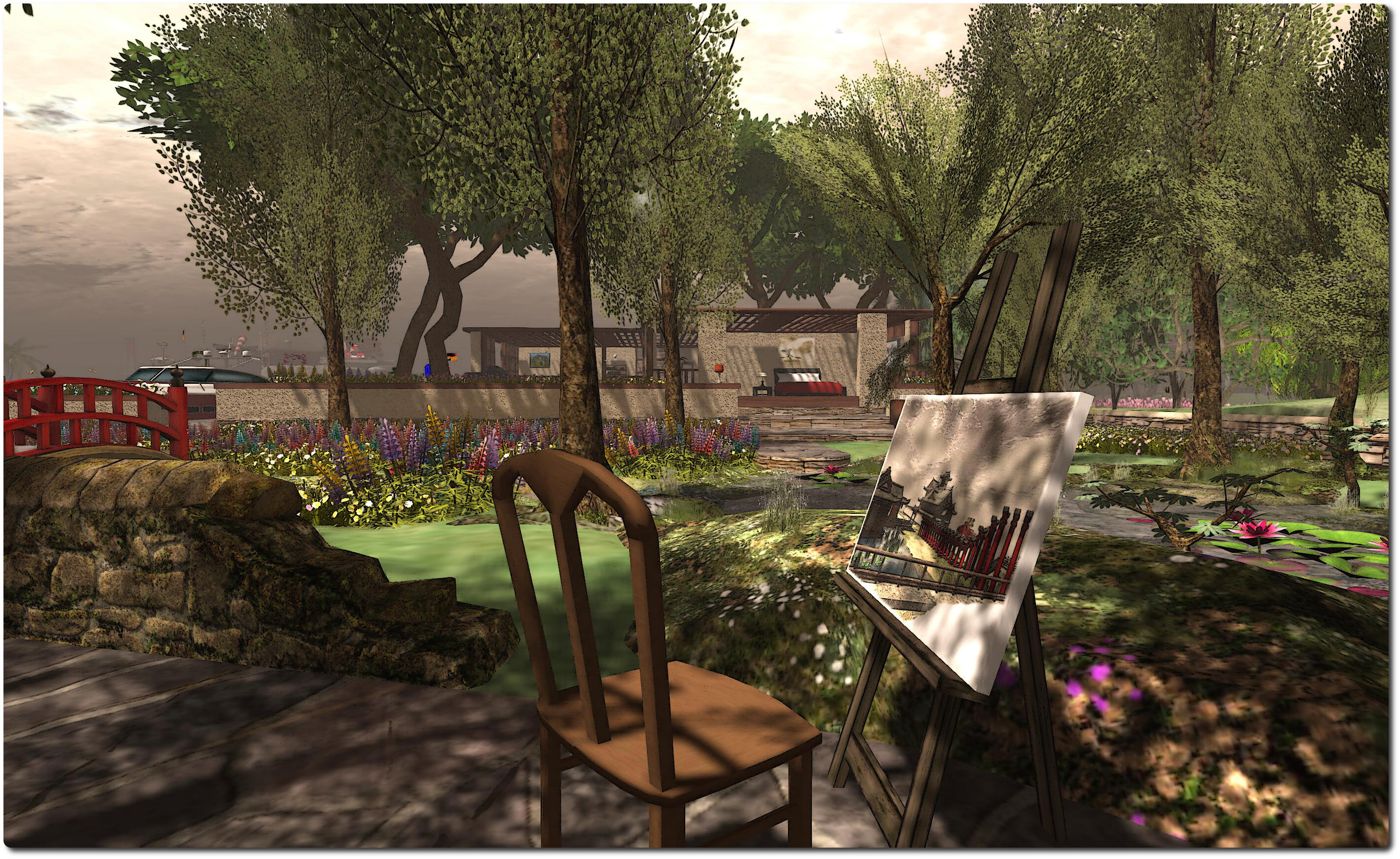
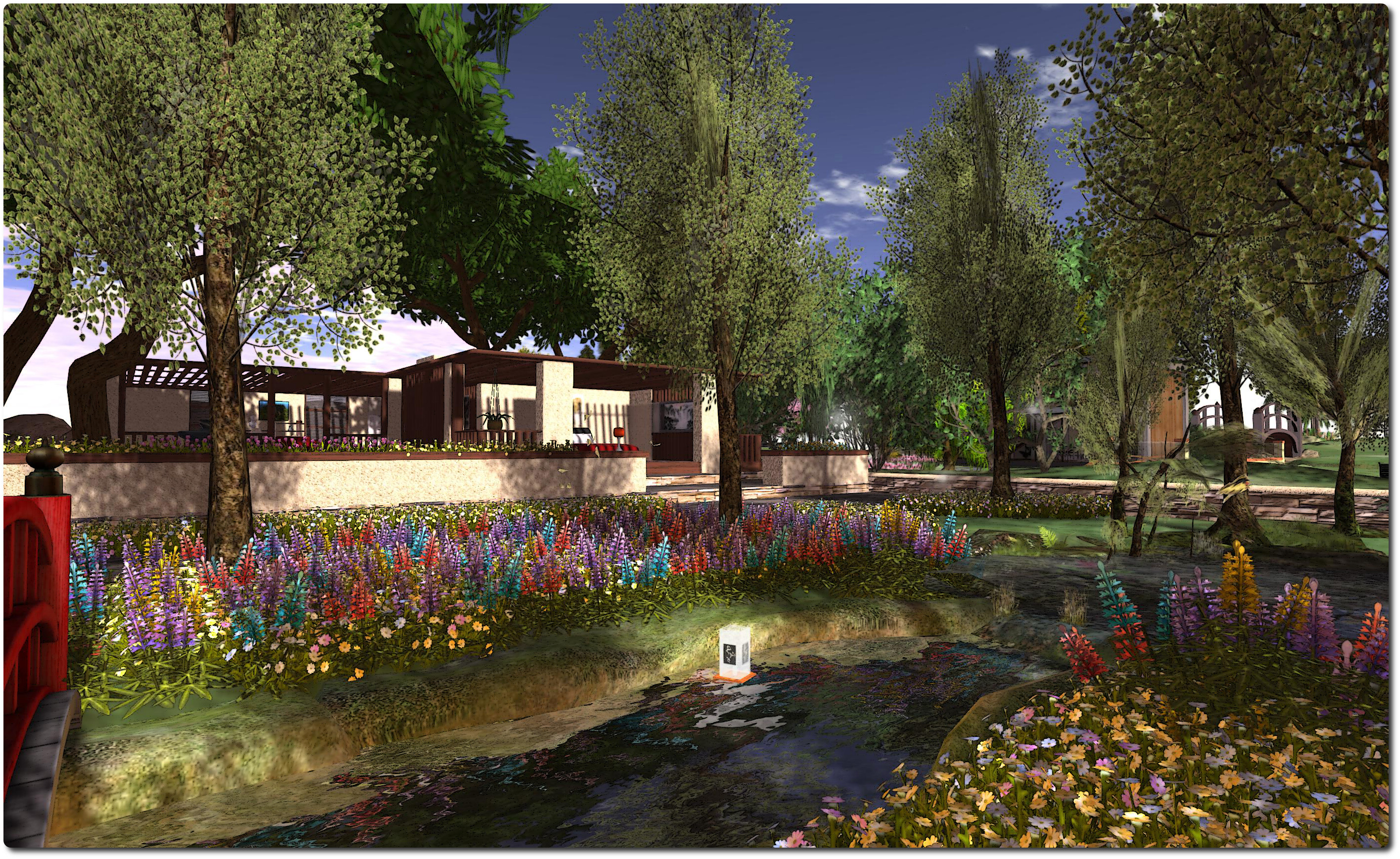
The main bits of additional work have been to add a decent mesh river course (from a kit by Flea Yatsenko), move the bridge and wooden deck, and lay some new paths which in turn allowed me to do more with the flower beds.

From the far side of the grounds

The river now more naturally splits the parcel into two – or at least, that’s the way I look at it 🙂 – which has allowed me to improve the look and feel of the river bank alongside the house with new paths and flowerbeds. The far side of the river is a little less organised, with trees and few ruined walls. It’s not quite as I’d like it to be, and could benefit from ferns or long grass, but I’ve yet to find anything that has sufficient caught my eye.

With a total land capacity of 800 prims, I set myself a ceiling of 500 for the work, of which some 246 was already accounted for by the house, furnishings and decor and also by my cruiser, Lady of Calas (157 prims on its own), leaving me 254 with which to play. Right now, the total count stands ay 491, so I’m feeling a little pleased with myself. A couple of things which have really helped along the way: the convex hull physics shape and mesh, both of which can help greatly reduce the land impact of a build.

I’ve written in the past about the ability of convex hull physics to help reduce LI / prim count by up to a half, depending on the complexity of the build in  question. Coincidentally, when I wrote that piece, I was using convex hull on the house I have now, reducing part of the structure from a LI of 32 to just 18.

From the side of the bridge

Continue reading “Home and garden … again”

Asterion Coen at LEA28: at what price art?

Update, December 4th: Asterion took the time to contact me and explain some of this issues which impacted his installation at LEA28. I’ve therefore offered a follow-up to this article which includes his comments, which I encourage you to read.

The fifth round of the LEA’s Artist In Residence (AIR) programme is in its final two months, and will draw to a close on January 31st, 2014. Already applications are open for round 6, and in the meantime, we’re well into the minimum time frame those awarded a region under the programme must open it to public access.

Asterion Coen was one of those awarded the use of a full region under AIR 5, and his build can be found on LEA28. Quite what the intent is with it, and why it was considered an “outstanding” (to quote the LEA Committee’s statement on the quality of the proposals granted the use of a full region) is, frankly, baffling.

Asterion Coen, LEA28

There is no doubt that he is a gifted creator. His military vehicles, ships and submarines,  military and civilian aircraft, trains and so on, are all beautifully executed, very well detailed and often a tour de force of prim design and construction. You can find them on the Marketplace, ranging in price from around L$900 through to over L$5,000 – and until the end of January 2014, you can find a good proportion of variants of those commercial models sitting on LEA28.

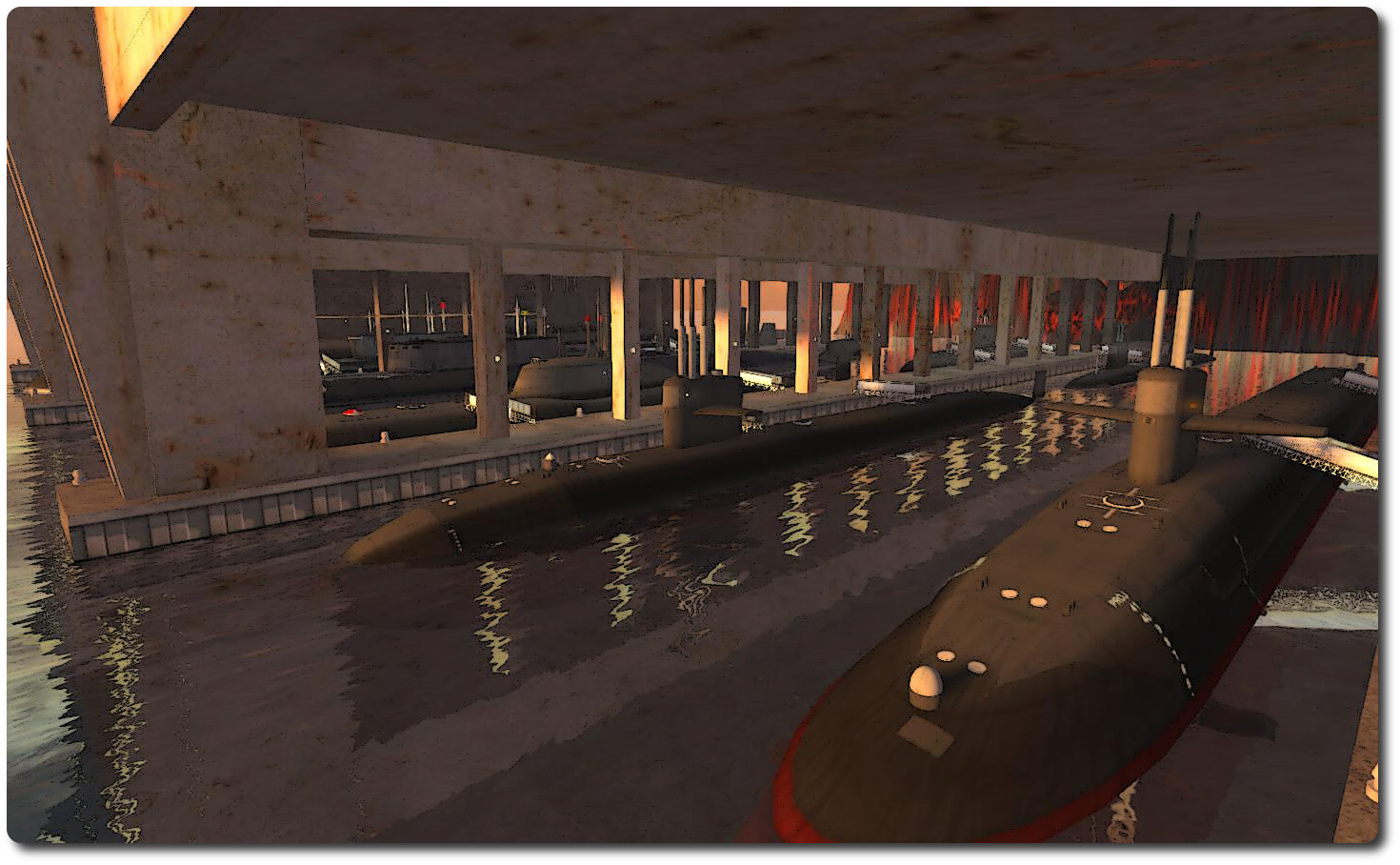
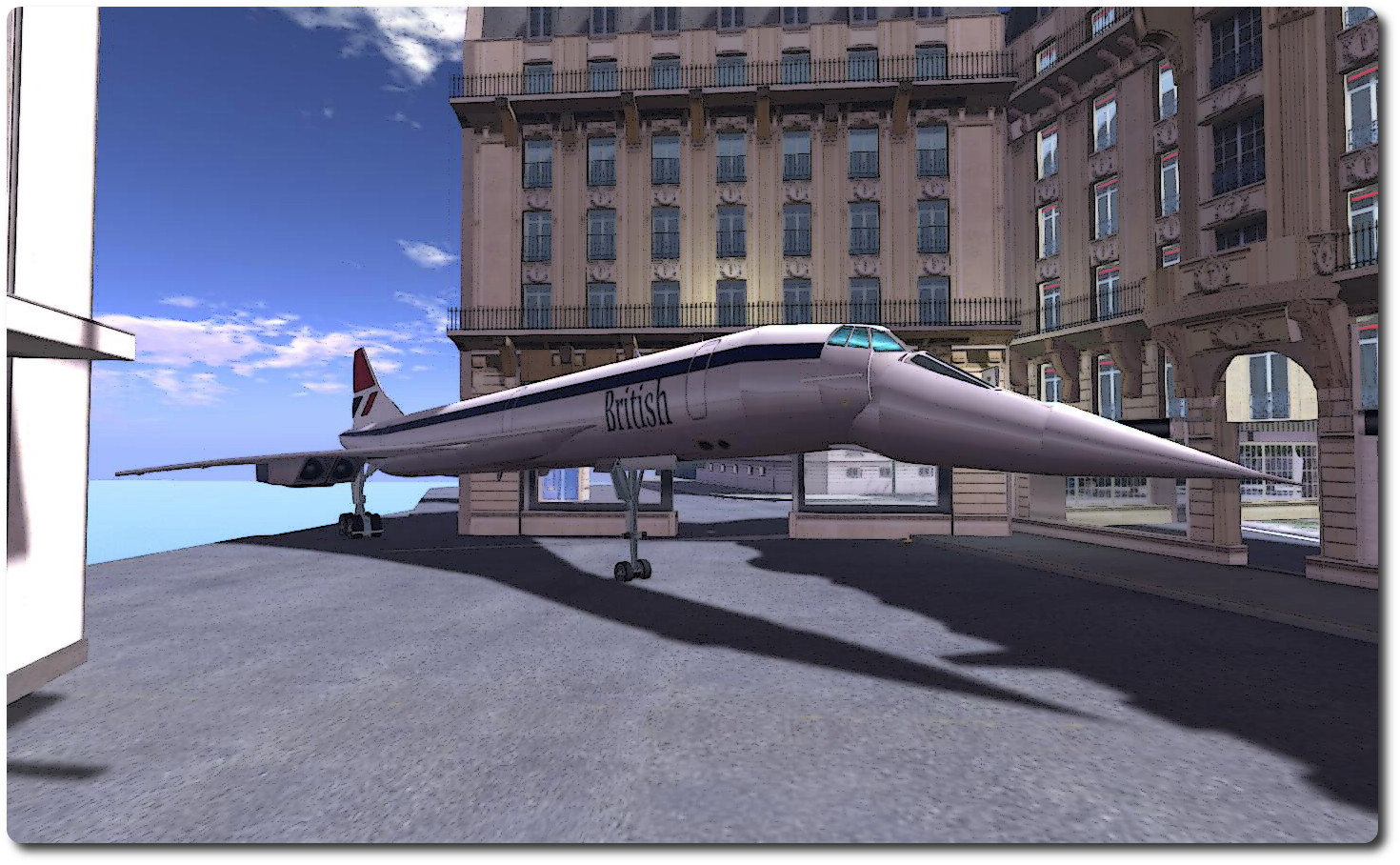
Tanks, trucks, buses, trains and a Concorde (partially embedded in a wall), sit on a platform of building false fronts and from which a Star Wars space ship is taking off / landing and above which a B-52 bomber looms. Under the platform sits a dockyard where many of Asterion’s ship and submarine models are docked. Quite why they are here, or what the build is intended to represent is unclear. A brief entry in his profile Picks suggests that it is simply intended to show the power of the prim to create a wide range of vehicles when many have turned to mesh.

Asterion Coen, LEA28

As a concept, this isn’t an invalid idea for an installation; in many respects the prim is still the backbone of content creation in SL – and still the only means to actually build in-world. I’m just sadly unconvinced that this installation actually achieves such a goal. Perhaps more guidance was needed from someone within the LEA to help visualise the strengths and attractiveness which were hopefully present in the original proposal. As it is, what is on display comes across as less of an exhibit and more of a private sandbox. Given that the majority of models do appear to be from Asterion’s commercial range of offerings (although none of them are actually on sale in the build), it also comes over as something of an inadvertent window into his SL Marketplace store. Not that there is anything wrong with an artist selling their works; just that in this case, the cart seems to be well before the horse, so to speak.

Others may see things differently; for my part, and given there were some 30 applications for the 20 regions on offer, successive visits to LEA28 have left me wondering what might have been, had the aforementioned guidance perhaps have been given, or indeed what might have been had the region been awarded to another proposal.

Asterion Coen, LEA28

Related Links