Located close to the channel connecting Blake Sea with Second Norway lies Foliage, a Homestead region noted for the presence of the Foliage airstrip and the Art Gallery Sky Hye, both of which are distinctive in the use of Art Deco style buildings designed by region holder Transparent Banshee (who also presents the neighbouring and massive Greenhouse next door).
The Art Gallery Sky Hye is home to the work of physical world artist and teacher / animator Sky Hye. Within it she presents a modest selection of her work in various styles and mediums, complete with explanatory text that provides insight into the techniques used to produce the art, thus providing an added layer of creative context to the displays.
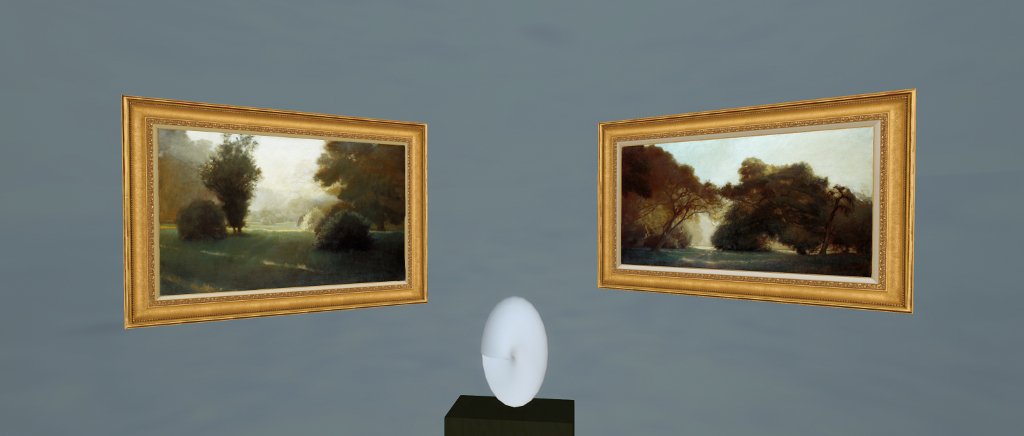
The building has a pleasant open plan look with high ceilings featuring a glass archway skylight, and space for a galleried upper level, all of which allows plenty of ambient light within the design. The lower level is divided into three areas. To the left on entering from the landing point give above, are two paintings from a series entitled Threatened Landscapes, and which show two tranquil country settings, either of which could have been painted as much in Second Life as in the physical world. A sculpture by region holder Transparent Banshee sits directly before the paintings, and a further sculpture (by Wolk Writer) can be found in the grounds of the gallery.
Split between the lower and upper levels are two displays of monotype images. As the gallery notes state, these are one-off prints created by applying paint of ink to a suitable surface – glass, metal, plastic – then transferring the image to paper via printing press.
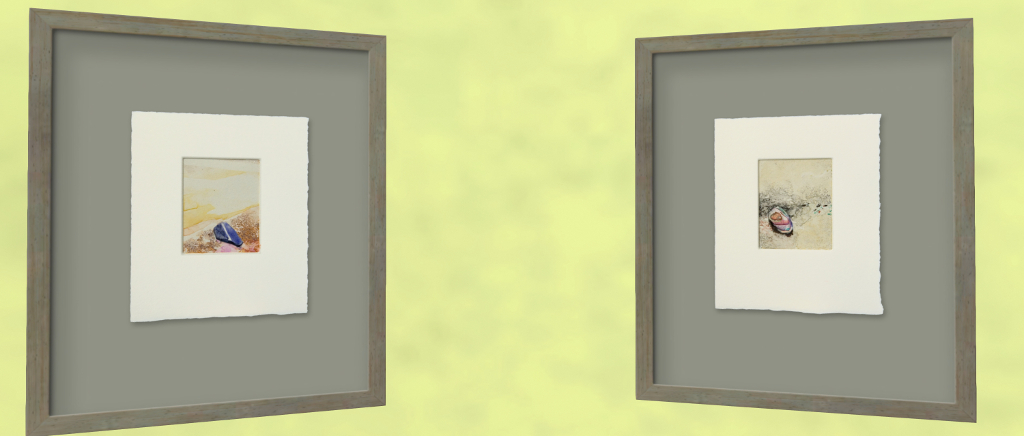
The series on the lower level is entitled Sand Treasures, and features paintings of glass fragments, shells and seaweed found on a beach. They are quite exquisite to examine – although given their size, some careful camming is required in order to fully appreciate each in turn. On the upper level, Sky presents an intriguing set of gesture figures, which she notes were painted during a figure drawing marathon prior to being transferred to paper the following day. It is perhaps the aspect of having been produced during a marathon that gives these paintings an added dynamic edge.
Also on the upper level are two paintings produced in 1999 which beautifully illustrate the artist’s skill in classical painting techniques (a further example can also be found in her Second Life profile).
The final display, located on the lower floor, is a series of wash drawings of the male body. These are drawings produced in a monochromatic style using ink or watercolours. For this series, Sky notes she used watercolour and bistre with hand-made and sized 100% linen paper. Again, while requiring some camming to full appreciate, this is again an exquisite series of images which demonstrates both the artist’s eye and skill.
The Starship Hopper under construction at the SpaceX facility at Boca Chica, South Texas. Credit: Austin Barnard/Bloomberg
On Friday, January 11th, 2019, Elon Musk tweeted the first official image of the completed Starship Hopper, the new SpaceX vehicle intended to be an atmospheric test vehicle for the company’s massive Starship vehicle that forms the upper stage of what used to be called the Big Falcon Rocket, the huge lunch system SpaceX is developing.
The vehicle has been under construction at the SpaceX test facility at Boca Chica since December 2018, with the work, surprisingly, being carried out in the open, allows passers-by to photograph and film the work and post to assorted social media, causing something of a stir.
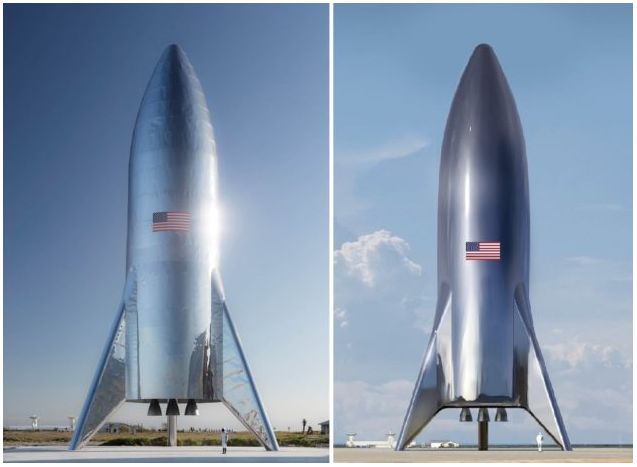
Hopper is not as large as the operational Starship vehicle will be (it is around 40 m / 130 ft tall, compared to Starship’s 52 m / 169 ft height). However, it is the same diameter (9 metres / 29 ft) and highlights the “radical” redesign of the vehicle, such as its more “retro” rocket ship look, and redesigned tail fins (which also double as its landing legs).
The completed Hopper (l) compared to a computer rendering of the vehicle (r), released on January 5th, 2019 by SpaceX CEO Elon Musk. Credit: SpaceX / Elon Musk
The vehicle is intended to be self-powered, using its own engines to fly to altitude, before making a controller descent and landing in the same manner as the full-sized vehicle. In this, its function mimics that of the SpaceX Grasshopper – a specially designed Falcon 9 first stage the company flew in order to learn about the handling characteristics of a Falcon 9 first stage attempting to make a controlled landing after a launch. Flights will initially be to low altitudes, then increase in height.
While Musk’s tweets indicated assembly of the vehicle was finished, further work is required to replace the temporary motors fitted to the vehicle with the flight-capable, methane-fuelled Raptor engines that will power it during ascent and descent. By the time the engines are fitted, the tail fins will have been fitted with shock absorbers to protect the vehicle against the impact of landings, and landing pads.
The “wrinkled” look to the vehicle’s hull is the result of the hull sections being made from a type of stainless-steel alloy which it is believed will be withstand atmospheric entry without the need for complex (and heavier) surface layering, such as reinforced carbon-carbon. Musk has indicated that the skin of the actual Starship will be smooth, and the vehicle will have “a smoothly curving nose section” (and windows).
In terms of the full size vehicle, the first of these is currently being fabricated, together with its booster stage – now simply called “Super Heavy”. Musk has indicated these could be ready as early as June 2019. Once operational, there will likely to be three versions of Starship:
The long-duration spacecraft capable of carrying passengers and /or cargo to interplanetary destinations such as the Moon and Mars or to LEO
A propellant tanker design to refuel other spacecraft – notably the passenger vehicle – whilst in low-Earth orbit.
A satellite delivery spacecraft with a large cargo bay and forward door, capable of placing both satellites and other payloads in Earth orbit, or recover items for return to Earth.
The accelerated pace of Starship / Super Heavy development is in keeping with Musk’s goal of flying Japanese billionaire Yusaku Maezawa and an entourage of artists around the moon and back in the mid-2020s. However, it comes at something of a cost. On the same day as Musk tweeted about the Hopper, SpaceX announced it would be laying-off around 10% of its current workforce, some 600 people, as it refocuses efforts on its new launch system and its broadband satellite system.
To continue delivering for our customers and to succeed in developing interplanetary spacecraft and a global space-based Internet, SpaceX must become a leaner company. “Either of these developments, even when attempted separately, have bankrupted other organisations. This means we must part ways with some talented and hard-working members of our team.
It sounds like something out of a Steampunk novel, but a collaboration between a private space company and the University of Central Florida has shown that a vehicle sent to the asteroids could explore them “indefinitely” using steam power to propel itself from asteroid to asteroid.
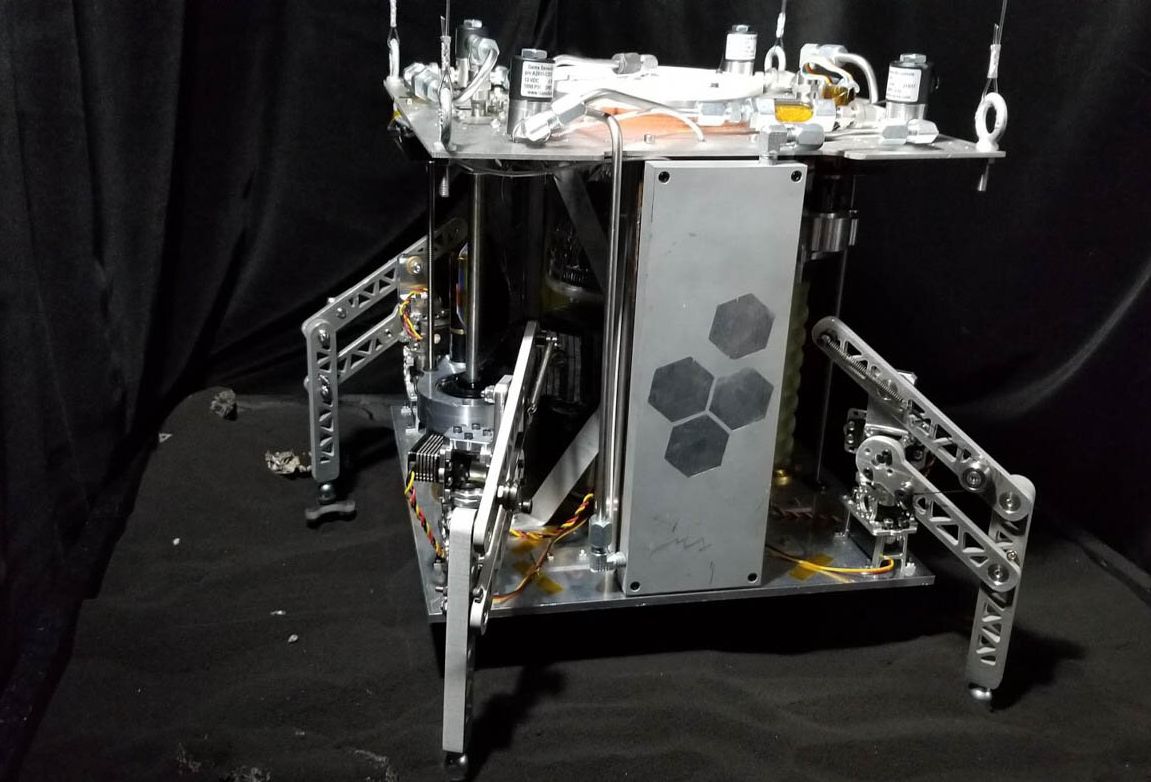
Honeybee Robotics, based in California, and the University of Central Florida (UCF) have developed a vehicle they called World Is Not Enough (WINE), capable of extracting water from asteroids or other planetary bodies, which it then uses as steam to propel itself to its next mining target. This effectively means it – or a vehicle like it – could become capable of indefinite self-refuelling and explore somewhere like the asteroid belt for decades.
By using steam rather than fuel, the World Is Not Enough (WINE) spacecraft prototype can theoretically explore “forever,” as long as water and sufficiently low gravity is present. Credit: University of Central Florida
UCF planetary research scientist Phil Metzger performed extensive computer modelling and simulations over three years in order to show the feasibility of steam propulsion, with the university developing simulated asteroid material that could be used as a feedstock. This work allowed Honeybee Robotics to build the microwave oven sized prototype, with Florida-based Embry-Riddle Aeronautical University providing the steam-powered rocket motors. The complete system was demonstrated for the first time on December 31st, 2018.
It’s awesome. WINE successfully mined the soil, made rocket propellant, and launched itself on a jet of steam extracted from the simulant. We could potentially use this technology to hop on the Moon, Ceres, Europa, Titan, Pluto, the poles of Mercury, asteroids—anywhere there is water and sufficiently low gravity.
– Phil Metzger, UFC, on the WINE prototype demonstration
One of the biggest constraints on robotic missions is the amount of fuel they can carry for manoeuvring. Being able to generate its own rocket propellant in the form of steam frees a vehicle from this constraint. All that is required is a suitable feedstock (and there is ice aplenty to be found throughout the solar system) and electrical energy, which could be supplied via solar panels or a small nuclear RTG “battery”.
Funding for the project has thus far been supported by the NASA Small Business Technology Transfer programme, intended to foster collaboration between universities and small businesses in the development of marketable commercial products. UFC and Honeybee are now seeking partners to continue development of the system.
On January 10th, 2019, Linden Lab released Sansar update R28.3. no detailed release notes are currently available (if they are needed), but the core of the update appears to be the new Social Hub.
Available from the Atlas or via a user’s Home Space, the Social Hub is intended to be an experience where Sansar users can conveniently explore, relax, play games, and – hopefully – meet other users. It can also (obviously) be used as a convenient meeting place when joining friends in Sansar.
The easiest way for users to reach the Hub when logging-in is via their Home Space, which how includes a small teleport alcove to one side (previously marked as “under construction”). Walking into the teleport device within the portal will load the Social Hub experience and deliver you to it – no need to touch anything.
The Hub comprises five areas at present: the welcome area / arrival point; a games area;, a social area (the tree house); a kinetic sculpture (take parts and throw them to form an object) and a teleport area, all connected by a network of footpaths, with space to allow for further expansion (in fact, one area was marked as “under construction” at the time of my visit).
The games area offers a series of simple games that can be played in VR mode as well as (with some fiddling to get used to things) Desktop mode. I confess the 10-pin bowling to be fun – in that the bowling lane would appear to exist in its own local gravity field – when the pins are hit, the ten to fly up into the sky and then remain there until reset.
The teleport area has (at the time of my visit) had three touch teleport portals, each of which appears to rotate through popular experiences on what appears to be a timed basis. Hovering the mouse over a portal will display the current destination for a portal.
The tree house offers seating for chat, etc, with more seating at the arrival / welcome area.
Note that when visiting the Social Hub, and as with the Home Space, the free cam capability in Desktop mode (F4) is disabled.
Given the ease of access from people’s Home Spaces, there is a potential for the Social Hub to become popular as a place to mingle and meet. Certainly during my own tour, there were around seven Greys (brand new avatars) who passed through – and interestingly, the ratio of VR to non-VR arrivals was biased towards VR (4 to 3).
However, the more I see Greys, the more I find myself wondering how they might dissuade people from sticking around in Sansar unless the find someone who can help them with their appearance (not exactly easy, given avatars vanish into Look Book); again, in y visit, I had two Grey approach me: one confused as to whether my avatar was “real” or an NPC, the other repeatedly asking “how do I look like you?”
Sit point indicator
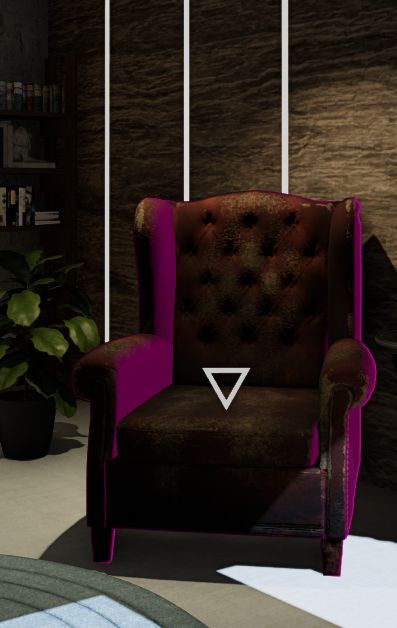
A further recent addition – I’m not sure which update it came with (R28.1, R28.2 or the current R28.3), is the Home Space seating now has sit point indicators for the chair (as does the Social Hub).
These inverted triangles (or arrowheads) are displayed when the mouse is hovered over any object that has a sit point associated with it (see my R28 release overview for more on sit points), and the object itself is outlined in purple. Left-clicking on the object will cause your avatar to sit on it.
I assume these sit point indicators will become the norm as the sit point scripts are employed in all experiences – to be honest, I haven’t been in Sansar frequently enough since the R28 release to see how sit points are being used.
Feedback
The Social Hub is something that has been promised for a while, and it is good to see it delivered. Together with the log-in Home Space, it serves to make Sansar a friendlier place. Hopefully, it is a place new users will find comfortable and engaging – although a lot will perhaps depend on people being there and willing to help out.
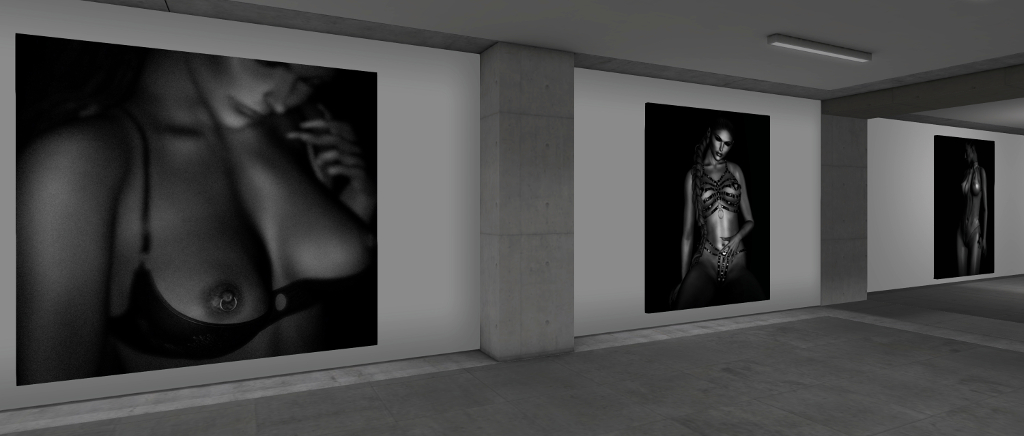
Now open at DiXmiX Gallery is an exhibition by The Huntress (TheHuntressSnare) simply entitled The Huntress. It presents 15 monochrome images, all of them nude studies of The Huntress, and which stand as a celebration of the female body.
By using monochrome, rather than colour, the images The Huntress presents a series of images that have a certain depth that might otherwise be lost. The dark background used in each tends to focus the eye and the mind much more keenly. This results in two things: it brings added life to the studies whilst also making no bones about the sheer sensuality contained within them. Within many of them, this is not only a woman comfortable with her body, she is prepared to delight in it and decorate it for her own pleasure.
The more sensual nature of the pieces displayed obviously also casts the observer into the role of voyeur. While obviously posed, there is a natural fluidity to several of the images that suggest the subject is perhaps unaware of the camera: the position of a hand over a breast as if stroking, or hovering over the midriff – as if a few more minutes would see the subject caught in flagrante delicto.
Obviously, such voyeuristic leanings, coupled with the level of nudity on display might put some off; on the other hand there is no denying the artistry involved in these images: the posing, the lighting, the angle and cropping. Each is in itself a study in the art of photography. They are also, possibly somewhat autobiographical, reflecting the artist’s own freedom from, and acceptance of, self.
Update, March 22nd: as per Cougar’s comment below, the château at Petit Lac Des Cygne is currently closed to public access.
Petit Lac Des Cygne (“The Little Lake of Swans”) is a private estate that recently opened to the public for several days of each week (it is closed to public access on Mondays and Tuesdays). This is a stunning Full region utilising the 30K LI allowance designed by Cougar (Cougar Sangria). Were I to sum it up in two words, they would be: quite magnificent.
The setting in modelled after the Nouvelle-Aquitaine region of south-west France, and is stated to lie some 100 kilometres from the Atlantic Ocean and 50 kilometres from the Spanish border with France – both as the crow flies. Originally located on a Homestead region, the setting had only recently located to this Full region, and has been expanded upon by Cougar in the process to provide a rich setting, in which resides the lake of the title, a château, and plenty more to explore.
The introductory note cards, provided automatically at the landing point, might read a little forthright, but the requests made within them are not unreasonable, and do state matters clearly. The region is open to rezzing props for photography; those who do so are asked to ensure they pick up their items after the fact, with repeat offences not being tolerated. A backstory for the setting has been written in two parts, and is available here (part 1) and here (part 2) on Cougar’s blog; I recommend reading both as they add further immersion to a visit.
Surrounded by the peaks of tall mountains free of the grip of snow, and whose slopes roll down to meet the region’s edge, this is a setting that very much has the feel of being located on the French side of the Pyrenees in, as Cougar points out in her backstory, the département Pyrenees Altantiques (which is also the adopted name for the region’s simulator).
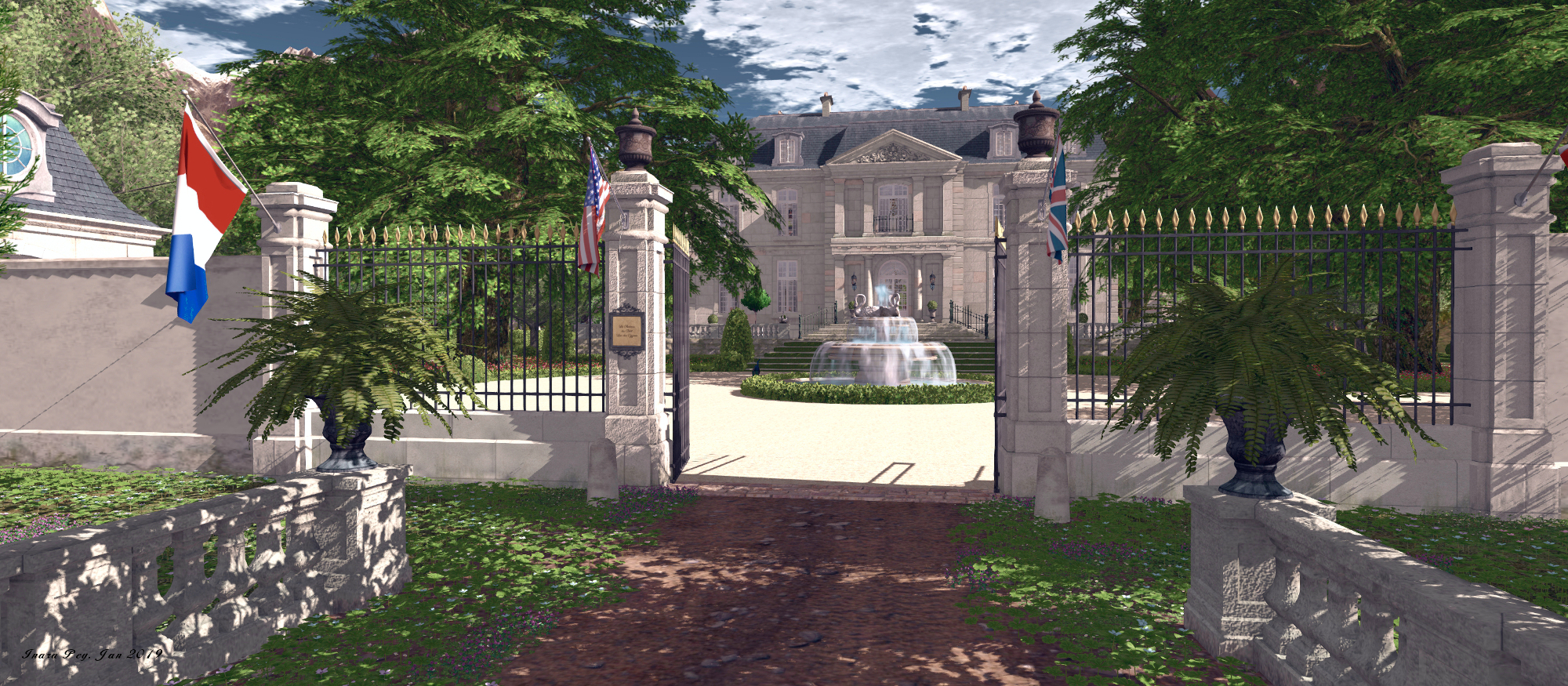
A track winds its way from the landing point, lazily meandering between tall grass and trees. It present a route around a local farmhouse (actually the Le Petit Café Cygne – about which you can read more here), complete with outdoor produce stalls, to the walls and gates of the château. Of modest size, this is nevertheless a fine house, with large courtyard to the front and formal gardens to the rear.
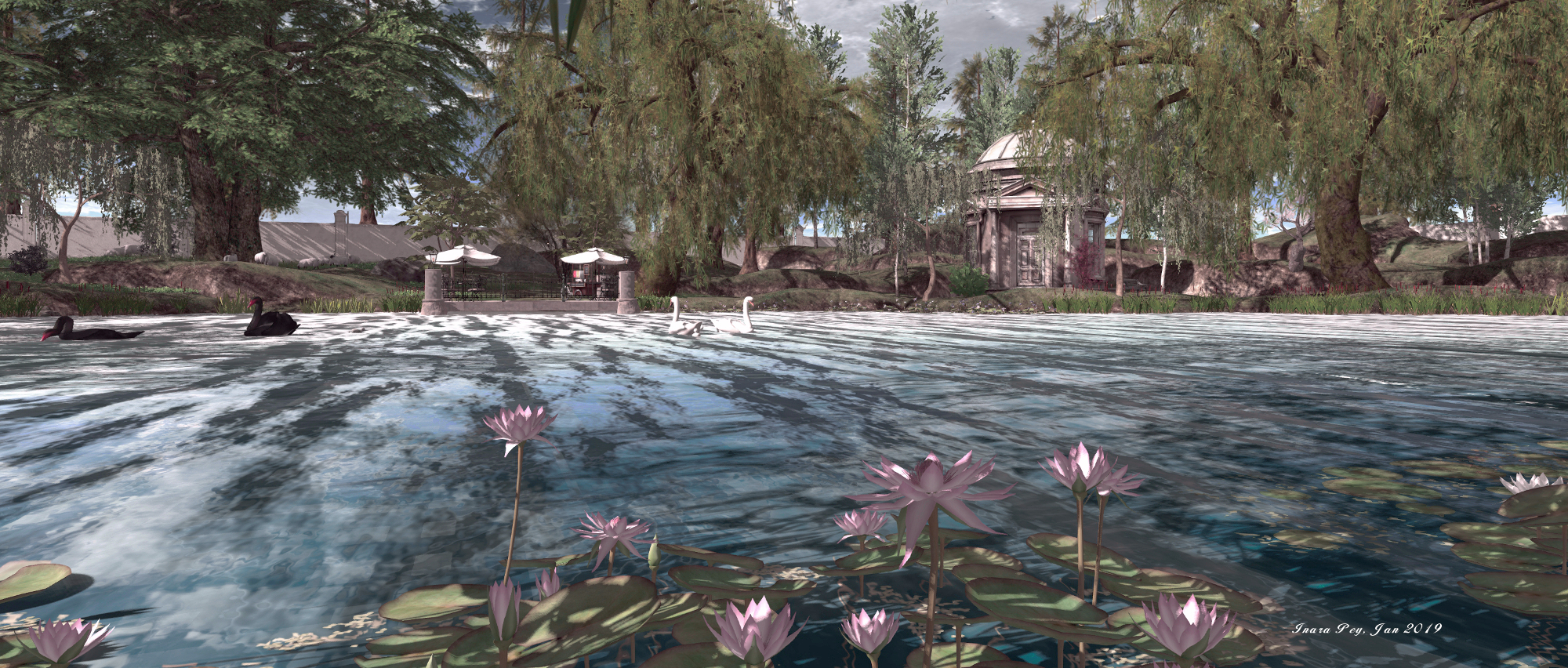
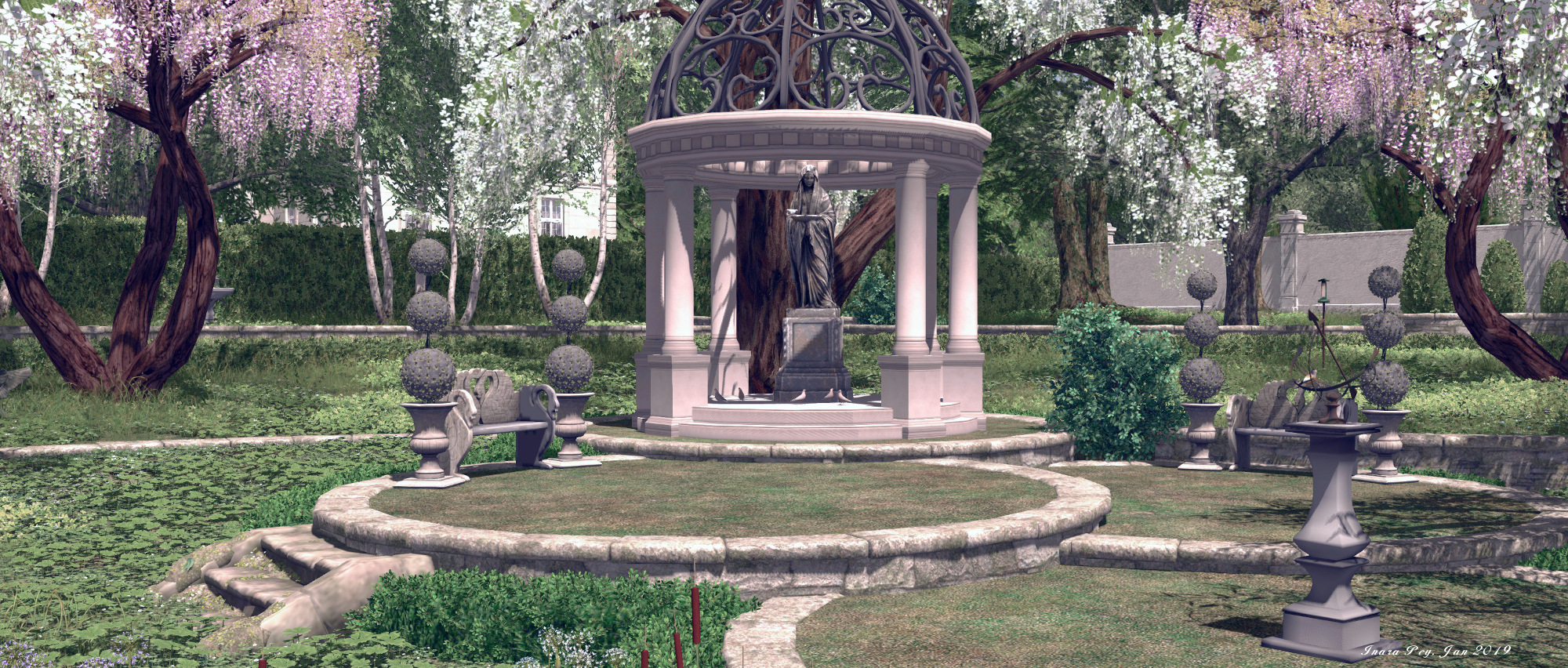
The path to the lake is to be found within the château grounds, and despite its name, it is of a reasonable size. Here, swans gently pass the time on the water, sheep graze along the lake banks, and a little outdoor café offers refreshments as it extends out over the water. All of this is watched over by a pavilion and a folly, standing as silent sentinels either side of the water. The latter is the studio for an artist, the former the setting for a small formal area amidst the wilder grasses, complete with astrolabe, statue and seating.
The château is elegantly furnished, wonderfully representative of a house that has been restored with care and love, again in keeping with the region’s backstory. The formal gardens are carefully laid out, a modern swimming pool set back and below the main house so as not to spoil the period feel, while chess can be found on one of the side lawns. Close by, a summer-house perhaps offers space for formal balls or receptions, the doors thrown wide in summer, allowing music and laughter to drift over the gardens.
Cougar describes the region as a labour of love for her; one that has taken several moths to achieve. This is very evident in the care and attention to detail that has been taken throughout the design. There is a natural look and feel to Petit Lac Des Cygne that is simply sublime; perfectly topped by an ambient sound scape (do make sure local sounds are enabled); it is beautifully presented, whether your interest is in exploring, photography and / or simple admiration. Places to sit can be found throughout, and make for welcome spots by which to pass the time.
While there is a lot going on within the region that might affect viewer performance, Petit Lac Des Cygne is a destination that rewards patience, and which really should not be missed.
Linden Lab have announced the second live comedy event to be held in Sansar. The SF Sketchfest will take place between 13:00-14:00 PST (21:00-22:00 GMT) on January 12th at the new SF Sketchfest Playhouse. The event will feature comedians David Cross (Mr. Show and Arrested Development fame) and Amy Schumer (MADTv, Insatiable, Shameless), together with openers Irene Tu and Chad Opitz).
Compared to the Comedy Gladiators event hosted in Sansar on December 10th, 2018 (read more here), the SF Sketchfest is receiving fairly low-key and what seems to be very short-notice advertising through social media (by contrast, Comedy Gladiators was promoted via a press notice via the Lab).
Ticket for the event are USD $4.99 each, and can be purchased directly from the Sansar Store.
The SF Sketchfest participants: David Cross and Amy Schumer, Irene Tu and Chad Opitz
These events utilise Sansar’s Broadcast capability, allows avatar audiences across two or more instances of an experience to experience performing avatars, with instances allowing a greater opportunity for friends to attend the vent together (although more work is required to make this more fully possible).
SF Sketchfest is also the second official Sansar event to use the platform’s new ticketing capability, which – when expanded – will be a further means for creator / experience holders to monetise their offerings in Sansar.










 Inara Pey: Living in a Modemworld