Linden Lab has been hit by a wrongful termination lawsuit by a former employee, Kavya Pearlman, in which allegations are made over potential violations of cybersecurity laws.
A security expert, Kavya joined Linden Lab in August 2017, and worked to develop information security strategies, advising on state and international information security regulations, managing IS systems, and more. Her employment with the Lab was terminated in March of 2019.
She publicly announced her lawsuit via a 12-point Twitter thread. In it she states that her employment came at a time when she was engaged in a risk assessment exercise involving the New York State Department of Financial Services, the Payment Card Industry Data Security Standard, and the European General Data Protection Regulation, which came after a period when “the company treated me with hostility when I raised concerns about potential violations of cybersecurity laws.”
The allegations would appear to encompass work related to the Lab’s subsidiary, Tilia Inc., and potentially both Sansar and Second Life – but Ms. Pearlman makes it clear that during her tenure at the Lab as Information Security Director, there were no security breaches.
Within the Twitter thread – and apparently within the lawsuit – she additionally alleges discrimination and retaliation on the basis of her gender and religion.
Given this is a lawsuit, and the fact I am neither a lawyer nor have I had any sight of the papers that have been filed, further comment on the lawsuit itself would be inappropriate, and I doubt that the Lab will reply to enquiries simply because this is a legal matter.
That said, and if and when possible, I’ll continue to watch this situation as it develops.
July 31st, 2019 marked the second anniversary of Linden Lab throwing open Sansar’s doors to any and all who might want to try out the company’s (at that time) VR-centric social platform. In 2018, I marked the platform’s “first public anniversary” with some observations and thoughts, so I thought I’d do the say on the platform’s “second anniversary”.
When the doors first opened, and as the Lab forewarned at length, Sansar’s capabilities were nowhere near as built-out and Second Life (with its – then – 14-year history of development), the platform was fairly roundly beaten by some in SL as being dead on arrival. I personally felt such reactions were overblown, simply because we had been so clearly forewarning. but, I did (and do) still feel that launch was perhaps premature, and possibly the result of a knee-jerk reaction to the (genuinely) overblown predictions of growth within the VR marketplace.
But that was July 2017. While the VR market is still trying to clamber its way to the forecasts made about it back then, a lot has changed for Sansar in that time. Releases for the platform have continued at the rate of one major release a month, with intermediate point releases that further help with bug fixes, put out minor improvements or smaller features.
In the last 12 months in particular the last 12 months have seen some significant updates, including:
Sansar’s “Three Pillars” of Audience
Content creation – including provided a set of well-round tools / support for tools for both avatar and world creation.
Socialisation – making sure people can interact with one another, make friends, hold social events.
Gaming / exploration – quests, mini-games, people exploring experiences and discovering what has been put into them.
Landon McDowell on Sansar’s audience segements
Working to bring the Desktop (non-VR) mode more up to parity with the platform’s VR mode (wrongly seen by some pundits as a “de-emphasising” of the platform’s VR focus).
Adding far more capabilities for direct interaction by users within experiences – including the recent (and still developing) quest system, and support for things like guns for shooting games, etc.
For VR users, full-body tracking has been introduced, with plans to continue to improve it.
Use-generated events capabilities have been released, allowing experience creators to host their own events.
Support for custom avatars has been added, together with avatar scaling, etc.
The licensing / permissions system was introduced, and the Sansar Store finally integrated into the client.
At the same time the platform has seen numerous improvements to the UI, both in Desktop Mode and in VR mode; Users have been offered more of a feeling that they have their own “personal space” when logging-in directly to the Sansar client (rather than by way of an experience on the web Atlas) through the “Home Space”, and so on. There have also been a broad range of under-the-hood tweaks, updates and change through Sansar to better support avatar counts within experiences, to reduce experience load times, to improve overall performance and stability, etc. And, of course, creator capabilities have continued to be expanded.
So Sansar has hardly stood still over the course of the year, and is something of a decent beast to how it looked just a year ago.
Click gallery images for views of the Sansar Home Space
That said, there are some capabilities within the platform that are still lacking, or which have stirred a degree of controversy, together with decisions by the lab that have perhaps resulted in raised eyebrows.
An example of the first of these is the fact that there is still no easy way for content creators to offer updates to their products on the Sansar Store (outside of scripts) – a pretty fundamental capability if you want commerce to thrive on the platform.
The upcoming release of Sansar’s Avatar 2.0 has also caused some upset in that it will effectively put an end to the current avatar form, and “break” things like rigged hair and clothing (at least until the creator re-rigs it to the new avatar). However, this is countered by comments from within Second Life that once deployed, it may well encourage more avatar-related creators to give Sansar a go, given the enhancements it will bring to the Sansar avatar.
In terms of raised eyebrows, the decision to launch on Steam at the end of 2018 was perhaps the biggest. Again, given the overall state of Sansar’s development at the time, it appeared to be premature. Yes, Steam is considered the biggest platform for VR games, but Sansar’s lack of capabilities meant it might not gain traction among the more “consumer” type of Steam users – those who like to play fully-rounded games.
However, the decision can perhaps be made more understandable if referenced in terms of economics: provisioning the platform on Steam comes at a cost (30% of sales). This required an adjustment to the fees charged by the Lab – a bridge perhaps best crossed sooner rather than hit a much larger audience of creators with the increase further down the road.
The subject of Steam, however, perhaps brings us to the elephant in the room: user numbers.
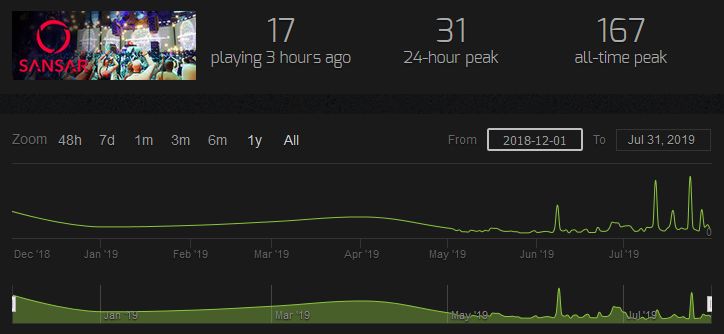
Steam stats reveal that, by-and-large, Sansar usage has been low, but they don’t necessarily reflect overall usage
Much has been made of this – particularly by pointing to the Steam stats. However, it’s important to remember that the Steam stats only represent one portion of those coming into Sansar: those accessing the platform through Steam’s own gateway (or who have maybe tied their Sansar account to Steam). As Linden Lab has noted, they don’t include people coming into the platform either directly through Sansar’s front door on the web, or by their local (non-Steam) installation of the client, or through specifically publicised events. Thus, when looking purely at the Steam stats, it is possible the entire picture isn’t being seen.
Nevertheless, and with the exception of recent events, it is not unfair to say that user numbers for Sansar have been disappointingly low. This has even been remarked upon by Landon McDowell, the Lab’s Chief Product Officer, and the person most directly in charge of Sansar’s development.
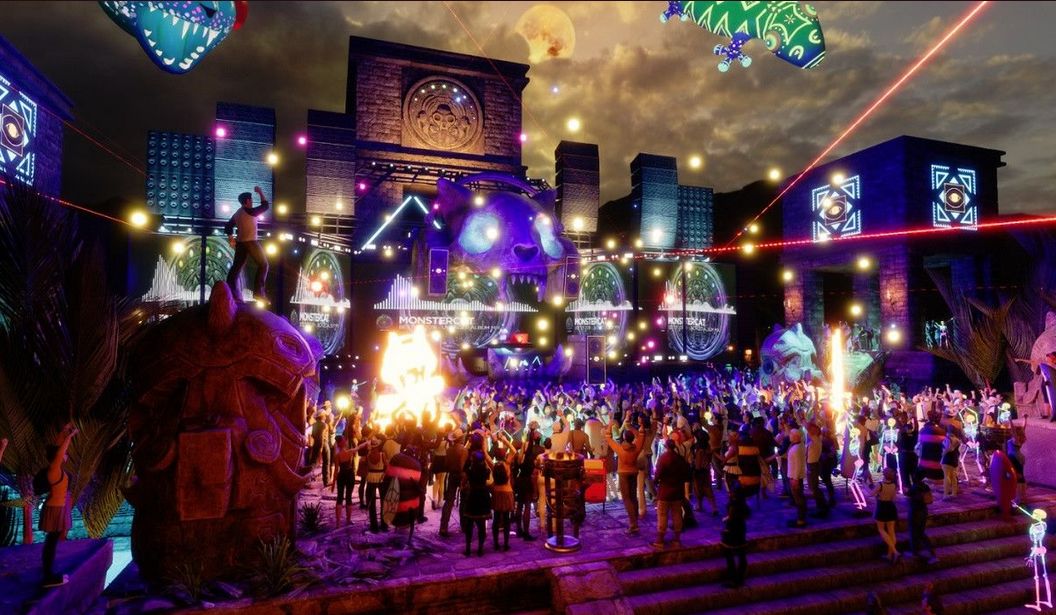
More recently, there have been some significant upticks in Sansar’s user counts – notably due to Linden Lab’s partnership with Monstercat, the Canadian independent electronic dance music record label. But again these tend to be spikes, rather than signs of a growing upward curve – which remains something Sansar has yet to really achieve. But this doesn’t mean Sansar has in any way “failed”.
The fact is, the virtual entertainment market is a highly competitive space; as such building an audience will take time (as the old adage goes, “it took my X years to become an overnight success”). With Sansar, this ability to to grow an audience has undoubtedly been hampered by the lack of broader capabilities.
The Monstercat launch event saw record currency for Sansar – although “record” is a relative term
However, there are signs that Sansar is now approaching a point in its development where it can start to appear to be far more sophisticated to incoming users, be they creators or “consumers”. Game play mechanisms are now appearing, opportunities for more direct immersion and engagement (regardless of whether or not a user has a VR HMD system) are growing, and even the avatars themselves are about to become a lot more engaging. Thus, the potential for Sansar to grow its user base over the next 12 months is potentially there.
There are still significant questions around Sansar and its future, not just in terms of raising its user count, but in terms of keeping pace with developing technology around VR (it doesn’t, for example support the Oculus Quest or similar Snapdragon based hardware). But again, it’s still too early to write-off Sansar on the basis of what it currently lacks, simply because it is still in development.
At the end of my look at Sansar’s first “public” 12 months back in July 2018, I noted that Sansar was not a place where I’d want to spend all my virtual time – and that is still the case today. But, having observed the development of the platform through the past year (and reporting on them), I confess to being somewhat optimistic that Sansar could well be in a stronger position in a year’s time.
Blocksworld was a sandbox type game allowing users to create and build from blocks, purchase specialist packs, and even sell their own creations through a marketplace
Update July 2020: on June 17th, 2020, the Blocksworld servers were shut down and the dedicated website closed, presumably as a part of the work in transitioning LL services to AWS. The app was removed from the Apple Store around the same time, and from Steam at the start of July 2020.
Linden Lab has confirmed it has “paused” development and promotion of its iOS sandbox app, Blocksworld.
For those unfamiliar with it, Blocksworld has been a part of the Lab’s product stable since 2013. Initially developed by a trio of Swedish guys calling themselves Boldai AB, it was acquired by Linden Lab at the time the company was looking to broaden its product offerings under the stewardship of former CEO Rod Humble. This effort encompassed:
The in-house development of games like Creatorverse (Android and iOS, 2012-2013 – now defunct) and Dio (browser based, 2013-2014 – now defunct)
The acquisition of companies and their products (LittleTextPeople and Versu, 2012 – IP released back to the original developers), 2015; and Boldai AB with Blocksworld).
Partnering with Free Range Games to produce Patterns (2012-2014, still available via Steam, but only in “off-line” mode, no shared worlds).
A short foray into owning a games distribution platform through the acquisition of Desura (2013-2014, sold to Bad Juju Games).
Since its launch, the game has been steadily developed and has performed reasonably well – including gaining some brand support through Hasbro (with their G.I. Joe brand).
More recently, the Lab made it available through web browsers (although it never really worked well in Firefox) and through the Steam Early Access programme. As a part of the Lab’s product family, it has always appeared on the More Products listing at the foot of the secondlife.com web pages – which is how I found something may have changed.
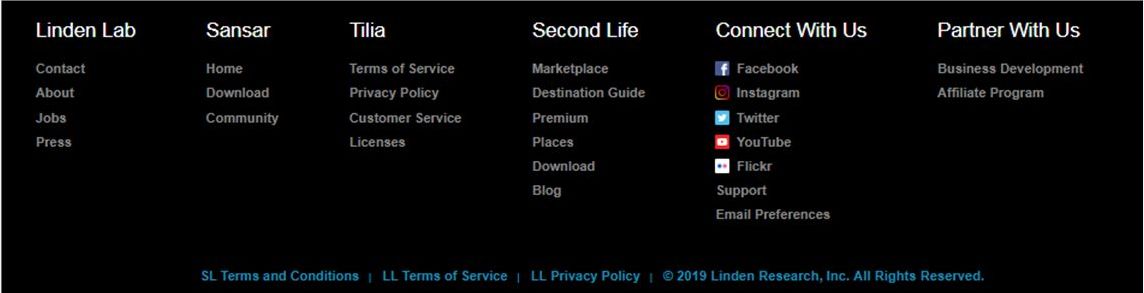
Blocksworld used to appear in the footer area of the secondlife.com web pages
In looking at my SL dashboard at secondlife.com on July 3rd, I noticed Blocksworld was no longer listed, leaving only Sansar. I also noticed the two websites associated with Blocksworld either redirected back to the Lab’s corporate website (in the case of blocksworld.com) or had an expired security certificate issue (playblocksworld.com).
Over the course of July, the footer area of the secondlife.com pages have continued to be revised so they focus on SL, Sansar and Tilia and appear to leave little or no room for Blocksworld to make a return. Nevertheless, the game continues to be available on the Apple Store App Preview, and on Steam Early Access, and to appear on the Lab’s product page.
The revised secondlife.com web page footers seem to leave little room for Blocksworld with their focus on SL, Sansar and Tilia
All of which made me wonder what was going on, so I reached out to the Lab in early July to ask. It took a little time to get a reply, and when it did come in, it was a little short, considering the length of time it took for it to arrive:
Our primary focus continues to be on Second Life and Sansar, so we’ve paused new development and promotion for Blocksworld. However, Blocksworld continues to be available in the App Store as it still has a healthy amount of users and many people continue to enjoy it.
Which is fair enough to a point. When one considers the Lab is now engaged in developing an iOS “companion” app for Second Life, then possibly stepping back from working on Blocksworld (assuming the skills used to develop Blocksworld are indeed still at the Lab) allows in-house iOS talent to be re-directed towards this new SL companion app.
Even so, something of a nagging doubt remains, for two reasons:
The last significant update to Blocksworld was March 2018 – well before any work started on an iOS app for Second Life. This tends to suggest the app’s development cycle had perhaps already reached a ceiling in terms of resources at the Lab.
Also, if skill sets have indeed been diverted away from Blocksworld to focus on the SL iOS, then they are potentially going to be re-directed for some time, simply because of the amount of time app development and enhancement takes.
So it’s hard not to wonder what the future might actually hold for Blocksworld. How long is the pause likely to be? Is there a risk that – given the amount of time since the last update – this “pause” might also stall the apps ability to acquire / retain users? If so, what then?
Will it be considered to still be a worthwhile enough revenue generator to warrant future development, or at least on-going support? Or might it come to be seen as a nice little app that has run its course, left to slowly fade away over time? I’m hoping for the former, and will continue to try to keep a check on it, even if it only sates my own curiosity!
This week is the week of the Lab’s Second Life feature summit. This is the time when engineers, developers and product managers for Second Life get together in person to discuss and plan the next several months of Second Life’s development.
This means that most / all of the Second Life user group meetings for the week are cancelled.
Next Meetings
The following table outlines when the next SL user group meetings will likely take place.
User Group
Next Meeting
Simulator User Group
Tuesday, August 6th
Governance User Group
Tuesday August 6th
Open-Source Development
Wednesday, August 7th
Content Creation
Thursday, August 15th
Concierge & Land
Thursday, August 22nd
Server Beta User Group
TBA – possibly Thursday, August 1st
Server Deployments
Again, due to the Second Life Feature Summit, there are no planned server deployments for this week. However, channel restarts may occur in accordance with the Lab’s 14-day restart policy.
SL Viewer
It is likely that there will no updates to the current pipelines for the official viewer this week, again as a result of the SL Feature Summit, although some of the RC viewers have updates either queued ready for, or getting close to being ready for, update. In the meantime, the pipelines remain as follows at the time of writing.
Current Release version 6.2.3.527758, formerly the Rainbow RC viewer dated June 5, promoted June 18 – No Change.
Release channel cohorts:
Love Me Render viewer, version 6.2.4.529302, July 15.
360 Snapshot project viewer, version 6.2.4.529111, July 16.
Legacy Profiles viewer, version 6.2.3.527749, June 5. Covers the re-integration of Viewer Profiles.
Linux Spur viewer, version 5.0.9.329906, dated November 17, 2017 and promoted to release status 29 November 2017 – offered pending a Linux version of the Alex Ivy viewer code.
Obsolete platform viewer, version 3.7.28.300847, May 8, 2015 – provided for users on Windows XP and OS X versions below 10.7.
Isla de Sol, July 2019 – click any image for full size
A little while ago I received an invitation from Noirran Marx to visit Isla de Sol, her Homestead region, which I gather is open to the public. It took a while for us to get there, but we did in July and found it to be a quiet, balmy tropical island that makes for an easy, gentle visit.
At the time we dropped in, the island offered a roughly north-south orientation, with the clearest signs of human habitation at the southern end, most notably in the form of a large house sitting within a low walled garden, with two trailer-style homes sitting close by under the boughs of tree that might be more at home in more northerly latitudes than suggested by the rest of the island’s styling.
To the north, the island is more open and tropical in looks. Grass sits under palm trees and a Greedy Greedy table sits bracketed between and old adobe building and the (rather incongruous) cone of a volcano that appears to be erupting…
The volcano forms the highest point within the region, but does tend to a look a little “glued on”, so to speak. To us, it was slightly jarring visual element in what otherwise is a pleasant low-lying island where the aforementioned Greedy Greedy can be enjoyed, and the outdoor decks offer places to sit, think, cuddle and / or chat.
So far as we could tell, the house is open to the public; there were certainly no security orb warnings on approach. It is cosily furnished, but the garden perhaps offers the best opportunities for those taken with photography.
Off to the west side of the island, behind the screen of fir trees, a four-legged platform rises from the shallows. A rusting lifeboat slide to one side of it suggests it might have once been some form of small drilling platform, but it is now given over to a shack in need of some renovation. The sea lions on the raft and rock below it don’t seem to mind its presence, tho.
Small, quirky and perhaps needing some of the bushes and plants to be made phantom (we bounced off of some of the palm trees while trying to pass under them!), Isla de Sol presents an easy visit for the beach inclined. There are opportunities for photography (rezzing is possible with a 5-minute auto-return) throughout, and it avails itself to a range of windlight options (I again used my default takes on Annan Adored’s End of Silence and Morning Dream in the four images here.
Three years ago, in July 2016, I wrote about an exhibition that I found utterly engaging and one of the most captivating exhibitions of physical world art to be reproduced in Second Life – and it remains so today.
That exhibition, Peter Vos in Second Life, celebrates the work of Dutch illustrator, humorist, caricaturist and artist, Peter Vos (Septmber 1935-November 2010). A recent conversation brought the exhibition to mind, do I decided to make a return visit, in part because I wanted to once again immerse myself in the wonderful art of a phenomenally talented artist, and in part to again draw attention to the exhibition through these pages for those who may not yet have visited it – because it remains an absolute must-see.
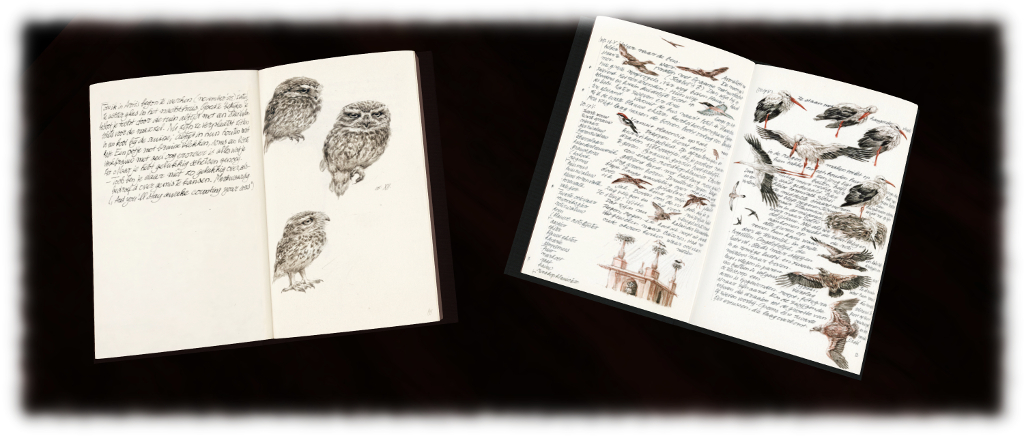
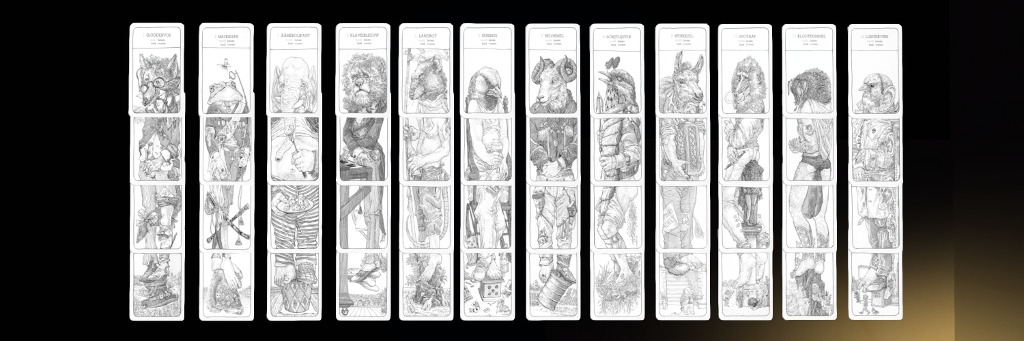
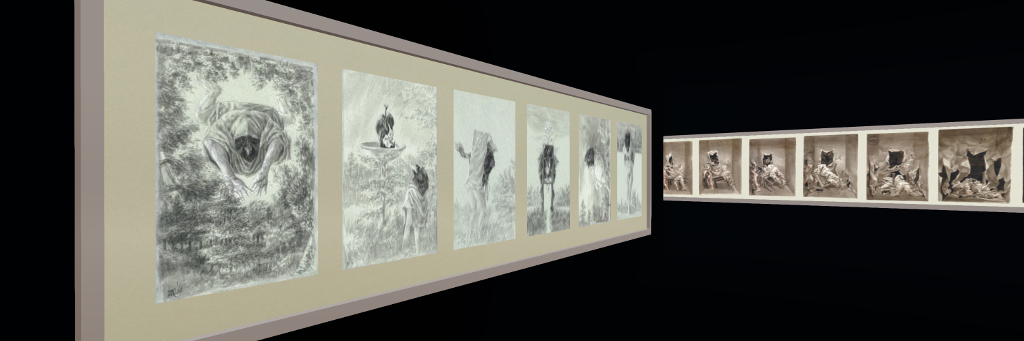
Put together by Vos’ son, known in-world as Karkassus Jigsaw, Peter Vos in Second Life attempts to encapsulate the penmanship and art of a man whose output was simply enormous and utterly exceptional. This is actually no easy task given Vos encapsulated so much as an artist: the illustrator, the fantasist, the cartoonist, the visionary, the caricaturist, the pasticheur, the letter-writer who stamped his letters with postage stamps of his own making and the dedicated bird-watcher.
As I noted in writing about the exhibition and Vos in July 2016:
Central to his work is a wonderful mix of styles and approaches – and also a deep and loving intimacy with his subjects and audience. In his twenties, he produced Portrait of Papa for his ailing father, followed by a book of pastiches lovingly depicting his father in a series of guises. Later, when he had a young son of his own, he would demonstrate this love for his family again, writing loving letters and postcards to the young boy, relating marvellous journeys around and beyond the Earth, opening his son’s own imagination.
On the ground floor of this gallery-come-museum are interactive elements that help engage the visitor – projectors that reveal varied elements of Vos’ work, including a number of utterly charming self-portraits, together with commentary on his work.
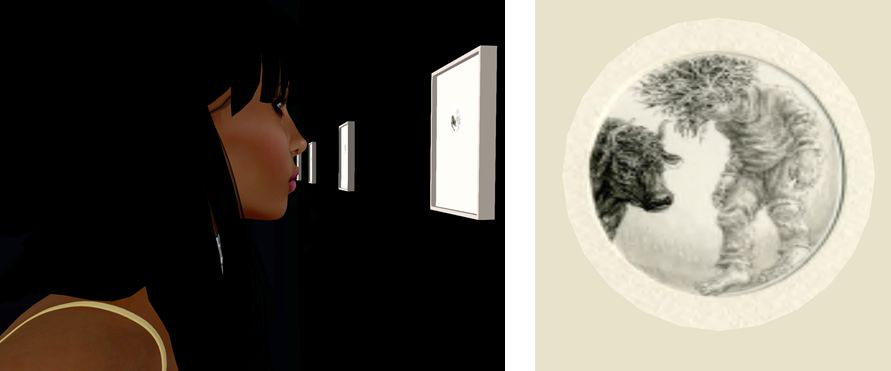
Also to be found on this level are reproductions of the miniatures Vos started painting in 1966. And by miniatures, I mean entire paintings and portraits, both monochrome and colour just 33 mm (1.3 in) across; so small some of the detailing meant working with just a single hair on a brush. These are superbly reproduced “to scale”, and should be viewed by pressing ESC to ensure your camera is free, and then touching the frame of a particular painting to sit. Click Stand to resume touring the gallery.
Peter Vos in Second Life– viewing his miniatures utilises both an animation of your avatar and a scripted camera positioning using a “hidden” gallery under the main structure
Upstairs are further examples of Vos’ work, encompassing humour, satire, and social commentary. However, as with my first visit, I find the desk scattered with the paraphernalia of Vos’ work scattered around to be perhaps the most engaging. With the tobacco pouch, notebooks displaying his meticulous studies of birds, his brushes and pens, it is hard not to believe Vos has simply stepped away from his work for a minute or two, and if we wait quietly enough, he’ll return, and allow us to watch him as he continues sketching a sparrow.
The art also continues outside of the gallery building and on the terraces leading up to the front doors. Here, as well as more reproductions of Vos’ art, there are links to a trailer for Vogelparadijs, a documentary film about Vos’ passion as both a bird watcher and an artist.
The beauty of this art and the manner in which it engages and immerses the observer cannot be overstated. AS I noted three years ago, it is absolutely not be missed or overlooked.







 Inara Pey: Living in a Modemworld