Space Sunday: lunar landers, asteroids and more

A GSLV Mk III lifts-off with the Chandrayaan-2 mission from India’s Satish Dhawan Space Centre, Sriharikota, 09:13 UTC, Monday, July 22nd, 2019. Credit ISRO

The Indian Space Research Organisation (ISRO) successfully launched its Chandrayaan-2 mission to the lunar south pole on Monday, July 22nd, after suffering a week’s day to the schedule. This is an ambitious mission that aims to be the first to land in the Moon’s South Polar region, comprising three parts: an orbiter, a lander and a rover.

Although launched atop India’s most powerful rocket, the GSLV Mk III, the mass of the mission means it cannot take a direct route to Mars, as the upper stage isn’t powerful enough for the mass. Instead, Chandrayaan-2 was placed into an extended 170km x 39,120 km (105 mi x 24,300 mi) elliptical orbit around the earth. For the next month, the orbiter will gradually raise this obit until it reaches a point where lunar gravity becomes dominant, allowing Chandrayaan-2 to transfer into a similarly extended lunar orbit before easing its way down to a 100 km (60 mi) circular polar orbit around the Moon, which it is scheduled to achieve seen days after translating into its initial lunar orbit.

How Chandrayaan-2 will reach the Moon and its operational orbit. Credit: ISRO

During this period, the combined vehicle will carry out multiple surveys of the Moon’s survey, focusing on the South Pole. It will also release the 1.47-tonne Vikram lander (named for Vikram Sarabhai, regarded as the father of the Indian space programme) which will make a soft decent to the lunar surface, which will take several days prior to making a soft landing.

The orbiter vehicle is designed to operate for a year in its polar orbit for one year. It carries a science suite of eight systems, including the Terrain Mapping Camera (TMC), which will produce a 3D map for studying lunar mineralogy and geology, an X-ray spectrometer, solar X-ray monitor, imaging spectrometer and a high-resolution camera.

The Vikram lander, with four science payloads, will communicate both directly with Earth and the orbiter. It will also facilitate communications with the Pragyan rover, which will be deployed within hours of the self-guiding lander touching down. Between them, the lander and rover carry 5 further science experiments and both are expected to operate for around 14 days.

Testing the deployment of the Pragyan rover from the Vikram lander. Credit: ISRO

Craters in the South Polar region lie in permanent shadow and experience some of the coldest temperatures in the solar system and NASA’s Lunar Reconnaissance Orbiter (LRO) has revealed they contain frozen water within them, water likely unchanged since the early days of the Solar System, and thus could hold clues to the history of the Solar System – hence the interest in visiting the region and learning more. The frozen water is also of interest to engineers as it could be extracted to provide water for lunar base; water that could be used for drinking, or growing plants and could also me split to produce oxygen and hydrogen  – essential fuel stocks.

The Chandrayaan-2 mission marks a significant step forward for India’s space ambitions; assuming the Vikram lander is successful, the country will become only the forth nation to land on the Moon after the United States, Russia and China. As a part of its expanding activities in space, the country hopes to fly it first astronauts into space in 2022 and have an operational space station by the end of the 2020s.

2019 OK

No, I’m not making a statement about the year – that’s the name of a chunk of space rock measuring 57 to 130m (187 to 42ft) across that passed by Earth at a distance of around 73,000 km (45,000 mi), putting it “uncomfortably close” to the planet. What’s more, we barely released it was there: 2019 OK was positively identified by the Southern Observatory for Near Earth Asteroids Research (SONEAR), just a couple of days prior to is passage past Earth, and was confirmed by the ASAS-SN telescope network in Ohio, leaving just hours for an announcement of its passage to be made.

Since then, the asteroid’s orbit has been tracked – forward and back (which revealed it had been previously spotted by observatories, but its small size and low magnitude meant its significance wasn’t realised). These observations confirmed 2019 OK is a reactively short-period object, orbiting the Sun every 2.7 years. It passes well beyond Mars before swinging  back in and round the Sun, crossing the Earth’s orbit as it does so. However, while it may pass close to Earth on occasion, it’s highly unlikely it will ever strike us.
Credit: NASA

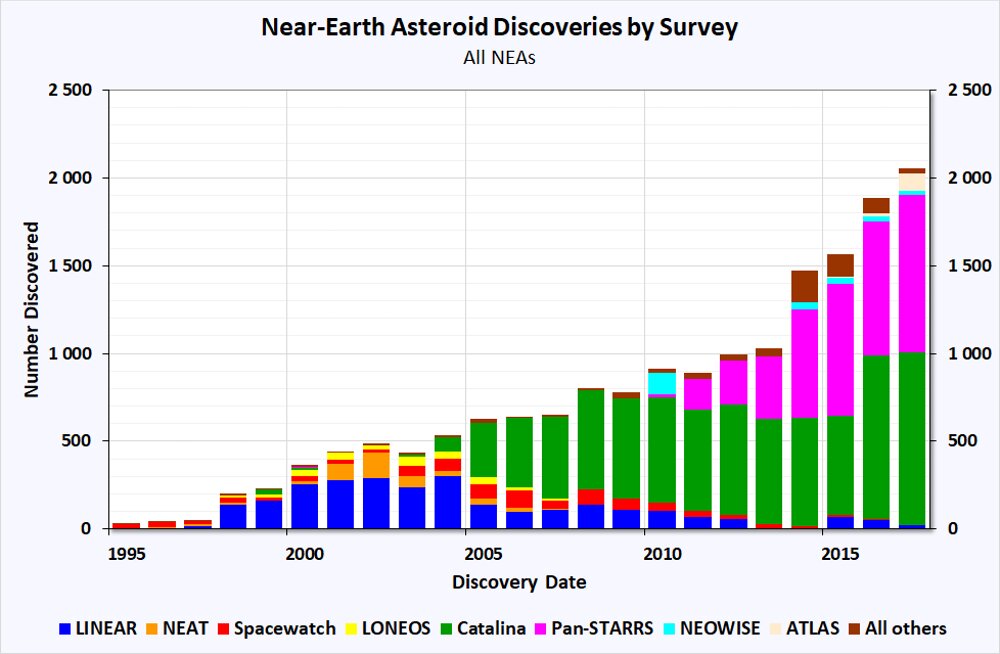
It does, however, remind us that near-Earth objects (NEOs) are common enough to be of concern; 2,000 were added to the list 2017 alone. The size of 2019 OK reminds us that there are more than enough of them to be of a significant enough size to pose a genuine threat.

In 2013, an asteroid measuring just 20m across entered the atmosphere to be ripped apart  at an altitude of around 30 km above the Russian town of Chelyabinsk. The resultant resulting shock wave shattered glass down below and injured more than 1,000 people. 2019 OK is at a minimum 2.5 times larger than the Chelyabinsk object – and possibly as much as 10 times larger, putting it in the same class of object that caused the Tunguska event of 1908, when 2,000 sq km (770 sq mi) of Siberian forest was flattened by an air blast of 30 megatons as a result of a comet fragment breaking up in the atmosphere.

Hence why observatories such as SONEAR, ASAS-SN telescope network, the Catalina Sky Survey, Pan-STARRS, and ATLAS and others attempt to track and catalogue NEOs. The more of them we can located and establish their orbits, the more clearly we can identify real threats  – and have (hopefully) a lead time long enough to take action against them.
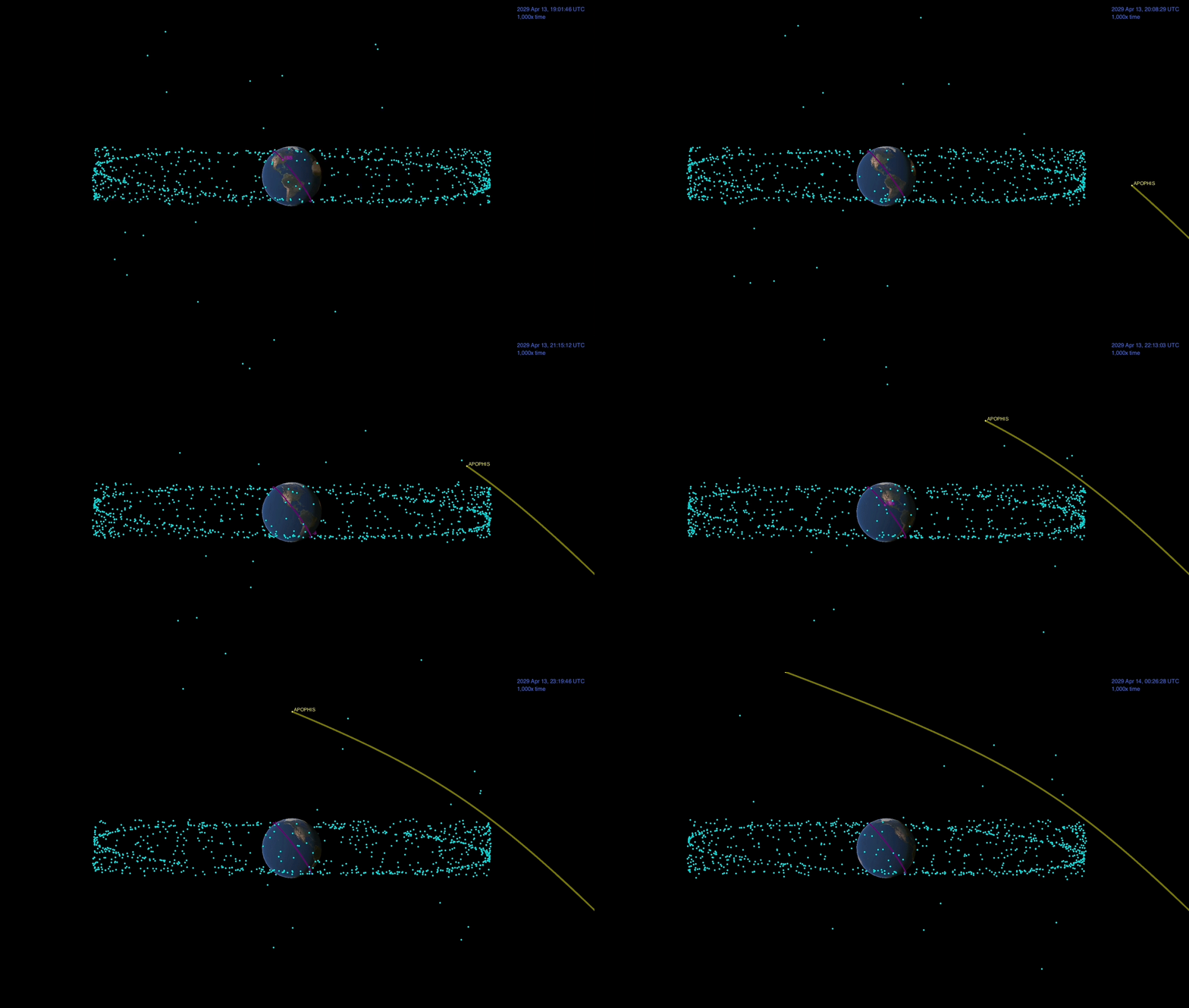
A computer model show the passage of 99942 Apophis on April 13th, 2029. The blue dots represent satellites in orbit around Earth and the pink line the orbit of the International Space Station. Credit: NASA JPL

Oh, and if you thought 2019 OK was big, consider 99942 Apophis. It’s around 400-450m across, and will swing by Earth at a distance of just 31,000 km on  – wait for it – Friday, April 13th, 2029 (so get ready for a lot of apocalyptic predictions in the months leading up to that date!).

Continue reading “Space Sunday: lunar landers, asteroids and more”
Jeeves, family, cyberpunk and fables in Second Life

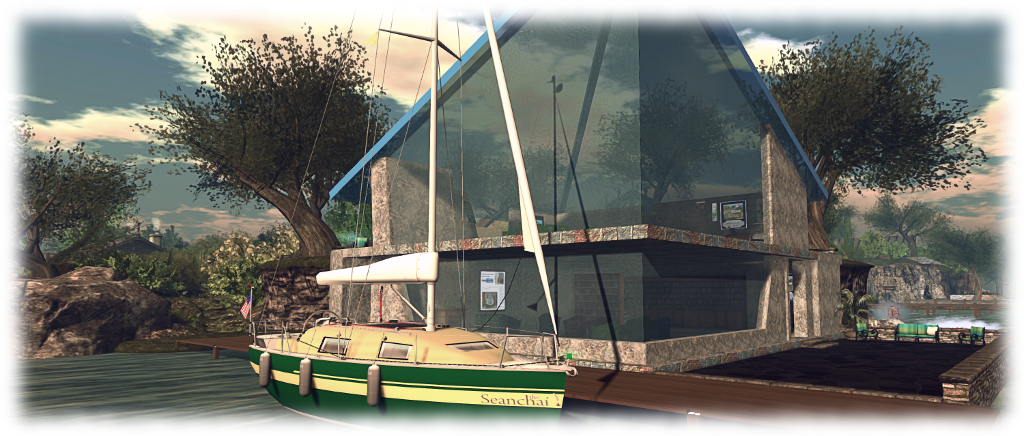
Seanchai Library

It’s time to highlight another week of storytelling in Voice by the staff and volunteers at the Seanchai Library. As always, all times SLT, and events are held at the Library’s home at Holly Kai Park, unless otherwise indicated.

Sunday, July 28th 13:30: Tea Time with Jeeves

Just for summer, Seanchai Library takes a dive into the world of Reginald Jeeves, a well-educated, intelligent valets of indeterminate age who is employed by the amiable young man-about-town, Bertie Wooster, whom Jeeves routinely has to benignly rescue from the consequences of his idiocy.

Created by author, humorist, and lyricist (working with Guy Bolton and Jerome Kern) Pelham Grenville Wodehouse (October 1881 – February 1975), Jeeves and Wooster are perhaps his most iconic characters, their adventures eventually growing to 35 short stories and 11 novels, the majority of which are first-person narrated from the perspective of Bertie Wooster.

In The Aunt and the Sluggard Bertie again finds things getting a little problematic as a result of a relative of a friend.

Rockmetteller “Rocky” Todd is the kind who prefers quiet country living, but his aunt wants him to make a move to New York City so he can send her a weekly letter describing city life. Thus he faces a dilemma. The allowance his aunt is willing to pay Rocky to help with living in New York would be most welcome – as would continuing to be remembered in her will. But living in the city is something Rocky would rather not contemplate – and so he turns to Bertie for help.

Inevitably, it is Jeeves who comes up with a possible solution: why not pay someone else to stay in New York and write notes on city life that Rocky can then incorporate into letters to his aunt? Bertie takes the idea a stage further: Jeeves can write about his evenings at his club, about the celebrities there, and more.

Everything proceeds swimmingly until Rocky’s aunt arrives on Bertie’s doorstep – his apartment is the address Rocky has been using for his letters, so she believes it is Rocky’s New York home. And thus things threaten to unravel…

Join Da5id Abbot, Kayden Oconnell, and Caledonia Skytower as they read this delightful series at Ceiliuradh Glen.

Monday, July 29th 19:00: The Ice is Coming

Gyro Muggins reads Patricia Wrightson’s 1977 novel.

Frost is seen in summer and ice patches form in spite of the hot Australian sun. To the Happy Folk, living on the continent’s green edges, the frost is a reason to laugh and joke. For the Inlanders (Wrightson’s fantasy view of the Australian Aboriginals), however, the frost was once seen as a warning that an ancient foe, the ice-bearded Ninya, were on the rise – and so it might be that they are again.

The first to recognise the rise of the old threat is young Wirrun of the People. He leaves his job and sets out to meet the Ninya, taking with him as a sidekick, the petulant Mimi, and for protection, the Power bestowed by the first of the creatures in their path.

To assist in his quest, Wirrun sends for the men from Mount Conner to sing the Ninya down and keep them in their caves. But he must also beat the Ninya to the Eldest Nargun, source of fire, and use it to hold the Ninya until the men from Mount Conner arrive. And so his adventure begins.

Tuesday, July 30th 19:00: The Penderwicks in Spring

Springtime is finally arriving on Gardam Street, and there are surprises in store for each member of the family. Some surprises are just wonderful, like neighbour Nick Geiger coming home from war. And some are ridiculous, like Batty’s new dog-walking business.

Batty is saving up her dog-walking money for an extra-special surprise for her family, which she plans to present on her upcoming birthday. But when some unwelcome surprises make themselves known, the best-laid plans fall apart.

Filled with all the heart, hilarity, and charm that has come to define this beloved clan, The Penderwicks in Spring is about fun and family and friends (and dogs), and what happens when you bring what’s hidden into the bright light of the spring sun.

Dive into Jeanne Birdsall’s classic revisiting to the lives of the Penderwicks, read by Caledonia Skytower.

Wednesday, July 31st: A Cyberpunk Summer

Short stories with Finn Zeddmore.

Thursday, August 1st 19:00: The Sea King’s Daughter

Deep beneath the Irish Sea lies a kingdom beyond mortal men’s imagining… Until one day a fisherman finds a beautiful maiden washed ashore. She cannot speak to him in any voice, though her yearning shines from her eyes. But with forces of land and sea arrayed between them, will they ever find their happy ending?

With Shandon Loring, also Also in Kitely – teleport from the main Seanchai World grid.kitely.com:8002:SEANCHAI.


NOTE: Seanchai library is taking a break between August 5th and 10th for a summer break.

A visit to Basilique in Second Life

Basilique, July 2019

Basilique is perhaps one of the more well-known public regions in Second Life. It has been popular among SL photographers, as well as once being the home of the Basilique Performing Arts Company.

In more recent times, ownership of the region has passed to Niccoli Sweetwater, who has taken it on with the aim of maintaining and extending the region’s arts ties, as she stated to me recently, “My goal is to restore Basilique and share it with the SL arts and live music community. This place is truly a labour of love.”

Basilique, July 2019

As a part of this, Niccoli has not dramatically changed the ground-level design of the region, which still retains its town-like feel and presents a welcome feeling of the familiar. Those who have visited the region whilst under its prior ownership will recognise the long form of the Basilica, modelled after the San Pietro Martire, in Murano, Italy.

Once a centre of productions by the Basilique Performing Arts Company, the Basilica has been restored to its role as a church, its triple nave dominated by two huge frescos. The pews and candles here are interactive, and the church is now offered for weddings and ceremonies.

Basilique, July 2019

Other familiar locations remain as well: the domed basilica, now the Galleria di Basilique, a ground-level art gallery; the pier and the appropriately-named Bar Moderna sitting in its corner terrace with fish still “flying”. But what now draws them together is a history and tour guide that has been written for the region by Niccoli. This both places the setting as an island community located on Lake Garda and traces the town’s story from 1292 as a fortified defensive location, through more recent times.

A group of deserting French knights founded Basilique in 1292, when they fled seeking refuge from the Mamelukes after the fall of Acre. The knights chose the island for its defensive position and established a stronghold, soon intermarrying with the local population. Over time the legions increased fortifications, but a fire destroyed the original structure in 1457 at which time the remaining inhabitants constructed the foundations for the modern town around the only remaining edifice – the stone tower that was at the centre of the old fort.

– From the “History of Basilique

Basilique, July 2019

The guide also points out the smaller locations in the region, including the Member’s Club, host to wine tastings, and incorporated within the old bathhouse alongside the island’s gardens, the pier with is rezzable rowing boats and the Taverna Fico Bar.

A new addition to the region is the Palazzo  di Basilique, a gallery space located in grounds of its own up in the sky. It is intended to offer “an elegant venue with a huge dance floor and dinner tables for a romantic night out listening to some of SL’s most talented artists.” Outside of this is a terrace café and gardens  to be enjoyed.

Basilique, July 2019

Still a photogenic region with much to offer, Basilique remains an engaging destination for visitors old and new. Just do please note that the house on the island to the north-east is a private residence that is not open to visitors.

SLurl Details

Admiring InPerfección in Second Life

The Eye Gallery – Kubbrick, July 2019

Currently open at The Eye art gallery, curated by Mona (MonaByte) is a most intriguing exhibition of digital photography and art by Kubbrick, entitled InPerfección.

Kubbrick describes himself as “a sailor of the virtual seas and an artist [who] captures images in the physical world and transforms them through software and pictorial techniques in a search for the beauty of shapes and colours.”

The Eye Gallery – Kubbrick, July 2019

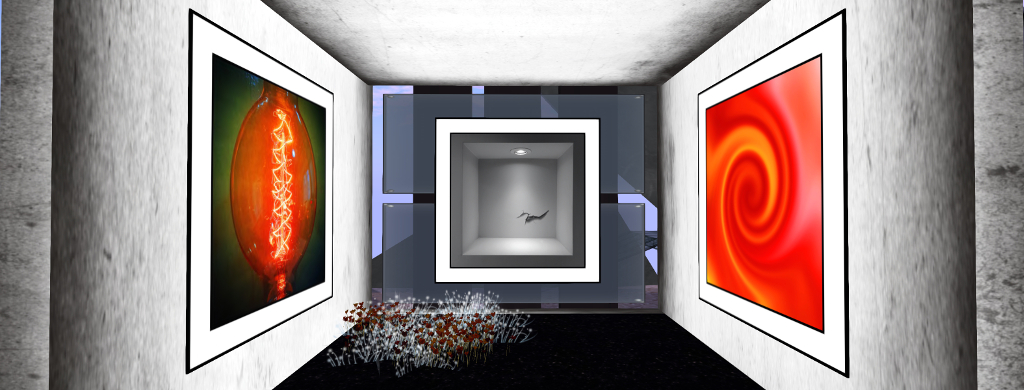
One the ground floor of the gallery space, for example is a series of studies -of water and bubbles. These include photos of all or parts of the human body in the water, some in clear focus, some blurred, with applied lighting and contrast that marvellous utilise colour and reflection to explore our own relationship with water.

This can be seen within Al Calor de la Flama – “the colour of flame”, and through the dynamics of motion in water shown through Nadadora de Aguas Profundas  – “deep water swimmer” and Escape en el Agua – escape in the water; mixed with these images are thoughts even on the nature of rain on a window with Paisaje (“landscape”). However, for me, Escape en el Agua is particularly captivating; within it there is a wonderful displacement of air through the water that’s given birth to clouds of bubbles, and these naturally lead on to the remaining images in this part of the gallery, which in turn offer fascinating abstractions on bubbles.

The Eye Gallery – Kubbrick, July 2019

It is perhaps “abstraction” that most applies to Kubbrick’s style, and this is further demonstrated in the digital pieces to be found on the upper level of the gallery.

These offer a rich mix of art, colour and form, all beautifully dynamic, some apparently created purely through digital means, others utilising “everyday” objects – the roof of what appears to be a gallery or stadium, the humble engine block, gears and chains, all combined with with digital techniques – to produce finished images that have an incredible feeling of being purely fractal in form. These all stand as captivating images in their own right; however, they also draw the eyes inevitably to Enfrentamiento (“confrontation”), a piece that appears to capture  in mirrored form a piece of wall art.

The Eye Gallery – Kubbrick, July 2019

My one regret with InPerfección is that I did not drop in sooner. The exhibition opened on June 28th, 2019, and so may not have much longer to run. So, if you do want to witness it for yourself, I would recommend a visit sooner rather than later.

SLurl Details

A little rock climbing in Second Life

Rock climbing / free climbing in Second Life

A while back Yasmin (YouAintSeenMe) mentioned to me that she was considering a rock climbing system for Second Life. Being one who doesn’t particularly handle looking over the edge of extreme tall / high things in the physical world, it struck me that a) rock climbing would not be my first recreational pursuit, and b) but why not have a go in Second Life where bones don’t get broken?

So, armed with a follow-up note card from Yasmin on the subject, I toddled off to try out a climb she’s set-up on the west face of Nitida Ridge, Heterocera.

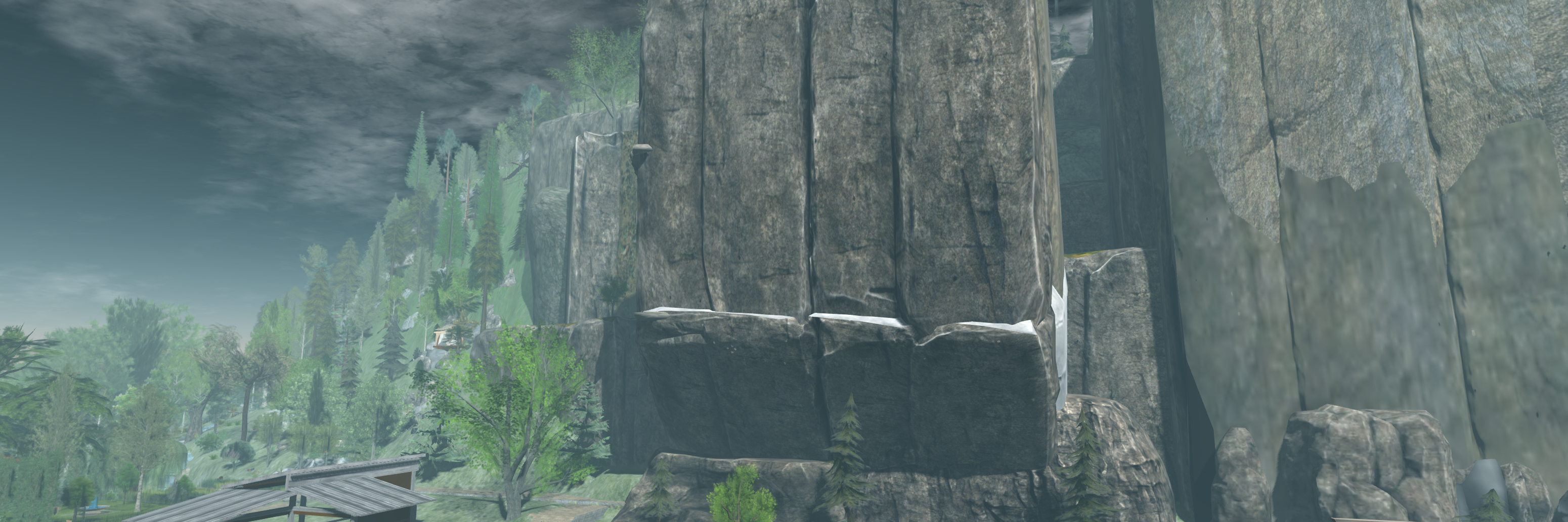
Nitida Ridge – 100m of cliffs to climb!

Here, at the foot of the ridge, sits a little base camp established by Yasmin, with tents, food and a warm fire. Close by is a sign that both introduces the climb(s) up the rock face and provides visitors with the necessary kit when touched. The latter is free, and comprises:

  • An abseil harness (worn invisibly, just ADD to attach to the stomach attach point); information on the climbing HUD, a note card on the routes up the cliffs – direct or extended; and an image of the cliffs overlaid with the routes up (green) and abseil descents (red).
  • The climbing HUD – clicking the sign will cause a pop-up asking for this to be attached so your avatar can be animated during a climb.
Starting my climb

The HUD attaches towards the lower right of your screen by default – although obviously can be repositioned.  It is colour-coded as follows: Blue (generally the default) = ready; Green  = active climb located / engaged; red = disabled. In addition, touch the HUD brings up a dialogue box. There are a handful of points to be remembered when climbing, and with the HUD in particular:

  • It is still an in-development system, so not all features may be present and the occasional bug might try to put you off your climb.
  • Not all the options on the dialogue box may be fully functional at present.
  • The ones you are most likely to want to use are the climbing speeds (Faster / Slower) and the avatar position options (In  / Out) – the latter to move your avatar either further away from the rock face (so you’re not up to your elbows inside the rock, for example, or climbing air).
Taking a breather and a look around at 170 metres above sea level and …. Eeep! It’s a long way down!

Climbing is a matter of finding the first pitch along the foot of the ridge. To do this, it is suggested that you examine the image of the ridge and then zoom out with your camera and align things visually. This can be a little difficult (but then, it’s not like people hang signs on rock faces that say, “Start Your Climb Here!” – you pick your start point by eyeballing the best spot to make an ascent), so for those who may get frustrated in trying to work out where to start, there is a direct SLurl link.

When you’ve found the correct point, the HUD will try green to indicate you can start to climb. Use the Up arrow key to climb – turning off any AO system can be an advantage here to prevent conflicts. When pressed, your avatar will start what is effectively a solo free climb. Releasing the key will pause you, but shouldn’t cause any backsliding.

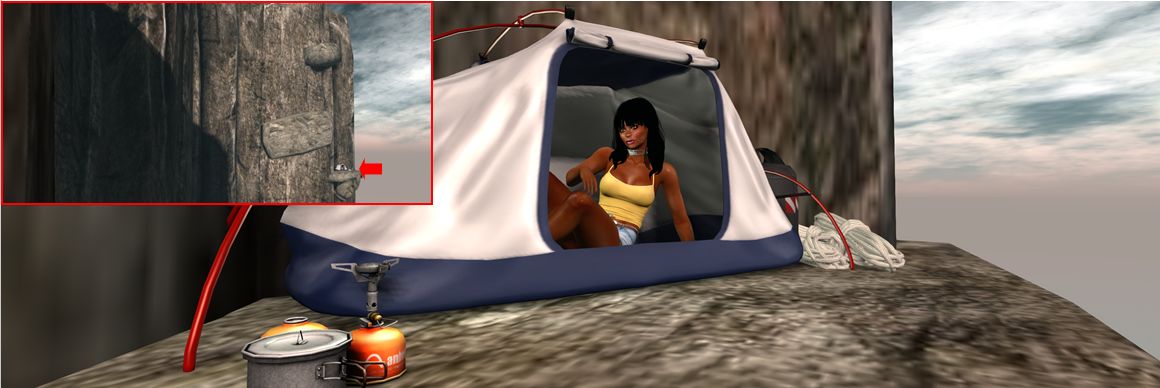
Taking a rest in a bivvy and inset, where it sits on the climb….

The nature of SL may mean at times you might get stuck. Should this happen, release the Up key and they resume. Similarly, you may “slip” and assume your default falling pose – again, releasing the Up key should revert your avatar to the “rest” pose. Also, sometimes using the Left / Right arrow keys can help a little – but take care. Left / Right can help you crab diagonally sideways in the climb, but use one of them too much and you’ll leave the “climbing path” – your HUD will turn blue and you’ll take a fall!

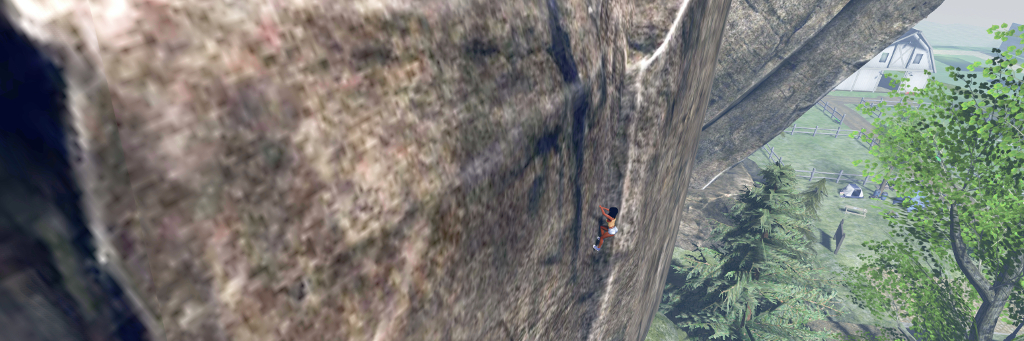
After the first 15 metre climb to a very broad ledge, you’ll have a choice: the direct route, or along the “bivvy” (bivouac) route. The latter is the more challenging, and requires you channel your inner Tom Cruise (Mission Impossible 2) for some diagonal climbing across the rock face to reach various ledges – including one with the tent, allowing you a little respite from the exertions of climbing – and additional vertical ascents.

Abseiling down the Nitida Ridge (note ropes added in post-processing so I don’t look like I’m simply sitting in mid-air!

The direct route is just that – straight up the cliff, using a natural fold in the rock, just as a real climber would. I admit to having a little trouble at the top of this – the climb animation refused to release, so I’d reach the top, fall back a couple of metres and resume climbing, reach the top, fall back… A double-click TP resolved this.

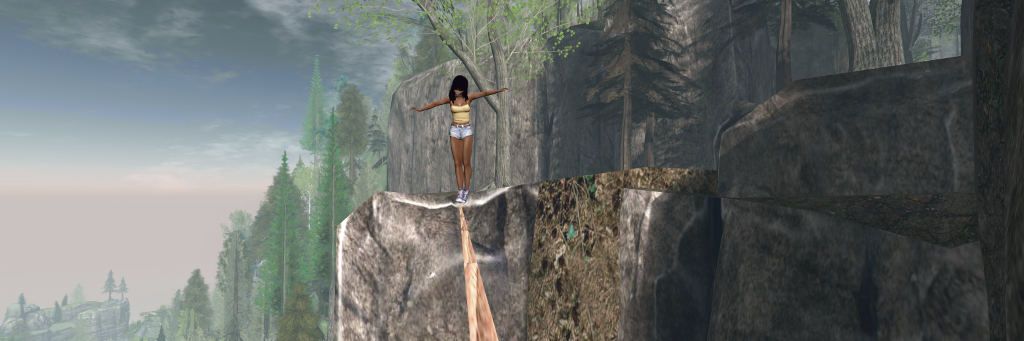
For those prone to a little daring-do, the Nitida Ridge climbs also include a couple of high lines (shown in blue on the climb image), where a little tightrope walking can be, um, enjoyed, using Yasmin’s tightrope kit.

Of course, getting up a climb is half the story – there is also getting back down. For this, Yasmin has included abseil options. Just find the anchor points located at various places on the cliff face (again, use the supplied image to help in locating them). Each is a square metal plate fixed to the rock with a carabiner hanging from it. Touch the carabiner and you’ll abseil neatly down the rock face.

Ropes for abseiling are invisible (a particle system would likely complicate matters), but the animations are fun to watch, and in keeping with climbing (I assume at least, not being an expert in any way whatsoever!) the shorter descents are more hand-over-hand.

This system is  – as noted – still somewhat in development, but it is simple and clean – and works. Obviously, you can add to the feel of climbing by dressing appropriately if you wish – I was tempted to add either a rucksack as a climbing backpack, or at least a bum bag to double as a chalk bag, but in the end just opted to get on with it.

Yasmin offers a number of alternate possible climbs within the HUD instructions note card, but as the HUD appears to be temp attach, you’ll need to keep it in place in order to try them, or return to Nitida Ridge to affix a new one before visiting an alternate climb. Overall, however, the Nitida Ridge climb is the most well-rounded in terms of climbs and features.

High lines offer the opportunity for some tightrope walking …

You still wouldn’t get me hanging off the side of a cliff at the end of a length of rope in the physical world, but within Second Life, free climbing / rock climbing like this is fun, and Yasmin has put together an excellent package that can be enjoyed individually or with friends. The kit isn’t (yet?) commercially available as it is in development (a further reason to try it at Nitida Ridge!), but I would suggest that if / when it is made commercially available, anyone with reasonable cliffs and highlands (say 15m or greater), it could be an attractive addition as an activity.

SLurl Details

2019 SL User Groups 30/3: TPVD Meeting and Singularity

Summer Edge; Inara Pey, June 2019, on FlickrSummer Edge, June 2019 – blog post

The following notes are taken from the TPV Developer meeting held on Friday, July 26th, 2019. A video of the meeting is embedded below, my thanks as always to Pantera for recording and providing it. The key points of discussion are provided below with time stamps to the relevant points in the video, which will open in a separate tab when clicked.

This was a short meeting with text chat around animation systems and options – please refer to the video for details.

SL Viewer

[0:00-1:48]

There have been no changes through the week with regards to the viewer pipelines. With the SL Feature Summit in week #31, it likely means there will be no updates then, either.

  • Current Release version 6.2.3.527758, formerly the Rainbow RC viewer promoted June 18th – No Change.
  • Release channel cohorts:
  • Project viewers:
    • 360 Snapshot project viewer, version 6.2.4.529111, July 16th.
    • Legacy Profiles viewer, version 6.2.3.527749, June 5th. Covers the re-integration of Viewer Profiles.
  • Linux Spur viewer, version 5.0.9.329906, promoted to release status 29th November 2017 – offered pending a Linux version of the Alex Ivy viewer code.
  • Obsolete platform viewer, version 3.7.28.300847, May 8th, 2015 – provided for users on Windows XP and OS X versions below 10.7.

Both Love Me Render and Rakes On Mesh are considered as being “very close” to promotion. However, as noted in my notes from the Content Creation meeting, BOM is going to be going through a QA review at the Lab, so Love Me Render might be the nearer of the two in terms of suitability for promotion.

SL Feature Summit

[1:51-2:00]

As noted, there is a SL Feature Summit in week 31, so there will also be no simulator releases next week.

Other Topics

UDP Messaging – Further Deprecation

[22:29-23:48]  There are still “a couple” of inventory-related UDP operations that need to be deprecated. This will not be a short-term change, however, as the corresponding HTTP operations handling has yet to be written. Once they have been, the UDP operations will be removed from the official viewer. Time – measured in months – will be allowed for TPVs to adopt the HTTP before the UDP is deprecated on the back end.

In Brief

  • [3:10-5:50] Can we have more than two shadow casting projectors? Short answer: not without measuring performance impact. Long answer: no further rendering type changes are up for consideration until after Love Me Render, EEP and BOM have been released. See also STORM-2147.
  • [4:04-4:17] OS X and OpenGL deprecation: the lab is still investigating options for Mac support after Apple deprecates OpenGL support.
  • [9:38-10:45] BUG-227350 – a feature request to allow LSL scripted toggling of voice on / off, which could be useful for guest-moderate talks, etc., when a land owner isn’t present – has been accepted by the Lab for consideration, but with the caveat the potential for abuse may prevent it being implemented. However, it stands as a good example of how to submit a feature request.

Singularity News

[16:59-17:33] Singularity was one of the viewers affected by the majority of UDP asset messaging paths being deprecated and removed from the back-endcode recently. While there are Singularity nightly builds to overcome the issue, there has yet to be an official full release – although this is being worked on. Commenting at the TPVD meeting, Inusaito Kanya stated:

We’re nearing release very soon, the build directed to on our site right now is http://links.singularityviewer.org/?to=nightly because we really don’t want anyone getting the UDP assets. We have Linux ready mostly and we’re working on a couple last minute fixes here and there but otherwise we should be good. Mostly graphics fixes and last minute UI touches[ still to be done].