The following notes were taken from the Tuesday, November 16th, 2021 Simulator User Group (SUG) meeting. The meeting was recorded by Pantera Północy, and the video is embedded at the end of this summary. Note this summary focuses on the key points of the meeting; where there is something to report, the video should be referred to should full details of the meeting wish to be reviewed.
Server Deployments
The are no planned deployments to the majority of the region simhosts.
On Wednesday, November 17th, the servers on the Bluesteel channel should be updated with a fresh version of the tools update simulator version.
It is unlikely the simulator version on Bluesteel will be rolled to additional simhosts / channels prior to US Thanksgiving, as there are some issued the Lab has noted, which are proving a little hard for the Lab to track down in testing on Aditi and the Lab’s internal test grid.
It is likely that the number of server deployments between now as the end of the year will be “minimal”.
SL Viewer
This list reflects those official viewers available via Linden Lab.
Release viewer: version version 6.5.0.565607, formerly the Maintenance RC and dated November 10, promoted November 15 – this viewer now contains a fix for the media issues caused by the Apple Notarisation viewer.
The Tracy Integration RC viewer version 6.4.23.563771 (dated Friday, November 5) issued Tuesday, November 9.
360 Snapshot RC viewer, version 6.5.0.564863, issued October 21.
Simplified Cache RC viewer, version 6.4.23.562623, dated September 17, issued September 20.
Project viewers:
Performance Improvements project viewer updated to version 6.4.24.565324 (dated November 5) November 9.
Performance Floater project viewer, version 6.4.23.562625, issued September 2.
Mesh Optimizer project viewer, version 6.4.23.562614, issued September 1.
Legacy Profiles viewer, version 6.4.11.550519, dated October 26, 2020.
Copy / Paste viewer, version 6.3.5.533365, dated December 9, 2019.
In Brief
It has been reported that general region performance is better with the new toolset simulator version. However, when something is rezzed with scripts there is a 2 second rez delay if there are child prims in the object – if it is a singular object, there’s hardly any delay. The object appears inworld but on_rez() and object_rez() don’t trigger for a solid 2 seconds. This does not happen for a single prim object. It’s not clear if this is some variant of BUG-228939; however, that tended to become more noticeable the longer a region was running, but this issue seems to occur immediately after a region is restarted.See here for more.
User Fourmilab has also been investigating the user of the broader “2-second delay”, and has posted findings here and here.
BUG-231303 “Scripted agents can no longer log in” is still under investigation, although it had been hoped the issue might have been resolved by now. The issue has caused some “alarm” (on behalf of those doing so) that so much is being run on what is effectively outdated “abandonware”.
Work is going on to make Map updates more reliable, and it is possible there may be further updates to the Map system in 2022.
Coven of Crows, November 2021 – click any image for full size
When Shawn Shakespeare first sent me the landmark to Coven of Crows, I initially thought that perhaps it would led me to a region offering something of a Games of Thrones theme. Well, I was entirely wrong – and all the better for being so. Not that I have anything against the books or the TV series; just that having recently waded back through the first three volumes A Song of Ice and Fire, I am a little full with the likes of Jon Snow, Daenerys Targaryen, Petyr “Littlefinger” Baelish, Cersei and Tyrion Lannister et al.
A Full region carrying the private island land capacity bonus, and designed by Sena Heartsong, Coven of Crows is, to quote the About Land description “a place between worlds, ruled by crows and magical souls”, to which I would add, “and a place with secrets awaiting discovery”, for such is the case on all counts.
Coven of Crows, November 2021
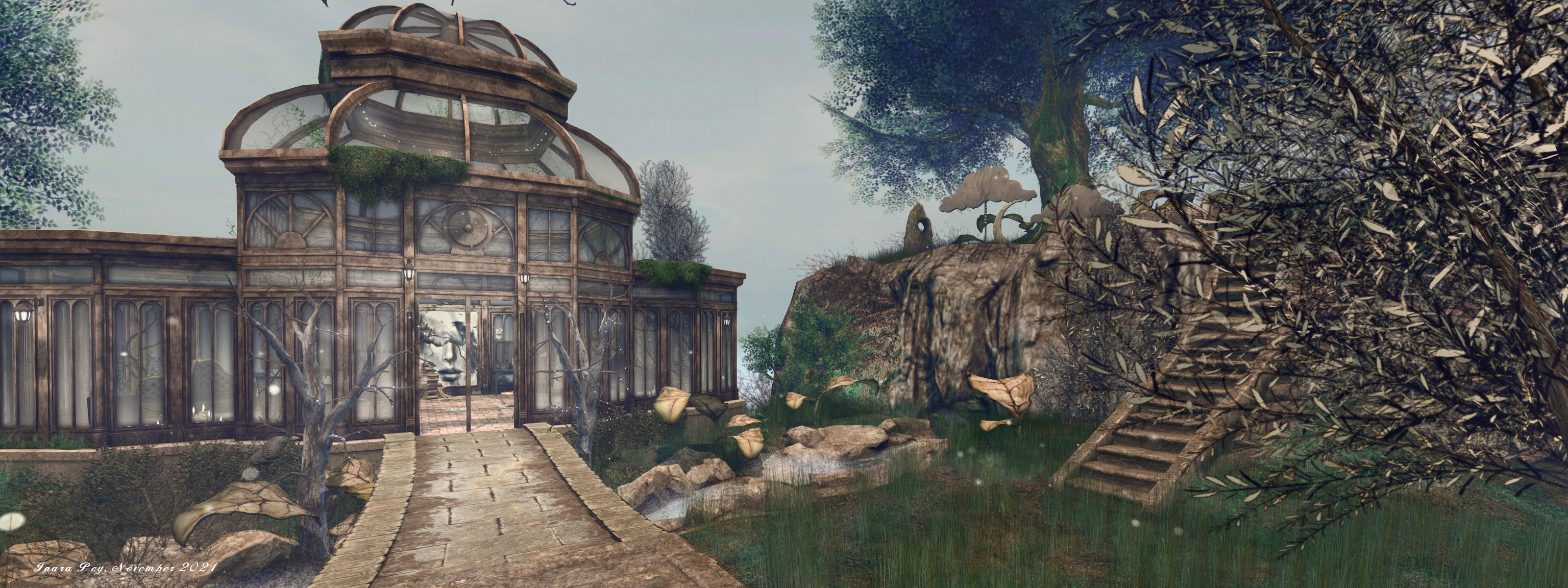
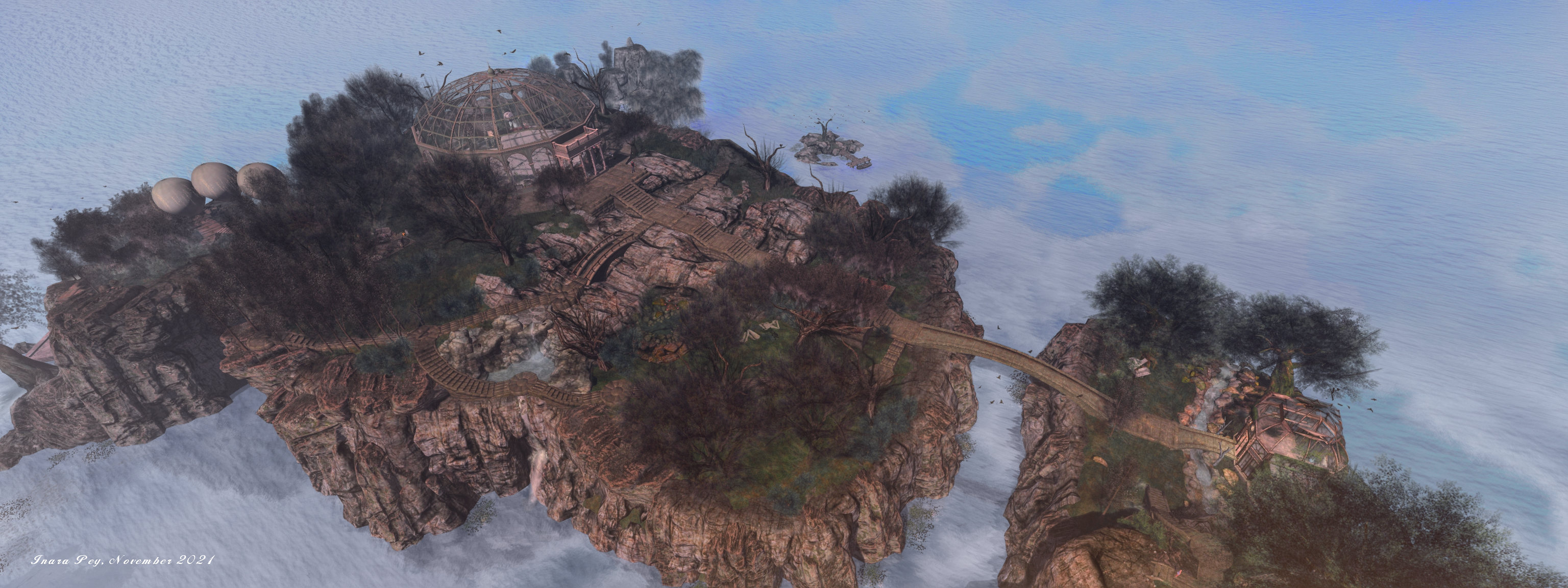
Set in a south-north orientation, the region comprises two main rugged islands linked via the single span of an elegant stone bridge, a handful of smaller isles scattered to either side of them. The more southerly and smaller of this main islands rises on near-vertical cliffs to form the landing point. This sits within a large conservatory offering comfortable seating, information, and wide open doors standing in invitation, from which an arrow-straight path runs due north, passing over a stream that issues forth from the island’s peak and thence over that graceful bridge to reach the larger island.
Here, atop cliffs every inch as sheer as those of the southern island, the great flags of the path rise by way of broad flights of steps to where a great palace of steel and and glass rises, beckoning visitors towards it as its domed roof rises above the tree tops.
Coven of Crows, November 2021
Intended as a place of music and dance, this circular house of glass of not the only destination upon this larger isle, however, for the path to it branches severally. One arm runs to the west to join with the island’s edge where water falls to the sea below and views might be taken of the islands that sit on the calm waters below. From here, the path joins with a second, as as it passes on around the island’s edge – and of which, more anon.
A further arm of the path points east, joining with an unpaved way that switch backs down to the waters edge and a small dock, one of many scattered among the islands. These docks form places where a boat might be rezzed (touch the dock and allow time for said boat to be delivered if one is not already available), such that travellers might make their way by water between the various isles.
Coven of Crows, November 2021
To the west, two of the islands are linked one to the other by way of a floating bridge, to the east, the two islands can each only be reached the use of the boats. All have points of interest to be found, be they ruins, or round pavilion with cosy bed, or long-dead tree. To the north lies the last of the islands, a high-topped nub of rock, a balloon-supported bridge linking it to the largest island in the group. A long finger of steps crooks its way down one side of this isle, the ruins to top and bottom offering points of photographic interest.
But to return to the large island and the path that runs to the west and north around its high-placed lip. This is the same path as gives access to the high, balloon-held bridge, beyond which it ends in steps that present the way down to a broad shoulder of rock, where another switch back of rocky path winds to the waters below – and the candle-lit entrance to mine-like tunnel entrance might be found. Enter this, and you will find a long passage, a throat hewn of rock that might swallow you into its depths by way of path and stair.
Coven of Crows, November 2021
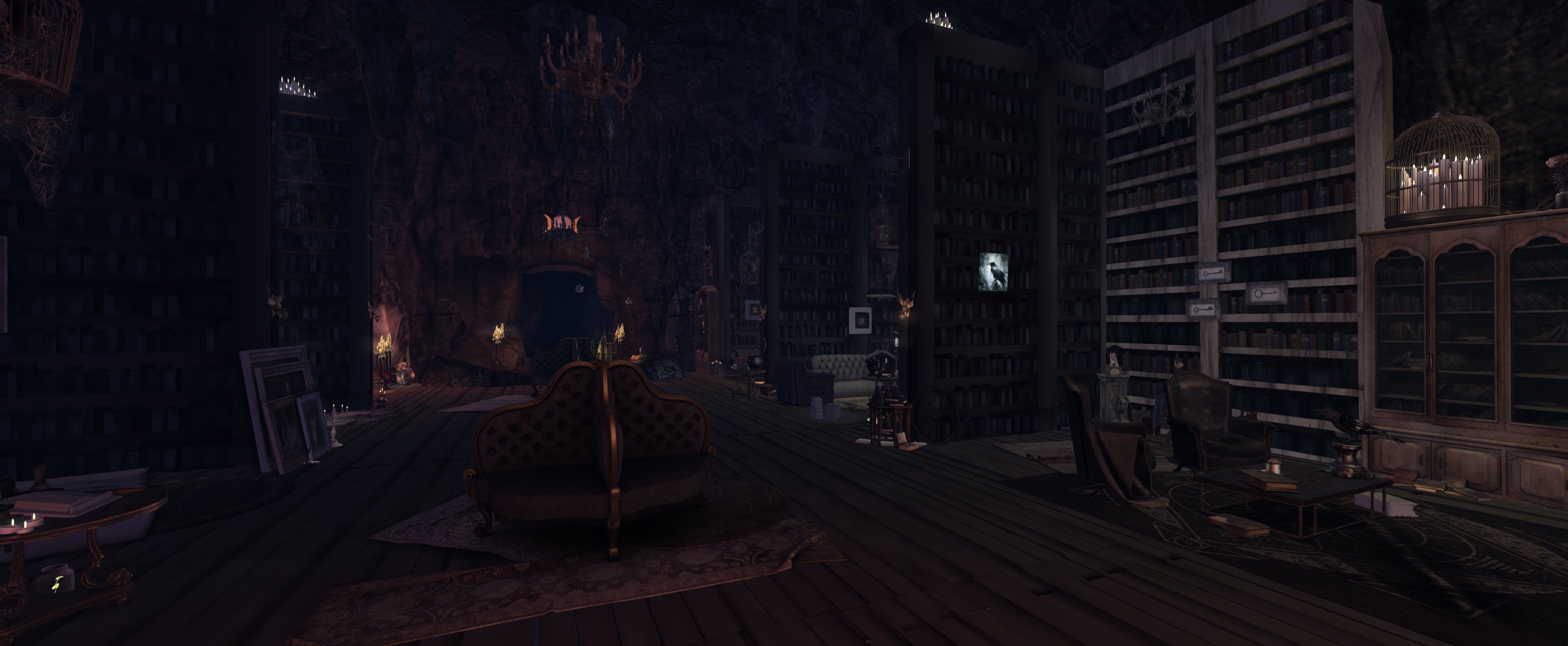
To enter it is to step into the region’s secret; for as the tunnel descends, so does it arrive at a huge cavern. High-ceilinged from which multiple chandeliers hang, and the broad entrance to a building hewn into the rock draws the eyes. Its columned façade forms the backdrop to what is at first glance a stage, and the great cavern a further place for dance. But a door in the façade gives access to a room beyond, wherein just a hint of the tales from Game of Thrones and thoughts of Aria Stark’s journey might reside.
Facing the entrance to this great chamber is a second tunnel, sitting on the far side of wood and door. Here the path runs beside water over which candles float, and the carved statue of a goddess rises. Thus with this small cavern and the chamber it faces, the mysteries of the island become clearer. But they are not the last of the secrets awaiting discovery, for the path leads onward to where another chamber sits, one perhaps with the largest surprise of all; a place that might be accessed through a second tunnel, one within its entrance somewhat hidden from the the view of the world at large.
Coven of Crows, November 2021
Watched over by the crows of its name, their caws and cries filling the air, this is a region rich in detail without being overly burdensome on the viewer; a place where many photographic opportunities await, as do places to sit and cuddle or simply pass the time. Recommended.
Logos representative only and should not be seen as an endorsement / preference / recommendation
Updates from the week ending Sunday, November 14th
This summary is generally published every Monday, and is a list of SL viewer / client releases (official and TPV) made during the previous week. When reading it, please note:
It is based on my Current Viewer Releases Page, a list of all Second Life viewers and clients that are in popular use (and of which I am aware), and which are recognised as adhering to the TPV Policy. This page includes comprehensive links to download pages, blog notes, release notes, etc., as well as links to any / all reviews of specific viewers / clients made within this blog.
By its nature, this summary presented here will always be in arrears, please refer to the Current Viewer Release Page for more up-to-date information.
Note that for purposes of length, TPV test viewers, preview / beta viewers / nightly builds are generally not recorded in these summaries.
Official LL Viewers
Release viewer: version version 6.5.0.565607, formerly the Maintenance RC and dated November 10, promoted November 15 – this viewer now contains a fix for the media issues caused by the Apple Notarisation viewer.
Release channel cohorts:
The Tracy Integration RC viewer version 6.4.23.563771 (dated Friday, November 5) issued Tuesday, November 9.
Project viewers:
Performance Improvements project viewer updated to version 6.4.24.565324 (dated November 5) November 9.
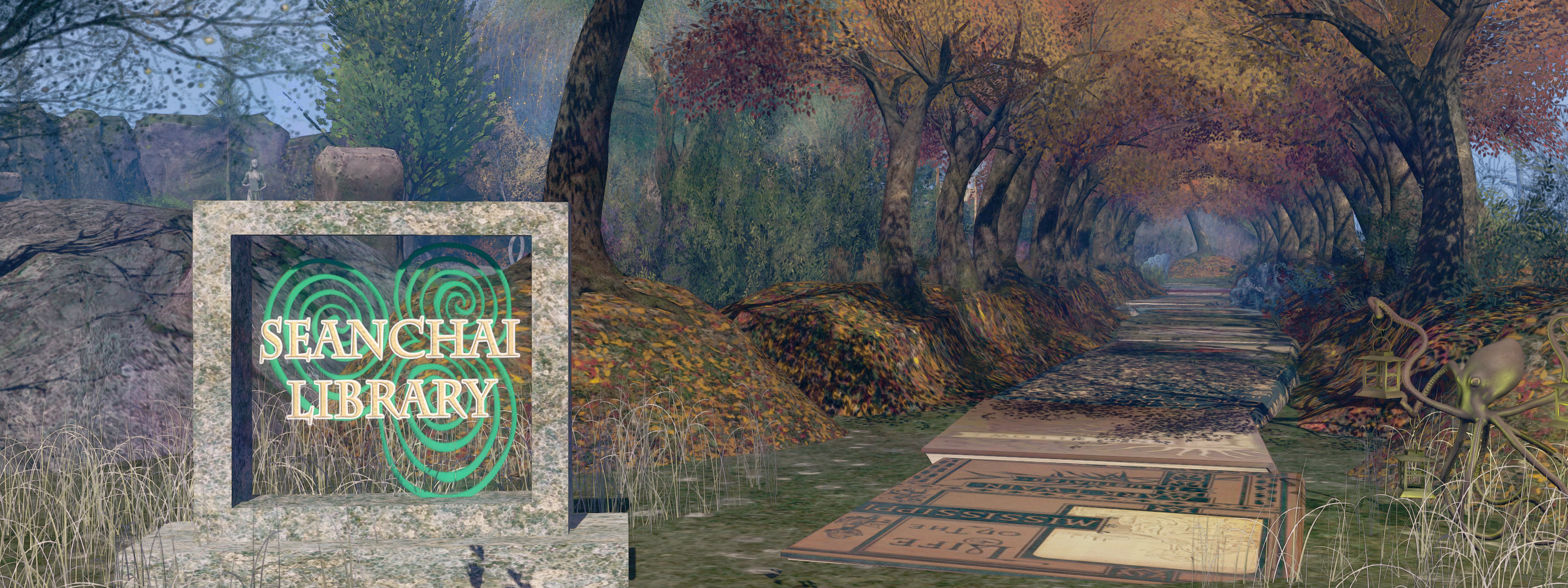
It’s time to highlight another week of storytelling in Voice by the staff and volunteers at the Seanchai Library. As always, all times SLT, and events are held at the Library’s home in Nowhereville, unless otherwise indicated. Note that the schedule below may be subject to change during the week, please refer to the Seanchai Library website for the latest information through the week.
Monday, November 15th, 19:00: The Stone God Awakens
A 20th century scientist is rendered frozen at the molecular level, and then reanimated millennia later by a freak accident. He finds himself in a strange world populated by sentient, anthropomorphic animals, who take his awakening to be the fulfilment of prophecy.
He accepts the mantle of godhood and sets about discovering this brave new world, hoping to find clues to the past while finding his place as the last human. But his quest leads to to question the reality of his status – might other humans also have survived? To find the answers he must lead his tribe of feline worshippers to the heart of a rival god: a great tree spanning half a continent.
Join Gyro Muggins as he reads a novella by the fantasy and sci-fi author Philip José Farmer.
A young artist returns to her cabin in the deep woods of Canada to concentrate on her illustrations. But somehow, strange and beautiful creatures are slipping into her drawings and sketches. The world of Faerie is reaching out to her for help – and she may be its last chance for survival.
With Willow Moonfire.
Wednesday, November 17th, 19:00 Steampunk Stories
Finn Zeddore opens the pages of Lightspeed magazine to read Carrie Vaughn’s Harry and Marlowe Meet the Founder of the Aetherian Revolution.
Despite the spiked iron gate, the estate was modest. Harry could have walked the perimeter of the grounds in half an hour, though the curving gravel drive gave the impression of greater space. At the end of the curve, one could glimpse the house, a two-story gray pile with a slate roof and clay chimneys, walls fuzzed with ivy, windows brooding—all of it easily manageable, easily guarded.
The gate was the only access through a ten-foot-high wall that surrounded the house. At the top of the wall, copper conductors placed every dozen feet or so guided an Aetherian charge, a crackling stream of deadly green energy: a second barrier, impassable, should someone think that they could climb the wall. The humming, flickering light travelled down the bars of the gate as well.
Thursday, November 18th,
19:00: Alice In Wonderland
Don’t fall down any rabbit holes, or allow yourself to get waylaid by airborne grins, because this is one tea party date for which you cannot afford to be late as Shandon Loring dives into Lewis Carroll’s popular tale – albeit this time a version with a certain Tim Burton twist!
Kondor Art Centre: Blip Mumfuzz – Urban and Industrial Images
As an artist, Blip Mumfuzz is generally an improvisor; her images tend to come about as a direct result of her general interaction with the environment she is in, rather than conscious pre-planning of pieces. Initially becoming involved in SL photography as a means of cataloguing her grid-wide travels, she started to drift away from the more conventional angles and camera positioning common to such photography, her eye and camera becoming freer, allowing her to look not so much at any given focal point within her field of view and any object therein, but more towards the physical relationships of objects, one to one another.
This gave rise to a more spontaneous, visually engaging style of photography, one coupled with a lean towards finding subjects that feature bright and / or contrasting colours, which images often presenting their subjects – objects, landscapes, settings and avatars, from unique angles or unexpected perspectives. This is turn feeds into exhibitions of Blip’s art being wonderfully free-form and rarely bound by a single idea of theme or narrative.
Kondor Art Centre: Blip Mumfuzz – Urban and Industrial Images
Which is why, when Hermes Kondor approached her about mounting an exhibition of her more urban / industrial art, Blip was somewhat sceptical, feeling that focusing on a single theme would be too confining, limiting her to archival pieces and forcing her to avoid other themes and ideas often present within her work. However, Hermes persisted, and with the assistance of Naru Darkwatch, Blip accepted his request – and the result is both unique and remarkable.
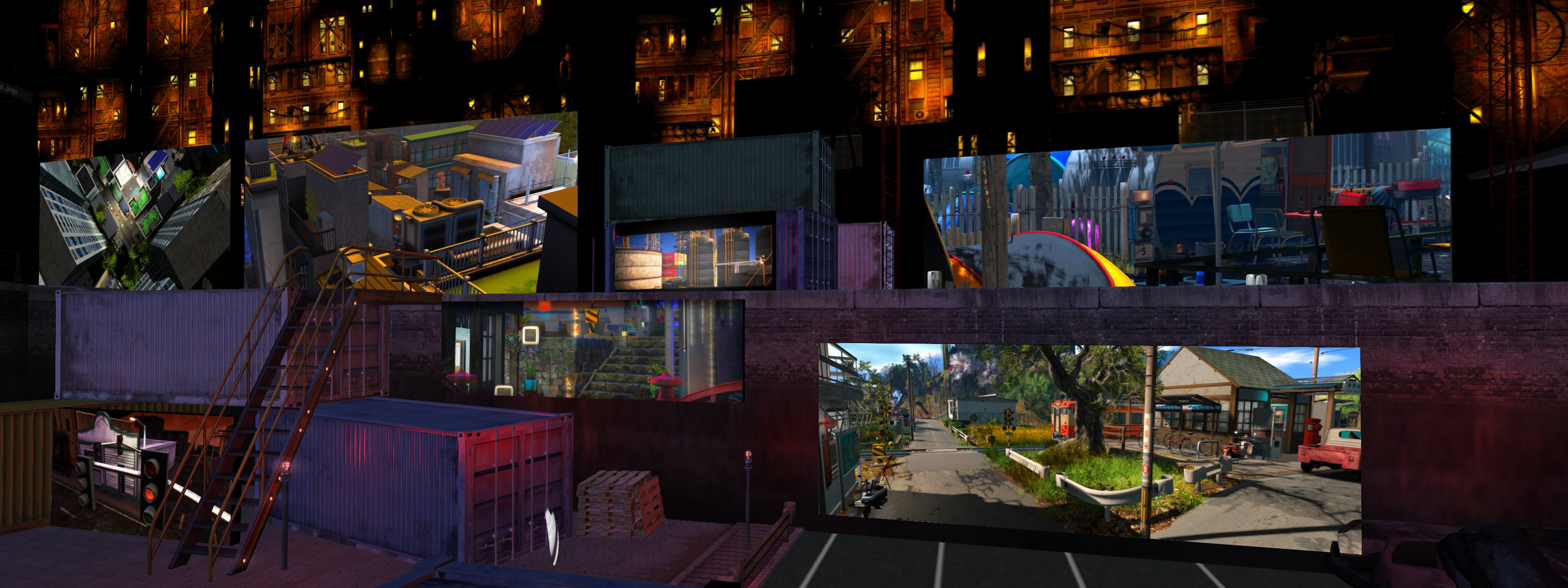
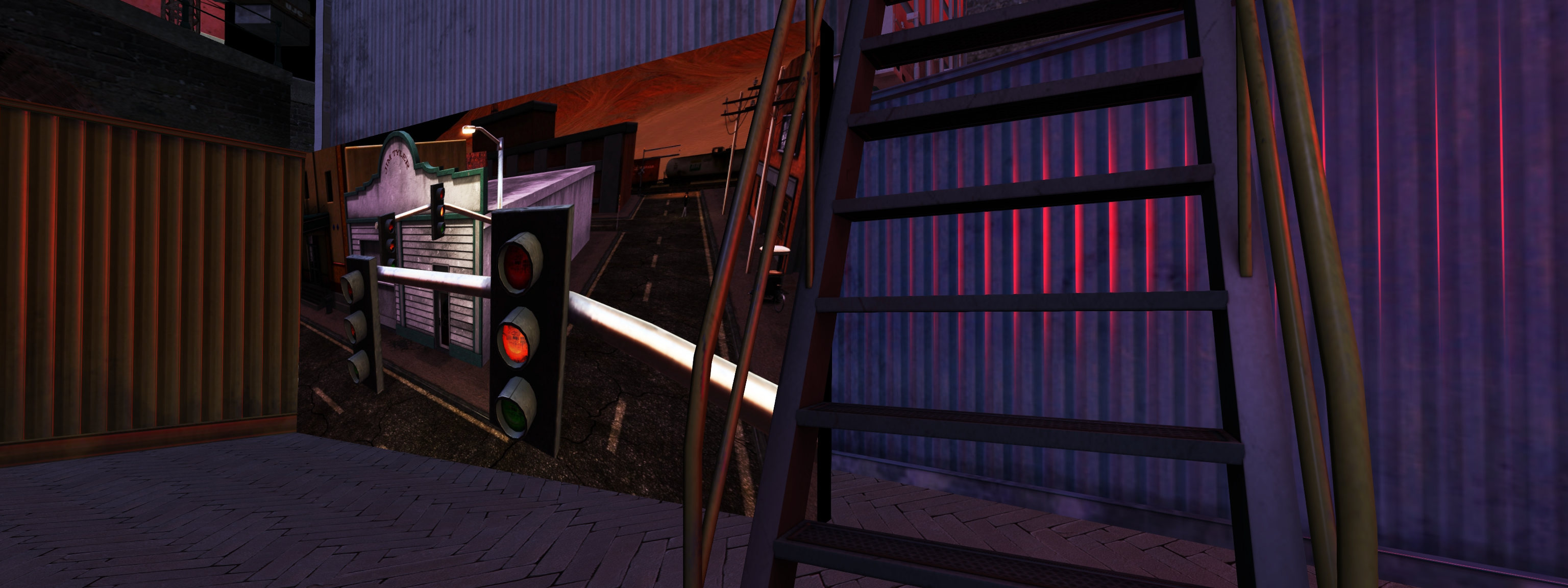
Urban and Industrial Images isn’t just an exhibition of Blips’ art, it is something of an immersive engagement with her work. Rather than merely hanging her images on the walls of a gallery space, she had the idea of presenting her work within a setting that reflects its nature. The result is an environment brought together by Naru as an industrial setting, split into two levels: an upper “street” level, where stand shipping containers, an office space and a backdrop of illuminated buildings suggestive of a larger town or city. The lower sits as a canal intended to bring barges and materiel to the city, and perhaps carry the detritus of industrial activities away – as with the barge sitting on the water.
Kondor Art Centre: Blip Mumfuzz – Urban and Industrial ImagesWithin it, Blip’s images have been laid out, some mounted in a manner so as to form a natural flow of the eye from backdrop into setting, others sitting within a building or mounted on the shipping containers, the back of a street sign, and along the deep walls of the canal. In this way, setting and art form a whole, allowing us not only to view Blip’s art, but to experience very much how she might see the scenes she comes across in her travels.
From the lower level, for example, a view of Tonarino is set beyond the arch of a bridge, the later curtailing our view, framing it to present it as a moment of motion rather than a photograph. Above it, meanwhile, the rooftops of Kekeland sit beyond the arm and jib of a crane as it raises a girder, forcing us to consider the spatial relationship between image and crane – just as Blip does in observing the places she explores and the objects within them – as does the placement of images within the old office space at one end of the setting.
Kondor Art Centre: Blip Mumfuzz – Urban and Industrial Images
An engaging, engrossing exhibition, Urban and Industrial Images is an engrossing examination of the photographer’s art.
A conceptual model of a SpinLaunch coastal launch facility with the vacuum accelerator exposed – the launch vehicle is located at the outer end of the black rotating arm. Credit: SpinLaunch
Up until now, the only means to get payload into space has been through chemical propulsion – rockets. And while they are not entirely efficient, they do work. However, if an American company gets its way, launching small payload into orbit could see the core part of their rocket replaced by a vacuum accelerator. Think of whirling an object around at speed on the end of a piece of string and then releasing it vertically, and you’ll get the picture.
The idea may sound bonkers, but it is precisely what US company SpinLaunch is planning to do.
They propose building a 100-metre diameter vacuum accelerator that, over the course of 90 minutes can accelerate an 11.2 tonne launch system up to a speed of Mach 5 before releasing it to travel along a launch tube and into the air. This velocity should be sufficient to propel the launch vehicle – comprising an aerodynamic aeroshell within which is placed a two-stage rocket carrying a 200 Kg payload.
The SpinLaunch payload vehicle, showing the outer dynamic shell, the two-stage rocket vehicle, and a pair of small satellites as the payload. Credit: SpinLaunch
On reaching a altitude matching that of a Falcon 9 first stage, the aeroshell would then split open, releasing the rocket to power itself and its payload on to orbit. Sound this work, it could reduce the cost of placing small payloads into space by around 80%, and allow for multiple launches from a single facility per day, if required.
To prove the idea works, SpinLaunch has constructed a one-third scale version of the accelerator, and on October 22nd, used it – operating at around 20% of rated output – to propel a 3-metre long ballistic projectile “tens of thousand of feet” into the atmosphere. According to SpinLaunch, the test was the first of 30 to take place over the next 6 months before they start work on construction on what they claim will be the first of a number of full-scale launch facilities at various points on the American coast.
That said, there are some significant technical challenges. Spinning at a maximum speed of 450 rpm, the system will subject the launcher and its payload to a peak dynamic load of 10,000 G; that’s a lot for the more sensitive part of the rocket motor to handle. More particularly, when it breaks the vacuum seal at the end of the launch tube, it will be travelling at Mach 5 – and slamming straight into the densest part of the atmosphere, again placing a massive load on it and its payload, as well as generating a lot of frictional heat as a result of its passage through the air. And that’s without considering the challenges in translating the spin of the accelerator into linear motion for the launch vehicle such that it can smoothly and successfully exit the launch tube, etc.
Even so, SpinLaunch appear to be carrying out the right amount of research – even if they are somewhat circumspect in addressing specific technical questions. As such, it will be interesting to see where things lead.
SpaceX Starship Update
With the public phase of the FAA’s Programmatic Environmental Assessment (PEA) of the Starbase facilities at Boca Chica now closed and the agency putting together its final version of the report, SpaceX has been moving ahead with site and vehicle development.
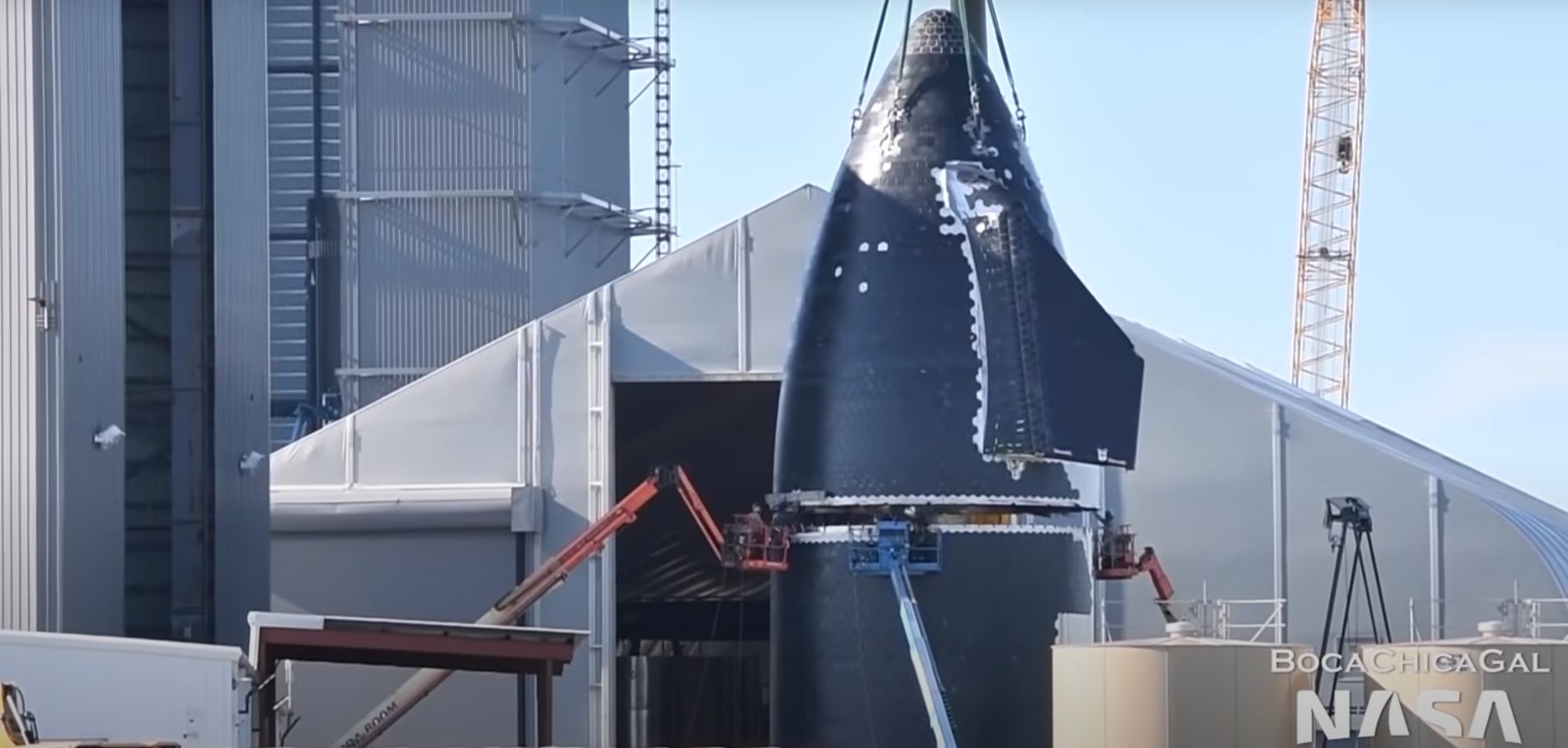
Most notably with the former has been work on erecting the framework of the new Wide Bay facility that could allow work to progress on up to four Super Heavy / Starship vehicles at a time, massively increasing the ability for the company to stack vehicles elements together. At the same time, in the current 2-vehicle High Bay, Booster 5 is nearing stack completion, and work has resumed on Starship 21.
The nose cone section of Starship 21, due to be the second orbit-capable test vehicle, is mounted onto the upper section of the vehicle. Note the thermal protection system already installed on both sections. Credit: BocaChicaGal / NASASpacelfight.comBooster 5 includes significant differences to Booster 4, which is now sitting on a hard stand at the launch facilities as work continues on the launch platform there. Most notably, elements of the booster are emerging from the fabrication facilities in a completed state than was the case with Booster 4 – which even now, is still awaiting various elements of aerodynamic casing, etc., to protect various parts during its ascent and decent through the atmosphere. Similarly, Starship 21 is showing differences in construction to Starship 20, most notably in having sections fitted with their thermal protection blankets and tiles prior to being stacked together.
At the launch site, work has continued in getting the catching mechanism on the launch support tower properly rigged to the cable system and massive winches that will allow it to move up and down the tower for eventual stacking and catching operations. A short distance away, Booster 4 has started to receive the protective skirting around its base to keep the more sensitive parts of its ring of outer engines safe from the flames and heat of ignition, as well receiving the last of its 29 Raptor engines.
However, the biggest new in recent weeks came with the pre-burn and static fire test of all six Raptor motors on Starship 20. These came almost back-to-back on November 12th, with the pre-burn (a kind of clearing the rocket engines’ throats) coming first and lasting just under a second. Then, around an hour later came a 2-second firing of the vehicles’ 3 sea-level engines and the 3 vacuum rated engines.
As with the last static fire test (with just 3 motors), some of the vehicle’s thermal protection tiles were blown clear, with a good number coming off lower down the vehicle when compared to the 3-engine test. Although brief, the static fire gave a small taste of the amount of noise that will be generated when Booster 4 ignites all 29 of its motors and then sustains their thrust through an actual launch.
Whether or not this launch, which will hopefully carry Starship 20 aloft, will come before the end of the year still hangs in the balance, with a lot riding on the outcome of the FAA’s final version of their PEA.
NASA Updates
Hubble Partially Recovered
On October 25th, the Hubble Space Telescope (HST) entered a “safe” mode, shutting down all science operations, the result of “multiple losses of synchronisation messages” – messages designed to coordinate how the various science instruments on HST receive and transmit data to / from the telescope’s primary computer system. While of concern, and possibly a little more frequent than initially diagnosed, the issue left Hubble in good health and engineers confident science operations could be recovered.
During the week, further tests were carried out that gave NASA the confidence to return the Advanced Camera for Surveys (ACS) to operational status on November 7th. The coming week will see the completion of additional tests with the hope that the more sensitive instruments on the telescope can be returned to operational status.
Artemis 3 Moon Landing Now “No Earlier” Than 2025
In a move that should have surprised no-one interested in space exploration, NASA has pushed back their return to the Moon to at least 2025, citing four reasons: the disagreement with Blue Origin over the contract for the Human Landing System (HLS), delays due to COVID working restrictions in 2020, Congress “failing” to fund HLS development and the Trump Administration placing unrealistic time frames on the programme.
Of the four reasons, the last is perhaps the most accurate: you simply cannot lop 4 years off of a programme and expect it to succeed (simply so you can take the credit as theoretically still be in office), without a commensurate increase in budget to allow NASA to achieve the required goals in the reduced time frame. On the other hand, blaming Congress isn’t entirely honest. In 2019, NASA stated they need $5+ billion for HLS development – but only requested less than $2 billion – hoping they could take money from the infrastructure bill and put into HLS – which Congress refused to allow.
The Artemis 1 mission profile. Credit: NASA – click for full size
As it is, the “no earlier” statement is standard NASA parlance when they do not wish to commit to a specific data as yet, in this instance it is perhaps indicative that Artemis 3 could slip to 2026. A lot is riding on the Artemis 1 mission, which has already slipped to February 2022, being the first flight of the Space Launch System (SLS) rocket critical in getting crews to the Moon. Should this first (uncrewed) flight reveal issues with either SLS or the Orion crew vehicle, then it is likely to seriously impact the entire Artemis timeline.
Similarly, while Elon Musk claims SpaceX will be able to land a crewed Starship HLS vehicle on the Moon in 2023, his time-frames tend to be over-optimistic. Also, there are some major questions around the Starship HLS that have yet to be answered; plus SpaceX are working to NASA’s crew safety requirements, not their own, which can (rightly, given crew safety is at stake) cause additional overheads on a development programme.
Crew Dragon: 4 Down, 4 Up
After uncooperative weather mixed things up, and caused delays, SpaceX Crew Dragon Endeavour has returned to Earth, bringing with it NASA astronauts Shane Kimbrough and Megan McArthur, ESA astronaut Thomas Pesquet and JAXA astronaut Aki Hoshide, who were all just a few hours short of spending 200 days aboard the space station.
Departure and splashdown took place on November 8th, with only the late-opening of one of the 4 main parachutes preventing the return from being perfectly textbook.
A remarkable shot captured by the NASASpaceflight.com team showing Crew Dragon Endeavour forming a bright star as it flies through re-entry high above the SpaceX Starbase at Boca Chica. In the foreground is the launch support tower for Super Heavy / Starship. Credit: NASASpaceflight.com
The departure left a lone US astronaut on the ISS along with two Russian cosmonauts. Mark Vende Hei arrived on the station aboard Soyuz MS-18 in April 2021. In September he and cosmonaut Pyotr Dubrov, who also flew to the station on MS-18, had their stay on the station extended through until March 2022. This means that Vende Hei will take the record for the longest individual space flight by an American – 353 days.
However, on Thursday, November 11th, he was joined by NASA colleagues Raja Chari, Tom Marshburn, and Kayla Barron, who arrived at the ISS along with ESA astronaut Matthias Maurer aboard Crew Dragon Endurance as the Crew 3 mission. They had launched earlier on Thursday, November 11th (Late on Wednesday, November 10th, US time), marking the maiden flight of the third Crew Dragon vehicle to enter service. They will remain aboard the station for 6 months.
Further Push to Retire SOFIA
NASA’s Stratospheric Observatory for Infrared Astronomy (SOFIA), the 2.5 metre telescope flown aboard a converted 747 SP aircraft has been recommended for “termination” by the committee that originally prioritised it.
The astrophysics decadal survey committee, which originally pushed for the airborne observatory in both 1990 (when it was not funded) and 2000 (when it was, although technical issues meant it did not enter service until 2014), now believe it is not worth the annual US $85 million cost of operating it and a “lack” of “scientific productivity”.
SOFIA: the Stratospheric Observatory for Infrared Astronomy, a flying observatory, capable of flying high enough to put it above the majority of atmospheric interference – but again threatened with cancellation. Credit: NASA
The “lack of productivity” references the fact that in its first 6 years, SOFIA has only generated 178 scientific papers that were cited 1,242 times, far less than other, more specialised observatories like the Transiting Exoplanet Survey Satellite (TESS); however, supporters of SOFIA note that the figures ignore the fact that in the last 12 months there has been a 59% increase in SOFIA papers, and the observatory is gaining more use in a variety of roles.
NASA has twice tried to cancel SOFIA, but in 2020 Congress provided sufficient funding for operations to through 2021 and into 2022. Currently, the House has also provided funding for the observatory until the end of 2023, although the Senate has yet to make a determination on funding.
Blue Origin Space Tourist Killed
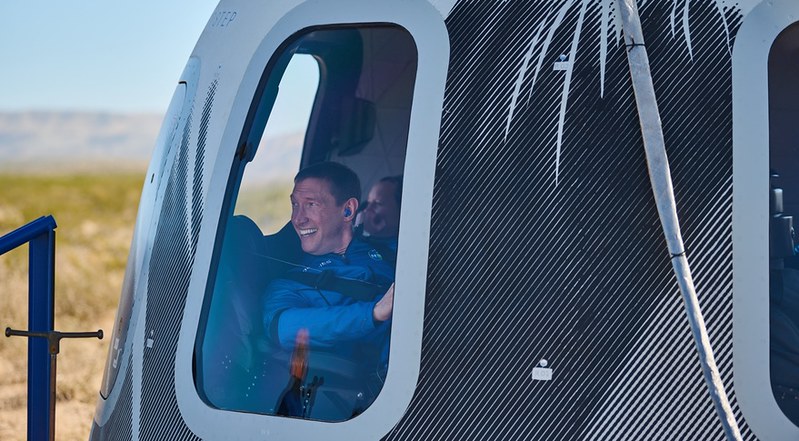
Glen de Vries, who flew with William Shatner, Chris Boshuizen and Audrey Powers, a Blue Origin vice president on the second passenger-carrying Blue Origin New Shepard sub-orbital flight, was one of two people on a Cessna 172 aircraft that crashed in New Jersey on November 11th.
Glen De Vries aboard New Shepard NS-18 capsule prior to launch
De Vries, a biomedical entrepreneur and self-described “space nerd”, paid an undisclosed sum for the flight, and had been giving talks and presentations on his experience since his return to Earth.
At the time of his death, he had been flying with Thomas Fischer from Essex County Airport in Caldwell, N.J. Both men were well-qualified pilots – Fischer also being a flight instructor – but it is not clear who was flying the aircraft. Emergency services were alerted after the pair failed to arrive at their destination, and the wreckage of the aircraft were subsequently found in a heavily wooded area near Hampton Township, about 64 kilometres northwest of New York City. At the time of writing, the cause of the crash remains undetermined.
We are devastated to hear of the sudden passing of Glen de Vries. He brought so much life and energy to the entire Blue Origin team and to his fellow crewmates. His passion for aviation, his charitable work, and his dedication to his craft will long be revered and admired.
Blue Origin statement on the death of Glen de Vries











 Inara Pey: Living in a Modemworld