Bella’s Lullaby, August 2022 – click any image for full size
I was off to Bella’s Lullaby (now at a new in-world location) once again to see how Bella (BellaSwan Blackheart) has dressed her Homestead region for the 2022 summer months.
Bella’s Lullaby is a place were nature breathes. Wander among flowers and animals and find your inner peace. Also there are plenty photogenic spots, perfect for those who love to have lots of nature and colours in their pictures.
– Bella’s Lullaby About Land description
Bella’s Lullaby, August 2022
As with previous builds, the August 2022 iteration of the region presents a relaxed, rural visit which is tranquil in both tone and look, surrounded by offshore island and under a rich blue sky. From the landing point sitting within a stone-built gazebo on the southern edge of the region, the landscape stretches northwards as a flat island with a largely shingle coastline and two smaller, and likely tidal, islands abutting it, one the the home of a windmill and the other the local lighthouse.
The general tone of the island is suggestive of a vacation retreat that is now well beyond its heyday, the handful of buildings and small structures scattered across the island looking as though they could could do with some TLC – with one exception: a recently-sold prefab home overlooking the setting’s large pond.
Bella’s Lullaby, August 2022
This is such an easy setting to explore, from the waterside café just a short walk from the landing point to the northern extremes of the island that describing it is to spoil the experience of wandering and seeing for yourself the level of detail Bella has (again) brought to her work. From the local birds and wildlife through the the flowers, cabins and caravans to the central run-down trailer home, this is a place awash with little touches that make ideal for the keen-eyed explorer and a haven for the Second Life photographer.
Bella’s Lullaby, August 2022
Nor is that all. Scattered through the setting – close to the buildings, out long the trails, on the shingles of the coastline and even over the waters, are multiple places to set and relax, either on your own or with someone close to you. the local soundscape adding to the sense of peace and restfulness.
This being the case, I’m not gone to drone on any further here. Instead, I’ll leave you with a couple of further images and encourage you to hop along and take a look for yourself.
Bella’s Lullaby, August 2022Bella’s Lullaby, August 2022
With thanks to MorganaCarter and Shawn Shakespeare for the pointers.
The following notes were taken from the Tuesday, August 23rd, 2022 Simulator User Group (SUG) meeting. They form a summary of the items discussed and is not intended to be a full transcript. A video of the entire meeting is embedded at the end of the article for those wishing to review the meeting in full – my thanks to Pantera for recording it.
On Tuesday, August 23rd, the simhosts on the Main SLS channel were updated with simulator version 574216. This includes the new LSL functions:
llReplaceEnvironment() – a scripted means to replace the environment in a parcel or a region, either for a single elevation track or the entire environment.
llSetEnvironment() – a scripted function to override the environmental settings for a region or a parcel. The owner of the script must have permission to modify the environment on the parcel or be an estate manager to change the entire region.
On Wednesday, August 24th, all simhost on the TC channel will be restarted without any deployment, leaving the also on simulator version 574216.
Available Official Viewers
On Monday, August 22nd, the Mesh Optimiser and Copy / Paste project viewers were both finally withdraw from the Alternate viewers download page, leaving the available official viewers as:
Release viewer: version 6.6.2.573358 – formerly the Maintenance 2 RC viewer, dated August 1, promoted August 4 – no change.
Profiles RC viewer updated to version 6.6.3.574158, on August 18<.
Maintenance P (Preferences, Position and Paste) RC viewer version 6.6.3.573877 issued August 15.
Izarra Maintenance RC, version 6.6.3.573920, August 15.
Maintenance (N)omayo RC viewer, version 6.6.3.573882, August 5.
Project viewers:
Love Me Render (LMR) 6 graphics improvements project viewer 6.6.2.573263, July 21.
Performance Floater project viewer, version 6.5.4.571296, May 10.
In Brief
HTTP discussion: a fair amount of the meeting was given over to HTTP which touched upon:
HTTP/2 multiplexing / pipelining (to replace the current HTTP 1.1 pipelining (which in turn touched upon TLS updates and Curl version updates) – in short, something the Lab is looking towards, but not on the immediate horizon.
The potential to obtain headers from an HTTP response using llGetHTTPHeader, which itself incorporated discussions of requirements, risk in exposing SL to returns of strings with uncontrolled lengths such that a verbose web site might cause a LSL stack overflow,
I’m actually hardly the best place to relay the ins and outs of the discussions, so I’ll refer you to the video for more.
Kondor Art Square, August 2022: Moki Yuitza – Illusory Frameworks
Now open at the Kondor Art Square – a part of the Kondor Art Centre, owned and operated by Hermes Kondor – is Illusory Frameworks, an exhibition of 2D art by Moki Yuitza.
Having entered Second Life in 2008, Moki was immediately drawn to the endless creative possibilities inherent within the platform. Starting with the basics of building, she moved on to master the use of lighting, projectors, SL physics, opting to focus on the use of prims – which are in many respects more “organic” than mesh, simply because they can be manipulated, changed, re-shaped in an almost tangible manner. The result of all this effort has been some of SL’s most remarkable 3D installations such as Hypercube, Synapses, and Cells, all of which have been both visually engaging whilst offering the opportunity to explore multiple themes – reality dreams, growth, change, geometry and more – some of which I’ve covered in these pages.
Kondor Art Square, August 2022: Moki Yuitza – Illusory Frameworks
Moki is also very much adept with 2D art. Much of her work within her Flickr stream focuses incredible avatar studies; pieces in which she brings to bear all of her vision, and skill with lighting, form, colour and narrative. However, Moki’s 2D extends much further, exploring many of the ideas and themes found within her 3D art – as with the likes of her Mindscapes exhibition at Nitroglobus earlier this year.
Within Illusory Frameworks – which is, as noted, an exhibition of 2D pieces – she combines her love of form, architecture and building with her thoughts on matters of life, reality, and the world to present a most engaging series of images that celebrates locations across Second Life whilst also offering the opportunity to take a deeper thought journey into the nature of SL – and, potential of our modern society.
Kondor Art Square, August 2022: Moki Yuitza – Illusory Frameworks
The 20 images presented within the square all feature locations from around Second Life, with each piece either overlaid with a subtle grid-like pattern, leaving the primary image visible but intentionally blurred, or post-processed to present a sense that it is entirely lattice-like in nature, reduces to a complex geometry of lines and bright concentrations of light.
Offered against black backgrounds and in more muted tones – noticeably teals, white and greys – these latter might initially put one in mind of something like Disney’s Tron Legacy, and this would not be entirely incorrect. Some of the underpinning terms within both Tron and Second Life – whilst not necessarily originating with either – are the same: the grid, rezzing, etc. Within both, all constructs are only made possible only thanks to an underpinning framework of intersecting lines, a wireframe, if you will. Thus through the lines and patterns in her art, Moki reminds us of this hidden fact: that all we see is an illusion of form, one built from a simple guiding framework (one you can bring forth, if you are so minded, through the use of CTRL-SHIFT-R and then hid once more in the same manner).
Kondor Art Square, August 2022: Moki Yuitza – Illusory Frameworks
More than this, however, is the reminder that even that framework itself is illusory, it exists only as long as there is power running through the circuitry managing the algorithms and computations need to keep it alive. And in this, perhaps is a deeper reflection of life and civilisation as a whole: that all of society is itself bound by an invisible framework of “laws” and “norms” which are themselves utterly illusory, holding true only so long as we allow them to do so.
Whether you opt to view Moki’s work through the lens of these deeper interpretations or simply as works of experimental art, Illusory Framework is an engaging visual feast.
Logos representative only and should not be seen as an endorsement / preference / recommendation
Updates from the week through to Sunday, August 21st, 2022
This summary is generally published every Monday, and is a list of SL viewer / client releases (official and TPV) made during the previous week. When reading it, please note:
It is based on my Current Viewer Releases Page, a list of all Second Life viewers and clients that are in popular use (and of which I am aware), and which are recognised as adhering to the TPV Policy. This page includes comprehensive links to download pages, blog notes, release notes, etc., as well as links to any / all reviews of specific viewers / clients made within this blog.
By its nature, this summary presented here will always be in arrears, please refer to the Current Viewer Release Page for more up-to-date information.
Note that for purposes of length, TPV test viewers, preview / beta viewers / nightly builds are generally not recorded in these summaries.
Official LL Viewers
Release viewer: version 6.6.2.573358 – formerly the Maintenance 2 RC viewer, dated August 1, promoted August 4 – NEW.
Release channel cohorts::
Profiles RC viewer updated to version 6.6.3.574158, on August 18.
Maintenance P (Preferences, Position and Paste) RC viewer version 6.6.3.573877 issued August 15.
Izarra Maintenance RC, version 6.6.3.573920, August 15.
As many doubtless already know, thanks to the work of other bloggers and also Lab Gab, NatureCon is currently underway within Second Life, and runs through until August 31st. Despite being offered the opportunity to preview it – my apologises to the organisers – the week ahead of the event opening was a little chaotic for me (hence the slow-down in general blogging), and I was unable to accept the offer. As the opening weekend in the regions was also super busy, I decided to hold off blogging until slightly quieter times allowed for more relaxed exploration.
NatureCon’s mission is to inspire connections between related SL communities and organizations from Bellisseria and the Mainland through a shared love of exploration and expressions of nature in SL.
In celebration of creative natural spaces and the folk who share them, NatureCon 2022 aims to unite Mainland’s and Bellisseria’s natural spaces and share a love of travel with the greater SL community.
– from the NatureCon 2022 Guide
NatureCon 2022: Ruthenium region – click for full size
The event is located within two Full regions on the southern tip of Sansara and connects to the open waters that offer passage to and from Bellisseria. As such, the event can be reached via direct teleport, by water from Bellisseria, by road from anywhere in Sansara or by air from the grid as a whole via the Gateway International Airport.
Between them, the two regions offer much to see and do, and features both groups and individuals from across Second Life, some of who I’ve been only too happy to cover in these pages – such as the Zany Zen Railway (see: Letting off steam with Zany Zen Railway in Second Life), one of the Great Little Railways of Second Life (alongside of Dreamshire Village – see here, and the Valkyrie Light Transport Railroad – see here, both of which are represented through advertising in the regions), and the Nature Collective by Emm (Emmalee Evergarden), which I wrote about in July 2022.
NatureCon 2022
Within the inland areas are trails and boardwalks to be followed (and climbed or descended!), which provide access to the various stages of live events, info and activity areas, allowing visitors to go horse riding, ride zip lines, try their hand at rope climbing or hang-gliding, and so on – and even tickle a volcano into an eruption(!). Down along the coast meanwhile are beaches, opportunities to mess about on (or in and under!) the water, the chance to catch the ferry to Bellisseria, and a special info centre by the SL Coast Guard.
As a celebration of Nature, there are multiple exhibits focused on the diversity of life on this planet, with a special habitat by the BB, a bird observatory, Emm’s aforementioned Nature Collective, undersea seas which include links to external resources on ocean and aquatic life conservation, and information boards a-plenty found throughout the regions, offering visitor plenty of opportunities to learn more about nature, conservation, and about communities across Second Life. In all, the event has involved the collaboration of some 60 people, including the Moles of the LDPW, and Mainland communities such as Bay City, and famous Mainland sites such as Mount Campion (see here and here for more) as well as those already mentioned.
NatureCon 2022 – Osmium region – click for full size
From the main info hubs, visitors are free to wander as they will; the trails and boardwalks offer the most direct means of getting around, but people can also avail themselves of the ChedderWorx Railway and any one of the many horse rezzers scattered around the landscape and hills – or can wear their own horse, as I did whilst exploring the greater part of the regions. Those who enjoy a hunt will also be rewarded by a visit, thanks to the NatureCon 2022 Artist Hunt – details via the posters at the two landing points. Art is also well represented through the event regions, with displays to be found under canopies of tall trees, along some of the trails and within places such as the Park Office.
Given all that is going on, a visit can put something of a strain on a visitor’s computer, so do be prepared to make some adjustments to your settings if you encounter issues – lowering draw distance may limit your view, but if it means you’re able to explore with greater ease, it’s worthwhile doing so. Also, for a fully immersive experience, do be sure to have local sounds enabled.
NatureCon 2022
It’s clear that considerable thought has gone into NatureCon 2022; so much so that drawing attention to personal niggles might seem a little unfair. However, whilst wandering, both Imp and I couldn’t help but feel while undoubtedly useful in some places, the boardwalks within the setting were in others a trifle over-used; this is a nature reserve after all, so why c;lutter so much of the landscape with (what felt like in places to be acres of) wooden planking? And while not exclusively affiliated with the Mainland, given their love of all things aquatic and for undersea life and nature, it would have been nice to visit the (otherwise bland) Mermaid’s Grotto and find information on Second Life’s mer communities.
But niggles aside, NatureCon 2022 is an obvious labour of love from all concerned, and well worth a visit. Details of facilities and events are in the images supplied here, simply click on any one of them for the full size, if required.
August and September 2022 mark the 45th anniversaries of the launches of Voyager 1 and Voyager 2, NASA’s twin interplanetary – and now interstellar – explorers.
Designed to take advantages of a planetary alignment which occurs once every 176 years, allowing the use the gravities of one of the outer planets to “slingshot” a vehicle on to the next, the two Voyager mission vehicles remain in operation today, and continue to stand at the forefront of our understanding of the local space surrounding our solar system.
Voyager 1 continues to set records as the furthest man-made object from Earth – it is now over 23.3 billion kilometres away – whilst Voyager 2 remains famous for giving us our first detailed views of Uranus and Neptune during its 20-year voyage through the outer solar system.
Products of the 1970s, the Voyager craft stand as museum pieces by today’s standards. Each has around 23 million times less memory than a modern cellphone, their communications systems can only transmit and receive data some 38,000 times slower than a modern cellular network, and they record the data they gather on an 8-track tape recorder prior to transmitting it back to Earth. Nevertheless, the amount of knowledge they have gathered and returned to us about the outer reaches of the solar system, the heliosphere (the bubble of space around the Sun in which the solar system resides), the heliopause (the boundary between that Sun-dominated “bubble” and the galaxy at large) and the realm of interstellar space beyond that bubble.
Operated by NASA’s Jet Propulsion Laboratory (JPL), the Voyager craft were launched in reverse order, with Voyager 2 lifting-off on August 20th, 1977 and Voyager 1 following on September 5th, 1977. The reason for this ordering was simple: during the development of the mission, Saturn’s moon Titan, known to have an atmosphere, was identified as a primary target for fly-by investigation, and so was assigned to Voyager 1.
Animation of Voyager 1’s trajectory around Jupiter: Pink – Voyager 1; Light Blue · Jupiter; Red · Io; Dark Blue -Europa; Yellow – Ganymede; Green · Callisto. Credit: Phoenix777
However, in order to reach the moon, the vehicle would have to follow a course that would carry it over Saturn’s northern reaches, and throw it “down” and out of the plane of the ecliptic and away from any chance of reaching the outer planets. Instead, Voyager 2 was tasked with completing the “grand tour” of the major planets – Jupiter, Saturn, Uranus and Neptune, and in order to achieve this, it would have to be launched first.
Even so, thanks to the nature of orbital mechanics requiring Voyager 2 to be thrown out on a more circular, “indirect” path towards Jupiter whilst Voyager 1 could be launched more directly towards Jupiter meant it could reach the gas giant first, arriving in January 1979, having “overtaken” Voyager 2 in December 1977. . Its passage through the Jovian system revolutionised our appreciation of the Galilean moons of the system, after which it travelled on to its November 1980 encounter with Saturn and then Titan.
Voyager 2’s more circular trajectory meant it did not reach Jupiter until July 1979, six months behind Voyager 1, but its route allowed it to make a much closer fly-by of Europa, the ice-covered Galilean moon, giving scientists the first hint of the nature of the mechanisms at work deep within the moon.
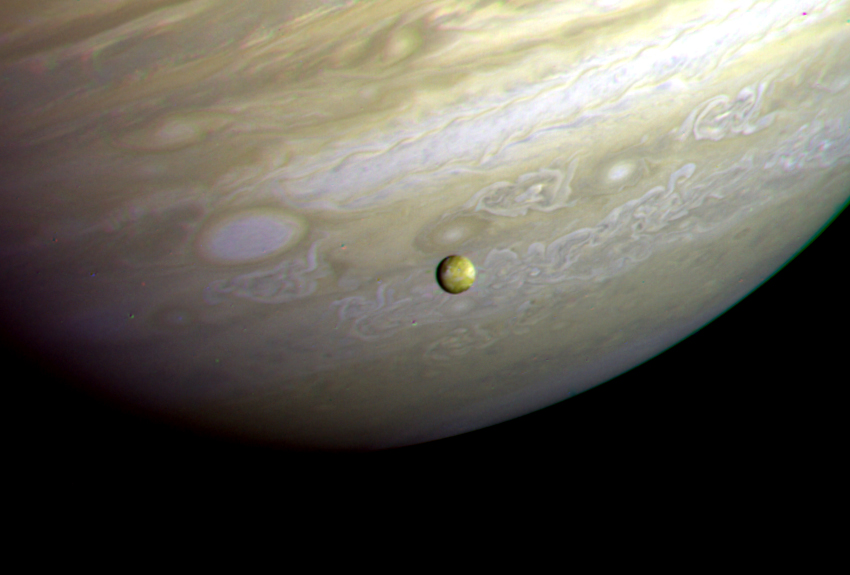
A transit of Io across Jupiter as imaged by Voyager 2 in July 2022. Credit: NASA/JPL
From here the vehicle journeyed on to an August 1981 encounter with Saturn and then Uranus in 1986 and then Neptune in August 1989, whilst Voyager 1 continued onwards toward the heliopause, all of which I covered in Space Sunday: Voyager at 40.
In 2010, Voyager 1 commenced a two-year transition from the space dominated by the Sun and its outward flow of radiation, and the realm of interstellar space. The first indications that it was beyond the influence of the Sun’s radiation came in later 2012 – although it was not until March 2013 that this was empirically confirmed through analysis of multiple data returned by the vehicle.
Voyager 2 commenced its voyage through the heliopause in 2013; however, as it was still travelling within the plane of the ecliptic, it was effectively travelling through a “thicker” part of the “bubble wall” of the heliosphere, so it did not enter interstellar space until November 2018.
Even so, and possibly confusingly, neither craft have actually departed the solar system per se. This is because the “size” of the solar system is measured in two ways: the influence of the Sun’s outward flow of radiation and by the influence of its. Despite having passed through the former, both craft are sill within space affected by the latter, and neither will reach the Oort Cloud – the source region of long-period comets and seen as marking the outer limits of the Sun’s gravitational influence – for another 300 years.
As such, both of the nuclear-powered vehicles are now engaged in a multi-vehicle mission (having been joined in it by the likes of the New Horizons spacecraft, the Parker Solar Probe and others) referred to as the Heliophysics Mission.
The Heliophysics Mission fleet provides invaluable insights into our Sun, from understanding the corona or the outermost part of the sun’s atmosphere, to examining the sun’s impacts throughout the solar system, including here on Earth, in our atmosphere, and on into interstellar space. Over the last 45 years, the Voyager missions have been integral in providing this knowledge and have helped change our understanding of the sun and its influence in ways no other spacecraft can.
– Nicola Fox, director of the NASA’s Heliophysics Division
Voyager 2 left the heliosphere on November 5, 2018. Credit NASA/JPL
Today, as both Voyagers explore interstellar space, they are providing humanity with observations of uncharted territory. This is the first time we’ve been able to directly study how a star, our sun, interacts with the particles and magnetic fields outside our heliosphere, helping scientists understand the local neighbourhood between the stars, upending some of the theories about this region, and providing key information for future missions.
– Linda Spilker, Voyager’s deputy project scientist at JPL






 Inara Pey: Living in a Modemworld