There was no deployment to the Main SLS channel on Tuesday, April 27th, although a couple of the smaller channels were restarted with thee latest simulator code version.
On Wednesday, April 28th, the RC channels should be updated with server update 558586, comprising internal fixes.
SL Viewer
There have been no updates to the current crop of official viewers to mark the start of the week, leaving the pipelines as possible.
Release viewer: Custom Key Mappings RC viewer, version 6.4.17.557391, dated March 24, promoted March 27th.
Release channel cohorts:
Maintenance RC viewer – Eau de Vie, version 6.4.18.558266, dated April 23rd.
Love Me Render (LMR) 5 viewer, version 6.4.18.558365, dated April 22nd.
Maintenance 2 RC viewer – Fernet, version 6.4.18.558441, dated April 21st.
Project viewers:
Legacy Profiles viewer, version 6.4.11.550519, dated October 26th, 2019.
Copy / Paste viewer, version 6.3.5.533365, dated December 9th, 2019.
Project Muscadine (Animesh follow-on) project viewer, version 6.4.0.532999, dated November 22nd, 2019.
360 Snapshot project viewer, version 6.2.4.529111, dated July 16th, 2019.
In Brief
BUG-139309 – “Allow setting of Hover Height via LSL” – originally closed as “unactionable”, this feature request is seen as having potential benefits (e.g. automatically adjusting the height of Animesh attachments such as a pets, so they appear to be on the ground, rather than floating above it as a result of a change of footwear on the controlling avatar) It has been suggested that the idea be re-submitted as a new feature request with examples, with Simon Linden noting:
We like the idea of making those adjustments easy to work with and use, and also don’t want to limit it to height. X and Y tweaks would be nice too.
Writer’s Block, April 2021 – click any image for full size
Over the weekend, Lex Machine (Archetype11 Nova) graciously invited me to visit his latest region design utilising his home region of Solveig ahead of him opening it to the public at large; and I say without reservation that it another absolutely stunning build that cannot fail to engage and captivate – one with the most fascinating (for me) titles: Writer’s Block.
Anyone who has ever seriously spent their time writing either for pleasure or for a living will be familiar with the idea of writer’s block – the inability to come up with original ideas, or to productively put pen to paper / fingers to keyboards.
Writer’s Block, April 2021
Contrary to the (sometimes flippant) proclamations of some noted authors that writer’s block doesn’t exist (after all, doctor’s don’t get “doctor’s block”, do they?) writer’s block can take a wide variety of forms, some of them very definitely the result of physical disorders (agraphia). Others can equally be purely psychological and / or self-inflicted.
Ender’s Game author Orson Scott Card, for example, notes that his most frequent form of his writer’s block is the result of knowing, subconsciously or consciously, something he’s written isn’t “right” in some way, be it in terms of character interaction or action, plot narrative or turn, or something else. It prevents him moving forward with a story until he has gone back, located the issue and worked out how to correct it. For others, it can come down to a loss of inspiration, simple distraction or even an over-abundance of ideas.
Writer’s Block, April 2021
Lex’s Writer’s Block offers a personification of much of the latter. As with his previous designs, this is an incredible landscape of vignettes and objects that, whilst offered within a contiguous landscape that brings them together, whilst they also stand as potential individual statements of ideas and narrative; exploring them is very much a tour through the mind of a writer / artist.
Writer’s Block, April 2021
Symbolism is – as with all of Lex’s designs – to be found through this build, and starts at the landing point, where sits an oversized manual typewriter. It is slowly being overcome by winding vines and thus speaks the the longevity that can genuinely occur with writer’s block. Pages rise from it, either blank or repeatedly printed with the image of a flower – both of which speak to two of the most recognised forms of writer’s block: the inability to get started with writing something, or becoming obsessively stuck on a particular aspect / passage / piece of writing to the point – as with Orson Scott Card, above.
Beyond this is a richly diverse landscape, a walk through the mind of a writer. Buildings stand as half-finished stories or unfinished plots that lay crumbling in the wilderness of the imagination; those that are complete, stand with empty rooms, signifying the structure of a narrative that awaits the décor of the plot and the presence of characters.
Figures human and fantastical, stand and sit as the personification of characters; the interactions between some suggest the waltz of possible interactions they might come to have within their tale; the pose of others personifying the sense of loss of creative vision or the weight or anguish of being unable to complete a story.
Writer’s Block, April 2021
Elsewhere, a flight of butterflies passes over the landscape like the flutterings of a half-considered idea, whilst feathers from angel’s wing speaks to the ephemeral nature of such ideas, so easily scattered on the winds of everyday distractions. Meanwhile, the ground offers paths – some obvious, others far less clear. For the visitor, they offer routes of discovery within the region; symbolically they perhaps reference the ease with the writer’s thoughts can wander in distraction from the task at hand.
Writer’s Block, April 2021
As is the way with Lex’s builds, the symbolism throughout Writer’s Block is stunning – but so too is the sheer artistry and the detail.
Lex has a marvellous talent from mixing ideas of scale, as anyone who has visited his previous designs will know. Here, “life-size” buildings share the space with giant carved figures, their contrasts blended through the use of trees and the rise and fall of the landscape itself.
Meanwhile, the smaller details offer both tales of their own that might be both threaded into the overall theme for the region, and also stand as suggestions of narratives waiting for our own imaginations to unwrap. These are incredibly diverse – from the statue of Freddy Mercury standing within a semi-walled garden or the little cottage that comes with mortars ranged in the front garden and the wrecks of a tank and armoured vehicle that flank it.
Writer’s Block, April 2021
I have said this before – and will doubtless say it again in the future; Lex Machine is one of the finest creators of region settings in Second Life today; his work never fails to stun and amaze in its breadth and depth. When building regions, we all pour something of ourselves into them – vision, ideas, wishes; but Lex does something more. Each of his designs invite us to witness not only his creativity, but take us on a journey through his imagination and to share in his thoughts – be they on subjects such as the global pandemic, his love for his partner Anastasia or his own psyche and outlook.
Writer’s Block is a continuation of all of this: breathtaking in scope and presentation, it is a must see for anyone familiar with Lex’s work. And if you haven’t visited his designs in the past, it makes for an excellent introduction – just be prepared to become a fan of his work!
Logos representative only and should not be seen as an endorsement / preference / recommendation
Updates from the week ending Sunday, April 25th
This summary is generally published every Monday, and is a list of SL viewer / client releases (official and TPV) made during the previous week. When reading it, please note:
It is based on my Current Viewer Releases Page, a list of all Second Life viewers and clients that are in popular use (and of which I am aware), and which are recognised as adhering to the TPV Policy. This page includes comprehensive links to download pages, blog notes, release notes, etc., as well as links to any / all reviews of specific viewers / clients made within this blog.
By its nature, this summary presented here will always be in arrears, please refer to the Current Viewer Release Page for more up-to-date information.
Note that for purposes of length, TPV test viewers, preview / beta viewers / nightly builds are generally not recorded in these summaries.
Official LL Viewers
Release viewer: Custom Key Mappings RC viewer, version 6.4.17.557391, dated March 24th, promoted March 27th – No Change.
Release channel cohorts:
Maintenance RC viewer – Eau de Vie, updated to version 6.4.18.558266 on April 23rd.
Love Me Render (LMR) 5 viewer, updated to version 6.4.18.558365, on April 22nd.
Fernet Maintenance 2 RC viewer, version 6.4.18.558441, issued on April 21st.
A comparison of the altitudes reached by Ingenuity during its first and second flights. Via NASA / JPL / iGadgetPro
Ingenuity, the small drone helicopter that forms part of the Mars 2020 mission, completed its 2nd successful flight on Mars on Thursday, April 22nd, 2021 (mission Sol 61), just days after become the first powered vehicle from Earth to lift-off and fly on another planet (see: ). And in keeping with the promise from the flight and engineering team, the second sortie was a little more ambitious than the first.
Lifting-off at 09:33 UTC, the helicopter rose to an altitude of 5 metres before hovering and then transitioning into a controlled sideways flight covering a distance of around 2 metres before again coming to a halt. It then hovered in place, rotating itself to point its on-board colour camera in several different directions before transitioning back into horizontal flight to hover over its landing site and then descend to a safe landing.
In all, the light lasted 52 seconds, and was watched by the Mars 2020 Perseverance rover, parked some 64 metres away on “Van Zyl Overlook”. During the flight, Ingenuity used its black-and-white camera to image the ground beneath it. Also – in another first – the helicopter took the first image of the surface of Mars captured by an operating aerial vehicle in controlled flight. The image clearly shows the tracks left by Perseverance as it manoeuvred around “Wright Brothers Field”, the location where Ingenuity is being tested.
An image from Ingenuity captured on April 22nd showing tracks left by Perseverance, note the helicopter’s shadow at the bottom of the image, and the landing feet visible top left and top right. Credit: NASA/JPL
While not overly dramatic in terms of manoeuvrings, the second flight paved the way for the third of five flights, which took place in the early hours on Sunday, April 25th, commencing at 05:31 UTC.
In this flight – for which data was still being received as this article was being prepared – Ingenuity rose to a height of 5.2 metres, hovered, and then flew a distance of some 50 metres downrange at a maximum speed of 2 metres / second (7.2 km/h). Following a further hover, the helicopter than returned uprange to again land at “Wright Brothers Field”. As with the 2nd flight, Ingenuity was able to use both its black-and-white and colour cameras, which have been received by NASA JPL and published.
Today’s flight was what we planned for, and yet it was nothing short of amazing. With this flight, we are demonstrating critical capabilities that will enable the addition of an aerial dimension to future Mars missions.
– Dave Lavery NASA program executive for Ingenuity, Washington DC
A further image captured by Ingenuity, this time during its April 25th 50-metre downrange flight. Credit: NASA/JPL
The April 25thflight was the longest yet, lasting 80 seconds. It now in turn paves the way for the last two in the pre-planned sequence of five initial flights in the coming days, and potentially opens the door for flights beyond those, if both are successful.
The video below compares Ingenuity’s first and second flights using animations of frames captured by the Mastcam-Z system on Perseverance. Note that the “side-to-side blinking” at the end of the video is a repeated showing of images captured by the left and right cameras of the Mastcam-Z system (which can also be used to produce stereoscopic images).
Perseverance also made history on April 22nd, by turning a sample of the Martian atmosphere into oxygen. Using the Mars Oxygen In-Situ Resource Utilisation Experiment ( MOXIE), a unit roughly the size of a car battery, the rover produced an initial 5 grams of oxygen – the equivalent to about 10 minutes of breathable oxygen for an astronaut carrying out normal activity, as explained in the video below.
Five grams is an impressive, but small amount; however, when running at full output, the MOXIE test-bed should produce around 10 grams per hour. More particularly, when scaled-up to a one tonne unit, MOXIE could produce 25 tonnes of usable oxygen over the course of several months. That’s enough to help fuel a vehicle from the surface of Mars and back into orbit.
And this is why MOXIE is important. A major part of the mass required for a human mission to Mars is the oxygen and fuel feed stock the crew will need both to survive some 500 days on Mars and to power the vehicle that must lift them back up to orbit (and / directly back to Earth). That adds up to a lot of payload mass that has to be carried to, and landed on, Mars. So, if a good proportion of that mass could be removed from the equation, then human missions to Mars become a lot less payload intensive.
This idea was first put forward in the late 1990s by Drs. Robert Zubrin and David Baker as a part of the Mars Direct mission concept. In that idea, they postulated not only producing oxygen using the Martian atmosphere, but also methane fuel. Their idea meant that potentially, 112 tonnes of fuel and oxygen could be produced on Mars ahead of each crewed mission – enough to fuel their return vehicle to Earth and provide a reserve for use during their stay on Mars, all for the cost of lifting around 6 tonnes of hydrogen to Mars.
The Mars Direct proposal used hydrogen as as a feed stock to produce both oxygen and methane that could be used to fuel the Earth Return Vehicle a crew would use travel back to Earth. Credit: Zubrin & Baker / Pey
NASA’s goal is more modest, with the focus currently only on oxygen production; fuel such as liquid methane would still have to carried to Mars from Earth and suitably stored – although there is no reason why a broader use of ISRU – In-Situ Resource Utilisation, as the process is called – to produce oxygen and fuel could not be tested in the future. On Earth, using a NASA research grant, Zubrin proved the basic concept he and Baker developed (which in turn uses 19th century chemistry) actually works, producing oxygen, methane and water using just carbon dioxide and hydrogen.
China Names Their Rover
Mid-May should see China place its first lander / rover combination on the surface on Mars. A part of the Tianwen-1 mission that arrived in Mars orbit ahead of NASA’s Mars 2020 mission, the rover has up until recently remained unnamed.
However, on Saturday, April 24th, the China National Space Administration (CNSA) announced the rover will now be called Zhurong after the god of fire and of the south, and an important personage in Chinese mythology and Chinese folk religion (also known as Chongli).
An artist’s impression of Chinese Zhurong rover on Mars. Credit: CNSA
The name was selected following a national competition of the kind NASA has used for the naming of its Mars rovers. It was seen by CNSA as being particularly apt as the Chinese name for Mars is Huoxing, or “fire star” – so it’s the god of fire on the fire star.
Roughly the size of NASA’s Wars Exploration Rovers Opportunity and Spirit, although slightly heavier, Zhurong carries panoramic and multispectral cameras, instruments to analyse the composition of rocks and ground-penetrating radar to also investigate subsurface characteristics. It will most likely set down on Utopia Planitia, a Martian plain where NASA’s Viking 2 lander touched down in 1976.
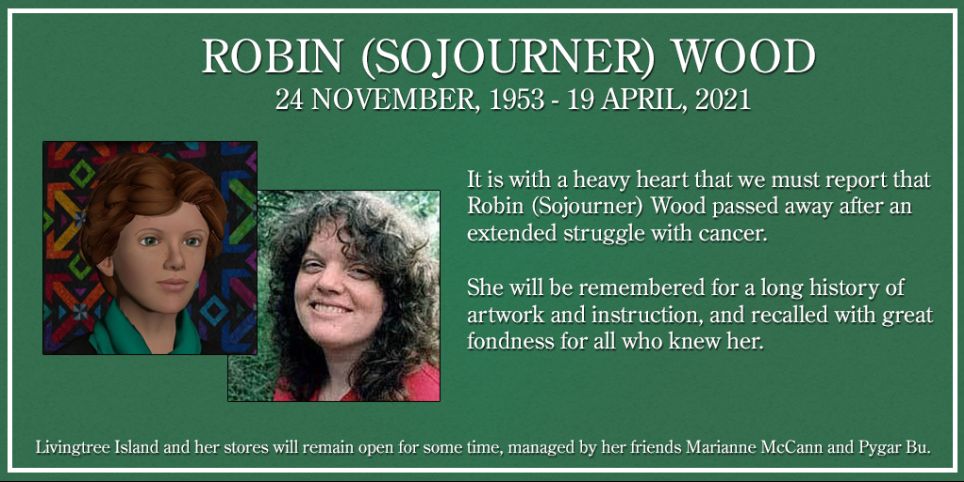
Robin (Sojourner) Wood November 24th, 1953 – April 19th, 2021
It is with a heavy heart that we must report that Robin (Sojourner) Wood passed away after an extended struggle with cancer (phyllodes tumours). She will be remembered for a long history of artwork and instruction.
With these words, Marianne McCann broke the news that one of Second Life’s long-time residents, Robin Sojourner – Robin Wood in the physical world – had passed away.
Robin was, without a doubt, one of the kindest, warmest and most giving hearts in all of Second Life; she never failed to have time for anyone who needed it. Whether it was simple conversation, the need for support, advice on creativity, assistance with solving a problem, or anything else, Robin would never fail to assist. A talented creator both inside and outside of the platform, she always had encouragement and advice for those wishing to express themselves creatively in-world by offering easy-to-follow tutorials via her website and You Tube, as well as providing both practical advice and a range of products and free resources via Livingtree island, her Second life home.
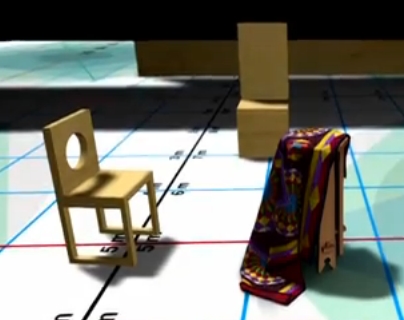
Then an now: Robin’s original 1LI prim chair and her recent mesh 1 LI creation: a stool draped with one of her quilt designs. Credit: Bernard Drax
A former teacher, Robin always enjoyed being creative, so much so that during her career she became a noted painter / illustrator, whilst her diverse interests led her into the field of writing, publishing numerous books on a range of subjects, including stories and fiction, as well as producing essays and thoughts through her blog and website.
Robin came to Second Life in 2004 during a search for a means of artistic and creative expression after fibromyalgia severely impacted her ability to paint and draw. Within the platform, she found the ideal solution.
Not only did Second Life offer an intriguing set of capabilities for creative expression, it also allowed her to work with her arms properly supported by her desk and chair. One aspect of fibromyalgia is that it can result in severe pain, notably in muscles and joints such at the shoulders, elbows and arms, particularly if they have to be raised for lengthy periods without any support, as is the case with painting. In addition, it allowed her to bring all her years of learning various 2D and 3D graphics applications together as a means to enhance her creativity.
One of the aspects of Second Life Robin always appreciated is the fact that it is a “melting pot” environment that allows anyone to (re)discover their innate creative abilities when the physical world so often encourages us to “self-edit” them away from an early age, in the false assumption that “creativity” is somehow exclusive. This was something she noted with considerable thought in a 2013 World Makers video about her, stating in part:
One of the things that has always excited me about Second Life is that people who have no idea that they are creative come into Second Life and find out that they can create things. We are all taught somewhat early that creativity is “reserved” for the creative types and they are “special” and there are only a few of them – and it’s just not true. All of us can be creative.
– Robin (Sojourner) Wood, via World Makers (2013)
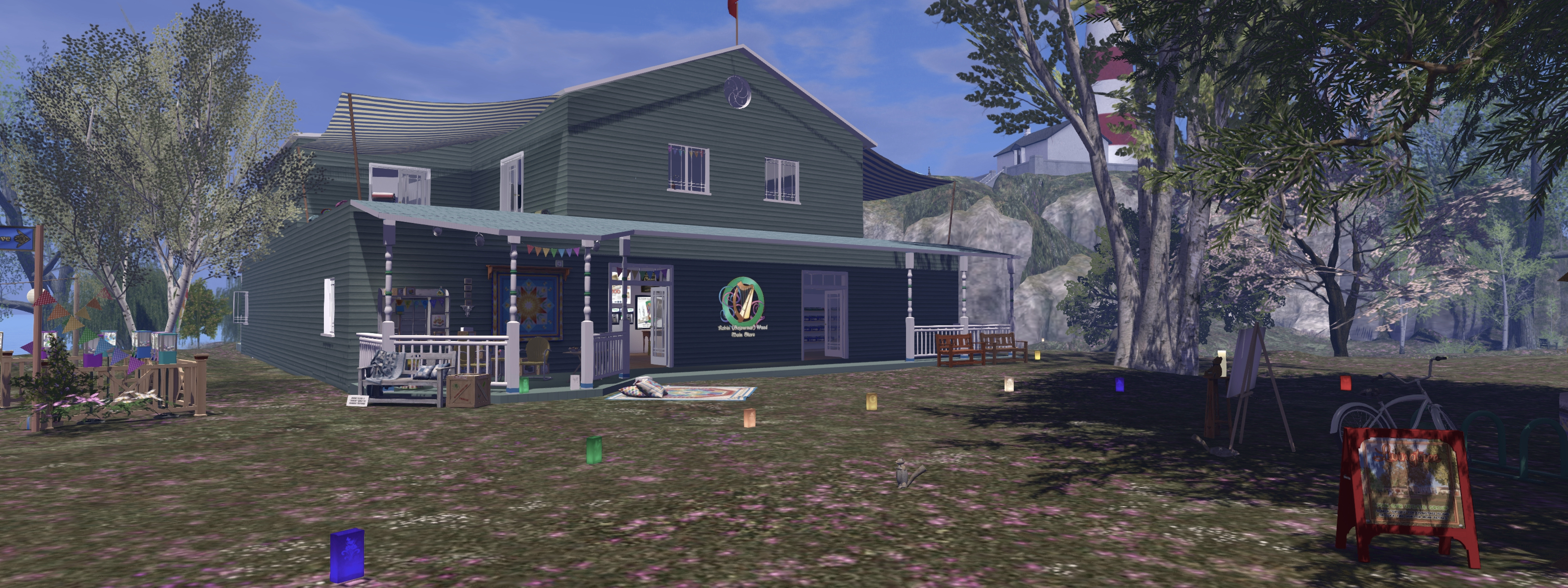
Robin’s store on Livingtree Island – a wealth of creativity and support for residents and creators alike
As a part of this outlook, Robin was always quick to embrace the significant changes we’ve seen within the platform over the years. She was one of the first to adopt mesh into her creative output and to offer tutorials and videos on making quality mesh items. Similarly, she quickly folded materials and other emerging capabilities into her work as and where appropriate.
This outlook also put Robin in a position where she could – with a wry sense of humour – offer truths about the general negative ballyhoo and foot-stomping that so often comes immediately after any change made to the platform.
[With] every single thing that has ever happened in Second Life people have yelled, “It’s the end of Second Life as we know it!” And in fact it is – because it keeps getting better!
– Robin (Sojourner) Wood, via World Makers (2013)
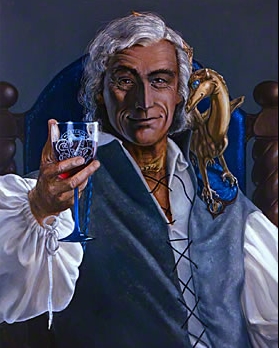
Robinton, Masterharper of Pern (oil, 1980) gained worldwide recognition for its depiction of one of Anne McCaffrey’s most-loved characters from her Dragonriders series. So much so that McCaffrey purchased the original from Robin to hang in her home.
Not only did Robin believe there is potential in all of us to be creative, she demonstrated it in very practical means, notably to her students.
As an accomplished painter and illustrator, her work has graced the covers and pages of numerous books and publications, and is utterly captivating in its style and depth. But rather than just show her works as an established artist, Robin never avoided showing her early efforts whilst learning her crafts, noting that if students and children could see how her work progressed from humble origins to incredibly rich and established pieces she went on to produce, then they might think, “if she can do this, why shouldn’t I?”
Robin’s belief that Second Life is a melting pot also extended to pushing back against the general false dichotomy often found within and without the platform that engaging in it is a matter of “either / or”. From outside of Second Life this can be expressed in views that really, you should be doing something “better” with your time; from within the platform, it can frequently be found in the idea of keeping “SL and RL entirely separate”.
Yet, as Robin demonstrated throughout her time as a Second Life resident, while we might not always see our avatars as being part of us, they are nevertheless a natural conduit of all of our ability to express ourselves and engage with others; our thoughts and outlook inform our avatars, and they in turn inform those around us – just as with our physical world interactions.
Similarly, our engagement with Second life can be as much a part of our physical lives as going out to socialise with friends in a park or through video calls, or going into the garden and spending a couple of hours tending to the flowers there – and be just as personally fulfilling.
Robin and her partner Michael with one of the quilts Robin would design via computer and then create in both Second Life and the physical world, illustrating the reality that the platform can be as positive a part of someone’s life as something like gardening. Credit: Bernard Drax
In addition to her creativity, Robin’s interests were wide-ranging, incorporating Wicca, tarot – she authored two books on the latter and also designed The Robin Wood Tarot, a set of tarot cards published by Llewellyn Worldwide in 1991 -, community and societal issues including LGBTQ rights, women’s rights and politics. She also wrote numerous books, including The People of Pern, co-authored with Anne McCaffrey herself – although I admit my personal favourite being The Theory of Cat Gravity.
Not even a diagnosis of phyllodes tumours (a form of breast cancer which can be particularly aggressive, requiring a full range of treatments – excision followed by radiation therapy / chemo therapy / further revision surgery) initially prevented Robin from creating and supporting others. In particular, she wrote a series of blog posts on her condition in the hope of encouraging those also suffering from phyllodes / breast cancer / cancer to seek treatment in it various forms, and what to expect from it.
Sadly, given the aggressive nature of phyllodes it can have a high rate of recurrence, and this is what happened with Robin, who suffered a relapse in mid-2020, and succumbed to the cancer on Monday, April 19th 2021.
To honour and remember her, there will be a memorial gathering for all who knew or encountered Robin to attend. This will be on Sunday, April 25th, 2021, commencing at 18:00 SLT. Those attending will be encouraged to share their memories and stories about her.
With thanks to Marianne McCann
For those unable to make the memorial, Livingtree Island will remain open for a time under the care of Marianne McCann and Pygar Bu, and an invitation is extended to visit and to follow the luminaria path that has been set out in personal reflection.
To Robin’s partner Michael, their family and all who knew Robin as a relative or friend, I offer my deepest condolences. As Marianne notes, Robin will be long remembered for all of her time in Second Life, and will be deeply missed.
As a mark of Robin’s life and philosophy, I’ll close by including her 2013 interview filmed as a part of the Drax Files World Makers series.
At the start of April I paid a (long overdue) visit to the Zany Zen Railway (see: Letting off steam with Zany Zen Railway in Second Life). During my chat with the ZZR’s owner and operator Zen Swords-Galway (ZenriaCo), she made mention of Dizzi Sternberg, who helped her with scripting elements of the ZZR.
At the time, I didn’t actually realise that Dizzi runs a narrow gauge railway of her own, the Valkyrie Light Transport Railroad Having since been made aware of this, I decided to hop over and take a look.
Unlike ZZR,the VLTRR is located on a single region – Lexicolo – rather than crossing multiple regions. However, it is every bit a busy – and in places as novel – as the ZZR, running both goods trains and passenger services on a central looped track that includes several branches, and even elephants trundling around their own route (I did say it was novel!).
Valkyrie Light Transport Railroad
Now around 14 years old, the VLTRR is an entirely scratch-built narrow gauge railway, part of the Great Little Trains of Second Life network – a small group of enthusiast who celebrate everything about narrow-gauge railways. Dizzi developed it with her SL partner, NightShade Fugu and Janet Rossini.
The best place to start a visit is the VLT Main Depot. This see passenger and goods trains passing through it together with the VLT trams, giving visitors a choice of rides.
A lot of work has cone into the layout – working trains run back and forth between yards and mines, and steam trains of a bygone era huff their way around the tracks while a Double Fairlie loco – perhaps most popularly associated with the Ffestiniog Railway in Wales hauls a couple of passenger cars and a caboose. The latter and the trams are available for riding around the main loop – although be aware that the trams may head into the sidings from time to time to allow another to take to the tracks.
Valkyrie Light Transport Railroad
Given the age of the VLTRR, the rolling stock is an interesting mix of prim and mesh builds with some of the older units possibly dated in looks – but if this is your focus, you’re missing the point. Much of this rolling stock has – as Dizzi informed me – been running continuously around the clock for 14 years (allowing for region restarts!) to cover a distance equivalent to a journey to the Moon!
As well as offering rides around the track, the VLTRR also offers access to the Aerodrome Amilia Earhart, owned and operated by Lady Meirit (Meirit). Built around the idea of an airfield first opened in the 1930s, it offers the chance to take in various historic aircraft dating from that period through World War II, both real and fictional, including a Supermarine S.6B of Schneider Trophy fame, a Free French Dewoitine D.520, Tiger moths, Lockheed Model 10s (appropriately enough).
The Sternberg mountain railway
The VLTRR is one of a number of rides and attractions Dizzi, NightShade and Janet provide within Lexicolo. A significant part of the region is given over to their passion for Norse history, including a number of rides, whilst tucked into a corner of the region is a theme park and a further train ride – this one modelled on Dizzi’s favourite Swiss Alpine narrow gauge track. All of this can be accessed from the main store and portal platform, where anyone wishing to have a narrow gauge railway on their own land can also purchase complete sets.
Compact and rich in history, the VLTRR is an engaging mainland visit and offers a gateway to a lot more that is waiting to be found.








 Inara Pey: Living in a Modemworld