Vanessa’s Vignettes of Calas Galadhon in Second Life

Camel Art Gallery: VanessaJane – Vignettes of Calas Galadhon

Currently open at the Carmel Art Gallery, curated by Martha McFarren (Martha Damballar), is a cosy exhibition by Vanessa Jane (Vanessajane66), entitled Vignettes of Calas Galadhon – A Journey to the Spirit of Place.

As one might gather from the title, the subject of the exhibition is the Calas Galadhon estate, thirteen regions of fabulous open landscape that form a public park operated for all Second Life residents by Tymus Tenk and Truck Meredith and their dedicated team.

Camel Art Gallery: VanessaJane – Vignettes of Calas Galadhon

Now in operation for more than a decade (December 2021 actually marks the estate’s 12th anniversary), Calas Galadhon is one of the genuine gems in Second Life’s crown, and a place one can never tire of seeing. While its form may have changed over the years as it has grown (and occasionally shrunk), it has remained a place of endearing beauty; its regions both demonstrate the power of creativity in Second Life and the true magic of the platform’s ability to offer living, breathing spaces we can escape to and enjoy.

Rich in open landscapes and waters that can be explored on foot or horseback or boat, or flown over in a hot air balloon, the park contains many places large and small to discover, and is home to regular and seasonal events. While through its contiguous vistas, it offers a breathtaking sense of space and natural depth that is genuinely stunning to the eye. In this, it stands equal to any national park we might choose to visit – but with the added benefit that the freedom and magic are just keystrokes, not hours, away, and can be instantly enjoyed whenever we choose.

Camel Art Gallery: VanessaJane – Vignettes of Calas Galadhon

It is this sense of place that Vanessa has sought to capture in the pieces offered through her exhibition. Within the fourteen images presented in the gallery space, she reveals both the estate’s essential natural beauty and the hints of otherworldliness that is very much a part of its magic (and which is reflected in their names, drawn as they are from Tolkien’s mythology).

Offered with an artful touch of post-processing Vanessa presents these pieces as if seen through the eyes of a painter. Each one individually and uniquely captures an aspect of the park’s landscape, offering a hint of story for the observer to unfold. They are also collectively part of a whole, their individual stories coming together to offer an anthology of images that reveal the living spirit contained with the Calas regions.

Camel Art Gallery: VanessaJane – Vignettes of Calas Galadhon

Set within a space that Vanessa has also dressed in a manner that reflects the park’s glades and grasslands, Vignettes of Calas Galadhon – A Journey to the Spirit of Place richly illustrates the enduring beauty of Calas Galadhon and the manner in which it can capture the hearts and eyes of those who visit. As such, it is the perfect way by which those familiar with the park might recapture specific memories of their times within it, while for those who have yet to wander the park’s regions, the exhibition presents the ideal means to whet appetites and prepare the eye for all that might be revealed when exploring the regions themselves.

SLurl Details

SL18B music festival auditions applications are open

June 2021 will see Second Life officially “come of age” as it were, as the platform celebrates it’s 18th anniversary of opening to public access – and around the world, 18 is generally acknowledged as the age of shedding minority status and of (if only in a legal sense in) reaching adulthood.

As such, this year’s Second Life Birthday (SLB) celebrations will likely acknowledge this in some way or ways – although we’ll have to wait to find out exactly how.

In the meantime, opportunities for Second Life residents to actively participate in official SLB events and activities are starting to open, with the first – as has tended to be the case over the last few years – being that of the Second Life Music Fest, applications for which opened on Friday, March 5th.

Now in its 7th year, the Music Fest has become the traditional opener for the official celebrations, and this year it will provide three days of live music entertainment between Thursday, June 17th and Saturday, June 19th inclusive.

The Lab is seeking at least a dozen performers, both veteran Second Life musicians and those new to the scene, to provide the music for the festival. Full details on requirements / policies can be found in the Music Fest application form; however, and in brief:

  • Previous sets at the festival have generally run to an hour in length, so unless otherwise stated, expect this to be the case.
  • Accepted acts are requested to be at the venue one hour ahead of their appearance, in order to complete final check-out with SLB personnel to ensure everything is ready for their set.
  • This year, there will be no payment for participation – however performers will be permitted the use of tip jars, subject to the festival policy notes.
  • All performances and song lyrics must be G-rated.
  • Applications will close on Sunday, March 28th, 2021.

As with previous years, final selection for participation in the festival will be via an audition process, details of which will be provided to successful applicants. However, note that application submission does not guarantee acceptance for audition; all applications will be subject to an initial review, and invitations to audition will be extended on the basis of that review.

For more information, check the links below.

Related Links

Space Sunday: Perseverance, SN10, and a little bit more

Part of a 360º panorama of Jezero Crater stitched together from 79 individual images captured by the high-resolution Mastcam-Z right-eye 110-mm zoom camera, captured on the afternoon of Sol 4 (Feb. 22nd, 2021). Credit: NASA/JPL

NASA is continuing to get the Mars 2020 rover Perseverance ready to commence science operations, with the past week has seen a number of milestones achieved – including the rover’s first drive on the surface of Mars.

Immediately following the post-landing check-outs, mission controllers were focused on swapping out the Entry Descent and Landing (EDL) software on the rover for the software that will be central to its surface operations. This work was completed on Friday, February 26th – Sol 8 on Mars for the rover. This paved the way for this week’s check-outs of systems.

On Sunday, February 28th, commands were sent to deploy the Mars Environmental Dynamics Analyser (MEDA). Located on the rover’s mast, this comprises two extensible booms and forms the rover’s “weather station”, a set of sensors that measure temperature, wind speed and direction, pressure, relative humidity, radiation, and dust particle size and shape, provided by Spain’s Centro de Astrobiología.

Created from a series of NavCam images recorded on February 28th, this .GIF reveals the deployment of one of the Mars Environmental Dynamics Analyser (MEDA) booms on Perseverance Mars rover. Credit: NASA/JPL

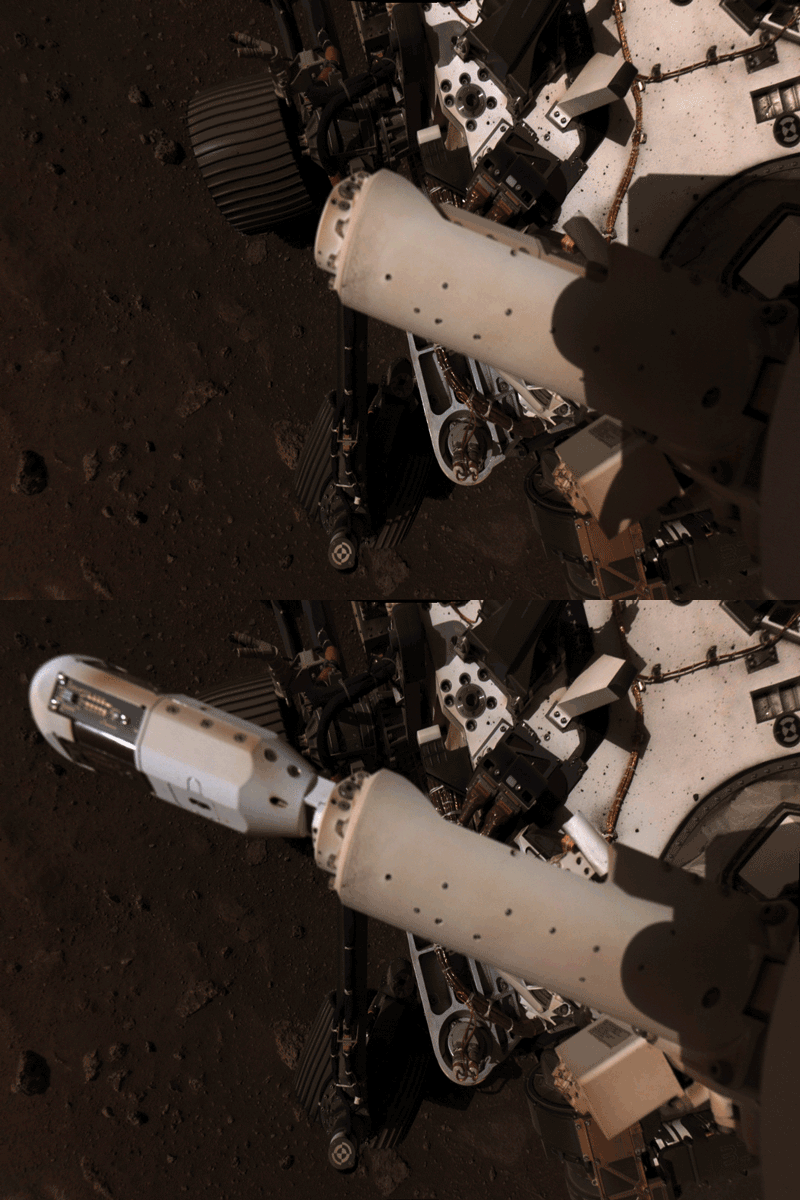
Following this, on Tuesday, March 12th (Sol 12 for the rover), the robot arm was put through its initial paces.

As with Curiosity, the robot arm on Perseverance forms a key part of its science and physical capabilities. At over two metres in length, it has 5 degrees freedom of movement, and ends with a 45 kg “turret” that carries numerous tools and instruments, including:

For its first use, the arm was extended from its cradle and raised to the vertical before being “wriggled” back and forth to confirm instrument stability. It was then lowered and put through a set of rotational moves (as was the instrument turret), before being returned to its cradle and the turret again rotated in two directions.

Images of the rover’s robot arm being put through a basic set of movements. The white “box” on the turret is the PIXL spectrometer, To the right of that is the sample / drill system and on the far side of the turret relative to PIXL is the SHERLOC / WATSON combination. Credit: NASA/JPL
Tuesday’s first test of the robotic arm was a big moment for us. That’s the main tool the science team will use to do close-up examination of the geologic features of Jezero Crater, and then we’ll drill and sample the ones they find the most interesting. When we got confirmation of the robotic arm flexing its muscles, including images of it working beautifully after its long trip to Mars – well, it made my day.

– Robert Hogg, Mars 2020 rover deputy mission manager

A further significant milestone was marked on March 4th (Sol 14), when the rover made that first drive. While covering less then eight metres, it was enough for the rover to perform a few basic manoeuvres intended to allow the engineering team to check-out the rover’s basic mobility capabilities.

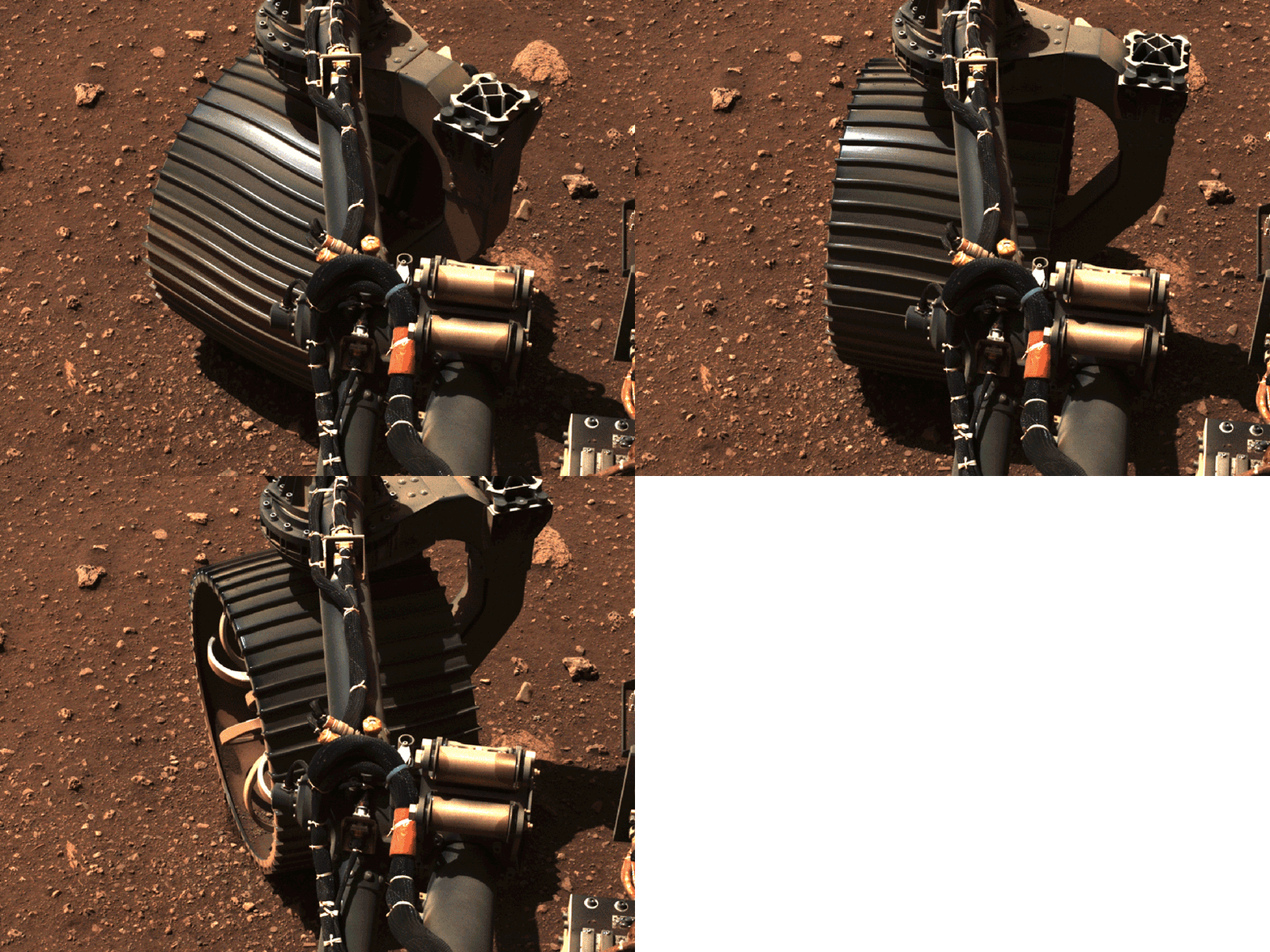
Perseverance wiggles one of its wheels in this set of images obtained by the rover’s left Navigation Camera on March 4th, 2021. Credits: NASA/JPL

Following a set of initial steering turns of the forward wheels (shown above), the rover drove forward 4 metres before turning 150o whilst standing still. It then reversed a further 2.5 metres to park in a new location. While comparatively short and taking 33 minutes to complete, this first drive is a small taste of what is to come. With its improved navigation and auto-pilot capabilities, Perseverance is  capable of covering up to 200 metres in a single day once surface operations commence.

This was our first chance to ‘kick the tires’ and take Perseverance out for a spin. The rover’s six-wheel drive responded superbly. We are now confident our drive system is good to go, capable of taking us wherever the science leads us over the next two years.

– Anais Zarifian, Mars 2020 rover mobility test bed engineer

This set of images shows parts of the robotic arm on NASA’s Perseverance rover flexing and turning during its first checkout after landing on Mars. These images were taken by the rover’s NavCam systems on March 3rd, 2021. Credits: NASA/JPL

The new parking position gave the mission team an opportunity to look back at the rover’s landing point and examine the surface and how the skycrane motors dispersed dust and regolith. The view also gave the mission team the opportunity to formally name the landing site, as has been done with past missions.

Using a press conference on the rover’s  progress held on Friday, March 5th, members of the Mars 2020 mission team announced the landing site will be known as the “Octavia E. Butler Landing”, named in honour of the African-American science fiction writer, who passed away in 2006.

Whilst not officially recognised by the International Astronomical Union, the body responsible for all official solar system designations, the name reflects the Jet Propulsion Laboratory’s practice of naming key sites for missions after noted scientists and science fiction writers (for example, the Curiosity rover landing site was dubbed “Bradbury Landing” after science fiction author Ray Bradbury, while the mountain it is exploring was dubbed “Mount Sharp” after American geologist Robert P. Sharp).

Depending on how reporting on the initial phases of the rover’s mission is handled by NASA, I’ll continue to update on Perseverance alongside other Mars missions either as a part of Space Sunday, or within a new series I’m debating running. In the meantime, the video below combines views of Jezero Crater captured by the rover’s Mastcam and NavCam systems during the rover’s first week of operations.

Continue reading “Space Sunday: Perseverance, SN10, and a little bit more”

Frogmore’s fourth in Second Life

Frogmore 4.0, March 2021

Tolla Crisp invited Caitlyn and I to visit Frogmore 4.0, the fourth iteration of her popular themed region which recently opened to visitors.

Once again, the setting draws its primary inspiration from the county of Cornwall, in the South-west of England – a place noted for its moors, hamlets, fishing, surfing, beaches and rugged beauty and which was the inspiration for the design we last saw in June 2020 (see Frogmore’s Cornish twist in Second Life). However, the design adds a couple of little twists of its own to the mix as well as offering a completely new look.

Frogmore 4.0, March 2021

Those twists take the form of a corner inspired by London’s Notting Hill, with another part taking the name “The Shire” – although whether this is a reference to Tolkien’s eponymous home of Hobbits or a reference to the shires of England in all their diverse beauty, is open to interpretation.

Now making use of the Land Impact bonus available to full private regions, this iteration has been designed by Dandy Warhlol (Terry Fotherington), who has been responsible for all of the various Frogmore designs. This ensures something of a continuity of approach as the region changes, helping to give it a sense of evolution / life in keeping with the continuing focus on Cornwell for on its inspiration.

Frogmore 4.0, March 2021

With this iteration, the region offers a look and feel of the more rugged parts of Cornwall’s coast that can feature rocky coves with little fishing hamlets tucked into them. Split into a series of islands, there is no set route to finding your way around the region, instead, visitors can wander as they please, causeways and bridges connecting the various areas.

The core influence for this design is the north Cornish fishing village of Port Isaac. It’s a place that may not be familiar to those outside of the UK, but since 2004 it has been the setting for the comedy series Doc Martin, at least one season of which has been streamed in the United States.

Frogmore 4.0, March 2021

It is also the home of Fisherman’s Friends, a male singing group who have been performing sea shanties since 1995. In 2010, they garnered worldwide attention after signing a recording deal with Universal Music, and their story was used as the basis for a 2019 romantic comedy film. The village is also part of the Baltic Live Cam network, with a 24/7 webcam stream.

Listed as a Conservation Area due to the buildings at its centre representing 18th and 19th century architecture, Port Isaac is historically significant, having likely been founded in Celtic times; its Cornish name, Porthysek means “corn port”, reflecting the use of the bay in shipping corn grown inland to centres of populace. It’s importance as a point of trade grew in the Tudor period, when Henry VIII had the bay dredged and the main pier and breakwater constructed. Apart from the corn that gave the town its name, cargoes of coal, wood, stone, ores, limestone, salt, pottery and heavy goods also passed through the harbour.

Frogmore 4.0, March 2021

However, pilchard fishing formed the backbone for the village for most of its history up until the late 1800s, with fishing still part of village life today, together with tourism. A curiosity with Port Isaac is that it shares a stretch of the coast with the hamlet  of Port Gaverne; whilst separated b around a kilometre, the latter is often to be an outlier of the village, something that might be reflected in the way elements of this design stand aside from the rest, but nevertheless appear to be part of the whole.

With its harbour cove caught at low tide complete with breakwater, the heart of the region captures something of Port Isaac’s waterfront look whilst offering a wilder,  more rugged landscape that is not so densely packed with houses and buildings. These are represented by the cluster of houses, barns and public building clustered on the island directly to the north.

Frogmore 4.0, March 2021

The Notting Hill aspect to the region can be found in the south-west corner, where an antiques boutique typical of those found along Portobello Road is waiting to be found. Sitting on a finger of land reached by a covered bridge, it sits separated from the main Cornish village element by The Shire.

This is a location that sits both aside from, yet a part of, the rest of the region. As already noted, whether one takes the area’s name from Tolkien or stands in reflection of England’s shire counties is a matter of choice. Certainly, there are no Hobbit holes waiting to be found, and the buildings, drywalls and gardens are suggestive of places like the Home Counties shires mixed with a dose of Yorkshire and Derbyshire. However, the high mountains surrounding the region – which are definitely not of England – give a New Zealandish feel to the setting, putting one in mind of the likes of Peter Jackson and his iconic visualisation of Middle Earth through his films, and thus call forth thoughts of Hobbits.

Frogmore 4.0, March 2021

As with all of the Frogmore iterations, this setting is rich in opportunities for photography, exploration and simply sitting and enjoying the view. Do be aware, however, that given many of the buildings are furnished, it is a place packed with mesh and textures,  and this can have an impact on viewer performance, so be prepared to make allowances should this be the case.

But that said, from the compact gathering of houses and buildings clinging to the shorelines and cliffs complete with narrow streets, to the sweep of a northern beach overlooked by the ruins of a promontory fort, the richness of the Cornish landscape is hard to deny; while the twists within – the hints of Portobello Road to the touch of the Mediterranean in some of the buildings – make Frogmore a delightfully engaging visit.

Frogmore 4.0, March 2021

To mark the re-opening of the region, Tolla is holding a photography competition with a L$17,500 prize pool, details of which can be found here.

SLurl Details

Visitors to a Museum in Second Life

The Eye Arts: Hermes Kondor – The Museum (The Visitors), March 2021

Now open at The Eye Arts, operated by Wan (Wan Laryukov) is a new exhibition of photography by the magnificent Hermes Kondor. Offered under the joint title of The Museum (The Visitors), it is a collection of Hermes’ work from the physical world that could also be called Watching the Watchers.

Spread across the two floors of the gallery is a series of black-and-white photograph that offer a unique take on a visit to a museum that Hermes explains thus:

I passed a few days in the Gulbenkian Museum in Lisbon, seeing how people react and behave in the presence of Art and Beauty. Some stop, look and enjoy it, others sit in front of it, looking deeply into the details trying to find the hidden magic and beauty of each piece of Art. Quite a lot, with ‘phone in hand take photos of every work, keeping it in a memory card for later enjoyment.

– Hermes Kondor

The Eye Arts: Hermes Kondor – The Museum (The Visitors), March 2021

The gallery is home to what is regarded as one of the most important private collections of art in the world, that of Calouste Sarkis Gulbenkian. Comprising some 6,000 pieces covering 5,000 of human civilisation, it includes 2D and 3D art representing Egyptian, Greco-Roman, Mesopotamian, Islamic Oriental, Armenian, and Oriental history, as well as westen art which in includes sculptures, the art of the book, paintings and one of the most extensive collections or pieces by the French glass artist René Lalique, from whom Gulbenkian personally commissioned 140 individual items.

Given this, the halls of the museum offer a considerable amount to see and appreciate – and, as Hermes notes, captivate those who visit. As such, it is a rich source of material for the skilled photographer, and Hermes demonstrates this to the full in the images gathered in this collection.

The Eye Arts: Hermes Kondor – The Museum (The Visitors), March 2021

These are a remarkable set of studies in human nature and behaviour, the use of monochrome giving them a timeless edge that perfectly fits the historical context of the museum and the collection within it.

The richness of human interactions – direct and indirect – found within these images cannot be overstated. Within them we find multiple expressions of how we interact with art and one another; from the unconscious use of stance – leaning forward or backwards whilst studying a painting – to the close inspections Hermes mentions and the manner in which phones are being used; even the manner in which some interactions can take place seemingly without awareness for those around us, caught as we are within our own social group, is perfectly reflected in some.

The Eye Arts: Hermes Kondor – The Museum (The Visitors), March 2021

For me, what makes these pictures especially captivating is the fact that they have often been taken without the awareness of the subjects within them. Thus, there is a natural vigor about them that gives the museum itself a vitality of life. In addition, this approach allows the pictures to be presented as a most unique series of studies into the human body as a statement of art.

As well as the individual images being available for purchase, Hermes has also collected them together as a book that can be purchased at the reception desk on the lower floor, allowing visitors to keep a memento of the exhibition.

SLurl Details

2021 CCUG and TPV Developer meetings week #9

Wildwood Gardens, January 2021 – blog post

The following notes were taken from my audio recording and chat log of the Content Creation User Group (CCUG) meeting held on Thursday, March 4th 2021 at 13:00 SLT, and Pantera’s video recording of the TPV Developer’s meeting of Friday, March 5th, a copy of which is embedded at the end of this article.

The majority of the TPVD meeting was given over to a discussion of the texture cache issue, together with a general discussion on the simplified cache structure and also on Jelly Doll avatars.

These meetings are chaired by Vir Linden, with dates available via the SL Public Calendar. The venue for the CCUG is the Hippotropolis camp fire, and the TPV Developer meeting is held at the Hippotropolis Theatre.

SL Viewer

[From the CCUG meeting & TPVD Meeting]

Release Roll-Back & Issues

  • The Simple Cache viewer, version 6.4.14.556088, had to be rolled back following its March 2nd promotion due to a number of bugs (e.g. cache location not being adhered to – BUG-230337; uploads of textures above a certain size were failing – BUG-230295).
  • The roll-back saw the Jelly Doll improvements viewer, version 6.4.13.555567 (originally promoted on February 17th) revert to being the de facto release viewer.
  • However, the roll-back resulted in some users who had updated to the Simple Cache viewer users experiencing a corrupted texture cache when using an older version of the viewer.
  • Unfortunately, LL are having problems consistently reproducing the texture caching issues, so it is unclear how matters will be resolved.

This means that for the meantime:

  • Those experiencing texture issues on the official viewer as a result of having used the Simple Cache viewer and then rolling back to, or installing, another version should try clearing cache and re-starting the viewer.
  • Until the Lab have more of a handle on the texture cache issues:
    • Those RC viewers that had been internally merged with the Simple Cache viewer will also be rolled-back to an earlier version.
    • Internal viewer testing procedures will be reviewed.
    • TPVs that have also merged the Simple Cache code will also likely need to roll back their code.
  • One suggestion for resolving this issue is for the official viewer to increment the texture cache version number, forcing a complete wipe / reset of the cache
  • Independent of the texture caching issues, and due to BUG-230337 and BUG-230295, the Simple Cache viewer will go back to a development status so the issues can be fixed.
    • Firestorm apparently has fixes for these particular issues, and these may be contributed to LL.

General Viewer Notes

  • A new Maintenance RC viewer – Eau de Vie, version 6.4.14.556149, was released on March 4th.
  • The Custom Key Mappings viewer updated to version 6.4.14.556098, also on Thursday, March 4th.

The rest of the official viewers in the pipeline remains as follows:

  • Release channel cohorts:
    • Love Me Render (LMR) 5 project viewer, version 6.4.14.556118, February, 23, 2021.
  • Project viewers:
    • Legacy Profiles viewer, version 6.4.11.550519, October 26.
    • Copy / Paste viewer, version 6.3.5.533365, December 9, 2019.
    • Project Muscadine (Animesh follow-on) project viewer, version 6.4.0.532999, November 22, 2019.
    • 360 Snapshot project viewer, version 6.2.4.529111, July 16, 2019.

There may be a viewer promotion during week #10 (commencing Monday, March 8th).  While no final decision has been made, it is possible the LMR 5 may be the viewer that gets promoted.

Viewer Rendering

[CCUG Meeting]

  • Euclid Linden continues to work on separating UI rendering from general scene rendering in order to improve overall viewer performance.
    • Currently the UI is completely redrawn every frame, along with the rest of the scene, whether or not it requires update.
    • This can take up to 40% of the rendering time, depending on the complexity of the scene being rendered, with around 10-20% being an average, so it is hoped the changes will particularly help those on less-capable systems.
    • There may be some subtle / slight reduction in UI responsiveness under certain circumstances, so a means to tweak the UI update rate may be provided via something like a Debug setting.
    • Note: this work is not physically altering the appearance of the UI, only the frequency with which it is drawn.
  • Ptolemy Linden continues to work on more general rendering performance improvements and rendering bug fixes.

In Brief

  • [CCUG] Map tiles are still being worked on. In the future the lab may look to implement a new means of generating the Map tiles in a more robust way.
    • The Lab has an internal proposal for updating terrain textures, but it has yet to be formally adopted.
  • [CCUG] Allow upload of ground  constrained animations – on the LL’s list,  but has not been looked at as yet.  Vir believes that as the capability is already supported (but undocumented) is should only require an alteration to the simulator animation code to ensure the constraints are correctly understood.
  • [TPVD] Firestorm has entered QA, with a release planned for mid-March.

Date of Next Meetings

  • CCUG: Thursday, March 18th, 2021.
  • TPV Developer: Friday, March 19th, 2021.