Logos representative only and should not be seen as an endorsement / preference / recommendation
Updates for the week ending Sunday, December 20th
This summary is generally published every Monday, and is a list of SL viewer / client releases (official and TPV) made during the previous week. When reading it, please note:
It is based on my Current Viewer Releases Page, a list of all Second Life viewers and clients that are in popular use (and of which I am aware), and which are recognised as adhering to the TPV Policy. This page includes comprehensive links to download pages, blog notes, release notes, etc., as well as links to any / all reviews of specific viewers / clients made within this blog.
By its nature, this summary presented here will always be in arrears, please refer to the Current Viewer Release Page for more up-to-date information.
Note that for purposes of length, TPV test viewers, preview / beta viewers / nightly builds are generally not recorded in these summaries.
Official LL Viewers
Current release viewer version 6.4.11.551711, formerly Cachaça Maintenance RC viewer promoted on November 12th – No Change.
Release channel cohorts:
Dawa Maintenance RC Viewer, updated to version 6.4.12.553723 on December 15th.
For those who have not already seen it, the next two weeks present an opportunity to witness a unique event – a very close conjunction between Jupiter and Saturn.
“Conjunction” is the term astronomers used to describe two astronomical objects or spacecraft having either the same right ascension or the same ecliptic longitude, and thus when seen from Earth, appear to be close together.
With the planets, such events are not especially rare – in fact as they and the Earth circle the Sun, conjunctions between Jupiter and Saturn tend to occur once every 20 years. However, most of these only see Jupiter and Saturn close to around one degree of one another, or about one-fifth the diameter of the Moon as seen from Earth. But sometimes they appear to get much closer, creating what is referred to as a “great conjunction”. This year, the two planets will appear to be just 6 arc minutes apart as seen from Earth on December 21st, 2020; so “close” (remembering that their respective orbits around the Sun will still be separated by 883 million km), they will almost, but not quite, appear as a single point of light when seen with the naked eye.
The great conjunction between Jupiter and Saturn,, tracked from October through to December 21st. Credit: Pete Lawrence
These “great conjunctions” occur, on average, once every 300-400 years, although such is the nature of orbital mechanics, they can actually occasionally occur more frequently, or have longer time gaps between them. As it is, the last time Jupiter and Saturn appeared as close as the will be between December 20th and 22nd was in 1623, not long after Galileo had observed both planets – although he was unable to witness the event, as the rising Sun would have rendered them invisible in its glare.
What is most rare is a close conjunction that occurs in our night time sky. I think it’s fair to say that such an event typically may occur just once in any one person’s lifetime, and I think ‘once in my lifetime’ is a pretty good test of whether something merits being labelled as rare or special.
Astronomer David Weintraub
However, the two planets can appear to be much closer. In 1226, and in the skies over the Mongol Empire, when the planets appear to be just 2 arc minutes apart.
Jupiter (again, the brighter object) and Saturn, seen in the sky over the Shenandoah National Park, Virginia, on December 13th, 2020. Credit: Bill Ingalls/NASA
Tracing these great conjunctions back in time reveals that Jupiter and Saturn may well have played a role in the legend of the Star of Bethlehem. In 7 B.C. not one, but three great conjunctions occurred, with the two planets again being within 2 arc minutes of one another as seen from Earth.
The first occurred in May of that year, when Jupiter and Saturn appeared as a morning star over the middle east. As the Magi were practitioners of (among other things) astronomy and astrology – both at that time pretty much joined at the hip – such an event may well have caused them to start out on their long journey towards Judea, the second conjunction, in September of the year, encouraging them to continue. The third conjunction occurred in December, 7 B.C., the time at which they were said to have met with Herod the Great.
Using Stellarium, open-source astronomy software, it is possible to reproduce how the great conjunctions of the 6th century B.C. might have looked to the Magi, as a wondrous new star, causing them to set out for Judea. Credit: Stellarium
This year’s conjunction will be not long after sunset, with the two planets located low over the south-west horizon. With a reasonable telescope or good pair of binoculars, you’ll have an ideal opportunity to see both planets and their major moons in the same field of view. Should you do so, you’ll be looking at over 90% of the planetary mass of the entire solar system.
Beyond the 21st, the two planets will gradually move “apart” as noted, until by the 25th December, they’ll be separated in the night sky by roughly the diameter of a full Moon, and will continue to draw apart relative to Earth as they pass below the horizon.
How to see the “great conjunction” of Jupiter an Saturn
And if you miss this close conjunction between the two, the next will be along in a relatively (and unusually) short period, occurring on March 15th 2080. The next time they’ll be as apparently close as they were in 7 B.C. will be on Christmas Day, 2874.
The Dickens Project: Invitational Art Show – CybleMoon and Silas Merlin
The Dickens Project 2020 Edition enters Christmas week with two art exhibitions for visitors to appreciate. Each is located in a different part of the Project’s Victorian townscape, offering those who visit the opportunity to explore the streets and discover more of what the Project has to offer this year.
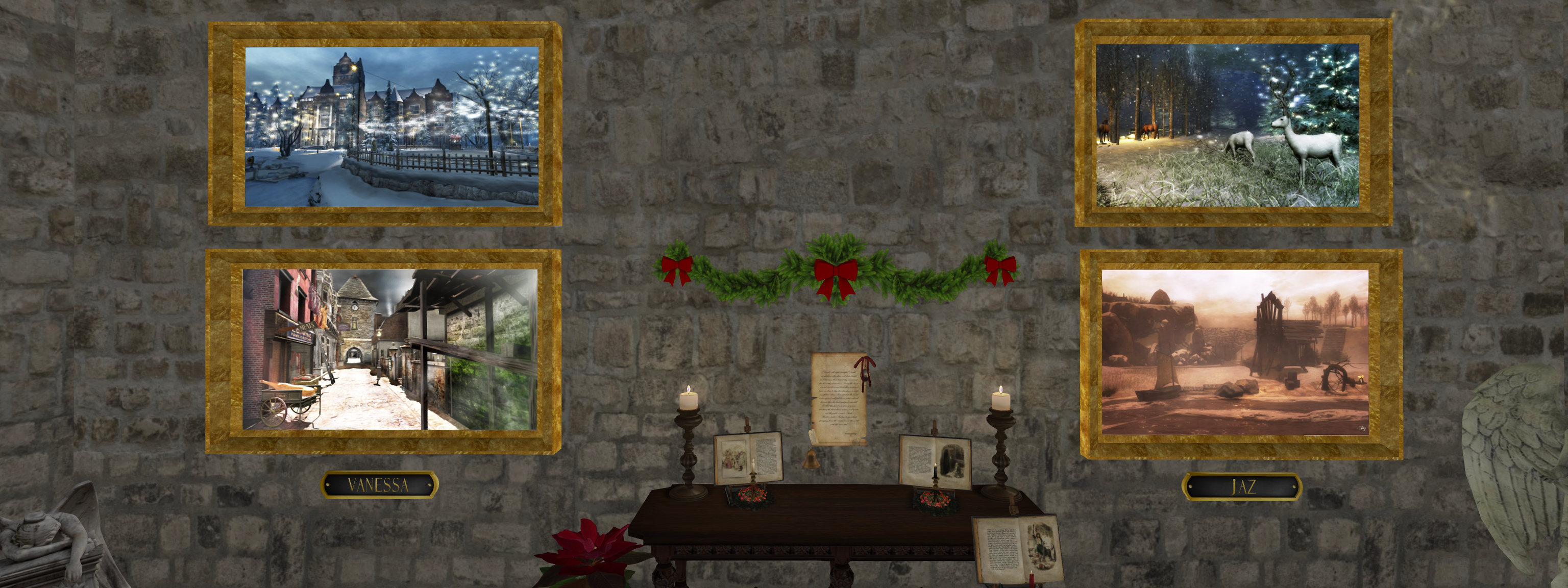
Located in the church sitting to one side of Dickens Square, the Project’s main landing point, is the Open Art Exhibition, featuring artists who accepted the Project’s invitation to display one or two pieces of art that have created on a Victorian Christmas / Dickensian theme.
The Dickens Project: Open Art Show – VanessaJane68 and Jezzamine2108
In all, seven artists responded to the invitation, and between them they offer an engaging series of images on the themes. The artists are: Jessamine2108, VanessaJane66, Stevie Morane Basevi, Dawn Greymyst, Banshee Heartsong, Evelyn Held and Vita Theas.
Together their images capture the spirit of The Dickens Project Past (e.g. Evelyn Held: A View From Dickens Harbour Lighthouse, Jessamine2108: Dickens Harbour), images with a decidedly Victorian feel (VanessaJane68 with Christmas Hall and Tower Lane; Dawn Greymyst: Holiday Preparation), and others with a clear Dickens influence (e.g. Vita Theas: Kids, Evelyn Held, Magic of Christmas Past).
The Dickens Project: The open Art Show – Evelyn Held
All of the pieces are evocative of the period they represent and the Dickens Project theme.
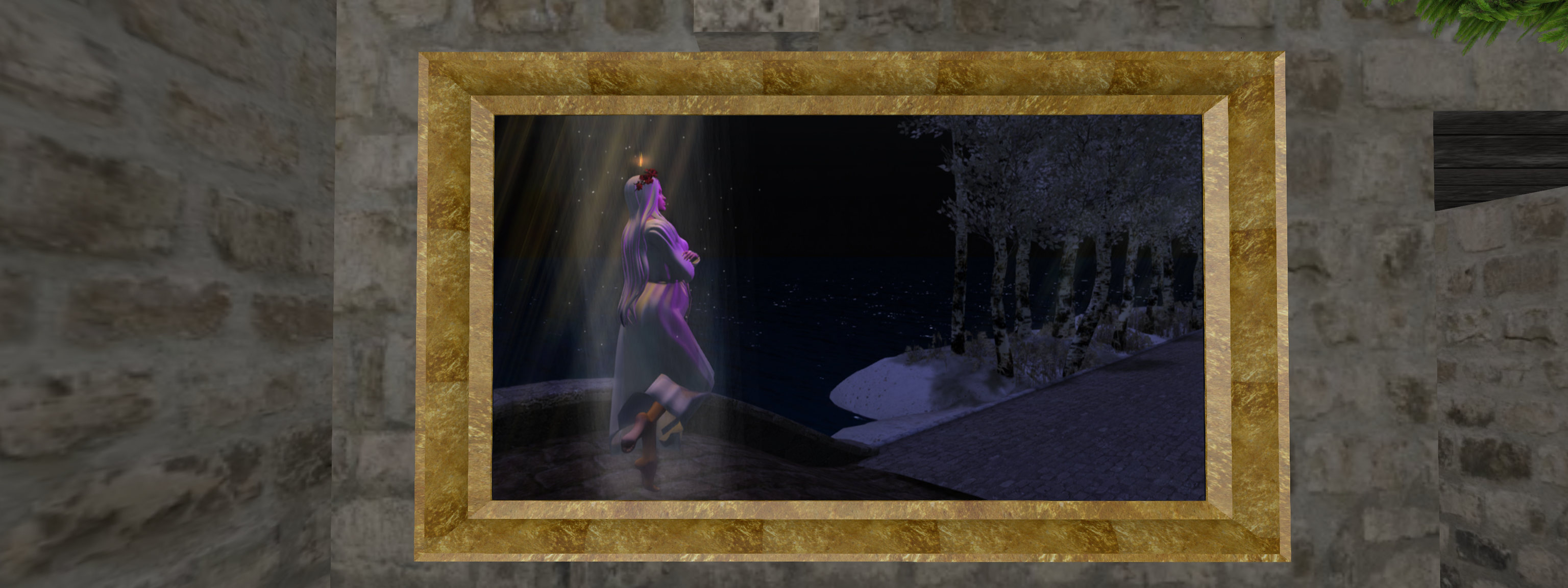
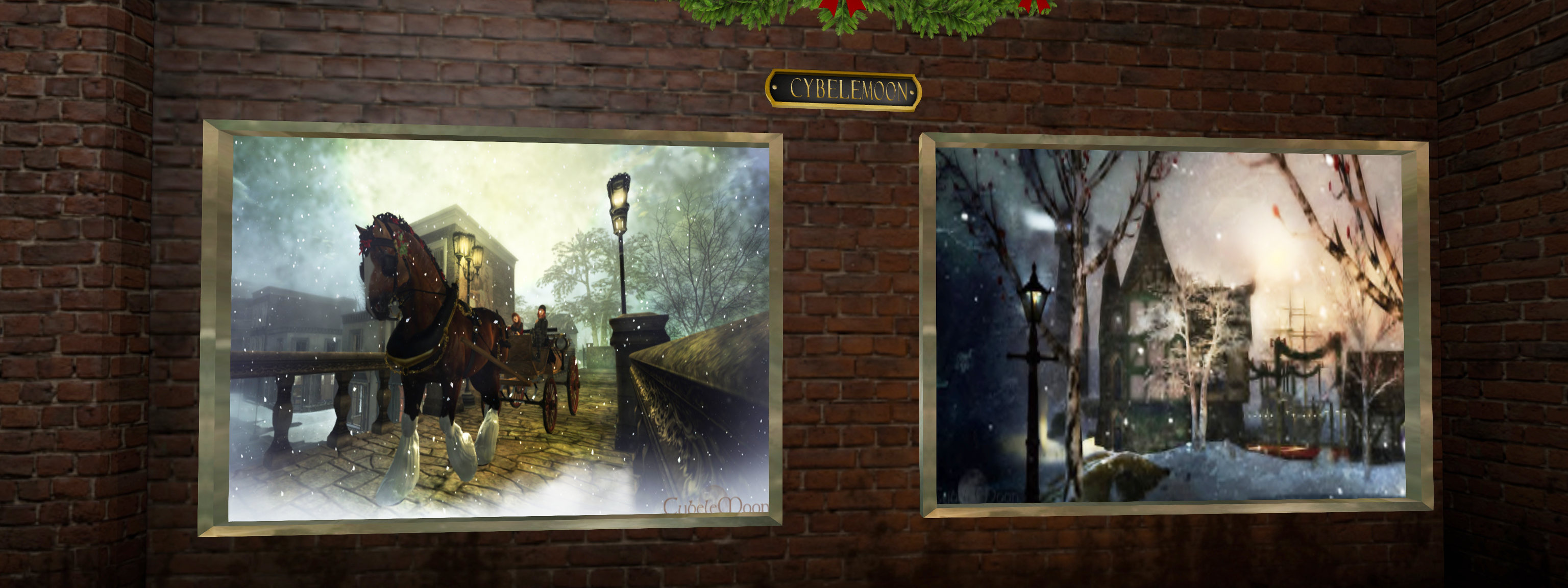
Off to the east side of the town, and between the clock tower and the harbour, sits a warehouse that is home to the Invitational Art Show. Open since the event started (the Open Art exhibition having opened its doors on Friday, December 18th), the participating artists for this exhibition comprise CyebelMoon, Iris Okiddo, Silas Merlin and … Yours Truly. Again, the overarching theme is of reflecting, Dickens, Victorian England and the Dickens project.
The Dickens Project: Invitational Art Show – CybeleMoon
Both Cybele and Iris offer evocative (as always!) pieces, that richly reflect these themes. Within Cybele’s pieces, entitled Winter Solitudes are a set of marvellous captures of past Dickens Project scenes, beautifully processed such that each encompasses its own story that captures both the romance of Victorian Christmases, and the settings found through The Dickens Project.
Iris, meanwhile, presents her own take on A Christmas Carol, presenting eight images in which she takes on the role of Ebeniris Scrooge and offers her interpretation of some of the damous scenes from the story. Thus we see her sitting miserly in her cold house, walking with the Ghost of Christmas Present, revisiting her lonely past, glimpsing a possible future, embracing a happier, brighter future (with, I think I’m correct in saying, Skippy Beresford getting a co-starring role), and more; all of the images again richly presented for our enjoyment.
The Dickens Project: Invitational Art Show – Iris Okiddo
Silas offers sculptures both indirectly and directly connected to the Victorian / Dickensian era, including barefooted street urchins, Oliver Twist, and a bust of Charles Babbage. For my part, I’ve offered a series looking back over The Dickens Project builds between 2015 and 2020.
Two engaging exhibitions in a setting that offers much to see and do – see my preview of this year’s Edition of the Project for more on the event.
The Dickens Project: Invitational Arts show – Silas Merlin
Links and SLurls
Note that The Dickens Project regions are rated Moderate. Note that SLurls will be available for use from 07:00 SLT on Friday, December 4th.
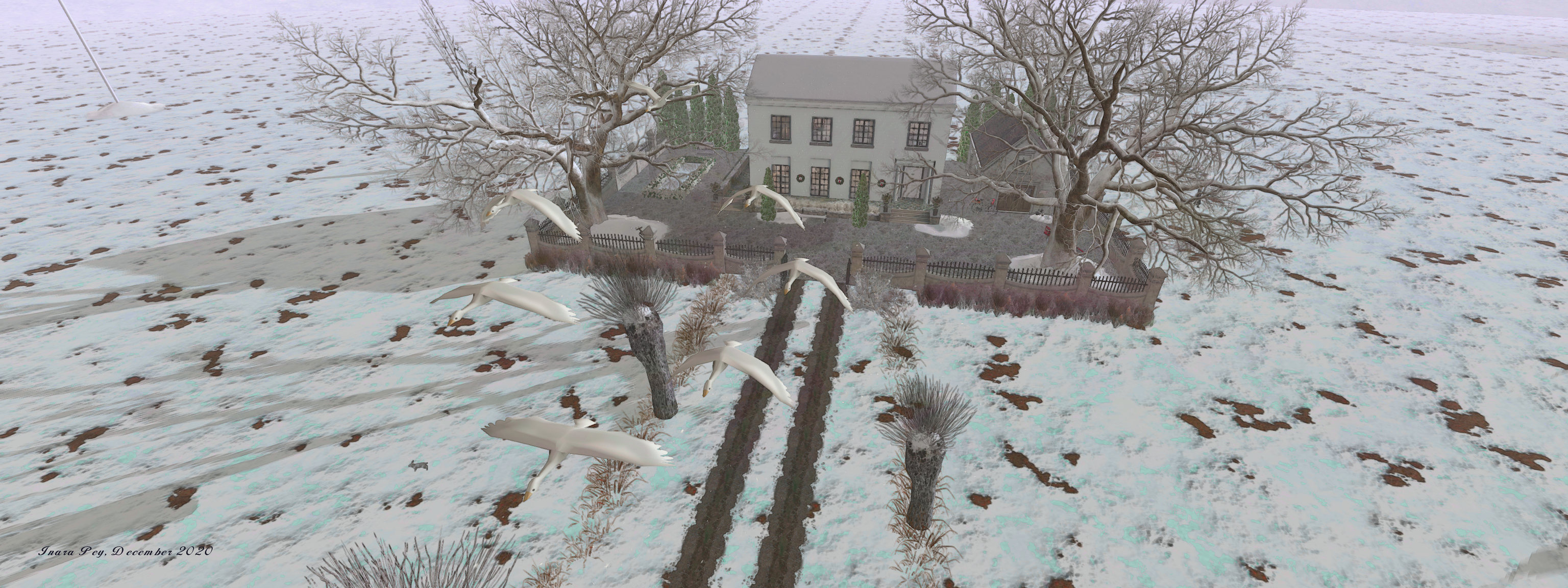
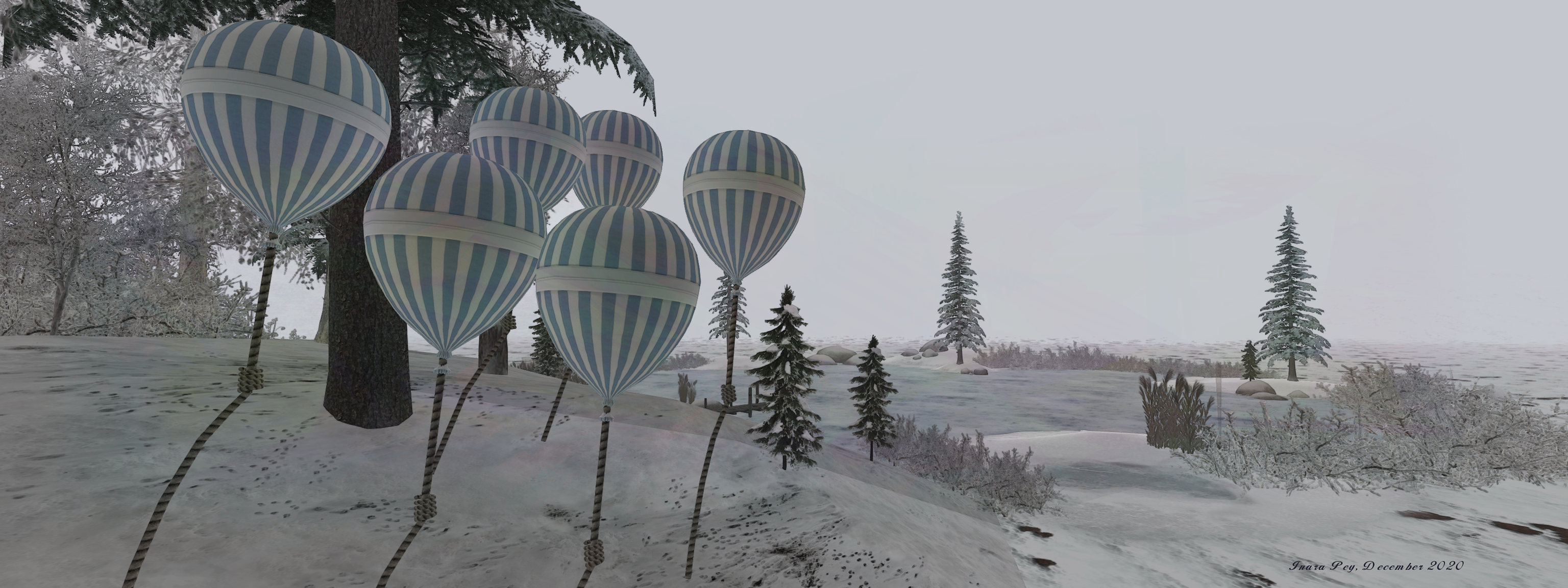
Sitting within a homestead region deep in snow, lays Snoweeta, a charming winter build that is engaging in its simplicity of presentation. Designed by Kaja Ashland, it offers people a little hint of Sweden, specifically taking as its inspiration the southern most county (or län) of Skåne; a place that is a relatively new county within Sweden, having been formed in 1997 – although it is named for the much older historical province of Skåne, from which it takes its coat of arms.
Whether or not Kaja has based the setting on an actual location within Skåne is open to her to tell. However, while it appears to sit on the road linking the small Baltic townships of Ystad and Simrishamn, it is perhaps not where this snowbound setting might actually be that is important, but rather the stories waiting to be found beneath the pale evening sky.
Snoweeta, December 2020
Central to these tales is the farm house sitting at the end of the long drive leading away from the road, the lane forming the region’s landing point. Lit from within, the house offers a sense of warmth and welcome, with the dining table set for dinner – but is it a family dinner, or are visitors anticipated for a gathering of friends? And who uses the garage alongside the main house, converted as it is into a cosy snug, warmed by a log stove? Is it a little work space for readying plants for the garden when spring arrives, or a teenager’s place to get away from Mum and Dad for a while?
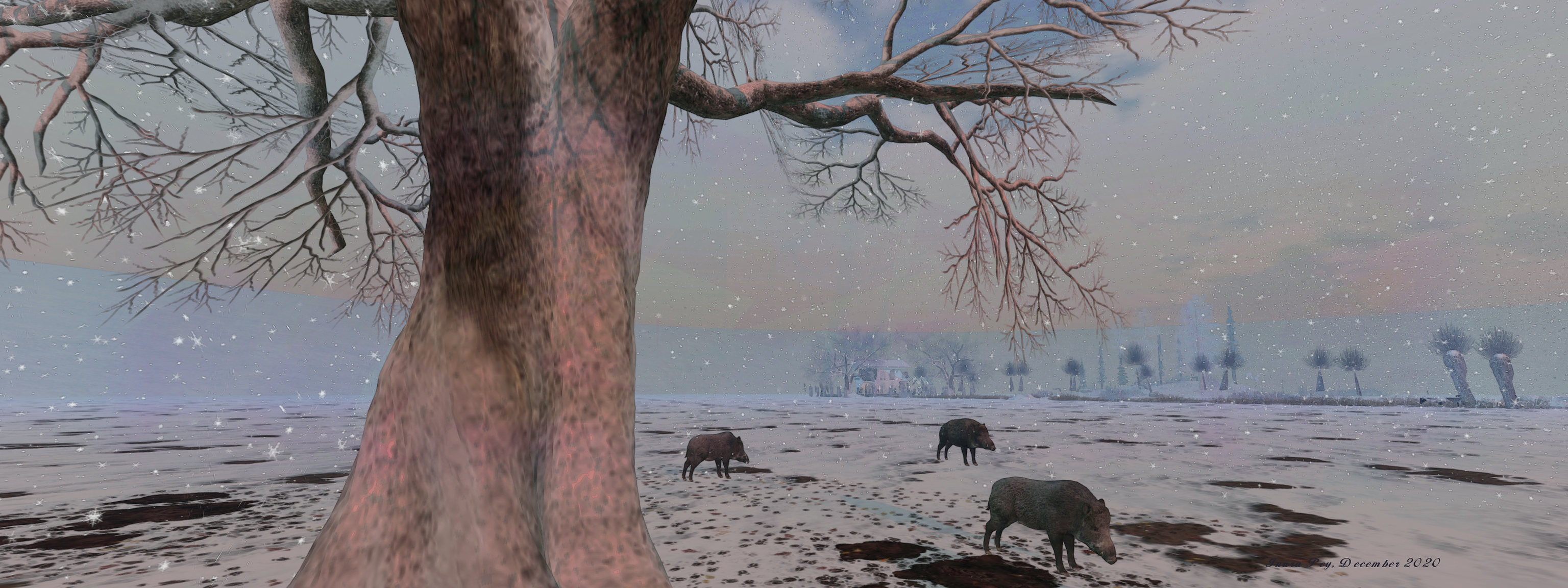
Beyond the house are more vignettes around which stories might be woven: just how did the tractor, a vehicle designed for operating over rough ground and muddy fields come to be bogged down whilst returning to the farm? And who is responsible for the boars gathered under the false shelter of the bare tree caught in its own little snowstorm? Are they a part of the farm or wild residents of the area?
Snoweeta, December 2020
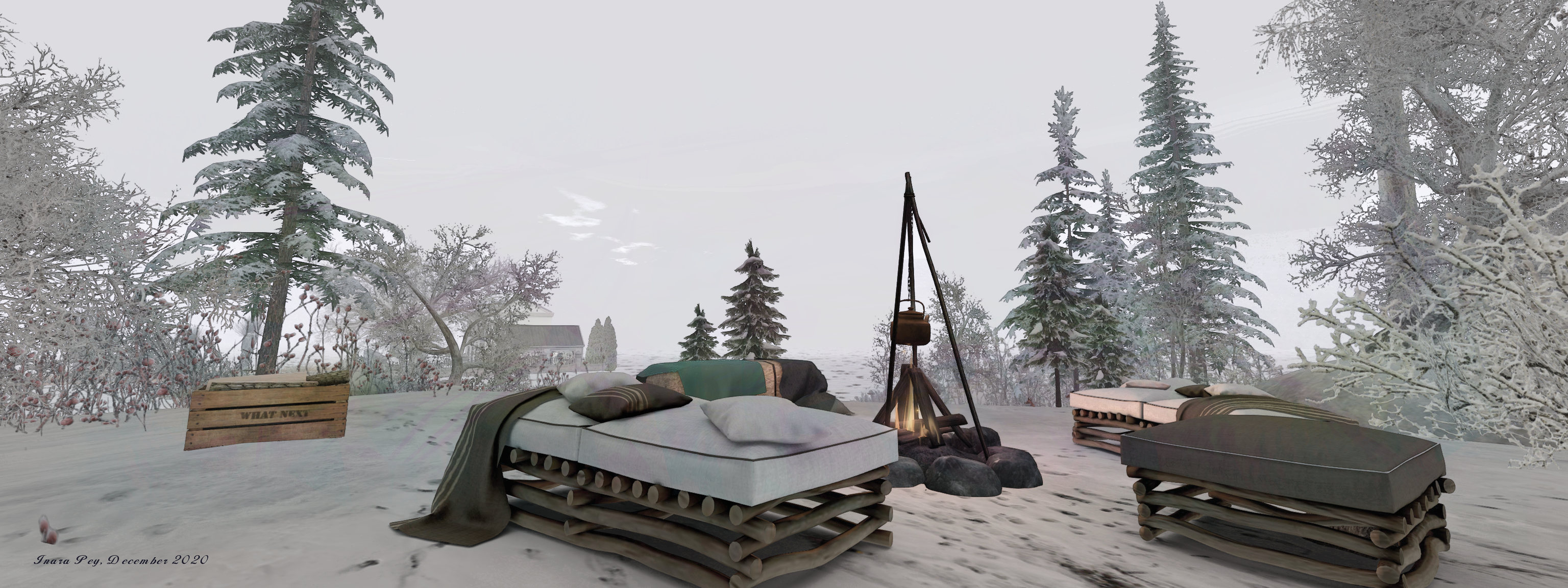
Those who prefer not to contemplate such question can instead snuggle up on the benches in the farm’s garden or inside the house or the cosy garage. Or, if preferred, a walk can be taken over the snowy field to where a low hill offers a retreat for trees within the farmlands, its top crowned by a little camp site. Here, a boiling kettle suspended over the flames of a fire, invites people to stop awhile and sup, while down the far slope of the hill is a frozen pond, prompting questions of skating and outdoor fun – although I wouldn’t recommend trying; the pond is beyond the edge of the region.
How far this place might be from either Ystad or Simrishamn is unclear, but the presence of a police car parked on the road’s shoulder (again, beyond the region’s edge) leaves one wondering what has happened to attract the attention of law enforcement – and whether the occupants of the patrol car are sitting in its relative warmth awaiting the arrival of Henning Mankell’s dour-faced Inspector Kurt Wallander, who might yet be driving his Volvo down the road from Ystad, where he both lives and works.
Snoweeta, December 2020
Simple and attractive in its design, Snoweeta offers an attractively different winter-themed visit.
Don’t forget that Friday, December 18th marks the 2020 residents vs. Lab snowball fight, as previously announced by the Lab on December 11th.
As with previous fights, the event will take place at the 5-rehion Winter Wonderland theme park in Second Life, and two fight sessions have been scheduled to meet the needs of residents around the globe. They are:
10:00 SLT
14:00 SLT
Again, both are on Friday, December 18th, 2020.
Winter Wonderland can be reached via either Portal Park 1 or Portal Park 2, or via direct teleport to the landing point. Just walk through the village on arrival and follow the path up over the hills. Kiosks at the entrance to the arena are available for obtaining your weapons, including a Premium-only Snowzooka.
Lock’n’load at the weapons kiosks at the entrances to the Snowball Arena
Milena Carbone (Mylena1992) has opened a new exhibition at Noir’Wen City. Entitled Lux Æterna, it encompasses themes in consideration of religion, humanity and personal belief; elements that are not new to Milena’s work, but are here presented somewhat differently, being projected largely through the work of others, notably Second Life artist Norton Lykin.
Through the exhibition Lux Æterna, I want to express this paradox which is at the heart of my deviant faith in an imperfect God. Our perception of light covers a ridiculously narrow spectrum, and yet this handicap allows us to contemplate incredible beauty. The human species represents a miserable, ignorant, fateful, devastating vermin, trapped in a thin layer of gas on a tiny planet, and yet we have been given the privilege to see, to feel what is. If there is an intention in the universe, this intention is totally indifferent to our fate, and has given us this gift with infinite generosity.
– Milena Carbone
Lux Æterna, “eternal light”, in terms of its religious use, is perhaps most familiar for being a part of the Catholic Requiem Mass, although – and as Milena notes, it most likely dates to Gregorian times. It is a call to God to let his eternal light shine upon the departed as they rest with his saints.
Milena Corbone: Lux Æterna – image by Norton Lykin
Here, the the idea of eternal light is used both physically and metaphorically. As Milena notes, the light humans can see is limited to an incredibly narrow spectrum; one that, long before we discovered the non-visible (to our own eyes) wavelengths on either side of it, nevertheless allowed humanity to contemplate so much, achieve so much through creativity on both an individual and collective basis, and to perceive the richness and beauty of not only our own planet, but the incredible cosmos around us. Yet, at the same time – and even with our going understanding of the non-visible spectrum this promises to reveal even more to us – humankind so often opted (and still opts) to walk the path of ignorance, even whilst espousing enlightenment.
Metaphorically, this narrow spectrum light through which we perceive everything could be said to reflect our narrowness of understanding of any supreme being that might exist. For so long, we constrained “god” in terms of our own viewpoint – one that, far from putting the almighty at the centre of things, has actually placed mankind so that everything – even the idea of a supreme being – literally and figuratively revolved around us, in what can only be viewed as a arrogant outlook on the cosmos.
And herein lies the first paradox: for just as the cosmos is vast – and made more so as we finally drew back the curtain on those parts of the spectrum we cannot visibly see -and with wonders yet to be understood, so to must any supernatural consciousness behind it be vast. Thus, could it even be aware of humanity, as we sit huddled under the protection of our backwater planet’s thin envelope of atmosphere? And so we enter into Milena’s realm of pondering the nature of God; whom she sees as not no so much capricious for allowing all the woes that can befall us, as some might argue – but simply indifferent and / or imperfect, simply because they have far too much to do in just keeping the rest of the cosmos going to pay us that much attention.
These ideas are bound together through Milena’s exhibition in a number of ways. As she notes herself, Norton’s art, in its abstracted beauty, informs us about the two greatest elements within the cosmos: emptiness and light. Both are enduring and unalterable; we can see the light of the stars and nebulae, of novae and supernovae, and of galaxies beyond our own, visual cues to the vastness of the universe in which we sit, whilst the distances separating them appear largely devoid of anything we can perceive, forming an huge and everlasting void around us. To this I would add that through the choice of colours found in the majority of the pieces – the reds, purples, oranges, blues and yellows – we are reminded of the spectrum of light that extends beyond either end of the visible, and thus of the unseen grandeur this sits within the cosmos, and which may yet be found within the the emptiness that sits between the lights of the stars and the galaxies.
And this is only scratching the surface of what is an incredibly simple installation in terms of design and presentation which folds within itself so much food for thought by way of metaphor and suggestion.within the design, for example, is a subtle blending of eastern philosophy and Christian religion: the installation stands as three arms, intentionally representative of the Christian trinity, whiles the empty space at its centre representing the eastern ideal of centring, chakras, inner peace and the natural flow of energy. Elsewhere the the rising stairs might be seen as metaphors for ascendency, an ideal common to both eastern philosophy and “western” religions, if interpreted somewhat differently by both.
Milena Corbone: Lux Æterna – images by Norton Lykin
Through all of this, Lux Æterna also serves to touch on two subjects that can never be far from thinking when contemplating life, the universe and everything (notably religious themes and similar): those of death and immortality. These are concepts that can be said to be uniquely human, as Milena underlines through her use of extracts from Jorge Lui Borges’s The Immortals. Unique because – as Borge himself notes, we are the only creature on Earth with an awareness of death and by extension, contemplate immortality. So animals might be said to be “immortal”, simply because they do not share this awareness or live in that ever-present terrible shadow, and as such, they might be said to be “closer to god” than we can ever aspire (and thus the hare-headed figure standing God-like over the scene).
And yet still, there is that eternal light of the cosmos surrounding us and reminding us of the richness and of everything; a light we cannot help – and indeed always should – contemplate in humility and reverence, simply because of the beauty it enfolds, and the encouragement it gives for us all to expand our thinking beyond the petty.







 Inara Pey: Living in a Modemworld