Linden Lab launches the Official Second Life Merchandise store

via Linden Lab / RedBubble

Some might say it’s a long time overdue, but on Friday, September 25th, Linden Lab announced the launch of the official Second Life Merchandise Store offering a range of physical world merchandise related to Second Life and Linden Lab.

The on-line store is hosted by RedBubble, and currently comprises a range of SL and Lab branded clothing items and accessories utilising both the “new” and “old” logos, with the promise that more items t come soon, including seasonal and limited time items.
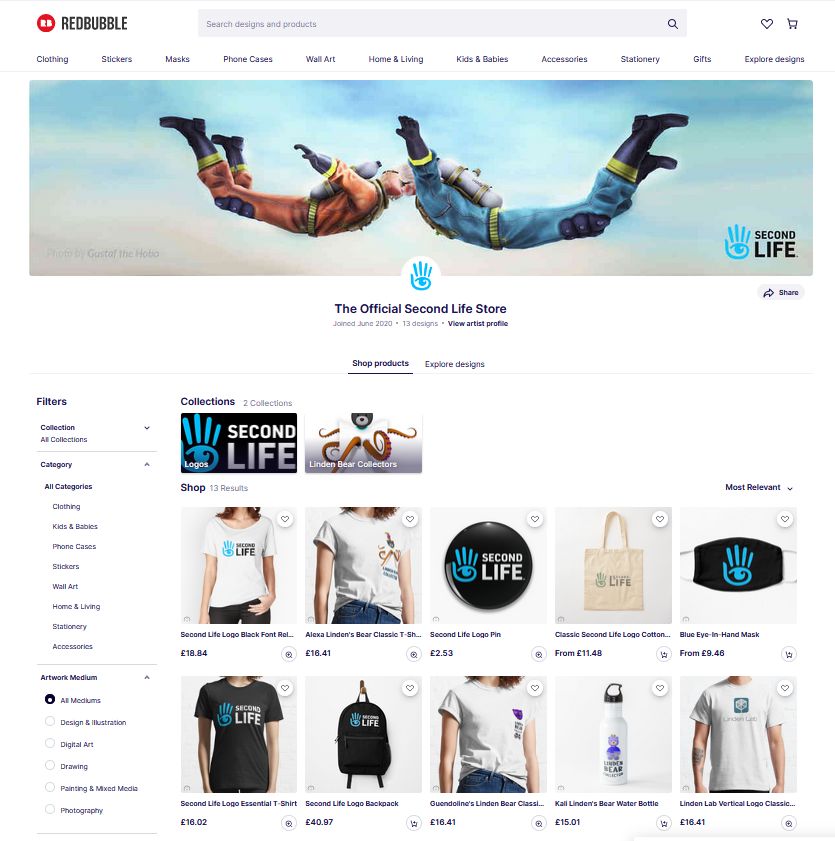
The Second Life store on RedBubble

As with most virtual market stores, the RedBubble Second Life Merchandise Store feature a list of categories down the left side of the page (note: these are a part of the site design, and not all of them may apply specifically to Second Life / Linden Lab). The main part of the site is then devoted to displaying the displaying the essentials on available merchandise, with filter options, and the ability to use at the designs offered with applicable products, rather than the product itself. Obviously, clicking on an individual item will open a page devoted to it, where things like size, etc., can be selected.

A nice aspect of the site is that it appears to automatically recognise your country of origin and presents prices in your local currency. Payments can be made via Credit / Debit card or using PayPal, whilst shipping options are available for “regular” or “faster” delivery. Joining RedBubble allows for faster checkout: your own personal page, a complete order history and tracking option, and the ability to follow favourite merchants on the site (such as Second Life / Linden Lab) and receive notification of new items as they are added to the store.
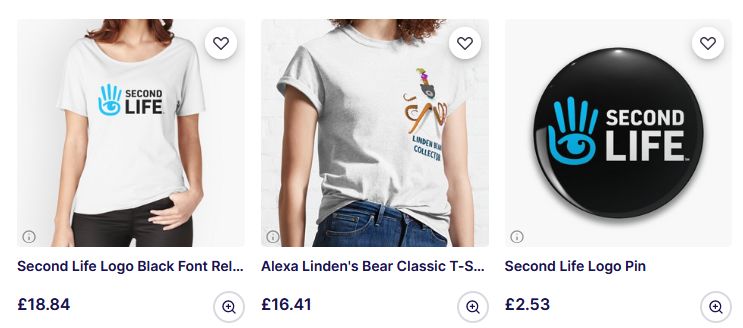
RedBubble automatically recognises your country of origin (unless using something like a VPN, perhaps), immediately presenting the price of items in your local currency, as seen here, in my view of some of the SL merchandise

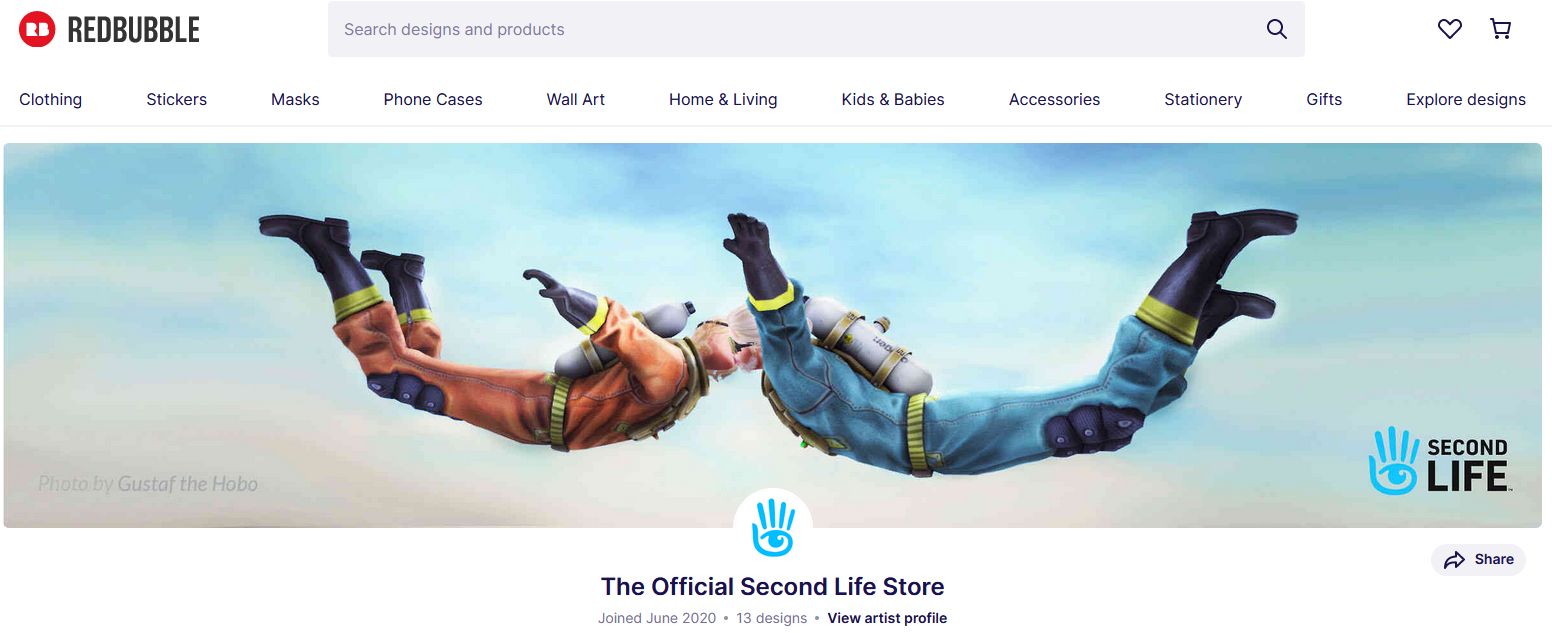
I’m not entirely sure why the site features a couple of skydivers snogging as its banner image – perhaps this will change according to some site criteria, but it did strike me as something not really immediately representative of either Second Life or Linden Lab – not that either is particularly easier to pigeon-hole in a single image for those unfamiliar with either.

That very minor niggle aside, the store would appear to be a good move – hopefully we’ll see merchandise such as mugs (Lab Gab mugs have oft been requested), coasters, key fobs and other handy items, as well and more clothing items appearing in due course. Actual Linden Bears would be fun as well, if perhaps harder to produce in  a cost-effective manner.

In the meantime,those interested / curious can hop over the the official store and have a mooch.

A Thousand Windows in Second Life

A Thousand Windows, September 2020 – click any image for full size

Lotus Mastroianni and Fred Hamilton (frecoi) are back with another region design that will likely be around for a month(ish) for people to enjoy. Their most recent builds have tended to have an urban design rooted in the physical world, starting with their take on a Brazilian favela back in May of 2020 (see:  Visiting A Favela in Second Life), and this latest design continues this theme, appearing to be inspired by a part of a place that lies very close to my heart.

With A Thousand Windows, Fred and Lotus seems to take as their inspiration the tight-knit tenement blocks located in the Mong Kok district of Hong Kong’s Kowloon peninsula. Mong Kok is a place I’ve visited on numerous occasions in my life (notably as a result of once living in Hong Kong many, many, years ago). I say this because, while there is no outright pointer to Mong Kok within the build, parts of it appear to pay clear homage to the district.

A Thousand Windows, September 2020

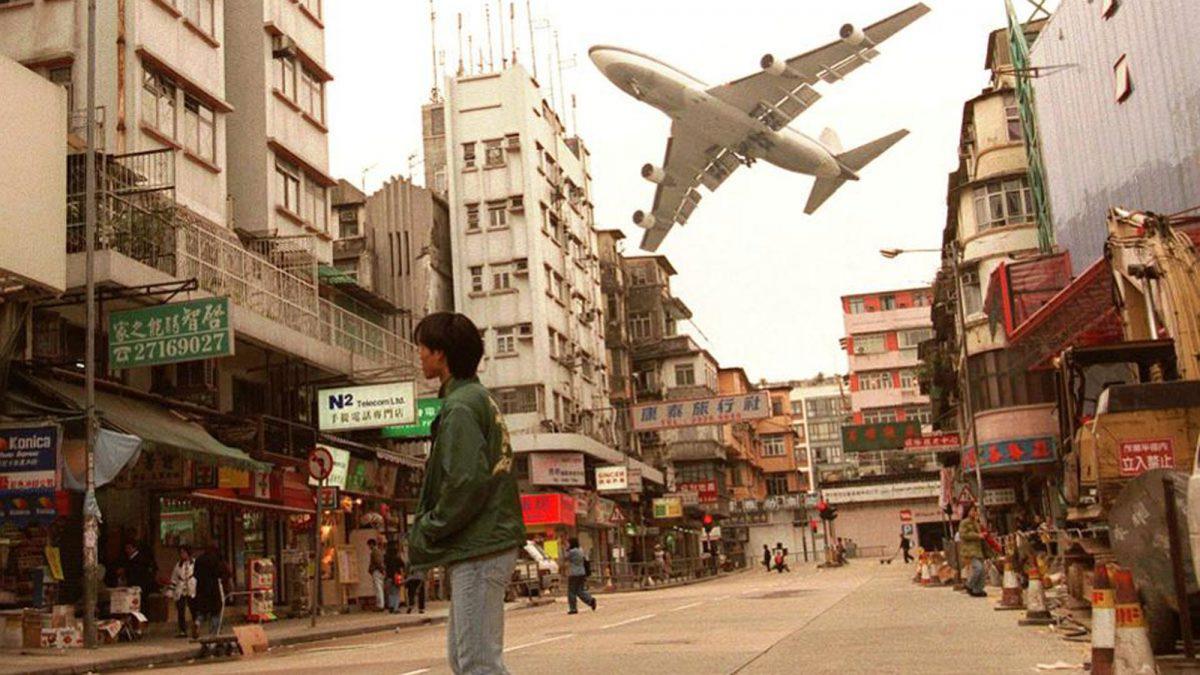
Take the 737 airliner passing overhead, for example; to me, it sits as a reminder that the district once lay beneath one of the approaches airliners had to make in order to touch-down at Hong Kong’s former airport at Kai Tak, a short distance away.  An approach that had aircraft practically scraping the roofs of the tenements, as made famous in many a photograph.

Elsewhere, in fairness, the region could have been inspired by any number of densely-packed housing units in the orient, but for me, Mong Kok is the place it brings to mind, even if Kai Tak did cease operations more than 20 years ago, having been replaced by a much larger, purpose-built facility built (much like Kai Tak) on reclaimed land, but out at Chek Lap Kok island, sitting off the north coast of Lantau. However, the focus of the build isn’t airlines or airports, but rather the densely-packed nature of the old tenements and the lives that go on within them.

A Thousand Windows, September 2020
There is a huge world out there, but what happens behind all those windows? what lives and worlds are hiding there? How many eyes peer into the fleeting reflections of so many lights?

– About Land, A Thousand Windows

This is actually a question I can remember asking myself, both as a youngster living in Kong Kong, and as an adult tourist who has made many return visits. With their shoebox sized (by western standards) living spaces, stacked one atop the next in grey, slab-like concrete towers cut through with narrow roads and alleys set back from the broader through routes of places like Yua Ma Tei occupying the main thrust of the Kowloon peninsula, parts of Mong Kok always struck me with a sense of mystery as to what was going on behind the blinds-shouded windows and narrow verandahs strung with laundry that so often formed the face of the squat tor blocks as they looks at the world.

All this is marvellously captured with Lotus and Fred’s design, which has been ideally set within a twilight environment to emphasise the volume of windows representative of people packed into so tight a space.

A Thousand Windows, September 2020

Set within four façades representative of five floors of apartment blocks, the region presents a number of tower blocks of similar height with narrow streets and alleys running between them. Neon signs hang from the sides of buildings and laundry hangs from verandahs – again a common sight I remember from Mong Kok. Most of the buildings within the setting are shells, although one or two contain interiors, making exploration worthwhile.

As well as the narrow streets sitting within their concrete canyons, the region offers elevated walkways from which the view can be appreciated, as well as offering the way to some outdoor spaces. And if you look hard enough, you might find an elevator leading up to the rooftops of one gathering of blocks, a couple of seats located just a across the roof from the elevator top from which to admire the view of the 737 passing overhead – and the visitors passing below.

A Thousand Windows, September 2020

Opportunities for photography, either by day or night, can be found throughout – as can be seen in the Flickr stream Lotus and Fred use for their builds. I admit to finding the sound scape accompanying the build a little odd – particularly the loud buzzing of flies (although that could perhaps be hornets of wasps, both of which could be a summertime nuisance in Hong Kong when I was little) but this can easily be ignored, leaving one to remain fully immersed in the setting.

All told, another enticing, attractive build. And just in case you haven’t seen photos of airliners over the actual Mong Kok district, I’ll leave you with the following.

A 747 passing over the broader streets of Mong Kok as it descends into the former Kai Tak Airport, Hong Kong – catch the 737 sitting above A Thousand Windows

SLurl Details

The Artists at Campbell Coast in Second Life

Artists’ Village, Campbell Coast

The Artists’ Village at Campbell Coast, created by BJoyful and Doc Rast (rasterscan) and curated by Owl Dragonash, opened A Street Fair, an extensive ensemble exhibition of 2D and 3D art on Tuesday, September 22nd.

A Scottish themed Mainland residential setting that’s open to the public, Campbell Coast offers access to both Linden roads and protected land and to sailable water, with the Artists’ village occupying one corner overlooking the coastal waters. The exhibition features a mix of residential artists and guest artists, with art displays both within the town houses of the village, along the cobbled streets and on the outdoor walls of some of the the buildings.

Artists’ Village, Campbell Coast: Etamae

Participating artists within the studio spaces comprise:  Dhyezl, Moondance, Reycharles, Gidgy Adagio, Whimsical Aristocrat, Michiel Bechir, Owl Dragonash, John and Tempest Huntsman, Suzen Juel, Dimi Ludwig, Jed Luckless, Lexus Melodie, Inara Pey, Larree Quixote, GoSpeed Rasere and Skip Staheli.

Further special exhibits are presented by Etamae, Jaz, Shakti Adored, Thomaz Blackbur, Lena Kiopak, Radagast Malaprop, and Ciottolna Xue.

Artists’ Village, Campbell Coast: Skip Staheli

As might be expected from this list, the art on display is wide-ranging and covers both 2D and 3D art, the former primarily focused on landscapes and avatar studies – although Jed luckless presents a rather unique display of posters from his past exhibitions and those from Phish Bowl events, , whilst GoSpeed offers links to her novels. Ciottolna Xue’s sculptures, meanwhile bring additional life to the local streets, together with some by Reycharles as they sit outside his studio.

Given the sheer volume of art on offer, trying to define all of it would lead to a TL;DR piece – suffice it to say that what is presented is engaging and well worth the visit. And given the sheer volume of art, for those looking for something new for their SL home, as well as those who appreciate art, will find this a worthwhile destination.

Artists’ Village, Campbell Coast: Yours Truly

SLurl Details

Calling artists: an exhibition to say farewell to the UWA in Second Life

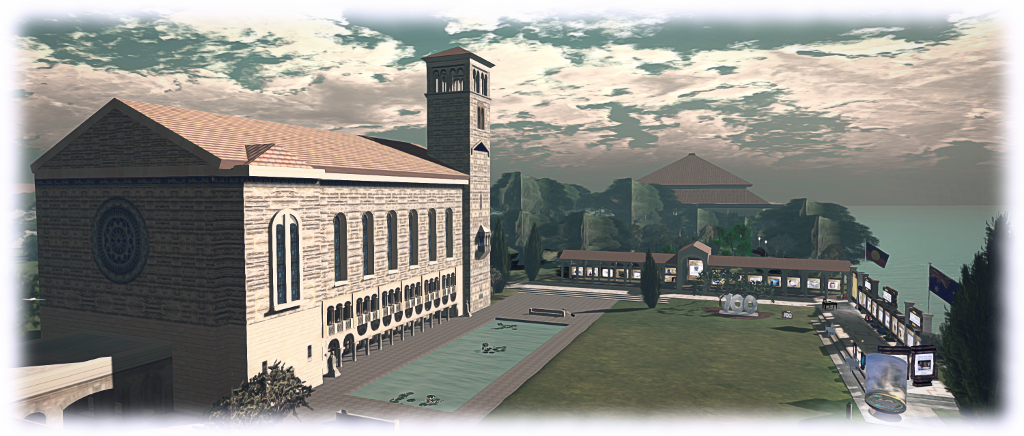
The University of Western Australia has been a long-term patron of the arts in Second Life

From 2009 through through 2018, the University of Western Australia (UWA) was a name synonymous with patronage of the arts in Second Life.

The university first became involved in Second Life largely through the encouragement of faculty member Jayjay Zifanwe, and under his guidance and the curation of FreeWee Ling, UWA oversaw a series of art challenges that offered impressive cash rewards for 2D, 3D and machinima artists.

These Art and Grand Challenges yielded some of the most exceptional displays of art and creativity seen within – and beyond – Second Life, and became a hallmark for artistic excellence.  Over the years, I attempted to cover down the years through this blog; however, from the end of 2015, UWA started a gradual winding-down of their operations in Second Life.

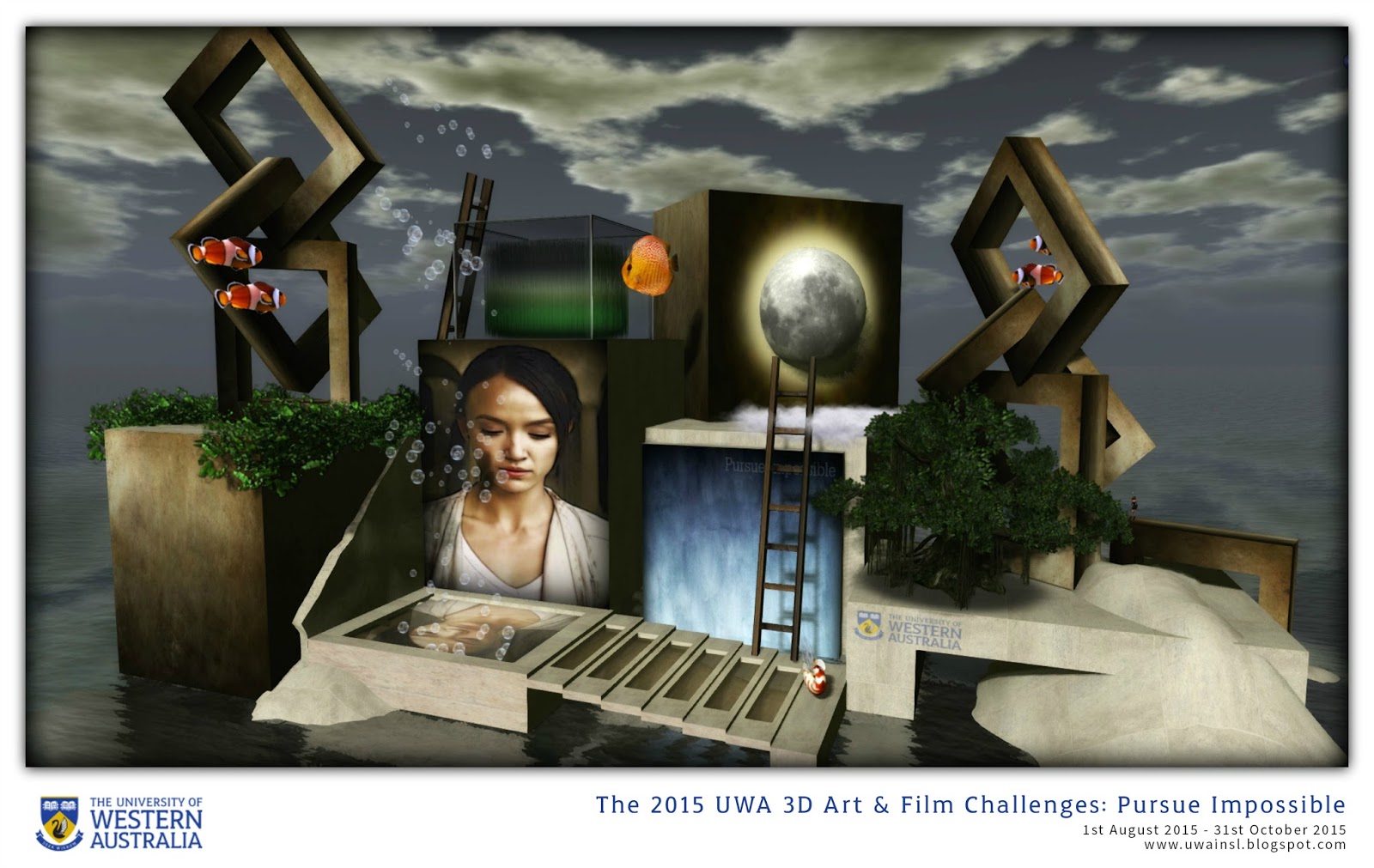
This started with the ending of their direct sponsorship of their art challenges with the Pursue Impossible challenge (see Pursue Impossible: celebrating art and machinima in Second Life), after which, events continued to be run, albeit without a cash prize incentive. Then in 2016, it was announced that four of the five regions operated by the university would be closing – although this was extended through to mid-2017 n (see UWA to scale back in Second Life and All UWA regions to remain in Second Life through mid-2017), allowing one more prize-based challenge  – sponsored through the generosity of LaPiscean Liberty – to take place (see UWA’s Transformations in Second Life

Pursue Impossible (2015) marked the end of the UWA supporting Second Life artistic expression with large-scale cash prizes. Image courtesy of UWA

Sadly, all good things must eventually come to an end, and the time is coming to say farewell to the last remaining UWA region – and in order to do so, a final art exhibition is to take place in the UWA’s exhibition space over the region.

Open to all 2D and 3D artists, the exhibition has been entitled Gratitude. It is being organised with the approval of the UWA by Chuck Clip, who describes the event thus:

This is a grand finale, a sad farewell to show our gratitude to UWA and all that they did for us as artists, curators, and residents of SL. Their work brought life and beauty to all of us and made the art world in Second Life a thing to behold. Why The Theme “Gratitude”? For over a decade, the University of Western Australia has been synonymous in the minds of many residents of Second Life with the arts and the support thereof. Their work was unparalleled on the grid, and made waves in the art world that, even as they prepare to close their sim, resonate through the art world today.
There are so many people whose lives they touched in one way or another. So many artists found inspiration in their 3D Art Challenge themes, and support in the encouragement of the community they created. Let us all come together this one last time to say thank you to the men and women of this great institution, to celebrate their achievements, their impact on our own achievements, and to mourn their departure.

– Chuck Clip, via note card

Those wishing to participate in this special event should note the following:

  • The event is open to all Second Life 2D and 3D artists, but is limited to one entry per artist.
  • Artists will be given a maximum of 150 LI with which to realise their work.
  • Entries should be able to be interpreted by the casual viewer as being representative of the theme of Gratitude. Where the link to the theme is difficult to ascertain, this should be referenced in a note card accompanying the work.
  • All entries must be submitted no later than 23:59 SLT on Sunday, November 1st, 2020 via the official UWA Art Show Submissions boxes (see below).
  • All entries must be accompanied by a note card containing: the artist’s name and a brief biography; the name of the submitted art (this should match the actual name of the piece as an object); a description of the piece; any landmark to more of the artist’s work, if applicable.
  • The exhibition will open at 12:00 noon SLT on Wednesday, November 11th, 2020, and will be marked by a special opening event with live entertainment, and will close on December 30th, 2020.
  • The region is currently set to close on December 31st, 2020, and art will be cleared prior to this occurring.

How to Enter

  • Place the artwork and covering note card in the UWA Art Show Submissions boxes located in the following regions:
    • University of Western Australia.
    • Sinful Retreat landing point.
    • To submit entries, left-click on the entry and HOLD the mouse button down, then press CTRL and drag the entry to the Art Show Submissions box. When the cursor is over the box (red outlines should appear around the receiver box), release your left mouse button and the item is received.
    • Repeat the above for the note card as well.
  • If you have problems with the box give artwork to Chuck Clip along with  a note card containing your name, together with the art.

General Rules

  1. Any style of 2D and 3D artwork can be submitted, provided it is in keeping with the exhibition theme and meets the General maturity rating for the UWA region and in accordance with Linden Lab’s Terms of Service and Community Standards. Items can be static or animated.
  2. In addition:
    • All entries cannot exceed a maximum of 20×20 metres.
    • If scripts are used, they should be kept too a run time of 0.2ms (0.5ms  maximum). Anything above this must include an on/off on touch with time out of up to 10 minutes.
  3. By submitting an entry, you are giving permission to the University of Western Australia and Chuck Clip to place the objects anywhere on the UWA region, and to have information and images of the entries placed on UWA websites and on websites promoting the UWA region or events held on the UWA region or to be filmed for machinima purposes.
  4. All work must be original. Renderings of works by others, in part or in whole, whether or not they are under copyright, should be acknowledged and permissions secured when appropriate.

2020 Simulator User Group week #39 summary

Dim Sum Gardens, July 2020 – blog post

The following notes were taken from the September 22nd Simulator User Group meeting – although there is not a lot in practical terms to report.

Simulator Deployments

Please refer to the server deployment thread for news and updates.

  • On Tuesday, September 22nd, the grid’s main SLS channel was updated to simulator maintenance release 548903, containing updates related to the cloud uplift work which contain no user-visible changes.
  • There are no RC deployments planned for the week.

SL Viewer

The Bormotukha Maintenance RC viewer, version 6.4.8.548890 dated September 18th, was promoted to de facto release status on Tuesday, September 22nd.

The rest of the official viewer pipelines remain as follows:

  • Current release viewer version 6.4.7.546539, dated August 11, promoted August 17, formerly the Arrack Maintenance RC viewer – No Change.
  • Release channel cohorts:
    • Mesh uploader RC viewer, version 6.4.8.548061, September 8.
    • Love Me Render RC viewer, version 6.4.8.547427, August 21.
  • Project viewers:
    • Project Jelly project viewer (Jellydoll updates), version 6.4.8.547487, issued August 26.
    • Custom Key Mappings project viewer, version 6.4.5.544079, June 30.
    • Copy / Paste viewer, version 6.3.5.533365, December 9, 2019.
    • Project Muscadine (Animesh follow-on) project viewer, version 6.4.0.532999, November 22, 2019.
    • Legacy Profiles viewer, version 6.3.2.530836, September 17, 2019. Covers the re-integration of Viewer Profiles.
    • 360 Snapshot project viewer, version 6.2.4.529111, July 16, 2019.

Cloud Uplift

  • There is a known issue with Navmesh retrieval on cloud-hosted regions on Aditi.
  • The Lab believe they have a solution for the outward e-mail issue with cloud-based regions. However, due to the way in which Aditi regions are set-up, testing of the fix is being carried out elsewhere, but the hope is the fix will be usable once there are user-accessible regions on Agni that are running on AWS services.

In Brief

  • There is no update on the Group chat / IM failure issue (see BUG-229219).
  • The majority of the meeting focused on a general discussion on region crossings – notably with vehicles – and the assorted problems that can arise, including the inconsistencies in some things like object entry and group access are handled (the former can prevent vehicle and avatar entry, whereas the latter can allow a vehicle into a region / parcel, but then eject the driver / passenger, obviously resulting in problems).

A new Muse in Second Life

The Muse, September 2020 – click any image for full size

In February 2020, we visited The Muse, a Homestead region designed by the superbly named “United Nerds of Building” (see: Finding The Muse in Second Life). Earlier this month, I received a note from Liss Beattie, that The Muse’s owner, Tribish Tammas, has both relocated and redesigned The Muse, so we took the opportunity to hop over and take a look.

Still occupying a Homestead region, The Muse retains some elements from the design we saw back in February, whilst also offering an entirely new look. As with the previous design, The Muse remains split between a core ground-level build and a sky platform, with the stated aim of the region being to offer a “space for couples, lovers, and friends to relax and spend time together”.

The Muse, September 2020

The main landing point is located in the the ground-level setting, on the south side of the region. Backed by a flat-topped bluff with grassy slopes to its seaward side, the landing point sits within the ruins of an ancient building – perhaps an aged temple – with a westward view towards the surrounding mountains. These sit beyond a small island that appears to have been formed by the local water cutting a channel to separate what had once been a headland.

Reached via a stone bridge that arches between two weather-beaten and somewhat decrepit gates, this little island is home to one of the elements seen within the previous design: an open-air Elven Ballroom.

The Muse, September 2020

The bluff behind the landing point runs east and then north, forming a low-lying table of land, its landward faces formed by rocky cliffs over which a waterfall tumbles to feed a stream that winds its way across the region. In doing so, it neatly cuts the lowlands into two unequal parts. On one of these sits a single barn, converted to an adult play area, surrounded by a sea of flowers. On the other, close to the rocky plateau, is a more expansive ruin that sits close to a place that winds up to the top of plateau.

Two bridges span the stream,providing easy passage between the two parts of the lowlands, while a third bridge reaches across a further channel of water to reach a north-eastern island.

The Muse, September 2020

The north-eastern island has a backbone of cliffs against which the intriguing bulk of The Retreat from The Looking Glass sit.. In the last iteration of The Muse we visited, this formed a mystical library. Now it fulfils more of the role of being a home, its westward aspect commanding a view across the region’s lowlands, ruins, barn and Elven Ballroom all visible among the trees sprinkled across the landscape. Also visible from this vantage point is a large garden bar sitting at the north end of the main island, a comfortable walk from both this house and the barn.

The sky platform is reached via teleport from the landing point (you’ll need to accept the region’s experience when asked). As  per the previous iteration of the design, it offers a large dance floor with and animated finish and now bracketed by a pair of floating islands  – one the teleport point, the other offering space for Tai chi exercise. It is watched over by a blue whale that swims through the air above it, and the eye of a large moon that slowly orbits the dance floor along with the stars and nebula of skybox surrounding the platform.

The Muse, September 2020

Throughout both settings, ground and sky, are numerous opportunities for dancing and / or sitting and relaxing, whilst on the ground, the islands are nicely rounded-off by a natural sound-scape.

One of the charms of The Muse when we last visited was the manner in which it comprised a series of individual vignettes loosely woven together by the setting in which they sat, rather than presenting a truly contiguous whole. It was both eclectic and yet complete, the various areas offering their own individuality but nevertheless flowing together as a whole.

The Muse, September 2020

This new iteration presents farm more a feeling of being a contiguous whole at ground level, a single environments with multiple points of interest. On the one hand, this means the current Muse perhaps lacks the eclectic mix of the old, but on the other, it means it offers its own unique look and feel – that of a temperate island that has seen the passage of time and human habitation, and is now a retreat from the pains and pressures of the world, ready to greet and comfort all who visit it.

SLurl Details

  • The Muse (Consensual Kinks, rated Adult)