Sansar Product Meetings week #30: more on quests

The first release of the new quest system was made on Tuesday, July 23rd

The following notes were taken from my recording of the July 25th (week #30) Product Meeting. Once again, this meeting had a focus on the new quest system, with some additional questions. As with these meetings, a lot of general feedback was given to be “taken back to the Lab” for consideration, and as such, aren’t reflected in the notes below – please refer to the meeting video, which is embedded at the end of this article.

Quests

  • The first pass of the quest system was released on Tuesday, July 23rd – see Sansar: user-generated quests release: an overview for more.
  • The Lab is working on some “best practices for quests” documentation, based on their own experience building quests, and on quest games in general.
  • Some time in around 2-4 weeks, there will be a special in-world questing tutorial event.

Quest Authoring Q&A

  • How does it work? Quest creation comprises two parts a) creating the quest data itself, using the authoring tool. This can be created and revised as often as required; b) using objects in scenes (experiences) that are directly linked to the quest and use / present the quest data.
    • The quest can be tested by the creator in the unpublished scene (by building and saving the scene).
    • The quest becomes public when the scene is published as an experience.
  • Quests are linear at present: start, objective A, objective B, etc. Can branches be offered (e.g. do objective A then choose either objective B or C)?
    • Possibly via custom scripting.
    • However, in the future it will be possible to author quest “storylines”, allowing multiple quests to be linked, and to be dependent one upon the last, thus offering a level of “branching”.
  • Will future updates to the quest system break what has been deployed? No. Features and a capabilities will be added, but will not break the established functionality. So, quests can be enhanced as new capabilities are added.
  • Can experiences with quests be made more readily identifiable in the Atlas? Not exactly, but the Lab is considering tools for monitoring how quests are being used (how many people participate, how many complete, etc.), and providing that information to creators.
    • Short-term this may be a manual system with reports curated by LL and made via Discord.
    • Longer term it should be more automated. This might also be built out to include the Atlas to show available quest experiences.

Badge System vs. Experience Points System

Since the week #29 Product Meeting, when the quest tools, rewards and the upcoming experience (XP) system  were announced, a badge system that could be used by individual experience creators, rather than having a global XP system as proposed, as this is seen by some as being more flexible.

  • The Lab views a global XP / level system as being more immediately understandable by users, as they can earn XP points and level up no matter what they are doing or how they participate in Sansar – there is no dependency on visiting specific experiences or having to complete specific tasks.
  • In time the XP system will be expanded beyond quests, but the first pass will be focused on questing.
  • However: the Lab is looking at a badge system, and see it differently to any kind of XP system, as badges can be used to show what a user has specifically done – i.e. a creator can gain various badges to mark their achievements as a creator, while a gamer who is good with shoot-em-ups, etc., can earn badges to reflect what they’ve achieved through that interest, etc.
    • These types of achievements would likely be made available through user profiles.

General Q&A

  • The usual trio:
    • High heels for avatars: not on the roadmap at present.
    • 3D mouse support: not on the roadmap, will more likely be a general project to support game pads, joysticks, etc., if done.
    • Wiki: the more user-submitted guides that are made to the forum public documentation area, the more weight is given to the case for the Lab creating and offering / managing a wiki.
  • Persistence: the Sansar devs would love documented requirements on where and how persistence might be needed / used, particularly as persistence is under consideration at the moment.
  • There is an issue with scripts failing to execute in experience instance with high numbers of avatars. The Lab has already started tweaking scripts within their own event instances, but are requesting more bug reports on where creators are seeing issues.

Streaming Sansar

Apparently, LL are in discussions with a number of streaming service providers about providing Sansar as a streamed (consumer?) option they could be delivered to a range of devices. No time frames on when this might surface (not in 2019), if it goes ahead.

The scenic glory of Athenaeum in Second Life

Athenauem, July 2019

It’s been almost a year since we first visited Athenaeum, the full region designed by Dema Fairport. At the time I noted the Adult-rated region to be stunningly scenic and offering a lot to see. For details of that first visit, see: Athenaeum: scenic beauty with an adult twist in Second Life.

More recently, Dema passed an invite for us to make a return visit following something of a re-design, I added it to the list of our upcoming destinations, and recently had the opportunity to drop in.

Athenaeum, July 2019

I’ll be honest, given the outstanding look and feel of Athenaeum a year ago, I was a little hesitant in thinking about what might have changed. The build we witnessed back in August 2018 was so visually stunning that there was a concern that any change might come at the cost of something very special being lost.

However, all such fears proved groundless; the “new” Athenaeum offers a well-rounded mix of new locations sitting within a setting that retains all of its scenic beauty and many of its popular locations. These include the the manor house to the south and the gorge that must be spanned to reach it. Thus Athenaeum presents a setting that is both familiar and new.

Athenaeum, July 2019

Chief among the changes is the landing point. This has moved from inland to the west of the region to sit on a waterfront pier. it offers the way to a surfaced road running past the gallery and museum, each of which still offers a celebration of the physical world photography of New York’s Darque, and a history of kink respectively.

From here the road climbs upwards, becoming a familiar (for those who have visited in the past) cinder track that offers the way to (again for visitors making a return to the region) a familiar bridge spanning the gorge to reach the the big manor house. The latter further retains its marvellous member’s club look and feel from August 2018, which I described thus:

Within its rooms are leather arm chairs, great bookcases filled with tomes awaiting reading, fires in the hearths, bottles of port and cigar humidors on some tables, coffee and After Eight mints on others, and just the most subtle of hints as to some of the activities that might follow conversations in these rooms; activities which themselves might be enjoined in the rooms above, going by their décor.

Athenaeum, July 2019

The manor house retains its terrace and pool where events can be held, while to the east, a path leads the way into the deeper shade of tall fir trees, to where the summer house and its pool still reside.

The newer touches to the region are subtle. Take, for example, the barn with horses roaming before it, additional cliff-top hideaways, or the rickety bridge crossing the deep gorge to offer a path to where Buddha still sits, going by way of a shaded snuggle spot.

Athenaeum, July 2019

And While it might be a case of mis-remembering over the course of the year, there also seem to be a lot more – and individually – attractive spots around the coastline for sitting and enjoying company, whether intimate or friendly. These include waterside camps with little fires blazing, covered seats mounted on rocky outcrops or wooden decks built out over the water. Cinder paths lit by lanterns and occasionally marked by vintage cars, point the way to most of them – although some may require a little discovery.

Throughout all of this, Athenaeum remains richly photographic, and the invitation for visitors to submit their images to the region’s Flickr pool remains open. If you’ve not visited before, I cannot recommend doing to enough – and if you have visited in the past but haven’t been recently, then a re-visit is also recommended.

Athenaeum, July 2019

SLurl Details

2019 SL User Groups 30/2: Content Creation summary

56578 Go Wild Blvd, Watery Cove, IS 245785; Inara Pey, June 2019, on Flickr56578 Go Wild Blvd, Watery Cove, IS 245785, June 2019 – blog post

The following notes are taken from the Content Creation User Group (CCUG) meeting, held on Thursday, July 25th 2019 at 13:00 SLT. These meetings are chaired by Vir Linden, and agenda notes, meeting SLurl, etc, are usually available on the Content Creation User Group wiki page.

Environment Enhancement Project

Project Summary

A set of environmental enhancements allowing the environment (sky, sun, moon, clouds, water settings) to be set region or parcel level, with support for up to 7 days per cycle and sky environments set by altitude. It uses a new set of inventory assets (Sky, Water, Day),  and includes the ability to use custom Sun, Moon and cloud textures. The assets can be stored in inventory and traded through the Marketplace / exchanged with others, and can additionally be used in experiences.

Due to performance issues, the initial implementation of EEP will not include certain atmospherics such as crepuscular rays (“God rays”).

Resources

Current Status

  • A further version of the RC viewer is in the pipeline and will be available soon.
  • As the project is seen as a “getting closer” and that now is the time for issues to be reported.
  • EEP and Bakes on Mesh have also swapped their internal QA teams, so that each project has fresh eyes on it as it gets closer to a potential release.

Bakes On Mesh

Project Summary

Extending the current avatar baking service to allow wearable textures (skins, tattoos, clothing) to be applied directly to mesh bodies as well as system avatars. This involves viewer and server-side changes, including updating the baking service to support 1024×1024 textures, but does not include normal or specular map support, as these are not part of the existing Bake Service, nor are they recognised as system wearables. Adding materials support may be considered in the future.

Resources

Current Status

  • As noted above, the BOM and EEP QA teams have swapped responsibilities, so that there are fresh eyes on both projects.
  • With BOM in particular, this means the project is to be subject to extensive internal review by the Lab ahead of possible release dates being considered.

Animesh Follow-On – Project Muscadine

  • DRTSIM-421 on Aditi now has the server-side code to support the new visual parameters LSL code.
  • The simulator build and a build of a project viewer supporting the new LSL code are both undergoing LL QA testing.
  • Once both have passed QA, the viewer will be made available for public testing on the relevant regions on the DRTSIM-421 channel on Aditi.
    • The viewer might be available within the next 2-3 weeks.
  • It’s been suggested that imposters for Animesh and imposters for avatars should be separated.
    • This would be possible, although it would require some code re-working within the imposter system, which hasn’t been planned.
    • There’s also the question of how many people would use a separate Animesh setting, even if it were provided – or perhaps even be aware of it – or if two settings might not confuse people

General Discussion

Tutorial Videos

  • The Lab is looking to again start producing tutorial videos.
  • Some of these will focus on the basics with content (e.g. how to dress an avatar, wear jewellery, etc.), and how to recognise well-made / optimised content. These videos may start to appear later in 2019.
  • The hope is that as well as helping to educated consumers, these videos may start encouraging creators to think more about issues of optimisation.
  • The Lab will be interested in hearing ideas on this from creators.
  • It is likely this work will be linked to things like Project ARCTan, which will look at rendering costs, etc.
    • It was intimated that in the future, landowners might be able to limit access to their land by avatar complexity as well as by the more recognised script load.
    • Any such changes will be introduced gradually, with the educational programme – videos, etc., preceding it to try to help users better understand optimisation and benefits.

In Brief

  • In-World Pose System: this has grown out of a code contribution, but is current on hold pending resources.
  • Pathfinding: something the Lab would like to look at again, but unlikely to be in 2019.
  • Puppeteering: this is an old project that several have suggested re-vitalising. The view from the lab appears to be that it is now too old and SL has moved on too far for it to be practical to try to just resume work.

Meetings

Due to the Lab’s internal SL Feature Summit and the monthly All Hand meeting at the Lab, the next CCUG meeting will likely be on Thursday, August 8th, 2019 – but check the wiki page to confirm,as it might be possible there is a meeting on August 1st, depending on the start of the SL Feature Summit.

Life through Xia’s Diary in Second Life

Diotima Art Gallery: Xia’s Diary

Xia’s Diary, currently open (for a little while longer, at least!) at Diotima Art Gallery curated by Red Bikcin, is an exhibition in images and words that offers reflections on life – both real and virtual – by Xia Chieng.

This is a thought-provoking installation in which Xia offers something of in introspection on her own life – how it has played out in Second Life, and how matters from her physical world life have informed her time in in the virtual and how the latter has caused her to more generally reflect on life as a whole.

My life has been intense, but I’ve never known where to fit. Opportunist and ambitious, my life has taken me to many places and to experience all kinds of situations, some good and some bad. Blinded by moving forward, never look around me or those left behind … When I looked at life through the camera, I felt that I could finally see it. Then he started a new path.

– Xia Chieng, defining Xia’s Diary

Diotima Art Gallery: Xia’s Diary

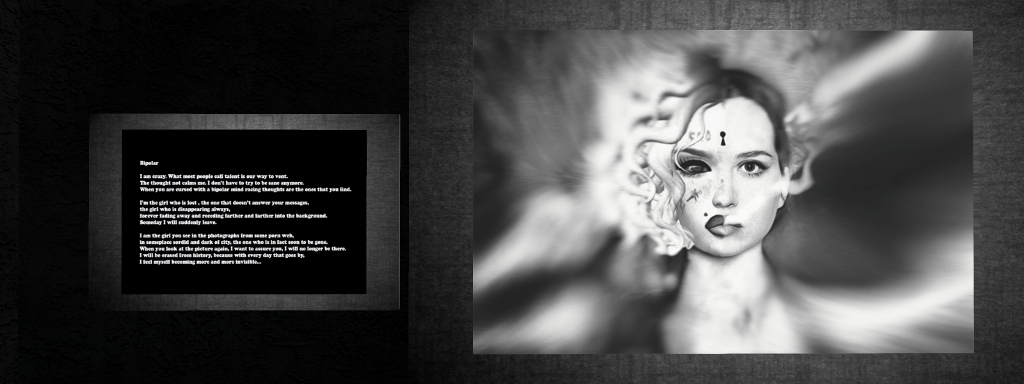
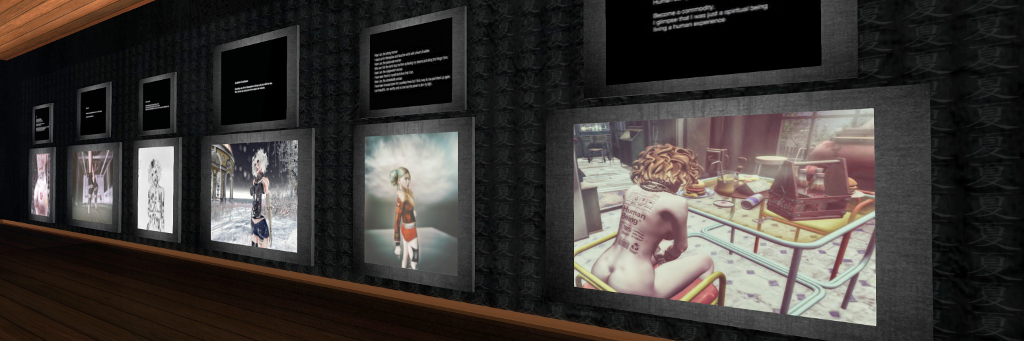
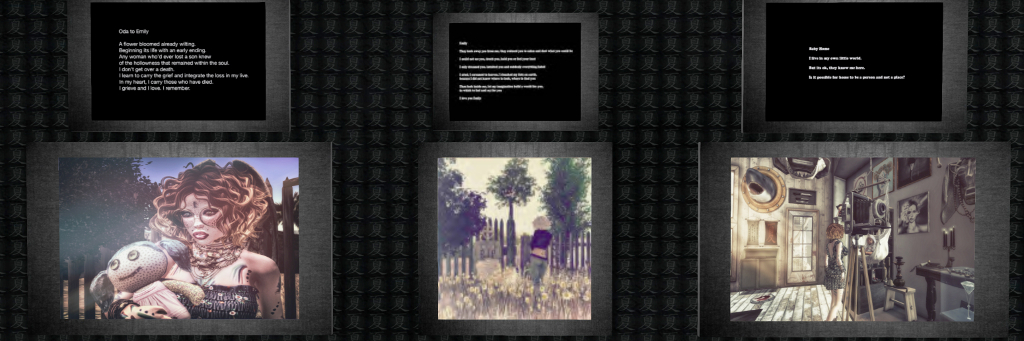
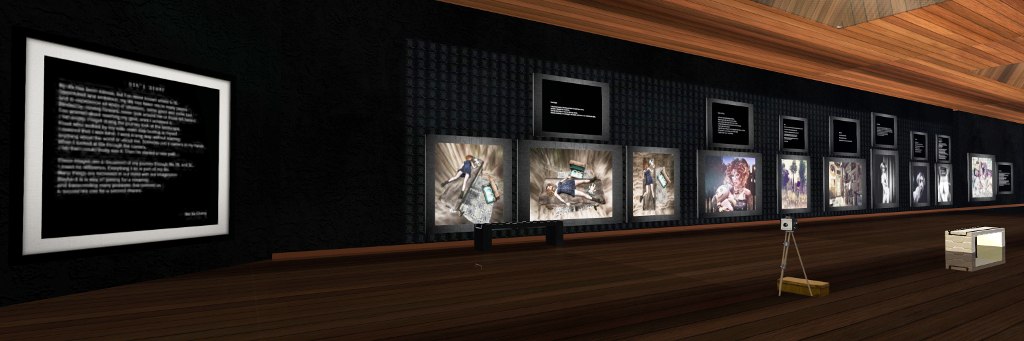
Twenty-one images – all of them avatar studies (although one has an aspect to it suggesting it might have originated in the physical world) – are presented in the exhibition. Most sit as individual pieces, although there are three that clearly form a single group, and three more are presented in such a way as to suggest they could form a set.

All are accompanied by Xia’s thoughts, the words provided with evocative titles such as Lost HopeOde to Emily, Broken Doll, and so on. They offer frames to the images over which they sit – and a windows into Xia’s thoughts and feelings.

These images are a document of my journey through life, RL and SL, I make no difference. Everything I do is part of my life. Many things are recreated in our mind with our imagination. Maybe it is a way of looking for a meaning and transcending many problems that torment us. A second life can be a second chance. 

– Xia Chieng, defining Xia’s Diary

Diotima Art Gallery: Xia’s Diary

The words, offered white-on-black are as clear-cut and unequivocal as their presentation. Evocative, provocative (as are some of the images), brutally honest, they offer the kind of introspection most of us probably prefer to carry out within our own heads (and most likely in a darkened room) well away from public display.

Thus, Xia’s Diary becomes something of a tour de force of feelings and responses in which we are cast into multiple roles. We are the voyeur and the emotional vampire, illicitly peeping in on the sometimes salacious, often poignantly deep, confessions from the heart and drawing from them. And given these are confessions – honest, down-to-Earth examinations of self, of hopes, of fears, of confusion of need – so too are we cast as the confessional-made-flesh, bearing witness to the opening of a soul. And because these are deeply personal reflections, so too are we given pause to hold up a mirror to ourselves and review who and what we are in life, both physical and virtual.

Diotima Art Gallery: Xia’s Diary

Intense, sometimes dark, expressive, and captivating, one of the more richly narrative and personal exhibitions I’ve recently seen.

SLurl Details

Sansar: user-generated quests release: an overview

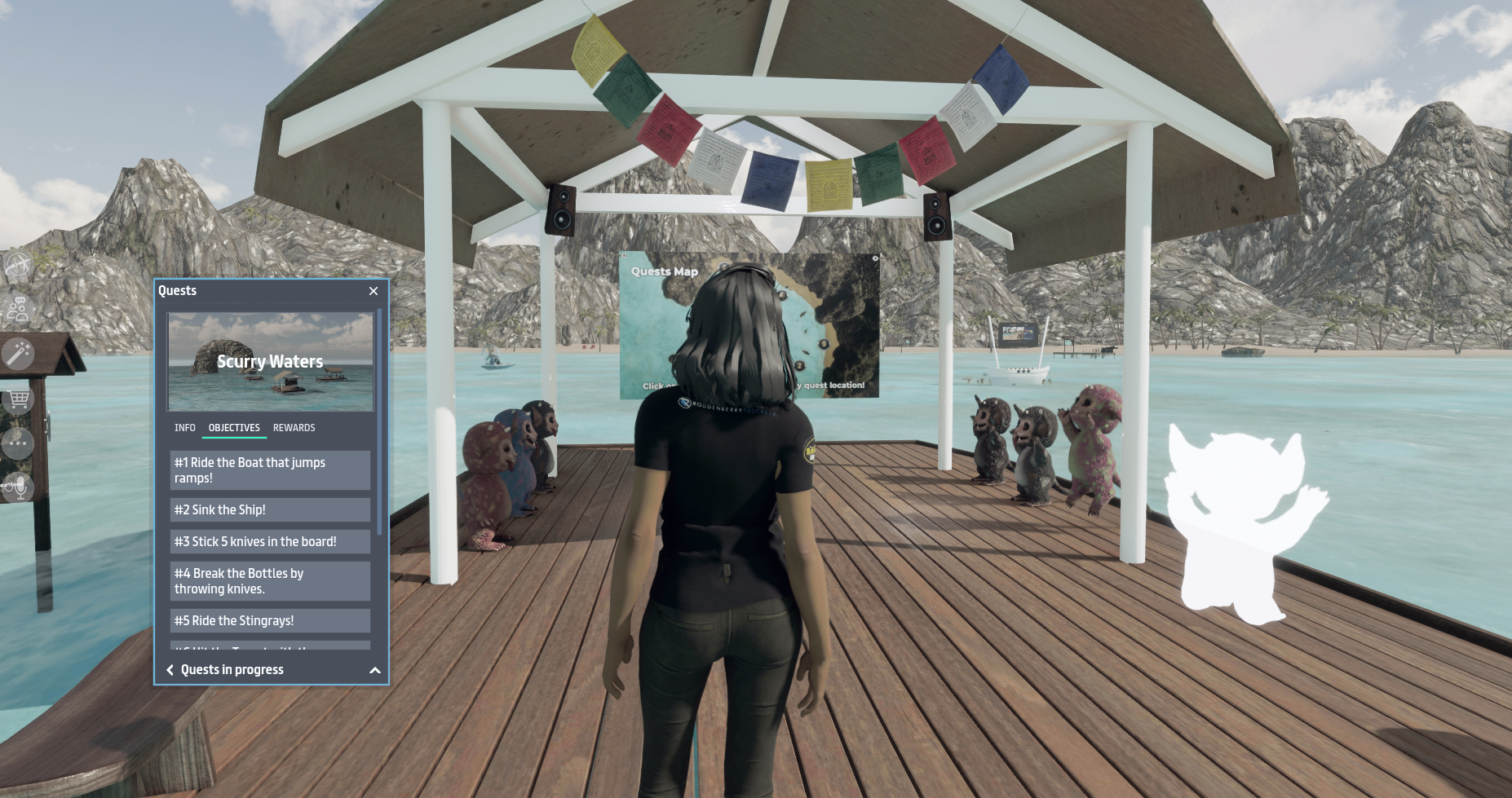
Scurry Waters in Sansar shows what can already be done with the quest system, using it to present games and unlock activities

On Tuesday, July 23rd, 2019, Linden Lab issued a Sansar point release containing the first cut of the user-generated quest authoring tool.

Also within the release are a couple of performance improvements:

  • Avatar movement and camera rotation are faster in keyboard turn mode.
  • Panels now retain their positions in the avatar editor.

Quests – Key Points

Quests are seen as a means of generating user engagement within experiences. A basic system – available only to the lab – has been used to provide a flavour of quests / hunts in places like the Sansar Social Hub, but which offer Sansar Dollar rewards.

The new quest system provides an new quest authoring tool directly to experience creators, however there are some key points to note about this first release:

  • Quests can only be linked to experiences owned by the quest creator (so creator X cannot develop a quest for use in creator Y’s experience(s).
  • Quests can be set for an individual experience or across multiple experience – again, providing all the experiences at are owned by the creator making the quest.
  • While it includes a tab for establishing rewards within a quest, this is not active with this initial release.
  • Once the rewards capability has been added by the Lab in a future update, quests will initially be limited to offering up to three objects as rewards, which will be presented to users completing a quest through the Sansar Store.

How quests might be used is down to individual creators. Ideas include:

  • Guided tours of experiences.
  • Simple introductions to a game.
  • Games.
  • Hunts. / actual quests.
  • Leaning experiences.
  • etc.

Obviously, some of these will be more likely to be attractive to users once the rewards system has been added – and may well require more that 3 rewards in order to maintain focus / interest  – and this is something the Lab have indicated they would be willing to review in the future. But even without a reward system, the deployment of the quest system offers creators the opportunity to play with the tools and gain familiarity with them.

Quest creation comprises two parts:

  • Creating the quest data itself, using the authoring tool.
  • Using objects in scenes (experiences) that are directly linked to the quest and use / present the quest data.

The quest can be tested by the creator in the unpublished scene (by building and saving the scene), and it becomes public when the scene is published as an experience.

The Tools

The initial quest system comprises:

Quest Building Basics

There is Lab-supplied documentation on making quests and assigning objectives. the following is a simple overview of the basics.

There are three parts to creating a quest:

  • Define the quest – via the quest authoring tool.
  • Define the objectives for the quest – via the quest authoring tool

Defining a new Quest

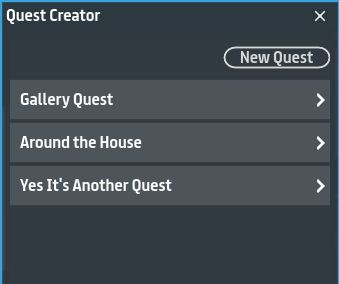
Create button > Create Quests > Quest Creator > New Quest.

  • Every quest requires a name (up to 100 characters) and a description (up to 250 characters).
  • Quests can optionally have:
    • A thumbnail image, displayed when a user viewer the quest, and captured using the For A Quest drop-down in the snapshot tool to generate any required image.
    • A completion message up to 250 characters in length, displayed when users complete the quest.
Creating a new quest from within the client. Note that the quests definition fields are show on the right for convenience, but will actually appear in the “middle” Quest Creator panel in the image.

Save the quest when done.

Editing a Quest

The Quest Creators records all quests you have created. To edit a specific quest (e.g. to add / change objectives):

  • Create button > Create Quests > Quest Creator.
  • The list of all your quests will be displayed.
  • Click on the name of the quest you want to edit.
  • The Quest Creator will display the quest and all defined objectives.
  • Edit and save as required.

Defining Objectives for a Quest

Note that when you create a new quest, you will automatically be presented with the option to add objectives to the quest – and you can have as many objectives in a quest as you require.

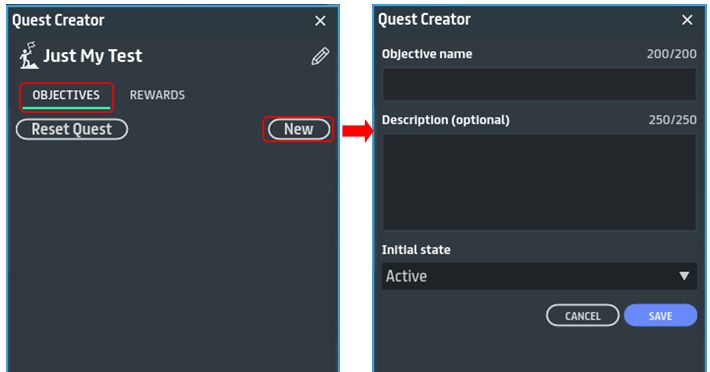
Select the required quest (if not already selected) > make sure Objectives is selected (default) > Click New to display the objective fields.

  • All objectives require a name (up to 200 characters), and should be set to Active or locked:
    • Set to Active if there is no dependency on the objective (i.e. it can only be completed if pre-requisites are met.
    • Set to Locked if it is dependent on completing certain objectives.
    • Prerequisites can be other objectives, scripted activities etc.
  • An optional  description, up to 250 characters.
Setting an objective in a quest. panel images shown side-by-side for clarity

Save the objective when done.

Adding Objects as Givers and Objectives in an Experience

Notes:

  • All quests require a Giver – the item that sets users on the quest, generally through direct interaction.
  • A quest can have as many objectives as required.
  • A quest should have a completion element.

Basic steps: edit the experience scene in which the quest will appear > add and place an object as the quest giver. Then:

  • Right-click the object and rename the object, if required.
  • Right-click the object > Add > Script.
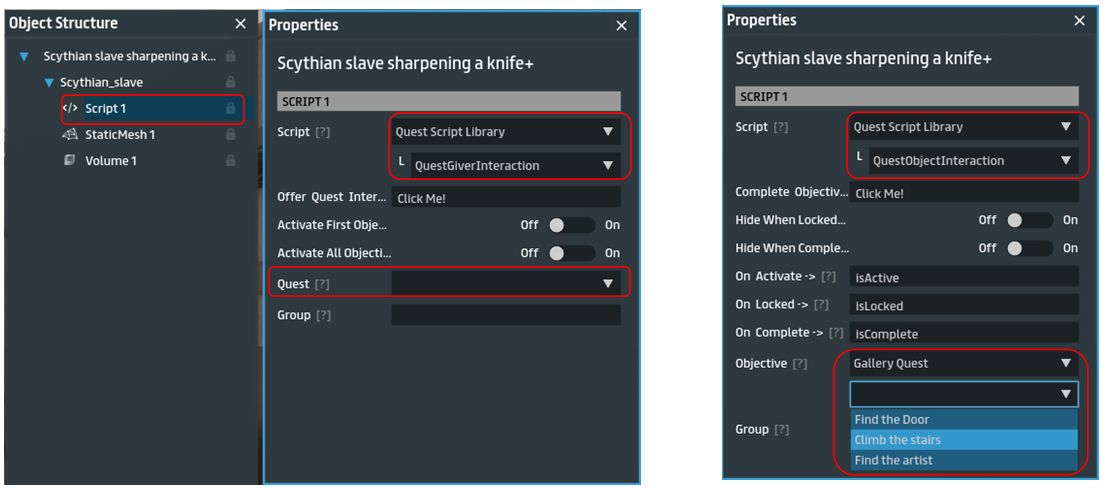
  • In Object Structure right click on the new script (general “Script1”) > Properties. Then:
    • Set Script to Quest Script Library
    • Set the script type to one of the available scripts (QuestGiver, QuestGiverInteraction, etc).
    • Use the Quest drop-down to select the quest with which the object is to be associated.
    • If setting a quest objective, also set the quest objective with which the object is to be associated (below, right).
Setting an object as a quest giver (left), and as a quest objective (right)

Testing a Quest

To test a quest in a scene:

  • Build and save the scene.
  • Visit the scene.
  • Click the quest giver – the quest should launch > test the objectives.
  • To reset the quest at any time (incl. testing): Create button > Create Quests > select quest > Edit > Reset Quest.

Feedback

A simple, easy-to-understand system (easy enough for me to understand!) with some built-in complexity (see the associated scripting documentation) and with a lot of potential for expansion. As always, check the official documentation for full details on the capability.

A return to Natural Falls in Second Life

Natural Falls, July 2019

Update: It appears this iteration of Natural Falls has closed. SLurls have therefore been removed.

DannChris might be a hamster in Second Life (and love the Maverick profile photo, Dann!), but he’s a hamster with a love of water settings. we discovered this when visiting his Natural Falls V in early 2017 (see Navigating Natural Falls in Second Life) and again with a visit to A L T I T U D E earlier in 2019 (see Gaining a little A L T I T U D E in Second Life).

At the start of July 2019, Dann dropped me a note thanking me for writing about A L T I T U D E which was nice in itself – and to inform me that a new Natural Falls would be coming along soon. More recently, friend and fellow traveller, Miro Collas poked me to let me know it had arrived. So hoping it has retained the watery themes present in the previous builds and within A L T I T U D E, we jumped over to take a look.

Natural Falls, July 2019

Natural Falls has tended to represent, in Dann’s words, a decaying city waterlogged by some disaster – whether man-made or natural or a combination of both (such as humanity’s willingness to acknowledge climate change but stubborn refusal to adequately address it), is up to the visitor to determine.

As with previous builds, the city sits at least knee-deep in water and under the cement conduits of a really elevated railway, the parallel tracks of which sit to the north and south, bracketing the larger part of the city below them.

Natural Falls, July 2019

Getting around is a matter of following the wooden board walks, some of which sit between walls cunningly designed to resemble buildings, adding to the feel that this is a sprawling, flooded metropolis when seen from lower levels.  Power lines are strung along some of this walkways, passing between tall poles that march along the board walks, giving the impression some of the buildings here are still occupied. The walkways don’t however, all interconnect – so if you’re going to explore everywhere (and you should), you’re going to have to be prepared to do a little jumping and / or get your legs wet.

This is particularly true if you want to get down to the little Japanese style market that sits just over (and on) the water, or drop in to the old amusement park the water has claimed as its own, the old roller coaster looking rather forlorn. A slightly worrying aspect of stepping down into the water is the fact that off to the north-east, a couple of massive electrical pylons drip their high-tension power lines in to the waves. Fortunately, neither one is actually connected to a electrical generation system, so there’s no risk of electrocution present with them!

Natural Falls, July 2019

Which is just as well, really, because it is only by wading through the water that you can get to visit what I personally think is one of the most gorgeous motifs Dann presents in his region designs: a fabulous walled and flooded garden. I first saw this in Natural Falls V, and it was  – for a time, and in an expanding form – a feature of A L T I T U D E, so encountering it within this iteration of Natural Falls came as an absolute delight.

“I had to recreate it,” Dann informed me when I noted its presence,  “We had a party at Altitude which needed a special place, but there wasn’t enough LI, so the garden got taken down.” He paused a moment and continued, “I will put it back at some point 🙂 .” If he does, I hope he actually reproduces the garden in some form at A L T I T U D E rather than moving it from Natural Falls, as it makes for an ideal focal point; and with a suitable teleport portal, could even make for a nice link between the two regions.

Natural Falls, July 2019

There are other reminders of past builds to be found here – the old pavilion sitting among the lilies, the great engines slung beneath the elevated railway lines and concrete channel that turn massive propellers – presumably helping to keep the structures aloft.

Also to be found are the more artistic / whimsical statements those who have visited past Natural Falls might find familiar. The figures close to the landing point, for the example, who stand beneath a pained warning: Who Watches The Watchers, even as a haphazard pile of televisions rises close by to apparently keep an eye on them – and while a flying saucer overhead appears to be spiriting some of them away! Then there are the quirky little places to sit waiting to be found, such as atop a set of diving boards, complete with a potted plant. Or, in a touch of delightful and fantastical whimsy, a blue whale slowly circling in the air and offering passers-by a ride, either hanging from the ladder that dangles from his flank or in the garden sprouting  from his back.

Natural Falls, July 2019

Imaginative, rich in detail, quirky, fun, and giving a little tap on the shoulder of ecological conscience, with this iteration, Natural Fall remains a thoroughly recommended visit. Photos can be shared via the region’s Flickr group.