On May 29th, 2019, Linden Lab issued a blog post outlining a number of changes to fees charged in connection with Second Life (see Land Price Reductions, New Premium Perks and Pricing Changes). In particular, for the purposes of this article, the Lab’s post indicated the Premium subscriptions would be increasing after June 24hth 2019 as follows:
Monthly subscriptions will be increasing from US $9.50 per month to US $11.99.
Annual subscriptions will be increasing from US $72.00 per year to US $99.00.
Quarterly subscriptions will be increased from US $22.50 to US $32.97.
In that blog post, it was also indicated that from both Monthly and Quarterly subscriptions would be applicable to user in EU countries, while Quarterly subscriptions would be discontinued as an option from June 24th for those upgrading to Premium after that date, but would remain available for those already subscribed to that option.
However, on Monday, June 10th, in responding to the comments left in the forum thread on the subject of the changes, Grumpity Linden indicated the Lab were making a temporary adjustment to the planned Premium fee changes, stating that the Quarterly subscription plan will now remain available to new premium sign-ups through until the “all-new membership level for those who want to get the absolute most out of their Second Life” is officially announced. The original blog post has been updated to reflect this.
Grumpity Linden’s forum comment on the short-term continuance of the Quarterly Premium subscription plan for users upgrading to Premium
This doesn’t offer much to those still feeling aggrieved by the fee changes as a whole (although – at the risk of earning a degree of ire – such changes are going to remain inevitable if the Lab is to maintain its ability to generate revenue whilst also meeting demands to lower virtual land tier), however, it does offer those wishing to upgrade to Premium but who are uncomfortable with playing the annual fee a further option to do so, albeit at the increased rate after June 24th, 2019.
Also, as can be seen in Grumpity’s reply, the Lab will try to address matters around the fee changes through their annual Meet the Lindens sessions that form a part of the Second Life Birthday events. As always, I will endeavour to provide a summary of these sessions, with audio extracts where relevant, as soon as possible after each session.
Update: Lotus Bay may no longer be open to public access.
Lotus Bay is a new homestead region design by the combined talents of Maria Kobaiernen (Dreamy Lebed) and Aydenn Palazzo (Aaydenn29) that recently slipped into the Destination Guide, and in doing so caught our attention.
Described as “a luxurious tropical island with a hedonistic resort vibe”, this is a quite marvellous design rich in content and detail. Admittedly, the amount of mesh and texture present can take something of a toll on a computer if you happen to like running with a lot of the viewer’s options active; however, this does not mean Lotus Bay should be avoided by the keen SL traveller, as doing so would rick missing out on seeing a very special place.
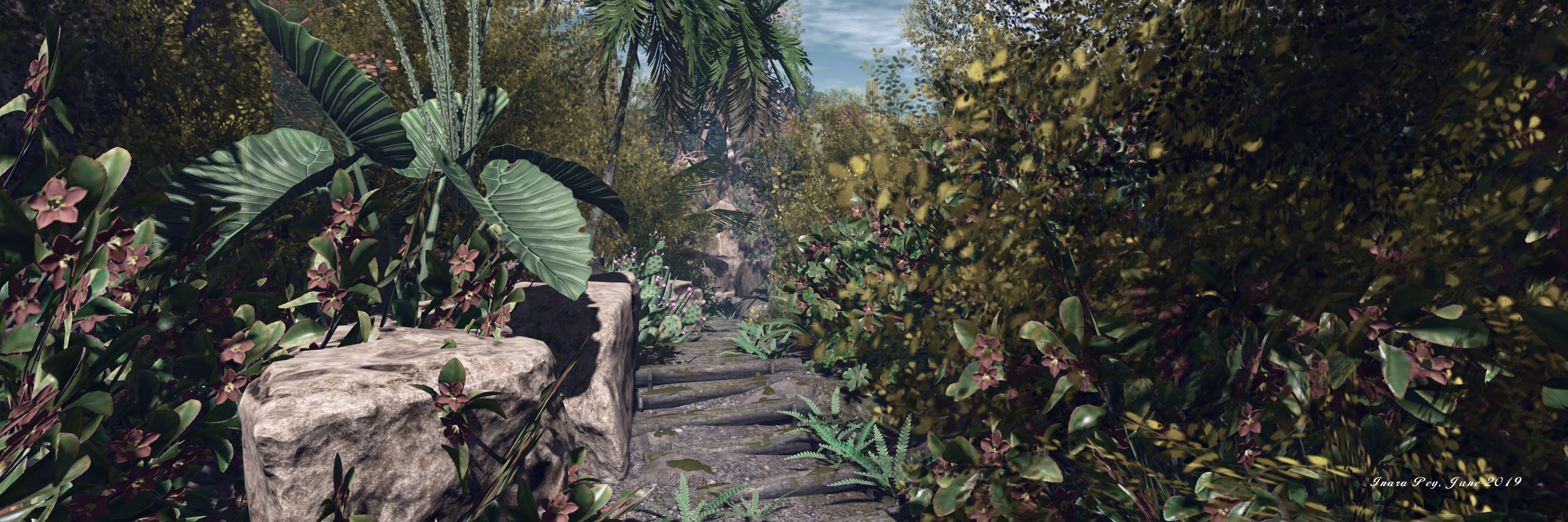
Rising from the sea with beaches to the west and east offering a buffer between land and water, Lotus Bay sits atop a magnificent table of rock. Sheer cliffs on all sides seem at first to rebuff visitors. However, the stone steps carefully cut into them just a short walk from the landing point give the lie to this.
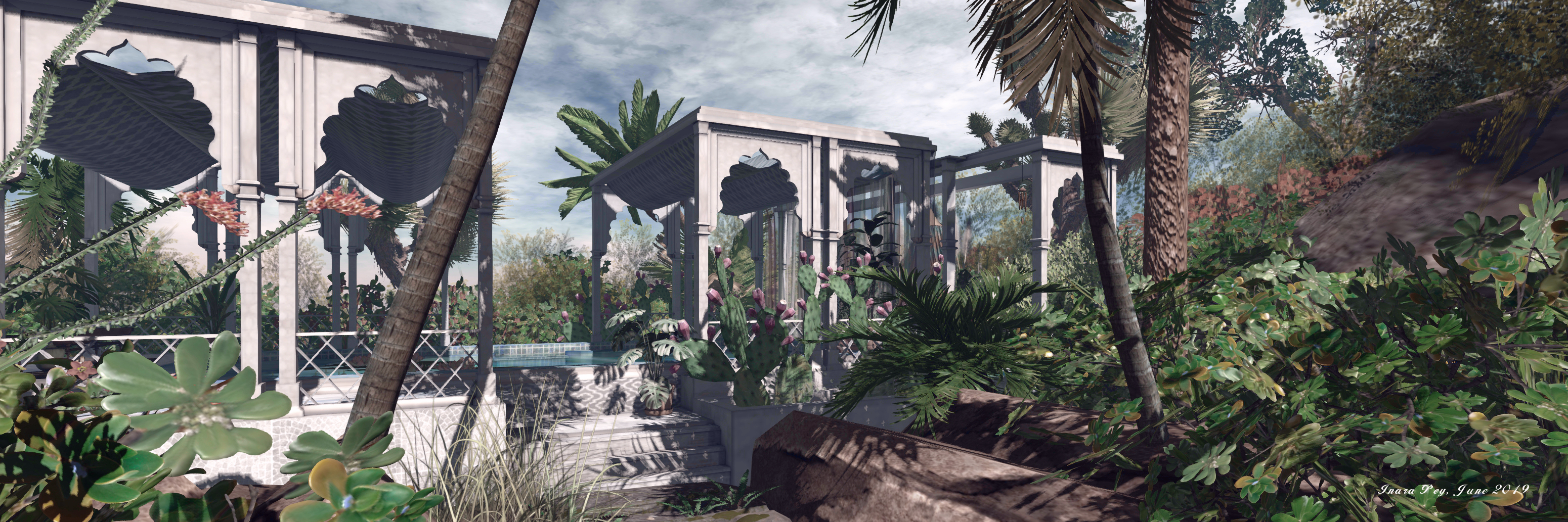
Winding upwards and slightly inland from the beach, these steps lead the way to a lush plateau, rich in foliage and colour, and home to a large, whitewashed house with a distinctly colonial look to it. Old and with its walls patched and the home to strands of vines, it is nonetheless furnished inside, witnessing its occupancy while the presence of the piano in the wooden-floored courtyard perhaps gives an indication that the rainy season here is very predictable.
While open to visitors, this house nevertheless raises questions: is it a primary residence or a holiday home? Certainly the nature of the island suggests it was never the centre of something like a working plantation. The log marked trails that extend away from the house at various points to make their way through the foliage and between rocks, suggest that the house is a vacation retreat, a Second Life Necker Island, if you will.
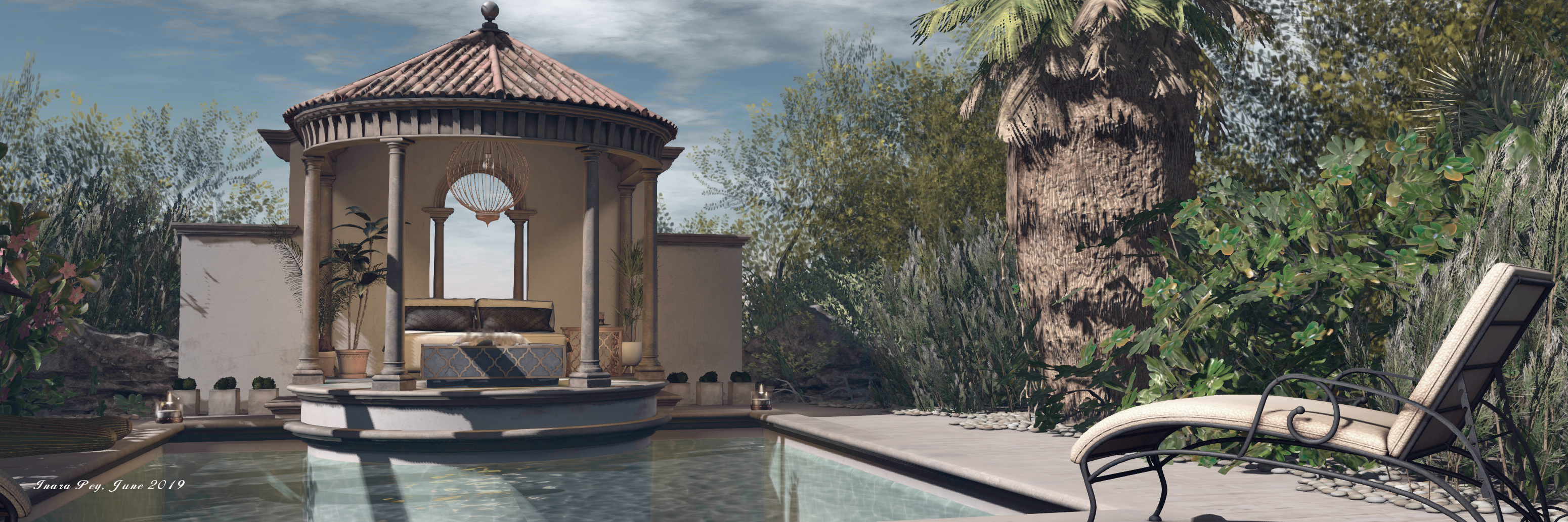
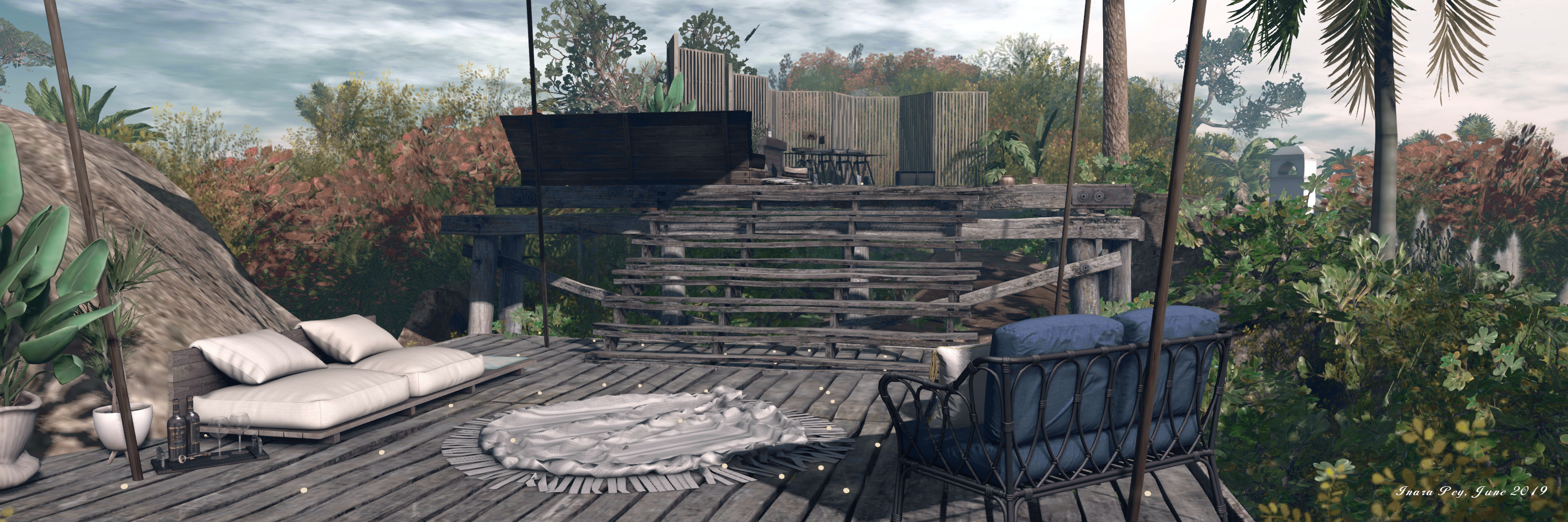
These paths, running snake-like and often branching to offer choices of route, provide access to swimming pools and open-air decks where people can relax and sit or dance. They offer the way to other steps leading back down to the golden sands of the beaches below, or to where a hot tub sits under the shade of rocks and palms. However, all of these little touches, each beautifully executed and presented, also speak to the idea that this is a resort more than a private location; a secret getaway for the well-informed.
This feeling of paradise delight is furthered down on the sweep of the east-side beach, where a deck awaits those wishing to partake of a Second Life wedding. There is also a little cluster of cabins built over the water, each one offered for rent by those wishing to extend their stay on the island as a vacation away from the rest of SL. Rates for both cabins and weddings can, I understand, be obtained by contacting Maria.
The care put into the design of Lotus Bay is evident throughout. The use of space, the placement of rocks, trees, paths, buildings, and so on has a perfectly natural feel that greatly enhances the sense of immersion; Lotus Bay feels like a place in which the building and structures have been placed to both take advantage of the landscape and utilise available spaces, rather than the landscape feeling it has been designed to fit around the buildings and locations within it.
The landscaping itself also has a wonderful eclectic feel to it: temperate shrubs and bushes mix with Junipers and cacti and palm trees in a glorious mix that gives Lotus Bay no fixed location, but the ability for it to be anywhere we might wish to imagine it – off the coast of central America, or an Indonesian island, or somewhere sitting off the coast of Vietnam or China, and so on.
For me, and despite the differences in local plant life, I was put in mind of the forests in Dambulla region of Sri Lanka and the Sinharaja Forest Reserve further to the south of that country. While there is nothing specific to the landscape at Lotus Bay to align it with Sri Lanka, I was nevertheless put in mind of walking through forest trails there, and reminded of the care with which some resort spaces in those places have been blended into their surroundings.
But wherever you might wish to place this setting, the important thing is that you go and see it, because it is a true delight for the eyes. Photographers can obtain rezzing rights for props by joining the local group. Photographs themselves can also be submitted to the region’s Flickr group.
In February 2019, it was indicated in a Third-Party Viewer Developer (TPVD) meeting that an upgrade to the system powering user profiles seen in the viewer, on the web, together with the feeds, etc., was in the pipeline (see 2019 SL User Groups 7/3: TPV Developer Meeting).
At the time of the announcement, it was indicated that the overall impact of the update on the feeds has a whole had yet to be determined. However, it was also made clear that the current web-based profile floater seen in the Lab’s viewer would in the coming months be replaced by a “legacy” style profile floater (e.g. the type seen within the Firestorm and Cool VL viewers).
On Wednesday, June 5th, the Lab took the first public step towards this by issuing the Second Life Legacy Profiles project viewer, version 6.2.3.527749. This viewer offers a first pass at the re-introduction of the “old” style profile floater to the official viewer, utilising code originally contributed by Kadah Coba of the Firestorm team.
The new Legacy Profiles project viewer replaces the current web-based profile panel (left), with an “old-style” profile floater panel (right)
With this viewer, it is important to note a couple of things:
This is an initial release of the viewer with the profile floater. As such, it may be refined / altered / fine tuned as the viewer progresses towards release.
There are a number of known issues with this initial release – see the release notes for a list of these.
As TPV user – notably (but not exclusively) Firestorm – I’ve always tended to find the legacy style of profile floater to be preferable: it tends to be faster loading, and (to me) has a more user-friendly means of navigation. As seen within the project viewer, the “new” floater is perhaps a little large in its default size, but adjusting it is easy enough – although having it a little smaller by default perhaps wouldn’t go amiss.
Those interested in trying this project viewer can do so via the Alternate Viewer page.
Now open at the Lin C Art Gallery, curated by Lin Carlucci, is an exhibition of physical world paintings by Xirana (Xirana Oximoxi).
An artist from Catalan, Xirana notes of her art:
My works reflect my concerns and my different moods. They are based on my experiences and express a personal sensitivity nourished by impressions from the external world and my internal world. In this latter sense, I like to call them abstractions or ‘mental landscapes’. The works reflect the influences of impressionism, expressionism, abstract expressionism of artists like Jackson Pollock and the informalism among many others.
For this exhibition, Xirana demonstrates this breadth of approach by offering pieces that range from landscapes, to impressionist pieces through to the more abstract.
The majority of the latter are located on the ground floor of the gallery. These are very tonal pieces carrying with them a strong geometric form within them, while the lines and colour offer a sense of informalism to which Xirana alludes in her biography.
The mezzanine level of the gallery contains a range of Xirana’s watercolour landscapes, most of which have a focus on water. Within some there is a hint of abstractionism, whilst one bridges the other six with five pieces that move more towards impressionism in their style, even as they maintain that hint of abstractionism.
Once again, an engaging exhibition presented by Lin that allows us to again share the work of a physical world artist whose work might otherwise remain beyond the reach of many of us.
Logos representative only and should not be seen as an endorsement / preference / recommendation
Updates for the week ending Sunday, June 9th
This summary is generally published every Monday, and is a list of SL viewer / client releases (official and TPV) made during the previous week. When reading it, please note:
It is based on my Current Viewer Releases Page, a list of all Second Life viewers and clients that are in popular use (and of which I am aware), and which are recognised as adhering to the TPV Policy. This page includes comprehensive links to download pages, blog notes, release notes, etc., as well as links to any / all reviews of specific viewers / clients made within this blog.
By its nature, this summary presented here will always be in arrears, please refer to the Current Viewer Release Page for more up-to-date information.
Note that for purposes of length, TPV test viewers, preview / beta viewers / nightly builds are generally not recorded in these summaries.
Official LL Viewers
Current Release version 6.2.2.527338, formerly the Teranino RC viewer, promoted May 22nd – No Change.
Release channel cohorts:
EEP RC viewer updated to version 6.4.0.527723 on June 6th.
Umeshu Maintenance RC viewer, version 6.2.3.527507, released on June 5th.
Rainbow RC viewer updated to version 6.2.3.527758, on June 5th. Contains a Windows / Nvidia fix.
Project viewers:
Legacy Profiles viewer, version 6.2.3.527749, released on June 5th. Covers the re-integration of Viewer Profiles.
Cool VL viewer Stable branch updated to version 1.26.22.50 and Experimental Branch to version 1.26.23.3 on June 8th (release notes).
Mobile / Other Clients
Lumiya is currently unavailable through Google Play – see my article and update here. However, it remains available to new users (or can be re-purchased if urgent) via SlideMe.
MetaChat updates to version 1.2.9105 on June 4th (release notes).
NASA has linked the Moon with Mars for decades, but only really emphasised the former whilst only talking vaguely about the latter. This lunar “bias” might have been the reason for a confusing tweet by President Trump on June 7th, 2019. Credit: NASA
In December 2017, President Trump signed Space Policy Directive (SPD)-1, directing NASA to focus on returning human to the Moon. More recently this has seen the White House to direct NASA to achieve this return by 2024, and not 2028, the US space agency’s target year. We’ve also seen the programme gain a name – Project Artemis (Artemis being the sister of Apollo in Greek mythology) and the White House and Congress getting into something of a tussle over NASA’s 2020 budget: the former wants to add US $1.6 billion to NASA’s budget specifically for the lunar effort, the latter wants to give NASA an extra US $1.3 billion for programmes other than a return to the Moon.
However, tussles over budget increases aside (and even if it were granted, US $1.6 billion is merely a splash of the level of financing NASA realistically needs to reach the Moon by 2024), the US space agency has at least had a goal to aim for, until President Trump appeared to rock the boat on June 7th, when he issued a tweet that appeared to suggest NASA shouldn’t be aiming for a return to the Moon, but should be focused on Mars.
Donald Trump’s June 7th tweet concerning NASA’s human space flight goals
The tweet drew a huge amount of backlash from people trying to claim that Trump regards the Moon as “part of Mars”. However, those doing so are somewhat misguided. Anyone with any understanding of NASA’s plans / desires over the last 30 years with regards to Mars know that the Moon has been indelibly linked to that effort; it’s been pretty much the view that the one (Mars) cannot be achieved without the other (a return to the Moon).
The cornerstone of this claim has always been that the Moon can be used as a testing ground for technologies that might assist us in the exploration / settlement of Mars.
The Moon provides an opportunity to test new tools, instruments and equipment that could be used on Mars, including human habitats, life support systems.
– NASA website
But how accurate is this assertion? “Not very” is a not unfair summation. Mars is a very different destination to the Moon. Just landing there requires substantially different capabilities to those required for landing on the Moon.
For example, Mars has an atmosphere and the Moon does not. This can be both an advantage (it can be used to help slow an incoming vehicle down on its way to the surface) and a disadvantage (lander vehicles must be capable of withstanding entry into that atmosphere and making use of it during descent, which adds significant complexity to them). Similarly, the technology needed to get off of Mars is different: more powerful motors are required to counter the greater gravity (twice that of the Moon), these in turn require more fuel, which makes the ascent vehicle more complex – which could also feed back into the decent vehicle as well, if a paired system, such as proposed for use with the Moon, is to be used.
That Mars has an atmosphere means that very different technical approaches must be taken for landing there compared to landing on the Moon. Credit: The Mars Society
Similarly, how local resources on the Moon and Mars might be used differ substantially. With the Moon, it is proposed water ice in the southern polar regions is leveraged as a means of producing oxygen, water and fuel stocks. This could also be done on Mars – but there is a far more accessible resource on Mars for this: its carbon-dioxide rich atmosphere.
Using a 19th century technique called the Sabatier Reaction, water, oxygen and methane can literally be produced out of the Martian air. The oxygen and methane can be used a fuel stocks, while the air and water have obvious life-support options.
The Sabatier reaction: (1) hydrogen feedstock carried to Mars is combined with the carbon-dioxide atmosphere to produce methane (CH4), used as propellant, and water (H2O). (2) Te water is split into hydrogen, which is fed back to to help support the first reaction, and oxygen, also used as a propellant. (3) A related reaction takes the CO2 atmosphere and splits it into “waste” carbon, returned to the atmosphere and oxygen, which can be used as propellant or to supplement air supplies.
Tests carried out by the Mars Society – and verified in a 2003 joint NASA / ESA study – show that an automated lander vehicle carrying just 6 tonnes of hydrogen to the surface of Mars could produce 112 tonnes of methane / oxygen fuel by the time a human crew arrives 18 months later – enough to power their ascent vehicle back to Mars orbit or – depending on the mission architecture used – even all the way back to Earth orbit.
And when it comes to things like life support systems and radiation shielding – do we actually need the Moon to test these for an eventual Mars mission? Actually no. In terms of life support systems, we already have the infrastructure in place for testing them, just 400km from the surface of Earth; we call it the International Space Station. And when it comes to testing technologies to protect against radiation – even GCRs (galactic cosmic rays) – this can be done through other, and potentially less costly, means.
Which is not to say that we shouldn’t be going to the Moon; the potential science returns are as significant as those in going to Mars. However, it’s not unfair to say that for the last 30 years, the constant linking of the Moon and Mars has resulted in NASA being unable to achieve either.
Thus, Trump’s tweet shouldn’t be seen as any kind of belief on his part that the Moon is anyway “a part” of Mars, but rather a reflection (or possibly parroting) of the frustration some space advocates feel in the way NASA constantly links the two, with the emphasis perhaps too closely focused on the Moon, rather than looking at the potential and inspiration humans face in going to Mars.
However, where Trump’s tweet is potentially harmful is in the confusion it might cause. Trump’s spur-of-the-moment tweets have an unfortunate habit of becoming “policy”. As such, it was hard to know if the June 7th tweet was simply parroting something heard, or whether it was signalling a genuine change in direction for US space policy. As such, some, such as the Planetary Society, more correctly sought not to belittle the Moon “a part” of Mars element of Trump’s tweet, but to request a clarification of anticipated goals.
The Planetary Society’s response to Trump’s Tweet, highlighting the real concerns, not “he doesn’t know the Moon from Mars” nonsense
This clarification appeared to come at the National Space Society’s International Space Development Conference in Washington DC on June 8th. At that event, Scott Pace, Executive Secretary of the National Space Council, indirectly referenced Trump’s tweet, stating that while efforts to return humans to the lunar surface by 2024 were ongoing, NASA and the administration should devote more attention to long-term aspirations of human Mars missions.
The president’s comments was a criticism not of going back to the moon but rather not paying more attention to that long-term goal. We’re head down, working on the immediate execution of this [and] I don’t think we always do a good job speaking to the larger vision that this is part of. What he [Trump] is doing is stepping back and expressing, I think, a very understandable impatience with how long all of that takes, and sometimes we miss the bigger picture.
– Scott Pace, Executive Secretary, the National Space Council
 On May 29th, 2019, Linden Lab issued a blog post outlining a number of changes to fees charged in connection with Second Life (see Land Price Reductions, New Premium Perks and Pricing Changes). In particular, for the purposes of this article, the Lab’s post indicated the Premium subscriptions would be increasing after June 24hth 2019 as follows:







 Inara Pey: Living in a Modemworld