The magic of images and words in Second Life

The Edge: ViktorSavior and AlenaPit

Currently open at The Edge gallery curated by Ladmilla, is an ensemble exhibition entitled Visual Poems. It features pairings of art and poetry, with some of the artists providing both the words and images, others working in pairs: one producing the images and the other the words.

Pieces are spread between two of the gallery’s exhibition spaces: the castle – notably the upper rooms and the parapet walks around the curtain walls – and in and alongside the cathedral. Those participating in the exhibition are: Mirabelle Sweetwater (images and words); Kapaan (images and words); PatrickofIreland (images and words); Thomascrown11 (images and words) VenicioArmin (images and words) Pearl Grey (images) and Klaus Bereznyak (words); TaraAers (images) and Oleanhorok (words); ViktorSavior (images) and AlenaPit (words); and Ladmilla (images) and Eli Medier (words).

The Edge: TaraAers) and Oleanhorok

This is a fascinating exhibition  – and one that, by virtue of the its scale, may require more than one visit to fully appreciate. The combining of words and images is always an interesting concept (something we have often explored with Seanchai Library with exhibitions at Holly Kai Park), perhaps doubly so when the creator of an image is entrusting their work to the imagination of another to produces the words around it.

Hence, within this exhibition there is an attractiveness to the pairing of artist and poet that can captivate, and without wishing to appear to select favourites, I admit to being particularly drawn to the pieces by Viktor and Alena (two of which form the banner image for this article). There is a minimalist beauty to Viktor’s images that is perfectly balanced by Alena’s 4-line verses. Together they paint a complete story that is deeply evocative.

The Edge: Mirabelle Sweetwater

Alena is a prolific writer, having produced more than 200 poems, and what fascinates me with this particular pairing is the question of which came first: the image or the poem? Or perhaps they have independent origins, with the artists matching words and pictures after the fact.

All my feelings from the heart and soul are reflected in poetry, which makes up most of my life in SL and RL. I write about different things: about romantic relationships, about feelings, about family, about nature, about hope and love. Many people say that my poems are positive and easy. I hope you leave me your opinion about them too. I write poems in Russian, but now I begin to prepare translations into English and arrange visual exhibitions in SL art galleries.

– AlenaPit on her writing

The Edge: Venicio Armin

Alongside the gallery’s cathedral is Venicio Armin’s selection of images for the exhibition, and I must again confess I found these to be completely engrossing. Presented in monochrome the images and words, provide a story of two relationships: the relationship between a man and a woman and the love Argentines have for the Tango. Through six images and short poems bother are beautifully framed and presented in magnificent depth, with Venicio also offering the opportunity to hear the music of the Argentine Tango.

Also on offer at the gallery is an exhibition of art by  anibrm Jung and 3D art by Sempiternel and Mariemadeleine38. These add further depth to an engaging visit – but again, you should allow time to give the exhibitions the attention the deserve.

SLurl Details

Happy Days at NorderNey in Second Life

IMAGO Art Gallery: Happy Days at NorderNey

Currently open at IMAGO Art Gallery, curated by Mareea Farrasco, is an ensemble exhibition celebrating NorderNey (closed to public access at the time of writing), one of Second Life’s more popular photogenic regions (and which I confess to having covered in these pages in 2014, and 2017, although I really should have taken the time to visit it more recently).

Happy Days at NorderNey is a small but enticing exhibition, featuring images by Maxie Daviau, Ninny Dazy, Sorcha Tyles and Mareea herself in a space specially prepared to resemble a part of the region with a sandy beach, the foaming wash of a tide, under an overcast sky.

Each of the artists presents four pieces of art, somewhat split between landscapes of the region and avatar studies that using the region as a backdrop. Together they form – as the title of the exhibition suggests – memories of happy times spent within NorderNey in one of its more recent iterations.

IMAGO Art Gallery: Happy Days at NorderNey – Maxie Daviau

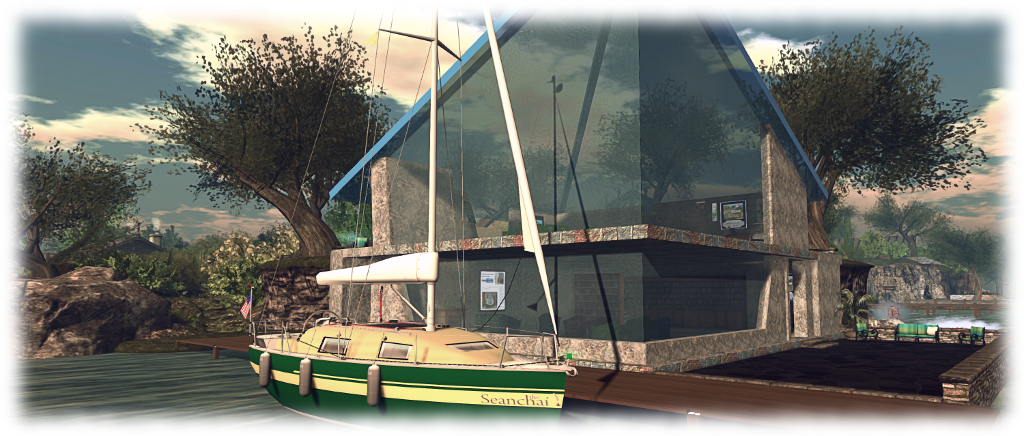
What is particularly interesting in the sixteen images presented is the way that all of the artists have selected more-or-less the same aspects of the region to include in their images: the path to the beach with bicycles leaning on the fence, the sailing boats moored off-shore the scooter sitting at the boundary between tall grass and warm sand for example.

In doing so, each presents unique perspectives on the setting through the use of colour, tone, and post-processing to bring out the clouds, or to offer a feeling of summer warmth or the overcast of an autumn’s day, and so on. Thus, each group of four images may feature some of the same elements as the others, but overall they present different moods and stir different emotional responses.

A small, easy-to view exhibition featuring a group of richly talented Second Life photographers.

IMAGO Art Gallery: Happy Days at NorderNey – Ninna Dazy

SLurl Details

2019 viewer release summaries week #18

Logos representative only and should not be seen as an endorsement / preference / recommendation

Updates for the week ending Sunday, May 5th

This summary is generally published every Monday, and is a list of SL viewer / client releases (official and TPV) made during the previous week. When reading it, please note:

  • It is based on my Current Viewer Releases Page, a list of all Second Life viewers and clients that are in popular use (and of which I am aware), and which are recognised as adhering to the TPV Policy. This page includes comprehensive links to download pages, blog notes, release notes, etc., as well as links to any / all reviews of specific viewers / clients made within this blog.
  • By its nature, this summary presented here will always be in arrears, please refer to the Current Viewer Release Page for more up-to-date information.
  • Note that for purposes of length, TPV test viewers, preview / beta viewers / nightly builds are generally not recorded in these summaries.

Official LL Viewers

  • Current Release version 6.2.0.526190, formerly the Estate Access Management RC viewer, dated April 12, promoted April 17 No change. – see my EAM overview for more information
  • Release channel cohorts:
    • Teranino Maintenance RC viewer updated to version 6.2.1.526845 on May 3rd.
  • Project viewers:
    • No updates.

LL Viewer Resources

Third-party Viewers

V5/V6-style

  • No updates.

V1-style

  • No Updates.

Mobile / Other Clients

  • Lumiya is currently unavailable through Google Play – see my article and update here. However, it remains available to new users (or can be re-purchased if urgent) via SlideMe.
  • MetaChat lists version 1.2.9104 (April 18th) as released; currently only version1.2.9103 is available via iTunes.

Additional TPV Resources

Related Links

Space Sunday: asteroid impacts and private space flights

An artist’s impression of a small (approx 60m) asteroid air burst disintegration over a city. Credit: Igor Zh./Shutterstock

I’ve written about the risk posed by the potential impact of a Near Earth Object on this planet several times within these Space Sunday articles. While they are rare, as we’ve seen with the Tunguska event of 1908, and the more recent  2013 Chelyabinsk air-blast and 2018 LA (ZLAF9B2) in June 2018, objects of a size sufficient enough to survive their initial entry into the Earth’s atmosphere before being ripped apart in a violent explosion can and do exist.

Nor is Earth alone in the threat – as witnessed by those observing the lunar eclipse of January 21st, 2019, the Moon can be hit as well. At 04:41 GMT, during the period of totality during that eclipse, numerous astronomers in North and South America and in Western Europe saw a sudden bright flash lasted less than 1/3 of a second. It was later attributed to an object around 30 to 60 centimetres (1 to 2 ft) across striking the Moon at around 61,000 km/h, producing a new crater somewhere between 10 and 15 metres (32 to 49 ft) across.

While the majority of the 10+ million objects thus far found crossing Earth’s orbit as they go around the Sun pose no real threat to us (in fact, the number of Potentially Hazardous Asteroids, or PHAs, has been put at just 2,000), and the risk of a substantial impact occurring in anyone’s individual lifetime is relatively remote, the fact is that – as Douglas Adams famously noted – space is big really big. Even the solar system is a vast place when compared to the size of Earth, big enough to hide any number of objects that might one day pose a very real threat to all life on Earth or, given humanity’s global distribution the potential to place one of our major cities at risk.

So how might we deal with such an eventuality? Currently, there are really only three practical options available to us – although others have been suggested, and more might be developed in the future. Which of them might be used depends on how much lead time we have in which to take action. To summarise:

  • The gravity tug: if the impact is decades away, a spacecraft with a motor such as an electric ion drive could rendezvous with the asteroid and enter a halo orbit around it. The motor could then be fired along the axis of flight, allowing the gravitational influence of the vehicle to “pull” the asteroid onto a new course. However, this option can really only be used if the inclination of the threatening asteroid is relatively close to that of Earth’s; if the two are very disparate, the time needed to get the spacecraft to the asteroid using gravity assist manoeuvres around the Earth or Venus or even Jupiter, might simply be too long.
The gravity tug explained. Credit: G. Manley / I. Pey
  • The Kinetic intercept: this uses brute force to deflect the asteroid by slamming relatively solid masses into to, their momentum serving to shunt it into a slightly altered orbit around the Sun that is sufficient for it to miss the Earth.
  • Nuclear deflection: similar to the kinetic intercept, but uses the shock waves of nuclear weapons detonated close to the asteroid to again shunt it into an altered orbit so it misses the Earth.

The major problem with the last two is the risk that if the asteroid is too fragile, rather than shunting it aside, they could shatter it, leaving Earth facing not s single object, but a scatter gun of debris, potentially with multiple elements large enough to devastate large areas of the planet’s surface should they enter the atmosphere and explosively disintegrate. This is also the reason why trying to directly blow an asteroid part using a nuclear strike isn’t regarded too favourably. There are other issues with each of these options that could also limit their effectiveness, or raise the need to repeat them, but they provide a general idea of how we might react.

NASA’s planned 2022 DART mission will deliberately smash a vehicle into a small asteroid to test the kinetic impact theory of asteroid deflection. Credit: NASA GSFC

Hence why the International Academy of Astronautics holds a Planetary Defence Conference every two years to discuss the latest findings with NEO and PHAs, and the ways and means to prevent such an impact – or at least the loss of life minimised. Since 2013, the 5-day conference has included a special “war game” type simulation to examine how a threat might be dealt with, and at the 2019 conference, held between April 29th and May 3rd, the simulation with publicly disseminated via social media as it progressed, to encourage grater public understanding about the need to better locate and track NEOs and PHAs (which are currently being discovered at the rate of around 700 a year).

In this simulation, which compressed an 8-year time frame into 5 days, the 200 astronomers, engineers, scientists and politicians at the conference were informed a large (fictional) asteroid around 300 metres across would slam into Colorado in 2027, unless then managed to divert it. Initially, things went well: a joint mission involving the USA, Russia, Europe, China and Japan used kinetic impacts to safely divert the bulk of the asteroid away from Earth. However, a 60m fragment broke away on a course that would see it hit the Earth’s atmosphere at 69,000 km/h (43,000 mph) and explode 15 km (9.3 mi) above Central Park, New York City. The force f the air blast would be sufficient to complete raze Manhattan and parts of New York City for a radius of 15 km (9.4 mi),  with the  effects of the blast felt up to 68 km (42.5 mi) from the epicentre. Plans were drawn up to try to deflect this fragment using a nuclear blast, but these became mired in political wrangling (not for the first time in these simulations)  until it was too late to achieve the desire deflection.

While such exercises might sound like scientists playing games, they do serve a purpose in that they help to underline the massive threat we face if we discover an asteroid is on a collision course with Earth – and the need for us to have better means to detect objects that might pose a threat early enough that we can take action, and also to better understand the processes – technical, scientific and political – that need to followed / overcome in order to prevent a collision.

They also highlight other issues as well. In this case, just how do you handle evacuating a city of 8 million souls? How much time is required (in the simulation, it came down to just 2 months)? What are the logistics required to ensure a (relatively) smooth evacuation? How and when should you tell the public? How do you avoid mass panic? This type of discussion is actually of major import, given current thinking is that if an object due to strike the Earth is 60 metres or less across, the focus should be on evacuating the area directly affected, rather than on trying to deflect it.

Continue reading “Space Sunday: asteroid impacts and private space flights”

Yúcale: an arts community in Second Life

Yúcale; Inara Pey, May 2019, on FlickrYúcale – click any image for full size

Update: Yúcale has closed, and the host parcel is now home to the OHM Valley hangout).

Saturday, May 4th, 2019 saw the grand opening – in fact the official return – of a base of operations for the Yúcale project and community in Second Life, Originally called the Yúcale Café Gallery (the name by which it is still known on Facebook), the project has a long history, as founder Samiraa Adderstein informed me during the second of two visits at the weekend.

Yúcale started in December 2014, we ran from then until June 2018, when I had a half years break from SL due to RL stuff. I started with a 300 LI parcel back then, and we’ve grown a lot since then, and actually moved three times!  We also had some smaller events before the official re-opening, and a benefit for Feed A Smile.

– Samiraa Adderstein founder of the Yúcale Coffee Gallery

Yúcale; Inara Pey, May 2019, on FlickrYúcale

Now called Yúcale Giramondi Virtlantis, the new location for Yúcale covers just under 1/3 of a Full region, and has been designed by Samiraa  – Samum to her friends – with the support of Pater Bac (Bacoo Balut) to be a place for mixed arts: exhibitions by photographers and painters (which will change bimonthly), together with readings by authors, music events. It is also a place where people can – as the About Land description notes, “meet every now and then to play games, listen to radio plays or watch movies together”.

We used to be the Yúcale Coffee Gallery, but I changed the name this time, because Kip Boahn of the Virtlantis language project sponsored us for almost a year, and it is a way for us to say “thank you”. Also, Giramondi was a small café in my home town that ran events like we do here. It has now sadly closed, but I wanted to remember it in our name.

 – Samiraa Adderstein explaining the name change

Yúcale; Inara Pey, May 2019, on FlickrYúcale

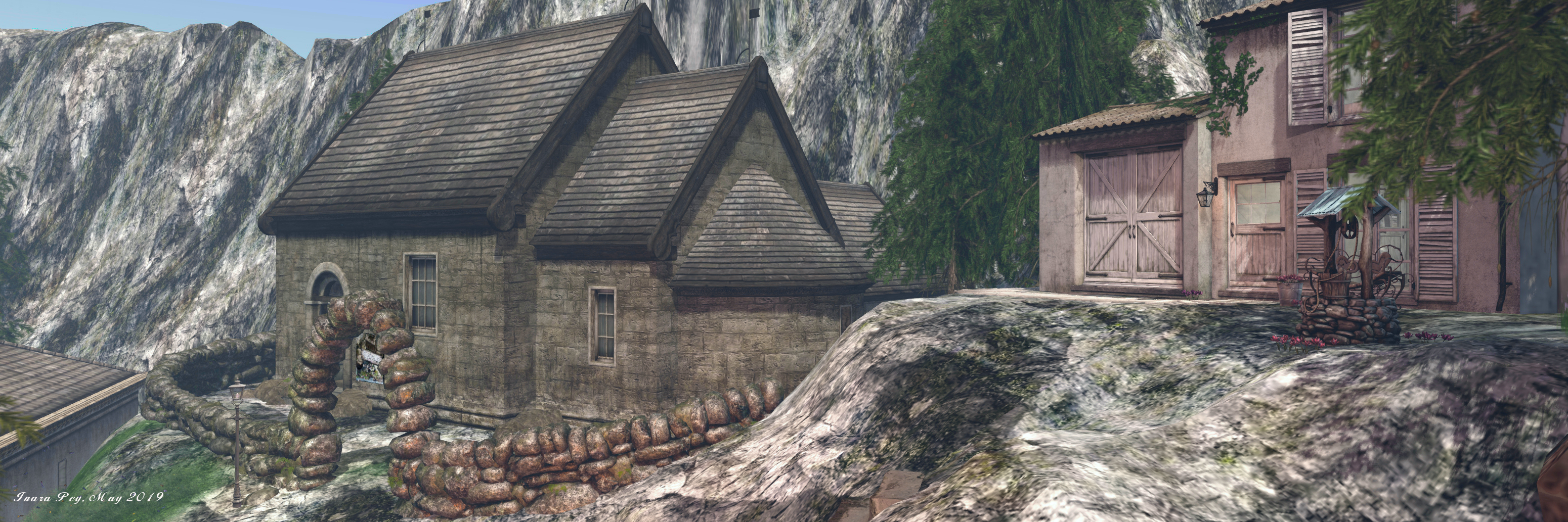
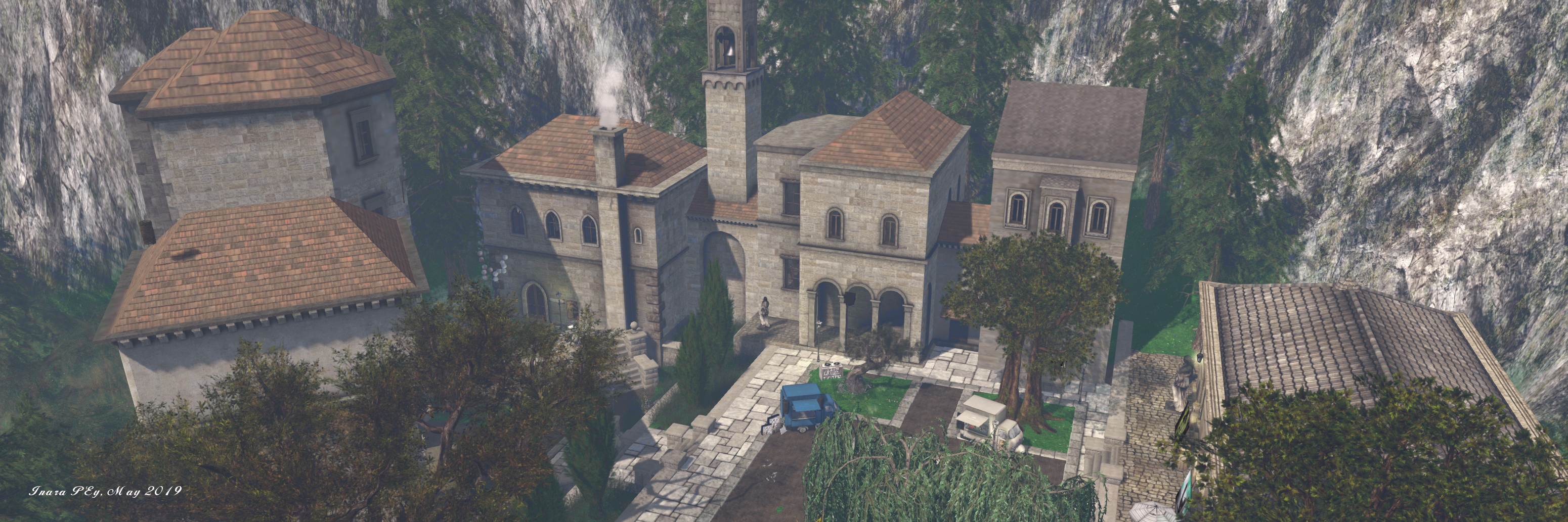
The new design for the community has a pleasantly Mediterranean feel to it. With a southern aspect and shoulder to the west and east by high cliffs, there is an intimate village feel to the location. With moorings down at the water’s edge connected by path and steps to the village above, it’s easy to imagine coming across it whilst sailing along the coast of Italy or Spain, and deciding to come alongside and enjoy an exploratory stroll up to the village square.

For the official opening, Yúcale features art by Belice Benoir, Jaëlle Faerye, Xirana Oximoxi, Balbera Resident and Samiraa herself. Individual exhibitions are located in different buildings both in the village and the parcel as a whole – Jaëlle’s work is displayed within the out warehouse in the south-west corner of the region overlooking the southern moorings and outside of the village, while Belice’s art can be found up in the little chapel looking down on village from a perch on the eastern highlands.

Yúcale; Inara Pey, May 2019, on FlickrYúcale – Balbera Resident

Yúcale is less a place than an idea. We do cooperative events quite often. On Sunday May 12th we have Sunday Lounge, a travelling event if you like. And As May 25th is International Towel Day, we’ll be holding an event to honour Douglas Adams with author readings, etc.

– Samiraa Adderstein

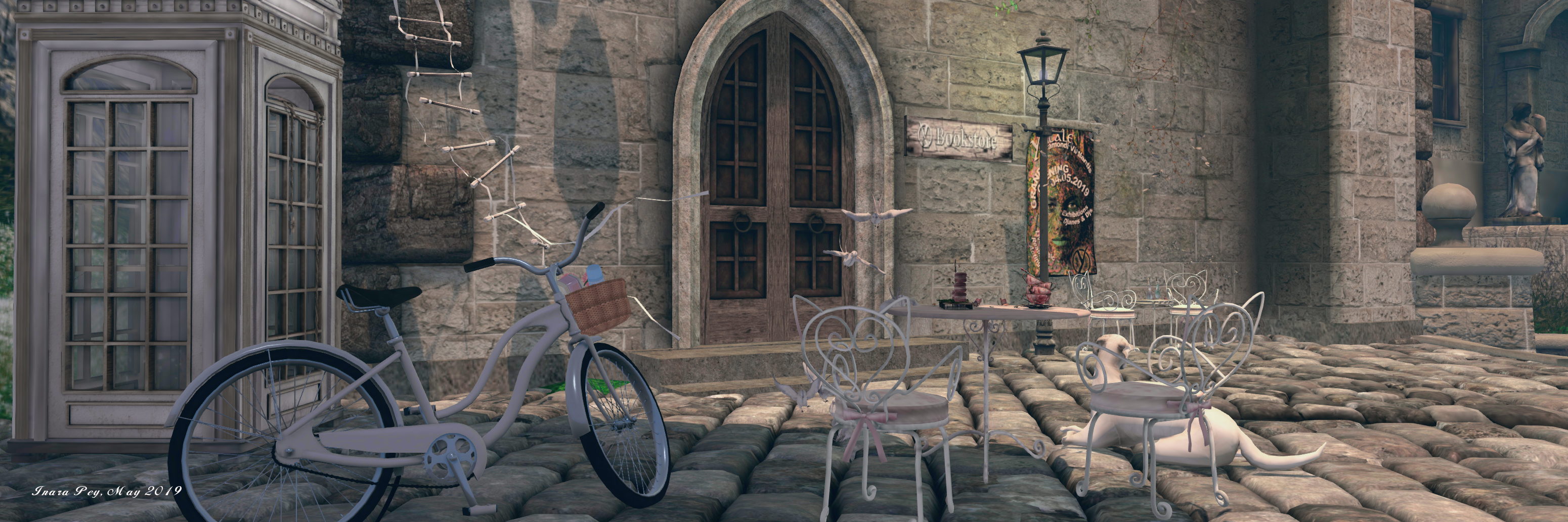
Scattered around and between the art locations are various venues for music – notably the village square and the circus tent down close to the waterfront, while some of the gallery spaces are large enough to accommodate music and dancing during openings. A restaurant / bar sits to one side of the village square, while a little book store (still being finalised at the time of our visits) pays homage to Yúcale’s café origins. In the unlikely event you have problems finding your way around, major venues within the location are linked via a teleport system as well.

Yúcale; Inara Pey, May 2019, on FlickrYúcale

Details of events at Yúcale are published via the Yúcale Café Gallery public Facebook page, the in-world .::Yúcale::. (subscribers at the location), and via a Flickr group. A new in-world publication has also been started, again available from Yúcale.

SLurl Details

Detectives, mages, kaleidoscopes and cave girls

Seanchai Library

It’s time to highlight another week of storytelling in Voice by the staff and volunteers at the Seanchai Library. As always, all times SLT, and events are held at the Library’s home at Holly Kai Park, unless otherwise indicated.

Sunday, May 5th,

13:30: Tea-Time at Baker Street

Caledonia Skytower, Savannah Blindside and Kayden Oconnell once again open the pages of The Casebook of Sherlock Holmes, the final set of twelve Sherlock Holmes short stories first published in the Strand Magazine in 1922.

This week: The Problem of Thor Bridge.

“The faculty of deduction is certainly contagious, Watson,” Holmes informs his good friend John Watnson one October morning after Watson had arrived for breakfast expecting to find Holmes in a depressed mood, wanting for a good, solid case, but finding him instead practically full of the joys of spring.

The comment comes in response to Watson’s observation that such a good mood could only mean that Holmes did indeed have a case. Even so, it is not until after breakfast that the Great Detective reveals the situation.

“You have heard of Neil Gibson, the Gold King?” he said.

“You mean the American Senator?”

“Well, he was once Senator for some Western state, but is better known as the greatest gold-mining magnate in the world.”

“Yes, I know of him. He has surely lived in England for some time. His name is very familiar.”

“Yes, he bought a considerable estate in Hampshire some five years ago. Possibly you have already heard of the tragic end of his wife?”

“Of course. I remember it now. That is why the name is familiar. But I really know nothing of the details.”

The details are that the wife of the aforementioned J. Neil Gibson had been most cruelly murdered by none other than the family’s governess, Grace Dunbar. The evidence in the case couldn’t be more clear, nor Miss Dunbar’s guilt more sure.

So the letter Holmes reveals to Watson he has received, and which protests Miss Dunbar’s innocence despite all the evidence indicating otherwise, is not only responsible for his upbeat mood, but also sets the Great detective a pretty riddle. Particularly as it has been written by none other than J. Neil Gibson himself …

18:00 Magicland Storytime

Caledonia begins Ian Flemming’s classic children’s tale Chitty-Chitty-Bang-Bang: the Magical Car from the Golden Horseshoe.

Monday, May 6th 19:00: Paper Mage

Gyro Muggins reads Leah R. Cutter’s 2003 début novel.

Set in the Tang Dynasty of the Middle Kingdom (about the time of Charlemagne in Europe), the novel tells us of the adventures of Xiao Yen, a young woman training to become a paper mage, a sorcerer with the power to endow folded creations with the semblance of life.

Because her gifts are in demand for the protection they can offer, Xiao Yen must leave behind her beloved family and their village home and embark on a dangerous mission when she is hired to protect a caravan. Yet even as she departs, she has no idea that this looming adventure will shape the very woman she is to become.

The story follows two time lines, alternating chapters between the caravan journey, where one of her fellow travellers is a goddess who charges her with a dangerous quest, and the story of her childhood training, when she lay caught between her aunt’s plans and her mother’s plans to have her married off.

Tuesday, May 7th  19:00: Kaleidoscope

When a brilliant young violinist dies in a horrific accident, Madame Karitska has only to hold the victim’s instrument in her hands to perceive the shocking truth. But when an insecure wife asks whether her husband will abandon her to join a sinister cult, Madame Karitska–as wise as she is lovely–chooses not to reveal all that she foresees. And when an attaché case is suddenly dropped into her lap by a man fleeing a crowded subway, she knows it’s time to consult her good friend Detective-Lieutenant Pruden.

A nine-year-old accused of murder, a man dying a slow death by witchcraft– for the hunted and the haunted, Madame Karitska’s shabby down-town apartment becomes a haven, where brilliant patterns of violence, greed, passion, and strange obsessions mix and disintegrate with stunning, kaleidoscopic beauty.

With Caledonia Skytower.

Wednesday, May 8th 19:00: Meet Midsummer

With Aoife Lorefield at LEA 2.

Thursday, May 9th 19:00: Edgar Rice Burroughs’ Cave Girl

Waldo Emerson Smith-Jones was not overly courageous. He had been reared among surroundings of culture plus and ultra-intellectuality in the exclusive Back Bay home of his ancestors. He had been taught to look with contempt upon all that savoured of muscular superiority, such things were gross, brutal, primitive. It had been a giant intellect only that he had craved, he and a fond mother, and their wishes had been fulfilled. At twenty-one Waldo was an animated encyclopaedia, and about as muscular as a real one.

And so we are introduced to Mr. Smith-Jones, the unlikely hero of this novel, set within Burroughs’ Lost World series. Swept overboard during a during a South Seas voyage intended to ease his ill-health, Waldo finds himself carried ashore on a primitive jungle island, where all his book learning can’t help him survive, particularly in the face of the terrifying ape-like throwbacks to mankind’s early evolutionary history who live on the island, and from whom he continually flees.

And then he encounters – rescues, even, albeit mistakenly – Nadara, the titular cave girl. Regarding him a hero, she teaches him the arts of survival and her primitive language, taking him back to her tribe – who turn out to be Palaeolithic cave people. If he is to stay among them, Waldo must prove his worth by fighting the strongest. He opts to flee instead.

However, as he spend more time in the jungle, gaining in strength thanks to Nadara’s teachings, he finds himself unable to put her out of his mind. So much so that when a ship finds the island, he refuses passage aboard her. Instead, more sure of himself than at any point in his life, he sets out to find the cave girl who believes he saved her.

With Shandon Loring. (Also in Kitely grid.kitely.com:8002:SEANCHAI).