Update: Ponto Cabana has closed. SLurls have therefore been removed from this article.
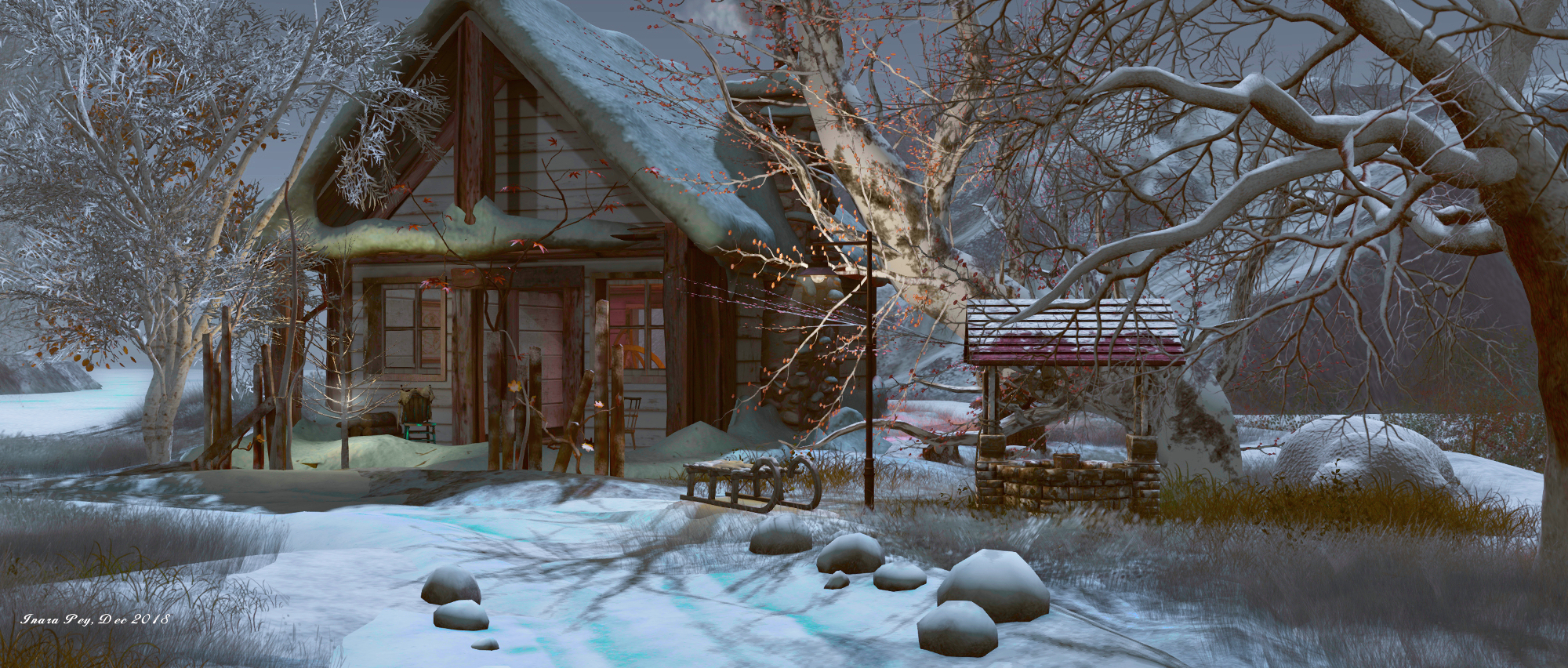
The last time we visited Ponto Cabana, the Homestead region sitting on Lemon Beach, it presented a place with both a colonial feel to it and one of great age (read here for more). Now, in the midst of winter, it has taken on a new design, one caught under snow and within the bonds of ice; a setting as evocative as the face it showed in July, and one that – for those of us who may feel like we’ve piled on a few pounds thanks to turkey and more – offers offer a taste of the great outdoors that might help put us in the frame of mind to take a few holiday strolls over the next few days!
While presenting a new design by region holder Iska (sablina), Ponto Cabana also carries echoes of its summer build that, for those of us who visited back around July, give it a sense of familiarity while offering much to see that is new and awaiting discovery.
Ponto Cabana
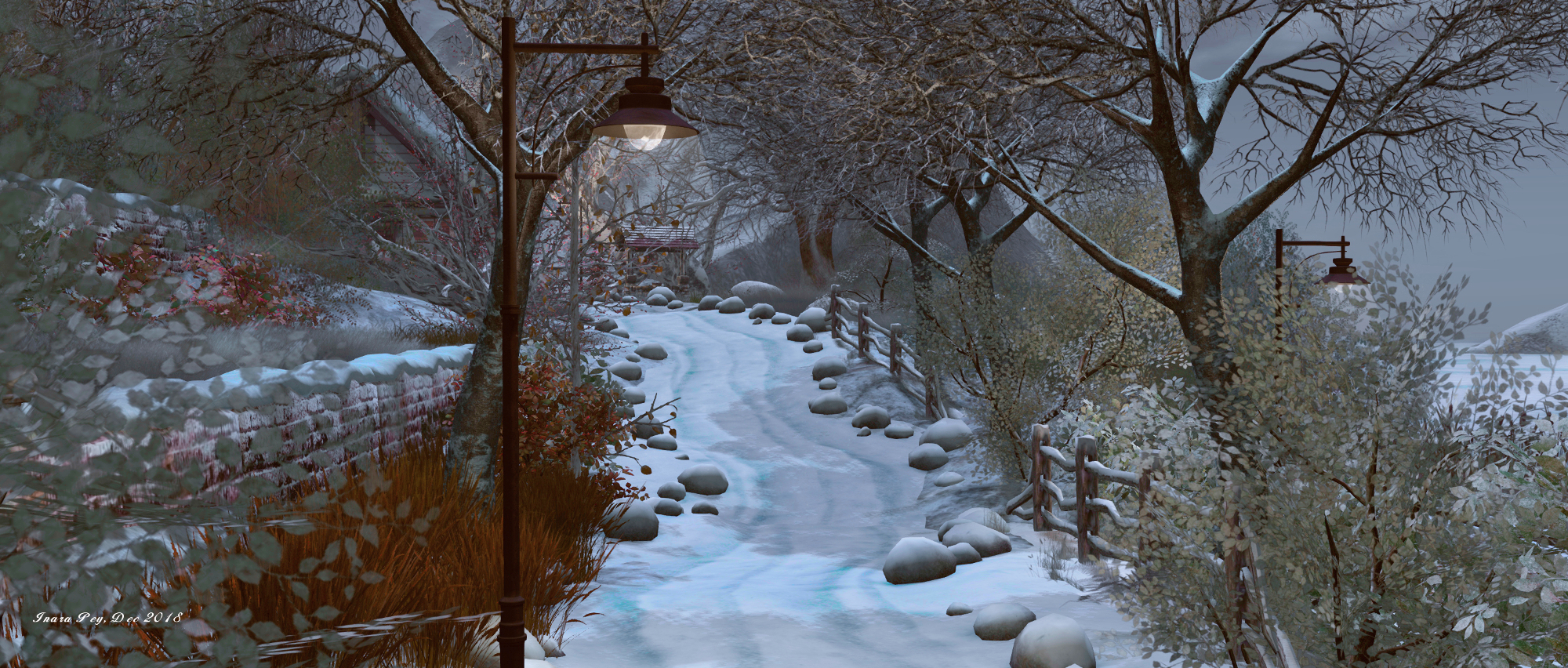
For example, the region largely remains split into two, linked by the span of a bridge. Further, the smaller of the two islands rises in terraces, a road curling up one side while stone steps offer a quicker route up to the table-top of the hill, much as it did back when it was home to a warmer setting.
However, where that hilltop was once home to a Spanish-style villa standing within and broad garden space with some of the terraces below it under cultivation, now the hill lies under snow and presented a more rugged face. It is also home to two red-painted houses that, with their red sides and white frames, might be taken for a farm. However, the courtyard before and between them perhaps offers a warmer greeting than can be found within either.
Ponto Cabana
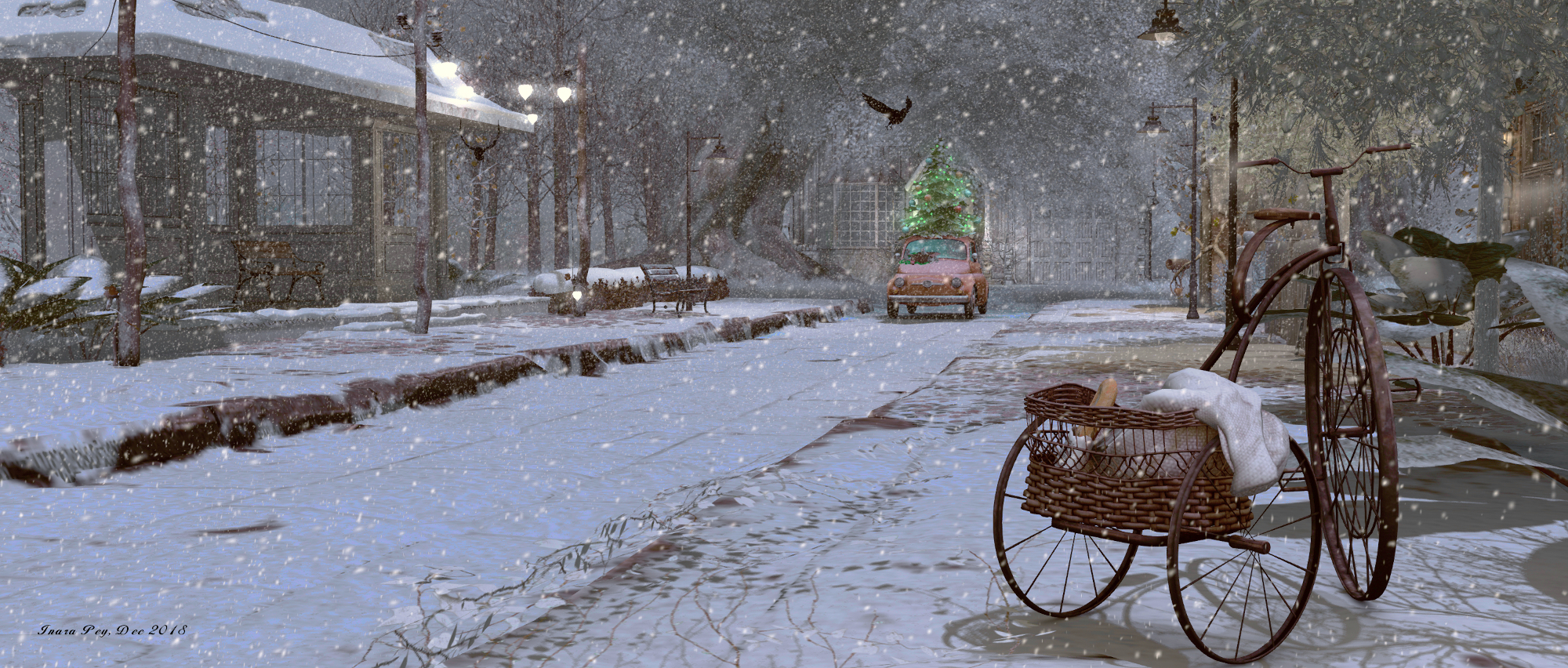
The larger island offers another little town setting, this one perhaps more homely than July’s version, be retaining an element of ruin in the broken walls of what might have once been a house, or perhaps a chapel. Along the broad street, partially lain with wide train or tram tracks, snow falls heavily, coating footpaths, tracks, houses and gardens alike in a soft blanket that invites visitors to be the first to leave their footprints in its covering.
A small station sits forlornly alongside the tracks awaiting passengers, while at one end of the street, a car carrying a Christmas tree adds flickering warmth to setting as its little lights wink and blink. The houses and buildings here are sparsely furnished, yet there is still a welcoming air surrounding them and along the single street.
Ponto Cabana
Surrounded by a lake of ice, Ponto Cabana is a perfect Christmas wilderness setting for those looking to get away from the excesses of Christmas and who wish to spend time relaxing and appreciating simple winter solitude. And if you really want to get away from it all, try a walk over the ice to the cabin on the smallest island, where a cosy time can be found.
Logos representative only and should not be seen as an endorsement / preference / recommendation
Updates for the week ending Sunday, December 23rd
This summary is generally published every Monday, and is a list of SL viewer / client releases (official and TPV) made during the previous week. When reading it, please note:
It is based on my Current Viewer Releases Page, a list of all Second Life viewers and clients that are in popular use (and of which I am aware), and which are recognised as adhering to the TPV Policy. This page includes comprehensive links to download pages, blog notes, release notes, etc., as well as links to any / all reviews of specific viewers / clients made within this blog.
By its nature, this summary presented here will always be in arrears, please refer to the Current Viewer Release Page for more up-to-date information.
Note that test viewers, preview / beta viewers / nightly builds are not recorded in these summaries.
Official LL Viewers
Current Release version 6.0.1.522263, dated December 5th, promoted December 13th. Formerly the Spotykach Maintenance RC viewer – NEW.
Each year through this blog I attempt to track news about, and changes to, Second Life, as driven by by Linden Lab. On the technical side, this is do through my weekly SL project summaries, which summarise the various in-world meetings the Lab holds each week / month, and the rest is done through various means, such as attending public meetings and Q&A sessions, tracking the official SL blog etc.
Given this has been in some ways a busy and ambitious year for LL and Second Life, I thought it might be interesting to look back over the major changes and technical projects that have come to pass, and some of those still on the horizon.
Land
2018 saw some significant moves on the virtual land front.
On Wednesday, March 14th, LL announced an immediate reduction in Mainland tier costs of 10%.
At the same time, they also announced the amount of “free” tier granted to Premium members would increase from 512 sq metres to 1024 sq metres.
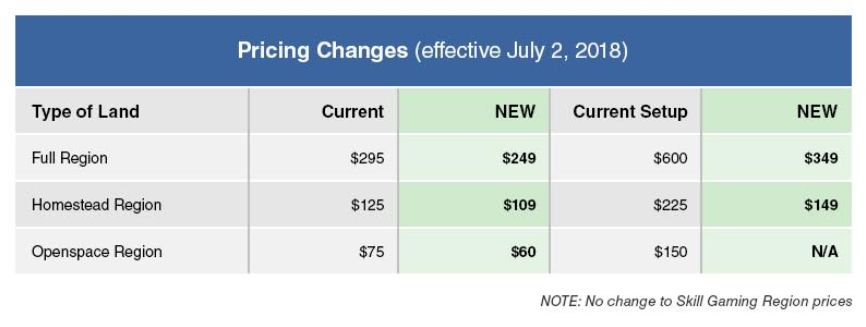
On July 2nd, 2018, private region fees dropped by up to 15%.
At the time of the Mainland restructure, and while welcoming it, I was a little dubious on how it would be received, simply because obtaining Mainland parcels could be something of a hassle. Well, it turned out the Lab had also thought of that, trimming back on the overhead involved in obtaining abandoned land and making it a simple ticket request.
The revised Mainland tier rates introduced in March 2018 (courtesy of Linden Lab)
Result: what has reported to be, and continues to be, a positive response to the change – although just how big is a little hard to judge at this point in time. The last date for which we have figures via Tyche Shepherd’s Grid Survey (January 11th, 2017), abandoned land accounted for around 21% of the Mainland. As (I believe) Tyche updates this figure annually, it’ll be interesting to see how things have changed come early 2019.
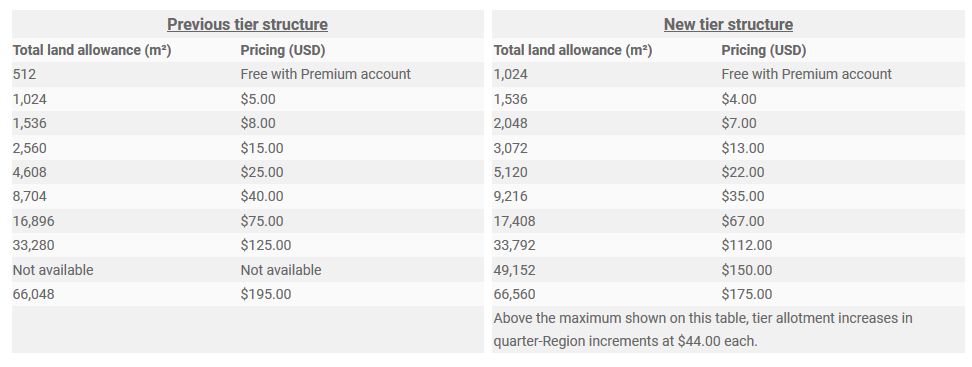
First announced in an official blog post on June 20th, The private tier pricing adjustments met with a mixed response, with some in the land rental business claiming they were being somehow being “gouged” on the basis that grandfathered regions were being excluded from the new pricing structure.
New Private region pricing structure, introduced from July 2nd, 2018 (courtesy of Linden Lab)
As I noted when the price adjustment came into effect, such claims were somewhat nonsensical. For one thing, grandfathered regions remain either US $54 per month (Full regions) or US $14 per month (Homestead)cheaper than the new rates. Further, while there was an up-front fee for converting regions to grandfathered status in the 2016 “buy down” offer, more than enough time had elapsed for those costs to be recouped in tier savings. For another, those best placed to capitalise on any surge in interest in holding / renting land as a result of the restructuring would actually be land rental businesses.
As it stands, and again using Tyche Shepherd’s grid survey, the restructuring may resulted in a very small increase in region numbers during 2018. However, I’ll have more on that when Tyche publishes her end-of-year report.
Fee Changes
Alongside the private region fee changes, the Lab also announced an increase in the cost of Linden Dollar purchases by US 0.50 per transaction. While in keeping with the goal of trying to shift the balance of the Lab’s revenue generation away from virtual land, the increase did cause a degree of upset, being the third such in around 15 months (the last being November 2017, when the cost per transaction rose by US 0.39).
This change particularly hit those who prefer to buy small quantities of L$ at a time. While it was pointed out that the impact could be somewhat mitigated through the purchase of larger L$ amounts over fewer periods – providing people’s available disposable income allowed them to make larger, if more infrequent L$ purchases. As it is, how the fee change may have impacted people’s buying / spending habits is a little hard to quantify.
Technical Updates
It may sound odd, but of the four major user-visible technical changes planned for 2018, three were actually established in 2017, with only one actually being delivered before the end of the year.
Animesh
The delivered project was of course Animesh – the ability to use the avatar skeleton to animate rigged mesh objects in a similar manner to animation an avatar (through scripted animations running the skeleton). I’m not going to dive deeply into Animesh, given it has been covered extensively in my Content Creation User Group summaries, and I also gave an overview when it was officially released in November, complete with resource links. Currently, the majority of Animesh creations that are surfacing appear to be basic NPC characters and pets / animals.
Bakes On Mesh
Bakes On Mesh (BoM) is a project extending the current avatar Appearance / Bake Services to allow wearable textures (skins, tattoos, clothing) to be applied directly to worn mesh faces in a manner similar to how they were for system avatars. It was first announced in May 2017.
Vir Linden’s original announcement of Bakes on Mesh in May 2017
BoM touches multiple Second Life services: viewer, simulator, appearance and bake, as such it is a complicated piece of work.
The first part of the process was to update the Bake Service to support 1024×1024 textures, in order to allow wearables to match the quality of textures applied to mesh faces by applier systems. After that, the service needed to be able to recognise how to handle wearables when applying them to mesh faces. The simulator also required updates to recognise things like BoM messages, and obviously the viewer and its UI also required updates.
Cathy Foil introduces Bakes on Mesh (April 2018)
As it stands, the vast majority of the work has been completed. A project viewer has been issued, and the support services updated while the simulator code is grid-wide. However, there are still some issues to be ironed-out viewer-side; currently, the viewer lead, Anchor Linden, is leading work to resolve a positioning issue with small mesh avatars, so BoM is, for the present “on hold”.
It should be noted that the Lab do not see BoM as being designed to replace mesh applier systems, but rather as an alternative. However, it is also seen as potentially a means to reduce the overall complexity of mesh avatar bodies and heads, which may have an impact on applier systems / how they function in future. Also:
This work does not include normal or specular map support, as these are not part of the existing Bake Service, nor are they recognised as system wearables.
It also will not provide a means of applying wearables via script + UUID.
Either of these options might be considered in some future BoM extension.
The first image taken by humans of the whole Earth, captured by Bill Anders. It shows the Earth at a distance of 30,000 km (18,750 mi). South is at the top, with South America visible at the covering the top half centre, with Africa entering into shadow. Credit: NASA / Bill Anders (as08-16-2593hr)
2019 marks the 50th anniversary of human beings setting foot on the surface of our Moon. The Apollo programme may have first and foremost been driven out of political need / desires, but it nevertheless stands as a remarkable achievement, given it came n the same decade when a human being first flew in space, and a little under 12 years since the very first satellite orbited the Earth.
To this day, Apollo stands as one of the most remarkable space programmes ever witnessed in terms of scale, cost, and return. It propelled a generation of American school children to pursue careers in engineering, flight, the sciences and more. In all, the Apollo lunar programme flew a total of 11 crews in space between 1967 and 1972, nine of them to the Moon, with two crewed missions to Earth orbit.
After the tragedy of the Apollo 1 fire in January 1967, which claimed the lives of Virgil “Gus” Grissom, Edward White II and Roger B. Chaffee, NASA worked hard to redesign the Apollo Command Module, providing far greater insulation against the risk of fire, as well as altering the vehicle’s atmosphere (from 100% oxygen to a 60/40 oxygen / nitrogen mix) and altering the main hatch so that the crew could escape in the event of a launch pad emergency. In October 1968, the redesigned vehicle, along with its supporting Service Module (together referred to as the Command and Service Module, or CSM) was tested in Earth orbit for the first time by the crew of Apollo 7.
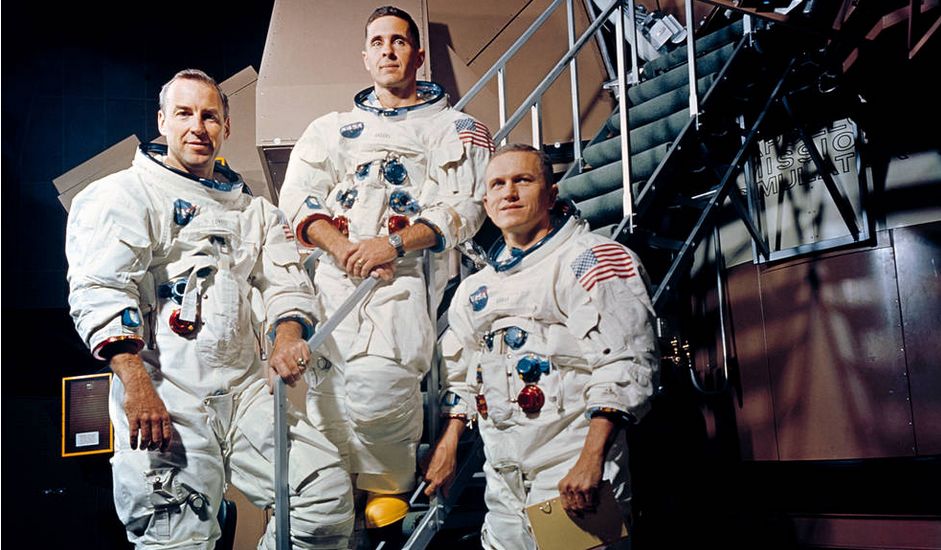
The crew of Apollo 8: (l) James A Lovell Jr, Command Module Pilot; (c) William A. Anders (Lunar Module pilot, although no actual lunar Module was flown); (r) Frank Borman, Mission Commander. This official photograph was taken on November 22nd, 1968, a month before they would orbit the Moon. Credit: NASA
Scheduled for launch towards the end of 1968, Apollo 8 had originally been planned as the first orbital flight test of the CSM and Lunar Module (LM). However, two events encouraged NASA to revisit their plans. Due to continued delays in the delivery of a flight-ready LM, the agency decided to swap the Apollo 8 and Apollo 9 missions and crews around; Apollo 9 would flight-test CSM and LM, once available. Meanwhile, Apollo 8, carrying Frank Borman, Jim Lovell and Bill Anders, and marking the first crewed flight of the mighty Saturn V rocket, would be used in an orbital flight designed to simulate the atmospheric re-entry at the speeds a Command Module would face on a return from the Moon without actually sending the crew to the Moon.
Then, in August and September 1969 photographs captured by US spy satellites suggested the Soviet Union had one of its massive N1 rocket, easily the equal of Saturn V, sitting on a launch pad. With fears that the Soviet Union was perhaps approaching the point where it could launch a crewed mission to the Moon, Apollo 8 was further revised and Borman, Lovell and Anders were informed they’d be spending Christmas 1968 where no other person had spent Christmas before: in orbit around the Moon, allowing them to fully check-out the CSM as it would be flown in an actual lunar landing mission.
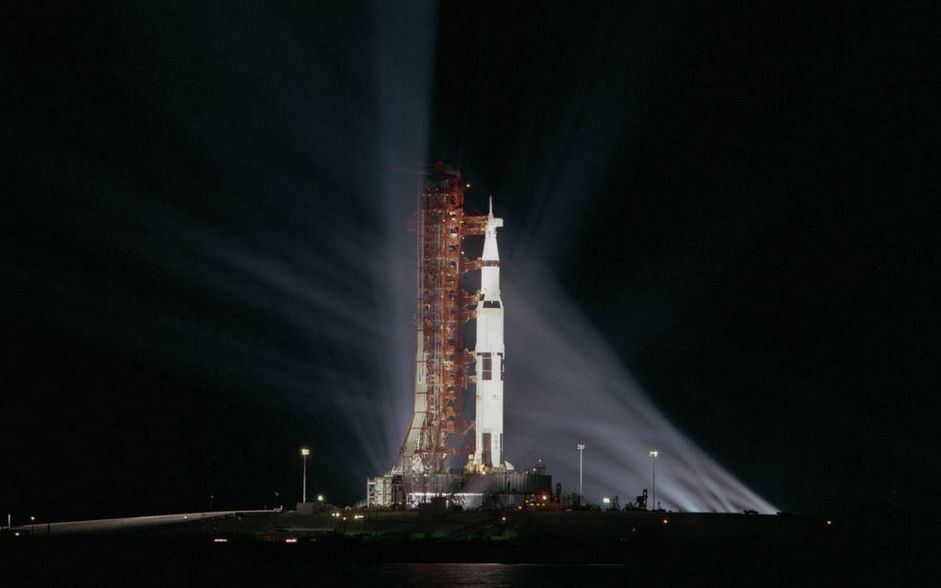
Apollo 8 on the launch pad the night before launch. Credit NASA
So it was that on Saturday, December 21st, 1968, Borman, Lovell and Anders were strapped into their seats atop the 110.6 metre (363 ft) tall Saturn V, about to undertake the longest journey ever undertaken by humans up until that point in time. At 07:51 local time (12:51 UTC) the five massive F-5 engines of the rocket’s first stage thundered into life, slowly lifting the 2,812 tonne (US 3,100 short tons) vehicle into the sky.
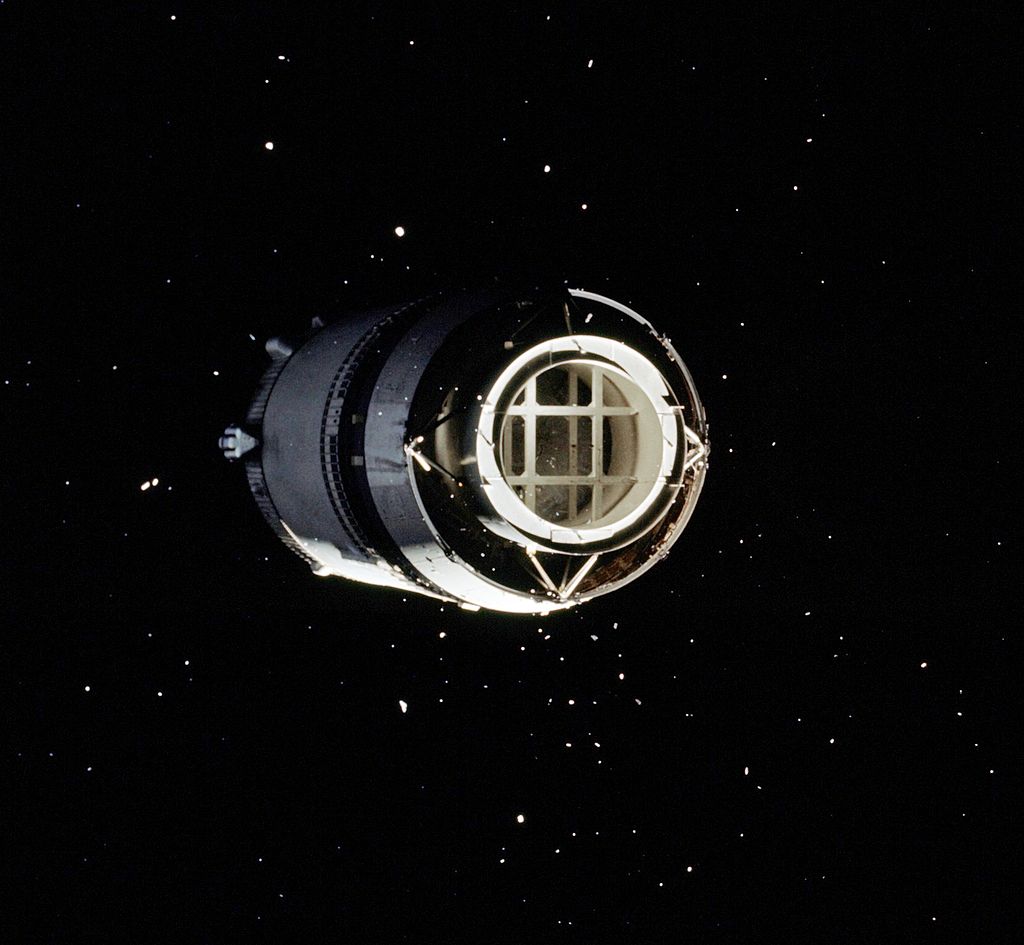
On reaching orbit, the CSM still attached to the Saturn V’s third stage, spent some 2 hours and 30 minutes in orbit while the crew performed a final check of their systems. Then the S-IVB motor was re-started, and in five minutes accelerated the vehicle from 7,600 to 10,800 metres per second (25,000 to 35,000 ft/s), pushing it away from Earth and on course for the Moon. With TLI – Trans-Lunar Injection successfully completed, the crew separated the CSM and rotated it to photograph the expended third stage, still following behind.
The Apollo 8 S-IVB third stage, imaged from the Command module, shortly after separation. The object at the forward end of the rocket stage is a Lunar Module Test Article, a dummy payload carried in place of an actual Lunar Module. Credit: NASA (from official image AS8-16-2583)
After a mid-course correction, and around 55 hours and 40 minutes after launch, the crew of Apollo 8 became the first humans to enter the gravitational sphere of influence of another celestial body as the effect of the Moon’s gravitational force on the vehicle had become stronger than that of the Earth. Nine hours later, the crew performed the second of two mid-course corrections using the CSM’s reaction control system, bringing them to within 115.4 km (71.7 m) of the lunar surface and oriented ready for a burn of the Service Module’s main motor to slow them into lunar orbit.
Second Life is always changing. Not just technically in terms of capabilities and options, or even visually in terms of the overall look and feel; but physically as well. Regions come, regions go – often with much lamenting in the case of the latter. Regions change hands from public to private; settings change with time both in reflection of the seasons and as of the evolving nature of design and model building.
Such is the way of things, it is sometimes easy to forget that there can also be found in Second Life a sense of constancy; travel through the mainland continents, for example will reveal places that many not have changed for a very long time, offering glimpse’s of the grid’s past and a reminder that it does have a history.
While they can be harder to find, such places do exist among the myriad of private regions scattered across the grid. Take :nostos:deer:, for example, the full region held by Dora Nacht and Hide Mint, and home to their Little Hopper brand. I first visited it almost six years ago, in February 2013, when it was already over a year old. I’m not sure I’ve actually ever been back, but sorting through photos on my hard drive recently brought me to a folder of images taken during that visit; seeing it was still on the map, curiosity got the better of me, so I hopped over to take a look, and it was like stepping back in time.
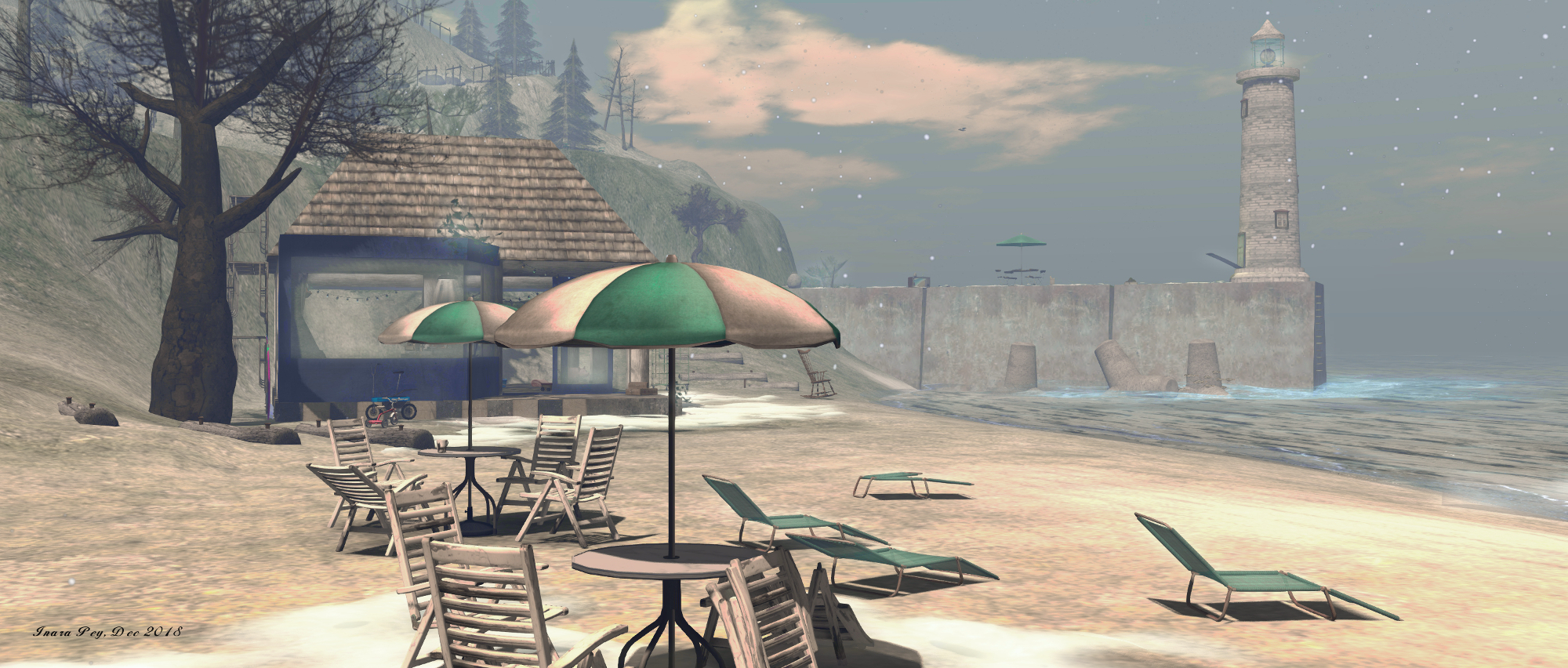
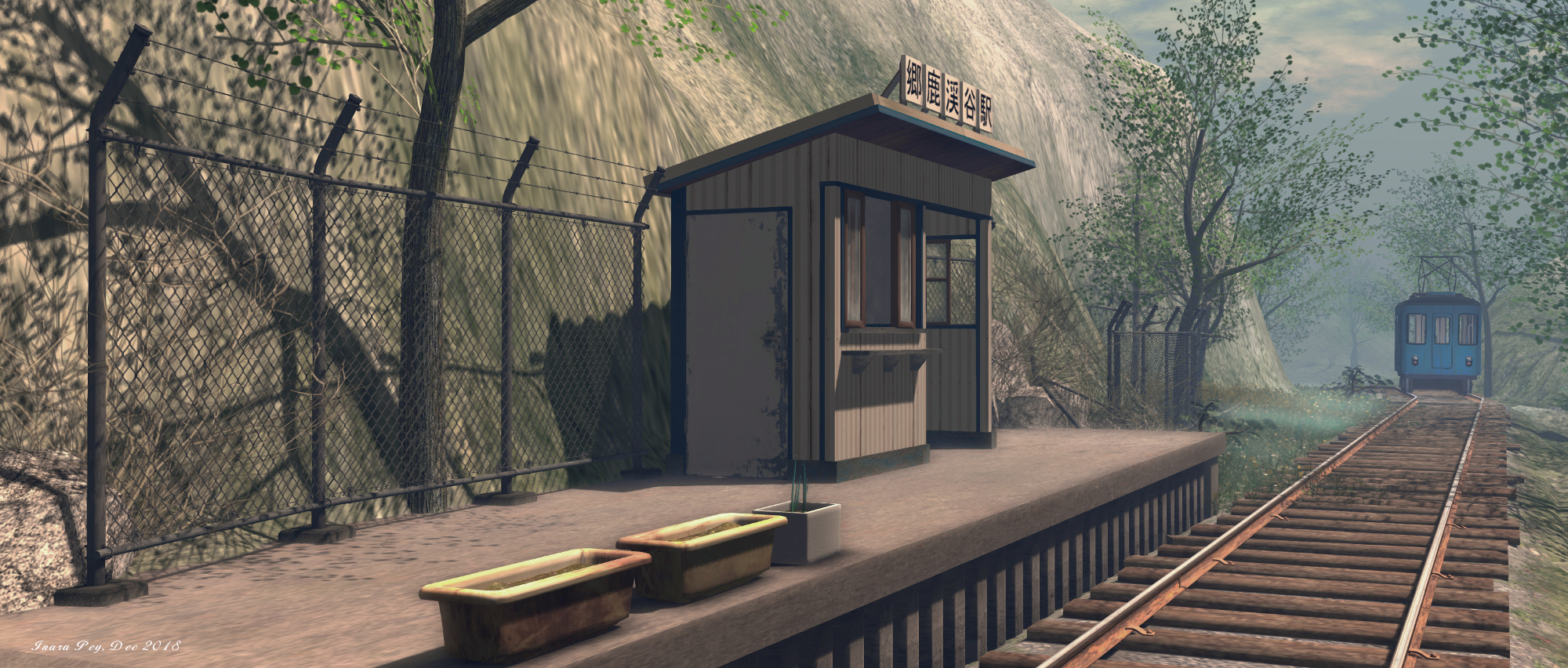
In 2013, I was struck by the simple design of the region and the sense of fun and whimsy within it, and it is true to start that, but for the snow present in 2018, almost nothing about the region has changed. The mine shaft entrance / teleport up to the skyborne store is still there, nestled by the deep gorge of the river that cuts through the region; the little purpose-built (by Hide) tram clatters along its single track, rolling from little station and out towards the coast before committing a 180-degree turn and trundling back as if it had a sudden change of heart; the east side beach is still watched over by the single finger of a lighthouse.
And there is the other little tram, still caught it time as it skitters on spinning wheels at the end of a track from which the bridge has vanished out from underneath it, rail sleepers tumbling like a twisted staircase into the sea below. Throughout the region, there is still an air that this is a place for doing things in a not-really-actually-doing-things kind of way.
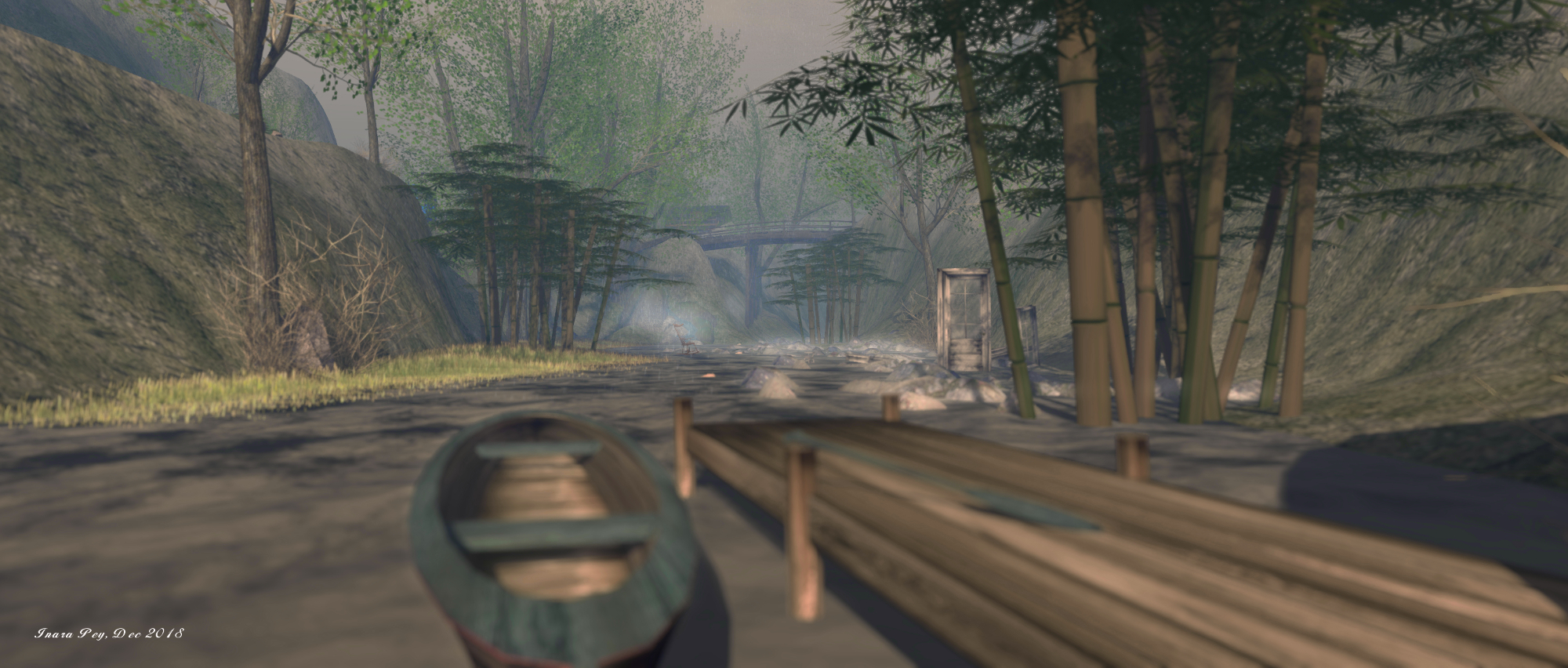
For example, the canoe awaits paddlers down in the river gorge, while the swan pedalo boats similarly await attention in the north-west. Elsewhere, wooden logs lie like abandoned sleepers to form paths both up hill and down dale for those wishing to follow them. But there is not sense of having to do all or any of this, with the region offering many places where people can simply sit and rest and let time pass them by.
Compared to the sophistication of modern region designs, some might view nostos:deer as “lacking”. It relies entirely on simple terraforming; there is no use of mesh landforms or other elements, the tress are predominantly prim-based, and so on. But that doesn’t make the region any less attractive per se.
Rather, the fact that it has stood so unchanged for so long allows it to stand as a glimpse into a bygone era of Second Life’s history. Equally, for those of us who remember it from visits taken four or five or six years ago, its unchanged nature causes a warming rush of familiarity, almost a sense of homecoming in keeping with the first part of the region’s name, mixed with a deep sense of nostalgia and re-discovery.
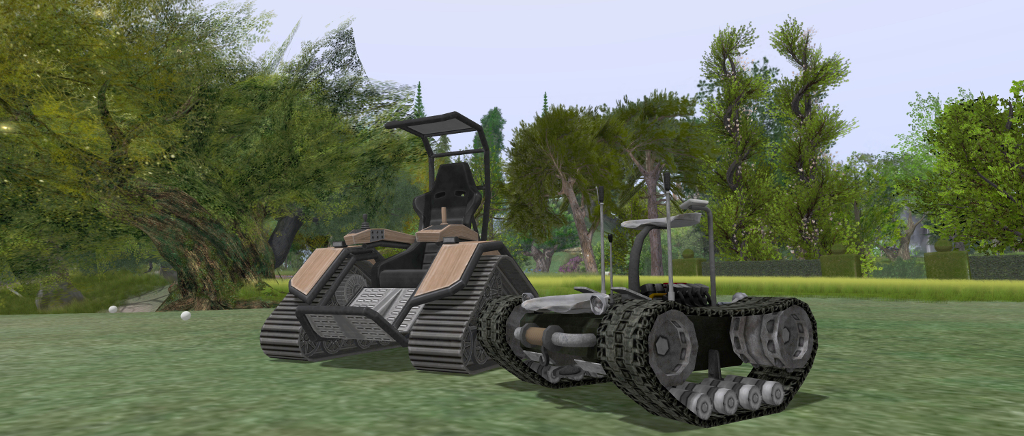
The [aR] Wild Goose by Arton Rotaru (left, shown in its default finish) and the Piaggio Systems Trackie by Ape Piaggio (right) – off-road funFrom time-to-time I receive gifts and / or find little treats that are fun to use in Second Life. Not everything gets blogged, for a variety of reasons – including the fact that even if I have an idea for blogging, I sometimes forget.
Such is the case with a couple of unusual off-road vehicles that came my way – quite a while ago now, if I’m honest; after an initial play with them, each ended up being put away, their original packages only coming back to my attention whilst I was going through one of my regular inventory sort-outs recently. Neither is particularly me, but before they vanished within a box of “packaged” items, I thought I’d finally write them up, should anyone be interested.
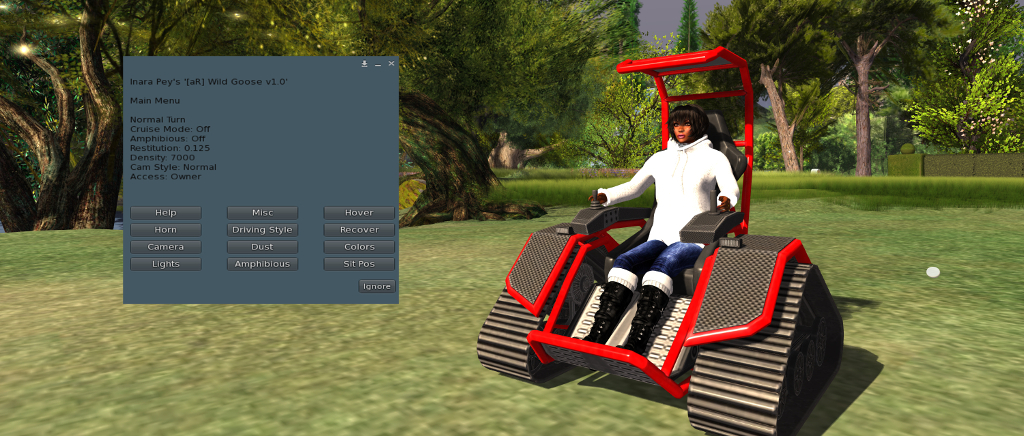
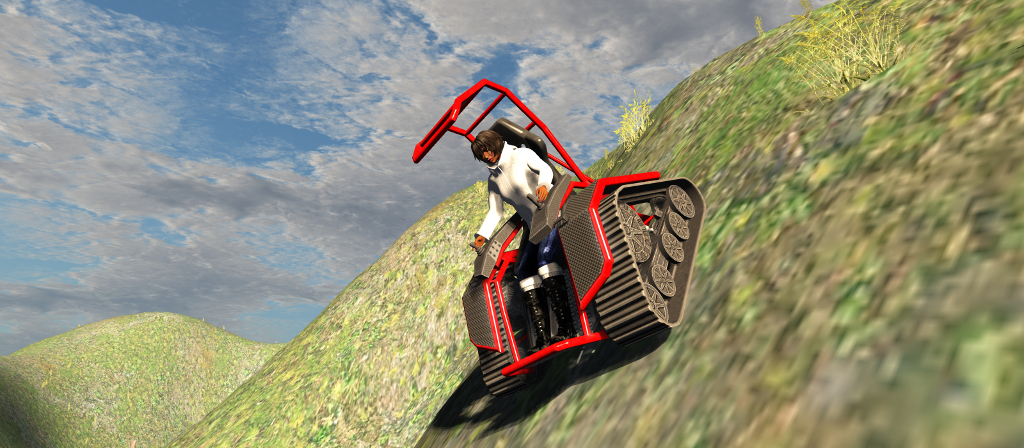
First up is the [aR] Wild Goose by Arton Rotaru. This is a single-seat tracked vehicle that is – going by the seat alone – designed for those who like their off-roading in comfort. Protected by a roll cage (handy, as it can roll onto its nose when cresting ridges with steep drops on the far side), the Wild Goose sits on a pair of broad tracks driven by two high-positioned drive wheels that help give the vehicle its distinctive looks.
With the engine started as soon as you sit, the Wild Goose is ready to go. Most options are available via the vehicle’s menu when seated, although the important options (light, horn, cruise control, and menu access) are also available from the optional HUD, which also includes a large speedometer and also a useful rez zone locator: pop the HUD on and when Rez Zone is clicked, it will indicate any local rez zones in chat, complete with Map SLurls. Also, for those who prefer keyboard commands, a number of command options can be accessed via function keys.
Handling-wise – and while I am no off-road expert, the Wild Goose is fun. The UP / DOWN (W,S) arrow keys provide forwards / backwards movement (and throttle, effectively), as one might expect, the LEFT RIGHT (A,D) keys handle turning. PAGE UP / PAGE DOWN (E, C) set the Goose’s cruise speeds (10 speeds): tap PAGE UP for a higher setting, PAGE DOWN for a lower setting. Whatever is set is the speed at which the Wild Goose will cruise at from initial start or accelerate to if moving.
Up hill and down: the Wild Goose will go pretty much anywhere, terrain-wise
An unusual aspect of the Wild Goose is that it is both amphibious and (this being SL) it can fly, with either option available from the menu. Should you end up flipping it over, it also has a menu / HUD button (Recover) button for righting it. The menu also has a comprehensive set of options for resizing the Wild Goose to better suit your avatar’s size, together with a choice of male and female sit animations for better apparent grip on the two hand controllers, and a set of built-in texture options. A final set of options allows the vehicle’s handling characteristics to be adjusted to match / contend with terrain you’re driving over.
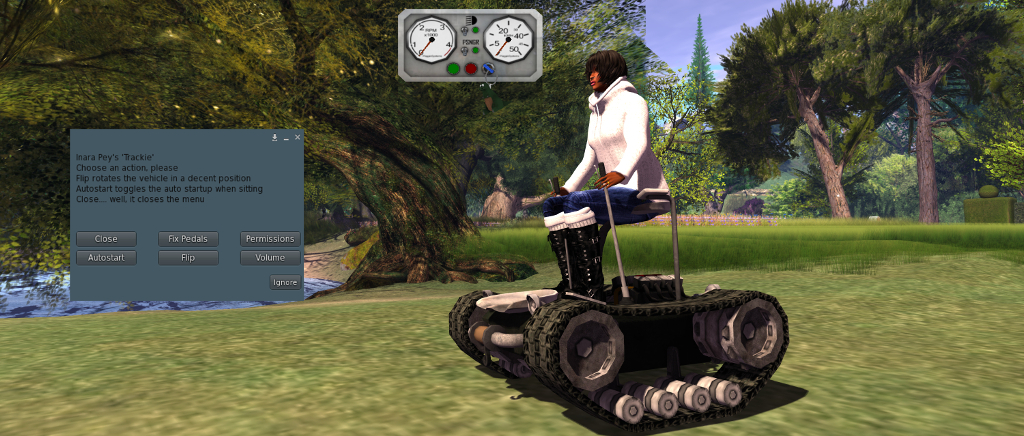
The Piaggio Systems Trackie, by Ape Piaggio is a smaller and – dare I say – far more raw vehicle, albeit one capable of carrying a (very brave) passenger! The “rawness” of the design is deliberate: Ape wanted a vehicle that looked like it had been cobbled together out of spare parts – and the look certainly works. Like the Wild Goose, the Trackie is a tracked vehicle (hence the name!), and utilises what might be regarded as a more conventional caterpillar-style track arrangement.
Both driver and front passenger are fully exposed: no role cage or seat belts, the driver sitting directly over the exposed engine, the passenger almost the front fender. Adjustment when seated is minimal – the driver’s foot pedals can be raised / lowered. The Trackie’s HUD is a reflection of the interactive “dashboard” mounted to the driver’s left. Both can be used to start / stop the vehicle when in manual mode (complete with use of the ignition key), and to set the front of the Trackie with a couple of foot rests for passengers or turn the headlights on / off.
The Trackie, with menu and HUD that duplicates the interactive dashboard
Driving-wise, the Trackie uses the LEFT and RIGHT arrow keys (A,D) for turning and UP / DOWN (W,S) for motion / Braking. The Two PAGE keys act as a conventional gear shift. Note that if you need to reverse, you’ll have to step down through the gears (PAGE DOWN) to engage reverse but use the UP key to drive in reverse, as it is a conventional road vehicle accelerator.
The Trackie’s ability to negotiate climbs is also far more linked to throttle use than is perhaps the case with the Wild Goose, although like the latter, it had a handy Flip function on the menu should you end up overturning it. For those not wanting to both with the manual start-up sequence, the Trackie can be set to Auto Start mode – the engine will fire-up when you sit on the vehicle.
The Trackie handles terrain pretty much as well as the Wild Goose, although more care with gear shifts is required
I confess that neither vehicle is really “me”; I say this simply because I’m not that into road vehicles in SL per se, not as any critique of either. Certainly, of you’re fond of off-road vehicles and don’t have either of these two, they could be fun.
Which you may prefer comes down to wants and needs. The Wild Goose is the more polished in terms of looks and options of the two – and the broader range of options is reflected in the price tag: $1,699 at the time of writing. The Trackie is very much more suited to those seeking a more “home built” look. It weighs-in at just over L$1,000 less than the Wild Goose at the time of writing. If you’re looking for a vehicle you can rez and share with friends, both vehicles come with a set of driver permissions (owner, group or everybody), so it’s easy to offer friends the chance to drive around with you. However, if you want to carry a passenger, the Trackie has that spare seat.

 Ponto Cabana



 key to drive in reverse, as it is a conventional road vehicle accelerator.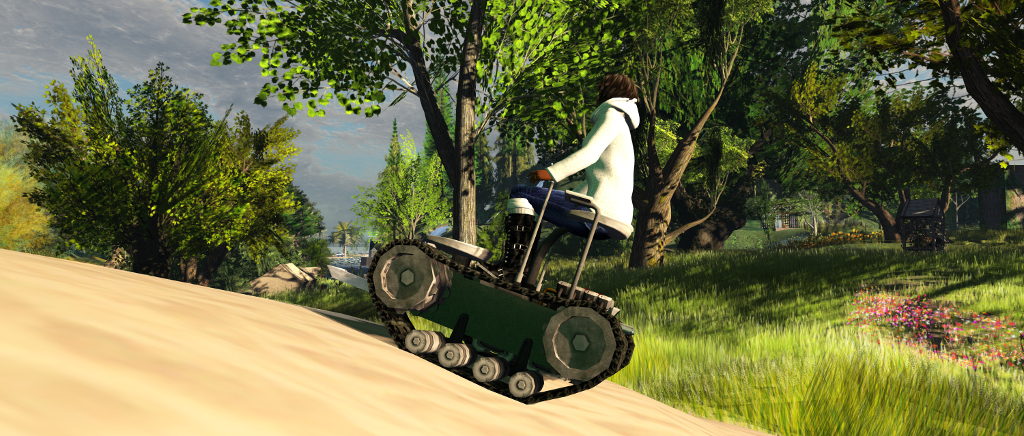
 Inara Pey: Living in a Modemworld