A quick round-up of news relating to a handful of viewers and clients.
Kokua
Kokua 64 bit (Windows, Mac and Linux) updated both the RLV (5.1.7.43693) and non-RLV (5.1.6.43692) flavours of the viewer on Sunday, August 11th. I’ve not had time to drive the update – and my not be able to, due to other commitments. However, the core of the update brings the viewer to parity with the SL viewer 5.1.7 code base, and offers some updates from the Kokua team, described in the release notes as follows:
In addition the options for configuring the chat range rings and colours move from the Kokua General preferences tab to Kokua Chat which as well as being more logical also frees up space needed in the RLV version for a new option on the General tab.
The RLV version gains an option on the Kokua General tab which allows @standtp to be disabled. This has been added because @standtp tends to operate in various counter-intuitive ways despite operating as intended.
Here’s one scenario that illustrates the problem:-
@standtp is applied to the avatar.
The avatar hitches to (sits on) a cart.
The avatar pulls the cart from location A to location B.
The avatar is unhitched from the cart (stands up).
At that point @standtp teleports them back to location A.
MetaChat the iOS client is having problems courtesy of Apple. The app was removed from the iStore on August 9th, as part of a purge by Apple on “gambling apps”.
Enquiries have been lodged with Apple on when / if the app will be allowed to re-list, but thus far, no response has been given.
In the meantime, versions already downloaded / downloaded and installed will still work, this move by Apple only affects the client’s listing on the iStore.
iOS / MetChat users can read more on the MetaChat blog, where updates will also be posted.
Firestorm Version Block
A reminder to Firestorm users, Firestorm 5.0.1.52150 (released December, 2016) will be blocked from Tuesday, August 14th, in keeping with the Firestorm team’s policy of only allowing the current, and the two version immediately prior to it.
This means that if you are still used Firestorm 5.0.1, you need to update to a more recent version: 5.0.7, 5.011 or the current 5.1.7 release.
To find out more about why Firestorm versions are blocked, please read this blog post from the Firestorm team.
Over the past few months, several mentions on the idea of themed Learning Islands have cropped up in various public discussions featuring staff from Linden Lab – notably CEO Ebbe Altberg.
The idea is that rather than a user signing-up for Second Life via an advert and / or landing page that delivers them to a “generic” learning island and then leaving them to discover things for themselves, incoming users will have a “path of interest” as it were, that leads them from an advert through the sign-up process and then delivers them in-world to a location in keeping with the theme of the ad that originally appealed to them.
The Lab runs a web advertising campaign featuring a specific theme – such as “science fiction”.
Those clicking on an ad are taken to a Second Life landing page that matches the ad’s theme (example shown below).
A Play Now button allows people to sign-up to SL and which, when they log-in for the first time with the viewer, will deliver them to a Learning Island in keeping with the theme of the advert and landing page, where they can get started with using the viewer, etc.
As well as lessons / opportunities to learn, this themed Learning Island includes one (or more) portals which allow incoming users to reach the destinations appearing on the landing pages (and others like them).
Part of the Sci-Fi landing page, an example of the themed landing pages used in conjunction with the themed Learning Islands
The first of these campaigns / themed Learning Islands has been in testing for the last couple of months, and the next is about to be rotated into testing, as Brett Linden, head of Marketing for Second Life, informed me.
Linden Lab is still in the early weeks of testing the concept of Themed Learning Islands. The initiative began quietly a month or so ago with a Romance-themed island test that is not currently active. Next up is a Sci-Fi-themed learning island that we’ll begin testing very soon. We’re also looking at several other themes for future tests, [and] it is also possible that we’ll revise the Romance and Sci-Fi themes as we gather more data on them.
– Brett Linden, head of Second Life Marketing, Linden Lab,
discussing the new themed Learning Islands
The Romance Learning Island presents a wooded island with trails and climbs, with a central “quick learn” starting point covering the essentials of movement
Of course, putting an ad campaign backed by a sign-up process, etc., is only part of the story. There needs to be some means of assessing just how well (or otherwise) it is performing. Such assessment is very much core to all of the Lab’s user acquisition and retention efforts, with A/B testing being one of the primary methodologies they employ. This is the case with these themed campaigns / islands as well, which will be tested from a number of perspectives.
Firstly, the themed campaigns and themed islands are operating alongside the Lab’s various other user acquisition campaigns and in-world learning islands. This allows the Lab to assess the overall effectiveness of each themed campaign compared to existing methods of acquisition / retention that take a more “non-themed” approach. Secondly, the themed Landing Islands within each campaign are being directly compared with their non-themed counterparts to assess their effectiveness in retaining a specific target audience, again as Brett informed me.
There is indeed an A/B test happening — where there are two equal themed landing pages with everything being identical in design/content — except for the Join URL. On the “A” version of the landing page, a click on Play Now will takeyou [via the sign-up process] to the non-themed learning island (currently used for most new users outside this test). The “B” version of this page contains the Join link that will direct [again via the sign-up process] the new user to the Themed Learning Island as their first login destination. In our paid ads that accompany this campaign, we’re distributing both the A and B versions of the landing page equally so that volume to each location will be equal.
– Brett Linden, head of Second Life Marketing, Linden Lab
on some of the Learning Island A/B testing
The Romance Learning Island presents core information on using the viewer to move, communicate and interact, and provides more general information on using Second Life
As a third level of testing, the Lab is using different approaches to the information provided within each type of Learning Island, again to assess what might be more or less effective in encouraging engagement and retention.
For example, the “Romance” themed Learning Island included what might be termed minimal user guidance beyond the basics of using the viewer to walk, jump, fly, communicate and interact. By contrast, the Sci-Fi island is far more hands-on with the user, with “main” and “advanced” tutorial areas, far more ways to impart information: info boards, local chat, links to external SL resources, etc. In the future, other means of providing incoming users with information and to help them understand to basics of the viewer, etc., will be tested in specific theme types.
Thus it is possible for the Lab to investigate what works and what doesn’t in terms of information presented to an incoming user: is it too little or too much? Where might the balance between the two lie? Does a relaxed approach that lets the user learn on their own as the explore work, or is something more “formal” in layout better? Is it better to employ one approach to passing on information, or multiple means – text, boards, videos, web links?
The Sci-Fi themed Island provides a much broader learning experience, covering many more aspects of viewer use, with subject matter split between “Main” and “Advanced” tutorial areas
When not being tested, some of the themed Learning Islands may be opened to broader access from within Second Life. However, during testing, the islands are not publicly offered up for general access. The reasons for this are fairly clear if you stop to think about them, and Patch Linden summed them up succinctly.
We actually want to discourage public access to the islands while in testing so that our statistics, measuring and data-gathering don’t get influenced by having the islands inundated with established users coming into them and possibly preventing new users from naturally proceeding through the anticipated test flow. That way, we can gather as accurate information as possible on what’s happening in terms of acquisition and retention against everything else.
Patch Linden, Senior Director of Product Operations, on why information
on the themed islands isn’t being generally announced
Also, once initial core testing with a specific themed island has finished, the Lab plan to add it to the broader Learning Island rotation. This allows a further level of comparison: does a themed Learning Island perform better with retention of users delivered to it outside of any related advertising campaign than is the case with non-themed islands, or does it not perform as well? Is there a difference? And so on.
Elements common to the “non-themed” learning islands can also be found in some of the themed islands, such as this guide to the SL viewer’s default toolbar buttons, again allowing for wider testing of approaches
One thing that struck me in talking to Keira, Brett and Patch about this programme is just what is going into user acquisition and attempts to improve user retention, when it is perhaps a little to easy to assume the Lab is just “tinkering without understanding”. Considerable thought is being put into trying to increase new user engagement and retention, and it does involve a lot of number crunching, analysis, and trying to build on what is shown to work, as well as trying entirely new approaches.
Overall, this themed approach to advertising / new user experience comes across as a good idea to try. Whether it actually works or not, and how well it works and with which themes, will only become clear over time; I do admit to being a little edgy around the Sci-Fi Island, which is very different in looks to the “hard sci-fi” images presented in the landing page – leading me to wonder if the contrast might have an impact on the new users who come through it.
But, concerns like that aside, it’s clear from talking to Brett, Keira and Patch that the Lab is pouring a lot of effort into this approach, as well as looking at other avenues of user acquisition and retention. Certainly, as this particular programme evolves I hope to be able to return to it in the future and offer updates and perhaps insights. In the meantime, I’d like to extend my thanks to Keira Linden, Patch Linden and Brett Linden for extending their time and input to this article.
Now open at Nitroglobus Roof Gallery, curated by curated by Dido Haas, is Hypnopompia, as exhibition by Cat Boucher. The title refers to the state of consciousness leading out of sleep (and not to be confused with hypnagogic state. The latter is associated with moving from wakefulness to sleep, and is referred to as a rational waking cognitive state).
Hypnopomia is more an emotional state of credulous dreaming, influenced by almost anything around us: noises, scents, touch, which on waking can lead to confusion, dissociation from our surroundings and confused (to others) speaking. The hypnopompic state is sometimes accompanied by lingering vivid imagery, and some of the creative insights attributed to dreams actually happen in this moment of awakening.
All of this is richly reflected in Cat’s images, which are quite stunning in their range. Among the 14 pieces on offer are monochrome images – perhaps reflective of the state experienced by around 12% of people, who only dream in black-and-white (a percentage, interestingly enough that has changed over the last 60-ish years: dreaming in colour was once a rarity reported by adults, and according to some researchers, the shift from “monochrome dreaming” to “colour dreaming” appears to be associated with the arrival and rise in popularity of colour television broadcasting).
Other images in this selection are presented in deep, vivid colours, perhaps reflective of the more vivid influence our surrounding can have on us as we move through hypnopomia to full wakefulness. Most, reflect not a scene, but a moment in time: bones of a fish; a face caught in sharp focus; a figure with legs curls and entwined, but seemingly without a body. In this they mirror how we so often recall our dreams – not as a continuous narrative, but as flashes of images and colour that we can only recall as a single, brief frozen moment, there rest having been lost as another stimuli causes the mind to discard the imagery and move on.
There would appear to be some plays here on the state of dreaming; one image seems to reflect an erotic dream – but whether it is brought about as a result of the brain processing actual events or simply the hypnopomic reaction of something, I leave to you to decide. There’s also an echo of the sepia tone so often loved by Hollywood directors when portraying dreams, while the clever use of vignetting can be said to both also reflect the Hollywood use of pinhole focus to convey dreaming and also, as noted above, as a metaphor for the way in which certain images in our dreams come into crystalline clarity and sharpness, imprinting themselves so strongly on our emotions, that the remain with us through our waking hours.
Evocative and captivating whether considered individually or as a part of the exhibition’s theme, these are stunning images – and all the more so given none are post processed; all Cat uses to achieve her completed images in the SL camera floater, within its colour and filter options, and suitable windlights.
Logos representative only and should not be seen as an endorsement / preference / recommendation
Updates for the week ending Sunday, August 12th
This summary is generally published on every Monday, and is a list of SL viewer / client releases (official and TPV) made during the previous week. When reading it, please note:
It is based on my Current Viewer Releases Page, a list of all Second Life viewers and clients that are in popular use (and of which I am aware), and which are recognised as adhering to the TPV Policy. This page includes comprehensive links to download pages, blog notes, release notes, etc., as well as links to any / all reviews of specific viewers / clients made within this blog.
By its nature, this summary presented here will always be in arrears, please refer to the Current Viewer Release Page for more up-to-date information.
Note that test viewers, preview / beta viewers / nightly builds are not recorded in these summaries.
Official LL Viewers
Current Release version 5.1.7.517973, dated July 30th, promoted August 3rd. Formerly the Quinquina Maintenance RC viewer.
BugSplat RC viewer, version 5.1.8.518305, August 7. This viewer is functionally identical to the current release viewer, but uses BugSplat for crash reporting, rather than the Lab’s own Breakpad based crash reporting tools.
Second Life Voice RC viewer, version 5.1.8.518310, August 7.
Project viewers:
EAM project viewer, version 5.2.0.518362, August 9 – improved region access control tools; see my overview for more.
MetaChat – Apple has (hopefully temporarily) removed the app from the iStore as part of a purge of “gambling” applications – read the MetaChat blog post for more. D/loaded + installed version s still work.
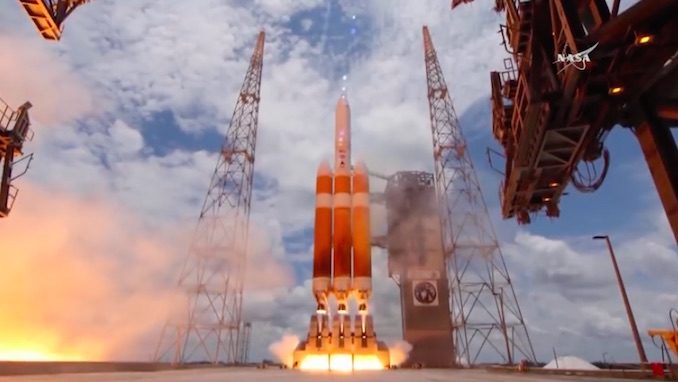
Ignition! The three main stages of the Delta 4 Heavy fire, starting the Parker Solar Probe on its mission to examine the Sun up close and personal. Credit: NASA
On the morning of Sunday, August 12th, 2018, NASA launched the Parker Solar mission, which it describes as being “to touch the face of the Sun”. It will be the first mission to fly through the Sun’s corona – the hazardous region of intense heat and solar radiation in the Sun’s atmosphere that is visible during an eclipse, and it will gather data that could help answer questions about solar physics that have puzzled scientists for decades. Over the course of its initial 7-years the Parker Solar Probe mission will allow us to better understand the fundamental processes going on in, on, and around the Sun, improving our understanding how our solar system’s star influences, affects and changes the space environment, through which we travel as the Earth orbits the Sun.
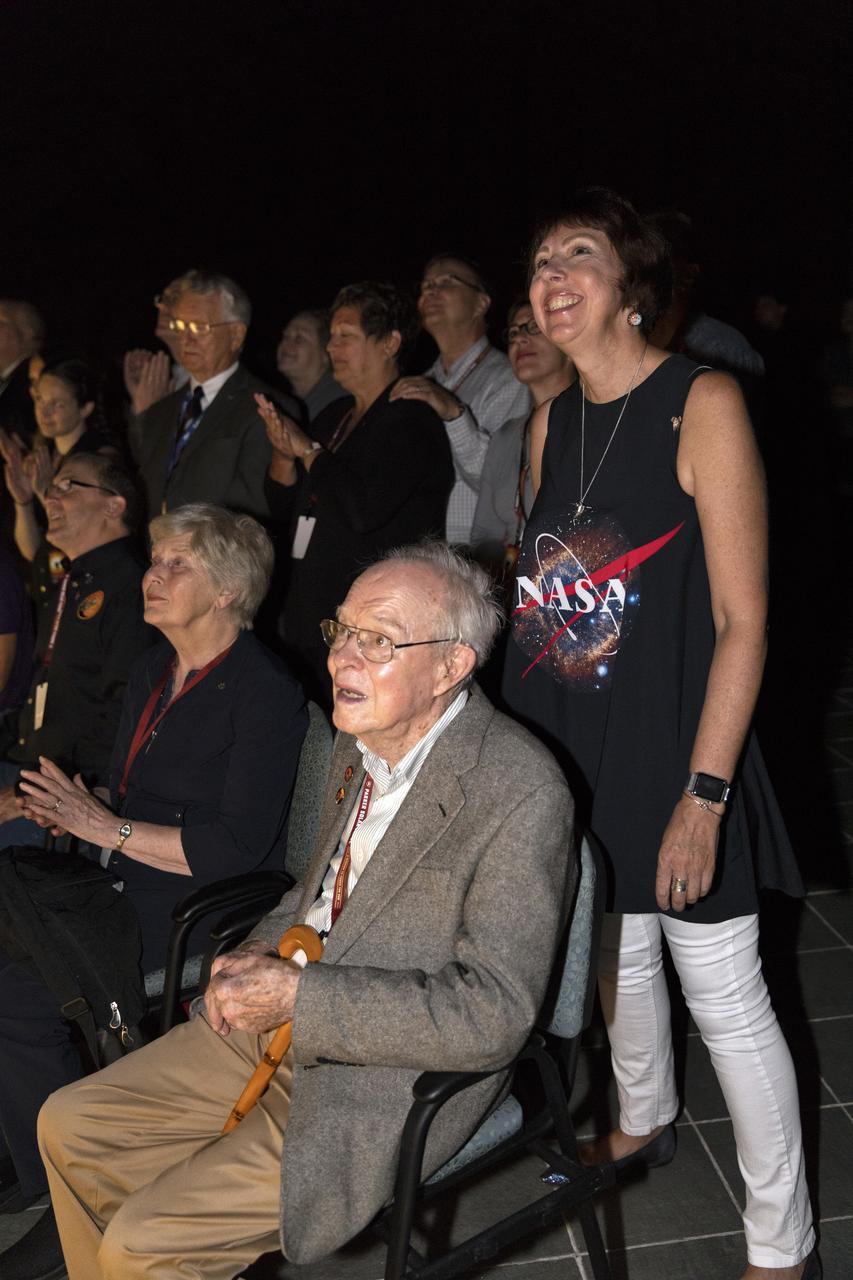
The probe and mission are named for Dr Eugene Parker, an American solar astrophysicist, who in 1958 first posited the theory of the supersonic solar wind, and who also predicted the Parker spiral shape of the solar magnetic field in the outer solar system. Now 91, he was present at NASA’s Kennedy Space Centre as a distinguished guest of the agency, to witness the probe’s launch, the mission (and vehicle) being the first in NASA’s history to be named after a still-living person.
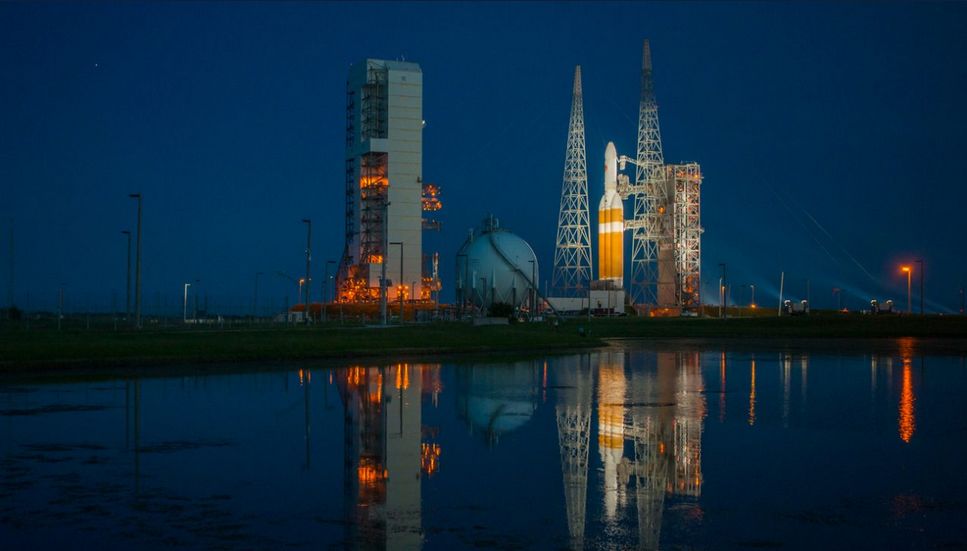
The Delta 4 Heavy carrying the Parker Solar Probe sits on the pad of Space Launch Complex (SLC) 37 at Canaveral Air Force Station, Florida, following the aborted launch attempt of Saturday, August 11th, 2018. Credit: Vikash Mahadeo / SpaceFlight Insider
Lift-off came at 03:31 EDT (6:31 GMT / 7:31 BST) on Sunday, August 12th, after the initial launch attempt was scrubbed on Saturday, August 11th, when a troubled countdown was halted just one-minute, 55 seconds before the engines on the United Launch Alliance (ULA) Delta 4 Heavy rocket were to ignite. The halt was called following a gaseous helium red pressure alarm, and investigations into its cause extended beyond the 65-minute launch window, resulting in the launch scrub.
The Sunday morning launch countdown proceeded without any significant hitches, and the Delta 4 Heavy – the most powerful rocket in ULA’s fleet of launch vehicles, comprising 3 Delta 4 first stages strapped side-by-side, the outer two functioning as “strap-on boosters” – lit up the Florida coastline as it took to the early morning skies.
Although a flight to the Sun might sound an easier proposition than reaching the outer solar system, it actually isn’t; it actually requires 55 times more launch energy than a launch to Mars. Hence why the relative small and light Parker Solar Probe, weighing just 685 kg (1,510 lb) at launch, required the massive Delta 4 and a rarely-used Star 48BV variant of the Payload Assist Module (PAM).
Originally developed as the upper stage for Delta 2 launch vehicles in the 1965, the Star family of solid-fuel PAM units were commonly used with the space shuttle for satellite launches from orbit: the shuttle would carry them aloft, release the PAM / Satellite combination, then move to a safe distance before the PAM motor was ignited to push the satellite on to its require Earth orbit. For the Parker Solar Probe, the Star 48BV was used to impart as much velocity as possible into the vehicle at is starts on it journey.
Dr. Eugene Parker, now 91, watches the launch of the probe named in his honour as it lifts-off from SLC-37, Sunday, August 12th, 2018. Credit: NASA / Glenn Benson
What makes a flight to the Sun so hard is that the Earth is moving “sideways” relative to the Sun at about 107,000 km/h (67,000 mph), and the probe has to cancel out a whopping 84,800 km/h (53,000 mph) of that “sideways” motion as it makes its way to the Sun in order to achieve orbit. At the same time, the probe needs to gain velocity as it moves in towards the centre of the solar system in order for it to balance the Sun’s enormous gravitational influence and achieve the required elliptical orbit.
The use of the Delta 4 / Star 48BV combination got both of these requirements started, by pushing the probe towards Venus in an arc that will both start to shed the “sideways” velocity, whilst also accelerating the craft in towards the Sun. But it will be Venus that does the real grunt work for the mission.
On October 1st, 2018, the probe will make the first of a series of flybys of Venus, where it will use the Venusian gravity to shed still more of the angular velocity imparted by Earth’s orbit and increase its velocity towards the Sun.
In all, seven such fly-bys of Venus will occur over the 7 year primary mission for the probe, and while only the first is required to shunt the vehicle into its core heliocentric orbit, the remaining six play an important role in both maintaining the vehicle’s average velocity across the span of the mission and in gradually shrinking its elliptical orbit around the Sun as the mission progresses.
The first pass around the Sun – and the start of the science mission – will occur in November / December 2018. At perihelion, the vehicle will be just 6.2 million km (3.85 million mi) from the Sun’s photosphere (what we might call its “surface”). During this time, the vehicle will be well within the corona, and will also temporarily become the fastest human-made vehicle ever made, achieving a velocity of around 700,000 km/h (430,000 mph) – that’s 200 km per second (120 mi/s), or the equivalent of travelling between London and Tokyo in around 50 seconds! At aphelion – the point furthest from the Sun, and brushing Earth’s orbit, the craft will be travelling a lot slower.
The corona is a very hot place – hotter than the “surface” of the Sun, however, it is also comparatively thin as far as an “atmosphere” goes. The distance at which Parker Solar Probe will be travelling from the Sun at perihelion, combined with its speed, mean that the ambient heat of the corona isn’t a significant issue. Direct sunlight radiating out from the Sun, however, is a significant problem.
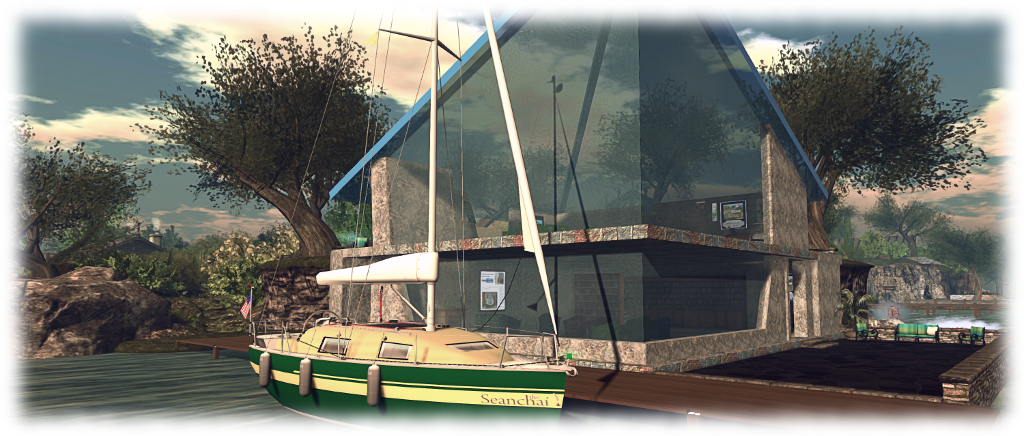
It’s time to highlight another week of storytelling in Voice by the staff and volunteers at the Seanchai Library. As always, all times SLT, and events are held at the Library’s home at Holly Kai Park, unless otherwise indicated.
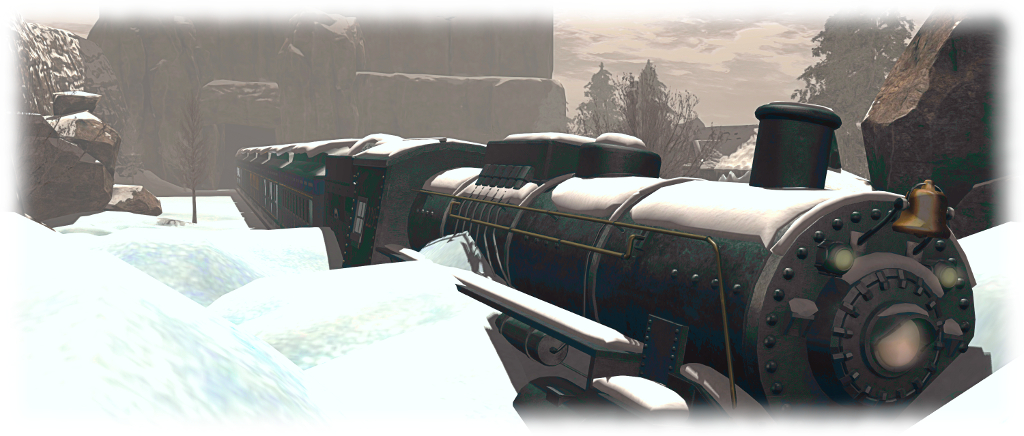
Join Seanchai Library and friends As they reach their final destination: a climatic 90-minutes session that sees a stranded train rescued and Hercule Poirot reaches his conclusions regarding a case most perplexing.
It should have been a route trip aboard the luxurious carriages of the Compagnie Internationale des Wagons-Lits’, Simplon-Orient Express. Yes, arrangements have been made in a rush, yes, it looked as if he would have to make the journey in the confines of 2nd class, but at least Poirot would make it back to London and the business requiring his urgent attention. Then his friend, M Bouc, who just happens to be a director of the company and travelling on the same train, arranges to have Poirot “upgraded” to first class and his accustomed comforts.
All is set for a most agreeable journey, but for the presence of one man: Samuel Ratchett, a noisome American, also aboard the train, and who accosts Poirot, claiming someone is trying to kill him, and demanding Poirot aid him. Refusing on account of finding Ratchett a disagreeable fellow and not at all whom he appears to be, the detective endeavours to enjoy the journey, finding his fellow first-class passengers a most curious group.
Ratchett, however has other ideas – or at least, someone does. With the train caught in a snow drift, the American is found dead in his sleeping cabin, and Poirot, now convinced of “Ratchetts” true identity – that of a child kidnapper and murderer known as Cassetti – finds himself cast into a familiar role of determining who is responsible.
But who – who among the group of travellers killed “Ratchett”? The hard, but quintessentially polite Englishman, Colonel Arbuthnot? The suspiciously acting Count and Countess Andrenyi? The cool and unruffled Mary Debenham? The mysterious and distracting Mrs. Hubbard, who herself probably is not whom she appears to be? The Russian Princess Dragomiroff, frequently giving to lying?
Or might it have been Cyrus Hardman, the flamboyant detective from New York City, whose “assistance” in the case seems less than genuine? Or perhaps it was Hector McQueen, “Ratchett’s” personal assistant – or any one of five other possible suspects? All of them appear to have a link either to “Ratchett” or to his most heinous of crimes and a reason for wanting him dead. Was it one of them? Some of them? All of them? Or – none of them?!
Board the Orient Express one last time in a special setting, as Seanchai library reaches the conclusion of this most famous and engaging of Agatha Christie’s novels!
18:00: Magicland Storytime
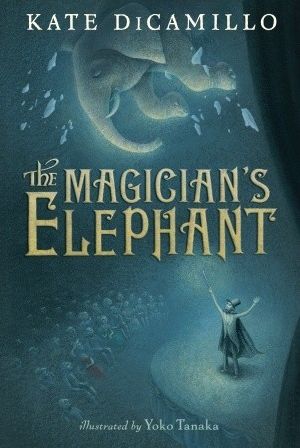
When a fortune-teller’s tent appears in the market square of Baltese city, orphan Peter Augustus Duchene knows the questions that he needs to ask: Does his sister still live? If so, how can he find her?
The fortune-teller’s mysterious answer that an elephant – an elephant! – will lead him to his sister, sets off a chain of events so remarkable, so impossible, that you will hardly dare to believe it’s true. And thus we’re off on a wondrous adventure of the kind only Newbery Medalist Kate DiCamillo could tell.
In this timeless fable, she evokes the largest of themes — hope and belonging, desire and compassion — with the lightness of a magician’s touch, and we are joined in a world of What if? Why not? Could it be?
Join Calaedonia Skytower at the Golden Horseshoe for this most enchanting of stories.
Monday, August 13th 19:00: The R-Master
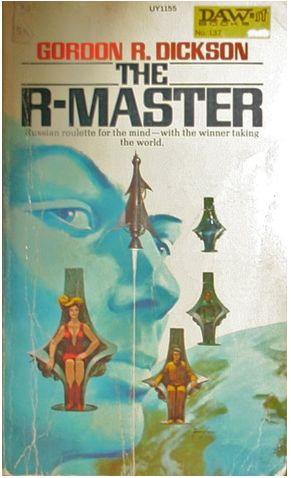
In the 21st century utopia has arrived in the form of a repressive but seemingly benevolent, if omnipresent, bureaucracy. Their perfectly ordered world, seemingly run for the benefit of all, is actually ruled with an iron fist. In claiming to have people’s best interest at heart, those in power keep the population occupied and docile with menial tasks and the promise of advancement with the aid of the strictly controlled drug, R-47.
For the vast majority, R-47 actually does nothing.But for a special few, observed and selected by the ruling Council, it can massively enhance their intellect, elevating them to the status of “R-Masters” allowing them to solve problems, see advancements, and help ensure – wittingly or not – the Council’s control over the world, cosseted and pampered well away from the drudgery of ordinary life.
However, there is a darker side to R-47: just as it can elevate the intellect of some of those chosen to receive it, so to can it reduce them to imbeciles – and there is no way of knowing who the outcome might be in advance. Wally Ho is one selected to receive R-47 – and suffers the latter fate.
Determining it will raise his problem-solving abilities and restore his brother, Etter Ho obtains R-47 and takes it. But, once elevated to the privileged ranks of the R-Masters and witness the truth behind the Council’s rule, Etter determines the established status quo cannot allowed to continue, and Big Brother must be brought to heel.
Join Gyro Muggins as he reads Gordon R. Dickson’s 1973 novel about life in what is now our times!
Tuesday, August 14th
The Library is closed for the evening.
Wednesday, August 15th 19:00: Mythos
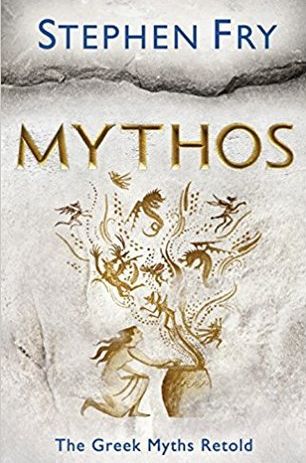
The Greek myths are the greatest stories ever told, passed down through millennia and inspiring writers and artists as varied as Shakespeare, Michelangelo, James Joyce and Walt Disney.
They are embedded deeply in the traditions, tales and cultural DNA of the West. In Stephen Fry’s hands the stories of the titans and gods become a brilliantly entertaining account of ribaldry and revelry, warfare and worship, debauchery, love affairs and life lessons, slayings and suicides, triumphs and tragedies.
Through them, you’ll once again fall in love with Zeus, marvel at the birth of Athena, wince at Cronus and Gaia’s revenge on Ouranos, weep with King Midas and hunt with the beautiful and ferocious Artemis.
Thursday, August 16th
14:00: Fireside Tales: The Ghost of the Bridge
Caledonia shares more from her latest short story, inspired by Pfaffenthal 1867 in SL, and a legendary ghost from Luxembourg.




 Inara Pey: Living in a Modemworld