Roaming the fields of Second Life

La Clef des Champs; Inara Pey, May 2018, on FlickrLa Clef des Champs – click any image for full size

La Clef des Champs (literally, “the key fields”, often used to indicate being out in the countryside) is a homestead region designed by Rose Ulrik (Rose Siabonne), which opened in April 2018. Caitlyn and I were able to visit not long after it opened – courtesy of a tip-off from Shakespeare and Max (♥ as always!) – and found it to be a simple, rustic design that is both restful and has what might be for some, a tiny bit of an edge to it.

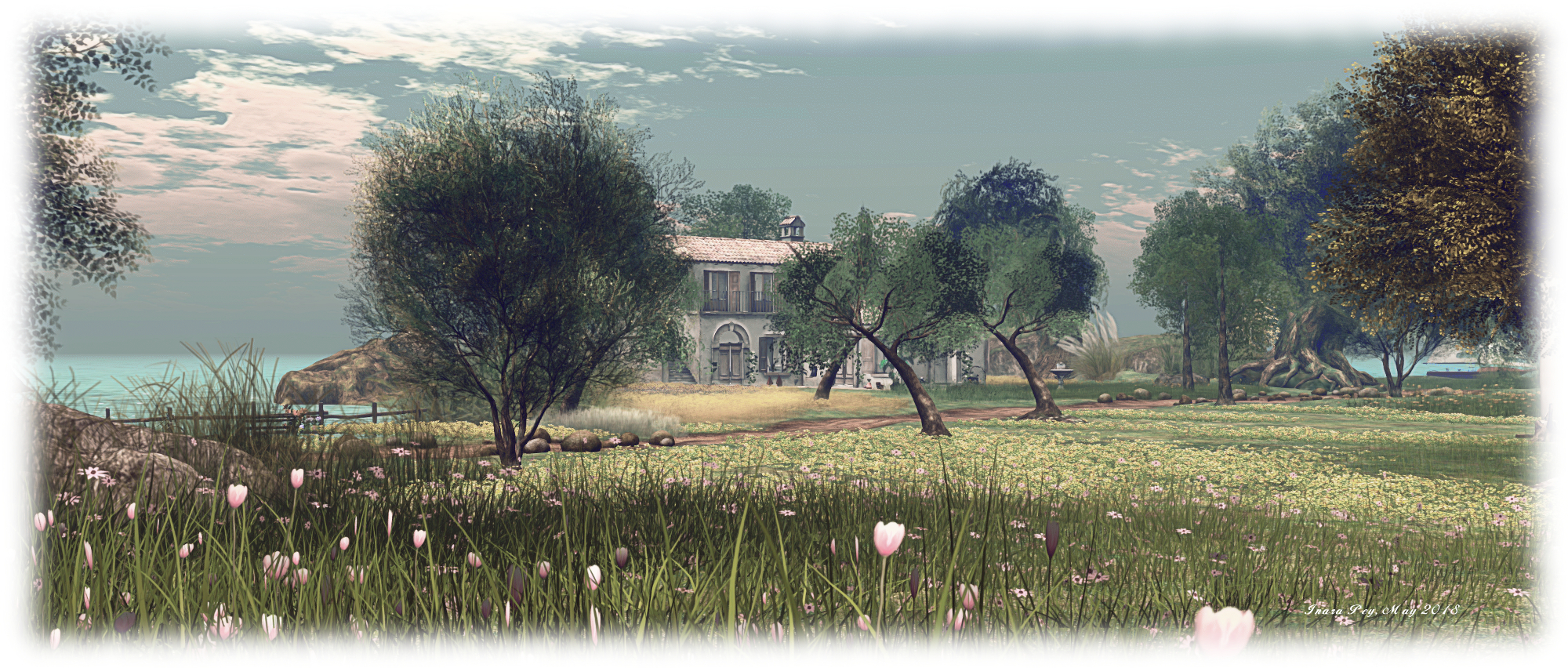
In keeping with its name, the region presents an open, undulating landscape on to which have been scattered a couple of continental farm houses and outbuildings, giving the suggestion the land might be open-sided fields. Visitors arrive in the north-east corner of the region, backed by cliffs and rocky slopes on three sides, while the fourth inclines gently down to the lands below, cut neatly by a farm track.
La Clef des Champs; Inara Pey, May 2018, on FlickrLa Clef des Champs

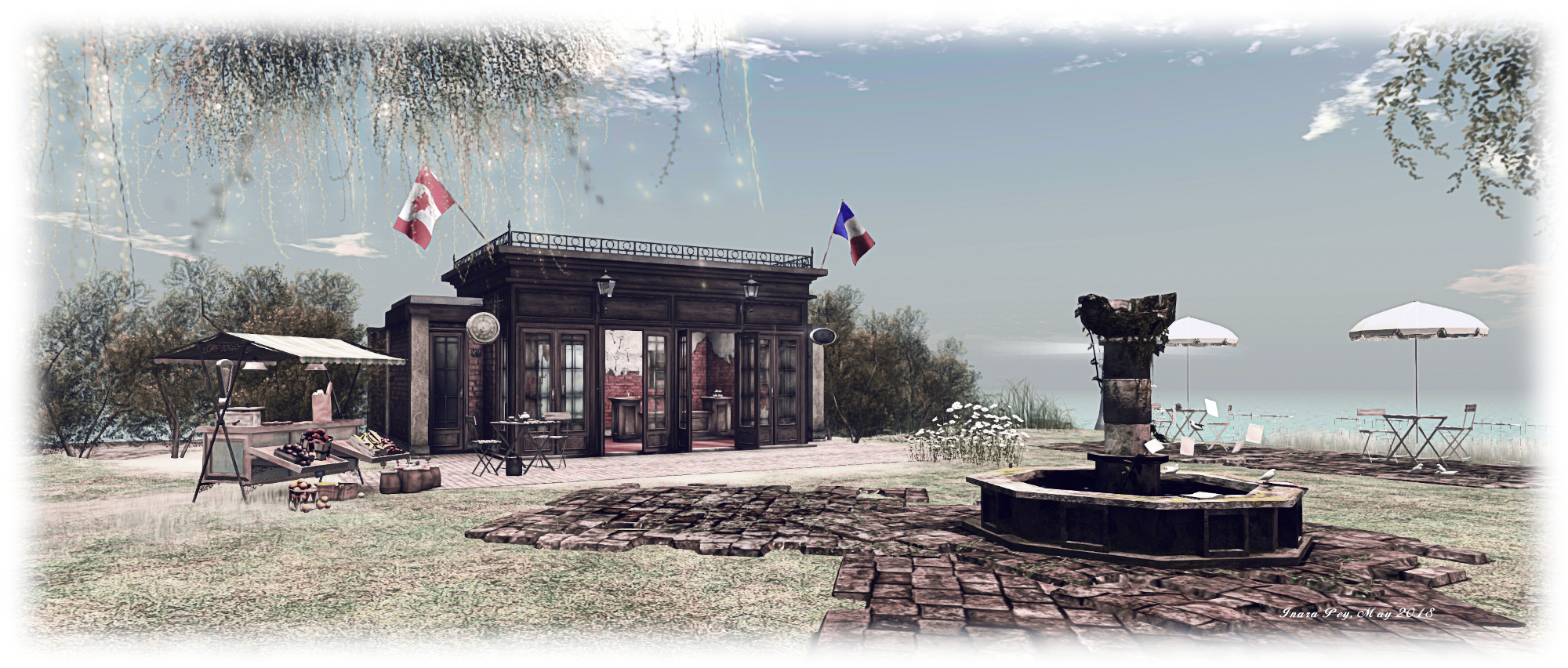
This hilltop is home to a modest café, proudly flying the French and Canadian flags and with a motif of the region – a series of large metal keys – hanging from one wall. From the worn patio outside of the café it is possible to look southwards over a small bay watched over by a lighthouse, to where one of the two farmhouses sits, its back to the sea, the track from the hill winding by a short distance away.

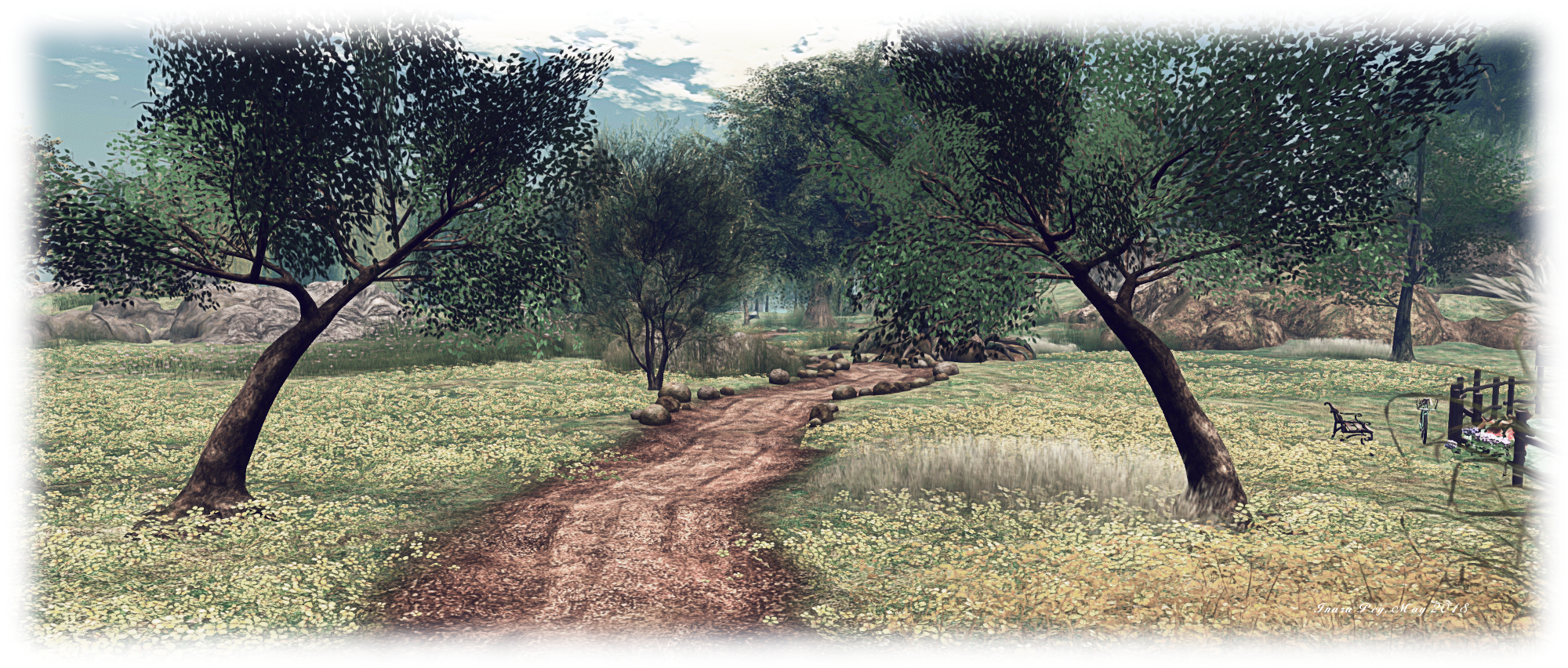
However, follow the track down the hill from the café, and before you get to the farmhouse, you’ll find the track forks, one arm continuing south past the little bay and towards the farm mentioned above, the second arm pointing a short finger west to where the second of the farms sits, chickens parading along its patio. Stepping stones offer a way onward, crossing the grass and skirting the house to curve past a little orchard and reaching on towards the farm’s outhouses, the way partially guarded by geese. A little way beyond this farm is a railway track, overlooked by an old warehouse sitting on a slight rise as the land reaches its western seaboard.
La Clef des Champs; Inara Pey, May 2018, on FlickrLa Clef des Champs

The fields between these two farms lie open to wander, a small pond offering a place to sit and, going by the bucket alongside the wooden chairs, plenty of good fishing. It looks south to where a single aged wall stands atop a low hill, the last remnant, it would seem, of a much larger structure that once occupied the hill.

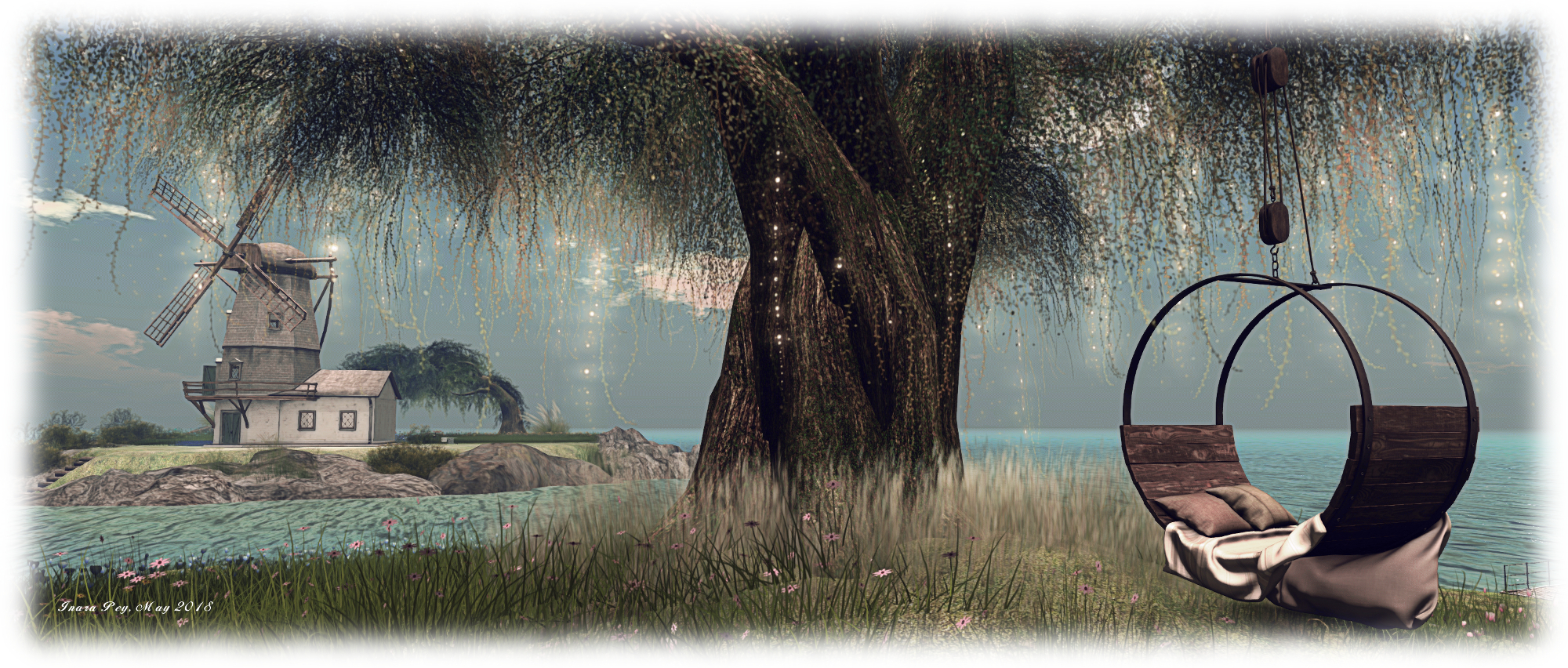
Just beyond the hill with its ruined wall, the landscape is again scooped into a shallow bay, a wooden deck set out over the water to face a small island bearing a windmill. A rowing boat can be obtained from the rezzer on the deck, allowing visitors to cross the water to this little island and explore the windmill and enjoy a little more privacy from the rest of the region.
La Clef des Champs; Inara Pey, May 2018, on FlickrLa Clef des Champs

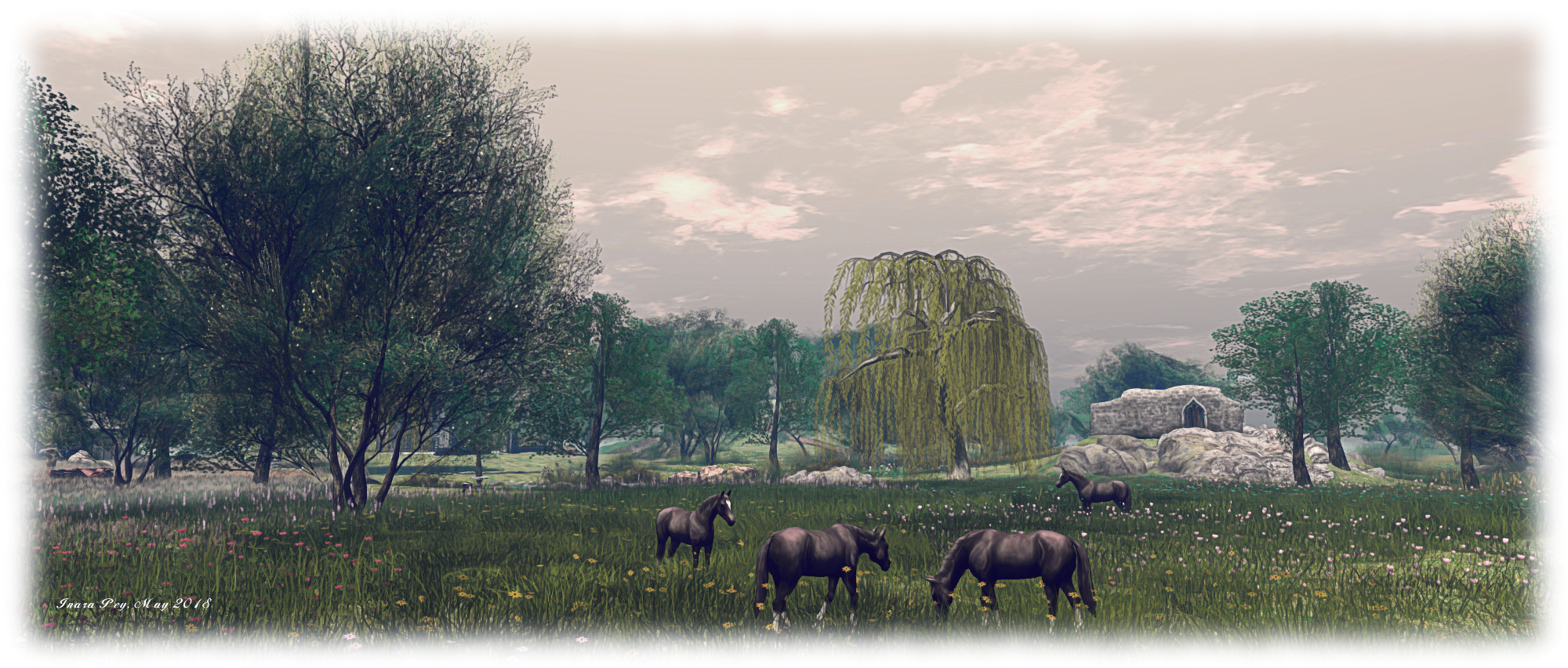
Deer and horses are to be found scattered around the region, together with numerous places to sit outdoors and enjoy the setting. These range from swings slung beneath the boughs of trees, to simple park benches to blankets waiting with lavish picnics, to the aforementioned decks and chairs – some of which also have food and drink at the ready. A little to the north of the windmill island sits an outdoor stage for music events, gently floating on the water and reached via stepping-stones – although admittedly, I’ve no idea if events are held there.

Elegant in its simplicity, La Clef des Champs makes for a relaxing visit, and rezzing is open for those wishing to use props with their photography – just do please remember to clean up behind you. There’s also a Flickr group for those wishing to submit their finished pictures. And the edge to the region I mentioned at the top of this article? It’s nothing serious for the open-minded; but do keep in mind this is an Adult region in which, although not overt, adult activities can take place.
La Clef des Champs; Inara Pey, May 2018, on FlickrLa Clef des Champs

SLurl Details

Starting May with Seanchai Library

Seanchai Library

It’s time to highlight another week of storytelling in Voice by the staff and volunteers at the Seanchai Library. As always, all times SLT, and events are held at the Library’s home at Holly Kai Park, unless otherwise indicated.

Monday, May 7th 19:00: The Crucible of Time

crucibleGyro Muggins reads the fix-up by John Brunner. First published as two-part story which appeared in Isaac Asimov’s Science Fiction Magazine, it’s an ambitious tale of alien intelligence which grew to a series of six linked tales pushed as a single novel in 1983.

Far off in space is an alien race which is so much like us, yet so un-alike. From the birth of their earliest civilisation through to their attainment of star flight as their star system passes through the galaxy, we follow their development through the ages.

Aquatic by nature, this race presents some significant challenges well outside the realms of anything encountered by humanity. But they are also driven by all too familiar hopes, fears, desires, needs, wants, prejudices, impact of religious ideologies, and the quest for knowledge we have experienced in the growth of our own civilisation.

Charting six periods of time, each a thousand years after the previous, the six stories focus on the efforts of a group of individuals in each era as they face one or more challenges, their success in overcoming these challenges inevitably leading them towards a greater understanding of their planet’s plight, and ultimately, the ability to deal with that plight and the survival of their civilisation.

Tuesday, May 8th 19:00: “I went to the Faire…”

Short Stories and Poems with Caledonia Skytower.

Wednesday, May 9th 19:00: TBA

Check the Seanchai Library blog nearer the time for updates.

Thursday, May 10th 19:00: Tails of the Apocalypse

The Walking Dead meets The Incredible Journey in 14 amazing tales by today’s most talented independent authors. Seven stories set in all-new dystopian landscapes. Seven stories set in the bestselling post-apocalyptic worlds of David Adams’s Symphony of War, Michael Bunker’s Pennsylvania, Nick Cole’s Wasteland Saga, Hank Garner’s Weston Files, E.E. Giorgi’s Mayake Chronicles, Deirdre Gould’s After the Cure, and Edward W. Robertson’s Breakers.

When the world ends, the humans who survive will learn an old lesson anew—that friendship with animals can make the difference between a lonely death among the debris and a life well lived, with hope for the future.

Also presented in Kitely (hop://grid.kitely.com:8002/Seanchai/144/129/29).


Please check with the Seanchai Library’s blog for updates and for additions or changes to the week’s schedule.

The current charity is Project Children, growing peace in Northern Ireland one (or two) children at a time..

2018 viewer release summaries week #18

Logos representative only and should not be seen as an endorsement / preference / recommendation

Updates for the week ending Sunday, May 5th

This summary is generally published on every Monday, and is a list of SL viewer / client releases (official and TPV) made during the previous week. When reading it, please note:

  • It is based on my Current Viewer Releases Page, a list of all Second Life viewers and clients that are in popular use (and of which I am aware), and which are recognised as adhering to the TPV Policy. This page includes comprehensive links to download pages, blog notes, release notes, etc., as well as links to any / all reviews of specific viewers / clients made within this blog.
  • By its nature, this summary presented here will always be in arrears, please refer to the Current Viewer Release Page for more up-to-date information.
  • Note that test viewers, preview / beta viewers / nightly builds are not recorded in these summaries.

Official LL Viewers

  • Current Release version 5.1.3.513644, dated March 27th, promoted April 13th – formerly the Media Update RC.
  • Release channel cohorts (please see my notes on manually installing RC viewer versions if you wish to install any release candidate(s) yourself):
    • No updates.
  • Project viewers:
    • No updates.

LL Viewer Resources

Third-party Viewers

V5-style

  • Kokua updated to versions 5.1.3.43237 (RLV) and 5.1.3.43238 (No RLV) on May 6th. This release includes a Linux flavour built using LL’s Alex Ivy code base and Kokua’s Linux libraries – release notes.

V1-style

  • Cool VL viewer stable branch updated to version 1.26.22.4 on May 5th – release notes.

Mobile / Other Clients

  • No updates.

Additional TPV Resources

Related Links

Sighs and Rainbows in Second Life

Club LA and Gallery: Rainbow in the Dark

Now open at Club LA and Gallery, curated by Fuyuko ‘冬子’ Amano (Wintergeist) are two very disparate exhibitions by Second Life artist / photographers which each have their own very individual nuances – and, if I’m subjectively honest for a moment – niggles.

Suspiria (“Sighs”) is the more recent of the exhibitions being held at the gallery, having opened on Sunday, May 6th, 2018. It is by Sophie and Dorian Gray (Sophie Stuer and dorianderrida), and is located on the mezzanine level. It presents 11 images, framed by a blank verse poem which reads more as a moment captured in time: two people reflecting on the nature of sight – do they each really see the same thing within a moment – and more particularly, the strength of their relationship.

Club LA and Gallery: Suspiria

Each of the pictures captures a scene from (presumably) this relationship; eleven emotive vignettes. Some appear clear in their meaning: a moment of tenderness, a mutual expression of love. Others, however, tend to reflect the questioning raised in the poem / narrative: are these two people really experiencing the same closeness, or are they in fact in different emotional places?

In several, this is perhaps reflected in the physical distance separating them as they sit across a room from one another, or even in separate rooms. In others, it is more subtle: crossed arms in the face of an oncoming kiss, suggestive of seeking self-comfort in the face of sign of affection the recipient is uncertain about (and, of course, there is also the psychological myth of crossed arms being a sign of defensiveness); the attempted hug that is blocked by am arm held across the recipient’s body. Throughout all of the pieces, one can almost hear the accompanying sighs that give the exhibit its title – but whether they are sighs of contentment or regret, I’ll leave to you to decide.

Club LA and Gallery: Suspiria

Rainbow in the Dark, by Cipher (Ciphertazi Wandin) is located on an overhead platform, reached via a ground floor teleport door.

This exhibition utilises lighting projectors, so you must ensure Advanced Lighting Model (ALM) option for your viewer is enabled (Preferences > Graphics). The ground level instructions also state Shadows should be set to Sun/Moon+Projectors. However, this isn’t actually required – SL’s lighting projectors do not require Shadows to be enabled (which can be a massive performance hit) in order to work; so nothing is lost by ignoring this instruction, providing you can use the suggested windlight option (Phototools – No Light, if installed on your system) or set your viewer’s time of day to Midnight.

Club LA and Gallery: Rainbow in the Dark

Rainbow in some ways mirrors Suspiria, in that it presents 11 images, all framed by a poem (found on one wall of the display space). However, the subject matters in these images is much more diverse: encompassing landscapes, avatar studies and object studies, each image having its own story to tell entirely independently of the others.

Nuanced, evocative and exceptionally eye-catching in tone and study, each of the images has a depth to it which is quite breathing – and the use of projectors to superimpose them on their canvases, rather than simply presenting them as mounted / framed images is quite inspired. (Hence why you must have ALM enabled in your viewer – if not, all you’ll see is eleven white panels in a dark room.)

Club LA and Gallery: Rainbow in the Dark

The subjective niggles I have with Suspiria and Rainbow are just that: entirely subjective. With Suspiria, I couldn’t help feel that many of the images have been finished a lot more darkly in tone and colour than necessary; one is often left peering at them, trying to make out what’s there rather than appreciating their narrative. With Rainbow, there is perhaps a risk that specifying a Windlight option only to be found in a specific viewer (unless manually installed), regardless of the popularity of that viewer, might put some off visiting. Better, perhaps, to specify Midnight as the setting, particularly as nothing is really lost in using it.

Nevertheless, both Suspiria and Rainbow in the Dark are more than worth taking the time to see, either individually or together – and when doing so, please also take time to appreciate Land of Confusion, the first public exhibition by Norri (Iron Emerald), which is still open on the ground floor of the gallery. Modestly sized with just a handful of images, it nevertheless reveals an artist whose work deserves to be seen much more widely in Second Life.

Club LA and Gallery: Land of Confusion

SLurl Details

Kokua presents Alex Ivy based 64-bit Linux Viewer

Viewer support has been a subject of frustration among SL users who prefer to use Linux (around 1%-1.5% of the total SL user base) over the lack of official support for the operating system.

As I reported at the time, in 2015 and due to a lack of Linux expertise, Linden Lab pulled back from active Linux viewer development in favour of seeking support from the open-source community in order to maintain a Linux version of the viewer (see here for more). More recently, the Lab has been looking to provide a means to build a Linux flavour of the viewer, based on their Alex Ivy 64-bit code base and libraries, but not distribute or build all the various dependencies required for the viewer, instead leaving this to TPVs to do as part of providing their own support for Linux users (see here for more), although this is taking time to happen.

In the meantime, on May 6th, 2018, the Kokua team released the first third-party viewer for Linux based on Lab Lab’s 64-bit Alex Ivy code base, although built using Kokua’s own Linux libraries.

Kokua release 5.1.3.43237 (RLV) and Kokua release 5.1.3.43238 (no RLV) are  are supplied in Windows, Mac and Linux flavours. In addition, and as is to be expected, both are built using the latest LL release code base (SL 5.1.3) while the RLV version is at parity with RLV release 2.9.23.0.

The viewer is currently available for download on the Kokua website for those who wish to try it – just scroll down to the RLV 64 bit (active development) or the NORLV 64 bit (active development) sections of the download page for the version you’d prefer to use.

If you are a Linux user and opt to download the viewer, please do take the time to report any issues you find with it via the Kokua Issue Tracker at Sourceforge,  as refinement and enhancement of the Linux flavour of the viewer is dependent on the Linux community, perhaps more so than the Mac and Windows flavours (which each have the advantage of larger user bases and more chances of issues being more widely identified and reported).

It should be noted that the Linux flavours of the viewers does come with a warning:

Some areas of the Linux release are still being worked on, however we believe that enough is working and well enough to share this with a wider audience to help us squash any remaining gremlins.

– The Kokua May 6th 5.1.3 release notes

However, the news that there is now an up-to-date 64-bit Linux viewer available for download which is based on the Lab’s current code-base should hopefully come as good news for Linux users.

Additional Links

Space Sunday: insight on InSight

via Associated Press

On Saturday, May 5th, 2018, NASA commenced the latest in its ongoing robot exploration missions to Mars, with the launch of the InSight lander mission.

The Interior Exploration using Seismic Investigations, Geodesy and Heat Transport (InSight) mission is the first designed to carry out a detailed examination of the Red Planet’s interior – its crust, mantle and core.

Studying Mars’ interior structure can answer key questions about the early formation of the rocky planets in our inner solar system – Mercury, Venus, Earth, and Mars – more than 4 billion years ago. In addition, the data gathered may also help us to understand how rocky exoplanets orbiting other stars in our galaxy may have formed.

As well as potentially being a ground-breaking mission, InSight’s departure from Earth marked the first time any US interplanetary mission had been launched from the West Coast, rather than the more familiar Kennedy Space Centre in Florida. InSight started its six-month journey to Mars atop a United Launch Alliance Atlas V 401 launch vehicle from Space Launch Complex 3-East at Vandenberg Air Force Base, California, lifting-off at 04:05 PDT (07:05 EDT; 11:05 UTC) on May 5th, marking the end of a 2-year delay for the mission.

That delay had been caused by the repeated failure of a vacuum sphere forming a part of a set of seismometers called the Seismic Experiment for Interior Structure (SEIS) package, a crucial part of the mission’s science. Attempts to correct the issue with the French-developed package consistently led to further problems until, in December 2015, NASA was forced to call off InSight’s planned March 2016 launch while the unit was France for further repairs – a move that gave rise to fears the entire mission would be cancelled if a solution could not be found in time for InSight to meet the next launch opportunity in 2018 – such launch windows occurring every 26 months.

The mission critical vacuum sphere originally designed by CNES, and which kept failing tests and caused a 2-year delay in InSight’s launch. Credit: CNES

The mission was saved in March 2016 – a week after its original launch date in fact – when NASA’s Jet Propulsion Laboratory (JPL) reached an agreement with the French space agency CNES. This allowed JPL to design, build and test a new vacuum enclosure, with CNES taking responsibility for integrating it with the SEIS package, and testing the completed unit in readiness for integration with the lander in time for a May 2018 launch.

On May 5th 2018, the launch itself proceeded smoothly, with the Atlas V booster quickly obscured by pre-dawn fog shortly after clearing the launch complex. however, it was caught at altitude by a NAA observation aircraft, as it rose above the cloud tops. As well as InSight, the rocket carried within its payload fairings two “cubesats”, each roughly the size of a briefcase, called MarCO A and MarCO B.

Together, these tiny, self-contained satellites for the Mars Cube One (MarCO) technology demonstrator. Sent on their way to Mars alongside InSight, they both operate independently of the lander, carrying their own communications and navigation experiments. Their mission is designed to provide NASA with a temporary communications relay system during InSight’s  entry, descent and landing (EDL) mission phase, as it heads towards a (hopefully) soft-landing on Mars.

Currently, surface missions to Mars are generally monitored by the Mars Reconnaissance Orbiter, which monitors transmissions from a vehicle descending towards a landing on Mars. However, it cannot simultaneously transmit that information to Earth. This means that it can be as much as an hour before the data gathered during the critical EDL phase of a surface mission can be received on Earth. MarCO will be able to simultaneously receive and transmit EDL data sent by InSight to Earth, allowing mission engineers and scientists to have a more complete picture of this critical phase of the mission that much sooner. If successful, MarCO cover pave the way to a greater use of cubesats in the exploration of Mars.

An artist’s impression of MarCO A and MarCO B with their communications antennae deployed post-launch and on their way to Mars. Credit: NASA/JPL

Continue reading “Space Sunday: insight on InSight”