Now open at MetaLES, curated by Ux Hax and Romy Nayar, is Journey into Communication, an installation by Nevereux. Mixing 2D art, words and 3D settings, it presents a quirky but thought-provoking journey into the ways in which we communicate which all contains a degree of social commentary and some insight into the artist herself.
Nevereux introduces the installation in a completely self-effacing manner, “So here you’ll find everything you need (aside from few artistic skills) so to waste your most precious 77 minutes. Due to a fortunate series of coincidences, you’ll find a brand new iPhoneZ and a handsome pencil on the ground. Sure I’ve also got lots of decent pictures, but they’re all just kinda boring. Keep yourself awaken by sniffing the paint(ings) on the walls.”
This drastically undersells the installation, reached via teleport from the MetaLES landing point. The art is ranging in a circle around a slightly undulating snowy landscape. Pictures hang from the sky, and are mounted within small sets related to their subject matter (those on signals from space, immersion, and similar, are presented within the shells of what might be a space station, for example).
At first, the installation can be confusing – however there is logic to it. A raised stage sits in the south-east corner, with a door marked Enter beneath it. This is the starting-point, and visitors should progress from here in a clockwise direction around the display areas. The first of these poses the question about how we look at the world: through the limits of the screen – be it television, computer, ‘phone and so on – or through the richness of knowledge and imagination presented by books. After this, we are warned – again in a self-effacing comment: This is where it all gets a bit surreal.
Surreal things might be in places; but so to are they rich in depth and meaning – pointed to by way of the labels each has. “The images you see here are concepts,” Nevereux states. And they very much are – and more. They are reflections and thought on life, how we relate to one another, to the world around us, our condition – even on the way life has been reduced to a matter of consumerism. In many these ideas are clearly offered, either directly or through the support of accompanying text; in others, they are more obscure, encouraging one to take time considering them.
This is a provocative exhibition in that it demands thought and consideration when visiting. There is even, as noted, a small section offering insight into Neverex herself – and it is beautifully presented: through the words of a poem. Bitter-sweet, poignant and rich in imagery, this alone make a visit worth while.
Logos representative only and should not be seen as an endorsement / preference / recommendation
Updates for the week ending Sunday, December 17th
This summary is published every Monday, and is a list of SL viewer / client releases (official and TPV) made during the previous week. When reading it, please note:
It is based on my Current Viewer Releases Page, a list of all Second Life viewers and clients that are in popular use (and of which I am aware), and which are recognised as adhering to the TPV Policy. This page includes comprehensive links to download pages, blog notes, release notes, etc., as well as links to any / all reviews of specific viewers / clients made within this blog
By its nature, this summary presented here will always be in arrears, please refer to the Current Viewer Release Page for more up-to-date information.
Official LL Viewers
Current Release version 5.0.9.329906, dated November 17, promoted November 29th – formerly the “Martini” Maintenance RC – NEW
Cool VL viewer Stable branch updated to version 1.26.20.39 and the Experimental Branch (Animesh) updated to version 1.26.21.5, both on December 16th (change log).
SpX-13 lifts-off from Space Launch Complex 40 at Cape Canaveral Air Force Station, Florida, marking the first time SpaceX has launched a previously-flown Dragon 1 resupply capsule atop a previously flown Falcon 9 first stage, in SpaceX’s 17th launch for 2017. Credit: NASA
SpaceX Has completed its first mission to the International Space Station with a Falcon 9 first stage and a Dragon 1 resupply vehicle which have both previously flown.
The launch took place at 15:36 GMT (10:36 EST) on Friday, from Space Launch Complex 40 at Cape Canaveral Air Force Station. As well as being the first time a previously used Falcon 9 first stage and Dragon capsule have flown together, the launch also marked the first from SLC-40 since a pre-launch explosion of a Falcon 9 rocket in September 2016, which completely destroyed the rocket and its Israeli payload, and severely damaged the launch facilities.
Three minutes after the launch, the first and second stages of the Falcon 9 separated, the latter continuing towards orbit while the former performed its “boost-back” manoeuvre, and completed a safe return to Earth and a vertical landing at SpaceX’s Landing Complex 1 at Canaveral Air Force Station. The landing marked the 20th successful recovery of the Falcon 9 first stage – with 14 of those recoveries occurring in 2017.
The Dragon capsule, carrying some 2.2 tonnes of supplies for the ISS, was first used in a resupply mission in April 2015. In its current mission, it reached the station on Sunday, December 17th, where it was captured by the station’s robotic arm and moved to a safe docking at one of the ISS’s adaptors where unloading of supplies will take place. The capsule will remain at the station through January, allowing science experiments, waste and equipment to be loaded aboard, ready for a return to Earth and splashdown in the Pacific ocean, where a joint NASA / SpaceX operation will recover it.
The SpX-13 Dragon sits alongside the International Space Station on Sunday, December 17th, waiting to be grappled by one of the station’s robot arms and moved to its docking port. Credit: NASA/JSC
The mission is a significant milestone for SpaceX, bringing the company a step closer to it goal of developing a fully reusable booster launch system. Thus far the company has successfully demonstrated the routine launch, recovery and reuse of the Dragon 1 capsule and the Falcon 9 first stage. On March 30th, 2017, as part of the SES-10 mission, SpaceX performed the first controlled landing of the payload fairing, using thrusters to properly orient the fairing during atmospheric re-entry and a steerable parachute to achieve an intact splashdown. This fairing might be re-flown in 2018. That “just” leaves the Falcon 9 upper stage, the recovery of which would make the system 80% reusable.
However, recovering the second stage is a harder proposition for SpaceX – at one point the company had all but abandoned plans to develop a reusable stage, but in March 2017, CEO Elon Musk indicated they are once again working towards that goal – although primary focus is on getting the crew-carrying Dragon 2 ready to start operations ferrying crews to and from the ISS.
The major issues in recovering the system’s second stage are speed and re-entry. The second stage will be travelling much faster than the first stage, and will have to endure a harsher period of re-entry into the Earth’s denser atmosphere. This means the stage will require heat shielding and a means to protect the exposed rocket motor, as well as the propulsion, guidance and landing capabilities required for a full recovery.
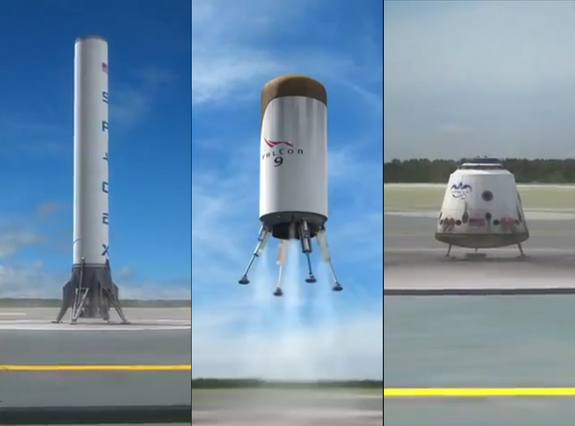
SpaceX has proven the reusability of the Falcon 9 first stage (left) and the Dragon capsule system (right). All that remains is developing a reusable second stage, most likely for use with the Falcon Heavy – or as a part of the ITS / BFR. This image shows the discontinued proposal for a reusable Falcon 9 second stage. Credit: SpaceX
The problem here is that of mass. The nature of rocket staging means that – very approximately, every two kilos of rocket mass on the first stage reduces the payload capability by around half a kilogramme. With a second stage unit, this can drop to a 1:1 ratio. So, all the extra mass of the re-entry / recovery systems can reduce the total payload mass, making the entire recovery aspect of a Falcon 9 second stage both complex and of questionable value, given the possible reduction in payload capability. However, with the Falcon Heavy due to enter service in 2018, a reusable second stage system does potentially have merit, as the combined first stages of the system can do more of the raw shunt work needed to get the upper stage and its payload up to orbit.
The Habitability of Rocky Worlds Around a Red Dwarf Star
Red Dwarf stars are currently the most common class (M-type) of star to be found to have one or more planets orbiting them. Many of these worlds appear to lie within their parent’s habitable zone, and while that doesn’t guarantee they will support life, it does obviously raise a lot of questions around the potential habitability of such worlds.
There tend to be a couple of things which often run against such planets when it comes to their ability to support life. The first is that often, they are tidally locked with their parent star, always keeping the same face towards it. This creates extremes of temperature between the two side of the planet, which might as a result drive extreme atmospheric storm conditions. The second is – as I’ve noted in past Space Sunday articles – red dwarf stars tend to be extremely violent in nature. Their internal action is entirely convective, making them unstable and subject to powerful solar flares, generating high levels of radiation in the ultraviolet and infra-red wavelengths. Not only can these outbursts leave planets close to them subject to high levels of radiation, they can cause the star to have a violent solar wind which could, over time, literally rip any atmosphere which might otherwise form away from a planet. This latter point means that one of the most vexing questions for those studying exoplanets is how long might such worlds retain their atmospheres?
In an attempt to answer to that question, planetary astronomers have turned to a planet far closer to us than any exoplanet: Mars.
Update: D 0 X has closed, and Paradise has a new setting – Tokyo Street. Read this review for more. SLurls removed from this article.
D 0 X is a Homestead region designed by Paradox Ivory, and the home of the Urben Gallery. Open to the public, the region, at the time of our visit, lay split into three winter-bound islands, rowing boats (via rezzer) enabling explorers to travel between them without the need for flying.
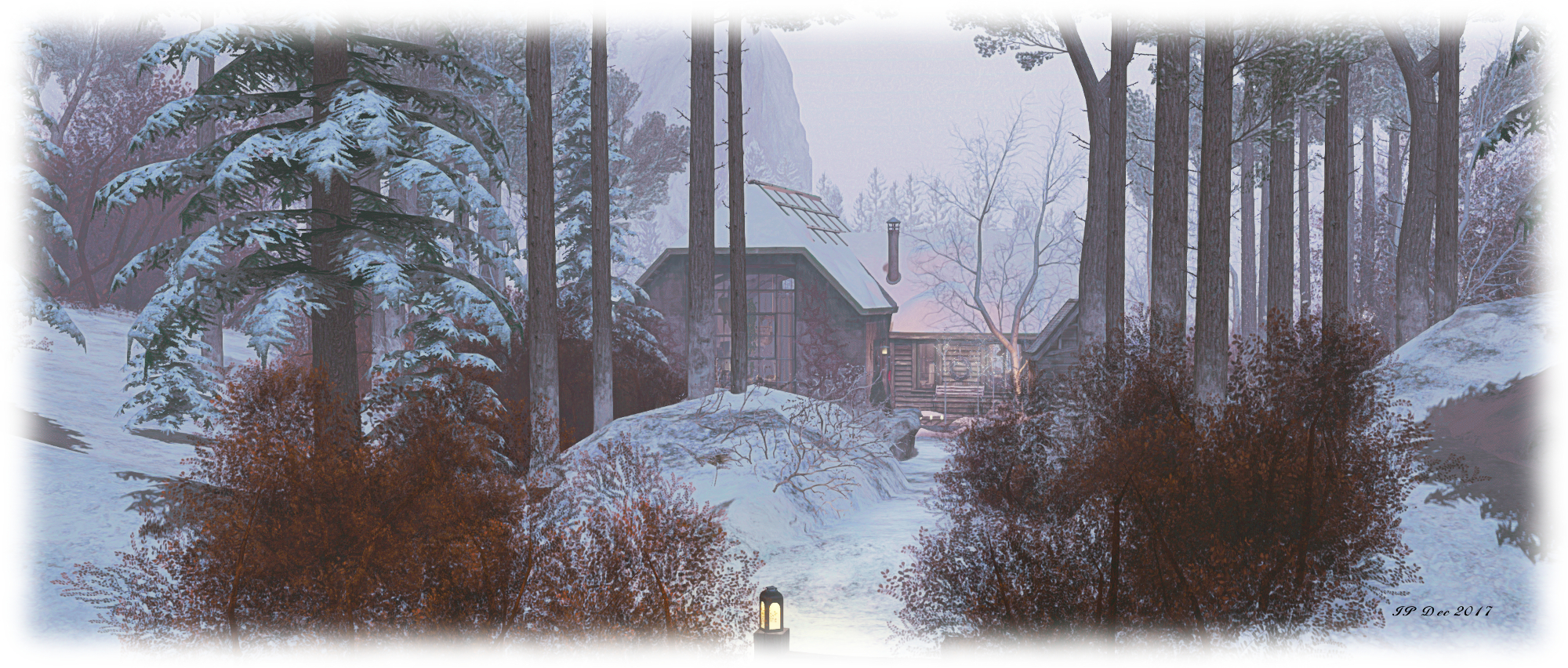
Visitors arrive on the largest of the three islands, on the north-west side of the region, where snow is falling heavily. The landing point is on the central neck of the island, a short distance from the warehouse forming this single living space on the island. This has been converted into a cosy home, where someone has been baking and the table is set for dinner. Through a glass panelled door, the bedroom is scattered with the bric-a-brac of daily living, the entire scene within the building one of homely warmth, perfectly contrasting with the snowy scenes visible through the windows.
D o X – click on any image for full size
Outside, paths offer ways west, east and south. The latter is the shortest, running past an old church gatehouse (in which sits information on the region and a teleport up to the Urben Gallery, which will open on January 7th, 2018. This path ends at a wooden jetty where a rowing boat can be reached, providing the way to reach the remaining two islands.
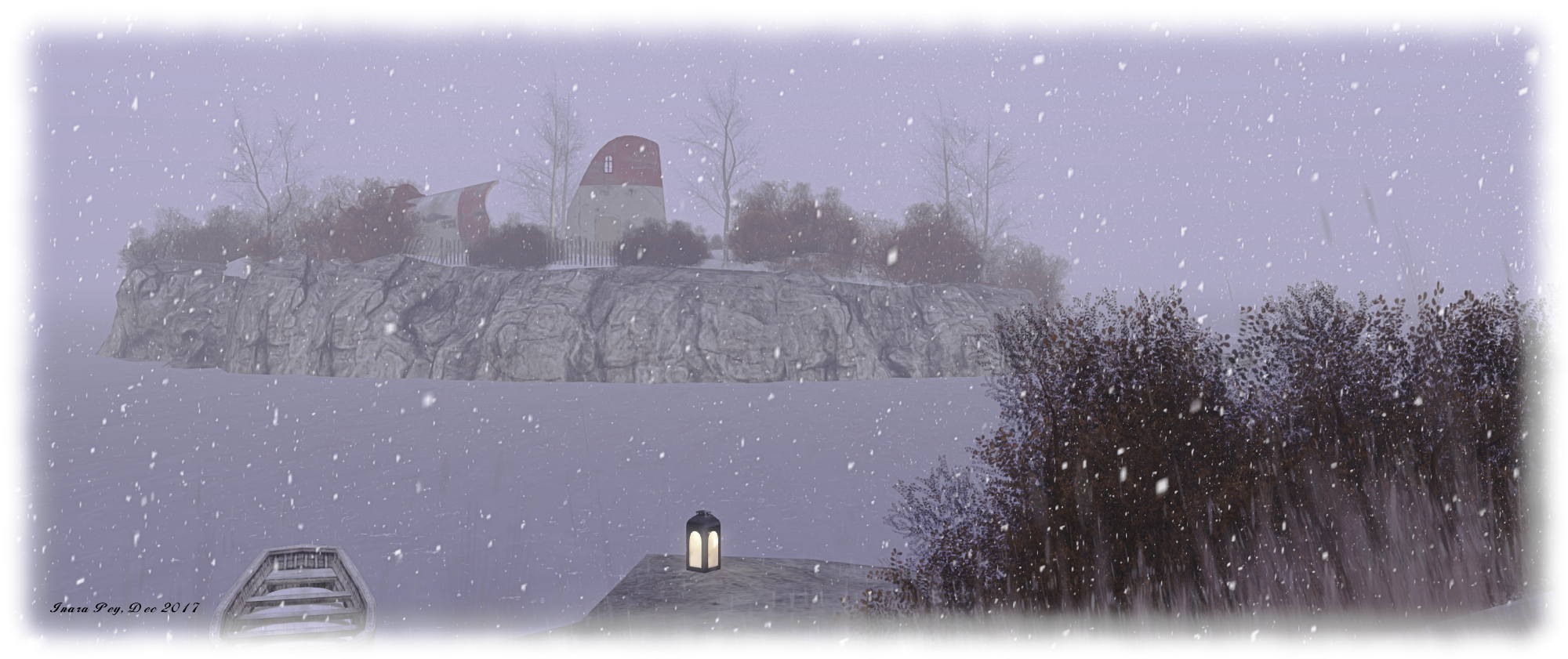
The path to the east climbs a little set of stone steps under an arch of rowan boughs string with lights. It leads, by way of a path running between trees and bushes, to a rocky outcrop providing a view out over the winter waters to the smallest of the three islands, the home of a ruined lighthouse. Westwards, the path is wilder, again running between trees and bushes to a south-facing headland and offering a view towards the second largest of the islands.
D o X – click on any image for full size
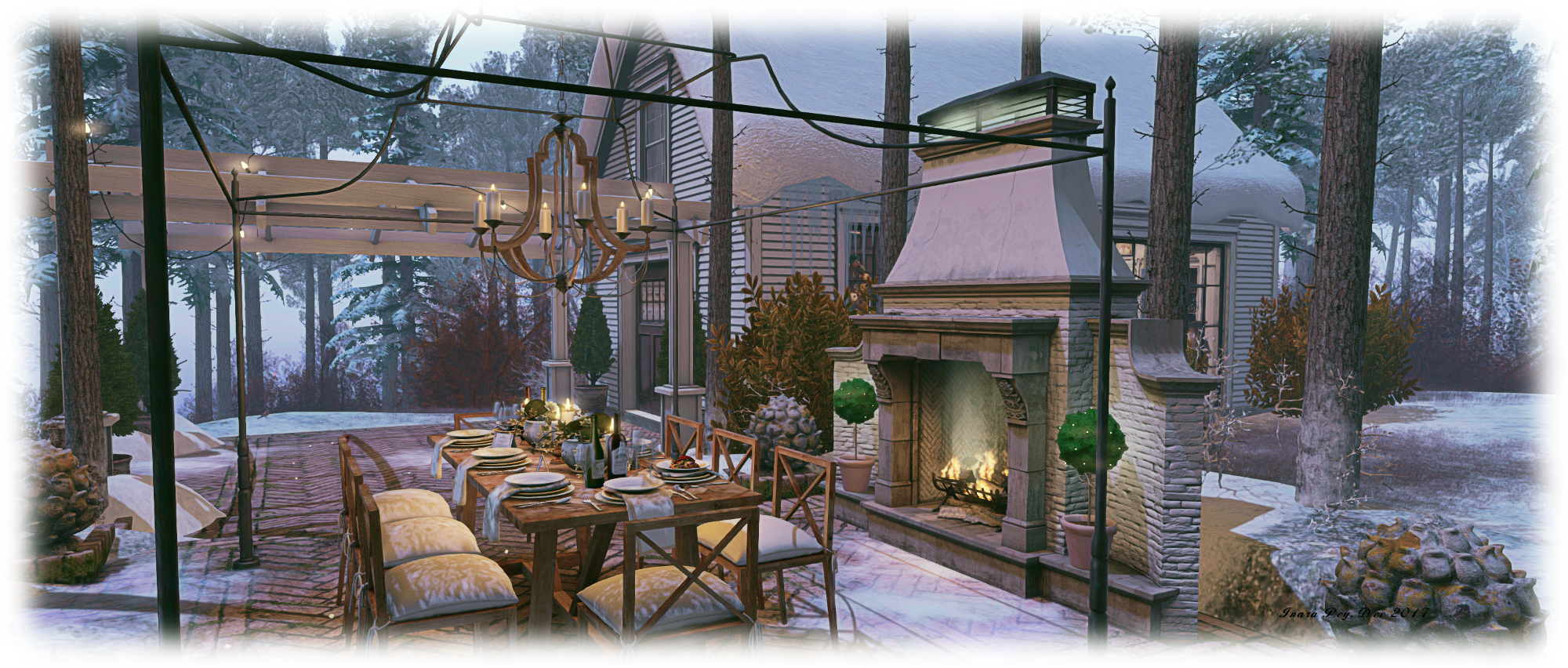
With a grey rocky skirt topped by undulating snow, this island is home to a barn converted into a warm snug of a home, where the traditional bed appears to have been replaced by a chaise. The fireplace sparkles with flames, armchairs you could lose yourself in ranged before it, with all the accoutrements of life again scattered cosily around. Whoever lives here obviously isn’t put off by the cold: the brick paved terrace to the front of the property features a table set for dinner, an outdoor fireplace glowing with warmth alongside it.
The barn is reached via a path rising by step and curve from the island’s jetty, guarded at either end by gabled gates. This path runs alongside the house, offering access to the front terrace before continuing on to another outdoor seating area atop a small squared-off terrace and warmed by another fire. A little to the south from the barn, and overlooking a little inlet, is another outdoor fire and seating, a Thermos available for hot drinks.
D o X – click on any image for full size
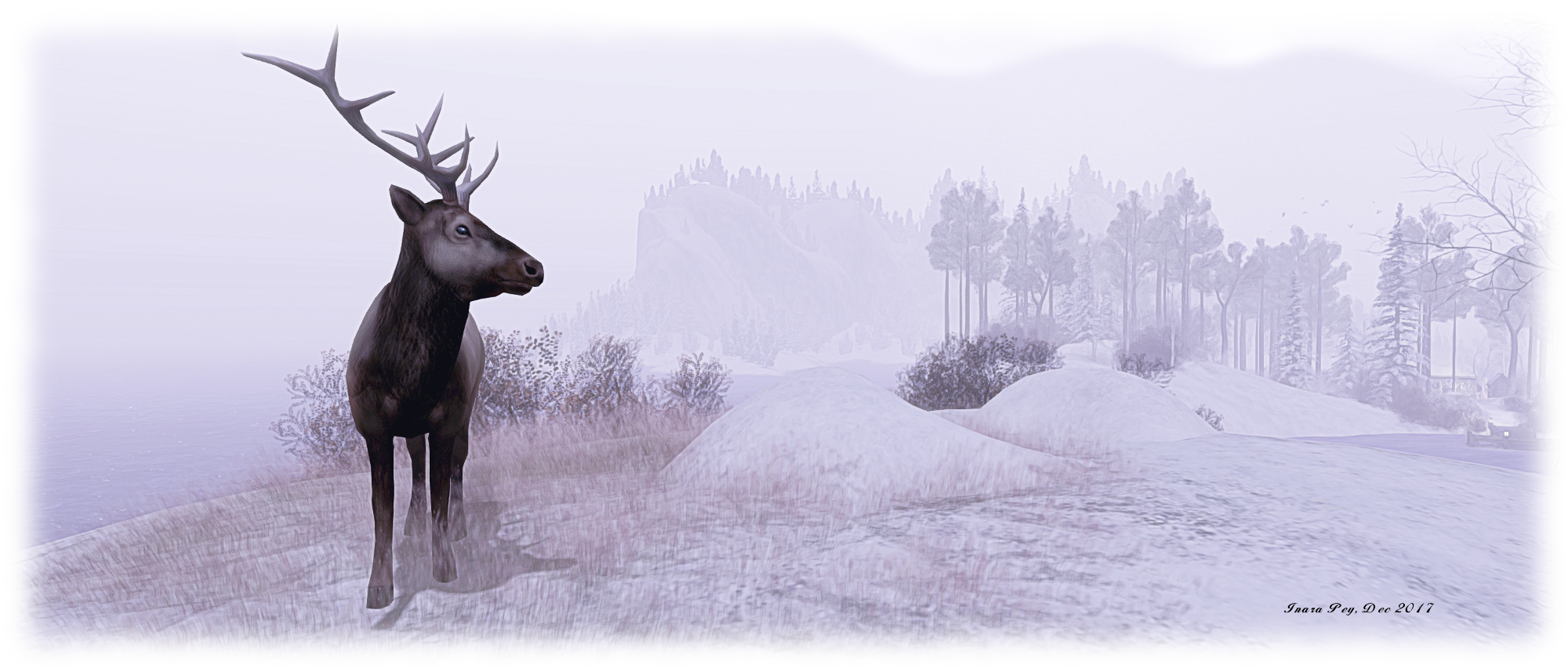
The northern end of this island is crowned by a great wind turbine – presumably providing electrical power to the properties on both of the larger islands. Its great blades turn steadily, shadows seeming to slice silently over the snow, completely ignored by the deer roaming here.
With two further (off-sim) islands to the north-west and south-east, D o X has the feel of a tiny winter-bound archipelago in which seasonal retreats have been established. Set beneath a twilight sky circled by an aurora and patrolled by deer, it is a picturesque setting. We’ll doubtless be returning in the new year, when we’ll also pay a visit to the Urben Gallery up in the sky.
The following notes are taken from the Sansar Product Meetings held on Friday, December 15th. These meetings are usually held every Friday at 9:30am PST and 4:00pm PST, and are open to all. There is currently no set agenda, and the meetings are a mix of voice and text. The official meeting notes are published in the week following each pair of meetings, while venues change each week, and are listed in the Meet-up Announcements. and the Sansar Atlas events section.
Nyx Linden attended the morning session; a former member of the engineering team for Second Life, Nyx is perhaps best known for his appearances in-world as the Tiny Robot, and leading the “old” Content Creation User Group meetings which used to take place in-world on Mondays. Nowadays, Nyx is a member of the Sansar product team, working on the planning / road mapping side of the platform’s development and coordinating the various development teams.
Fashion Release
Again, please refer to my week #49 and week #48 updates for notes on known elements in the upcoming release.
The Fashion release should be deployed during the week commencing Monday, December 18th.
This initial release will not include cloth physics within the run-time mode (although they may be available in the Avatar App). Instead the baking service will continue to handle clothing as is currently the case.
The avatar mesh models will be provided via the Knowledge base when the release is deployed. These will most likely be supplied as .FBX files, rather than a blend file – but this is still TBC.
It will be possible to upload hair attachments, but the recommendation appears to be for creators to initially keep to shorter hair styles to avoid hair cutting into the avatar bodies at this point in time
On the non-Fashion side, the release will include a number of script updates including keyboard commands for scripts and updates to object APIs.
Modifying Materials on In-World Objects
There is still considerable upset over the decision to allow experience creators to modify / change the materials of in-scene items. This change is due to be deployed with the Fashion update, but does not extend to avatar clothing or attachments and any changes made to an object last only as long as the object is within a scene – they cannot be saved back to inventory when the object is removed.
Some creators see this as a reason not to upload their items until such time as the permissions / licensing system is deployed.
Some want to see a guarantee from the Lab that the change will not be extending to include accessories / clothing in a future release, ahead of the licensing / permissions system deployment. This is to be escalated to senior management for feedback.
Character Creation Flow
A point to note with the Fashion release is that users logging-in to Sansar the first time after the release has been deployed will have to go through the character creation flow.
This is because existing clothing will no longer work with the update.
It will mean that any custom work done to the avatar’s face will have to be re-done as well.
Sansar Store: Product Updates: Nyx indicated that there are still complexities around licensing / pricing which need to be resolved. As such, the Lab is considering possibly going with a basic system to allow for updates through the store, and then enhancing it as other elements of work fall into place. However, there is no time line as yet on when something might appear, but it is on the road map.
Permissions / Licensing System: the Lab is actively working on a permissions / licensing system, however, there is still no time frame as to when it might start to be deployed.
Dynamic mirrors and using in-scene cameras to record and project the scenes onto a surface: neither are on the road map as present. Dynamic mirrors can be rendering-heavy, and are not something the Lab is currently looking at.
The following notes are taken from the TPV Developer meeting held on Friday, December 15th 2017. The video of that meeting is embedded at the end of this update, my thanks as always to North for recording and providing it.
SL Viewers
[2:35] The Alex Ivy 64-bit RC viewer has one more bug the Lab would like to resolve, this one with the updater within the viewer. The hope is a fix for the issue will be in a further update to the viewer at the start of week #51, commencing Monday, December 18th. If so, the viewer might be promoted to de facto release status before the holiday break.
[6:46] Once the Alex Ivy viewer is promoted to release status, the Lab will move to block versions of their viewer older than the 5.0.6 viewer (the HTTP updates from June 2017).
[4:00] The Voice RC viewer updated to version 5.0.10.330039 on December 12th. This is doing “very well” and is currently being held from promotion due to the wish to promote the Alex Ivy viewer. As a result, the Lab might do a further RC update for it, with a new update from Vivox.
[5:19] A new Maintenance viewer, version 5.0.10.330035, appeared on December 13th. It features a range of fixes, and is code-named Nalewka, in keeping with the Lab’s new habit of naming Maintenance viewers after alcoholic beverages. Nalewka is, according to Wikipedia, a rather interesting beverage mixing alcohol (vodka or neutral spirits) and fruits, herbs, spices, sugar / molasses and which has a liquer-like taste.
[5:43] The anticipated 360-snapshot viewer update has been held while it is integrated with Second Life Place Pages. This will allow 360 images to be uploaded to Place Pages and used in hero images, etc. It is anticipated that these updates will now appear early in the New Year and the viewer should move quickly to RC status thereafter.
[4:43] TPVs attempting to use the viewer updater have encountered issues, often resulting in them disabling it. Oz Linden acknowledges it isn’t easy for TPVs to update it, but has offered to work with them to fix issues once the Alex Ivy viewer (which uses a new version of the updater) reaches release status, coupled with a code refactoring to make updating it easier in the future.
Linux and the Viewer
[20:51-24:28] As per my previous TPV meeting notes, once the Alex Ivy 64-bit viewer (Windows and Mac) goes to release status, the Lab will look to TPV / open-source developers to help move the Linux viewer build to a Debian package without the additional libraries. this will allow TPVs to add the dependencies they require for their flavour of Linux build. If help is given and the project is successful, the Lab will then maintain the Linux build, with the caveat that it will only be subject to cursory QA, and will continue to look to the Linux community for fixes.
A repository for code submissions will be made available, together with a blog post / open-source community notification on the specifics, after the 64-bit viewer has been promoted to release status. Those wishing to support the work will need to sign a contribution agreement with the Lab.
Texture Decoding and Texture Memory Limits
[28:23-29:52] The Lab is making improvements to texture handling (e.g. using raw texture data rather than encoded). Some of this work is in the current rendering project viewer; there is another non-public viewer which uses a new structure for the rendering cache – although this hasn’t been overly successful in testing thus far. Oz is anticipating his team spending more time on rendering in early 2018.
Environment Enhancement Project (EEP)
A set of environmental enhancements, including the ability to define the environment (sky, sun, moon, clouds, water settings) at the parcel level; a new environment asset type that can be stored in inventory and traded through the Marketplace / exchanged with others; scripted, experience-based environment functions, an extended day cycle and extended environmental parameters. This work involves both a viewer updates (with a project viewer coming soon) and server-side updates.
[10:01-11:34] “Rider’s been on a power trip since starting this project!” Grumpity joked at the meeting, “Moving these celestial bodies around the sky!” – which Rider admitted was fun.
Progress continues, and it is anticipated that test regions on Aditi and a project viewer will be available “soon after” the new year, although these may not initially support using environment settings and inventory assets.
Server-side Reset Skeleton
[30:10-35:25] Bento introduced a reset skeleton option for details with avatar deformations. However, it is viewer-side only – therefore, if someone swaps between skeletons / avatars + attachments and is displayed deformed (e.g. BUG11310) or with attachments wrongly place (or a combination), they, and everyone viewing them has to individually perform a reset skeleton on their avatar to correct how they appear.
A preferred means of handling this might be for a local reset to be sent update the appearance system to ensure everyone gets updated (so if I’m deformed, I can use reset skeleton, and everyone around me gets the update as well, rather than having to also use the reset skeleton option). Oz has requested clear, concise feature request on the idea. Grumpity has indicated she’ll follow-up on the specifics of BUG-11310, which the Lab thought to be resolved through and internal JIRA.
Simulator Resources and Simulator Crashes / Performance Degradation
[43:53-50:20] Discussion on simulator resource use / loading balancing. This proceeds from the false assumption that a region / simulator can be crashed “just” by overloading it via a resource / physics hungry script. While there may still be exploits where this might be the case, the Lab long ago imposed absolute limits on script and physics time per frame. What more usually happens is that excessive script / physics loading on a region as whole as a whole can degrade performance as some script / physics executions are skipped within a frame (so scripted objects are slow in responding / may not respond as anticipated, for example); although it is acknowledged that specific items – intentionally or through bad scripting – can have an undue impact on performance. Anyone encountering specific objects, which can individually adversely impact region / simulator resources / performance is asked to file a JIRA with details of the object in question, so that the Lab can obtain a copy and poke at it.
Other Items
[13:24] Estate access / ban lists: (Estate/Region floater) – work has stalled on this.
[14:21] A question was raised on the ability to teleport others home from, or out of, your own parcel, a capability that had been available in the older v1 (and v2?) viewers. Having an ability to remove people at parcel level is something the Lab will likely look at as they continue to work on the land tools.
[16:59] the updates to the estate tools will include a log of ban actions taken – who banned whom and when – which will be visible to all Estate Managers (not general group / land users).
[35:35-36:20] Semi-automatic viewer tests: Kitty Barnett (Catznip) have a number of semi-automated viewer tests (e.g. checking to see if all UI elements / floaters work in different languages). The Lab have found that as the viewer is updated / changed so often, such tests rarely maintain their value over a period of time. However, Oz is willing to learn more about at Kitty’s framework if it avoids such issues.
[36:39-37:53] Viewer support for local meshes: this has been a frequent request, particularly with content creators. It is also something the Lab and Firestorm have looked into. However, supporting multiple mesh formats, dealing with LOD compositing, etc., makes it complex and difficult to implement within the viewer. However, if the Lab can find a way for the viewer to do this, they would consider implementing it.
[50:43-55:07] Phishing/ URL link spoofing: a discussion on the use of URL link spoofing – which has affected Second Life and is a general issue on the web as a whole. Short version: always check URLs before clicking whatever you’re doing, and in terms of SL: always treat links receiving (e.g. via dialogue boxes, via unexpected / unknown IM, etc.) with caution, and while it does not eliminate risks, configure your viewer to use an external web browser to open external links. Obviously, and like any other company, the Lab cannot – and will not – every guarantee the safety of accessing URLs which are outside of its control.
While not foolproof, setting your viewer to use an external web browser or to only use the built-in browser for trusted links from LL, might provide some added protection against scam URLs you might obtain through in-world sources
Lab No Change window: runs from Thursday, December 21st 2017 through until Tuesday, January 2nd, 2018.
Next TPV Developer meeting: Friday, January 12th, 2018.
Firestorm release: the next Firestorm release now looks set to go to beta in the week commencing Monday, December 18th, with a release to be made early in the New Year.









 Inara Pey: Living in a Modemworld