Return to ISM in Second Life

International Space Museum

It’s been over five years since I wrote about the International Spaceflight Museum (ISM) in Second Life.  At that time, this two-region facility, offering something of a history of space exploration, had just come through something of a financial crisis (see here and here).  Prior to that, my last visit was far back in 2012 – so I thought I’d hop back over for an update.

Comprising Spaceport Alpha and Spaceport Beta, and entirely funded by donations and sponsorship as a 501(c)3 non-profit, ISM is a large-scale undertaking, providing a good introduction to the history of space flight, charting many of the key events and the systems they used. It provides insight into international space operations covering – America, the Soviet Union/Russia, Europe, Japan, China, India – together with something of a look at commercial activities.

International Space Station: Rocket Ring

A visit starts at the main landing point / information hub. This features a citation to a letter from Konstantin Eduardovich Tsiolkovsky, the Soviet Russian rocket scientist regarded as the “grandfather” of modern rocketry. Given as Earth is the cradle of humanity, but one cannot live in a cradle forever, the quote is from a phrase Tsiolkovsky wrote in 1911, which transliterates as Planyeta yest’ kolybyel razuma, no nyelzya vietchno zhit’ v kolybyeli – “a planet is the cradle of mind, but one cannot live in a cradle forever”. However, both this literal translation and the more popular quote point to the same ideal: that to grow as a species, humanity must as some point reach beyond the planet of our birth.

A path leads away from the landing hub towards ISM’s most impressive feature: the Rocket Ring. This provides models of some of the major launch systems used by countries around the world. This includes vehicles such as the V2 rocket – which both Russia and America utilised in their early post-war experiments; launch systems developed from ballistic missile systems – such as America’s Titan and Atlas; through to more familiar launchers such as the Soviet / Russian Soyuz and Proton families, and a look at some of the more recent vehicles to enter the market: SpaceX’s Falcon 9 and Falcon Heavy.

International Space Museum: SpaceShipOne

The ring is far from complete – systems such as Blue Origin’s New Shephard and New Glenn are lacking, NASA’s Space Launch System is missing (although the cancelled Ares launchers from the US Constellation programme are present, dominating the ring alongside Russia’s massive N1 lunar booster). However, space is limited, and what is presented is still a rich array of launch vehicles which, for those interested in the less well advertised space programmes – such as Japan’s, India’s or China’s, provides some excellent models of their current fleets.

Beneath the Rocket ring are further exhibits, including models of the Apollo Command and Service Module (CSM) and Lunar Excursion Module (LEM), the Gemini capsule, and a look at the lives of  Tsiolkovsky and Robert Hutchings Goddard, regarded as the “father” of modern rockery. NASA’s Orion Multi-Purpose Crew Vehicle (MPCV) in both its original form, with rounded solar arrays and a more recent design, featuring twin rectangular solar arrays. Orion will use a Service Module based on the European Automated Transfer Vehicle (ATV), which used to haul up to 5 tonnes of supplies and equipment to the space station, and include the ATV’s unique arrangement of four solar arrays.

International Spaceflight Museum: an historical look at the ISS with the shuttle docked, and a European ATV resupply vehicle arriving. Also docked is a combination of Soyuz+Progress vehicles

Further out from these are further displays, including the Apollo Saturn 1B rocket, information centres and more. These also include interactive elements, such as a Gemini V / Atlas II rocket, which offers a ride up to one of the sky exhibits – that of the International Space Station (which can also be reached from the ground-level sit-on teleport kiosks). Also in the sky and reached from the ISS display, are models of the solar system.

Spaceport Bravo, reached via a runway-like bridge over which the first sub-orbital flight of SpaceShipOne is recorded, sits a reproduction of NASA’s Vehicle (or Vertical, as it was originally known) Assembly Building (the VAB). This is where the Apollo rockets and space shuttle systems were “stacked” and readied for launch, and where the SLS rocket will be assembled ready for flight. One of the bays in the VAB feature the space shuttle Atlantis, which has just been mated with its External Tank / Solid Rocket Booster units; the other features a Saturn V leaving the bay atop its crawler-transporter. Alongside of this is an Orbiter Processing Facility (OPF), the interior of which is somewhat sparse, but does offer models of NASA’s lunar rover vehicle and the  Lunniy Korabl (LK) lander vehicle which formed part of the Soviet Union’s manned lunar programme aspirations.

International Space Station: Mercury recalled

Visually, ISM offers a lot to see, not all of which is expressed here – and at one time hosted a range of events (it’s unclear whether this is still the case). However, there are some disappointments. An attempt has been made to link exhibits to a wiki, but the majority of pages have yet to be populated, for example. Several areas appear a little sparse – such as the OPF building, as noted; all of which gives a feeling the ISM is caught in time – as if in the midst of a still-to-be completed update, including elements which might be relatively easily seen to. Take the photo map of the Florida space coast, for example. This shows the facilities at both Kennedy Space Centre and Cape Canaveral Air Force Station, but has yet to be updated to reflect SpaceX’s use of Kennedy’s Pad-39A and Canaveral’s SLc-40 and SLC-13.

Even so, for those who want to dip their toes a little more deeply into the world of space flight, ISM retains a lot to offer, while across the water NASA’s Explorer Island offers an interesting looking back in history to the US space agency’s involvement in Second Life.

SLurl Details

International Spaceflight Museum (Spaceport Alpha, rated; General)
Magic Leap previews its first AR/MR system

Magic Leap One. Credit: Magic Leap

Magic Leap has had its share of ups-and-downs over the past few years. Founded by tech wizard Romy Abovitz, the super-secret company has been at the centre of hype, speculation and doubt. Much of the hype has been spun by the company itself, much of the doubt has been driven by reports of friction in the company, issues with the technology, and so on.

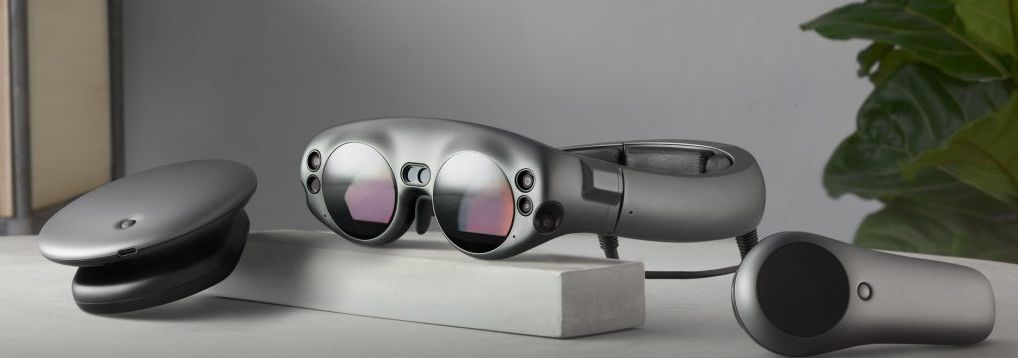
Now, a year after scepticism around the company overtook the hype, Magic Leap has announced the availability of its first product: the Billed as the Magic Leap One Creator Edition augmented (or mixed) reality system, the unit comprises three parts:

  • Lightwear: a headset utilizing the company’s “Digital Lightfield” display technology with multiple integrated sensors to gather spatial information.
  • Lightpack: a  circular belt-worn hip pack that contains the computer powering the headset via a tether.
  • Control: a hand-held controller that can be tracked in space that helps users navigate menu selections, etc.

As an augmented / mixed reality system Magic Leap One is designed to blur the divide between the digital and the real, with the company promoting a series of potential use-cases for it, including:  web browsing and shopping, working on multiple virtual monitors, social telepresence, theme park “rides” and experiences, and gaming.

The system is somewhat removed from some of the hype built-up around Magic Leap’s initial designs – which tended to suggest something far more glasses-like.

There’s no doubt the headset is a lot bulkier than might have been imagined from past descriptions, and while nowhere near as bulky as a VR headset, it leaves a lot to be desired in the ergonomics department, particularly when compared to the likes of AR headsets like Google’s Glass Enterprise Edition or AR systems using  Qualcomm’s snapdragon processors. My own impression on seeing the Magic Leap One images is that the headset looks sci-fi bug-eyed  – almost sinister – and the size of the lenses has me wondering about effective field-of-view.

Lightwear, Lightpack and Control. Credits: Magic Leap

The Lightpack has also come in for critique, with some tech journos calling it “large” or “bulky”. been called “large” by some in the tech press, it’s actually about the same size as Walkman CD players people used to happily clip onto their belts and wear.

The Control has a trackpad and six degrees of freedom (6DOF) tracking, and some six option buttons.

Other than that – details are currently light right now. There are no technical specifications or pricing. However, and in fairness, Abovitz does refer to the announcement as “a small reveal“, rather than any kind of pre-release notification. Instead, interested parties (defined as developers, reporters and the curious) can register their wish to learn more by supplying their e-mail details via a form as the bottom of the Magic Leap home page.

So far, Magic Leap has demonstrated various iterations of their equipment to assorted people from the technology and entertainments industries. All seem to have been thoroughly impressed – although sworn to secrecy – which has been frustrating for those trying to figure out exactly what the company has got. This approach actually continues with this pre-announcement about Magic Leap One – Rolling Stone magazine has an extensive article about Magic Leap in Glixel – but the use of an NDA prevents much in the way of really solid facts around the technology from being revealed, while descriptions of environments are sans images.

Telepresence with Magic Leap One? Credit: Magic Leap

There are, however, some intriguing little pieces of information within the article – such as this ability to generate very life-like characters, which Brian Crecente, writing for Glixel, suggests could become a kind of virtual assistant for those using the Magic Leap:

She walked up to me, stopping a few feet away, to stand nearby. The level of detail was impressive, though I wouldn’t mistake her for a real person, there was something about her luminescence, her design, that gave her away. While she didn’t talk or react to what I was saying, she has the ability to [do so] … I noticed that when I moved or looked around, her eyes tracked mine. The cameras inside the Lightwear was feeding her data so she could maintain eye contact. It was a little unnerving and I found myself breaking eye contact eventually, to avoid being rude.

One day, this human construct will be your Apple Siri, Amazon Alexa, OK Google, but she won’t just be a disembodied voice, she will walk with you, look to you, deliver AI-powered, embodied assistance.

Which sounds very sci-fi-ish, raising the idea of virtual tour guides and suchlike – as well as the question of whether or not we’ll have to cross the uncanny valley with AR as well as (possibly) VR.

I’m somewhat of the belief that AR / MR has the potential to be far more ubiquitous that VR, and garner a much larger, multi-use audience. The likes of Glass Enterprise and several of snapdragon headsets demonstrate considerable interest within healthcare, engineering and retail. The very nature of the technology means it can be integrated far more easily into our everyday lives and work than VR allows. That said, where and if Magic Leap fits into all of this remains as murky as ever. Perhaps the upcoming “Creator Portal”, promised for “early 2018”, coupled with a lifting of the restrictions concerning direct reporting on the system will do more to answer questions.

Steampunk Moods in Second Life

Steampunk Modes: Gem Preiz

Now open at Galerie des Machines, Paris Couture and curated by Olympe (OLYMPES Rhode), is Steampunk Moods, a celebration of steampunk and Victorian technology, with a touch of ecological commentary. The exhibition features art by Gem Preiz, Melusina Parkin, Haveit Neox and Bénédicte Petiet.

“Straddling the reincarnation of the past and a certain idea of ​​the future, Steampunk is primarily an aesthetic current of literary origin before developing on a multitude of other media,” Olympe states in the introduction to the exhibition. “A temporal paradox, it mixes centuries of fiction, Jules Verne, [Herbert] George Wells, popular culture, films, comics and other video games.” The art presented within the gallery’s halls reflects this in a most eclectic mix of 2D art spanning the virtual and the physical, and which mixes what might be termed “traditional” steampunk imagery with more familiar Victoriana and interpretations of the future.

Steampunk Modes: Melusina Parkin

The ground floor of the gallery features a selection of Gem Preiz’s stunning fractal art, and the first glimpse into the future. It’s well established that I’m a major admirer of Gem’s work, and the pieces selected for this exhibit reflect why. Gem’s fractal art is hugely evocative in painting visions of the future; they encompass everything from cosmology through issues of ecology and human development,  touching – richly so – on concepts of architecture,  design and culture.

Several of these factors are touched upon within the thirteen images presented here – but so to is a sense of mechanisation. Several of the pieces have the look and feel of great engines – or parts of engines; others seem to suggest great cogs and wheels. There are also other reflections of steampunk: hints of lenses, twists of grill work and plating that are almost decorative in look and feel – the finery that can so often be found in more delicate pieces from the era. Each image is uniquely beautiful and  – literally – multi-faceted, demonstrating Gem’s multi-panel approach to his art that allow him to offer marvellously high-resolution pieces of his original art.

Steampunk Moods: Haveit Neox

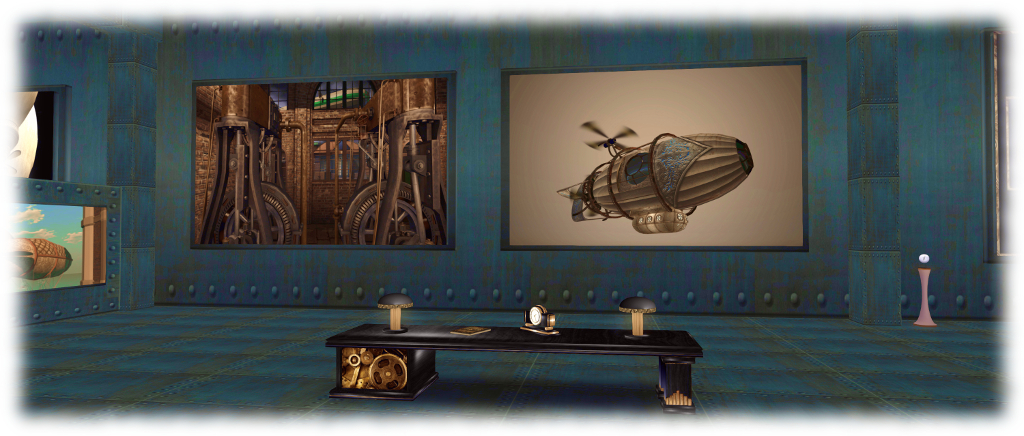
On the floor above Gem’s exhibit is an extensive display of in-world photography by Melusina Parkin, featuring steampunk elements found throughout Second Life, both large and small and presented in a suitably metal-walled environment. Many of the images present objects and scenes in Melu’s familiar close-up style, focusing our attention on specifics, rather than a broader scene, while still conveying an entire story to a piece. Several of them present familiar steampunk themes – powered airships: both dirigible and boat-hulled. Propellers also feature, while there are hints of Verne and Wells to be found.The models of Battersea Power Station, dating from the 1930s, might seem a little incongruous. But given it is an iconic emblem to industrial power, it is somehow fitting.

Passing through the display of Melusina’s art brings visitors to a second hall, where Haveit Neox’s contribution can be found. This takes the form of an iteration of his installation, The Miniature Goal, first seen in 2014.  Within it, Haveit asks, “What if our physical world shrunk in proportion to the resources we drain from it?” As I wrote back in 2014, this is a fascinating piece; here it perhaps offers a slightly different look at steampunk. The technology of the latter is somewhat based on the consumption of fossil fuels and other natural resources, consideration of the consequences are perhaps not so at odds with the core theme.

Steampunk Modes: Bénédicte Petiet

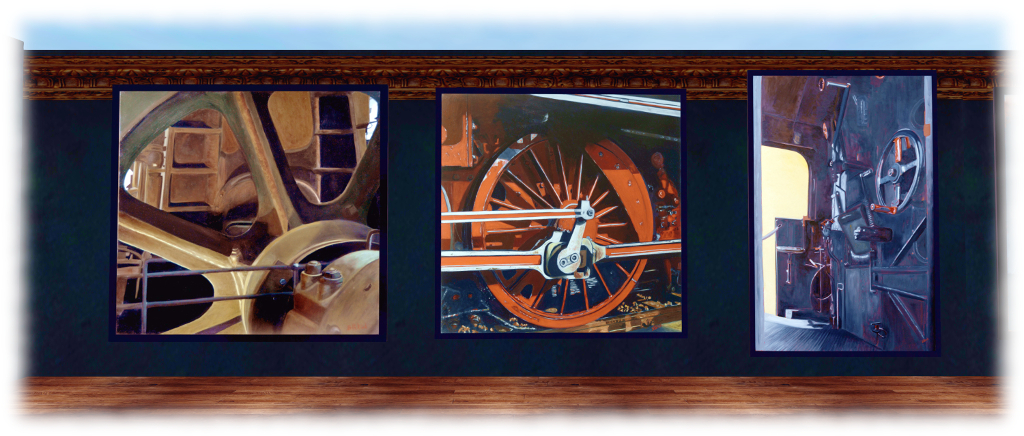
Above the floor featuring the physical world art of   Bénédicte Petiet. Again, the canvas here is broader than what might be regarded as “traditional” steampunk. Like Melu, Bénédicte presents the most of his images in close-up: machines, wheels, pistons, gears, relays … all are presented here. So to are what might be considered elements from outside the realm of steampunk itself: cars from the recent past, and even street scenes. With the exception of the latter – which appear to be a mini-exhibit in their own right – the rest of the images suggest something almost “retro-futuristic”: the past we can recognise presented through a digital medium of their future.

All told, a multi-faceted exhibition, well worth exploring.

SLurl Details

SL project updates week #51: server, viewer

Cherishville; Inara Pey, November 2017, on FlickrCherishvilleblog post

Server Deployments

There are no planned deployments for week #51. This will leave the grid running on server release 17#17.12.01.511131 (link to SLS summary page).  However, given the RC channels have not been restarted in the last two weeks, there may be a rolling restart for all three RC channels on Wednesday, December 20th.

SL Viewer

The Nalewka Maintenance RC viewer updated to version 5.0.10.330111 on Tuesday, December 19th. This adds a further 11 fixes and updates to the viewer since the initial release of the viewer RC.

The Project Render Viewer updated to version 5.1.0.511446 on Monday, December 18.

The Alex Ivy 64-bit RC may also get an update during the week. However, at the moment the remainder of the SL viewer pipeline remains as per the end of week #50:

  • Current Release version 5.0.9.329906, dated November 17, promoted November 29th – formerly the “Martini” Maintenance RC – No Change
  • Release channel cohorts:
  • Project viewers:
  • Obsolete platform viewer version 3.7.28.300847, dated May 8, 2015 – provided for users on Windows XP and OS X versions below 10.7.

User Group Meeting Dates

With the holiday season on us, users group meeting dates are as follows:

  • Simulator User Group: next meeting: Tuesday, January 2nd, 2018, 12:00 noon.
  • Open-source development group: Wednesday, December 20th; Wednesday, January 3rd, 2018.
  • Server Beta User Group: Aditi, Thursday, December 21st, December 21st; Thursday, January 4th, 2018 – both at 15:00.
  • Content Creation User Group: Aditi, Thursday, December 21st; Thursday, January 4th, 2018 – both at 13:00 SLT
  • Third-Party Developer Meeting: Friday, January 12th, 2018, 12:00 noon SLT.
  • Web User Group: Friday, January 5th, 2018, 14:30 SLT.

Tarrying at Tramore Bay in Second Life

Tranmore Bay; Inara Pey, December 2017, on FlickrTramore Bay – click on any image for full size

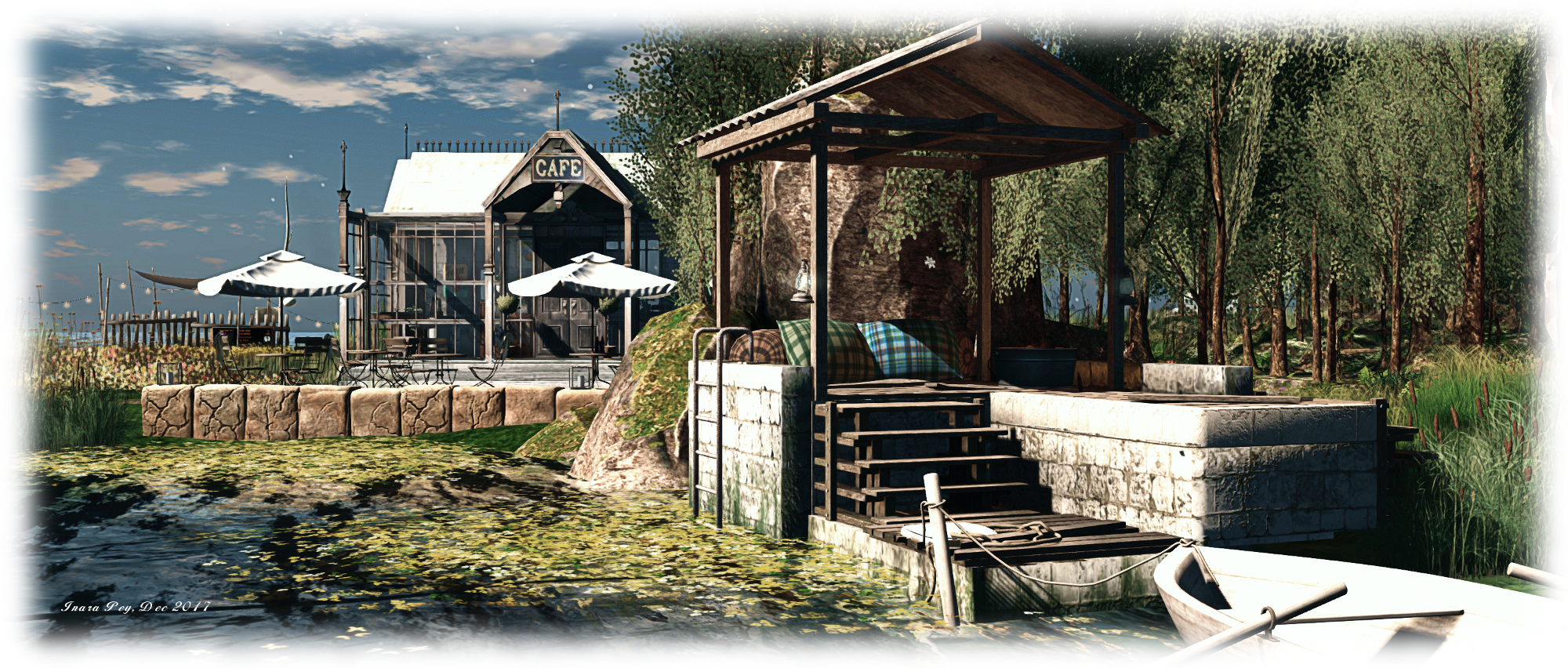
Tramore Bay, the work of Pernilla (PernillaOhl) and Amelie Tautou (Amilee34) is once again evidence that you don’t need at entire region – Full or Homestead – to make a lasting impression in Second Life. Occupying the south-east corner of a Full region, Tranmore Bay is a compacts design, making full used of the space available to presents a highly photogenic and quite delightful cove-like environment in which to spend time.

That said, a visit begins, not within the cove itself, but high overhead, at the industrial / brewery chic Tramore Bar, where music can be enjoyed with a drink and game of darts or while cosying close to the fireplace.  Six teleport options are available on the wall next to the landing point (and a TP station in on the floor, the twin of several at ground level), each of which delivers visitors to an area of the cove at ground level. As all are within easy walking distance of one another, which you take to the ground isn’t that important – although the café is perhaps the most central.

Tranmore Bay; Inara Pey, December 2017, on FlickrTramore Bay – click on any image for full size

The default windlight at ground level is a deep sunset, but this is a place where a rich variety of environmental settings can be used to create the ambience required of your pictures. As Caitlyn and I both felt we needed a break from winter’s snow and hints of winter, I selected a more late summer setting for the pictures here to add some further sensations of warmth.  The café is an old wooden structure, looking equally out to sea and inland. It’s and the rest of the cove lay protected by high rocky walls on three sides, with a view out over beach and sea to the south.

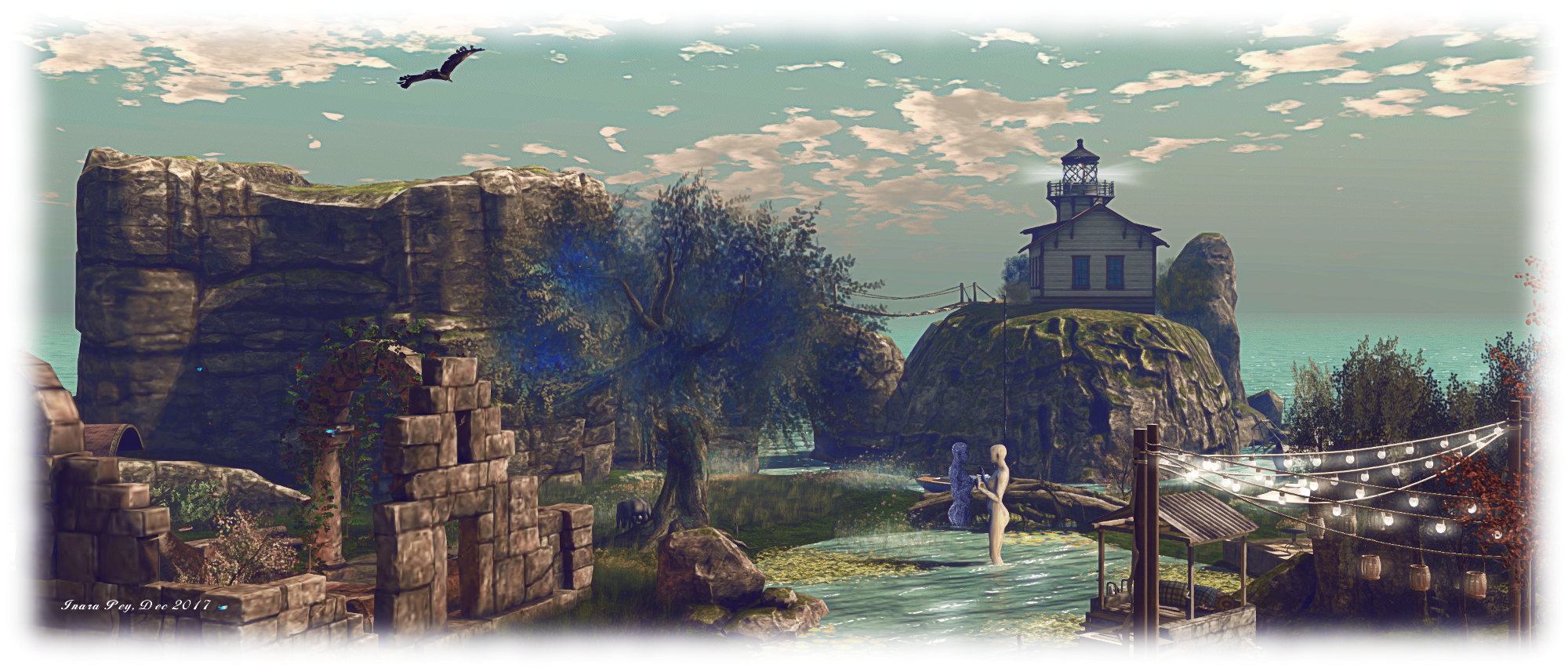
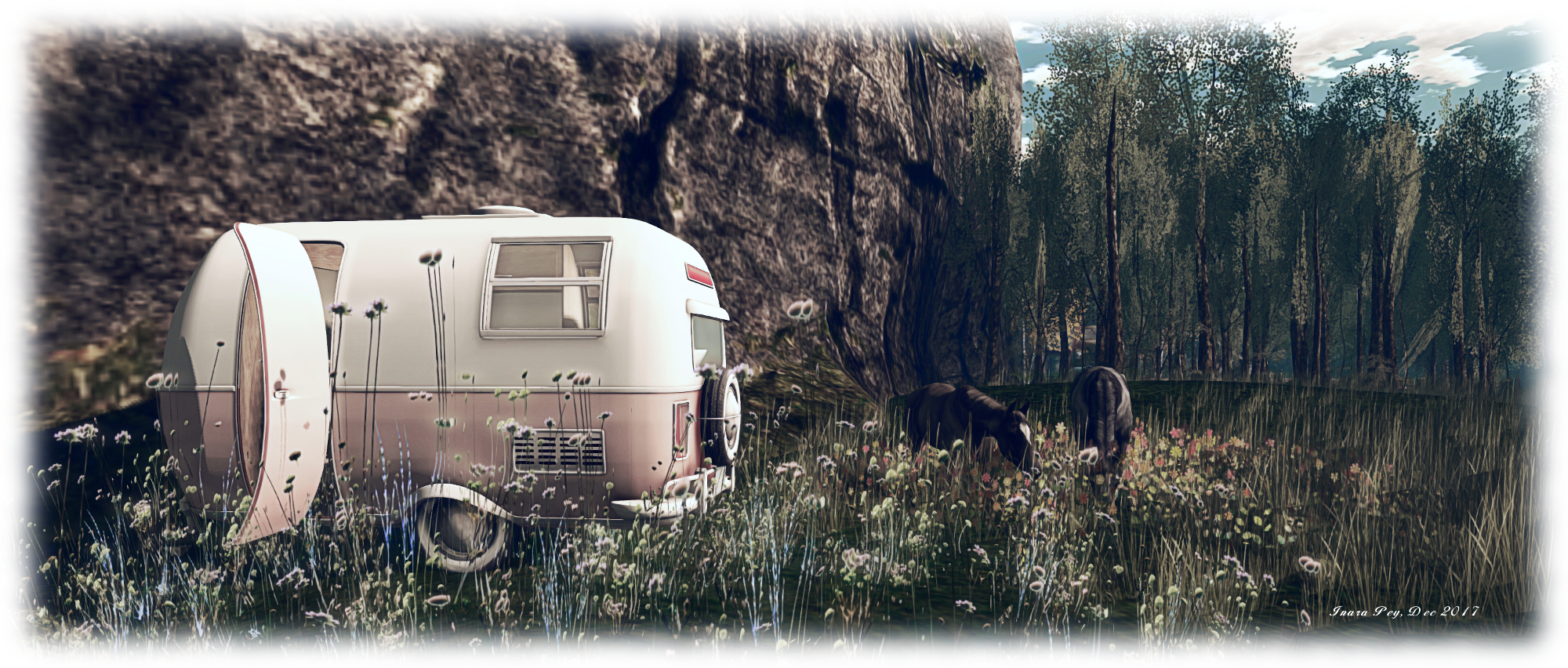
Woodlands border one side of the café , sitting in the lee of the cliffs and offering paths to wander and deer and horses to watch. Inland from the café is a music stage, with a path lurking in the shadows, offering a winding path up into the west cliffs. It is this path, and the one to the east of the land, which add further depth to the setting, allowing visitors to climb up between rocky shoulders to the flat cliff tops, then roam along the grass-covered rock to a camp site on the west cliffs or, by way of wooden bridge, to the chapel-like lighthouse keeping a watchful eye on things from a rocky island in the very south-east corner of the region.

Tranmore Bay; Inara Pey, December 2017, on FlickrTramore Bay – click on any image for full size

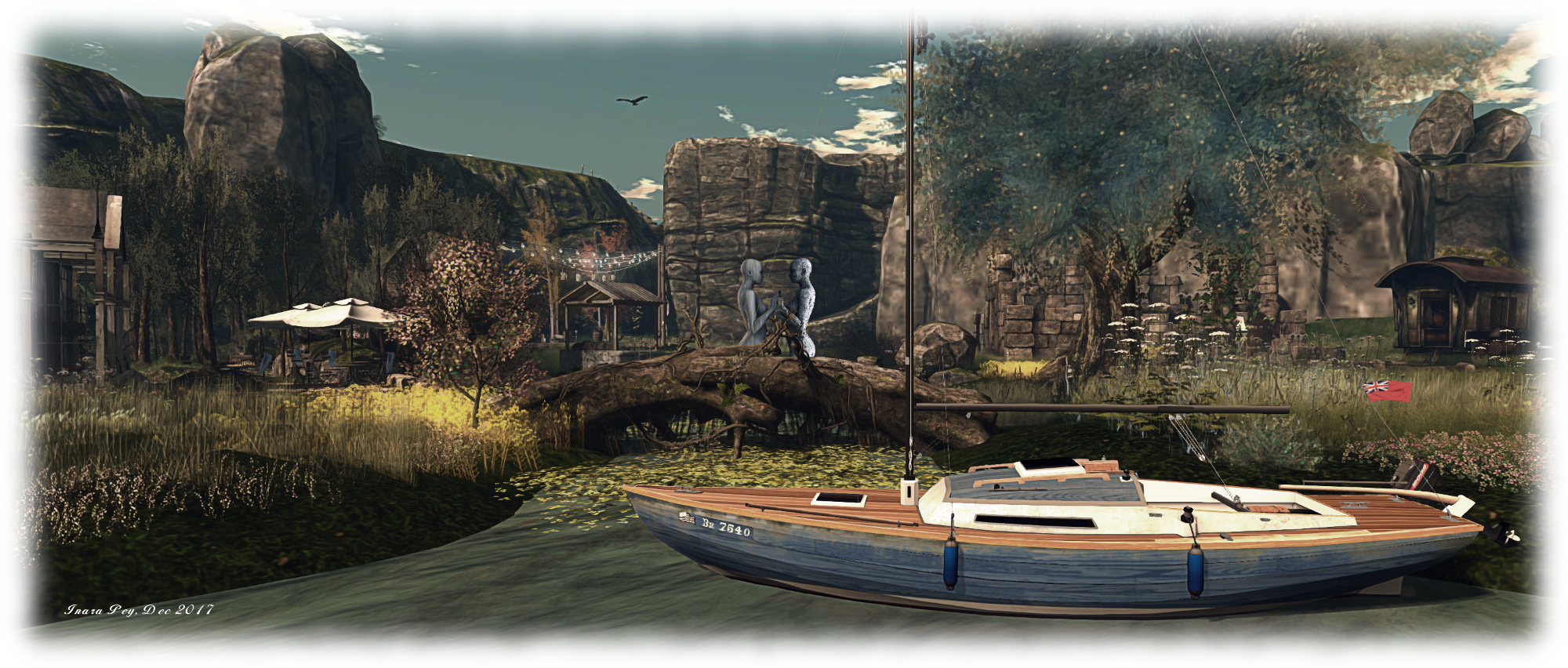
The path to the lighthouse lies across a narrow body of water from the café , spanned by a rough bridge formed by the fallen trunks of trees. The path to it, like the one to the camp site, offers superb views over the land, particularly from the great rocky arch spanning the water to the lighthouse’s little perch. Also to be found on this side of the water, tucked under the cliffs, is an old ruin, the setting for outdoor dining, a little Romany camp close by.

Throughout all of this, there are charming little touches: the wild flowers; the snuggle posts on the beach and around camp fires; a scatter of art by Mistero Hifeng which add a unique feel to the setting; the sailing boat (privately owned) moored in the lee of cliffs and lighthouse island – and more besides. There are a couple of little rough spots in the landscaping where plants perhaps need to be phantom, or path sections don’t quite align, but these are more than compensated for by the sheer beauty of Tranmore Bay.

Tranmore Bay; Inara Pey, December 2017, on FlickrTramore Bay – click on any image for full size

All told, this is a really delightful place to visit. Those interested in learning about music events at Tramore Bay can join the local group, photographers can enjoy the setting for their work, and explorers will find plenty to see and appreciate – and to offer reasons to tarry a while. Should you enjoy your visit, do please consider making a donation towards the enjoyment of Tranmore Bay by others via the tip jar up at the bar.

Tranmore Bay; Inara Pey, December 2017, on FlickrTramore Bay – click on any image for full size

SLurl Details

Sansar Fashion release overview

The Sansar Fashion release, with Marvelous Designer integration. Credit: Marvelous Designer

On Monday, December 18th, Linden Lab announced the Sansar Fashion release, the last major release to the platform for 2017. The title of the release is reflects the fact that the major aspect of the release is focused on clothing and fashion design in Sansar. However, the release covers a lot more than this, with improvements to the uploader, the UI, audio and media, and a host of over changes. I’ve had a quick run through the update, and release notes and the following is offered as an overview of the principle updates.

Avatar Update

The first thing users will notice with this update is that their avatars will need to be re-created – this is as a consequence of the fashion update, and the separating off of the clothing layers. This means facial sliders have to be re-set, but it also means users can experiment with removing /adding clothing.

  • Within in the Avatar App – now called LookBook rather than My Looks -, locate an article of clothing already work and click on it to remove it. Click another item of clothing to wear it.
  • Clothing is split between upper and lower body, and are limited to two layers apiece.
  • Note that the avatar’s underwear is still baked in place, and cannot be removed.
  • Hair can also be removed as well as styles changed.

Once your avatar is set to your satisfaction, save the changes via Done.

Fashion Updates

Clothing

The core of the Fashion updates can be summarised as new clothing support for Sansar. Designers can create their own rigged clothing for use in Sansar / sale through the Sansar Store.

In addition, Sansar offers integrations with Marvelous Designer. This is software that allows designers to create virtual clothing “from basic shirts to intricately pleated dresses and rugged uniforms”. It is able to replicate fabric textures and physical properties, drape garments on physical forms as well as providing the creator with a range of editing tools. It is used by games manufacturers such as EA Games and film effects studios such as Weta Digital.

A new exporter capability in Marvelous Designer allows creators to export their designs directly from the software into Sansar with ease. One in Sansar, clothing can be adjusted on the avatar within the Avatar App (LookBook). You can learn more here, and via the video below. Note: cloth physics for clothing are not currently available in Sansar’s runtime mode.

Sansar creator resources for Marvelous Designer can be found here.

Avatar Meshes

.FBX files for the Fashion update should have been made available, but none are referenced in the release notes, and I was unable to find any reference in the knowledge base outside of the .FBX files for accessories – which may or may not be suitable for clothing (male .fbx; female .fbx).

Hair

Creators and stylists can now create and sell hair styles for avatars. As noted above, avatars can also be bald.

Wearable Accessories

With the Fashion release, wearable accessories are no longer limited to a 1m x 1m x 1m size, instead, they must be within the Axis Aligned Bounding Box (AABB). with the knowledge base article on accessories noting that for import:

Avatar accessories must be close to the avatar. The entire accessory must be within the Axis Aligned Bounding Box (AABB) of the avatar. The AABB’s area is as follows: 0.8m left and right, 0.6m front and back, and 2.2m tall from the feet of the avatar, and 0.05m below the avatar (to account for shoes)**

Note: **Minimum (-0.8m, -0.6m, -0.05m) and Maximum (0.8m, 0.6m, 2.2m).

Atlas Update

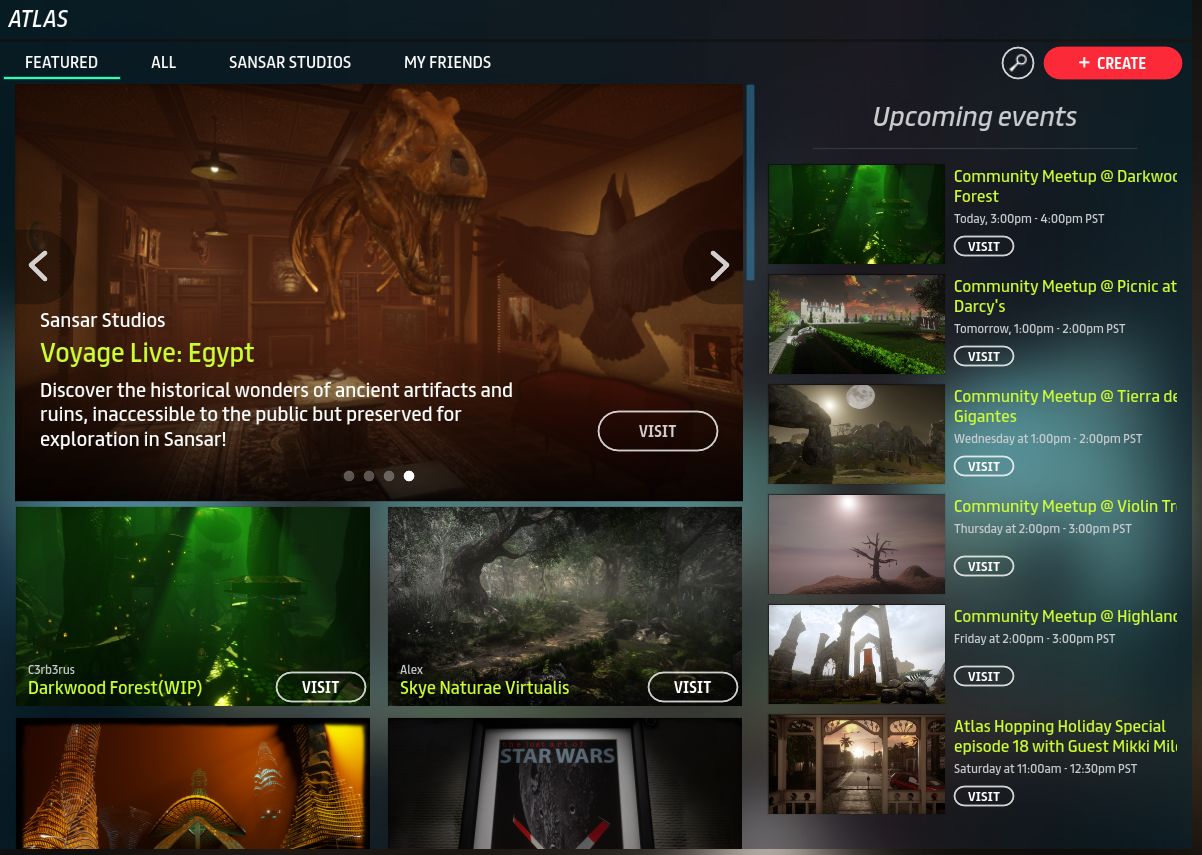
The client atlas has been updated to include submitted events – which are now displayed on the right side, if there are any in the calendar. Each has a Visit button, which will load the experience.

The events section (right) in the updated client Atlas

The Web client now has a new Friends tab. This displays all experiences created by people on your Friends list. If they have created an experience exclusive for access by their friends, this is also where it will appear – it will not appear in the public (Home or All) listings of the Atlas.

Editing Updates

There are a range of editing updates with the Fashion release – for details, please refer to the release notes. These include:

  • A range of audio updates and improvements.
  • A revised upload tool for 3D models and has been relocated to the Scene tool bar – see Importing items to Sansar for more.
  • The ability to import custom heightmaps.
  • New control options to help control an animations – see Working with animated objects.
  • The ability to preview audio and video from within the scene editor.
  • Updates to Reflective interfaces.
  • New object APIs.
  • It is now possible to enable memory limits for scripts which is now capped at 32MB per scene. See Sansar.Script.Memory for more information.
  • Keyboard commands for scripts – subscribe to client “commands” with default keyboard bindings. See AgentPrivate.Client.SubscribeToCommand and the Command Example script in the client folder.

Continue reading “Sansar Fashion release overview”