Space Sunday: “super Earth”, “supermoon”, and Orion’s future

An artist's impression of a "super Earth" type planet in orbit around a red dwarf star. Credit: NASA / Dana Berry.
An artist’s impression of a “super Earth” type planet in orbit around a red dwarf star. Credit: NASA / Dana Berry.

In a couple of recent Space Sunday reports, I covered the discovery of an Earth-size planet orbiting  our nearest stellar neighbour, the red dwarf Proxima Centuari (see here and here). Red dwarfs  are a class of star which has proven rich ground for planet hunters  –  and this has once again proved the case.

The European Southern Observatory ESO), one of the leading hunters of exoplanets, has  reported the discovery of a “super Earth”, a sold planetary body with roughly five times the mass of Earth. It is orbiting GJ 536, an M-class red dwarf star some 32.7 light years from the Sun. The planet is orbiting its parent once every 8.7 days, at a distance of 0.06661 AU.

The planet was discovered using a pair of instruments operated by ESO: the High Accuracy Radial velocity Planet Searcher (HARPS), mounted on ESO’s 3.6 metre telescope at the La Silla Observatory in Chile, and its sister instrument, HARPS-N, at the La Palma Observatory in Spain. The findings from these instruments were combined with photometric data from the All Sky Automated Survey (ASAS), which has observatories in Chile and Maui, to confirm the existence of the planet.

Red dwarf stars are entirely convective in nature, making them extremely volatile in nature, and subject to massive stellar flares. Credit: NASA/CXC/M.Weiss

However, its was no rapid-fire discovery. In all, data from over eight years of observations of the star went into confirming the presence of the planet. Such is the extended period of observations, that the science team were able to gather a huge amount of spectroscopic data on the star. This has revealed it has a rotational period of about 44 days, and magnetic cycle that lasts less than three years. By comparison, the Sun has a rotational period of 25 days and a magnetic cycle of 11 years.

This indicates that GJ536 is, in keeping with most red dwarf stars, exceptional volatile. Such stars are so small, all activity within them is entirely convective in nature, which gives rise to massive stellar flares. So while the new planet may well have “earth” in its description, it is unlikely to be “Earth like”, particularly given its relatively close proximity to its parent star.

Not much more is known about the planet at this point, but this is liable to change over time, and in the meantime, the survey team will continue to gather data on GJ 536 to see if it is home to other planets, such as gas giants further away from it.

November’s Supermoon
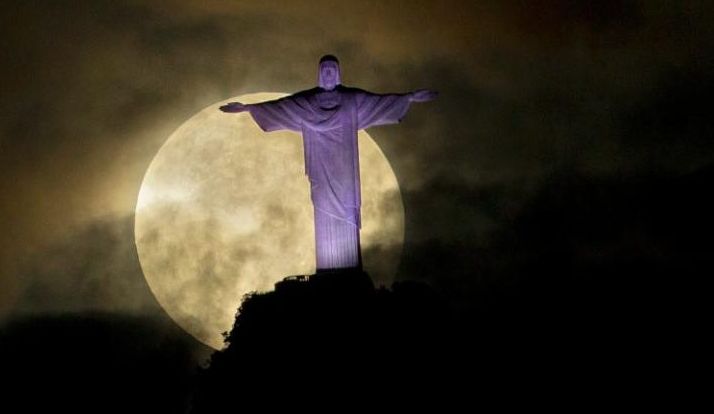
A dramatic supermoon is seen behind the Christ the Redeemer statue in Rio de Janeiro, in May 2012. Credit: AP Photo/Victor R. Caivano

The last three months of 2016 are marked by three so-called “supermoons”, and the biggest will be in the night skies on Monday 14th November 2016.

The Moon is in an elliptical orbit around the Earth, at apogee, the point furthest from the Earth, it is between 404,000–406,700 km (252,500-254,187 mi) from Earth. At perigee, the point closest to the Earth, the Moon is between 356,400–370,400 km (222,500-231,500 mi) away. A “supermoon” occurs when the Moon is both full and at perigee, when it can appear up to 14% large in diameter than “normal” full moons.
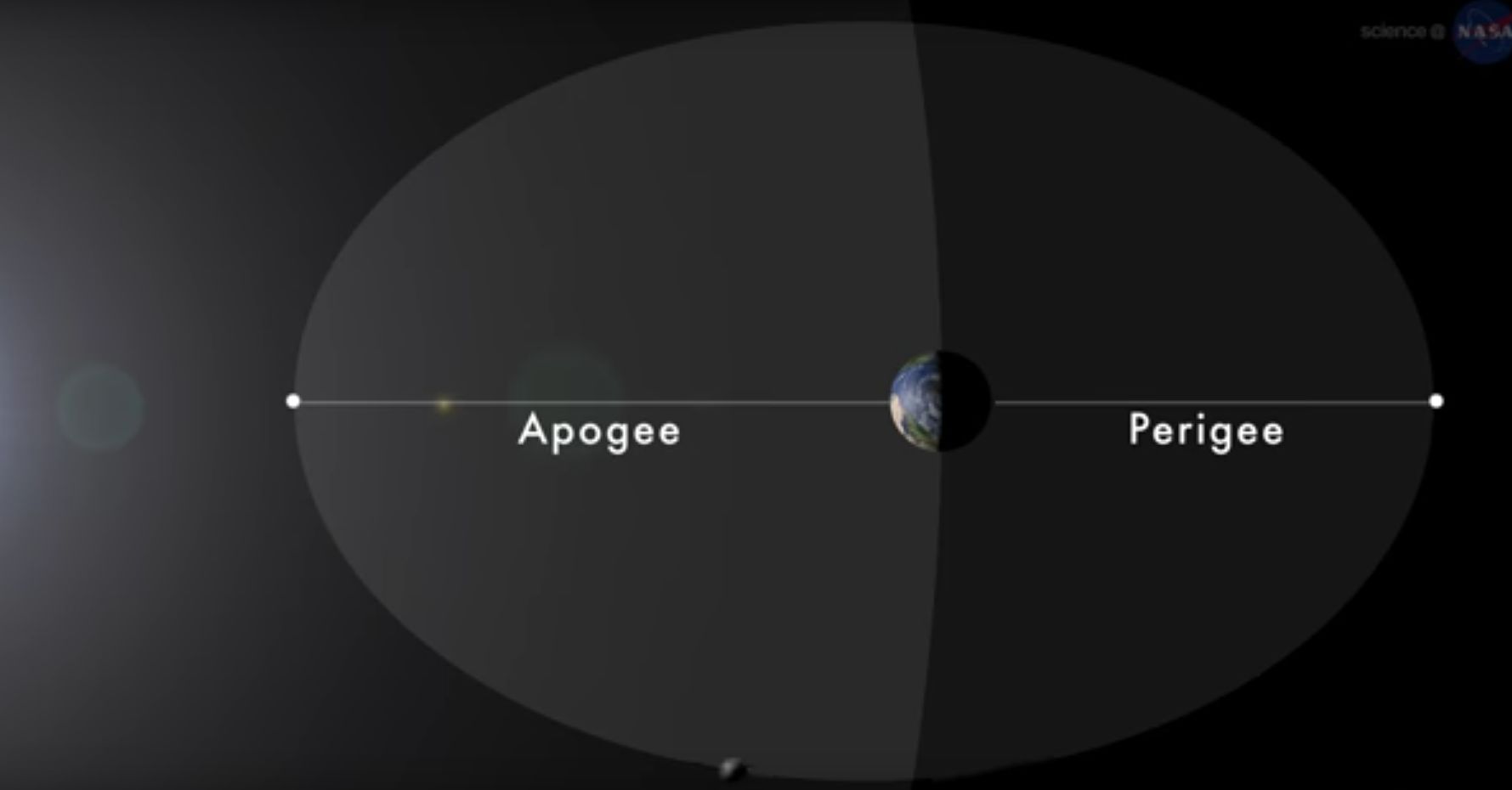
Apogee and preigee in the Moon's orbit around Earth. Credit: NASA
Apogee and perigee in the Moon’s orbit around Earth. Credit: NASA

“Supermoons” aren’t actually rare events; they take to occur once every 14 months on average.  However, the supermoon on November 14th, scores double. Not only will be “just” 356,509 kilometres (221,524 miles) from Earth, pushing it to that 14% increase in apparent size, but also because the Earth/Moon system is approaching the time of year when it is closest to the Sun (which will occur on January 4th, 2017). Therefore, the Moon will be receiving more sunlight than average, further boosting its apparent brightness.

Together, these two events mean that the Moon will be at its “largest” and brightest in the sky since 1948. The next comparable event will not occur again until 2034 – although there will be a further “supermoon” on December 14th, when the Moon again reaches its full phase, but it will be slightly further away from the Earth in its orbit at that time, so not quite as “super”.

How the Moon can appear to differ i size at apogee (the point furthest from Earth in its orbit) and perigee (the point in its orbit closest to Earth). Credit: Catalin Paduraru
How the Moon can appear to differ in size at apogee (the point furthest from Earth in its orbit) and perigee (the point in its orbit closest to Earth). Credit: Catalin Paduraru

Continue reading “Space Sunday: “super Earth”, “supermoon”, and Orion’s future”
Baroque Dreams in Second Life

Baroque Dreams
Baroque Dreams

The Edge, the fashion division of Kultivate Magazine, is celebrating it’s one year anniversary between November 11th to 30th, As a part of the celebrations, Haveit Neox has been commissioned to design and build a special, one-of-a-kind artistic runway, bringing together art and fashion.

Entitled Baroque Dreams, the installation serves a dual role, both as an art installation, which will formally open at 16:00 SLT on Sunday, November 13th, with a live performance by Dimivan Ludwig, and as the setting for a special The Edge anniversary fashion show featuring the designs of Lyrical Bizarre, which will take place between 14:00 and 15:00 SLT on Sunday, November 13th. Thereafter, the installation will remain open to visitors for a period of a week.

Baroque Dreams
Baroque Dreams

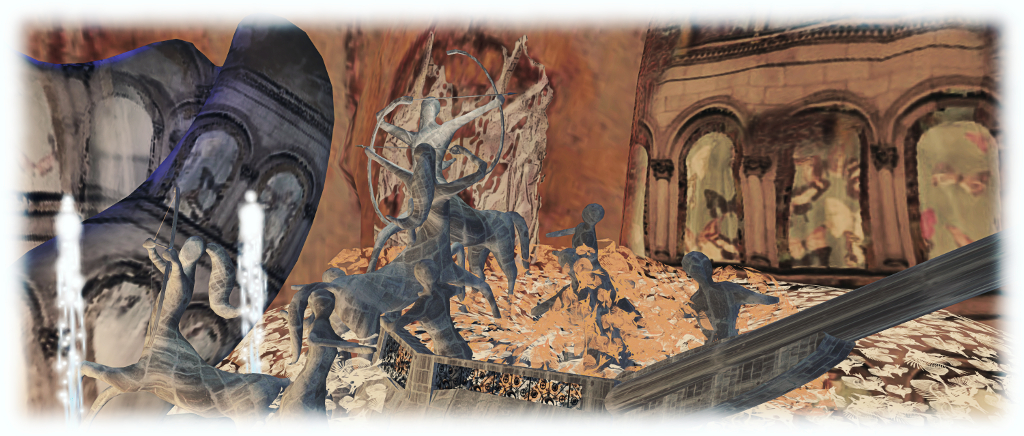
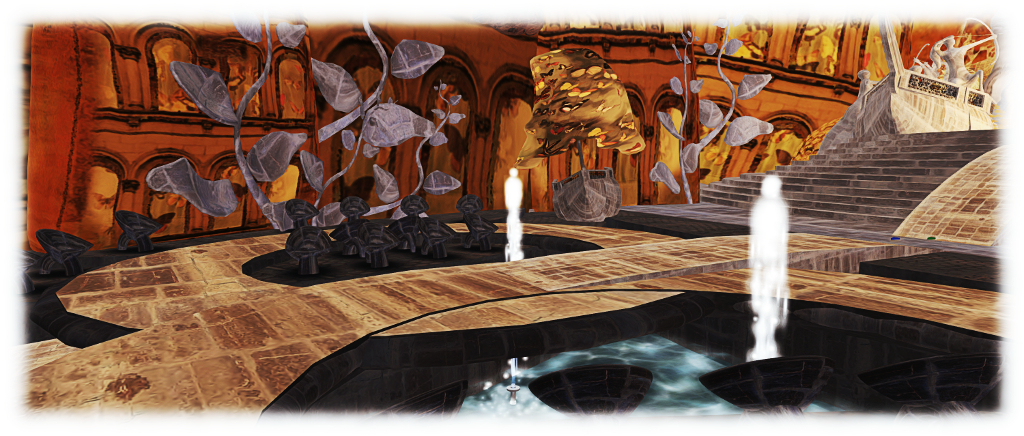
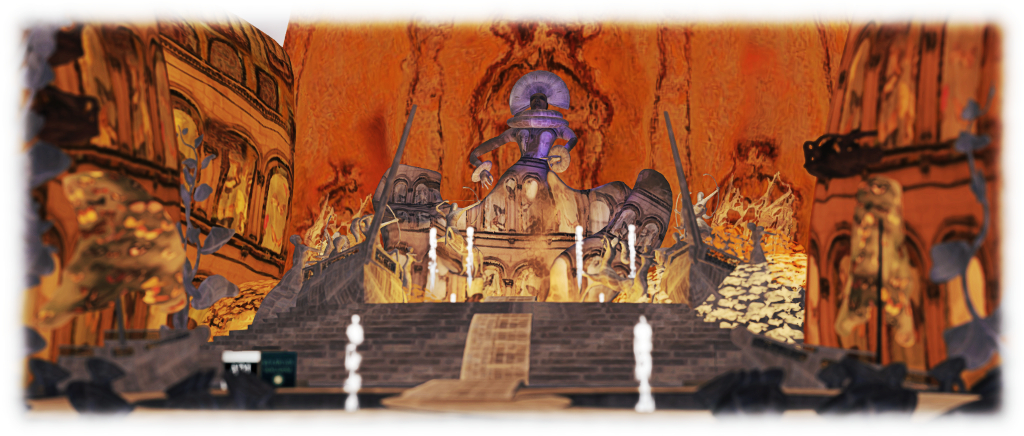
Baroque Dreams takes visitors to one of the fashion capitals of Italy and the world: Venice. On arriving, visitors walk between two tall figures and into what might be a portion of the Grand Canal; gondolas lay moored on the water, and buildings rise on three sides. A set of stepping-stones mark the way to where the runway rises from the water, arched like a canal bridge before it splits and loops  around audience seating. From there it climbs towards a set of fountains – another Venetian landmark, to where a huge Fashion Queen rises as if toy oversea proceedings, her headgear and dress suggestive of St. Marks Basilica.

Within this are many of Haveit’s hallmarks: a rich use of colour, sculpted centaurs, proud ships – also indicative of Venice’s history as a centre of commerce and seaborne trade. While around everything, the tall buildings of Venice rise.

Baroque Dreams
Baroque Dreams

Compact and yet with a grand sense of scale, Baroque Dreams is a unique installation, ideally suited to embodying The Edge’s aim to bring together art and fashion. Congratulations to all Eles, John and all at The Edge on this first anniversary.

SLurl Details

Baroque Dreams (Water Haven, rated: Moderate)

Women of Science in Second Life

Women of Science History Museum

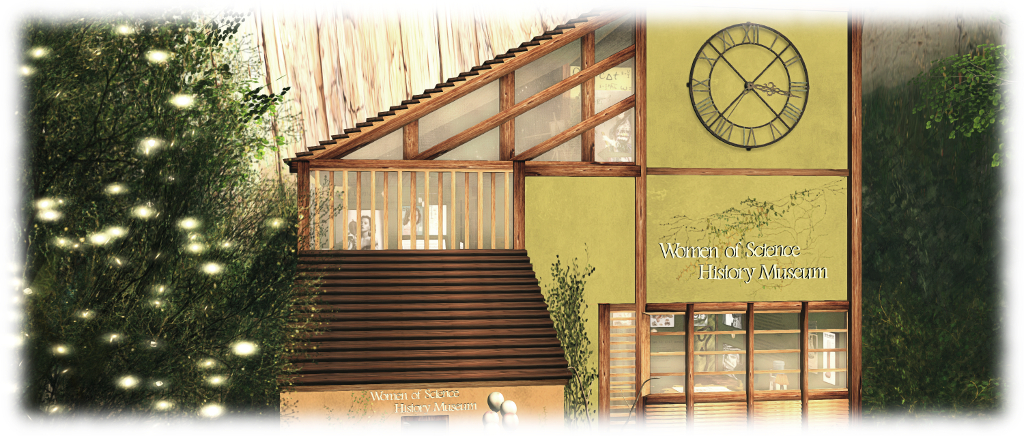
Tucked into a little corner of Second Life, and easily overlooked, is the Women of Science History Museum. I first visited it in early October, after noting it featured as an Editor’s Pick in the Destination Guide, but it’s taken me a little while to sit down and write about it!

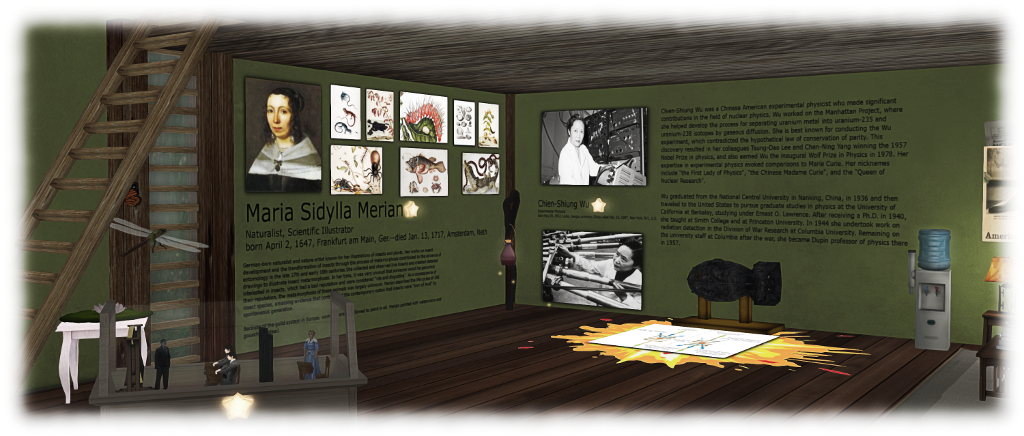
Occupying a modest garden offering a place for visitors to sit as chat, the museum is curated by Elliot (LadyAngelDust), and occupies a three storey structure to one side of the garden. Inside is a selection of informative biographies of some of the women who have contributed to our understanding of the sciences over the years.

Women of Science History Museum

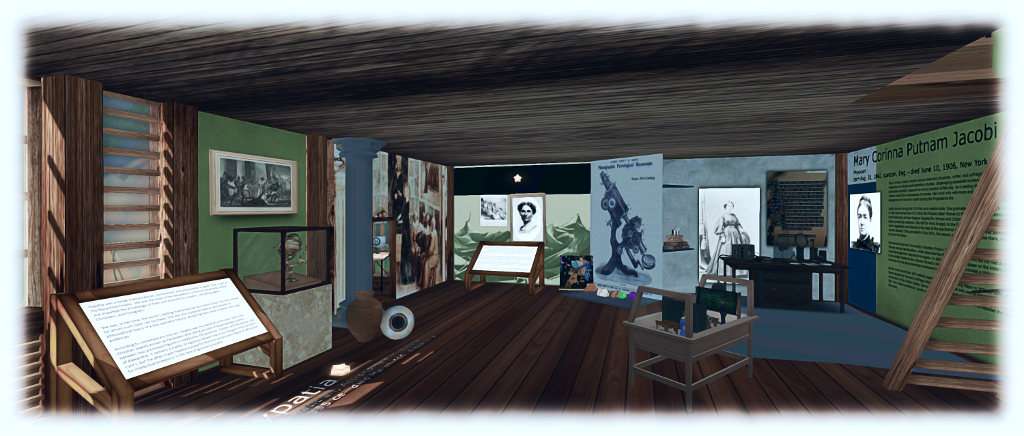
It’s an eclectic and diverse group; some will be familiar to many – Hypatia (355-415 ce), Ada Lovelace (1815-1852) and Marie Curie (1867-1934) to name three – while others may be less well-known, such as Mary Sherman Morgan (1921-2004) and Chien-Shiung Wu (1912-1997), with a total of twelve women from history represented across the three floors of the museum.

Each woman is represented by a display which includes props representing their field, photographs and a biography – the latter of which can also be obtained in note card form by clicking on the gold star alongside their names.

Women of Science History Museum

Wisely, they are not presented by science background or in chronological order (although the second floor exclusively features women born in the 20th century). This encourages fully exploration through the museum, which leads visitors up to the upper floor and a teleporter sitting in a corner.  This provides access to the planetarium and the biographies of four more women, including a personal heroine of mine, Claudia Alexander.

There is perhaps a slight bias towards American women evident at times, particularly in the planetarium section, where it would have been nice to see someone like Nicole-Reine Lepaute recognised. I also felt it a shame that Mary Anning, who was denied proper recognition for her ground-breaking work in palaeontology during he own lifetime, is not included. But these are minor niggles, and it’s fair to say there are a lot of women who might justifiably be included, but the museum only has so much space. Certainly as minor critiques, they do not detract from the fact the museum does make for an informative visit, and is fully deserving in being recognised as a DG Editor’s Pick.

Women of Science History Museum

SLurl Details

Of Victorian investigations, supernatural quests shapeshifting children

It’s time to kick-off a week of story-telling in voice, brought to our virtual lives by the staff and volunteers at the Seanchai Library. As always, all times SLT, and events are held at the Library’s Second Life home at Bradley University, unless otherwise indicated.

Sunday, November 13th 13:00: Tea-time at Baker Street

Tea-time at Baker Street sees Caledonia Skytower, John Morland and Kayden Oconnell open the pages of the second full-length novel by Sir Arthur Conan Doyle featuring Sherlock Holmes and John Watson. Originally commissioned for Lippincott’s Monthly Magazine, for which it was serialised under the original title The Sign of the Four; or The Problem of the Sholtos. This was reduced to The Sign of the Four in later serialisations and when published in book form in 1890 – a title which itself was further abbreviated to The Sign of Four for various film and television adaptations.

Sign-of-fourIn 1888, Mary Morstan comes to Sherlock Holmes seeking his assistance in two matters. The first is with regards to her father. Having returned safely from India in 1878, Captain Arthur Morstan had arranged to meet his daughter at the Langham Hotel, London – but he had vanished from the hotel prior to her arrival. In the decade since, no trace of his whereabouts has ever been discovered.

However following his disappearance – and possibly pursuant to it – is the second reason for Miss Marstan’s visit. Every year from 1882 onwards, she has been in receipt of a single pearl, which started arriving after she had responded to a strange newspaper advert inquiring for her. The latest such pearl to arrive had come with a letter, indicating she had somehow been wronged, the sender asking to meet with her.

Holmes discovers that the pearls started arriving shortly after the death of a Major Sholto, who served with Arthur Morstan in India. His investigations leave him convinced there is a complex set of connections between Morstan and Sholto, which involves an Indian fortress, the names of three Sikhs, an Englishman by the name of Jonathan Small and Sholto’s two sons. If all that weren’t enough, it would seem that greed and treasure may lay at the heart of matters..,

Monday, November 14th 19:00: The War Hound and the World’s Pain (Von Bek #1)

von-bekGyro Muggins concludes Michael Moorcock’s 1982 supernatural novel.

Europe, the 17th century: nations are ravaged by the Thirty Years’ War, driven by religion and engulfing most of the Great Powers. Weary of the fighting, disillusioned, faithless and cynical, Ulrich von Bek, the War Hound, deserts his troops and travels through a Germany ruined by the war and religious persecution.

Coming to a strange forest, he finds within it a castle which appears to have escaped the war. He decides to seek shelter within its walls – only to find this is no ordinary castle. The lord within it is none other than Satan himself.

Von Bek discovers he has been allowed into the castle so that Satan might seek his help. In return for his soul, the Devil asks him to seek out the Cure for the World’s Pain, so that Satan might use it as proof to God that he wishes to be reconciled with heaven.

The hosts of Hell, however, aren’t that keen on the idea of reconciliation…

Tuesday, November 15th 19:00: Serafina and the Twisted Staff

Caledonia reads the second adventure for Robert Beatty’s young heroine, Serafina, published in July 2016.

serafina-2Introduced in Serafina and the Black Cloak, the titular heroine had, up until the events of that story, lived a secret life in the basement bowels of the manor house on Biltmore Estate. However, she was forced to reveal herself to the estate owner’s young nephew in order that together, they might discover why the children on the estate were mysteriously vanishing.

Now, just a few weeks after those events, Serafina and her new friends must confront a new danger, one worse than the Black Cloak.

In doing so, they well face tests that will strain friendships, while Serafina learns more about her unique talent and abilities, allowing her to grow from introspective “other”, to a young girl accepting of herself. Nor is she alone in her growth; Braeden also is able to come into his own, understanding his own particular gifts,

Intended for younger readers, the Serafina books have a richness of prose and an approach to storytelling guaranteed to keep readers – and listeners – of all ages enthralled. Join Caledonia to find out more!

Wednesday, November 16th 19:00: For the Love of Billy

Caledonia Skytower, Kayden Oconnell and Corwyn Allen read selected poems by Billy Collin, the Poet Laureate between 2001 and 2003.

Thursday, November 17th

19:00: The Ransom of Red Chief and More

Shandon Loring leads listeners in the world of short stories by William Sydney Porter, known as a writer by his pen name, O. Henry.

21:00: Seanchai Late NIght

With Finn Zeddmore.


Please check with the Seanchai Library SL’s blog for updates and for additions or changes to the week’s schedule.

The featured charity for November-December is Reach Out and Read, a non-profit organization that gives young children a foundation for success by incorporating books into paediatric care and encouraging families to read aloud together.


Sansar at Web Summit 2016

The new Sansar logo (courtesy of Linden Lab)
Logo courtesy of Linden Lab

November 10th and 11th saw the 2016 Web Summit take place. An annual technology conference, 2016 marked the event’s first appearance at its new home in Lisbon, Portugal. However, as with the 2015, it included a look inside Linden Lab’s Sansar platform, this year presented by the Lab’s CEO Ebbe Altberg and Bjorn Laurin, VP of Product at the Lab.

The official Web Summit video of the demonstration has yet to appear (if indeed they filmed any of the sessions). However, courtesy of Loki Eliot, I was steered towards a video of the presentation taken by an attendee at the summit: Miguel Mimoso Correia, which I’ve taken the liberty of embedding below, as there are a number of points of interest.

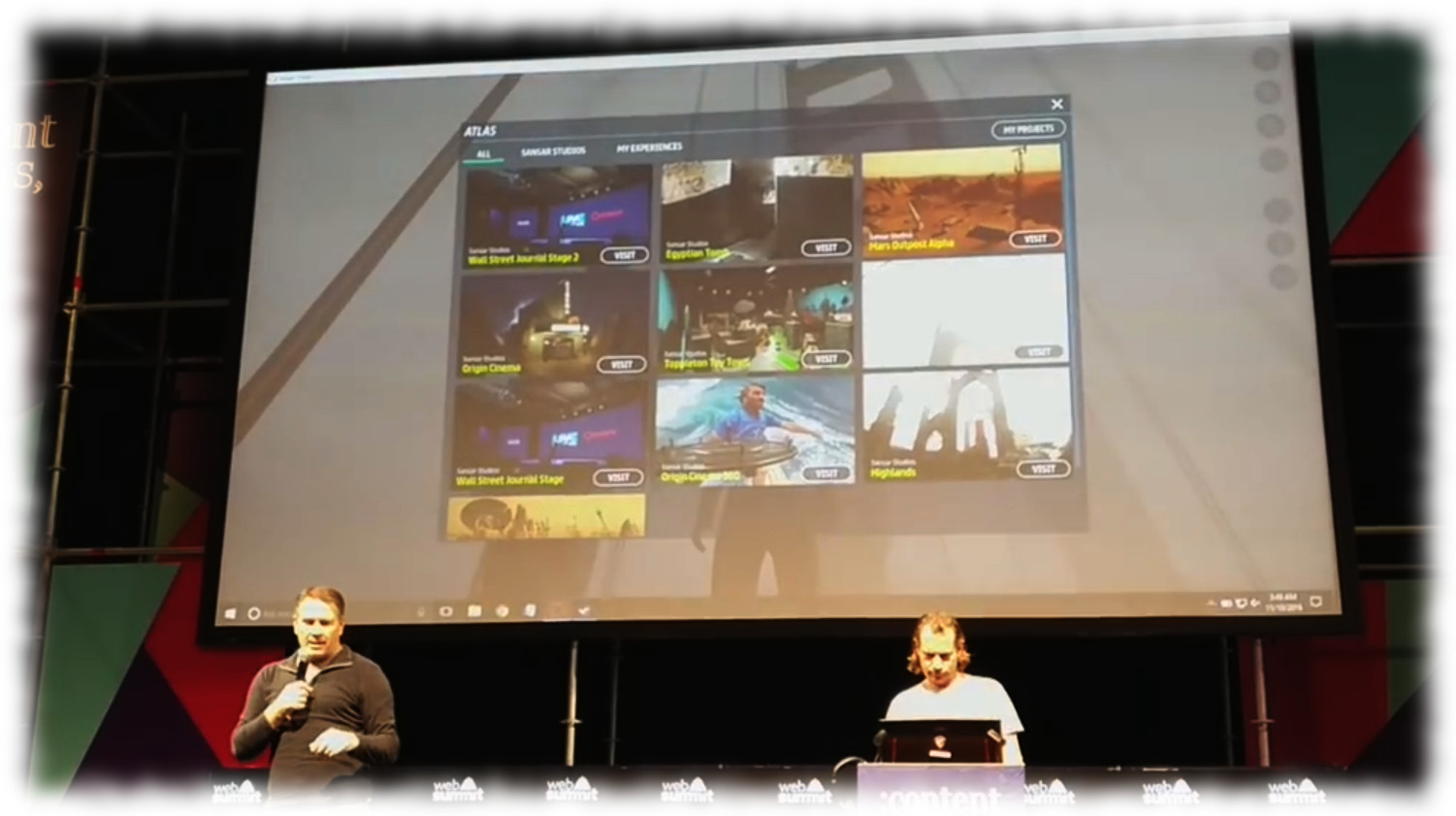
The Sansar Atlas
The Sansar Atlas – a Kitely-like directory of accessible places

The first is seeing Sansar operating in a purely third-person, keyboard / mouse driven mode. While the platform is obviously primarily geared to VR HMDs and controllers, it’s nevertheless good to get a better look and feel for how it might also be used by people without such hardware. Of particular interest to me in this was the suggestion that users might have relatively free camera placement when moving their avatar around in a third-person view, rather then their camera being locked into a “default” view, as with Second Life.

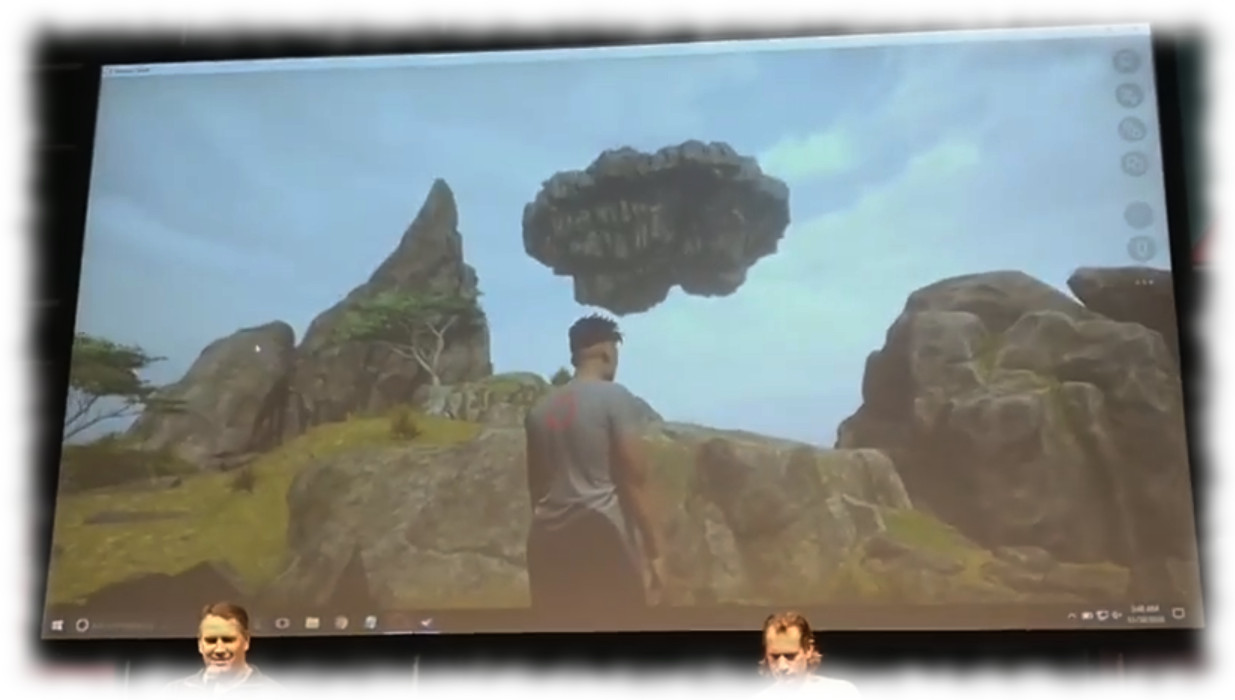
In the “highlands” scene, for example, the camera is clearly set low down, affording a good view of the avatar and the hilly terrain around him as he walks through it. Meanwhile, in the Mars scene, the camera position is noticeably higher relative to the avatar, giving a broader view of the flatter landscape. The avatars also appear to respond more naturally as well – note how Bjorn’s avatar casually rests one foot on the dais in the 360-degree video sphere when he stops walking.

The “highlands” environment

While the demonstration is given in third-person view, insight is given into how movement is achieved when in a first-person VR headset view:

With VR, we found one thing that’s uncomfortable for some people is to just use a thumb stick, like on an Xbox controller or whatever, and just walk around …. because … you can start spinning the world around. And when your body’s not moving, but the world is moving, some people can get nausea or something like that. So … the way we prefer to move around in VR [in Sansar], is that we actually have with the controllers, a way to point to a spot in front of us with an arrow … and we just jump to that spot.

For those used to Second Life, there might be something of a “bleah” response to this description; but really, it’s not that much different to the convenience of SL’s double-click to teleport option.  However, that said, it would be nice to see if there’s also a Sansar equivalent to SL’s “single click to walk” – something which might be preferable to having other people seeing avatars hopping around, as suggested in Ebbe’s explanation. Elsewhere, we get to see a little of the dynamic capabilities in Sansar, which employ some of the platform’s physics.

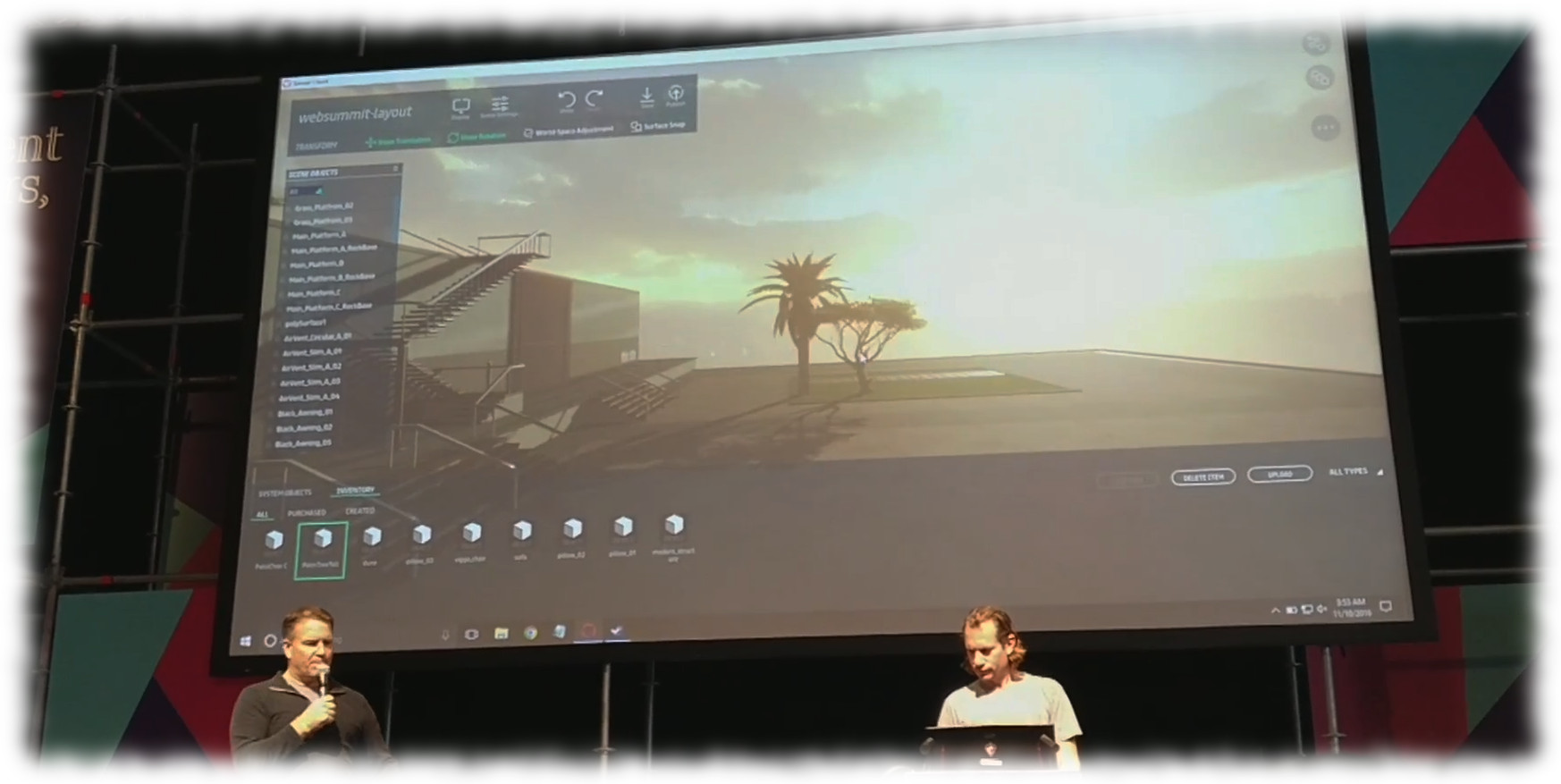
A further (brief) look at Sansar's editing environment

A further (brief) look at Sansar’s editing environment

The creative aspects of Sansar are only briefly looked at, and for those who have been following Sansar reports, offers nothing of significance. However, it is somewhat interesting to learn that the familiar Golden Gate bridge seen in Sansar is actually a TurboSquid model, underlining the ability for models to be purchased from other mediums and pulled into Sansar.

But for me, what is more interesting – if only because it offers room for speculation. Is the use of the term “Sansar Studios”, which appears as each scene is loading. Why not “Linden Lab (or even “Linden Research”)?

Is it simply indicating that the scenes are the result of collaborative work between the Lab and content creators / “content partners”, and simply a means to denote “pre-built” environments which will be available for people to explore when Sansar opens its doors to the public? Or might it be indicative of something else? Might the Lab be looking to sell its own scenes within the platform as a means of additional revenue generation? Or that “Sansar Studios” might be the marketing brand for the platform? Again, I’m not indicating a particular belief, I’m simply speculating as I write.

TSansar, October 2016; Linden Lab, on Flickr A further look at the fantasy “highlands” Sansar space, as revealed by Linden Lab in October 2016

I’m pretty happy with my lot in Second Life and  – at this point in time – have no desire to own a VR HMD (something which might change in the future, depending on how the market and technology develop). Ergo, an outright move to Sansar doesn’t interest me (not that Sansar is intended to be any kind of “replacement” for Second  Life – it isn’t. Hence why the Lab has said Second Life will continue well into the future).

However, I do continue to see the potential for something like Sansar, particularly in those markets where the emerging “low-cost” VR tools could have significant impact: design, engineering, architecture, simulation, education, training, healthcare. These are very much the markets the Lab is looking at for Sansar.

As such, even if the whole “social VR” thing falls flat on its face, I still hold the view that there are potential VR niches and audiences out there Sansar could occupy and be a success, just as Second Life has successfully occupied a niche and developed its own audience.


A mystical Telrunya Winter in Second Life

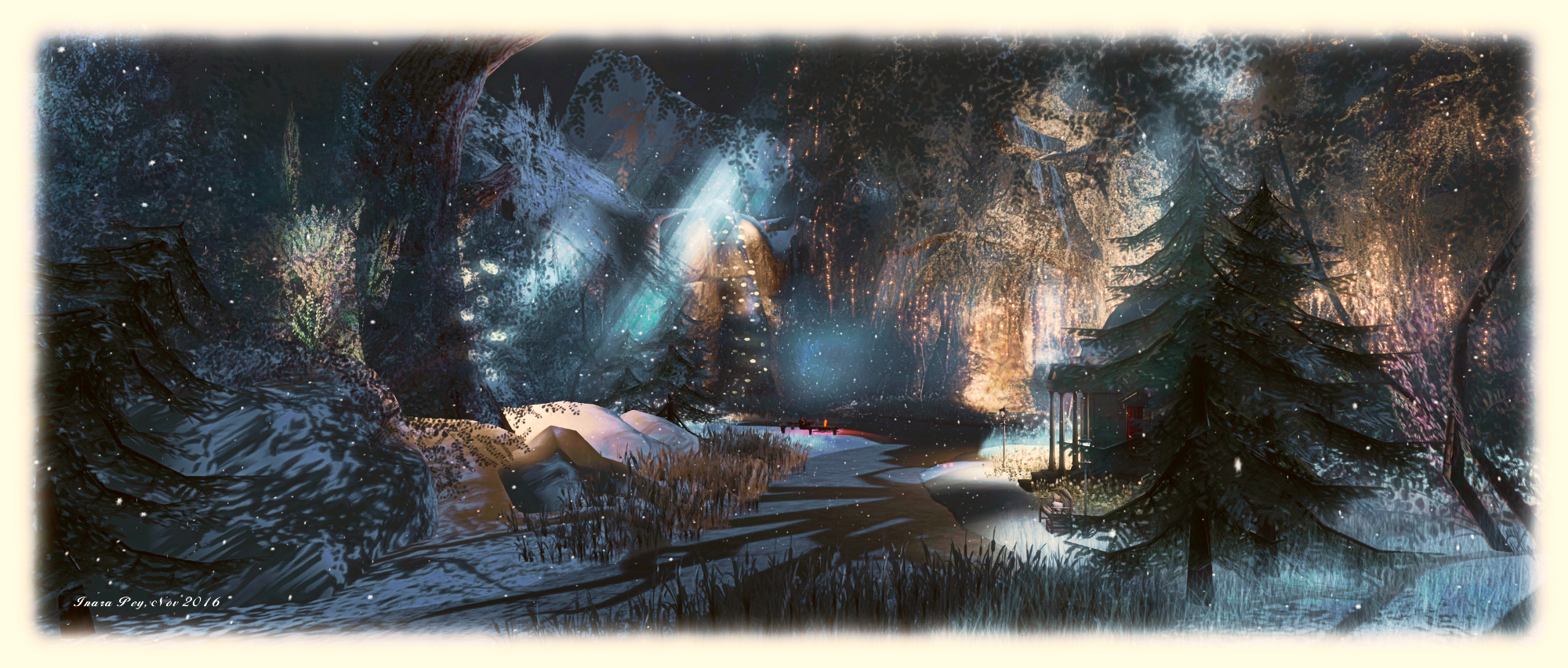
Telrunya Winter; Inara Pey, November 2016, on Flickr Telrunya Winter – click any image for full size

At the start of 2016, I wrote about Telrunya – Forest of Dreams, a resign design by Nessa Zamora (Noralie78). It was a beautiful, tranquil place which I likened to an elven corner of Tolkien’s Middle Earth.

Well, time has moved on since then, and places have changed; the Forest passed into the west some time in 2016. However, Telrunya’s spirit has now returned to Second Life in the form of a new design by Nessa, in a new location, and with a new name.

Telrunya Winter; Inara Pey, November 2016, on Flickr Telrunya Winter

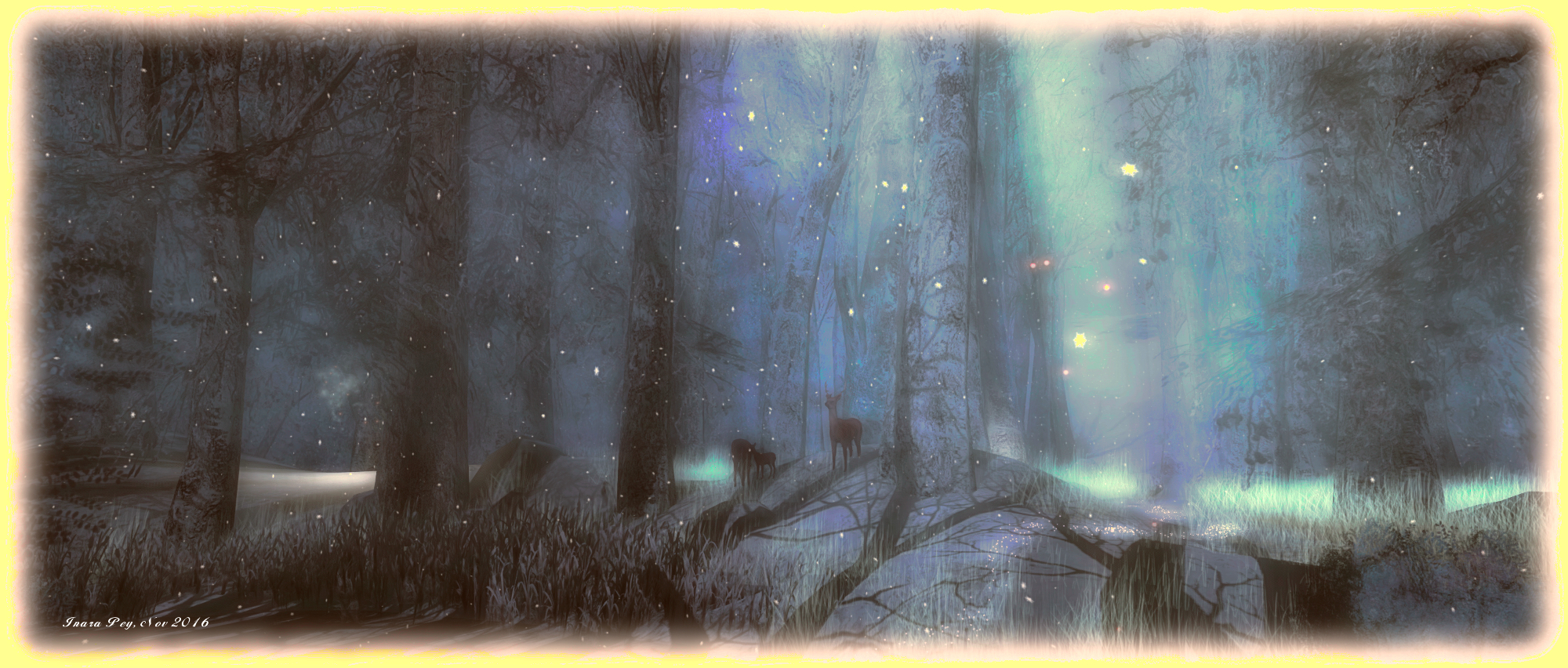
Telrunya Winter, occupying the homestead region of Diamond Island presents visitors with a winter wonderland of snow, night skies, shafts of Moonlight filtering through frosted trees and the glow and scatter of winter lights. It is at once very different to the Forest  of Dreams while at the same time bearing an echo of that build.

From the landing point under the dome of a Victorian gazebo, visitors are invited to explore the region on foot or via ice skates – sets are available with snowballs at the landing point for a small fee. A frozen river offers plenty of scope for the latter, as it curls away from an ice-covered pond. And if you take the right direction, you might find a little surprise.

Telrunya Winter; Inara Pey, November 2016, on Flickr Telrunya Winter

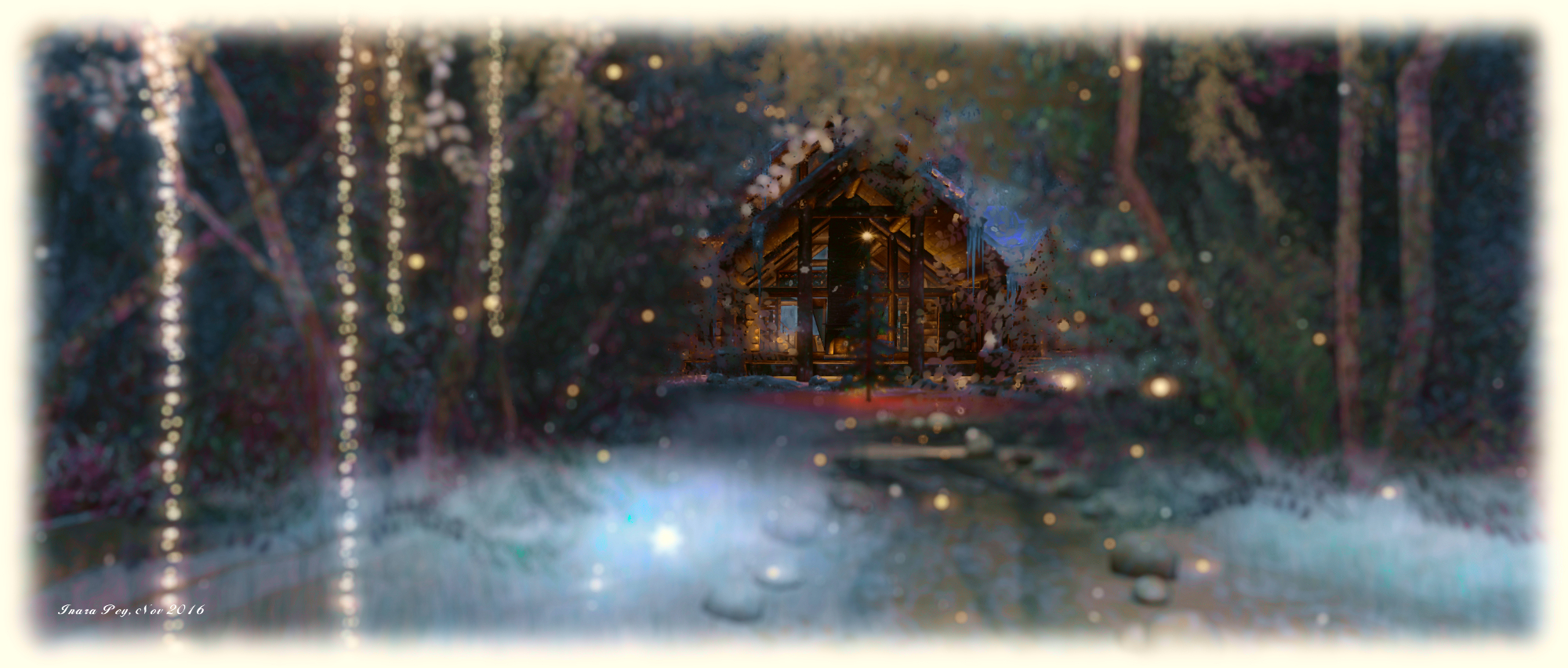
For those whole prefer walking, the crisp, white snow is inviting of footfall, and walking across it, one can almost hear that soft, fresh crunch of it being compacted underfoot. Follow the stone-edged trail over a bridge and under bough, and you’ll find your way to a wood cabin. Here, light and warmth invitingly pour forth; fires burn brightly in hearths, warming rooms furnished with deep armchairs and sofas. For those not yet ready to come inside, another fireplace on the covered porch offers warmth to those wishing to use the bench alongside to sit in comfort and continue to appreciate the aurora-washed sky and the gently falling snow.

South of the gazebo, across ice and snow, a low rocky plateau pushes upwards from the otherwise almost flat land, a table on which ancient ruins sit, arches lit by naked flames as they look out between the snow-draped shoulders of the high surrounding peaks. Elsewhere, strings of lights hang from the bare arms of trees, deer walk between moonlit trunks, lanterns glow and float through the air, giving the entire region a feeling of otherworldly magic, with places a-plenty to sit and ponder and enjoy, alone or with a friend or loved one.

Telrunya Winter; Inara Pey, November 2016, on Flickr Telrunya Winter

With winter closing around us in the northern hemisphere, it is traditional to see winter landscapes come to the fore in Second Life. Telrunya Winter is the first I’ve visited since the start of the year, and it certainly won’t be the last. However, it will be special, Nessa has a talent for creating places with a mystical air and feel, as Telrunya Winter amply demonstrates. It is a tranquil slice of winter not to be missed.

SLurl Details