Toys for Tots Breedables Expo and Fair in Second Life

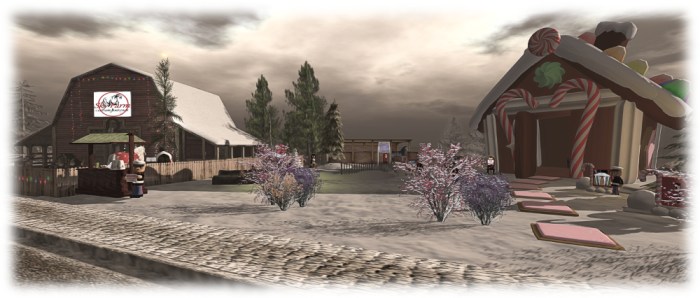
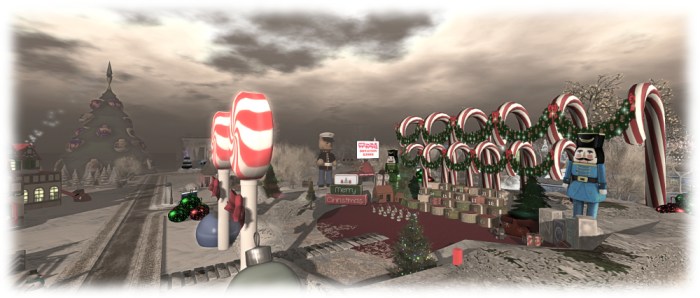
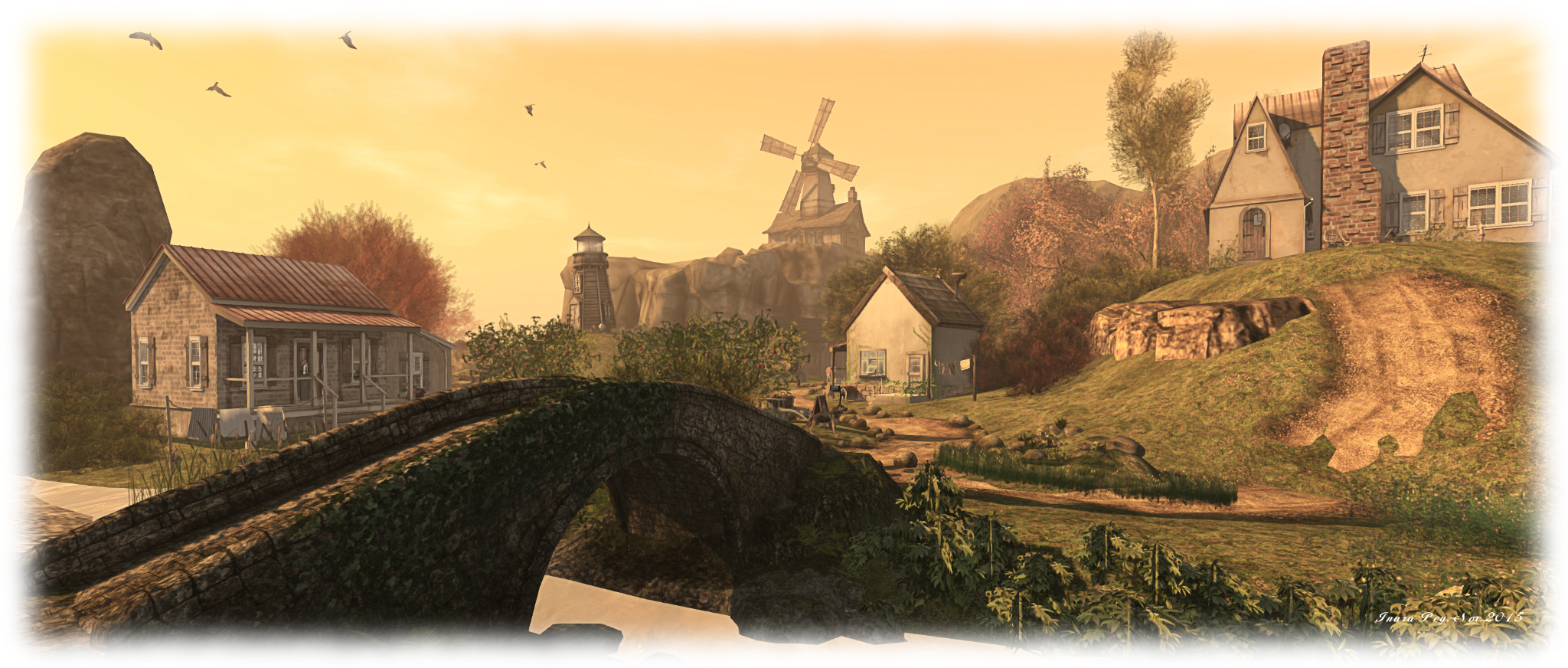
Toys for Tots Expo 2015

Saturday November 21st marked the start of the seventh annual SL Toys for Tots season in support of the United States Marine Corps Reserve Toys for Tots programme, which distributes toys to children whose parents cannot afford to buy them Christmas gifts.

The Toys for Tots Breedables Expo and Fair will run through until November 29th, and features two regions, sponsored by WK Wild Kajaera, dedicated to all Breedables in SL and also non-breedable vendors/sellers. Events throughout the week will include live performers, raffles, and a very special auction.

The 2014 SL Toys 4 tots Expo raised over L$9,566,604 for the programme, and the organisers are hoping this year marks an even greater success, with L$838,163 donated even before the Expo gates have opened. Since its inception, SL Toys 4 Tots has raised over US $90,000 for the Toys for Toys programme.

If you would like to help with fund-raising, you can obtain the Toys for Tots fund-raising kit by contacting one of the following people in-world: Rocky Hillburton, Marissa Goodliffe, or Shannon Hillburton (Shannon Dubratt). You can also join the Annual T4T Christmas Benefit in-world group (key: secondlife:///app/group/28795771-c4a8-ac48-cf40-ead01828608c/about – paste into your viewer) to keep up-to-date on news and information.

Toys for Tots Expo 2015

About Toys for Tots

Toys for Tots began as a Los Angeles charitable effort in 1947. William Hendricks was inspired by his wife Diane, when she tried to donate a home-made Raggedy Ann doll to a needy child but could find no organisation to do so. At her suggestion he gathered a group of local Marine reservists, who together coordinated and collected some 5,000 toys for local children that year from collection bins placed outside of Warner Bros. movie theatres. Their efforts were so successful that, in 1948, Toys for Tots was launched as a national campaign in the United States, with a mission to “collect new, unwrapped toys during October, November and December each year, and distribute those toys as Christmas gifts to needy children in the community in which the campaign is conducted.”

Related Links

Kokua 3.8.6: notify me

kokua-logoOn Tuesday, November 17th, Nicky Perian announced the release of Kokua 3.8.6.37336,  which brings the popular SL and OpenSim viewer to parity with both recent Linden Lab code releases and with Marine Kelley’s RLV,  while including some additional tweaks from the Kokua team.

The release was preceded by a test release version focused on integrating the most recent updates for RLV in order to ensure there were no unpredictable outcomes from multiple merges, etc. A request was put to Kokua users to assist in testing that pre-release, which saw around 600 people respond and download the viewer. Their feedback formed the basis for additional refinements to the code leading up to this release, with Nicky passing on his personal thanks to all of those who participated.

The Lab code releases in the Kokua 3.8.6 comprise:

  • Release 3.8.5.305531, dated October 13th – an Maintenance release comprising 90+ fixes, updates and feature requests from the Lab (release notes)
  • Release 3.8.6.305981, dated October 26th – the notifications viewer, incorporating the new notifications floater (release notes).

Notifications Update

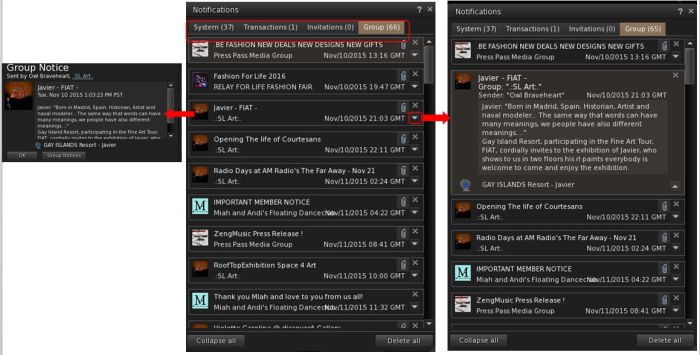
The notifications update presents a new floater for managing all your incoming notifications and notices, the result of a feature request to the Lab from Aki Shichiroji.  This sees incoming notifications split between four tabs: System, Transactions, Invitations and Group, with each tab displaying the total number of notices stored within it.

Kokua 3.8.6 incorporates the Lab's new notifications floater, itself the result of a feature request from Aki
Kokua 3.8.6 incorporates the Lab’s new notifications floater, itself the result of a feature request from Aki Shichiroji

Clicking on an individual notice, or the down arrow to the right of a notification will open the details within the preview panel. Individual notices can also be closed by clicking the X to the right of them. The two buttons at the foot of the floater will either collapse all “open” notifications within the current tab, or deleted them all from the tab.

The RLV updates bring Kokua fully up to par with RLV 2.9.15, including the hotfix release of 2.9.15.1 on November 9th intended to correct BUG-10601.

The Kokua team contributions for this release comprise:

  • Uploading a Blender generated dae, and NOT retaining material group order (see Bug 10326)
  • OpenSim update –  Set Lag Meter Server section to operate at 11 fps.

There are a number of known issues with this release – please refer to the Kokua 3.8.6 release notes for details.

I confess to (once again) not having have that much time to drive this release due to having a busy schedule at the moment. However, when I was able to run it however (sans RLV active), I encountered no significant issues. My apologies (also again) to Nicky for not having spent more time using the release ahead of this summary review.

Related Links

Holly Kai Park: the gardens

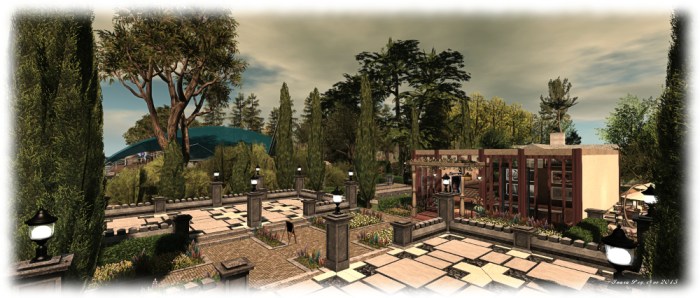
The Garden at Holly Kai Park

The last few days have been a tad busy for me, hence the slow-down in blog posts. When in-world, I’ve been pushing ahead with the Holly Kai project in order to get more things finished and ready for the re-launch in December.

I’ve already written about the work in the park itself – there’s still some more to be completed with this; notably the live voice area for readings, etc. However, I decided to get the garden area laid-out as well, rather than dragging the project out. This may not open to art exhibitions until the New Year, but the work is now mostly complete, and the gardens are open for visitors.

The Garden at Holly Kai Park: studio gallery

Located in the north-east corner of Holly Kai, the garden area has a formal layout to contrast with the wilderness look of the park. It includes  its own mooring slip for boats, located on the north side of the parcel. From this, visitors can access the gardens directly, or via the refreshments terrace, which offer seating and suchlike.

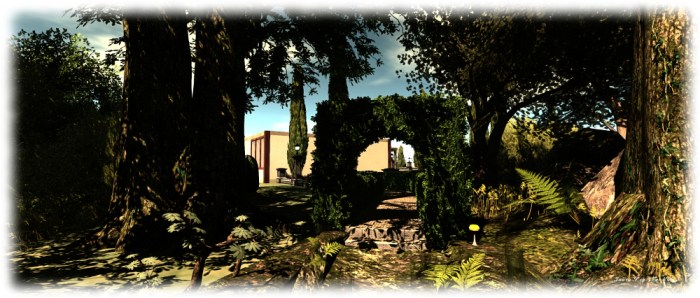
Within the garden are two further terraces, which are intended for artists applying to display in the garden and sit across from the gallery studio, which will be the home for the Artist in Residence. With Mediterranean Cypress trees, hedgerows and flowerbeds laid out around the garden, and with cobbled paths, seating and a koi pond, we hope the garden will be a suitably relaxing place to visit. Getting between it and the park also couldn’t be easier; a path in the south-west corner of the garden links the two, and can be reached via the park trail behind the pavilion for those coming to the garden from the park.

The Garden at Holly Kai Park: link path from park to Garden

There will inevitably be the nips and tucks over the coming week or so, such as adding more ambient sounds, seating places in the park, etc., but by-and-large the core work should now be finished. Next up is the park blog, which will be used to carry news of exhibitions, in both the park and the garden, and live events at the pavilion and at Caitinara Bar, as well as carrying news in general about Holly Kai Park.

SLurl Details

Second Life projects update 47/1: server, viewer, issues

It's a New Dawn; Inara Pey, November 2015, on Flickr It’s a New Dawn (Flickr) – blog post

Server Deployments Week #47

As always, please refer to the server deployment thread for the latest updates.

  • There was no deployment to the Main (SLS) channel on Tuesday, November 17th
  • The maintenance package deployed to all three RC channels in week #46 received a further update on Wednesday, November 18th. This was apparently due to the postponed deployment from week #46 not containing all of the desired updates.

SL Viewer

After mysteriously vanishing from the viewer release channel, the HTTP project viewer (Project Azumarill) reappeared on Tuesday, November 17th, still with the same version number (3.8.7.306796, dated November 2nd) as previously.

The Vivox viewer entered the release channel as a RC viewer on Tuesday, November 17th. Version 3.8.7.3.8.7.307744 corrects a number of Voice quality and connection issues on both Windows and the Mac.

The Chrome Embedded Framework Viewer also reached RC status with the release of version 4.0.0.307894 on Wednesday, November 18th.

Group Ejections and Group Chat

SVC-32, “Person kicked remains in chat session” came up for discussion at the Simulator User Group Meeting on Tuesday, November 17th.

This is the ongoing issue where those who are ejected from a group whilst in a group chat session still being able to continue using the chat until they close the window (with various permutations on the issue vis muting and unmuting people).

The cause of the problem seems to be quite deeply rooted in how the group chat service works, with Simon Linden noting, “I hate that one … and I’ve been lurking in some large groups (like FS) and seeing it abused. It’s an ugly problem and I’ve looked into it … basically because the info about how to add the logic isn’t where the log needs to be run … I looked into revoking caps and other ideas but didn’t find a silver bullet, or a pile of them, that would work … I’ll try to get some time to see if there’s anything that can be done without major architecture changes or new servers.”

Object and Linkset  Contents and Limits

Changes were recently made to how many objects can be placed within an individual in-world / worn object  and linkset. The limit per individual objects is now 10,000, and the limit per linkset is 30,000. The limits were revised to help deal with people using objects which massive contents from eating up server resources and impacting region performance as a form of griefing. However, a side issue with the changes has been that tools such as texture organisers with huge contents spread through the linkset can stop working – permanently.

To help people check their organisers and make suitable adjustments in line with the new limits, the Unpackistan region has a 90K limit for linksets (although there was an issue with this region as well – BUG-10695 – which should now have been corrected).

Concerns were raised the simulator User Group over the lack of follow-through when limits like this are changed (there has been no Wiki update in this instance, for example).

While it is understood limits may be changed to help reduce problems with griefing, etc., and thus the Lab may no wish to announce forthcoming changes in case it leads to an increase in abuse before the door is shut, so to speak, it was pointed out that providing some indicators as to what has changed, and ensuring reference documentation is properly updated could go a long way to help people figure out what might have happened as a result of such changes having an unexpected repercussion (as in this case).

Acknowledging this point, Simon agreed to take the concerns raised back to the office for further discussion.

Firestorm 4.7.5: something for everyone

firestorm-logoTuesday, November 17th saw the release of Firestorm 4.7.5.47975.  While not as major in terms of LL features and updates as the August 4.7.3 release, the new version of Firestorm nevertheless brings with it plenty of general fixes and improvements, both via the Lab and the Firestorm team and contributors.

As per my usual MO, what follows is an overview of the release, highlighting some of the more significant / interesting changes, updates and  fixes to be found in the release.  For full details of all changes, and all due credits to contributors, etc., please refer to the official release notes.

The Usual Before We Begin Notes

For best results when installing this release:

Details of any versions of Firestorm to be blocked as a result of this release will be announced in due course.

Lab Derived Updates

Firestorm 4.7.5 brings the viewer to parity with the Lab’s 3.8.6 code base, and so includes the new Notifications updates and changes to the mesh uploader. These and other key updates from the Lab are listed below.

Notifications Update

The notifications update presents a new floater for managing all your incoming notifications and notices, the result of a feature request to the Lab from Aki Shichiroji. Within this floater, incoming notifications are split between four tabs: System, Transactions, Invitations and Group, with each tab displaying the total number of notices stored within it.

Notices are initially displayed in summary format presenting the title, date of receipt and other immediately relevant data, and can be opened in one of two ways:

  • Clicking on a notice directly will open in a new floater (shown below left) – this is a Firestorm-specific feature for the floater
  • Clicking on the small downwards arrow to the right of the notice will expand it within the existing floater (show below right).
The new Notifications floater from the Lab is included in Firestorm 4.7.5.

The floater also includes two buttons: Collapse All and Delete All. Both do as they suggest: collapse all notices open within a tab in the floater and delete all notices with a tab. Two further Firestorm-specific aspects of the notifications floater are:

  • An improved display of condensed group notices and show group name instead of sender name
  • The floater remembers the last selected tab after a relog.

Mesh Uploader Updates

Firestorm 4.7.5 includes the updated mesh uploader from Linden Lab, as seen in the SL viewer 3.8.4.305119 release.

This feature modifies the mesh importer to (optionally) improve debug output, perform name-based LOD association, and handle models with many materials, and allows models with more than 8 unique faces to be imported. When using it, note that:

  • The same limitations on LODs and materials remain in place (e.g. your low LOD mesh materials must be a subset of the full LOD materials).
  • LODs and Physics reps can now be explicitly associated with a given mesh in the full LOD model using name-based matching.
  • By properly naming the meshes in your lower LOD meshes and physics reps, you can avoid issues with ordering of the meshes within your DCC tool and other material mismatching errors.
  • An ImporterDebug option has been added to the settings.xml file which, if enabled, causes more information to be output during import than you can shake a stick at.
    The extra output can be very helpful for diagnosing authoring errors (e.g. violating the material subset constraints mentioned above) and pinpoint what needs to be fixed in the source model for successful import.

Further information can be found in the Lab’s Knowledge Base article.

Other Updates from the Lab

Other notable updates from the Lab include, but are not limited to:

  • A fix for unable to wear a copy of a wearable until relog or swapping to a wearable with a different UUID (see: BUG-8388 and FIRE-16097)
  • A fix for viewer crashing at logout if wearing clothing textured with a local texture (BUG-8872 and FIRE-15787)
  • A fix for viewer crashing if you open Help > About while a group member list is loading (see BUG-9396)
  • A fix for deleting objects too quickly from contents of another object results in viewer crash (see BUG-9492 and FIRE-16352)
  • A fix for alpha masking not working when ALM is enabled if the object has a legacy bump set (see BUG-7263)
  • Fixes for mesh models sometimes failing to load completely (see: BUG-6803, BUG-7239, BUG-8806, and FIRE-15690)
  • A fix for the inventory count sometimes not displaying (see BUG-7263)
  • A fix for group members of large groups in a role which has “Invite people to this group” ability not being able to send group invites (see BUG-9404)
  • A for fox errors when texturing a linkset “Unable to add texture. Please wait a few seconds and try again.” (see BUG-9957 and FIRE-16755)
  • A fix for the massive slowdown when opening “Place Profile” or “About Land” dialogue when the Covenant text is long
  • A fix for broken texture animation on rigged mesh
  • A fix for building block type changing to Torus after cancelling changing of texture for sculpted object
  • The time remaining is now displayed before the avatar name in the parcel ban list for timed bans
  • A huge number of maintenance fixes from various LL Maintenance viewer updates – for the full list, please refer to the Firestorm notes.

Continue reading “Firestorm 4.7.5: something for everyone”

Second Life land set-up fees reduced

Land costs in Second Life are one of the most controversial issues to discuss. While it is often claimed that “the tier is too damned high”, the Lab has always been somewhat hoist by its own petard in having virtual land fees as the mainstream of its income. As I explained at length in January 2013, this actually limits how much the Lab can actually do with regards tier without potentially hurting its ability to function.

However, one area that has always seemed unaccountably high is the one-time set-up fees charged for private regions. These have stood at US $1,000 for a standard full region and $375 for a standard Homestead region (both inclusive of the first month’s tier, and ex-VAT where applicable) for many years, which has always come across as an exorbitant  amount to charge. There have been numerous calls over the years for these fee to be reduced; in my 2013 article linked to above, I went so far as to suggest a reduction in set-up fees coupled with a modest reduction in tier might be a way forward for the Lab.

The Lab, though, seemed steadfast in its approach. Tier would always be difficult to adjust, and they appeared reticent to play with the set-up fees. But on Tuesday, November 17th, that latter point changed.
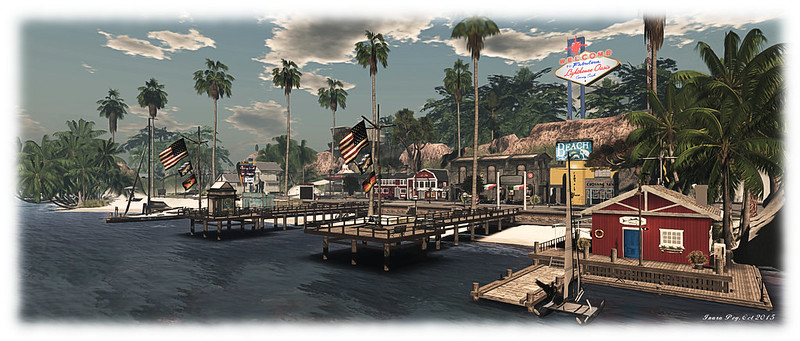
Crossing Sands; Inara Pey, October 2015, on Flickr With immediate effect, set-up fees for all private island products (unthemed and themed) in Second Life have been reduced by 40% (image: Crossing Sands MarinaFlickr)

As announced in a an official blog post, the Lab has confirmed that with immediate effect set-up fees across all private island products (Full, Homestead and OpenSpace, both developed and undeveloped), have been reduced by 40%. This means that the set-up fees for all classes of private island product are now (ex-VAT, where applicable):

  • Full Private Island US $600
  • Themed private island US $629
  • Homestead region US $225
  • Themed Homestead region $250
  • OpenSpace region US $150

What’s more, anyone who has paid a region set-up fee in the past 14 days will receive the difference in fees back as a credit(in US Dollars to their account balance.

This is undoubtedly a step in the right direction – although how much of an impact on land usage it has will be interesting to monitor. In October 2011, the Lab abolished all set-up fees for a period of one month in a “land sale”, which saw  689 added to the grid, a net growth of some 508 regions for the month. Unfortunately, such was the situation then that, as the realities of tier kicked-in, the increase in regions was all but negated in a few months as the heavy decline in region numbers continued through 2012.

As it stands, it is fair to say the global economic situation has improved since 2012, and people have again found themselves with more in the way of disposable income in their pockets they can put towards tier. This has likely to have been a contributing  (but not the only) factor in the slow-down in regions losses seen in 2013 / 2014. But will a cut in set-up fees be sufficient to fuel a further sustained slow-down in grid shrinkage which has accelerated slightly in 2015? That’s something only time will tell, although I’m admittedly sceptical.

Which is not to negate the move by the Lab in any way – rather the reverse, it is most welcome, if perhaps a little overdue.
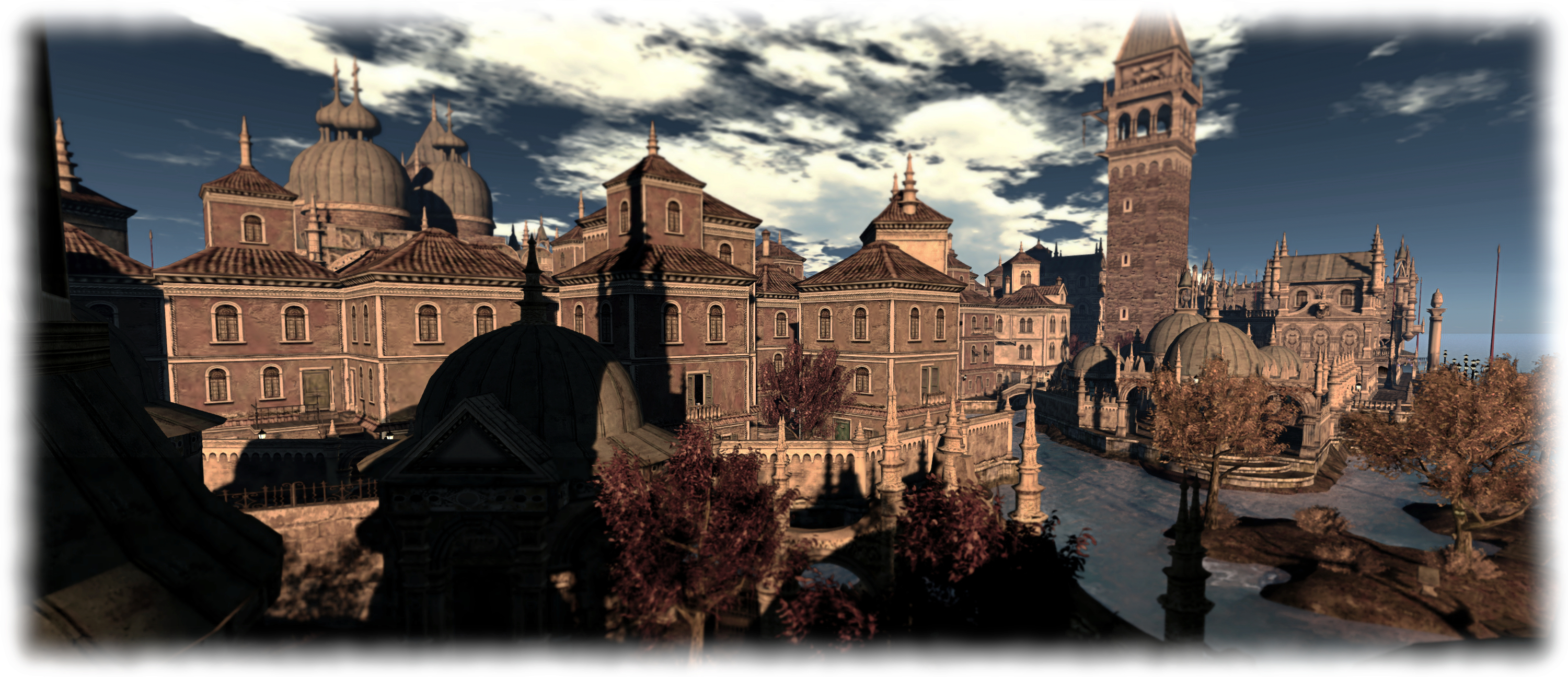
Venexia; Inara Pey, June 2015, on Flickr Tier has been a significant contributor to the loss of regions in SL, including places such as Venexia (above) and its sister region, Goatswood.  Whether the reduction in set-up fees will help slow this situation down is an open question.

Changes to Transferring Regions

Alongside the set-up fees reduction for private regions, the Lab has also announced changes to transferring regions with grandfathered pricing, with the blog post stating;

Previously, Private Islands with grandfathered pricing would lose that status and revert to the usual schedule of land maintenance fees when the regions were transferred to a new owner. Today, we are changing that policy to make it easier for these regions to remain on the grid if and when they are sold to new owners.

Effective immediately, both Grandfathered Full Private Island regions ($195/month) and Grandfathered Homestead Private Island regions ($95/month) may be transferred to new owners without losing the discounted pricing.

However, this news come with a caveat: the one-time transfer fees for grandfathered regions are increased, with grandfathered full regions costing US $600 to transfer and maintain the grandfathered tier, and homestead regions US $300 (both fees per region, and exclusive of VAT where applicable),