2015 viewer release summaries: week 9

Updates for the week ending: Sunday, March 1st, 2015

This summary is published every Monday, and is a list of SL viewer / client releases (official and TPV) made during the previous week. When reading it, please note:

  • It is based on my Current Viewer Releases Page, a list of all Second Life viewers and clients that are in popular use (and of which I am aware), and which are recognised as adhering to the TPV Policy. This page includes comprehensive links to download pages, blog notes, release notes, etc., as well as links to any / all reviews of specific viewers / clients made within this blog
  • By its nature, this summary presented here will always be in arrears, please refer to the Current Viewer Release Page for more up-to-date information.

Official LL Viewers

LL Viewer Resources

Third-party Viewers

V3-style

  • No updates.

V1-style

  • Cool VL Viewer – Stable branch updated to version 1.26.12.33, and Experimental branch to 1.26.13.1, both on February 28th (release notes for both).
  • Singularity release a supplemental update, version 1.8.6.6157 on February 27th – core updates: a fix for AMD users wishing to use the latest AMD Catalyst drivers (release notes)

Mobile / Other Clients

  • LittleSight for Android updated to version 1.6.1.0 on February 22nd – core update: changing the default log-in to a user’s home location to avoid log-in failures.

Additional TPV Resources

Related Links

HTC enters the VR arena with Vive and Valve

The Vive from HTC: a VR headset developed with Valve
The  Vive from HTC: a VR headset developed with Valve

On Sunday, March 1st, 2015, Taiwanese smartphone manufacturer HTC caught the VR world and tech media somewhat off-guard when, among a series of product announcements on the eve of the Mobile World Congress (March 2nd-5th, 2015, Barcelona), they revealed a new high-end VR headset they have been developing in partnership with Valve, the on-line gaming service.

The revelation comes after a week of speculation on what Valve; statement they’d be revealing a “previously unannounced” Steam VR Development Kit, thought to comprise a new headset and other goodies, at the upcoming Game Developer’s Conference  in San Francisco.

As reported by Engadget among other tech journals, the HTC headset is called the Vive, and is both the headset Valve have been dropping hints about and is a direct competitor to the Oculus Rift, rather than being a headset for use with mobile devices, despite being announced at a an event focused on mobile devices.

As reported by Gamespot, it’s unit offering a 1,200 by 1,800 pixel screen in front of each eye, each with a 90 fps refresh rate to eliminate image judder and offer “photo realism”. It also features a gyrosensor, accelerometer, and laser position sensor. The latter tracks the rotation of your head, allowing you to look around a virtual environment naturally.

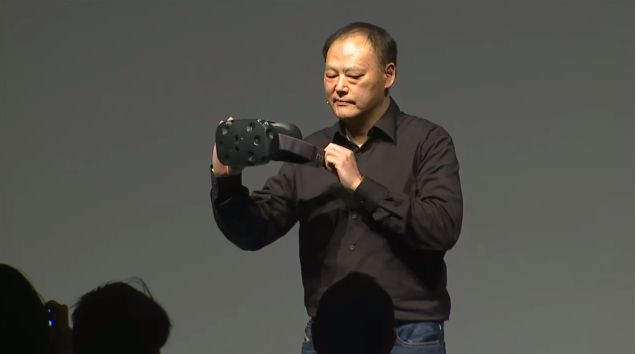
Peter Chou, HTC's CEO, unveils the Vive on the eve of the Mobile World Congress in Barcelona, March 1st, 2015
Peter Chou, HTC’s CEO, unveils the Vive on the eve of the Mobile World Congress in Barcelona, March 1st, 2015

According the HTC, the new headset will have high fidelity audio capabilities as well. But what is particularly interesting about it is that HTC are claiming it “will bring the first room-scale [VR] experience” to the world.

This is apparently achieved by combining the headset with a pair of SteamVR “base stations”, and some 70 movement sensors within the system. When placed out, the “base stations” can scan a square space up to 4.6 metres (15 feet) on a side, and any body movement, walking, jumping, turning, etc., captured within that space will be tracked and reproduced within the VR space being seen through the headset.

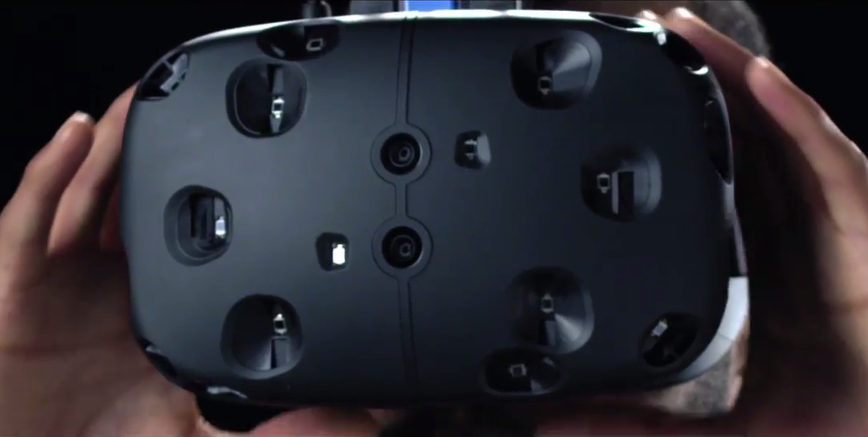
If that wasn’t enough, HTC are also indicating that they have solved the issue of interacting in virtual spaces. They’ve done this by pairing the headset with a set of wireless hand controllers of their own design. These apparently allow the wearer to use their hands, point, hold things, etc., with sensors mounted on the front of the headset tracking all such movements / actions and again reproducing them in the virtual environment.

The front of the HTC Vive, showing the sensors for capturing hand movements
The front of the HTC Vive, showing the sensors for capturing hand movements / tracking head movements

Like the Oculus Rift, the headset is being initially aimed at the games market, with HTC indicating that Dovetail Games, Fireproof Games, Cloudhead Games, Owlchemy Lab, Bossa Studios, Steel Wool Games and Vertigo Games already having signed-up to support the device.

In addition, and as reported by The Road to VR (see the link earlier in this article), Valve have also been putting out the word that they want to hear from developers and a link from the HTCVR website, launched at the same time as the announcement was made, directs any developer wishing to register their interest in working with the new headset to the Steam website, where they can do so.

Continue reading “HTC enters the VR arena with Vive and Valve”

Volumetric lighting: soon for SL?

Blackdragon logoUpdate, March 11th: The capabilities described below are now available in Black Dragon 2.4.1.9, which I’ve overviewed here.

Update, March 4th: Niran is continuing to experiment with shaders, and has posted an interesting snapshot taken under water.

NiranV Dean has always enjoyed a reputation for pushing the limits of the the viewer, first within his Niran’s Viewer, and more recently with his Black Dragon viewer.

A lot of the work he does builds on code developed by Tofu Buzzard – such as with his implementation of screen space reflections and, more recently, Godrays. This work, coupled with his own, has enabled him to earn a reputation for producing a viewer with rich graphical capabilities.

Now Niran is pushing the limits again, using both his one code and elements such a Tofu’s Godrays to bring something to Sl people have long wanted to see: volumetric lighting effects.

On Sunday, March 1st, he released a stunning video showing the work to date. When watching it, be aware that while the camera is moving, everything else is static, other than the grating in the ceiling of the room. When you’ve got that, note how the grating not only casts shadows on the floor, it actually breaks up the light falling through it, just as would happen in real life where light rays hit a solid object and are broken up by it.

“The original Godrays are from tofu,” Niran says of the work. “The problem was, they only worked on objects and terrain; they got cut off on the sky. So I’ve worked on that, and added some code to my viewer, which was really the first iteration of things we saw on my viewer [the updates with Godrays from 2014].

“Since then, I’ve been working on improved resolution and smoother Godrays, moving things to another shader, which brought it’s own problems. Most recently I’ve been moving to another shader for depth of field and improved shadows.”

Interest in the work Niran has been doing has been expressed by the Lab, and he will be offering it as a code contribution for them to consider, although he still has some further work to do.

The first of this is to introduce a global fading effect on the Godrays such that they appear to fade away as an observer looks away from the sun. The basic code is already there, but is disabled in the video, as Niran is still working on things. He hopes to be able to offer the fading effect as a toggle on / off option once the work has been completed.

“The other work still to be done is with particles,” he told me. “Since these Godrays are in the final depth of field shader, they also share the same problems. So, if I can move it into a separate shader on top of everything else, it should resolve the remaining issues, and everything should be good to go.

Of course, contributing code to the Lab doesn’t always mean adoption by the Lab; there can be many intervening factors that prevent the latter. However, Niran is quietly confident his work will be adopted. But if not, “well, there’s always my viewer with it!” he tells me with a wink and a smile.

Thank you

When I started blogging, it was because I felt I needed to say something on a particular topic. Writing has always been a part of my life (although it can be somewhat slapdash in these pages as I try to get my head around multiple things!), and so I wasn’t too concerned about finding an audience, I simply wanted the means of expressing things I wanted to say on that subject.

  However, few things in life stay constant, and so it has been with my blogging and virtual worlds writing, something I’ve covered numerous times elsewhere in these pages.

Recently, Strawberry Singh ran a Monday Meme asking people to write about the things Second Life has encouraged them to learn or do. For me, the it’s been a circular thing: as my blogging slowly expanded, so it encouraged me to delve deeper into Second Life – exploring, visiting art exhibitions, learning about how the platform actually works, and learn about the company that brings us this platform on a daily basis – Linden Lab. In turn, all this encouraged me to blog more, and so the circle continued.

As I’ve gone through this cycle, I’ve been fortunate enough to find other people like to read what I have to write, and have always been grateful for the support people have shown in doing so.

Today, Sunday, March 1st, I discovered that I have received the 2015 Avi Choice Award for Favourite Entertainment  / Arts SL Blog or Website (and thank you, Tina, for poking me on Twtter about it!).

I would be lying if I said I was unaware that I’d been nominated. For one thing, Arkad Baxton IM’d me to ask if he might nominate me, which was flattering enough (and again, thank you, Arkad for doing so); for another, I did receive word from the organisers as well.

However, actually winning an award was genuinely unexpected. As such, I would like to offer my sincere thanks to everyone who voted. I’d also like to thank all of you who continue to show your support for these pages by reading them and commenting on them daily, and for your support through the SL Feeds, Twitter, Plurk and so on.

Your support has, and remains, deeply appreciated, and remains the motivation for me to keep writing and covering all I can about Second Life and virtual worlds.

My congratulations also go to all of the nominees and winners in all of the Avi Choice categories.

Related Links

The rugged beauty of Leka in Second Life

Leka, Nordan om Jorden; Inara Pey, March 2015, on Flickr Leka, Nordan om Jorden (Flickr) – click any image for full size

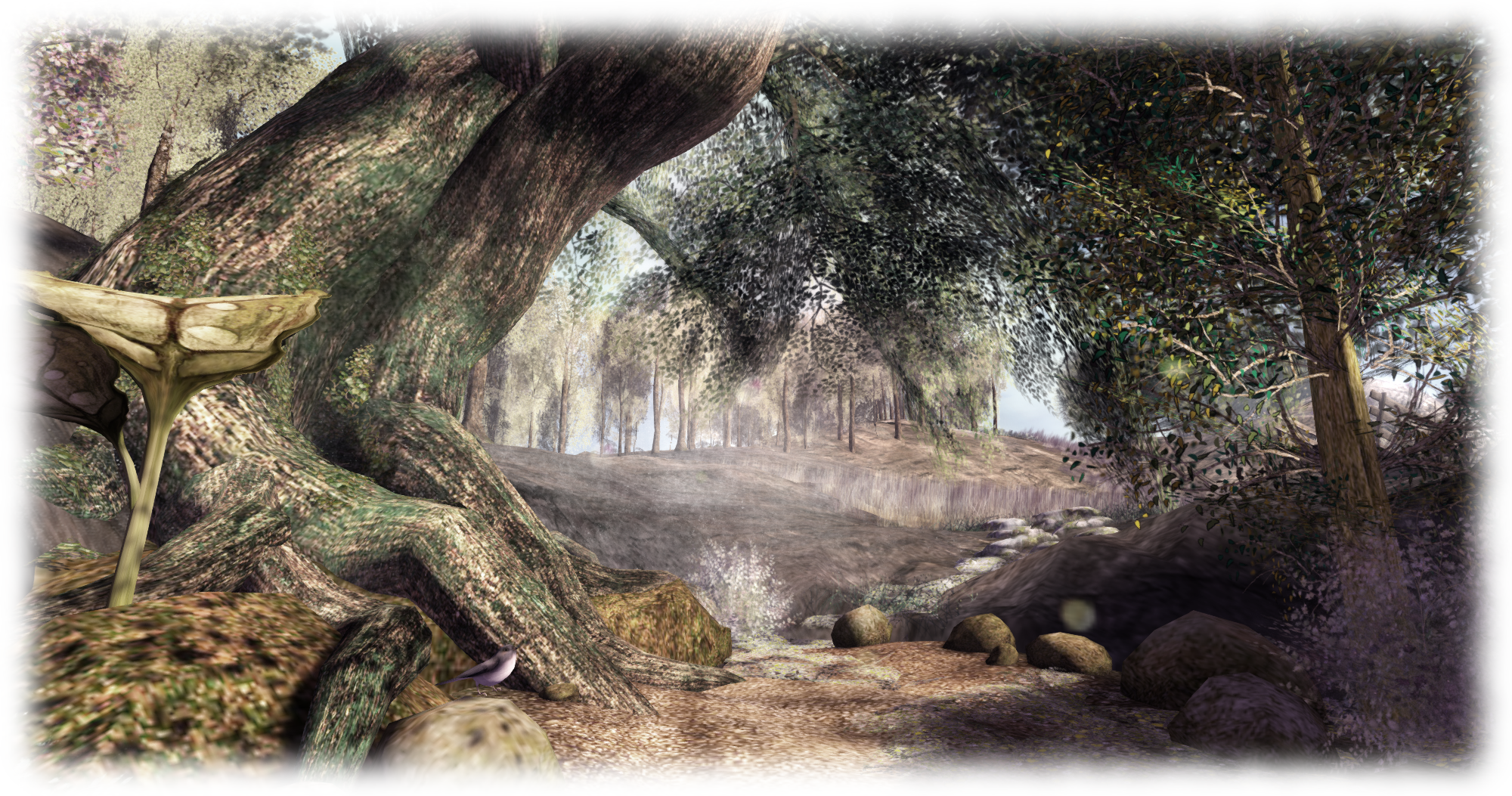
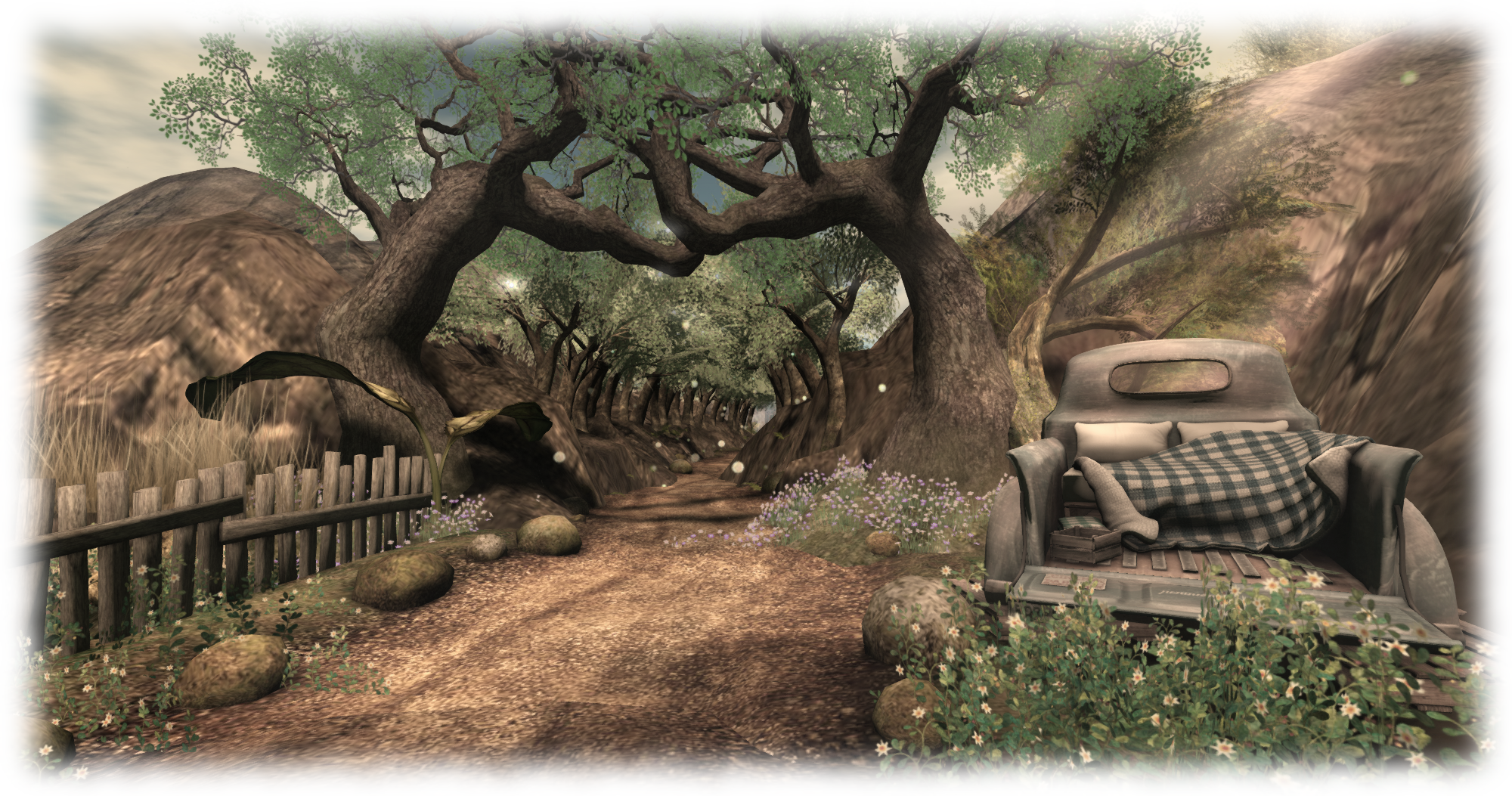
Leka is the new name for Kate Bergdorf’s freshly re-worked and re-opened homestead region of Nordan om Jorden. The last time I visited, the region presented a rural landscape deep in the grip of winter. Now all that has changed, and visitors are presented with a rugged island, aligned in an east-west orientation, with a smaller island just off the southern shoreline.

The first thing that struck me when I arrived for a visit at Kate’s invitation, is that Leka has something of a Hebridian feel to it, although the name is suggestive of a more Nordic origin.  From the landing point, it is possible to teleport directly to various points of interest on the island. However, I strongly recommend you forego these, and explore the island either on foot or via the bicycles that Kate has provided.

Leka, Nordan om Jorden; Inara Pey, March 2015, on Flickr Leka, Nordan om Jorden (Flickr)

A dirt track across a wooden bridge from the landing point offers the most convenient choice of routes for explorers. In one direction, it climbs the rocky flank of the island to it tree-covered upper reaches, while in the other, it winds its way around the coast, turning north to quickly disappear from view, inviting people to follow it.

Take the latter, and you’ll find yourself on a pleasant walk (or ride, if you take a bicycle) around the island to one of its more prominent features: a large bath house, open to all to enjoy. Wander on westward, and through the gates on the far side of the meadow by which the bath house sits, and a tree-lined avenue will take you to the rocky western end of the island and a small beach offering the chance of views of sunsets of the open seas, and where horses graze on the tough grass growing up through the sand.

Leka, Nordan om Jorden; Inara Pey, March 2015, on Flickr Leka, Nordan om Jorden (Flickr)

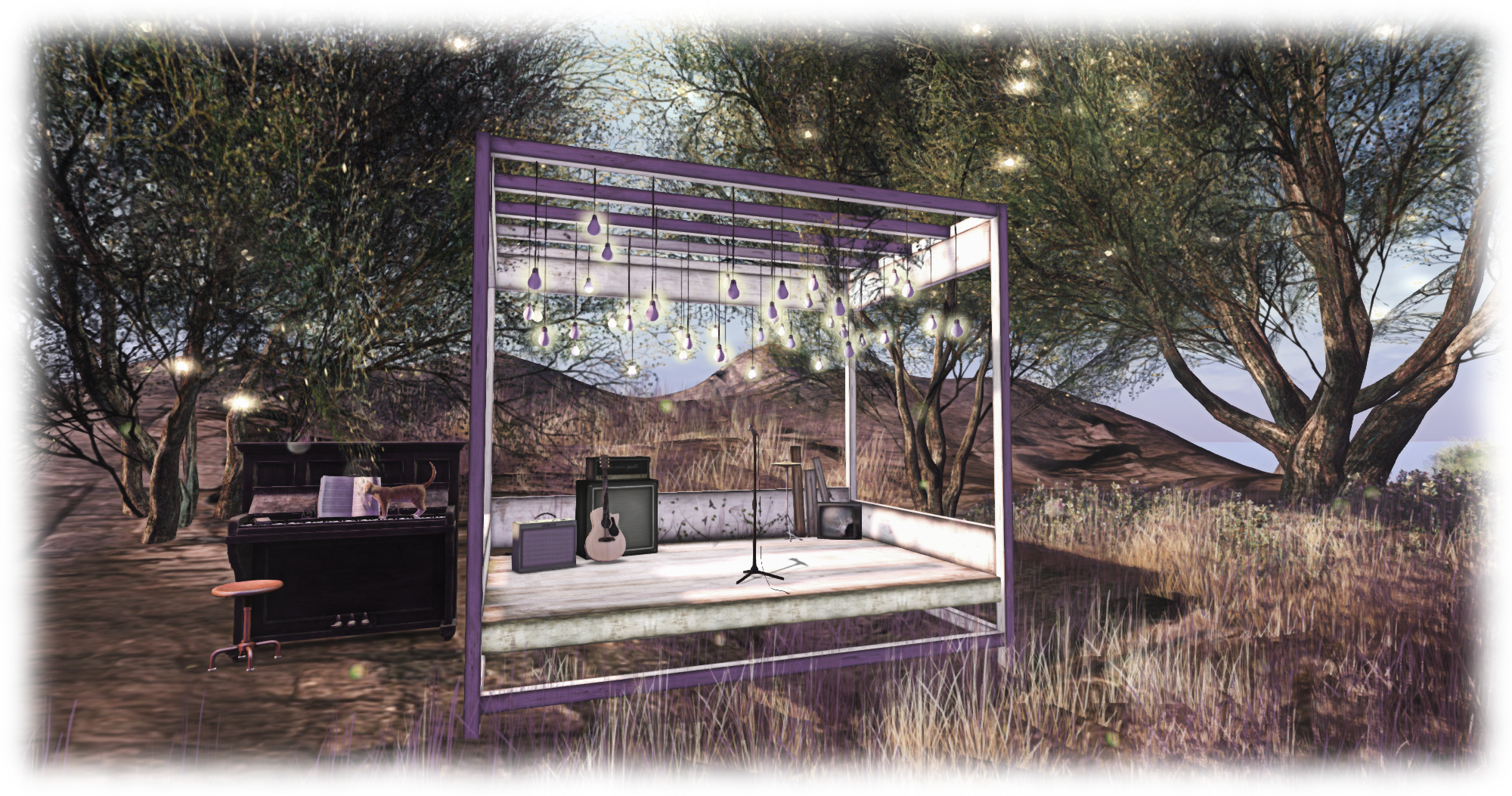
Wander inland, and you’ll likely find you way to the upper slopes, where a small venue for live entertainment can be found, a simple little each with speakers, an amp, a microphone, guitar and upright piano, all presided over by a ginger cat.Further to the east sit a couple of greenhouses, one of which has been converted into a comfy seating area, no doubt nicely warmed by the sunlight striking its glass roof.

Seaward, the smaller island, perhaps once low-lying part of the main island, but now separated and slowly being drowned by an encroaching sea, offers a different environment. Thunder rumbles overhead, rain falls hard on the bear rock while a broken iron rail fence and tumbledown ruin of a house speak to what might one have been here.

Leka, Nordan om Jorden; Inara Pey, March 2015, on Flickr Leka, Nordan om Jorden (Flickr)

Leka is currently featured in the SL Destination Guide, and deservedly so.  It is a visual and photogenic treat, with much to see and appreciate, and plenty of opportunities to simply sit and admire. Auto-return is set to 20 minutes, should you need any props for photography – but do please clean up behind you. A Flickr group  is available available for those wishing to share any images they take of the isalnd, and if you do enjoy your visit, please consider making a donation at one of the post boxes around the island so that Kate can continue to offer the region for everyone’s enjoyment.

Related Links

Tales from Ireland and space, mysterious books, and strange letters

It’s time to kick-off another week of fabulous story-telling in voice, brought to Second Life and Kitely by the staff and volunteers at the Seanchai Library.

As always, all times SLT / PDT, and unless otherwise stated, events will be held on the Seanchai Library’s home on Imagination Island, or at their Kitely Homeworld.

Sunday, March 1st

11:00: Seanchai Kitely: Bard: The Odyssey of the the Irish

Caledonia Skytower reads selections from Morgan Llywelyn’s 1984 historical fantasy novel depicting a hypothetical 4th century migration of Galicians to Ireland, led by Amergin the bard.

13:30: Seanchai SL: Tea Time at Baker Street

Caledonia, Kaydon OConnell and Corwyn Allen reconvene at the rooms of 221B Baker Street to this week read the story of The Five Orange Pips, which first appeared in The Strand Magazine in November 1891.

In 1887, John Openshaw, a young gentleman brings to Holmes and Watson a strange tale concerning his uncle, Elias Openshaw and his father, Joseph Openshaw, which goes back several years.

Having lived as a plantation owner in Florida and then served on the side of the Confederate States during the American Civil War, Elias Openshaw had returned to England and settled at an estate in Sussex.

After a few years, he invited his unmarried nephew to join him, offering him the run of the estate with the exception of one locked room, in which Openshaw the elder kept his travelling trunks. Other than this, there is nothing really out of the ordinary.

Until, in 1883,  a strange letter containing five orange pips arrives. It sends Elias Openshaw in a frenzied downwards spiral of increasingly erratic behaviour, until he is found dead in the garden pond, having apparently drowned after a drunken fall. Then, a year later, having inherited Elias’ estate, John’s father, Joseph, receives an identical letter. Five days later, he is found dead, apparently the victim of a fall into a local quarry while visiting a friend.

And now, in September 1887, John Openshaw himself has received a letter, again containing five orange pips, and has turned to Holmes for help….

18:00: Magicland Park SLLeprechauns, Witches & Gold, OH MY!

With Caledonia Skytower.

Monday, March 2nd

06:00: The Emerald Atlas

emerald atlasCata Charisma continues his reading of John Stephens’ The emerald Atlas, the first volume in his fantasy trilogy for young adults, The Books of Beginning.

Having been passed from pillar to post through orphanages, three siblings, Kate, Emma, and Michael, find themselves lodged at the home of one Dr. Stanislaus Pym. Kate, the eldest of the three is driven by a promise made by her mother, that if Kate protects her younger sister and brother, then their family will be one day reunited.

But in their explorations of Dr. Pym’s house the three of them find their way into the basement, where they come across a mysterious door and a equally mysterious emerald-covered booth, entirely without text. When an old photograph touches the blank pages of the book, however, the three are immediately transported to the time and place depicted in the photograph. Her they find themselves in a realm populated by witches, henchmen, giants, dwarves and more – and one Dr. Stanislaus Pym, a good deal younger than when they last saw him in his house…

19:00: Starswarm
StarswarmStarswarm Station is a remote research station established to study strange alien life. The planet on which it is located is the home of the starswarm, intelligent plants living under the planet’s shallow lakes and seas, and roaming bands of centaur-like creatures dubbed “haters”.

The station is also home to Kip, a teenage boy living under the guardianship of his “uncle”. However, as Kip begins to discover, he has another guardian: Gwen, an AI system his mother had been working on, prior to her death, and which communicates with Kip via a small implant placed inside his brain at birth.

Gwen knows far more about the planet and the lifeforms it harbours than Kip could imagine. It also knows a lot about the company that runs the station and, for all intents and purposes, “owns” the planet on which it sits.

Slowly, Gwen reveals these various truths to Kip, including his own destiny. But in doing so, it puts Kip, and potentially the entire station, at risk.

Join Gyro Muggins as he commences a reading of Jerry Pournelle’s 1998 novel intended for teenage readers but which offers an interesting look at subjects such as neural nets and living computer systems.

Tuesday March 3rd, 19:00: Ireland: More from the Land of Poets

With Caledonia Skytower and Kayden OConnell.

Wednesday March 4th, 19:00: The Quiet Man

quiet-manReleased in 1952, John Ford’s The Quiet Man is regarded as a classic Irish-American romantic comedy / drama. Starring John Wayne, Maureen O’Hara (and assorted members of their RL families!) and Barry Fitzgerald, it is a popular choice among critics and film-lovers.

The screenplay for the film was drawn in a large part from a short story of the same name originally published in 1933 in the Saturday Evening Post, and penned by Irish author, Maurice Welsh. Together with a number of other short stories by Walsh, The Quiet Man was gathered into a single volume of his short stories, The Quiet Man and Other Stories, which dealt with many recurring characters living in rural Ireland of the 1920s, and set against the backdrop of the civil unrest which affected the country at that time, while examining the complexities and occasional intrigues of life, love and Irish traditions.

Join Caledonia Skytower as she reads Walsh’s original tale of The Quiet Man, Paddy Bawn Enright..

Thursday March 5th

19:00: Celtic Myths and Magick

With Shandon Loring.

21:00 Seanchai Late Night

With Finn Zeddmore.

Saturday March 7th, Seanchai Kitely: The Faery Handbag

Shandon Loring reads Kelly Link’s 2005 winner of 2005 the Hugo Award for Best Novelette.

Genevieve has a somewhat eccentric grandmother, Zofia, who claims to have a community of faeries, about whom she often tells the strangest tales. The faeries are also, apparently, responsible for all sorts of mischief, such has hiding her library books when they are due to be returned, so they become overdue. Then Jake, Genevieve’s boyfriend, decides to steal the bag and see if it really does contain faeries….

—–

Please check with the Seanchai Library SL’s blog for updates and for additions or changes to the week’s schedule. The featured charity for January / February is Project Children, teaching and building peace in Northern Ireland, one child at a time.

Related Links